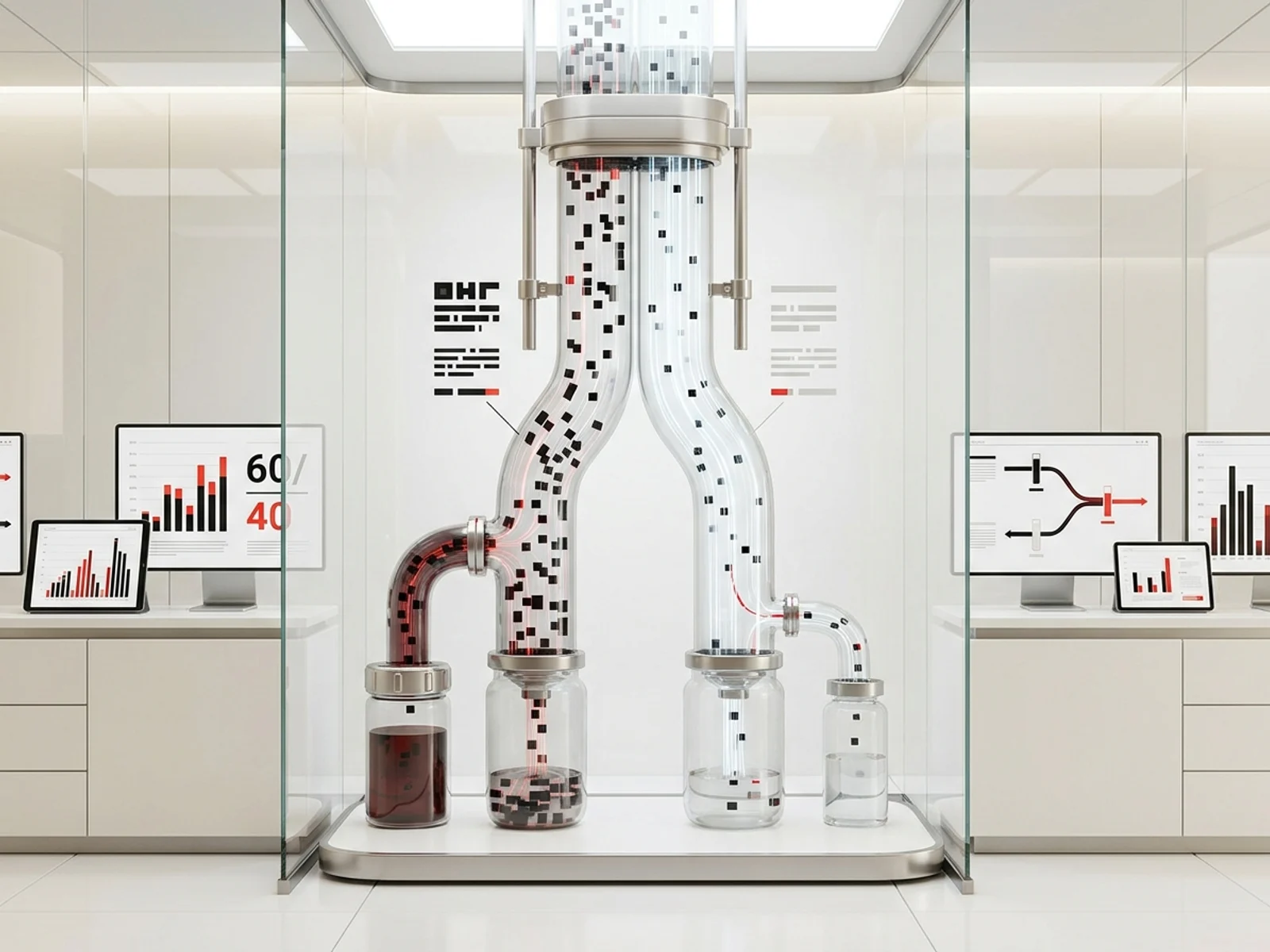
The FDA Adverse Event Reporting System (FAERS) holds 1,561,353 individual safety reports that name at least one of the five marketed tumor necrosis factor (TNF) blockers — adalimumab (Humira), etanercept (Enbrel), infliximab (Remicade), certolizumab pegol (Cimzia), or golimumab (Simponi) — in any role, filed between 2004, when the modern openFDA FAERS record begins, and early 2026. Adalimumab leads the class with 666,053 reports (42.7 percent), followed by etanercept at 584,481 (37.4 percent) and infliximab at 233,655 (15.0 percent); certolizumab (117,763) and golimumab (70,499) round out the field. Roughly half of every class-level report — 769,879, or 49.3 percent — carries an FDA seriousness flag, and 52,857 reports (3.39 percent) record a fatal outcome. The reaction list is a rheumatology, dermatology, and gastroenterology registry at once: "drug ineffective" is the single most coded term at 144,934 reports, but the events the Boxed Warning exists for — serious infection (106,807 reports across the infection family) and malignancy (72,683) — sit behind the symptomatic volume, exactly where postmarketing surveillance places them.
This article is a class-level descriptive read of TNF-blocker reporting in FAERS, written for pharmacovigilance, medical-affairs, market-access, and biosimilar-commercial teams who encounter TNF safety numbers in label negotiations, prior-authorization rationale, biosimilar formulary switching, and the step-therapy sequencing logic that gates every newer immunology class behind a TNF-blocker prior failure. Every figure here is computed from the public openFDA FAERS extract (20,328,575 total reports, export dated 2026-06-08). It is not a disproportionality signal analysis, it is not a safety claim, and it is not incidence data. FAERS is a spontaneous-reporting system: it captures what was reported, never what was caused, and it has no exposure denominator. Tens of millions of patients have taken TNF blockers over a quarter-century — Humira alone — so the reporting volume here is a small, skewed slice of real-world exposure. Those caveats shape every number below, and the reporting-mix distortions they produce — particularly infliximab's inpatient, infusion-channel skew — are spelled out in the methodology and the per-drug sections. For the class-wide FAERS methodology and the database aggregate picture, see the companion analysis of 20 million FAERS reports; for adjacent class cuts, see JAK inhibitors and IL-17/IL-23 biologics in FAERS. For the access picture, see the TNF inhibitor access landscape and the Humira and Remicade biosimilar comparisons. This article stays on the five TNF blockers.
Methodology, in one paragraph
A report is counted for a TNF blocker when the agent's generic or brand name appears anywhere in that report's drug list — as a suspect, concomitant, or interacting drug — using a case-insensitive substring match across the drug_substances and drug_brands fields. Matching both fields matters here more than for most classes: adalimumab is filed in FAERS overwhelmingly under its brand name Humira, so a generic-only read would undercount the class's single largest agent by roughly an order of magnitude. Because a single report can name several drugs, the per-substance totals sum to more than the 1,561,353 class-level (union, deduplicated) reports: about 111,000 reports name more than one TNF blocker, typically a patient who switched from Humira to Enbrel or was documented on a TNF blocker plus methotrexate. A "serious" report is any report the FDA coded as serious. A report counts toward death when the seriousness field carries a death flag; the resolved-Fatal-outcome field sits slightly lower (42,000 reports) because not every death-flagged report carries a resolved outcome. Reactions are coded to MedDRA Preferred Terms; reaction counts are case-normalized to avoid splitting the same concept across "Injection site pain" and "INJECTION SITE PAIN." The adverse-event families aggregate related Preferred Terms (for example, "serious / opportunistic infection" combines tuberculosis, histoplasmosis, candidiasis, pneumonia, sepsis, herpes zoster, and related terms), and a report contributes once to a family if any term in the family appears. The "any role" counts reported here are intentionally inclusive, so they will exceed suspect-only or differently normalized counts cited elsewhere for the same agent.
The reporting-volume picture, by drug
| TNF blocker (brand, first US approval) | Reports (any role) | Share of class | Serious | Death |
|---|---|---|---|---|
| Adalimumab (Humira, 2002) | 666,053 | 42.7% | 323,481 (48.6%) | 28,231 (4.24%) |
| Etanercept (Enbrel, 1998) | 584,481 | 37.4% | 204,950 (35.1%) | 12,658 (2.17%) |
| Infliximab (Remicade, 1998) | 233,655 | 15.0% | 203,445 (87.1%) | 9,833 (4.21%) |
| Certolizumab pegol (Cimzia, 2008) | 117,763 | 7.5% | 76,920 (65.3%) | 3,834 (3.26%) |
| Golimumab (Simponi, 2009) | 70,499 | 4.5% | 49,611 (70.4%) | 1,932 (2.74%) |
| Class (union, deduplicated) | 1,561,353 | 769,879 (49.3%) | 52,857 (3.39%) |
Three patterns matter for access and medical-affairs teams. First, volume tracks market penetration and time on market, not intrinsic risk: adalimumab and etanercept together carry 80 percent of class reporting because Humira was, for most of the 2010s, the highest-selling prescription drug in the world and Enbrel is its closest peer by tenure — both have been on the US market for more than two decades. Second, the serious-share band runs from etanercept's 35.1 percent to infliximab's 87.1 percent, and that range is a route-of-administration and channel artifact, not a safety differential. Etanercept is a subcutaneous self-injection used in outpatient dermatology and rheumatology, so its reports skew toward milder injection-site and symptomatic terms; infliximab is a two-hour intravenous infusion delivered in infusion centers and hospital outpatient departments to the sickest rheumatology, IBD, and dermatology patients, so its reports are dominated by hospitalized, serious cases — infliximab's 87.1 percent serious share describes where the drug is given, not how dangerous it is. Third, the per-drug death-flag percentages cluster between 2.2 and 4.2 percent and move with indication and population mix (certolizumab and golimumab, smaller and used heavily in IBD and axial spondyloarthritis, sit in the middle), not with a clean drug-safety ranking. Quoting any single agent's death-flag rate without that caveat is quoting a population-confounded number.
The class-level outcome profile
| Outcome (report-level) | Reports | Share of class |
|---|---|---|
| Unknown outcome | 765,751 | 49.0% |
| Not recovered | 399,897 | 25.6% |
| Recovered | 289,680 | 18.6% |
| Recovering | 143,427 | 9.2% |
| Fatal | 42,000 | 2.7% |
| Recovered with sequelae | 5,683 | 0.4% |
A report can carry more than one outcome, so these shares sum to more than 100 percent. The dominant "unknown outcome" share is typical of FAERS follow-up gaps in a class that is heavily consumer-reported. The Fatal outcome count (42,000) sits below the death-flag measure (52,857) because not every death-flagged report carries a resolved Fatal outcome field. At the report level, 274,535 reports (17.6 percent) flag a hospitalization, 22,921 (1.5 percent) flag a life-threatening event, and 22,541 flag a disabling outcome. As with every FAERS outcome table, none of these percentages is incidence — the denominator is reports, not exposed patients.
The infection and malignancy footprint behind the Boxed Warning
Stripping out the non-specific terms (drug ineffective, arthralgia, pain, fatigue, headache) that dominate the raw reaction list for any high-volume outpatient class, the label-relevant adverse-event families that define the TNF-blocker safety profile leave a clear footprint:
| AE family (aggregated MedDRA terms) | Class reports | Share of class |
|---|---|---|
| Serious / opportunistic infection | 106,807 | 6.8% |
| Malignancy / neoplasm (incl. lymphoma) | 72,683 | 4.7% |
| Infusion and injection-site reactions | 397,566 | 25.5% |
| Cytopenia (leukopenia, pancytopenia, thrombocytopenia) | 17,506 | 1.1% |
| Hepatic / transaminase elevation | 17,817 | 1.1% |
| Lupus-like / autoimmunity | 8,979 | 0.6% |
| Heart failure | 6,042 | 0.4% |
| Demyelination / neurologic | 2,121 | 0.1% |
The serious-infection signal is exactly what the label warns about. The FDA's Boxed Warning on every TNF blocker lists active tuberculosis (including reactivation of latent disease) and invasive fungal infections — histoplasmosis, coccidioidomycosis, candidiasis, aspergillosis — alongside bacterial infections such as Legionella and Listeria, and the agency has repeatedly strengthened that language, including a 2011 update adding Legionella and Listeria to the warning after an AERS review identified 80 Legionella pneumonia reports in TNF-blocker patients between 1999 and 2010. The 106,807-report infection family — pneumonia (25,542 reports on its own), herpes zoster, tuberculosis, candidiasis, sepsis — is the descriptive postmarketing backdrop to that label language. A 2024 FAERS disproportionality analysis of TNF inhibitors (PMC11398834) reported reporting-odds-ratio signals for tuberculosis, herpes zoster, and sinusitis across the class and found adalimumab carried the broadest infection-related signal set, including lower-respiratory-tract inflammation (ROR 61.9) and coccidioidomycosis (ROR 13.0) — the descriptive counts here are the reporting volume behind those signals.
The malignancy family (72,683 reports) aggregates lymphoma, hepatosplenic T-cell lymphoma, and the broader neoplasm and cancer terms. The Boxed Warning cites lymphoma and other malignancies, "some fatal," in children and adolescents, and flags the rare, aggressive hepatosplenic T-cell lymphoma seen primarily in young male Crohn's disease patients on concomitant azathioprine or 6-mercaptopurine. As with every spontaneous-reporting malignancy count, these reports cannot establish drug causation — the underlying inflammatory diseases themselves carry elevated lymphoma risk — but the family's presence at scale is why every TNF label retains the malignancy warning and why oncology-vigilance programs track it.
The infusion- and injection-site family is the largest in raw volume (397,566) but the least safety-relevant: it is dominated by injection-site pain, erythema, swelling, and bruising on the subcutaneous agents (adalimumab, etanercept, certolizumab, golimumab) and infusion-related reactions on infliximab. It is a tolerability footprint, not the infection and malignancy signal the warning addresses.
Who is reporting
| Reporter type | Reports | Share of class |
|---|---|---|
| Consumer / patient | 759,435 | 48.6% |
| Physician | 397,627 | 25.5% |
| Other health professional | 318,567 | 20.4% |
| Pharmacist | 47,116 | 3.0% |
Consumers file nearly half the class's reports — a share that reflects two decades of self-administered subcutaneous Humira and Enbrel and the manufacturer and patient-advocacy reporting channels around them. This is a more balanced reporter mix than the consumer-dominated IL-17/IL-23 or insulin records, because TNF blockers' inpatient infliximab channel pulls a large physician and HCP share (45.9 percent combined), and that HCP-heavy slice is where the serious-infection and malignancy reports concentrate. The reporter mix is one reason raw reaction counts understate the most serious events relative to what HCP-filed reports show.
The indication mix, and why it matters for the label
The reaction list reads as an indication map: rheumatoid arthritis (49,207 reports as a coded reaction term), Crohn's disease (29,439), psoriasis (37,710), and the arthralgia/joint-swelling/arthropathy cluster that surrounds them. The class's approved indications span rheumatoid arthritis, juvenile idiopathic arthritis, psoriatic arthritis, ankylosing spondylitis, plaque psoriasis, Crohn's disease, ulcerative colitis, and hidradenitis suppurativa, and each indication carries its own age, comorbidity, and concomitant-immunosuppressant profile that shapes the reporting mix. The Crohn's-disease footprint is the one access teams should weight most: it is the indication tied to hepatosplenic T-cell lymphoma in young patients on concomitant thiopurines, and it is the population in which infliximab's inpatient, infusion-channel reporting skews the class serious rate upward.
The year-over-year accumulation curve
| Receive year | Class reports (any role) |
|---|---|
| 2004 | 9,871 |
| 2006 | 13,267 |
| 2008 | 31,485 |
| 2010 | 40,723 |
| 2012 | 81,393 |
| 2014 | 92,459 |
| 2015 | 124,352 |
| 2016 | 153,998 |
| 2018 | 98,630 |
| 2020 | 87,634 |
| 2022 | 122,035 |
| 2023 | 82,256 |
| 2024 | 64,280 |
| 2025 | 54,469 |
| 2026 (partial) | 9,201 |
Two inflection points are visible. The 2016 peak (153,998 reports) tracks Humira's peak dispensing era and the full expansion of the anti-TNF indication set across rheumatology, dermatology, and gastroenterology. The 2022 secondary peak (122,035) coincides with the US Humira biosimilar launch window — nine adalimumab biosimilars began reaching the US market in 2023 — and with a general post-pandemic reporting rebound. The post-2022 decline in raw class volume reflects normal FAERS reporting dynamics and biosimilar market fragmentation, not falling use; anti-TNF dispensing has continued at scale on the strength of biosimilar adalimumab, infliximab, and etanercept adoption.
What the Boxed Warning actually says, and how it reaches the formulary
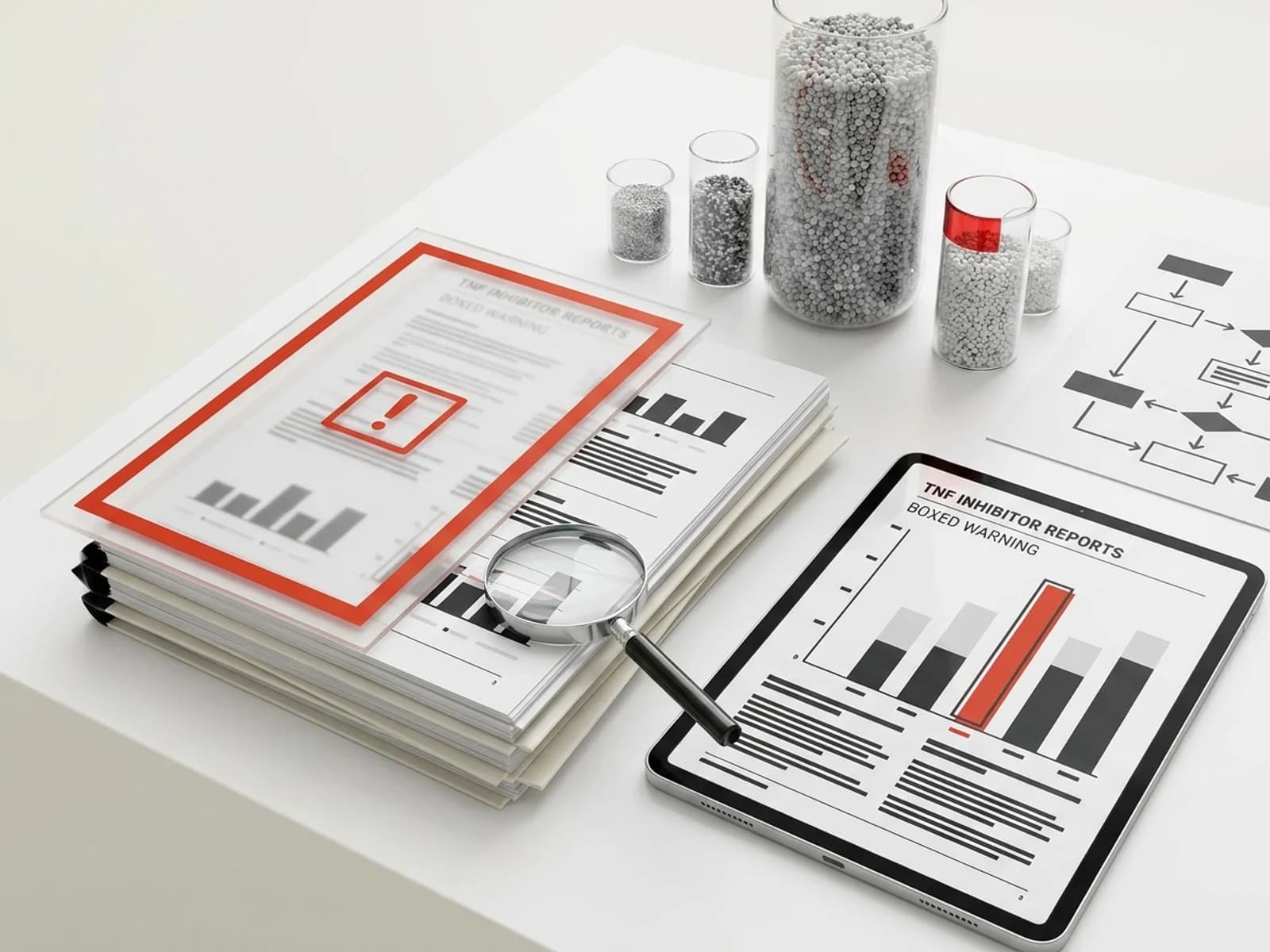
The FDA placed a Boxed Warning on the TNF blocker class — Serious Infections and Malignancy — and every label (adalimumab revised October 2025, infliximab 2021, etanercept 2022) carries it. The warning is mechanism-wide: it applies to all five agents by class effect, not by individual-agent trials. The access consequence is concrete and cascading. Every TNF blocker's label requires tuberculosis evaluation (including a test for latent TB) before initiation and monitoring for infection during therapy, and these requirements are written directly into prior-authorization criteria, REMS-adjacent pharmacy protocols, and specialty-pharmacy intake forms. More importantly, the TNF-blocker safety record is the reference standard against which every newer immunology class is benchmarked: the JAK-inhibitor Boxed Warning requires a TNF-blocker prior failure before initiation, and IL-17 and IL-23 formularies routinely sequence behind TNF experience. The FAERS volume behind that policy is the surveillance backdrop, not the trigger — the triggers were clinical-trial signals and postmarketing case series — and FAERS confirms the reporting footprint but does not, by itself, establish causation.
The biosimilar access picture
TNF blockers are now the most biosimilar-saturated class in US immunology, and that saturation is the dominant live market-access story. Humira (adalimumab) has ten FDA-approved biosimilars, of which eight — Amjevita, Cyltezo, Hyrimoz, Hadlima, Abrilada, Hulio, Simlandi, and Yuflyma — carry interchangeability designation allowing pharmacy-level substitution subject to state law. Remicade (infliximab) biosimilars (Inflectra, Renflexis, Avsola, Ixifi, and others) have competed since 2016, and etanercept biosimilars (Erelzi, Eticovo) and certolizumab and golimumab biosimilars are now entering; the first golimumab (Simponi) biosimilar, Immgolis, was approved in May 2026. The FAERS volume here is the postmarketing safety backbone for that switching: biosimilar labels carry the same Boxed Warning, the same TB-screening requirement, and the same indication set, and payer formularies that preferred one biosimilar over Humira did so on net-price and interchangeability grounds, not on a differentiated safety profile. For the interchangeability framework, see the interchangeable biosimilars by-the-numbers read and the FDA's streamlined interchangeability pathway.
How to read these numbers (and how not to)
Volume is market tenure, not risk. Adalimumab's 666,053 reports reflect a 2002 launch and two decades as the world's top-selling drug; etanercept's 584,481 reflect a 1998 launch. Rank reports per patient-year of exposure — which FAERS cannot compute — and the ordering changes.
Infliximab's 87.1 percent serious share is a channel artifact. The IV-infusion, inpatient, sickest-patient channel inflates serious and death reporting relative to the subcutaneous agents. Do not quote it as evidence that infliximab is more dangerous than etanercept.
Reaction counts understate the Boxed-Warning events relative to the symptomatic volume. Infection and malignancy sit behind "drug ineffective," arthralgia, and injection-site reactions in the raw list because consumers under-report the serious events relative to symptoms, and because MedDRA disperses them across many granular terms.
FAERS has no denominator. None of these numbers is an incidence rate, a relative risk, or a causal estimate. A 1,561,353-report class total says the surveillance system has watched this class closely for two decades; it does not say the class caused 1,561,353 events.
Sources
US FDA, FDA Adverse Event Reporting System (FAERS) / openFDA drug adverse event data, public extract (20,328,575 reports, export dated 2026-06-08). Aggregates computed by PharmaDossier from the openFDA FAERS full extract. https://open.fda.gov/data/faers/
US FDA, HUMIRA (adalimumab) Prescribing Information, including BOXED WARNING: Serious Infections and Malignancy (label revised October 2025). https://www.accessdata.fda.gov/drugsatfda_docs/label/2025/125057s424lbl.pdf
US FDA, REMICADE (infliximab) Prescribing Information, including BOXED WARNING (label 2021). https://www.accessdata.fda.gov/drugsatfda_docs/label/2021/103772s5401lbl.pdf
US FDA, ENBREL (etanercept) Prescribing Information, including BOXED WARNING and Warnings and Precautions (2022). https://www.accessdata.fda.gov/drugsatfda_docs/label/2022/103795s5591lbl.pdf
US FDA, "Updates to Boxed Warning for TNF Blockers Regarding Risk of Legionella and Listeria Infections" (2011 safety communication; AERS review 1999–2010). https://www.medscape.org/viewarticle/750358
Chen C, et al., "Safety of TNF-α inhibitors: A real-world study based on the US FDA Adverse Event Reporting System Database" (FAERS disproportionality signals for tuberculosis, herpes zoster, sinusitis; adalimumab infection-related signal set). PMC11398834. https://pmc.ncbi.nlm.nih.gov/articles/PMC11398834
Tumor Necrosis Factor Inhibitors, StatPearls (NCBI Bookshelf) — class indications, mechanism, and malignancy/box-warning context. https://www.ncbi.nlm.nih.gov/books/NBK482425
US FDA, Purple Book: Database of Licensed Biological Products (adalimumab biosimilars and interchangeability designations; golimumab biosimilar Immgolis, May 2026). https://purplebooksearch.fda.gov
Venable / BiologicsHQ, "May 2025 Stelara and Humira Interchangeable Biosimilar Approvals" (eight interchangeable adalimumab biosimilars incl. Hadlima). https://biologicshq.com/may-2025-stelara-and-humira-interchangeable-biosimilar-approvals
US FDA, MedWatch adverse-event reporting program. https://www.fda.gov/safety/medwatch-fda-safety-information-and-adverse-event-reporting-program