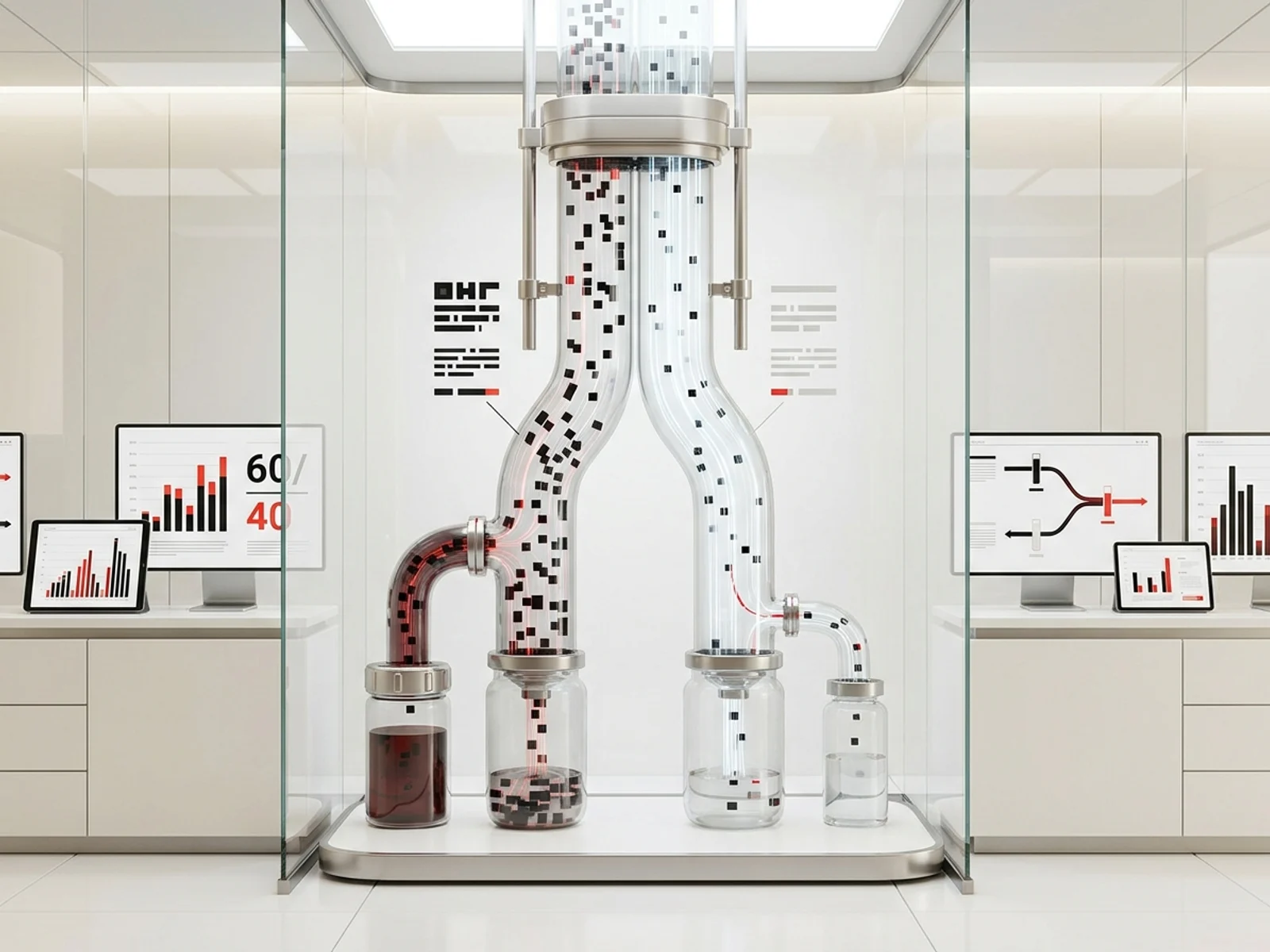
The FDA Adverse Event Reporting System (FAERS) holds 242,498 individual safety reports that name at least one of the four inflammatory Janus kinase (JAK) inhibitors — tofacitinib (Xeljanz), upadacitinib (Rinvoq), baricitinib (Olumiant), or abrocitinib (Cibinqo) — in any role, filed between 2008 and early 2026. Tofacitinib alone appears in 157,601 reports, reflecting its 13-year head start as the first-in-class oral JAK inhibitor; upadacitinib, approved in August 2019, has already accumulated 73,063 reports and is the fastest-rising agent in the class. Half of every class-level report — 121,894, or 50.3% — carries an FDA seriousness flag, and 7,908 reports (3.3%) record a fatal outcome. The single most common reaction term across the entire class is "drug ineffective," at 35,169 reports, ahead of every safety term on the list.
This article is a class-level descriptive read of inflammatory JAK inhibitor reporting in FAERS, written for pharmacovigilance, medical-affairs, market-access, and payer-policy teams who encounter JAK safety numbers in label negotiations, prior-authorization rationale, and formulary committee briefings. Every figure here is computed from the public openFDA FAERS extract (20,328,575 total reports, export dated 2026-06-08). It is not a disproportionality signal analysis, it is not a safety claim, and it is not incidence data. FAERS is a spontaneous-reporting system: it captures what was reported, never what was caused, and it has no exposure denominator. Those caveats shape every number below, and the reporting-mix distortions they produce — particularly for baricitinib's inpatient COVID-19 use — are spelled out in the methodology and the per-drug sections. For the class-wide FAERS methodology and the database aggregate picture, see the companion analysis of 20 million FAERS reports; for the GLP-1 class cut, see GLP-1 receptor agonists in FAERS. This article stays on the four inflammatory JAK inhibitors.
Methodology, in one paragraph
A report is counted for a substance when the substance's generic name appears anywhere in that report's drug list — as a suspect, concomitant, or interacting drug — using a substring match so that "tofacitinib citrate" and "tofacitinib" both count. Because a single report can name several drugs, the per-substance totals sum to slightly more than the 242,498 class-level (union) reports: only 1,307 reports name more than one JAK inhibitor. A "serious" report is any report the FDA coded as serious. A report counts toward death when either the seriousness field carries a death flag or the outcome field carries a Fatal outcome. Reactions are coded to MedDRA Preferred Terms; the openFDA extract carries mixed casing for some terms, so reaction counts are case-normalized to avoid splitting the same concept across "Pain" and "PAIN." The "any role" counts reported here are intentionally inclusive, so they will exceed suspect-only or differently normalized counts cited elsewhere for the same agent; they are not directly comparable to single-substance figures in the companion database-wide analysis.
The reporting-volume picture, by drug
| JAK inhibitor (brand, approval year) | Reports (any role) | Share of class | Serious | Death |
|---|---|---|---|---|
| Tofacitinib (Xeljanz, 2012) | 157,601 | 64.9% | 66,445 (42.2%) | 4,451 (2.82%) |
| Upadacitinib (Rinvoq, 2019) | 73,063 | 30.1% | 48,548 (66.4%) | 2,564 (3.51%) |
| Baricitinib (Olumiant, 2018) | 9,396 | 3.9% | 6,489 (69.1%) | 869 (9.25%) |
| Abrocitinib (Cibinqo, 2021) | 3,745 | 1.5% | 1,267 (33.8%) | 58 (1.55%) |
| Class (union, deduplicated) | 242,498 | 121,894 (50.3%) | 7,908 (3.3%) |
Two patterns stand out for access teams. First, volume is not a safety signal: tofacitinib dominates the count because it has been on the market since 2012 and has accumulated 13 years of reports, not because it is inherently more dangerous than its younger counterparts. Second, the per-drug serious and death percentages move in the opposite direction from volume, and that movement is a reporting-mix artifact worth understanding. Upadacitinib (66.4% serious) and baricitinib (69.1% serious) skew far more serious than tofacitinib (42.2%), and baricitinib's death-flag rate of 9.25% is more than triple tofacitinib's 2.82%.
The most important driver of baricitinib's death-flag rate is not the inflammatory-disease label that payers manage — it is the COVID-19 inpatient use that the FDA authorized in November 2020. Baricitinib reports during 2020–2022 name severe COVID-19 pneumonia in critically ill, already-hospitalized patients, a population with high baseline mortality, so a death flag on a baricitinib report in that window says something about the disease and the indication, not the drug's chronic-use safety profile. Access teams quoting baricitinib's 9.25% death-flag rate without that caveat are quoting a COVID-confounded number. Upadacitinib's high serious rate, by contrast, reflects a newer, more HCP-channel reporting mix and broad uptake across rheumatoid arthritis, psoriatic arthritis, atopic dermatitis, ulcerative colitis, and Crohn's disease — multiple approved indications concentrated into roughly six years of marketing.
The class-level outcome profile
| Outcome (report-level) | Reports | Share of class |
|---|---|---|
| Unknown outcome | 174,471 | 71.9% |
| Not recovered | 47,987 | 19.8% |
| Recovered | 35,877 | 14.8% |
| Recovering | 28,945 | 11.9% |
| Fatal | 7,347 | 3.0% |
| Recovered with sequelae | 974 | 0.4% |
At the report level, 37,161 reports (15.3%) flag a hospitalization, 2,278 flag a life-threatening event, and 2,310 flag a disabling outcome. The high "unknown outcome" share is typical of consumer-filed FAERS reports and is one reason outcome percentages should never be read as incidence.
The top reactions, and what they actually mean
| Reaction (MedDRA Preferred Term) | Reports |
|---|---|
| Drug ineffective | 35,169 |
| Pain | 19,031 |
| Arthralgia | 15,639 |
| Condition aggravated | 14,602 |
| Off label use | 10,210 |
| Headache | 10,121 |
| Fatigue | 10,063 |
| Rheumatoid arthritis | 10,048 |
| Pain in extremity | 8,426 |
| COVID-19 | 8,043 |
| Malaise | 7,938 |
| Diarrhoea | 7,462 |
| Joint swelling | 6,781 |
| Nausea | 6,608 |
| Nasopharyngitis | 5,923 |
| Musculoskeletal stiffness | 5,503 |
| Peripheral swelling | 5,473 |
| Product dose omission issue | 5,373 |
| Fall | 5,300 |
| Pneumonia | 5,050 |
| Death | 5,020 |
| Herpes zoster | 4,597 |
| Urinary tract infection | 4,282 |
The reaction list is dominated by lack-of-efficacy, musculoskeletal, and infection terms rather than the cardiovascular, thrombotic, and malignancy events that drove the boxed warning. That gap is itself the access-relevant finding: the events that the ORAL Surveillance trial and the FDA's 2021 safety communication flagged — major adverse cardiovascular events (MACE), venous thromboembolism, malignancy, and mortality — do not top the raw FAERS reaction count for the class, because FAERS Preferred Terms spread cardiovascular and thrombotic events across many granular terms (myocardial infarction, pulmonary embolism, deep vein thrombosis, stroke, and so on) and because consumers under-report these events relative to symptomatic terms like nausea and arthralgia. "Drug ineffective" at 35,169 reports is consistent with the class's known primary-non-response rate and with the step-therapy context in which many US patients start a JAK inhibitor only after a TNF blocker has failed.
Infection terms deserve a separate read. Herpes zoster appears in 4,597 reports, pneumonia in 5,050, urinary tract infection in 4,282, and nasopharyngitis in 5,923 — together a reminder that the infection-signal burden that occupies the JAK labels' warnings and precautions section is visible in the postmarketing data, even before the MACE and malignancy signals.
Who is reporting
| Reporter type | Reports |
|---|---|
| Consumer | 120,996 |
| Other health professional | 70,231 |
| Physician | 42,859 |
| Pharmacist | 6,548 |
Consumers file half the class's reports (120,996 of 242,498), a share that depresses the apparent serious rate and inflates symptom-based reaction terms. This is the same consumer-dominated reporting mix that shapes the GLP-1 FAERS record, and it is the reason raw reaction counts understate serious cardiovascular and thrombotic events relative to what HCP-filed reports would show.
The indication mix, and why it matters for the label
| Indication | Reports |
|---|---|
| Rheumatoid arthritis | 118,596 |
| Product used for unknown indication | 37,926 |
| Ulcerative colitis | 12,914 |
| Psoriatic arthritis | 10,756 |
| Atopic dermatitis | 9,173 |
| Crohn's disease | 6,638 |
| COVID-19 immunisation | 5,239 |
| Ankylosing spondylitis | 2,433 |
| Psoriasis | 2,396 |
| Alopecia areata | 1,663 |
Rheumatoid arthritis dominates the indication field (118,596 reports), which matters because the boxed warning that now governs every JAK inhibitor's access was generated in an RA population — the ORAL Surveillance trial randomized rheumatoid arthritis patients over 50 with at least one cardiovascular risk factor. Alopecia areata (1,663 reports) is the newest indication in the mix and the one where access friction is highest: baricitinib (Olumiant) and deuruxolitinib (Leqselvi) reached alopecia areata after the boxed warning was already in place, so launch formularies and prior-authorization policies built the TNF-blocker-prior-failure expectation directly into criteria from day one.
The year-over-year accumulation curve
| Receive year | Class reports (any role) |
|---|---|
| 2012 | 66 |
| 2013 | 1,669 |
| 2014 | 2,544 |
| 2015 | 4,065 |
| 2016 | 8,306 |
| 2017 | 13,984 |
| 2018 | 19,692 |
| 2019 | 21,125 |
| 2020 | 27,190 |
| 2021 | 22,901 |
| 2022 | 38,752 |
| 2023 | 28,897 |
| 2024 | 25,065 |
| 2025 | 23,856 |
| 2026 (partial) | 4,381 |
Two inflection points are visible. The 2022 peak (38,752 reports) tracks the combined effect of ORAL Surveillance publication in the New England Journal of Medicine, the September 2021 boxed warning, and the full indication expansion of upadacitinib. Upadacitinib alone went from 2,514 reports in 2020 to 15,714 in 2022 and 16,565 in 2025 — a launch-trajectory reporting curve steeper than any other agent in the class. The post-2022 decline in raw class volume reflects normal FAERS reporting dynamics and is not evidence of falling use; US JAK inhibitor dispensing has continued to grow on the strength of upadacitinib's uptake.
What the boxed warning actually says, and how it reaches the formulary
The FDA placed a Boxed Warning on tofacitinib, baricitinib, and upadacitinib on September 1, 2021, citing increased risk of major adverse cardiovascular events, cancer, thrombosis, and death, and extended the framework to abrocitinib when it was approved for atopic dermatitis. The warning rests on the ORAL Surveillance trial, in which tofacitinib 5 mg twice daily carried a MACE hazard ratio of 1.33 (95% CI 0.91–1.94) and 10 mg twice daily 1.43 (0.94–2.18) versus a TNF blocker; venous thromboembolism HR 1.66 (5 mg) and 3.52 (10 mg); malignancy HR 1.47–1.48; and death from any cause HR 1.49 (5 mg) and 2.37 (10 mg, 1.34–4.18). FDA applied the warning to baricitinib and upadacitinib by class mechanism, not by a completed head-to-head safety trial.
The access consequence is concrete. The agency limited all approved uses of the three agents to patients who have not responded adequately to, or cannot tolerate, one or more tumor necrosis factor (TNF) blockers. That single sentence is now the most-cited line in JAK prior-authorization criteria, and it is the reason every formulary tiering decision for this class — preferred, non-preferred, step-therapy-after-TNF, or excluded — references a TNF-blocker prior failure, an age threshold, and cardiovascular and thrombotic risk-factor screening. The FAERS volume behind that policy is the backdrop, not the trigger: the trigger was a randomized trial, and FAERS confirms the postmarketing surveillance footprint but does not, by itself, establish causation.
How to read these numbers (and how not to)
Volume is market tenure, not risk. Tofacitinib's 157,601 reports reflect a 2012 launch and broad, long use. Upadacitinib's 73,063 reports reflect a 2019 launch and a six-indication expansion. Rank reports per patient-year of exposure — which FAERS cannot compute — and the ordering changes.
Baricitinib's death-flag rate is COVID-confounded. The 9.25% figure is real in the data but driven by 2020–2022 inpatient COVID-19 reports in critically ill patients. Do not quote it as a chronic-inflammatory-use safety statistic.
Reaction counts understate the boxed-warning events. MACE, thrombosis, and malignancy are dispersed across many MedDRA terms and under-reported by consumers, so they do not appear near the top of the raw reaction list even though they are the events the label warns about.
FAERS has no denominator. None of these numbers is an incidence rate, a relative risk, or a causal estimate. A 242,498-report class total says the surveillance system is watching this class closely; it does not say the class caused 242,498 events.
Sources
US FDA, FDA Adverse Event Reporting System (FAERS) / openFDA drug adverse event data, public extract (20,328,575 reports, export dated 2026-06-08). Aggregates computed by PharmaDossier from the openFDA FAERS full extract. https://open.fda.gov/data/faers/
US FDA, "FDA Requires Boxed Warning about Increased Risk of Serious Heart-Related Events, Cancer, Blood Clots, and Death for JAK Inhibitors That Treat Certain Chronic Inflammatory Conditions," September 1, 2021. https://www.fda.gov/drugs/drug-safety-and-availability/fda-requires-warnings-about-increased-risk-serious-heart-related-events-cancer-blood-clots-and-death
Ytterberg SR, Bhatt DL, Mikuls TR, et al., for the ORAL Surveillance Investigators. "Cardiovascular and Cancer Risk with Tofacitinib in Rheumatoid Arthritis." New England Journal of Medicine, 2022;386(4):316–326. https://www.nejm.org/doi/full/10.1056/NEJMoa2109927
American College of Rheumatology, "Janus Kinase Inhibitor Boxed Warning Statement" (ORAL Surveillance adjudicated MACE, malignancy, VTE, and mortality hazard ratios). https://rheumatology.org/api/asset/bltd58974433694d161
Wei D, et al., "Characteristics of Adverse Event Reporting of Xeljanz/Xeljanz XR, Olumiant, and Rinvoq to the US Food and Drug Administration" (FAERS, 2013–2020). https://pmc.ncbi.nlm.nih.gov/articles/PMC10372959
"Safety of Janus kinase inhibitors in rheumatoid arthritis: a disproportionality analysis using FAERS database from 2012 to 2022" (tofacitinib, baricitinib, upadacitinib FAERS hospitalization and outcome counts, 2012–2022; cross-check against the class-level 2026 aggregates here). https://pmc.ncbi.nlm.nih.gov/articles/PMC11993438
US FDA, XELJANZ (tofacitinib) Prescribing Information, including BOXED WARNING and ORAL Surveillance data summary. https://xeljanz.pfizerpro.com/r/efficacy-safety/oral-surveillance-pooled-safety-analysis-ra
US FDA, MedWatch adverse-event reporting program. https://www.fda.gov/safety/medwatch-fda-safety-information-and-adverse-event-reporting-program