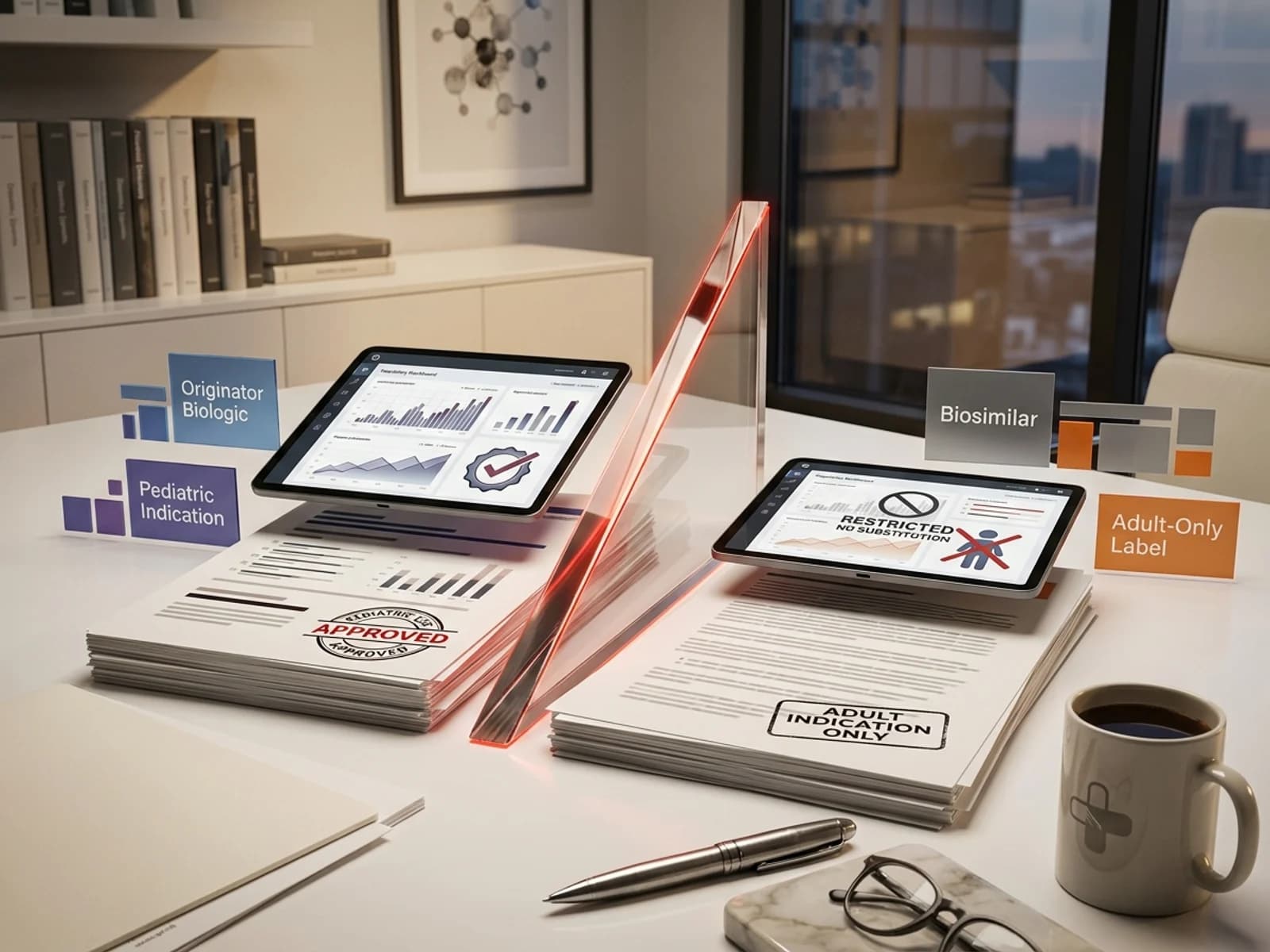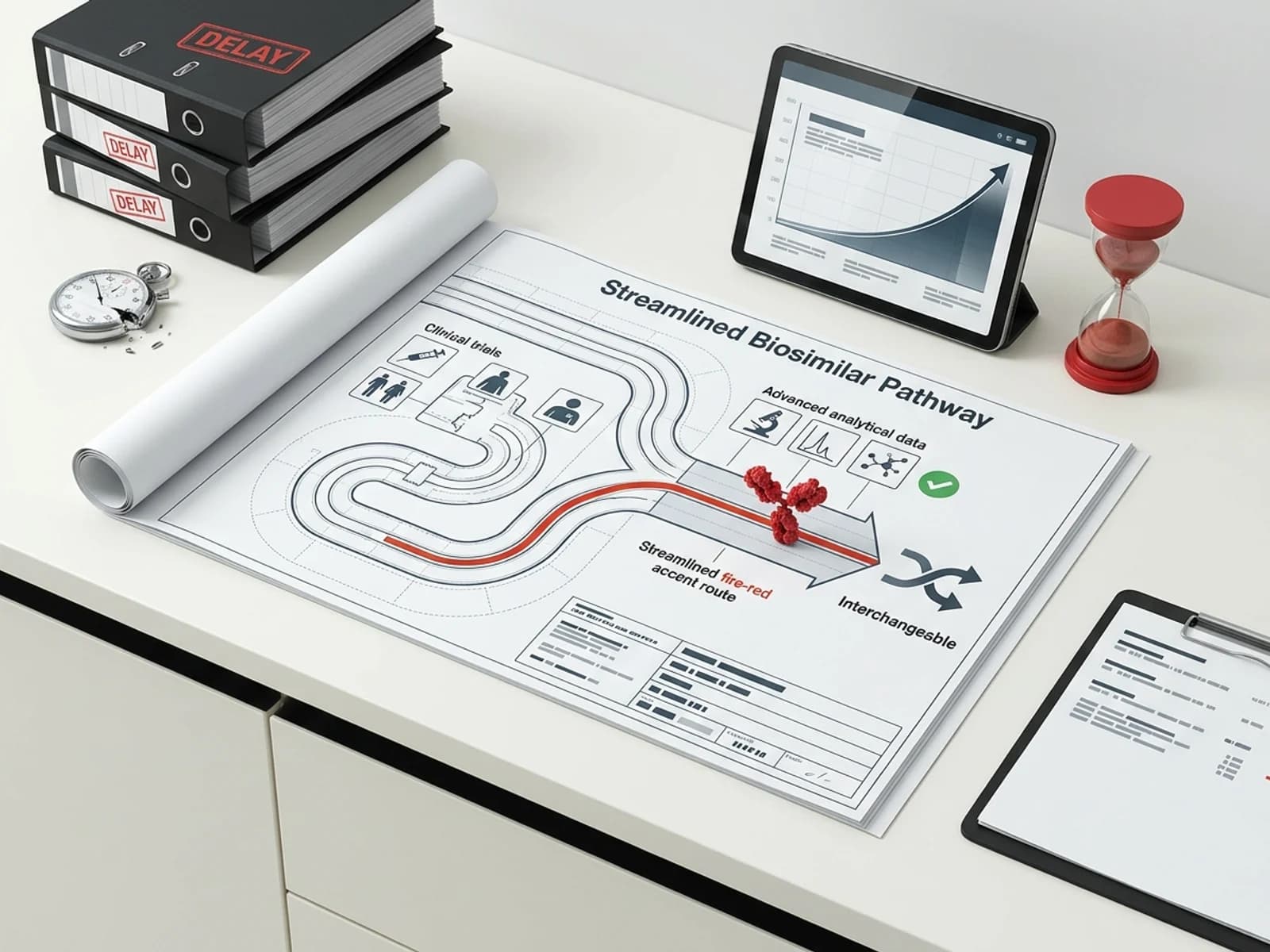
The FDA has approved 82 biosimilars as of early 2026, but only a fraction carry the interchangeability designation that enables pharmacy-level substitution without prescriber intervention. The agency is now finalizing guidance that would eliminate the clinical switching studies historically required for interchangeability and streamline pharmacokinetic (PK) study requirements, potentially making all non-vaccine biosimilars eligible for interchangeability based on analytical and clinical data alone.
The regulatory shift arrives as more than $230 billion in annual biologic revenue faces patent expiration by 2030. The first biosimilar to receive a Phase 3 clinical-efficacy-study waiver — Formycon's pembrolizumab biosimilar FYB206 — demonstrates that the FDA's totality-of-evidence approach is already operational. If the agency finalizes its planned interchangeability guidance in the first half of 2026, as Commissioner Marty Makary has stated, the bottleneck for biosimilar market entry will shift from clinical trial execution to analytical characterization and formulation design.
This article explains what changed, what the new pathway means for regulatory strategy, and how the competitive landscape for the $230 billion patent cliff is being reshaped.
What the FDA's 2026 guidance changes
Elimination of switching studies for interchangeability
On June 20, 2024, the FDA issued draft guidance updating its interchangeability recommendations. The guidance reflected the agency's conclusion that accumulated experience and advanced analytical methods have made dedicated switching studies unnecessary for most biosimilars. The key policy changes:
No dedicated switching studies required — applicants may now rely on comparative analytical and clinical data already submitted for biosimilarity to support the interchangeability determination, provided they explain why the data is sufficient
Totality-of-evidence standard — the FDA will evaluate interchangeability in the context of the entire biosimilar development data package, including analytical characterization, PK/PD data, immunogenicity data, and clinical efficacy data
Case-by-case approach — the FDA retains the authority to request additional data on a product-specific basis, but the default expectation is that existing biosimilarity data will be sufficient
Commissioner Makary stated that FDA plans to finalize both the biosimilarity and interchangeability guidance documents within the first half of 2026 to align the biosimilar pathway more closely with the generics model. Jones Day's December 2025 analysis noted that this timeline could result in the FDA beginning to approve all non-vaccine biosimilars as interchangeable by default.
Streamlined PK study requirements (March 2026 Q&A guidance)
On March 9, 2026, the FDA issued a new draft guidance — "New and Revised Draft Q&As on Biosimilar Development and the BPCI Act (Revision 4)" — that further streamlined biosimilar development by reducing PK study requirements. Key changes:
Elimination of three-way PK bridging studies — the FDA removed the default requirement for a PK study comparing the proposed biosimilar, the U.S.-licensed reference product, and a non-U.S.-licensed comparator product. Sponsors may now justify the relevance of clinical data generated with a foreign comparator through robust scientific rationale, advanced analytical data, and publicly available information.
Up to 50% reduction in PK study costs — the FDA estimated that the revised approach could save biosimilar developers approximately $20 million per development program
Withdrawal of 2015 guidance — the FDA withdrew its April 2015 final guidance "Scientific Considerations in Demonstrating Biosimilarity to a Reference Product," stating that its scientific thinking has evolved since that document was issued, when only one biosimilar had been approved
The FDA's own data confirmed that as of September 2024, nine of the 13 approved interchangeable biosimilars had been approved without additional switching studies, demonstrating that the agency's practice had moved well ahead of its formal guidance. The Paragon Institute's analysis characterized this gap between policy and practice as evidence that the switching-study requirement was already obsolete.
The comparative efficacy study waiver (October 2025 guidance)
Separately, in October 2025, the FDA released draft guidance recommending that comparative efficacy studies (CES) — phase 3 trials comparing clinical outcomes between biosimilars and reference products — no longer be a default requirement. The agency recognized that advanced analytical and in vitro data often provide a more precise and reliable way to assess similarity. These studies can take one to three years to complete and cost approximately $24 million.
The IPD Analytics analysis projected that removing both switching studies and Phase 3 efficacy trials could reduce biosimilar development costs from $100–300 million to $50–75 million and compress timelines from 7–8 years to 5–6 years.
The pembrolizumab case study: FYB206
First Phase 3 waiver for a major monoclonal antibody
Formycon AG's pembrolizumab biosimilar FYB206 became the first pembrolizumab biosimilar to receive an FDA waiver of Phase 3 clinical efficacy studies. The FDA determined that Formycon's comprehensive analytical characterization and Phase 1 clinical data were sufficient to establish biosimilarity without a confirmatory efficacy trial.
Andrew Baron, Scientific Director of Bioanalytics at RoukenBio, characterized the decision as "a landmark moment for the biosimilars industry," noting that it signals the growing acceptance of totality-of-evidence approaches where comprehensive analytical and Phase 1 data can be sufficient to establish biosimilarity.
The Ranbhor and Kulkarni analysis published in PMC examined the net-present-value implications of Phase 3 waivers for monoclonal antibody biosimilar development, finding that the elimination of Phase 3 trials could render previously uneconomic biosimilar programs commercially viable, particularly for products with smaller addressable markets.
Why the pembrolizumab race matters
Pembrolizumab (Keytruda, Merck) is the world's top-selling drug, with revenue exceeding $25 billion annually. Its primary patent expires in 2028. The DeepCeutix analysis estimated that the gap between a 2026 filing and a 2028 filing for a pembrolizumab biosimilar could represent several billion dollars in cumulative revenue, because filing first pays disproportionately — the first interchangeable biosimilar in a category captures the largest market share.
With the streamlined pathway, the competitive advantage shifts from clinical-trial execution speed to analytical-characterization excellence. Companies with strong analytical platforms can reach the biosimilarity and interchangeability thresholds faster and cheaper than competitors relying on traditional clinical development strategies.
First-interchangeable exclusivity under the new framework
How exclusivity works
Under 42 U.S.C. 262(k)(6), the first interchangeable biosimilar for a given reference product receives a period of exclusivity during which subsequent biosimilars cannot be approved as interchangeable for the same reference product. The exclusivity period is:
1 year from first commercial marketing of the first interchangeable biosimilar
18 months from approval if patent litigation is resolved before then
42 months from approval if no patent litigation resolution occurs
4 years from approval if the applicant has not yet been sued for patent infringement
Under the old framework, first-interchangeable exclusivity was less valuable because obtaining interchangeability required dedicated switching studies that delayed filing and approval. Under the streamlined framework, any biosimilar applicant can seek interchangeability as part of the initial filing, making the race to be first more competitive.
What happens to subsequent biosimilars
A critical question remains: if the FDA begins approving all non-vaccine biosimilars as interchangeable by default, does first-interchangeable exclusivity block subsequent biosimilars from receiving the interchangeable designation? Jones Day's analysis flagged this possibility, noting that it could paradoxically delay access to subsequent biosimilars that would have sought the designation independently. The Paragon Institute similarly questioned what remains of the interchangeability distinction if switching studies are no longer required and all biosimilars can qualify.
The answer will depend on how the FDA's final guidance defines the boundary between biosimilarity and interchangeability in the absence of dedicated switching studies. If the distinction is merely administrative — a check-box on the application — first-interchangeable exclusivity could become a significant competitive barrier.
The $230 billion patent cliff
Biologics facing biosimilar competition by 2030
The Skadden analysis from March 2026 noted that more than $200 billion in annual biologic revenues are at risk from patent expirations by 2030. DeepCeutix placed the figure at $230 billion. Key biologics approaching the patent cliff include:
Pembrolizumab (Keytruda) — primary patent expiry 2028. Multiple biosimilar programs in development, including Formycon's FYB206. Annual revenue exceeds $25 billion.
Nivolumab (Opdivo) — facing biosimilar development. IPAY 2028 orphan-drug exclusion shielded it from Medicare negotiation, but the exclusion will not protect it from biosimilar competition.
Ustekinumab (Stelara) — already facing aggressive biosimilar competition in 2025–2026, with 12 biosimilars plus an unbranded biologic marketed by J&J. The Drug Channels analysis documented list-price discounts ranging from 5% to 90% below Stelara's list price.
Atezolizumab (Tecentriq) — biosimilar development underway. The recent subcutaneous formulation (Tecentriq Hybreza) may extend the commercial lifecycle but will not prevent biosimilar competition with the IV formulation.
Accelerated timeline impact
If the streamlined pathway reduces biosimilar development timelines by 1–2 years, several products that were expected to face biosimilar competition in 2029–2030 could see biosimilar launches as early as 2027–2028. The Rubix LS analysis characterized the FDA's guidance as "not a simplification, but an evolution of scientific rigor" that rewards sponsors with strong analytical capabilities.
For originator biologic manufacturers, the compressed timeline means that lifecycle-management strategies — new formulations, new indications, subcutaneous versions, and fixed-dose combinations — must be executed faster to maintain competitive advantage. The Jones Day analysis noted that innovators must "continue to improve their lifecycle management playbooks, prioritize innovation and differentiation, and prepare for a more dynamic, competitive and cost-sensitive biologics marketplace."
Legislative action: the Biosimilar Red Tape Elimination Act
Separate from the FDA's regulatory guidance, Congress is considering the Biosimilar Red Tape Elimination Act (S. 1954/H.R. 5526), which would go further than the agency's current approach. The bill would:
Automatically deem all FDA-approved biosimilars as interchangeable with their reference products, eliminating the need for any additional interchangeability evidence
Remove first-interchangeable exclusivity periods entirely, eliminating the competitive barrier that currently blocks subsequent biosimilars from receiving interchangeable designation during the exclusivity window
Restrict the FDA's authority to require switching studies after approval, allowing the agency to mandate such studies only after briefing specified congressional committees
The ERISA Industry Committee's analysis noted that the legislation would align U.S. policy with international scientific consensus showing no added risk from switching between biosimilars and reference products. If enacted, the bill would eliminate the two-tier system (biosimilar vs. interchangeable biosimilar) entirely, making pharmacy-level substitution available for every approved biosimilar in states with automatic-substitution laws.
The AJMC analysis by Rome, Bhaskar, and Kesselheim (April 2026) examined the practical implications of the interchangeability framework, noting that 26 interchangeable biosimilars had been approved as of September 2025, with 19 approved between January 2024 and September 2025 alone — reflecting the accelerating pace of interchangeable designations even before the legislative proposals.
What this means for access teams
For biosimilar manufacturers
Invest in analytical characterization — the new pathway rewards analytical excellence over clinical-trial scale. Companies with high-resolution mass spectrometry, advanced functional assays, and comprehensive structural characterization will reach the biosimilarity threshold faster.
Evaluate interchangeability strategy early — if the FDA finalizes guidance making interchangeability available without switching studies, every biosimilar applicant should consider seeking the designation to gain pharmacy-substitution advantages and potentially block competitors through first-interchangeable exclusivity.
Model the accelerated timeline — recalculate commercial projections assuming a 1–2 year acceleration in biosimilar launch timing, particularly for pembrolizumab, nivolumab, and other biologics approaching the 2028–2030 patent cliff.
For originator biologic manufacturers
Accelerate lifecycle management — new formulations and indications must be filed and approved before biosimilar entry, not after. The compressed development timeline for biosimilars means the window for lifecycle differentiation is shrinking.
Prepare for interchangeable substitution — if biosimilars receive interchangeability designations more easily, pharmacy-level substitution will become a larger channel for market-share erosion. Originator teams should prepare prescriber communication, patient-support programs, and contracting strategies to address automatic substitution.
Monitor first-interchangeable exclusivity races — for each biologic approaching the patent cliff, track which biosimilar applicant is likely to file first and receive the interchangeable designation. The exclusivity period can delay competitors by 1–4 years.
For payer and PBM teams
Update formulary-transition timelines — the accelerated biosimilar pathway means that formulary transitions from originator biologics to biosimilars may occur earlier than previously projected. CVS Caremark's July 2026 Stelara-to-biosimilar transition is a template for how quickly PBM-driven formulary shifts can occur when competitive biosimilar options are available.
Evaluate interchangeable-designation implications — interchangeable biosimilars can be substituted at the pharmacy level without prescriber intervention in states with automatic-substitution laws. This enables broader and faster formulary conversion than non-interchangeable biosimilars, which require a new prescription.
Track the pembrolizumab biosimilar race — given pembrolizumab's $25+ billion annual revenue and 2028 patent expiry, the first interchangeable pembrolizumab biosimilar will be the largest biosimilar market event to date. Payer teams should begin modeling formulary-transition scenarios now.
Sources
FDA, "FDA Moves to Accelerate Biosimilar Development and Lower Drug Costs" — https://www.fda.gov/news-events/press-announcements/fda-moves-accelerate-biosimilar-development-and-lower-drug-costs
FDA, "FDA Takes Further Steps to Streamline Biosimilar Development and Make Medicines More Affordable" — https://www.fda.gov/news-events/press-announcements/fda-takes-further-steps-streamline-biosimilar-development-and-make-medicines-more-affordable
Big Molecule Watch, "FDA Issues Draft Guidance Further Streamlining Biosimilar Development" — https://www.bigmoleculewatch.com/2026/03/11/fda-issues-draft-guidance-further-streamlining-biosimilar-development
Skadden, "FDA Moves to Streamline Biosimilar Development: The Implications for Regulatory and IP Strategy" — https://www.skadden.com/insights/publications/2026/03/fda-moves-to-streamline-biosimilar
Jones Day, "FDA's Biosimilar Playbook: Merging Biosimilarity with Interchangeability" — https://www.jonesday.com/en/insights/2025/12/fda-biosimilar-playbook-merging-biosimilarity-with-interchangeability
DeepCeutix, "82 Biosimilars Approved and Your Reference Product Is Next" — https://deepceutix.com/insights/biosimilar-formulation-race
Ranbhor and Kulkarni, "Net Present Value Impact of FDA's Phase 3 Waivers on Monoclonal Antibody Biosimilar Development" — https://pmc.ncbi.nlm.nih.gov/articles/PMC12912049
Paragon Institute, "Platinum-Standard Science: FDA's New Streamlined Framework for Biosimilars and Interchangeability" — https://paragoninstitute.org/public-health/platinum-standard-science-fdas-new-streamlined-framework-for-biosimilars-and-interchangeability
Parexel, "FDA's New Biosimilar Guidance Explained: Key Changes in Reference Product Requirements" — https://www.parexel.com/insights/blog/fdas-new-biosimilar-guidance-explained-key-changes-in-reference-product-requirements
IPD Analytics, "Biosimilars Boom: 2025's Fast Track Approvals Look to Reshape Healthcare" — https://www.ipdanalytics.com/post/biosimilars-boom-2025-s-fast-track-approvals-look-to-reshape-healthcare
AJMC, "Biosimilar Interchangeability and Substitution in the US: What Comes Next?" — https://www.ajmc.com/view/biosimilar-interchangeability-and-substitution-in-the-us-what-comes-next-
PubMed, "Regulatory Requirements for Interchangeable Biosimilar Designation" — https://pubmed.ncbi.nlm.nih.gov/41243076
ERISA Industry Committee, "Streamlining Biosimilar Interchangeability Requirements" — https://www.eric.org/streamlining-biosimilar-interchangeability-requirements