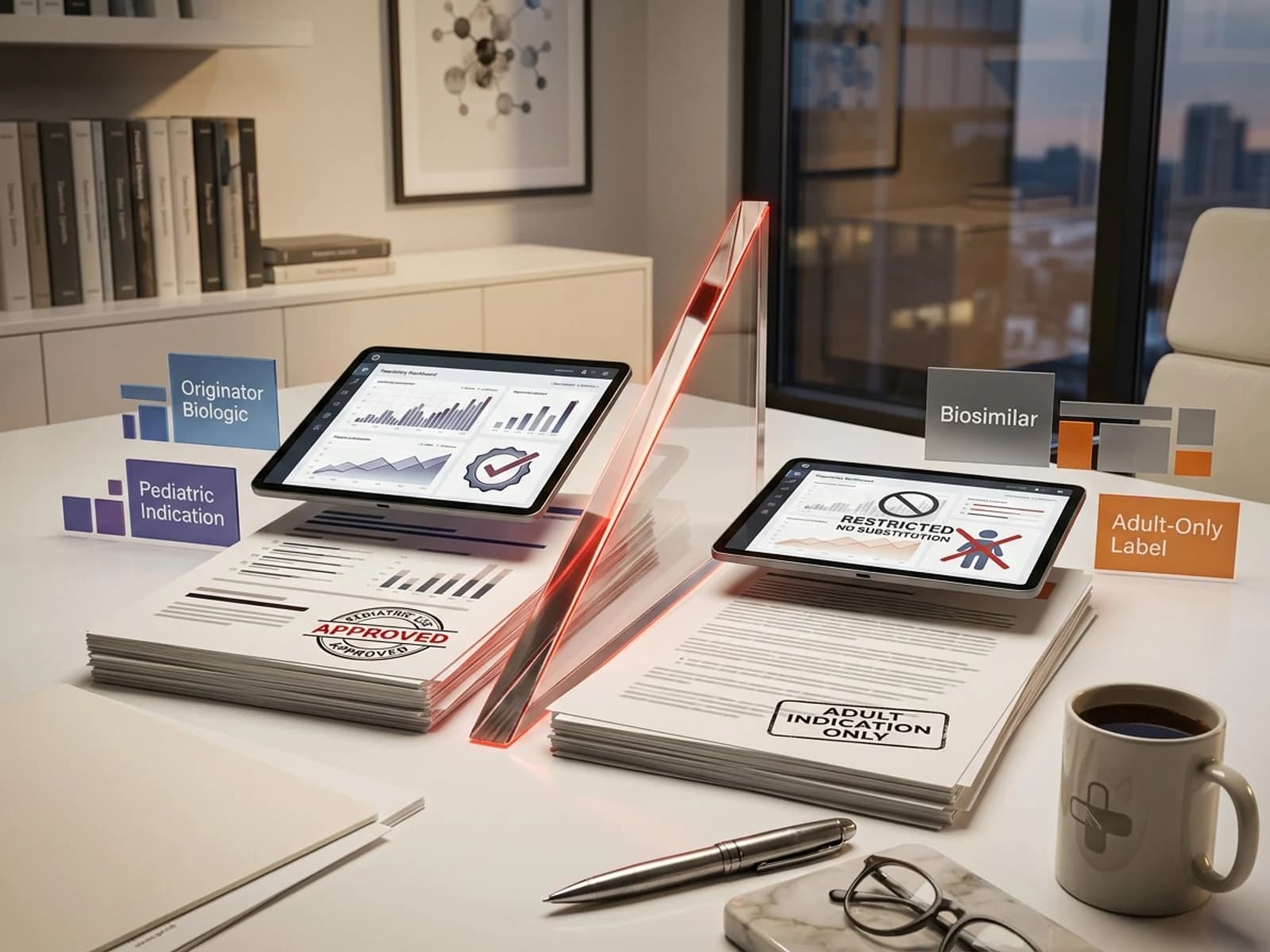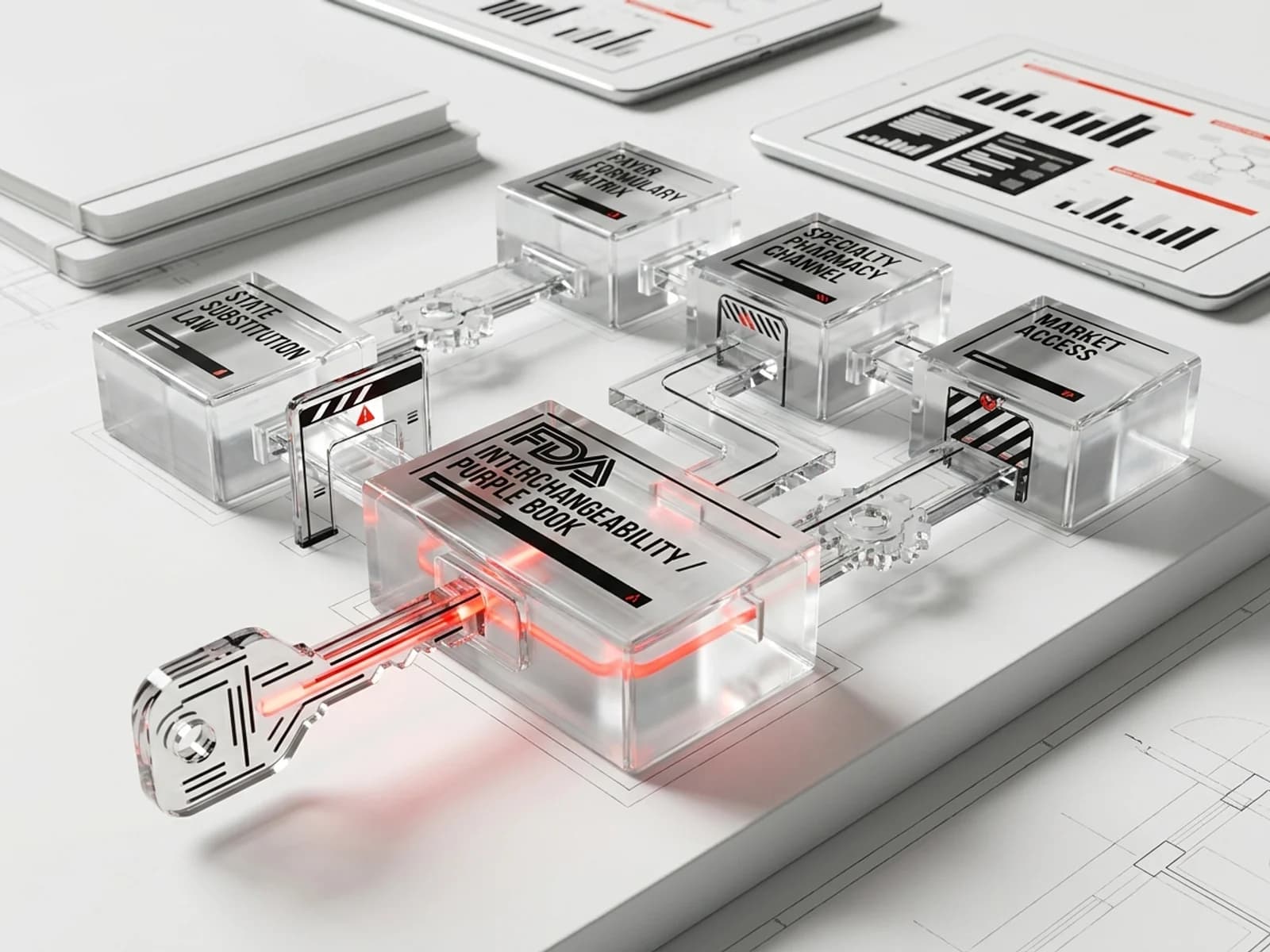
The FDA Purple Book lists 46 distinct interchangeable biosimilar products — 127 licensed product entries across strengths and presentations — covering 12 reference biologics as of the June 10, 2026 extract. That is up from a single product (Semglee, insulin glargine) in July 2021, and it means exactly half of all distinct biosimilar products licensed in the United States (46 of 92) now carry the interchangeable designation that permits pharmacy-level substitution without consulting the prescriber. The map is highly concentrated: denosumab (Prolia/Xgeva) alone holds 18 interchangeable product entries from nine manufacturers, adalimumab (Humira) holds eight, and ustekinumab (Stelara) holds seven — together 33 of the 46 products. And it is visibly incomplete: eight reference biologics that already have biosimilar competition — bevacizumab, rituximab, trastuzumab, infliximab, pegfilgrastim, filgrastim, epoetin alfa, and natalizumab — still have no interchangeable at all.
This is a structured, numbers-first read of the FDA Purple Book's interchangeable-biosimilar layer, written for biosimilar commercial, market-access, formulary, and pharmacy-substitution teams who need to know which reference products have an interchangeable, which manufacturer holds the first-interchangeable exclusivity, and where the pharmacy-substitution lever is and is not yet available. Every figure is computed from the public FDA Purple Book extract, run date June 10, 2026. For the broader biosimilar-competition picture, see the companion Purple Book biosimilar-competition analysis; for the regulatory mechanics of interchangeability and the September 2024 streamlined pathway, see how to read biosimilar interchangeability and the FDA streamlined interchangeability pathway. This article stays on the counts and the structure of the interchangeable layer.
Methodology, in one paragraph
The source is the FDA Purple Book purple_book.csv extract (2,175 rows, run date June 10, 2026), read at the licensed-product (BLA product-number/strength) grain. A row is an interchangeable if its BLA Type field equals 351(k) Interchangeable; a row is a non-interchangeable biosimilar if BLA Type equals 351(k) Biosimilar; the 351(a) rows are originator and other reference products. "Distinct interchangeable product" deduplicates interchangeable rows by (proprietary name, applicant), collapsing the multiple strengths and presentations a single branded biosimilar carries — so the 46 figure counts Cyltezo once even though it appears across many high- and low-concentration strengths. Denosumab's 18 count reflects nine manufacturers each holding two separately branded products, one referenced to Prolia and one to Xgeva, because the FDA licenses a Prolia-referenced and an Xgeva-referenced denosumab as distinct products. "First interchangeable" status and exclusivity are read from the First Interchangeable Exclusivity Exp. Date field. All 127 interchangeable rows carry Licensure = Licensed; four carry Marketing Status = Disc (discontinued presentations) and 123 are active Rx.
The headline picture
The interchangeable layer has grown from one product to 46 in under five years, and it now spans a meaningful share of US biologic spend:
| Metric | Count |
|---|---|
| Distinct interchangeable biosimilar products | 46 |
| Licensed interchangeable product entries (all strengths/presentations) | 127 |
| Reference biologics with at least one interchangeable | 12 |
| Distinct biosimilar products, interchangeable + non-interchangeable | 92 |
| Share of distinct biosimilar products that are interchangeable | 50.0% |
| Reference biologics with a biosimilar but no interchangeable | 8 |
Two patterns matter for access teams. First, the interchangeable designation is no longer rare or marginal — half of all distinct biosimilar products now hold it, and the 2025 wave (driven by the September 2024 FDA draft guidance streamlining the interchangeability pathway and dropping the dedicated switching study) converted a pipeline of approved-but-non-interchangeable biosimilars into interchangeables in a single year. Second, the coverage is uneven by molecule: three reference products (denosumab, adalimumab, ustekinumab) account for 33 of the 46 interchangeables, while eight reference products with active biosimilar competition have none.
Where the interchangeables concentrate
The interchangeable layer is dominated by three reference biologics, and within those by a small set of manufacturers:
| Reference biologic | Distinct interchangeable products | First-interchangeable exclusivity holder |
|---|---|---|
| Denosumab (Prolia / Xgeva) | 18 (9 manufacturers × Prolia + Xgeva) | Jubbonti / Wyost (Sandoz) |
| Adalimumab (Humira) | 8 | Cyltezo (Boehringer Ingelheim) |
| Ustekinumab (Stelara) | 7 | Wezlana (Amgen) |
| Ranibizumab (Lucentis) | 3 | Cimerli (Sandoz) |
| Insulin glargine (Lantus) | 2 | Semglee (Biocon) |
| Aflibercept (Eylea) | 2 | Yesafili / Opuviz (Biocon / Samsung) |
| Tocilizumab (Actemra) | 1 | Avtozma (Celltrion) |
| Etanercept (Enbrel) | 1 | Eticovo (Samsung Bioepis) |
| Insulin aspart (Novolog) | 1 | Kirsty (Biocon) |
| Eculizumab (Soliris) | 1 | Bkemv (Amgen) |
| Omalizumab (Xolair) | 1 | Omlyclo (Celltrion) |
| Pertuzumab (Perjeta) | 1 | Poherdy (Shanghai Henlius) |
The adalimumab eight — Amjevita (Amgen), Cyltezo (Boehringer Ingelheim), Hyrimoz (Sandoz), Hadlima (Samsung Bioepis), Abrilada (Pfizer), Hulio (Biocon), Simlandi (Alvotech), and Yuflyma (Celltrion) — are the high-concentration Humira biosimilars whose interchangeability designations landed across 2023–2025; Yuflyma's was expanded to all dosage forms and strengths in May 2025. The ustekinumab seven (Wezlana, Selarsdi, Steqeyma, Pyzchiva, Otulfi, Starjemza, Yesintek) all converted between late 2024 and mid-2025 as the Stelara biosimilar cohort launched.
The denosumab wave is the largest and most recent. The FDA approved the first interchangeable denosumab — Sandoz's Jubbonti (referenced to Prolia) and Wyost (referenced to Xgeva), denosumab-bbdz — on March 5, 2024, with US commercial launch on June 2, 2025. Eight more manufacturers followed with interchangeables across 2025–2026: Celltrion's Stoboclo/Osenvelt, Samsung Bioepis's Ospomyv/Xbryk, Fresenius Kabi's Bomyntra/Conexxence, Henlius's Bildyos/Bilprevda, Biocon's Bosaya/Aukelso, Hikma's Enoby/Xtrenbo, Accord's Jubereq/Osvyrti, and Amneal's Boncresa/Oziltus. Nine manufacturers, each with both a Prolia-referenced and an Xgeva-referenced product, is why the Purple Book carries 18 interchangeable denosumab product entries — the densest interchangeable cluster of any reference biologic.
The first-interchangeable exclusivity map
The first manufacturer to win an interchangeable designation for a given reference product earns a statutory exclusivity period during which FDA may not approve a second interchangeable — historically 12 months from commercial launch, now shaped by the exclusivity mechanics in the streamlined pathway. The Purple Book's First Interchangeable Exclusivity Exp. Date field makes those positions visible, and several have already expired, opening the field to the multi-product clusters above:
| Reference biologic | First interchangeable (holder) | First-interchangeable exclusivity |
|---|---|---|
| Insulin glargine | Semglee (Biocon) | Expired Nov 15, 2022 |
| Ranibizumab | Cimerli (Sandoz) | Expired Oct 3, 2023 |
| Adalimumab | Cyltezo (Boehringer Ingelheim) | Expired Sep 18, 2023 |
| Ustekinumab | Wezlana (Amgen) | Expired Apr 30, 2025 |
| Denosumab | Jubbonti / Wyost (Sandoz) | Expired Oct 29, 2025 |
| Eculizumab | Bkemv (Amgen) | Expired Nov 28, 2025 |
| Tocilizumab | Avtozma (Celltrion) | Expires Jul 24, 2026 |
| Etanercept / insulin aspart / aflibercept / omalizumab / pertuzumab | Eticovo / Kirsty / Yesafili-Opuviz / Omlyclo / Poherdy | Date TBD |
Semglee's position is the one that started the category: on July 28, 2021, the FDA approved Biocon and Viatris's Semglee (insulin glargine-yfgn) as the first interchangeable biosimilar in the United States, referenced to Lantus, carrying the first-interchangeable exclusivity that ran to November 2022. The expired exclusivities explain why adalimumab, ustekinumab, and denosumab now carry seven- and eight- and nine-manufacturer interchangeable clusters: once the first mover's exclusivity lapsed, FDA was free to designate the rest. The "Date TBD" rows — newer interchangeables whose exclusivity dates have not yet been set in the Purple Book — are the ones whose first-mover protection is still being adjudicated.
The eight reference biologics still without an interchangeable
The interchangeable designation has reached only 12 of the 20 reference biologics that have any biosimilar approved. The eight that have biosimilar competition but no interchangeable yet are the structurally important gap:
Bevacizumab (Avastin) — biosimilars approved, none interchangeable.
Rituximab (Rituxan) — biosimilars approved, none interchangeable.
Trastuzumab (Herceptin) — biosimilars approved, none interchangeable.
Infliximab (Remicade) — biosimilars approved, none interchangeable.
Pegfilgrastim (Neulasta) — biosimilars approved, none interchangeable.
Filgrastim (Neupogen) — biosimilars approved, none interchangeable.
Epoetin alfa (Epogen/Procrit) — biosimilars approved, none interchangeable.
Natalizumab (Tysabri) — biosimilar approved, none interchangeable.
These are older, high-volume biologic markets where the first biosimilar wave was approved under the pre-2024 interchangeability standard — which required a dedicated switching study — and no sponsor invested in that study because the medical-buyer and 340B economics rewarded the lower net price of a non-interchangeable biosimilar over the substitution convenience of an interchangeable. The September 2024 FDA draft guidance, which allows sponsors to use a totality-of-evidence approach and data already in the biosimilar application rather than a standalone switching study, is the change that makes future interchangeables in these molecules economically viable. Whether any sponsor returns to file an interchangeable in, say, infliximab or trastuzumab is the open question this list poses.
Who makes the interchangeables
The interchangeable layer is concentrated in a handful of biosimilar sponsors with broad US portfolios:
| Applicant | Interchangeable product entries |
|---|---|
| Celltrion | 22 |
| Samsung Bioepis | 17 |
| Sandoz | 16 |
| Amgen | 14 |
| Biocon Biologics | 14 |
| Alvotech | 9 |
| Fresenius Kabi | 7 |
| Boehringer Ingelheim | 6 |
| Pfizer | 5 |
Celltrion, Samsung Bioepis, Sandoz, Amgen, and Biocon together account for 83 of the 127 interchangeable product entries. The manufacturer concentration matters for formulary and contracting: the same five sponsors recur across adalimumab, ustekinumab, and denosumab, which is why a single manufacturer can now offer an interchangeable across multiple reference-product categories.
What this means for access, formulary, and pharmacy teams
For pharmacy substitution, check the Purple Book designation, not just biosimilar status. Only 12 reference biologics have an interchangeable, and the pharmacy-substitution lever (subject to state law) is available only for those 12. The eight biosimilar-but-not-interchangeable molecules still require a new prescription to switch — a workflow the interchangeable-biosimilar pharmacy-substitution notices piece covers in detail.
For payer formulary strategy, the interchangeable layer is the substitution lever; the biosimilar layer is the price lever. In adalimumab, ustekinumab, and now denosumab, a payer can pair a mandated-interchangeable formulary preference (auto-substitution) with net-price competition among eight or nine manufacturers. In rituximab, trastuzumab, and infliximab — no interchangeable — the formulary lever is limited to step edits and preference rules, not automatic substitution.
For biosimilar commercial teams, the first-interchangeable exclusivity is a finite, now-expired advantage for the early molecules. Insulin glargine, ranibizumab, adalimumab, ustekinumab, denosumab, and eculizumab exclusivities have all lapsed; the value of an interchangeable designation now is formulary positioning, not exclusivity. Tocilizumab's (Avtozma, to July 2026) is the only major near-term exclusivity still running.
For 340B and buy-and-bill programs, denosumab is the 2026 displacement event. Eighteen interchangeable denosumab product entries across nine manufacturers, with the Prolia (office-administered for osteoporosis) and Xgeva (oncology skeletal events) presentations both covered, is the largest interchangeable-driven margin and routing shift in the dataset. Payer policies are already separating Prolia-referenced from Xgeva-referenced products in criteria.
For pipeline watchers, the eight non-interchangeable molecules are the post-2024-pathway opportunity set. Whether the streamlined interchangeability pathway converts any of bevacizumab, rituximab, trastuzumab, infliximab, pegfilgrastim, filgrastim, epoetin alfa, or natalizumab into interchangeable territory is the structural question for the next interchangeability cycle.
Sources
US FDA, Purple Book: Database of Licensed Biological Products, extract run date June 10, 2026 — BLA type, reference product, approval and first-interchangeable exclusivity fields. Aggregates computed by PharmaDossier from the public Purple Book extract. https://purplebooksearch.fda.gov
US FDA, "FDA Approves First Interchangeable Biosimilar Insulin Product for Treatment of Diabetes" — Semglee (insulin glargine-yfgn), approved July 28, 2021. https://www.fda.gov/news-events/press-announcements/fda-approves-first-interchangeable-biosimilar-insulin-product-treatment-diabetes
US FDA, "FDA approves first interchangeable biosimilars to Prolia and Xgeva" — Jubbonti / Wyost (denosumab-bbdz, Sandoz), approved March 5, 2024. https://www.fda.gov/drugs/news-events-human-drugs/fda-approves-first-interchangeable-biosimilars-prolia-and-xgeva-treat-certain-types-osteoporosis-and
Venable BiologicsHQ, "Sandoz Launches Jubbonti / Wyost as First Prolia / Xgeva Interchangeable Biosimilars" — US commercial launch June 2, 2025. https://biologicshq.com/sandoz-launches-jubbonti-wyost-denosumab-bbdz-as-first-prolia-xgeva-interchangeable-biosimilars
Venable BiologicsHQ, "May 2025 Stelara and Humira Interchangeable Biosimilar Approvals" — ustekinumab interchangeables (Selarsdi, Otulfi, Starjemza) and Yuflyma expansion to all dosage forms. https://biologicshq.com/may-2025-stelara-and-humira-interchangeable-biosimilar-approvals
The Rheumatologist, "Biosimilar Update: 2025 Brings More FDA Approvals & Interchangeability" — denosumab interchangeability designations (Stoboclo/Osenvelt, March 2025) and adalimumab interchangeable cohort. https://www.the-rheumatologist.org/article/biosimilar-update-2025-brings-more-fda-approvals-interchangeability
US FDA, "Biosimilar Product Information" — approved biosimilars list with reference products and approval dates (2025–2026 interchangeable cohort). https://www.fda.gov/drugs/biosimilars/biosimilar-product-information
Celltrion, "US FDA grants interchangeability designation to STOBOCLO and OSENVELT" (denosumab-bmwo), effective October 29, 2025. https://www.celltrionusa.com/board/newslist/46
US FDA, "Considerations in Demonstrating Interchangeability with a Reference Product" (2019 guidance) and the September 2024 draft guidance streamlining the interchangeability pathway (totality-of-evidence approach, dedicated switching study no longer required). https://www.fda.gov/vaccines-blood-biologics/biosimilars/interchangeable-biosimilar-products
US HHS ASPE, "U.S. Biosimilar Market Entry Challenges and Facilitating Factors" (August 2025) — Purple Book entry counts and biosimilar-market reference-product coverage. https://aspe.hhs.gov/sites/default/files/documents/2d5c0a194c180b52d1c760d3bb09f70a/Biosimilars%20Final%20Report_250825_v508.pdf