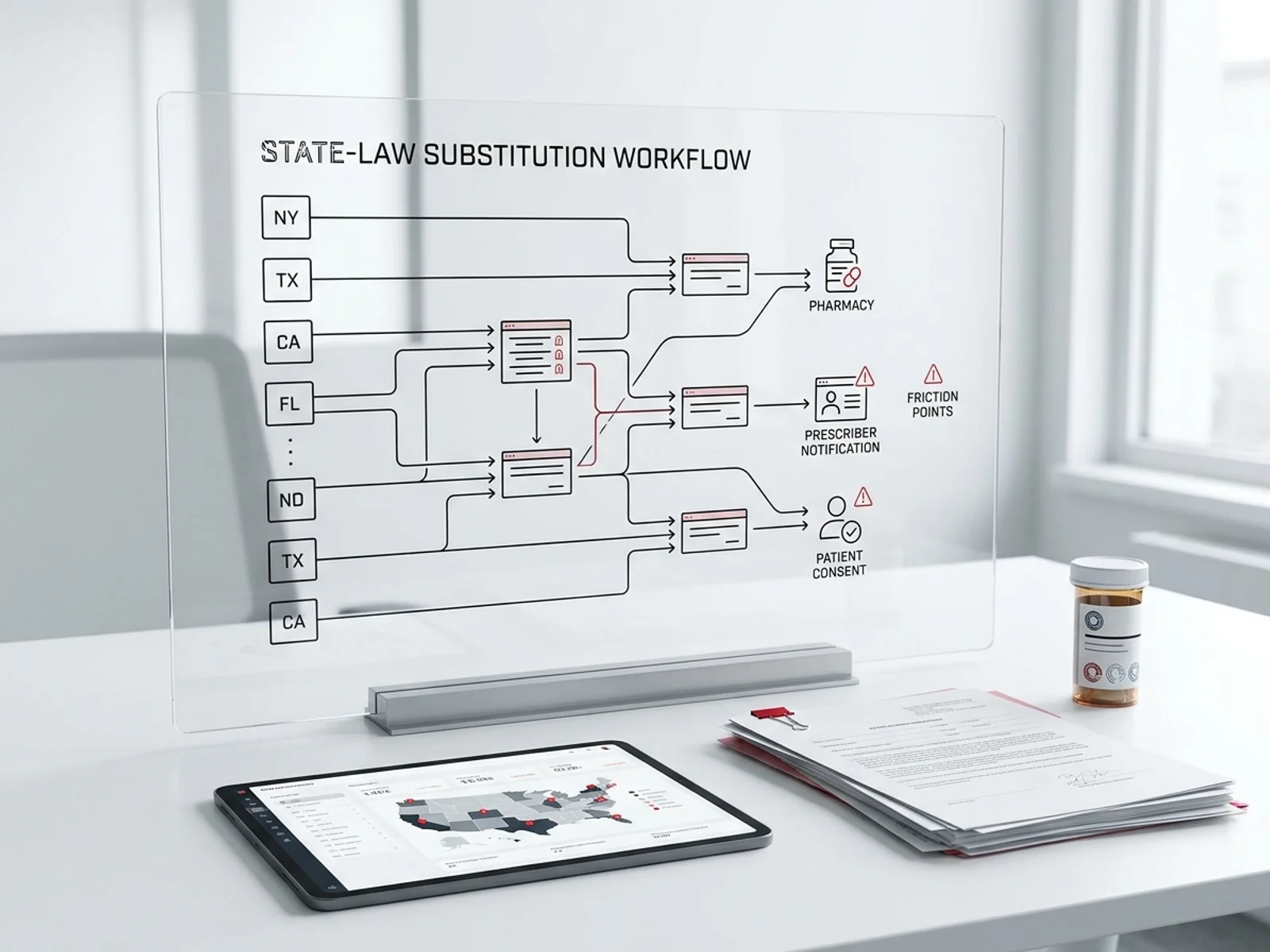
When the FDA designates a biosimilar as interchangeable with a reference product under 42 U.S.C. § 262(k)(4), the product may be substituted at the pharmacy level without the prescribing provider's direct intervention. This is the primary commercial advantage of the interchangeable designation: it enables pharmacy-level substitution, which can drive faster formulary adoption and higher utilization — similar to the mechanism that gives generic drugs 97 percent market share when available.
But the substitution itself is governed by state pharmacy practice law, not by the FDA. Every state has its own statute specifying when a pharmacist may (or must) substitute an interchangeable biosimilar, what notifications are required, how quickly they must be sent, and what records must be maintained. These requirements create operational friction that does not exist for generic substitution and can slow biosimilar uptake even when the product is designated interchangeable.
This article is written for manufacturer market access teams, biosimilar commercial launch teams, specialty pharmacy operations managers, and prescribers who need to understand the state-by-state substitution workflow and its operational impact on access.
FDA interchangeability: what the designation means
Under the Biologics Price Competition and Innovation Act (BPCIA), a biosimilar may receive an interchangeable designation if it meets the statutory standard: the product must be expected to produce the same clinical result as the reference product in any given patient, and for products administered more than once, the risk of switching or alternating must not be greater than the risk of continuing the reference product.
Key regulatory points:
Interchangeability is a product-specific designation between the biosimilar and the reference product. The FDA does not certify that two biosimilars of the same reference product are interchangeable with each other.
An interchangeable biosimilar may be substituted at the pharmacy without prescriber intervention, subject to state law.
The interchangeable designation does not guarantee insurance coverage or formulary placement.
As of January 2026, the FDA had approved 86 biosimilars, with 41 percent approved in just the past two years. The number of products with interchangeable designation continues to grow.
In 2025, the FDA issued draft guidance proposing to streamline the interchangeability standard by eliminating the requirement for dedicated switching studies when analytical and pharmacokinetic data are sufficient. FDA Commissioner Marty Makary stated that the agency plans to finalize both biosimilarity and interchangeability guidance documents within the first half of 2026. This regulatory evolution is expected to increase the number of interchangeable designations, making state substitution law compliance even more operationally important.
The current interchangeable biosimilar landscape
Interchangeable products as of early 2026 span several therapeutic areas:
| Reference product | Interchangeable biosimilars (examples) | Therapeutic area |
|---|---|---|
| Humira (adalimumab) | Amjevita, Cyltezo, Hadlima, Hyrimoz, Simlandi, Yusimry, and others | Immunology |
| Lantus (insulin glargine) | Langlara (approved April 2026), others in pipeline | Diabetes |
| Neulasta (pegfilgrastim) | Multiple interchangeable pegfilgrastim products | Supportive oncology care |
| Lucentis (ranibizumab) | Byooviz, Nufymco | Ophthalmology |
The FDA Purple Book database (purplebooksearch.fda.gov) maintains the current list of all licensed biological products with their designation status (reference product, biosimilar, or interchangeable).
State-law substitution framework: common elements
As of 2026, all 50 states, the District of Columbia, and U.S. territories have enacted biosimilar substitution statutes. While the specifics vary, most state laws share these common elements:
Substitution authority
The pharmacist may substitute an interchangeable biosimilar for the prescribed reference product only if:
The FDA has determined that the biosimilar is interchangeable with the prescribed product.
The prescribing provider has not prohibited substitution (typically indicated on the prescription as "dispense as written" or "brand medically necessary").
The biosimilar costs the patient less than the prescribed reference product (required in some states).
Prescriber notification
Most states require the dispensing pharmacist (or designee) to notify the prescriber that a substitution was made. Key variations include:
| Notification element | Common range |
|---|---|
| Timing | Within 3 to 5 business days of dispensing |
| Method | Electronic health record entry (presumed to constitute notice in most states), fax, or other means |
| Content | Product name and manufacturer or NDC number of the dispensed biosimilar |
| Exceptions | Some states exempt inpatient or institutional settings |
For example:
New York: Prescriber notification within 5 business days of dispensing.
Texas: Prescriber notification within 3 business days, conveyed via interoperable electronic medical records system or through other means if EMR is not accessible.
Florida: Pharmacist must notify the person presenting the prescription of the substitution; record must be maintained.
Nevada: Prescriber notification within 3 business days.
Colorado: Prescriber notification "within a reasonable time."
Patient notification
States vary on patient notification requirements:
Some states require the pharmacist to inform the patient (or the patient's agent) at the point of dispensing that a less expensive interchangeable product is available and is being substituted.
Some states require written notice, while others accept verbal communication.
Some states require a visible sign in the pharmacy informing patients about biosimilar substitution.
Some states do not require affirmative patient notification but do require patient consent if the patient declines substitution.
Prescriber opt-out
In all states, the prescriber retains the ability to prohibit substitution. This is typically done by:
Writing "dispense as written" (DAW) on the prescription.
Indicating in the electronic prescribing system that substitution is not authorized.
Specifying "brand medically necessary" on the prescription form.
Recordkeeping
Most states require the pharmacy to maintain records of the specific biological product dispensed, including the product name and manufacturer or NDC number. Some states have specific record retention requirements for biosimilar substitutions that exceed standard pharmacy recordkeeping obligations.
Operational friction points
The state-law requirements create several operational challenges that slow interchangeable biosimilar adoption:
Friction 1: Notification burden
For a busy pharmacy filling hundreds of prescriptions daily, the additional step of notifying a prescriber within a specific time window — and documenting that notification — adds workflow complexity that does not exist for most generic substitutions. If the financial or operational incentive to substitute is not sufficient to overcome this administrative burden, pharmacies may be less inclined to perform the substitution, particularly for patients whose copay is the same regardless of which product is dispensed.
Friction 2: EMR interoperability gaps
Most states accept an entry in an interoperable electronic medical records system as constituting prescriber notification. But if the pharmacy's system and the prescriber's EMR are not interoperable — which is common for independent pharmacies, small practices, and prescribers using different EMR vendors — the pharmacy must use an alternative notification method (fax, phone, or mail), which adds time and cost.
Friction 3: Biosimilar-to-biosimilar substitution uncertainty
The FDA designates interchangeability between a biosimilar and the reference product. It does not designate interchangeability between two biosimilars of the same reference product. State laws generally authorize substitution only when the product is interchangeable with the prescribed product. If a prescription is written for one interchangeable biosimilar (e.g., Amjevita), most state laws do not clearly authorize a pharmacist to substitute a different interchangeable biosimilar (e.g., Cyltezo) for the prescribed one. This creates uncertainty when a payer mandates a specific preferred biosimilar that differs from what was prescribed.
Friction 4: Payer-mandated switching vs. state substitution law
Payers and PBMs increasingly mandate that patients switch from a reference biologic to a preferred biosimilar. This payer-mandated switch is different from pharmacy-level substitution — it typically requires a new prescription or prior authorization — and is not governed by the same state statutes. However, the interaction between payer mandates and state substitution laws can create confusion. A payer may require a switch to a non-interchangeable biosimilar through the PA process, even though the state's pharmacy substitution statute only covers interchangeable products.
Friction 5: Nocebo risk and patient communication
When a pharmacist substitutes a biosimilar at the pharmacy, the patient may be surprised to receive a different product than the one their doctor prescribed. If the pharmacist's explanation is brief or the patient has concerns about biosimilar safety, the switch can trigger a nocebo effect — where negative expectations about the new product lead to perceived side effects or reduced adherence. Manufacturer access teams and pharmacy operations teams should prepare patient-facing communication materials that explain the substitution clearly, reference the FDA's interchangeable designation, and provide a contact number for questions.
What manufacturer access teams should do
For biosimilar manufacturers launching an interchangeable product, the state-law substitution framework requires coordinated action across multiple functions:
Pre-launch
| Action | Rationale |
|---|---|
| Map all 50 state substitution statutes | Identify notification timing, method, and patient consent requirements in each state where the product will be distributed |
| Identify the pharmacy networks most likely to dispense the product | Limited-distribution networks allow focused training; open distribution requires broader outreach |
| Develop pharmacy-facing substitution workflow guides | One-page reference cards that pharmacists can use at the point of dispensing, tailored to the most common state requirements |
| Coordinate with EMR vendors | Ensure the product's NDC and proper name are loaded in major pharmacy management systems and EMR platforms before launch |
Post-launch
| Action | Rationale |
|---|---|
| Track substitution rates by state and pharmacy | Identify states or chains where substitution is lagging despite formulary preference, and investigate whether notification burden or EMR gaps are the cause |
| Monitor DAW rates | High "dispense as written" rates may indicate prescriber unfamiliarity with the interchangeable designation or patient resistance to switching |
| Provide patient communication materials | Brochures, FAQ sheets, and pharmacy conversation guides that address the interchangeable designation and the FDA's safety review |
| Coordinate with payer teams | Ensure that formulary positioning and copay structures align with state substitution requirements — a biosimilar that is cheaper on a gross-cost basis but has the same patient copay as the reference product provides less substitution incentive |
California SB 1094: a potential shift
In 2026, California's SB 1094 is under consideration. The bill would authorize pharmacists to substitute a biosimilar (not just an interchangeable product) for a prescribed biological product if the biosimilar is "biosimilar to" the reference product, expanding substitution authority beyond the interchangeable designation. If enacted, California would become the first state to allow pharmacy-level substitution of non-interchangeable biosimilars. Tennessee enacted similar legislation in 2025, authorizing health carriers, benefit plans, and utilization review organizations to require patients to try a biosimilar product before providing coverage for the equivalent branded prescription drug — effectively enabling substitution at the plan level without the interchangeable designation. These state-level actions signal a broader trend toward expanding biosimilar access outside the traditional interchangeable framework, and manufacturer access teams should monitor legislative developments in additional states.
What to monitor
FDA interchangeability guidance finalization: Expected in the first half of 2026, the finalized guidance may eliminate the switching-study requirement and increase the number of interchangeable designations.
State legislation tracking: California SB 1094 and similar bills in other states could expand substitution authority beyond interchangeable products. Avalere Health's annual Biosimilar Substitution State Statute Report tracks changes across all 50 states.
Payer formulary mandates: As more interchangeable products enter the market, payers may shift from PA-based switching to automatic substitution at the pharmacy level, which would increase the operational importance of state notification compliance.
Purple Book updates: The FDA Purple Book is updated regularly with new interchangeable designations. Access teams should monitor for new interchangeable products in their competitive set.
Prescriber education needs: The FDA's moves to streamline interchangeability may reduce the perceived difference between biosimilar and interchangeable products, but prescriber comfort with pharmacy-level substitution will take time to build. Manufacturer field teams should be prepared to address prescriber questions about the difference between a biosimilar and an interchangeable biosimilar.
This article is for informational purposes only and does not constitute legal, medical, or regulatory advice. State pharmacy practice laws vary and are subject to change. Consult the relevant state board of pharmacy and legal counsel for authoritative guidance on substitution requirements.
Sources
42 U.S.C. § 262(k)(4) — Biologics Price Competition and Innovation Act, interchangeability standard.
FDA Biosimilar Product Information. FDA.gov, updated May 2026. https://www.fda.gov/drugs/biosimilars/biosimilar-product-information.
FDA Purple Book Database. https://purplebooksearch.fda.gov.
Avalere Health. "2025 Update: Biosimilar Substitution State Statute Report." Avalere Health Advisory, 2025.
Rome BN, Bhaskar A, Kesselheim AS. "Biosimilar Interchangeability and Substitution in the US: What Comes Next?" American Journal of Managed Care, April 2026.
Jones Day. "FDA's Biosimilar Playbook: Merging Biosimilarity with Interchangeability." Jones Day Insights, December 2025.
RAPS. "FDA Proposes Major Change to Biosimilar PK Study Requirements." Regulatory Affairs Professionals Society, 2025.
Cardinal Health. "State Laws for Biosimilar Interchangeability." Cardinal Health, updated February 2026.
National Psoriasis Foundation. "Biosimilar Substitution Rules by State." psoriasis.org.
American Pharmacists Association. "Biosimilars: Pharmacist Substitution Authority." pharmacist.com.
Florida Statutes § 465.0252 — Substitution of interchangeable biosimilar products.
Texas Administrative Code § 309.5 — Communication with Prescriber.
California SB 1094 (2025–2026 session) — Prescription drugs: biological product substitution.
California Health Benefits Review Program. "Analysis of California Senate Bill 1094: Prescription Drugs." CHBRP, April 2026.
ERISA Industry Committee. "Driving Access to Affordable Drugs — Streamlining Biosimilar Interchangeability Requirements." ERIC.
DrugPatentWatch. "Interchangeability Unlocked: A Strategic Analysis of the Key to U.S. Biosimilar Adoption." DrugPatentWatch, 2025.
Mintz Levin. "State Biosimilar Substitution Laws Chart." 2015 (updated periodically).
GaBI Online. "45 US States Have Passed Biosimilar Substitution Laws." Generics and Biosimilars Initiative.