Humira (adalimumab, AbbVie) was the world's best-selling drug for most of the 2010s. US biosimilar entry began in 2023 after patent settlements, and ten biosimilars are now FDA-approved. Eight of those carry the interchangeable designation, meaning they may be substituted at the pharmacy level without prescriber intervention in states that permit it. Payers, PBMs, and health systems have moved aggressively to shift utilization away from branded Humira toward lower-cost biosimilars.
This reference-product dossier is for prescribers, access teams, pharmacists, and payer professionals who need to track which biosimilars are available, how payers are covering them, and what switching rules apply.
FDA-approved biosimilars
As of May 2026, ten biosimilars referencing Humira have been approved by the FDA:
| Biosimilar | Nonproprietary name | Manufacturer | FDA Approval | Interchangeable | Launch |
|---|---|---|---|---|---|
| Amjevita | adalimumab-atto | Amgen | Sep 2016 | Yes | Jan 2023 |
| Cyltezo | adalimumab-adbm | Boehringer Ingelheim | Aug 2017 | Yes | Jul 2023 |
| Hyrimoz | adalimumab-adaz | Sandoz | Oct 2018 | Yes | Jan 2023 |
| Hadlima | adalimumab-bwwd | Organon / Samsung Bioepis | Jul 2019 | Yes (May 2025) | Jul 2023 |
| Abrilada | adalimumab-afzb | Pfizer | Nov 2019 | Yes | Jul 2023 |
| Hulio | adalimumab-fkjp | Biocon Biologics | Jul 2020 | Yes | Feb 2024 |
| Yusimry | adalimumab-aqvh | Coherus | Dec 2021 | No | Jul 2023 |
| Idacio | adalimumab-aacf | Fresenius Kabi | Dec 2022 | No | Jul 2023 |
| Yuflyma | adalimumab-aaty | Celltrion | May 2023 | Yes (Apr 2025) | Jul 2023 |
| Simlandi | adalimumab-ryvk | Alvotech / Teva | Feb 2024 | Yes | Jul 2023 |
Interchangeability
Eight of the ten biosimilars carry the FDA interchangeable designation: Amjevita, Cyltezo, Hyrimoz, Hadlima, Abrilada, Hulio, Yuflyma, and Simlandi. Interchangeable status means the product may be substituted for Humira at the pharmacy counter without contacting the prescriber, subject to state pharmacy practice laws. Not all states permit automatic substitution.
Two biosimilars — Yusimry and Idacio — are approved as biosimilars but do not carry the interchangeable designation. They can still be dispensed when a prescription is written specifically for the biosimilar, but they cannot be automatically substituted for Humira by a pharmacist.
Indications
All ten biosimilars share the same FDA-approved indications as Humira: rheumatoid arthritis, juvenile idiopathic arthritis (ages 2+), psoriatic arthritis, ankylosing spondylitis, Crohn's disease, ulcerative colitis, plaque psoriasis, hidradenitis suppurativa, and uveitis.
Formulations and devices
Biosimilars are available in both high-concentration (100 mg/mL, citrate-free) and low-concentration (50 mg/mL) formulations. Device types vary across prefilled pens, prefilled syringes, and vials. Availability of specific presentations differs by product:
Amjevita: Available in high-concentration and low-concentration formulations; prefilled pens, prefilled syringes, and vials.
Cyltezo: Available in high-concentration citrate-free formulation; prefilled pens and prefilled syringes.
Hyrimoz: Available in high-concentration and low-concentration formulations; prefilled pens and prefilled syringes. Also available as unbranded adalimumab-adaz.
Simlandi: Available in high-concentration citrate-free formulation; prefilled pens and prefilled syringes.
Hadlima: Available in high-concentration and low-concentration; prefilled pens and prefilled syringes.
Hulio: Available in low-concentration citrate-free; prefilled pens and prefilled syringes. Also available as unbranded adalimumab-fkjp.
Abrilada: Available in high-concentration citrate-free; prefilled pens and prefilled syringes.
Idacio: Available in low-concentration citrate-free; prefilled pens and prefilled syringes.
Yuflyma: Available in high-concentration; prefilled pens and prefilled syringes.
Yusimry: Available in low-concentration; prefilled pens and prefilled syringes.
Payer and PBM coverage
Commercial insurance
The three largest PBMs — CVS Caremark, Express Scripts, and Optum Rx — have all moved to exclude branded Humira from their standard commercial formularies and prefer biosimilars:
CVS Caremark: Removed Humira from its major national commercial template formularies in April 2024, making it the first major PBM to do so. Preferred biosimilars include Sandoz products (Hyrimoz branded, unbranded adalimumab-adaz, and the Cordavis private-label version) and the Biocon low-list-price product. CVS Caremark reports $1.5 billion in gross savings from the Humira biosimilar transition, with 95% adoption of low-cost preferred biosimilars and $0 out-of-pocket cost for most members.
Express Scripts (Cigna): Its 2026 National Preferred Formulary excludes Humira. Preferred adalimumab biosimilars are manufactured by Boehringer Ingelheim (Cyltezo/unbranded adalimumab-adbm), Alvotech/Teva (Simlandi), and Sandoz. Express Scripts also includes a Quallent Pharmaceuticals private-label version manufactured by Samsung Bioepis.
Optum Rx (UnitedHealth Group): Effective July 1, 2025, Humira was excluded from commercial and exchange formularies. Preferred options include the high-list-price Amjevita and a low-list-price Nuvaila private-label version (manufactured by Amgen).
Horizon Blue Cross Blue Shield of New Jersey: Effective July 1, 2025, Humira brand was moved to non-formulary or non-preferred tier. Preferred biosimilars (Tier 2) include Hadlima and unbranded Yuflyma (adalimumab-aaty).
Medicare Part D
An HHS Office of Inspector General analysis found that in 2025:
96% of standalone Prescription Drug Plans (PDPs) covered at least one Humira biosimilar, up from 65% in 2024.
88% of Medicare Advantage Prescription Drug (MAPD) plans covered at least one biosimilar, up from 52% in 2024.
Some plans covered biosimilars only and not Humira, effectively requiring biosimilar use.
99% of formularies that covered both Humira and biosimilars placed them on the same cost-sharing tier, meaning formularies generally did not use tier differentiation to incentivize biosimilar use.
A few plans placed one preferred biosimilar on a lower cost-sharing tier (e.g., fixed-dollar copayment versus percentage-based coinsurance).
For 2026, all large national Part D carriers cover at least one biosimilar. Humana and CVS/Aetna continue to cover branded Humira in some plan designs, while other carriers have moved to biosimilar-only coverage.
Blue Cross Blue Shield of Michigan (Medicare Advantage): Effective September 1, 2025, replaced Humira with adalimumab-aaty and adalimumab-adbm as preferred products. Current Humira users received pre-approved authorizations for biosimilars. No new prescription required for interchangeable products.
Louisiana Blue (Commercial): Preferred Humira biosimilars include adalimumab-adaz (Sandoz, high-concentration), Simlandi (Teva), and Quallent products. Members get $0 out-of-pocket cost when filling with Accredo Specialty Pharmacy.
Michigan Meridian Medicaid: Effective November 1, 2025, adalimumab-adbm (unbranded Cyltezo) became a preferred option covered without prior authorization. Prescribers were encouraged to convert established Humira patients to the biosimilar.
State Medicaid programs have varying approaches to Humira biosimilar coverage. Most states require prior authorization and may mandate trial of a biosimilar before approving branded Humira. Some states have implemented mandatory substitution policies for interchangeable biosimilars.
Pricing landscape
The Humira biosimilar market has split into two pricing tiers:
High-list-price biosimilars: Priced at or near Humira's wholesale acquisition cost (WAC) of approximately $6,923 per 40 mg pen. Cyltezo (branded) is approximately 5% off Humira WAC. These products compete primarily on rebates to plan sponsors.
Low-list-price biosimilars: Priced at a significant discount to Humira's WAC. Unbranded adalimumab-adbm (Boehringer Ingelheim) is approximately 81% off Humira WAC. Unbranded adalimumab-adaz (Sandoz) and certain private-label versions offer similarly deep discounts.
PBMs and payers increasingly favor low-list-price products, particularly for Medicare Part D where the Part D benefit redesign shifts more cost exposure to plans. The private-label biosimilar model — where a PBM's affiliated entity (Cordavis, Nuvaila, Quallent) markets a biosimilar — has added a layer of vertical integration to the pricing dynamic.
Pharmacy substitution and switching
State law
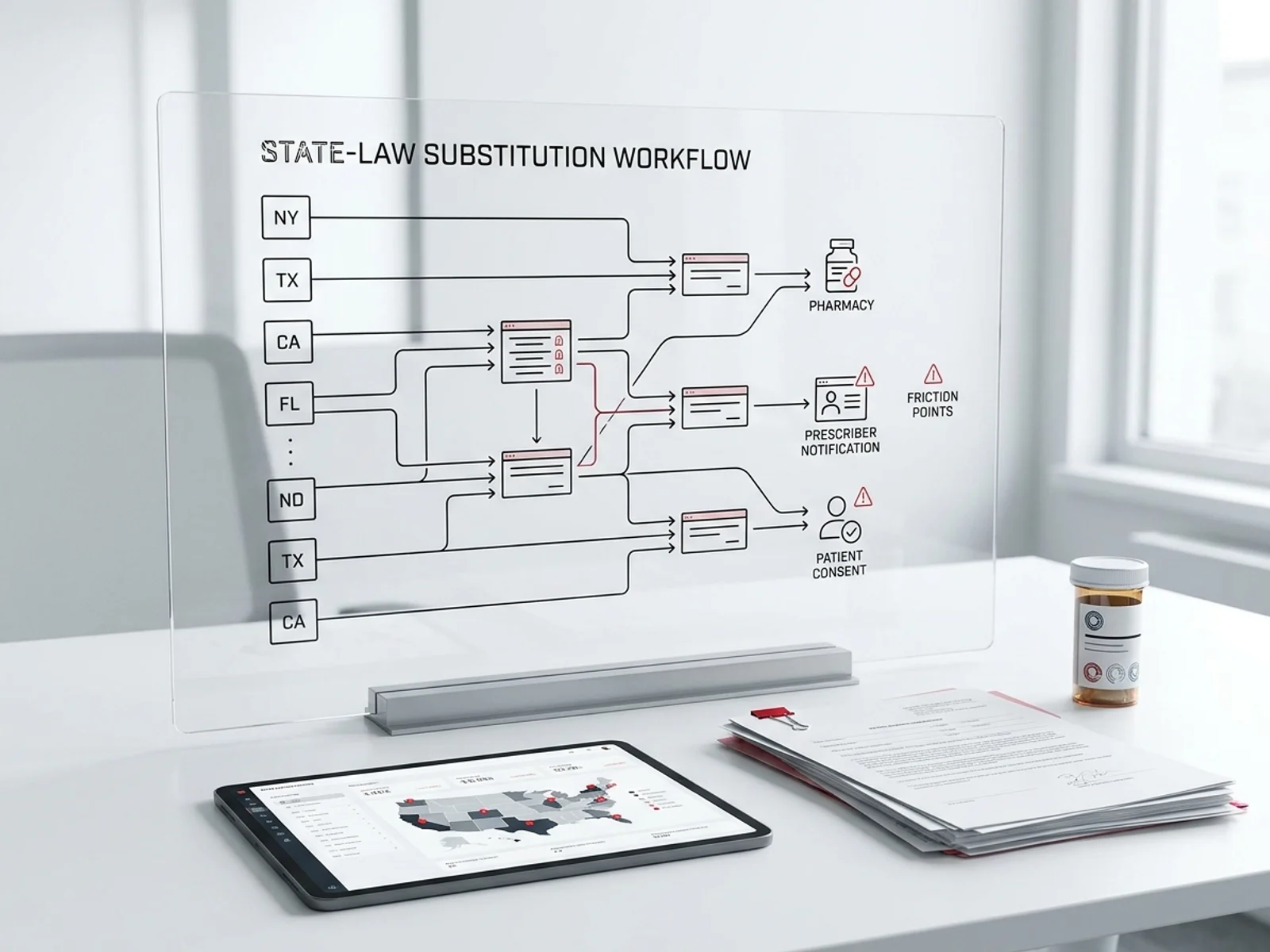
Interchangeable biosimilar substitution is governed by state pharmacy practice laws. Most states permit automatic substitution of interchangeable biosimilars for the reference product, with requirements to notify the prescriber within a specified timeframe. Some states require patient consent. Prescribers can prevent substitution by writing "dispense as written" or "brand medically necessary" on the prescription.
Medical benefit versus pharmacy benefit
Adalimumab products are dispensed through both the medical benefit (buy-and-bill, administered in clinic) and the pharmacy benefit (self-injected, dispensed through specialty pharmacy). Payer switching policies differ by benefit type:
Pharmacy benefit: PBM formulary exclusions and preferred product lists drive switching. When a plan excludes Humira, the specialty pharmacy will contact the prescriber to obtain a new prescription for a preferred biosimilar.
Medical benefit: Hospital and clinic formularies may have their own preferred products. The 340B program adds complexity, as 340B pricing may differ significantly between Humira and biosimilars.
Patient transition
When a payer excludes Humira, the transition process typically follows this pattern:
Patient receives a letter 30–60 days before the formulary change date.
Specialty pharmacy contacts the prescriber for a new prescription for a covered biosimilar.
Prior authorization for the biosimilar is submitted (many payers auto-approve transitions from Humira to a preferred biosimilar).
Patient begins therapy with the new product.
Based on employer reports and PBM data, the transition from Humira to biosimilars has caused minimal clinical disruption. One large Midwest employer reported saving millions of dollars with no member complaints after transitioning, attributing success to advance communication and provider education.
What to monitor
Remaining Humira market share: Despite ten approved biosimilars, branded Humira retains significant market share in some channels. Monitor quarterly earnings and PBM reports for utilization trends.
Private-label biosimilar pricing dynamics: The Cordavis, Nuvaila, and Quallent models represent a structural shift. Watch for plan sponsor pushback and regulatory scrutiny.
340B program interaction: Hospital systems' 340B pricing for Humira may continue to favor the branded product, creating a split incentive between the pharmacy and medical benefit channels.
New biosimilar entrants: Additional adalimumab biosimilars may enter the US market. Monitor FDA Purple Book updates.
IRA negotiated price impact: Humira is not currently selected for IRA Medicare price negotiation, but biosimilar-driven price erosion may trigger CMS evaluation in future cycles.
Sources
FDA. Biosimilar Product Information. Updated May 2026. https://www.fda.gov/drugs/biosimilars/biosimilar-product-information
FDA. Purple Book: Database of Licensed Biological Products. https://purplebooksearch.fda.gov/
HHS Office of Inspector General. Most Medicare Part D Plans' Formularies Included Humira Biosimilars for 2025. OEI-05-23-00520. https://oig.hhs.gov/reports/all/2025/most-medicare-part-d-plans-formularies-included-humira-biosimilars-for-2025/
Kaufman MB. Biosimilar Update: 2025 Brings More FDA Approvals & Interchangeability. The Rheumatologist. 2025.
CVS Caremark. Biosimilar transition success data. Accessed May 2026.
CVS Health. CVS Caremark Expands Biosimilar Adoption Through Formulary Updates. Press release. May 5, 2026.
Drug Channels. The Big Three PBMs' 2026 Formulary Exclusions: MFP, Private Label Biosimilars, and Direct-to-Patient Threats for PBMs. January 2026.
Drug Channels. The Big Three PBMs' 2025 Formulary Exclusions: Humira, Stelara, Private Labels. January 2025.
Oliver Wyman. Part D Formularies Enter a New Era in 2026. February 2026.
Optum Business. Provider Biosimilars eToolkit. July 1, 2025.
Horizon Blue Cross Blue Shield of New Jersey. Effective July 1, 2025: New biosimilars to replace Humira and Stelara.
Gabionline. Biosimilars approved in the US. Updated January 27, 2026.
Coherent Market Insights. Humira Biosimilar Market Size and Growth Rate. 2026.