On July 16, 2026, Angelini Pharma S.p.A., the pharmaceutical arm of the Italian multi-business group Angelini Industries, completed its acquisition of US rare disease specialist Catalyst Pharmaceuticals, Inc. Under the terms of the transaction, Angelini acquired all outstanding common shares of Catalyst for $31.50 per share in cash, representing an aggregate equity purchase price of approximately 4.1 billion US dollars (or approximately 3.5 billion euros).
The acquisition price represented a 21 percent premium over Catalyst’s unaffected closing price on April 22, 2026, and a 28 percent premium over its 30-day volume-weighted average price (VWAP). Upon closing, Catalyst was delisted from the Nasdaq Stock Market, becoming a wholly owned subsidiary of Angelini Pharma.
The transaction is notable for two primary reasons: first, its unusual capital structure, which combines private equity, sovereign capital, and a syndicated bank debt pool to finance a transatlantic expansion for a privately held European company; and second, the stark contrast in longevity between the three primary commercial products acquired.
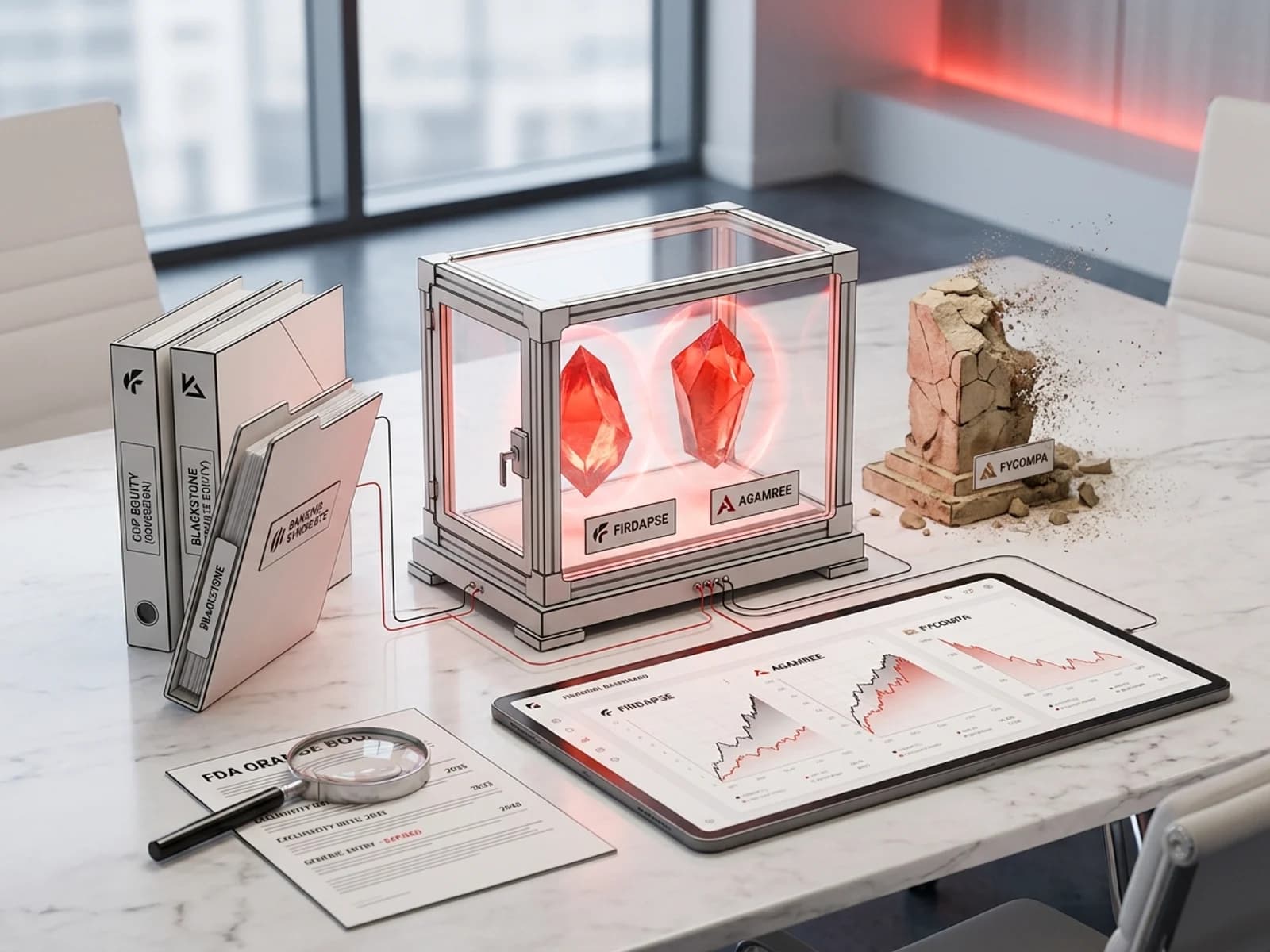
An examination of FDA Orange Book patent listings and National Average Drug Acquisition Cost (NADAC) pricing data reveals that Angelini effectively paid for two exclusivity-protected rare disease growth assets—Firdapse and Agamree—while inheriting a third product, Fycompa, that is undergoing rapid generic erosion.
Below is a comprehensive analysis of the transaction, detailing financial terms, capital structure, regulatory exclusivity profiles, disease pathophysiology, clinical mechanisms, generic competition risks, commercial contracting, and integration implications.
What Were the Terms and Structure of the Angelini-Catalyst Deal?
The transaction was initially announced on May 7, 2026, following unanimous approval by the boards of directors of both Angelini Pharma and Catalyst Pharmaceuticals. The acquisition was structured as a one-step cash merger under Delaware law, requiring approval by a majority of Catalyst’s outstanding voting shares alongside customary regulatory clearances under the Hart-Scott-Rodino (HSR) Antitrust Improvements Act.
                      Angelini-Catalyst Transaction Summary
  +-------------------------------------------------------------------------+
  |  Per-Share Consideration:     $31.50 Cash per Common Share              |
  |  Total Equity Value:          ~$4.1 Billion USD / ~€3.5 Billion EUR     |
  |  Unaffected Premium (Apr 22): 21% Premium over Unaffected Price ($26.03) |
  |  30-Day VWAP Premium:         28% Premium                               |
  |  Announcement Date:           May 7, 2026                               |
  |  Closing & Delisting Date:    July 16, 2026                             |
  +-------------------------------------------------------------------------+
Target Valuation and Revenue Multiples
Catalyst reported record full-year 2025 financial results on February 26, 2026, posting $588.99 million in total net product revenue (a 19.8 percent increase over FY2024) and $214.33 million in GAAP net income (up 30.8 percent), with Q4 2025 alone at $152.6 million. For full-year 2026, Catalyst guided total net revenue to $615–645 million, split by product as Firdapse $435–450 million, Agamree $140–150 million, and Fycompa $40–45 million.
At the $4.1 billion equity transaction value:
The purchase price represents 7.0 times FY2025 actual total revenue.
The purchase price represents 6.4 to 6.7 times FY2026 guided total revenue.
However, because Catalyst held $755.9 million in cash and cash equivalents with zero funded debt as of March 31, 2026, the net enterprise value paid by Angelini at closing was approximately $3.34 billion, translating to an enterprise-value-to-revenue multiple of 5.7 times FY2025 revenue and 5.2 to 5.4 times FY2026 guided revenue.
How Does the CDP Equity and Blackstone Financing Model Work?
Structuring a $4.1 billion cash takeover represents a transformative capital deployment for Angelini Industries, a private Italian family-owned group generating slightly over €2.0 billion in annual revenue across healthcare, consumer goods, and industrial technology.
To complete the purchase without over-leveraging Angelini’s core balance sheet, Angelini assembled a hybrid financing model combining private equity investment, Italian sovereign wealth capital, and a syndicated bank facility.
                      Angelini Transaction Financing Structure
  +-------------------------------------------------------------------------+
  |  Sovereign Equity:     ~€1.0 Billion from CDP Equity (23.5% Stake)      |
  |  Preferred Equity:    €1.0 Billion from Blackstone Funds                |
  |  Bank Debt Syndicate:  Underwritten by BNP Paribas + 13 Institutions    |
  |  Sponsor Equity:      Angelini Pharma / Angelini Industries Balance Sheet|
  +-------------------------------------------------------------------------+
1. Italian Sovereign Wealth Investment (CDP Equity S.p.A.)
CDP Equity, the equity investment arm of Italian state-backed financial institution Cassa Depositi e Prestiti (CDP), approved an investment of approximately 1.0 billion euros into Angelini Pharma. This investment was executed through a reserved capital increase, granting CDP Equity a 23.5 percent equity stake in Angelini Pharma. The investment serves a strategic industrial policy mandate: backing an Italian healthcare enterprise to establish a direct commercial footprint in the US pharmaceutical market.
2. Private Equity Preferred Capital (Blackstone)
Funds managed by Blackstone committed 1.0 billion euros in preferred equity financing. The preferred equity structure provides Angelini with long-term, non-dilutive common equity capital while guaranteeing Blackstone a structured return tier backed by Angelini’s combined European and US cash flows. The completion of Blackstone’s preferred equity investment remains subject to customary regulatory approvals.
3. Banking Syndicate and Underwriting Pool
The debt portion of the acquisition was structured and underwritten by BNP Paribas, acting as sole global coordinator and underwriter. BNP Paribas syndicated the credit facility across an international syndicate of 14 banking institutions:
Bookrunners & Mandated Lead Arrangers: Crédit Agricole CIB, Intesa Sanpaolo, and Mediobanca.
Mandated Lead Arrangers & Participants: Banco BPM, Bank of America, Cassa Depositi e Prestiti, ING, Natixis, UniCredit, BBVA, Barclays, Commerzbank, and Banca Nazionale del Lavoro (BNL).
This capital structure provides a model for mid-cap European pharmaceutical companies seeking large US commercial acquisitions: combining sovereign industrial backing with private preferred equity to execute transactions beyond the capacity of traditional corporate debt alone.
What Exclusivity Did 4.1 Billion Dollars Buy in the FDA Orange Book?
The strategic logic of Angelini’s acquisition depends on the regulatory exclusivity, patent protection, and market entry barriers governing Catalyst's three primary commercial drugs: Firdapse (amifampridine), Agamree (vamorolone), and Fycompa (perampanel).
An analysis of our July 25, 2026 FDA Orange Book snapshot reveals a sharp divergence in product lifecycle stage across the portfolio:
| Brand Name | Active Ingredient | Brand NDA (approval) | Approved ANDAs | Listed Orange Book Patents | Latest Listed Patent Expiry | Active Regulatory Exclusivity | Last Exclusivity to Expire |
|---|---|---|---|---|---|---|---|
| Firdapse | Amifampridine | NDA 208078 (Nov 28, 2018) | 0 | 6 patents | Feb 25, 2037 | ODE-553 (orphan) | Sept 29, 2029 |
| Agamree | Vamorolone | NDA 215239 (Oct 26, 2023) | 0 | 7 patents | Jul 16, 2040 | NCE (to Oct 26, 2028) + ODE-450 | Oct 26, 2030 |
| Fycompa | Perampanel | NDA 202834 (Oct 22, 2012) / NDA 208277 (Apr 29, 2016) | 5 | 1 distinct patent (US8772497, listed across 7 product rows) | Jul 1, 2026 | None | Expired |
Three things in that table do most of the work in the valuation.
First, zero approved ANDAs against both growth assets. Not "few" — zero. As of the July 25, 2026 Orange Book snapshot there is no approved generic amifampridine or vamorolone in the United States, and after the Hetero settlement there is no pending litigation either.
Second, the binding constraint on Firdapse is not orphan exclusivity. ODE-553 runs to September 29, 2029 — a date that reflects the September 2022 pediatric indication expansion to patients aged 6 and older, not the original 2018 approval. But settlement agreements license generic entry no earlier than January 2035, and the lead patent (US 10,626,088) runs to February 25, 2037. The 2029 date is the least relevant of the three.
Third, Fycompa's remaining patent estate is a single molecule patent that expires within weeks of the deal closing. US 8,772,497 expires July 1, 2026 — fifteen days before Angelini took ownership. There was nothing left to buy.
                       FDA Orange Book Exclusivity Profiles
  Firdapse (Amifampridine): [=== Orphan Exclusivity to 2029 ===][=== Patents to Feb 2037 ===]
  Agamree (Vamorolone):     [=== NCE / Orphan to Oct 2030 =====][=== Patents to Jul 2040 ===]
  Fycompa (Perampanel):     [ Genericized - 5 Approved ANDAs / Price Down 52% ]
How Fast Is Fycompa Eroding Following Generic Entry?
The data shows that Fycompa represents an asset in steep revenue decline, offering minimal long-term value to Angelini beyond near-term cash generation.
Catalyst acquired US commercial rights to Fycompa (perampanel), a non-competitive AMPA receptor antagonist approved for partial-onset seizures and primary generalized tonic-clonic seizures, from Eisai in January 2023. The loss-of-exclusivity (LOE) sequence then unfolded across three distinct events rather than one, which is why the erosion curve looks stepped rather than cliff-shaped:
May 2025 — the first US perampanel patent expired; Teva's ANDA 209801 was approved May 23, 2025 and tablet generics began entering.
December 2025 — exclusivity on the Fycompa oral suspension lapsed, opening the second formulation.
July 1, 2026 — US 8,772,497, the last Orange Book-listed patent on the brand NDAs, expired, removing the final listed barrier fifteen days before Angelini closed.
Orange Book ANDA Listings and Generic Approvals
The FDA Orange Book confirms that five Abbreviated New Drug Applications (ANDAs) have received final approval for generic perampanel formulations:
Teva Pharmaceuticals USA: ANDA 209801 (Approved May 23, 2025)
MSN Laboratories: ANDA 218152 (Approved July 11, 2025)
Taro Pharmaceutical Industries: ANDA 209538 (Approved November 25, 2025)
MSN Laboratories: ANDA 218178 (Approved November 25, 2025)
Taro Pharmaceutical Industries: ANDA 219052 (Approved June 15, 2026)
Revenue Impact and Price Erosion
The entry of multiple generic manufacturers triggered an immediate decline in brand Fycompa revenue:
FY2024 Revenue: $137.2 million
FY2025 Revenue: $113.34 million (down 17.4 percent year-over-year)
Q1 2026 Revenue: $13.77 million (down 61.3 percent compared to $35.61 million in Q1 2025)
Our analysis of CMS National Average Drug Acquisition Cost (NADAC) pricing data quantifies the extent of price erosion between brand and generic perampanel. The effective-date column matters and is usually omitted elsewhere: brand Fycompa's last NADAC observations in the file are all dated 17 December 2025, while generic perampanel continues to reprice. Only the 10 mg and 8 mg generic strengths carry a July 2026 price; the rest are still at their December 2025 level. Comparing a July 2026 generic price against a December 2025 brand price is a like-for-like comparison of the most recent available observation for each, not of two prices on the same day.
| Product | Strength / Form | Class | NADAC unit price | Effective date | Differential vs brand |
|---|---|---|---|---|---|
| Brand Fycompa | 10 mg tablet | B | $39.15805 / ea | 2025-12-17 | Baseline |
| Generic perampanel | 10 mg tablet | G | $18.79276 / ea | 2026-07-22 | −52.0% |
| Brand Fycompa | 8 mg tablet | B | $39.11635 / ea | 2025-12-17 | Baseline |
| Generic perampanel | 8 mg tablet | G | $19.12435 / ea | 2026-07-22 | −51.1% |
| Brand Fycompa | 6 mg tablet | B | $39.14842 / ea | 2025-12-17 | Baseline |
| Generic perampanel | 6 mg tablet | G | $33.12439 / ea | 2025-12-17 | −15.4% |
| Brand Fycompa | 4 mg tablet | B | $39.13937 / ea | 2025-12-17 | Baseline |
| Generic perampanel | 4 mg tablet | G | $31.59536 / ea | 2025-12-17 | −19.3% |
| Brand Fycompa | 12 mg tablet | B | $39.20722 / ea | 2025-12-17 | Baseline |
| Generic perampanel | 12 mg tablet | G | $31.69987 / ea | 2025-12-17 | −19.2% |
| Brand Fycompa | 0.5 mg/mL oral susp | B | $4.46401 / mL | 2025-12-17 | Baseline |
| Generic perampanel | 0.5 mg/mL oral susp | G | $3.99447 / mL | 2026-07-22 | −10.5% |
The date column is the analysis. Read the rows in pairs and a clear pattern emerges: the strengths that have repriced in 2026 are down ~52 percent; the strengths still sitting on their December 2025 price are down only 15–19 percent. That is not a strength-specific pricing strategy — it is the same erosion curve caught at two different points in time. The 6 mg, 4 mg and 12 mg discounts are stale snapshots of early-generic pricing, and the honest projection is that they converge toward the 10 mg and 8 mg levels as more ANDAs commercialise. Any due-diligence model that averaged all six differentials into a single "generic perampanel is 30 percent cheaper" figure would understate the erosion by roughly half.
The oral suspension is the genuine exception. It shows only a 10.5 percent discount on a July 2026 price, consistent with a single generic entrant rather than a competitive field — Catalyst noted one oral-suspension generic competitor versus three for tablets at the time of its 2026 guidance.
In its Q1 2026 Form 10-Q filing, Catalyst formally acknowledged that Fycompa revenue will continue to decline significantly as generic substitution expands. Catalyst's own FY2026 guidance quantifies exactly how much: Fycompa is guided to $40–45 million for 2026, down from $113.34 million in 2025 — a planned decline of 60 to 65 percent in a single year. Angelini did not need to build its own erosion model; the target published one. Against that, Firdapse was guided to $435–450 million and Agamree to $140–150 million. Fycompa is roughly 7 percent of guided 2026 revenue and falling.
Firdapse (Amifampridine) Exclusivity, LEMS Pathophysiology, and Litigation Settlement
Firdapse (amifampridine 10 mg tablets) is approved for the treatment of Lambert-Eaton Myasthenic Syndrome (LEMS) in adults and pediatric patients aged 6 and older. LEMS is a rare autoimmune presynaptic neuromuscular junction disorder characterized by progressive muscle weakness resulting from autoantibodies directed against P/Q-type voltage-gated calcium channels (VGCC) on motor nerve terminals. By blocking presynaptic voltage-gated potassium channels, amifampridine prolongs nerve terminal action potentials, enhancing presynaptic calcium influx and stimulating acetylcholine release into the neuromuscular synaptic cleft.
Firdapse represents Catalyst's primary commercial asset, generating $358.38 million in FY2025 revenue (60.8 percent of total company sales) and $98.86 million in Q1 2026 revenue (up 18.1 percent year-over-year). In the US, LEMS prevalence is estimated at 3,000 to 4,000 patients, approximately 60 percent of whom present with paraneoplastic LEMS secondary to small cell lung cancer (SCLC).
The Orange Book lists six patents covering Firdapse, extending through February 25, 2037 (led by US Patent 10,626,088), alongside Orphan Drug Exclusivity (ODE-553) running through September 29, 2029.
                   Firdapse Generic Protection Timeline
  [ Orphan Exclusivity (ODE-553): Sep 2029 ]
  [ Licensed Generic Entry (Hetero Settlement): Jan 2035 ]
  [ Orange Book Patent Expiry (US10626088): Feb 2037 ]
Crucially, on May 7, 2026—the same day the Angelini acquisition was announced—Catalyst and its licensor SERB S.A. entered a settlement agreement with Hetero Labs Ltd. (together with Hetero USA, Grace Consulting Services and Annora Pharma) resolving pending Hatch-Waxman patent litigation in the US District Court for the District of New Jersey. Under the terms of the settlement:
Hetero was granted a license to market a generic amifampridine 10 mg tablet in the US starting no earlier than January 2035 (or earlier under specific, customary limited circumstances).
The settlement resolved the final outstanding ANDA challenge against Firdapse, following earlier settlements with Teva (licensed entry no earlier than February 25, 2035; settled January 2025), Inventia, and Lupin (also February 25, 2035).
The timing is the part worth noticing. Trial in the Hetero matter was scheduled to commence on May 18, 2026 — eleven days after the settlement and the deal announcement landed together. A litigated loss would have opened Firdapse to generic entry nine years before the settled date; a litigated win would have been the same outcome the settlement delivered without the risk. Clearing the last Paragraph IV challenge on the announcement date removed the single largest diligence contingency from the transaction, and it is difficult to read the sequencing as coincidental.
As a result of these settlements, Angelini acquired a Firdapse franchise with zero pending generic litigation and a contractual generic-entry floor of January 2035 — a runway roughly five and a half years longer than orphan exclusivity alone would provide.
The Margin Detail Most Deal Coverage Missed
Firdapse's economics improved materially in the six months before the acquisition, for reasons unrelated to volume. Per Catalyst's Q1 2026 disclosure, a royalty obligation on US Firdapse sales expired, and on January 1, 2026 the royalty payable to Jacobus under the RUZURGI acquisition and license agreement stepped up from 1.5 percent to 2.5 percent. Net of both changes, the total royalty rate Catalyst pays upstream licensors on US Firdapse net sales fell to 6 percent, down from a previous maximum of 18.5 percent.
On guided FY2026 Firdapse revenue of $435–450 million, a 12.5-point reduction in royalty burden is worth roughly $54–56 million of annual gross margin. Angelini acquired the asset immediately after that step-down took effect — a detail absent from the wire coverage but directly relevant to the multiple paid.
Agamree (Vamorolone) in Duchenne Muscular Dystrophy: Dissociative Steroid Biochemistry vs. Prednisone
Agamree (vamorolone 40 mg/mL oral suspension) is a first-in-class dissociative steroid approved by the FDA on October 26, 2023, for the treatment of Duchenne Muscular Dystrophy (DMD) in patients aged 2 years and older. Catalyst licensed US commercial rights to Agamree from Santhera Pharmaceuticals in July 2023.
Dissociative Steroid Pharmacology
Traditional glucocorticoids like prednisone and deflazacort operate through two distinct molecular pathways:
Transrepression (Anti-Inflammatory): The ligand-bound glucocorticoid receptor binds to transcription factors (NF-kB, AP-1), inhibiting pro-inflammatory cytokine expression.
Transactivation (Steroid Toxicity): The receptor homodimerizes and binds to glucocorticoid response elements (GREs) on DNA, triggering transcription of genes responsible for muscle atrophy, bone mineral density loss, growth retardation, insulin resistance, and Cushingoid facial features.
Vamorolone was designed as a "dissociative" steroid. It maintains potent anti-inflammatory transrepression while lacking the GRE-mediated transactivation activity that causes systemic steroid toxicity. Furthermore, vamorolone acts as a potent antagonist of the mineralocorticoid receptor, preventing sodium retention and hypertension.
                      Steroid Pharmacology Comparison
  Traditional Glucocorticoids (Prednisone / Deflazacort):
  [ Anti-Inflammatory (Transrepression) ] + [ Steroid Toxicity (Transactivation) ]

  Agamree (Vamorolone Dissociative Steroid):
  [ Anti-Inflammatory (Transrepression) ] + [ Mineralocorticoid Antagonism ]
  (Minimal GRE Transactivation -> Preserved Growth & Bone Mineral Density)
In the pivotal VISION-DMD programme, vamorolone met its primary motor-function endpoint against placebo and showed motor outcomes broadly comparable to prednisone over 48 weeks, while avoiding the growth-velocity stunting and lumbar-spine bone mineral density loss seen with the prednisone comparator. The trial was not powered as a formal non-inferiority test against prednisone on every endpoint, so "comparable efficacy with a better safety profile" is the defensible reading, not "equivalent."
Agamree demonstrated rapid commercial uptake following its March 2024 launch, generating $117.09 million in FY2025 net revenue and $36.71 million in Q1 2026 net revenue — a 66.6 percent increase year-over-year against $22.04 million in Q1 2025. Catalyst's own 2026 guidance, issued before the deal was announced, projects Agamree at $140–150 million for the full year (growth of 19.6 to 28.1 percent).
The Orange Book snapshot confirms that Agamree carries zero ANDA filings and possesses two overlapping layers of FDA regulatory exclusivity:
New Chemical Entity (NCE) Exclusivity: Protects the active moiety through October 26, 2028.
Orphan Drug Exclusivity (ODE-450): Protects the DMD indication through October 26, 2030.
Patent Portfolio: Seven listed patents extend through July 16, 2040 (anchored by US Patent 11,382,922).
Additionally, neither Firdapse nor Agamree appears in CMS NADAC pricing databases, reflecting their specialized distribution through restricted specialty pharmacy networks rather than traditional retail pharmacy channels.
What Did $4.1 Billion Actually Buy, Per Year of Exclusivity?
Combining Catalyst's own 2026 product-level guidance with the Orange Book exclusivity floors gives a cleaner view of the transaction than any revenue multiple does.
| Firdapse | Agamree | Fycompa | |
|---|---|---|---|
| FY2026 guided revenue | $435–450M | $140–150M | $40–45M |
| Share of guided total (midpoint) | ~70% | ~23% | ~7% |
| Approved US generics today | 0 | 0 | 5 |
| Contractual / statutory generic-entry floor | Jan 2035 (settlements) | Oct 2030 (ODE-450) | already open |
| Latest listed patent | Feb 2037 | Jul 2040 | expired Jul 1, 2026 |
| Protected years remaining from close | ~8.5 | ~4.3 | 0 |
Two readings follow.
On enterprise value. Net of $755.9 million cash and no debt, Angelini paid roughly $3.34 billion. Assign Fycompa a generously optimistic terminal value of $150 million — roughly three years of a declining $45 million stream — and the residual $3.19 billion is being paid for Firdapse and Agamree. Against their combined guided midpoint of $587.5 million, that is 5.4× revenue for the protected portion of the portfolio, versus the 5.7× headline EV/revenue multiple. The blended multiple flatters the deal by including revenue Angelini's own model assumes disappears.
On duration. This is the decision that matters. Firdapse carries roughly 8.5 protected years from close; Agamree carries about 4.3 before orphan exclusivity lapses, though its patent estate runs to 2040 and no ANDA has been filed. Agamree, not Fycompa, is the asset to watch. Its ODE-450 expires October 26, 2030, and the first Paragraph IV certification against its seven listed patents — whenever it comes — will be the real test of whether Angelini bought 4 years or 14. The Fycompa story is already resolved; the Agamree story has not started.
Regulatory and Patent Due Diligence Framework for Rare Disease Portfolios
When evaluating rare disease acquisitions, biopharma business development teams must execute rigorous regulatory and patent due diligence:
Hatch-Waxman Paragraph IV Notice Screening: Buyers must inspect whether generic applicants have submitted Paragraph IV certifications against listed Orange Book patents. Under 21 CFR Part 314, filing a Paragraph IV notice triggers a 45-day window in which the patent holder must file suit to invoke an automatic 30-month stay of ANDA approval.
FTC and DOJ Settlement Filing Requirements: Under Section 1112 of the Medicare Prescription Drug, Improvement, and Modernization Act of 2003 (MMA), patent litigation settlements between brand and generic manufacturers must be submitted to the Federal Trade Commission (FTC) and Department of Justice (DOJ) within 10 days of execution. Settlement terms must avoid "reverse payment" cash transfers that could invite antitrust enforcement.
Orphan Drug Exclusivity Scope: Orphan exclusivity (7 years in the US under Section 526 of the FD&C Act) blocks FDA approval of any subsequent drug for the same rare indication unless the secondary applicant demonstrates clinical superiority. Buyers must verify whether competing therapies hold orphan designations for overlapping pediatric or adult sub-indications.
Commercial Contracting & Specialty Pharmacy Hub Workflows
A major contributor to Catalyst's commercial profitability has been its specialized market access and patient support infrastructure. Firdapse generated $358.4 million in FY2025 across a US LEMS population estimated in the low thousands of patients; Agamree added $117.1 million in its second year on market. At that revenue-per-patient intensity, commercial execution depends entirely on hub-assisted prior authorization management — a single denied or lapsed authorization is a materially large revenue event.
1. Patient Access Programs (Catalyst Pathways)
Catalyst operates a single hub program, Catalyst Pathways, covering both Firdapse and Agamree, with care coordinators and Patient Access Liaisons who manage benefits verification, prior authorization (PA) filing, and appeals. Per Catalyst's published patient and HCP materials, the program's terms are:
| Program element | Published terms |
|---|---|
| Commercial copay support | Out-of-pocket lowered to $0 per month for commercially insured patients |
| Bridge medicine | Up to 60 days of free drug while insurance coverage is being verified |
| Patient Assistance Program | Free medicine for qualifying uninsured/underinsured patients |
| Foundation assistance | Referral to independent charitable foundations (relevant for Medicare patients, who are ineligible for manufacturer copay cards) |
| Reported outcome | 95 percent of qualifying patients pay nothing out of pocket; average monthly copay under $2 among Pathways enrollees (Catalyst data on file, 2021) |
The structural point for an acquirer: this hub is the asset. Neither Firdapse nor Agamree appears in CMS NADAC pricing files at all, because neither moves through retail pharmacy — both are distributed through restricted specialty networks in which the hub, not the pharmacy, controls whether a prescription converts. Angelini bought a US commercial infrastructure it had no way to build organically at the speed the exclusivity clock requires.
2. Payer Coverage Criteria and Formulary Placement
Ultra-rare products at these price points are managed through prior authorization rather than formulary tiering, and coverage criteria are set plan by plan rather than nationally. In practice, plans key their criteria to the FDA-approved indication and the diagnostic standard for each disease: for Firdapse, confirmed Lambert-Eaton myasthenic syndrome in a patient aged 6 or older, prescribed by or in consultation with a neurologist; for Agamree, confirmed Duchenne muscular dystrophy in a patient aged 2 or older, prescribed by a specialist. Because criteria and renewal cycles are plan-specific, sponsors and prescribers should verify the operative policy for the individual plan rather than assume a uniform national standard; that verification burden is precisely what the hub exists to absorb.
Transatlantic Life Science M&A Lessons for Mid-Cap European Buyers
Angelini’s acquisition of Catalyst offers strategic lessons for European mid-cap biopharma companies seeking to establish direct commercial capabilities in the United States:
Focus Valuation on Exclusivity-Protected Assets: Angelini structured its valuation against Firdapse and Agamree cash flows, treating Fycompa as an eroding asset. Buyers must conduct rigorous Orange Book and ANDA screening to avoid overpaying for products approaching loss of exclusivity.
Utilize Hybrid Sovereign and Private Equity Funding: Partnering with sovereign wealth funds (CDP Equity) and private equity firms (Blackstone) allowed Angelini to complete a $4.1 billion transaction without overburdening its core European corporate balance sheet.
Secure Long-Term Patent Litigation Settlements: Closing the Hetero patent litigation settlement simultaneously with the transaction announcement eliminated legal uncertainty, guaranteeing Firdapse exclusivity through 2035.
Preserve Specialty Hub Infrastructure: Transatlantic acquirers must preserve local US specialty pharmacy hubs and field forces to ensure patient retention and commercial continuity.
Related Deal and Access Analyses
Our deal anatomy of the Angelini-Catalyst acquisition connects to broader coverage of biopharma M&A, neuromuscular disease access, and specialty pharmacy dynamics across our publication:
Market access and payer coverage for Agamree can be reviewed in our comprehensive DMD access landscape analysis.
For historical context on generic antiepileptic drug entry and adverse event surveillance relevant to Fycompa, see our study on antiepileptic drug FAERS adverse events by the numbers.
Market access dynamics in adjacent neuromuscular junction disorders are detailed in our analysis of the myasthenia gravis (gMG) access landscape.
For comparisons with other mid-cap European and international platform acquisitions, see our coverage of Sun Pharma's Organon acquisition.
The closest structural comparable is Vertex's rare-endocrine purchase of Crinetics, where the same question — how many protected years does the price actually buy — is worked through in our Vertex–Crinetics deal anatomy.
Broad transaction trends across biopharma are tracked in our overview of 2026 biopharma M&A by the numbers.
Frequently Asked Questions
What was the total purchase price paid by Angelini Pharma for Catalyst Pharmaceuticals?
Angelini Pharma acquired Catalyst Pharmaceuticals for $31.50 per share in cash, representing an aggregate equity purchase price of approximately $4.1 billion USD (approximately €3.5 billion EUR). Net of Catalyst's $755.9 million in cash and zero funded debt, the enterprise value was approximately $3.34 billion.
Who financed Angelini's acquisition of Catalyst?
The transaction was financed through a hybrid structure comprising ~€1.0 billion in equity from Italian state-backed CDP Equity (for a 23.5 percent stake), €1.0 billion in preferred equity from Blackstone, and a syndicated debt facility underwritten by BNP Paribas alongside 13 international financial institutions.
When will generic competitors to Firdapse be allowed to launch in the United States?
Under a patent litigation settlement completed on May 7, 2026 with generic applicant Hetero Labs (alongside prior settlements with Lupin and Teva), generic amifampridine 10 mg tablets are licensed to enter the US market no earlier than January 2035, providing Firdapse with protected exclusivity for nearly nine additional years.
Why is Fycompa revenue declining rapidly?
Fycompa (perampanel) began losing US exclusivity in May 2025, and five generic ANDAs (Teva, MSN ×2, Taro ×2) have since been approved. On the most recent CMS NADAC observations, generic perampanel 10 mg is priced 52.0 percent below brand Fycompa. Fycompa net revenue fell 61.3 percent year-over-year in Q1 2026, to $13.77 million, and Catalyst guided the full year to $40–45 million against $113.34 million in 2025.
Sources
Angelini Pharma S.p.A.. Angelini Pharma Completes Acquisition of Catalyst Pharmaceuticals (July 16, 2026 Press Release). angelinipharma.com
Angelini Pharma S.p.A.. Angelini Pharma to Acquire Catalyst Pharmaceuticals for $31.50 per Share in Cash (May 7, 2026 Press Release). angelinipharma.com
Reuters. Italy's Angelini Pharma completes $4.1 billion state-backed takeover of Catalyst (July 16, 2026). reuters.com
Catalyst Pharmaceuticals, Inc.. Form 8-K: Agreement and Plan of Merger with Angelini Pharma (May 7, 2026). sec.gov
Catalyst Pharmaceuticals, Inc.. Reports Record Fourth Quarter and Full Year 2025 Financial Results (February 26, 2026 Press Release). biospace.com
Catalyst Pharmaceuticals, Inc.. Reports First Quarter 2026 Financial Results and Form 10-Q (May 11, 2026). globenewswire.com
Catalyst Pharmaceuticals, Inc.. Announces Settlement of FIRDAPSE (amifampridine) Patent Litigation with Hetero Labs Ltd. (May 7, 2026 Press Release). globenewswire.com
U.S. Food and Drug Administration (FDA). Approved Drug Products with Therapeutic Equivalence Evaluations (Orange Book Snapshot July 25, 2026). accessdata.fda.gov
Centers for Medicare & Medicaid Services (CMS). National Average Drug Acquisition Cost (NADAC) Files. medicaid.gov