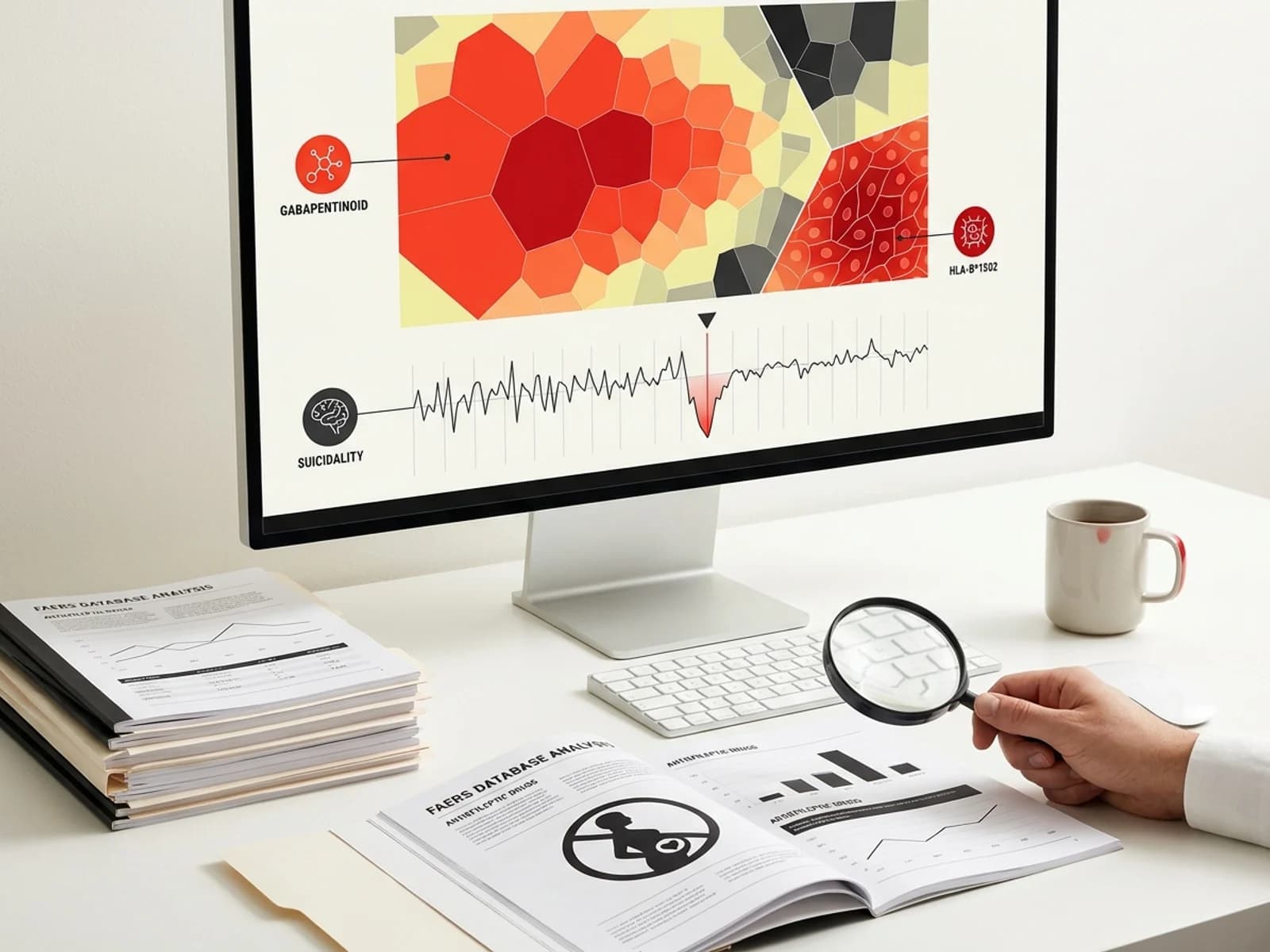
The FDA Adverse Event Reporting System (FAERS) holds 1,012,103 individual safety reports that name at least one of twenty antiepileptic drugs (AEDs) still marketed in the United States — the gabapentinoids gabapentin and pregabalin, the broad-spectrum agents levetiracetam, lamotrigine, valproate, topiramate, carbamazepine, and phenytoin, the newer agents lacosamide, eslicarbazepine, brivaracetam, perampanel, cannabidiol, and clobazam, and the older or niche agents oxcarbazepine, phenobarbital, zonisamide, ethosuximide, rufinamide, and felbamate — in any role, filed between 2004, when the modern openFDA FAERS record begins, and early 2026. Gabapentin dominates the class on raw volume with 334,657 reports (33.1 percent of the class total), a share that reflects the drug's enormous off-label neuropathic-pain and anxiety prescribing rather than its epilepsy indication, followed by pregabalin (228,106), levetiracetam (125,539), lamotrigine (123,005), valproate (91,161), topiramate (77,295), and carbamazepine (65,760). Of the class-level reports, 694,268 — 68.6 percent — carry an FDA seriousness flag, and 84,752 (8.4 percent) record a fatal outcome. The class skews female — 564,924 reports in female patients against 336,455 in male patients — a pattern driven by gabapentinoid pain prescribing (fibromyalgia, diabetic neuropathy) and by the women-of-childbearing-potential weight around valproate and lamotrigine. The safety footprint is the most clinically heterogeneous of any class cut here: 31,207 reports in the Stevens-Johnson, toxic-epidermal-necrolysis, and DRESS family concentrated in carbamazepine, lamotrigine, and phenytoin; 56,348 in the suicidality and mood family that underlies the 2008 class-wide boxed warning; 14,104 pregnancy-exposure and congenital reports dominated by valproate; and 125,861 dizziness, ataxia, and somnolence reports.
This article is a class-level descriptive read of antiepileptic reporting in FAERS, written for pharmacovigilance, medical-affairs, neurology market-access, and formulary teams who encounter AED safety numbers in labeling reviews, pharmacogenomic policy (notably HLA-B*1502), pregnancy-prevention program work around valproate, and step-therapy design. Every figure here is computed from the public openFDA FAERS extract (20,328,575 total reports, export dated 2026-06-08). It is not a disproportionality signal analysis, it is not a safety claim, and it is not incidence data. FAERS is a spontaneous-reporting system: it captures what was reported, never what was caused, it has no exposure denominator, and AED reporting is dominated by a chronic-use population that frequently takes these drugs for non-epilepsy indications (pain, migraine, bipolar disorder) in which falls, fractures, depression, and suicide are common regardless of attribution. Those caveats shape every number below. For the class-wide FAERS methodology and the database aggregate picture, see the companion analysis of 20 million FAERS reports; for the other class cuts, see atypical antipsychotics, statins, proton pump inhibitors, GLP-1 receptor agonists, SGLT2 inhibitors, JAK inhibitors, DOACs, and checkpoint inhibitors in FAERS. This article stays on the twenty marketed AEDs.
Methodology, in one paragraph
A report is counted for an agent when the generic or brand name appears as an exact drug-field token in that report — as a suspect, concomitant, or interacting drug — using an exact-token match across the drug_substances, drug_generics, and drug_brands fields (a |-delimited token match, so that the same number is not double-attributed across the class). Because a single report can name several AEDs (polytherapy is the norm in refractory epilepsy, and the gabapentinoids are routinely co-prescribed), the per-agent totals sum to more than the 1,012,103 class-level (union, deduplicated) reports. The valproate row aggregates valproate sodium, valproic acid, and divalproex sodium into a single canonical agent; the phenytoin row aggregates phenytoin and fosphenytoin. A "serious" report is any report the FDA coded as serious. A report counts toward death when either the seriousness field carries a death flag or the outcome field carries a Fatal outcome. Reactions are coded to MedDRA Preferred Terms; reaction counts are case-normalized. The adverse-event families aggregate related Preferred Terms (for example, "Stevens-Johnson / TEN / DRESS" combines Stevens-Johnson syndrome, toxic epidermal necrolysis, erythema multiforme, drug reaction with eosinophilia and systemic symptoms, and acute generalised exanthematous pustulosis; "suicidality / mood" combines suicidal ideation, suicide attempt, completed suicide, suicidal behaviour, depression, and depressed mood; "pregnancy exposure / congenital" combines foetal and drug exposure during pregnancy, congenital anomaly, and congenital malformation), and a report contributes once to a family if any term in the family appears. The "any role" counts reported here are intentionally inclusive, so they will exceed suspect-only or differently normalized counts cited elsewhere for the same agent.
The reporting-volume picture, by drug
| Antiepileptic drug (brand) | Reports (any role) | Share of class | Serious | Death |
|---|---|---|---|---|
| Gabapentin (Neurontin) | 334,657 | 33.1% | 208,752 (62.4%) | 31,329 (9.4%) |
| Pregabalin (Lyrica) | 228,106 | 22.5% | 146,696 (64.3%) | 15,883 (7.0%) |
| Levetiracetam (Keppra) | 125,539 | 12.4% | 103,822 (82.7%) | 11,007 (8.8%) |
| Lamotrigine (Lamictal) | 123,005 | 12.2% | 87,824 (71.4%) | 9,125 (7.4%) |
| Valproate (Depakote) | 91,161 | 9.0% | 73,293 (80.4%) | 8,173 (9.0%) |
| Topiramate (Topamax) | 77,295 | 7.6% | 49,259 (63.7%) | 4,220 (5.5%) |
| Carbamazepine (Tegretol) | 65,760 | 6.5% | 56,482 (85.9%) | 5,538 (8.4%) |
| Lacosamide (Vimpat) | 35,434 | 3.5% | 27,881 (78.7%) | 3,017 (8.5%) |
| Oxcarbazepine (Trileptal) | 29,201 | 2.9% | 22,151 (75.9%) | 1,976 (6.8%) |
| Clobazam (Onfi) | 23,683 | 2.3% | 18,537 (78.3%) | 1,538 (6.5%) |
| Cannabidiol (Epidiolex) | 22,732 | 2.2% | 13,270 (58.4%) | 1,802 (7.9%) |
| Phenytoin (Dilantin) | 21,153 | 2.1% | 18,861 (89.2%) | 2,958 (14.0%) |
| Phenobarbital | 13,350 | 1.3% | 11,049 (82.8%) | 1,568 (11.7%) |
| Zonisamide (Zonegran) | 12,435 | 1.2% | 9,445 (76.0%) | 748 (6.0%) |
| Brivaracetam (Briviact) | 8,426 | 0.8% | 6,769 (80.3%) | 427 (5.1%) |
| Perampanel (Fycompa) | 6,928 | 0.7% | 5,708 (82.4%) | 424 (6.1%) |
| Eslicarbazepine (Aptiom) | 3,158 | 0.3% | 2,180 (69.0%) | 89 (2.8%) |
| Ethosuximide (Zarontin) | 2,432 | 0.2% | 1,958 (80.5%) | 62 (2.5%) |
| Rufinamide (Banzel) | 2,306 | 0.2% | 1,606 (69.6%) | 120 (5.2%) |
| Felbamate (Felbatol) | 1,720 | 0.2% | 1,222 (71.0%) | 87 (5.1%) |
| Class (union, deduplicated) | 1,012,103 | 694,268 (68.6%) | 84,752 (8.4%) |
Three patterns matter for access and medical-affairs teams. First, the two gabapentinoids together account for more than half of all class reporting (562,763 reports, 55.6 percent), and that share is a prescribing-volume artifact: gabapentin and pregabalin are among the most-dispensed drugs in the United States, used overwhelmingly for neuropathic pain, post-herpetic neuralgia, fibromyalgia, and off-label anxiety, not for epilepsy, so their FAERS volume reflects the size and chronicity of the exposed pain population, not an anticonvulsant safety differential. The scale is striking and is the access context for the gabapentinoid reporting share: per CDC data reported in 2025, gabapentin was the fifth most-dispensed drug in US retail pharmacies in 2024, gabapentin prescriptions per 1,000 people more than doubled from 2010 to 2024, and the number of Americans taking gabapentin rose from roughly 5.8 million to 15.5 million over that period — growth that tracks the post-opioid shift toward gabapentinoids as opioid-sparing pain agents and that has driven the reclassification of gabapentin as a controlled substance in a growing number of states. The same 2025 reporting noted an emerging dementia and mild-cognitive-impairment signal in patients prescribed gabapentin for chronic low back pain, a signal that is not yet reflected in the in-label warnings and that pharmacovigilance teams should monitor. Second, the serious-share band runs from the high-50s percent for cannabidiol to 89.2 percent for phenytoin, and it tracks indication and monitoring channel. The older, narrow-therapeutic-index agents — phenytoin, carbamazepine, phenobarbital — cluster at the top of the serious-share range because they are used in sicker, often hospitalized or refractory populations with intravenous loading and serum-level monitoring, while cannabidiol (a newer, pediatric-onset, Dravet/Lennox-Gastaut agent) and the gabapentinoids (outpatient pain) sit lower. Third, phenytoin's 14.0 percent death-flag rate is the class outlier and is a population effect: phenytoin is a narrow-therapeutic-index drug used intravenously in status epilepticus and in medically complex, often elderly or hospitalized patients, where mortality is high regardless of attribution; it is not a clean safety ranking. The same caveat applies to the older agents' double-digit death-flag rates.
The class-level outcome profile
| Outcome (report-level) | Reports | Share of class |
|---|---|---|
| Unknown outcome | 516,346 | 51.0% |
| Recovered | 222,879 | 22.0% |
| Not recovered | 187,100 | 18.5% |
| Recovering | 99,159 | 9.8% |
| Fatal | 64,714 | 6.4% |
| Recovered with sequelae | 7,670 | 0.8% |
A report can carry more than one outcome, so these shares sum to more than 100 percent. The Fatal outcome count (64,714) sits below the death-flag measure (84,752) because not every death-flagged report carries a resolved Fatal outcome field. As with every FAERS outcome table, none of these percentages are incidence — the denominator is reports, not exposed patients. Tens of millions of patients take antiepileptic drugs, the great majority for non-epilepsy indications; the reporting volume here is a small, skewed slice of that exposure.
The skin, suicidality, and teratogenicity footprint
Stripping out the non-specific terms (dizziness, somnolence, nausea, fatigue, drug ineffective) that dominate the raw reaction list for any high-volume CNS class, the label-relevant adverse-event families that define the AED safety profile leave a clear footprint:
| AE family (aggregated MedDRA terms) | Class reports | Most-associated agents (this read) |
|---|---|---|
| Dizziness / ataxia / somnolence | 125,861 | Gabapentin, pregabalin, topiramate |
| Suicidality / mood | 56,348 | Levetiracetam, topiramate, valproate |
| Stevens-Johnson / TEN / DRESS | 31,207 | Carbamazepine, lamotrigine, phenytoin |
| Cognitive impairment | 21,763 | Topiramate, levetiracetam |
| Pregnancy exposure / congenital | 14,104 | Valproate |
| Aplastic anaemia / cytopenia | 13,498 | Carbamazepine, felbamate |
| Hepatic injury | 10,444 | Valproate, phenytoin |
| Hyponatraemia | 8,397 | Carbamazepine, oxcarbazepine |
The footprint maps onto the regulatory and pharmacogenomic literature. The 31,207 Stevens-Johnson/TEN/DRESS reports are the class's most feared acute event, and they are concentrated in the aromatic AEDs — carbamazepine, lamotrigine, phenytoin, and oxcarbazepine — for which the FDA label ties SJS/TEN risk to the HLA-B*1502 allele. Serious dermatologic reactions are estimated at 1 to 6 per 10,000 new carbamazepine users in mainly Caucasian populations but roughly ten times higher in patients of Asian descent, and retrospective case-control studies found that of 60 Han Chinese subjects with carbamazepine-associated SJS/TEN, all but one carried HLA-B*1502; the allele is carried by more than 15 percent of the population in Hong Kong, Thailand, Malaysia, and parts of the Philippines, about 10 percent in Taiwan, and 4 percent in northern China, and the label recommends HLA-B*1502 screening before carbamazepine initiation in genetically at-risk populations, with cross-reactivity warnings for phenytoin. The 56,348 suicidality and mood reports are the reporting backdrop to the 2008 class-wide boxed warning (below). The 14,104 pregnancy-exposure and congenital reports are dominated by valproate, the single most regulated teratogen in the class. The 8,397 hyponatraemia reports concentrate in carbamazepine and oxcarbazepine, consistent with the well-described SIADH effect of the dibenzazepine AEDs.
The 2008 suicidality class warning
The single most consequential class-level labeling event for the AEDs was the 2008 suicidality warning. On January 31, 2008, the FDA issued an alert that clinical trials of AEDs showed an increased risk of suicidal thoughts and behavior; at a July 10, 2008 joint meeting of the Peripheral and Central Nervous System Drugs and Psychopharmacologic Drugs advisory committees, the committees agreed with the finding; and on December 16, 2008, the FDA notified the public that all AEDs would require suicidality warnings and a Medication Guide. The underlying FDA meta-analysis (dated May 23, 2008) pooled 199 placebo-controlled trials of eleven AEDs covering 27,863 drug-treated and 16,029 placebo-treated patients and found an odds ratio for suicidal behavior or ideation of 1.80 (95% CI 1.24–2.66), with an estimated incidence of 0.43 percent among drug-treated patients versus 0.24 percent among placebo-treated patients — roughly one additional case of suicidal thinking or behavior for every 530 patients treated — a finding that was consistent across drugs of varying mechanisms and across indications and was therefore applied to all AEDs regardless of indication. The 56,348 suicidality/mood reports in this read are the descriptive echo of that warning; the warning itself is a placebo-controlled-trial evidence construct, not an inference from the spontaneous counts. Levetiracetam, which is well-documented in the postmarketing literature for behavioral and irritability adverse effects, appears disproportionately in the suicidality family in this descriptive read, consistent with its known neuropsychiatric profile.
Valproate — teratogenicity and the pregnancy-prevention framework
Valproate is the most regulated agent in the class on reproductive grounds, and the 14,104 class-wide pregnancy-exposure and congenital reports concentrate there. The valproate label is contraindicated for migraine prophylaxis in pregnant women and in women of childbearing potential who are not using effective contraception, and it carries a Boxed Warning for teratogenicity: valproate causes major congenital malformations, particularly neural tube defects (spina bifida), and is associated with decreased IQ and neurodevelopmental disorders following in utero exposure. The North American Antiepileptic Drug Pregnancy Registry reported a major-malformation prevalence of 10.7 percent (16 of 149 first-trimester valproate-monotherapy exposures) versus 2.9 percent for other AED monotherapies, an odds ratio of 4.0 (95% CI 2.1–7.4), and the NEAD (Neurodevelopmental Effects of Antiepileptic Drugs) cohort found dose-dependent reductions in IQ at age 6 in valproate-exposed children. These findings drove the valproate pregnancy-prevention program framework and the indication-by-indication contraindication structure, under which valproate should not be used in women of childbearing potential unless other treatments have failed and effective contraception is in place. The female skew of the class-wide FAERS population (564,924 female vs 336,455 male reports) is partly the reporting echo of this reproductive focus around valproate and lamotrigine, and partly the gabapentinoid pain-prescribing skew toward women.
Phenytoin, felbamate, and the narrow-index and blood-signal anchors
Two older agents anchor the blood-and-hepatic signal corners of the class. Felbamate, approved in 1993 and carrying the class's best-known black-box blood risk, is associated with aplastic anemia and hepatic failure — the basis for the 13,498 class-wide aplastic-anemia and cytopenia reports and for the restricted-access framework under which felbamate is reserved for severe refractory epilepsy. Carbamazepine carries its own Boxed Warning for aplastic anemia and agranulocytosis (population-based data put the risk at 5 to 8 times background), in addition to the SJS/TEN/HLA-B*1502 boxed warning. Phenytoin's 89.2 percent serious share and 14.0 percent death-flag rate reflect its narrow therapeutic index, its intravenous use in status epilepticus, and the medically complex populations in which it is deployed; it is not a drug-versus-drug safety ranking. These agents together carry the heaviest labeling burden in the class and explain why the older AEDs remain heavily restricted on formulary despite generic availability.
The reporting trajectory, by year
| Receive year | Reports |
|---|---|
| 2004 | 10,621 |
| 2005 | 14,136 |
| 2006 | 18,574 |
| 2007 | 15,959 |
| 2008 | 16,222 |
| 2009 | 22,194 |
| 2010 | 33,894 |
| 2011 | 30,209 |
| 2012 | 40,631 |
| 2013 | 40,641 |
| 2014 | 46,662 |
| 2015 | 61,859 |
| 2016 | 66,271 |
| 2017 | 65,639 |
| 2018 | 74,278 |
| 2019 | 82,431 |
| 2020 | 70,194 |
| 2021 | 65,118 |
| 2022 | 59,685 |
| 2023 | 55,264 |
| 2024 | 55,185 |
| 2025 | 53,786 |
| 2026 | 12,718 |
The trajectory tracks the class's reporting ecosystem and the gabapentinoid prescribing boom, not a safety trend. The 2009–2010 step-up (from ~16,000 to ~34,000) coincides with the December 2008 suicidality class warning and Medication Guide rollout, which generated prescriber and consumer attention; the 2014–2019 climb to an ~82,000-report peak tracks the explosive growth of gabapentin and pregabatin prescribing for pain during the post-opioid period, as gabapentinoids became first-line neuropathic-pain and opioid-sparing agents; and the post-2019 decline to a ~55,000-report steady state reflects both reporting normalization and the maturing of the gabapentinoid prescribing base. The 2026 figure (12,718) is a partial year through the extract cut-off. The pre-2004 counts are negligible because the modern openFDA FAERS record begins in late 2003.
What this means for pharmacovigilance, medical-affairs, and access teams
For pharmacovigilance teams, the class's 68.6 percent serious share and 8.4 percent death-flag rate are population effects, not signal. Read serious and death proportions against a chronic-use, often-elderly, often-pain population in which falls, fractures, depression, and suicide are common; the signals that matter are the disproportionality-documented SJS/TEN/DRESS (carbamazepine, lamotrigine, phenytoin), suicidality, teratogenicity (valproate), and hyponatraemia (carbamazepine, oxcarbazepine) families.
For medical-affairs and label teams, the HLA-B*1502 pharmacogenomic framework for carbamazepine and phenytoin and the valproate pregnancy-prevention framework are the durable regulatory anchors. Any AED label or risk-management review must address SJS/TEN genotyping policy, the 2008 suicidality warning, and the valproate indication-by-indication contraindication structure.
For neurology and pain market-access teams, gabapentinoid prescribing volume is the access story. Gabapentin and pregabalin reporting reflects the size of the neuropathic-pain and fibromyalgia population, not anticonvulsant risk; formulary positioning, quantity limits, and controlled-substance scheduling (pregabalin is Schedule V; gabapentin is state-scheduled in a growing number of states) are driven by misuse and respiratory-depression concerns, not by these counts.
For risk-management and pregnancy-prevention teams, the valproate contraindication structure is the template for any new AED or repurposed agent with reproductive signal. The pregnancy-registry infrastructure (North American AED Pregnancy Registry), the childbearing-potential contraception requirement, and the indication-by-indication contraindication approach are the established model.
For dossier and evidence teams, per-agent FAERS figures must be anchored with exposure and indication context. A gabapentin number in a multi-billion-prescription pain population is not comparable to a felbamate or ethosuximide number in a fraction of that denominator, and a phenytoin serious-share percentage is not comparable to a cannabidiol percentage; quoting raw volumes or shares without indication and population context invites a misread.
Sources
US FDA, openFDA FAERS (Adverse Event Reporting System) extract, export dated 2026-06-08 (20,328,575 total reports). Per-drug, class-union, outcome, AE-family, sex, and trajectory aggregates computed by PharmaDossier from the public FAERS extract. https://open.fda.gov/data/faers/
US FDA. "Suicidal Behavior and Ideation and Antiepileptic Drugs." 2008 — meta-analysis of 199 placebo-controlled trials of 11 AEDs (27,863 drug vs 16,029 placebo patients); OR 1.80 (95% CI 1.24–2.66); incidence 0.43% vs 0.24%; ~1 additional case per 530 patients; class-wide label + Medication Guide, December 16, 2008. Surfaced in FDA Keppra (NDA 21-035/S-078) and Gralise (NDA 022544) risk reviews. https://www.accessdata.fda.gov/drugsatfda_docs/appletter/2009/021035s078,s080.021505s021,s024ltr.pdf and https://www.accessdata.fda.gov/drugsatfda_docs/nda/2011/022544Orig1s000RiskR.pdf
Tegretol (carbamazepine) prescribing information, Boxed Warning — SJS/TEN and HLA-B*1502 allele; aplastic anemia and agranulocytosis (5–8× background); SJS/TEN 1–6 per 10,000 in mainly Caucasian populations, ~10× higher in patients of Asian descent; HLA-B*1502 prevalence >15% in Hong Kong/Thailand/Malaysia/Philippines, ~10% Taiwan, 4% northern China; screen before initiation; phenytoin cross-reactivity. https://www.accessdata.fda.gov/drugsatfda_docs/label/2023/016608s121_018927s60_020234s054lbl.pdf
US FDA. Phenytoin (Dilantin) labeling review (NDA 008762/S-039) — HLA-B*1502 and SJS/TEN association with phenytoin in Asian-ancestry patients; phenytoin-induced SJS 100% HLA-B*1502-positive in Thai cohort (OR 18.5). https://www.accessdata.fda.gov/drugsatfda_docs/nda/2011/008762Orig1s039.pdf
Depakote (valproate) prescribing information, Boxed Warning and Use in Specific Populations — major congenital malformations (neural tube defects); decreased IQ and neurodevelopmental disorders; contraindicated for migraine prophylaxis in pregnancy and in women of childbearing potential not using contraception. https://www.accessdata.fda.gov/drugsatfda_docs/label/2019/018723s062lbl.pdf
Stavzor (valproate) prescribing information, Use in Specific Populations — North American AED Pregnancy Registry: 10.7% major-malformation prevalence (16/149 first-trimester valproate monotherapy) vs 2.9% other AED monotherapy, OR 4.0 (95% CI 2.1–7.4). https://www.accessdata.fda.gov/drugsatfda_docs/label/2009/022152s002lbl.pdf
US FDA. "FDA warns of rare but serious drug reaction to the antiseizure medicines levetiracetam (Keppra, Keppra XR, Elepsia XR, Spritam) and clobazam (Onfi, Sympazan)." DRESS warning, FAERS-derived. https://www.fda.gov/drugs/drug-safety-communications/fda-warns-rare-serious-drug-reaction-antiseizure-medicines-levetiracetam-keppra-keppra-xr-elepsia-xr
US CDC / MedPage Today. "Gabapentin Under Scrutiny: 2025 Data Challenged Risk Profile." January 2026 — gabapentin was the 5th most-dispensed US retail drug in 2024; prescriptions per 1,000 more than doubled 2010–2024; users rose from ~5.8M to ~15.5M; emerging dementia/mild-cognitive-impairment signal in chronic low back pain. https://www.medpagetoday.com/neurology/painmanagement/119247
US FDA, Drugs@FDA approval records — phenobarbital (1939+), phenytoin (Dilantin, 1953), carbamazepine (Tegretol, 1968), valproate (Depakene/Depakote, 1978/1983), felbamate (Felbatol, 1993), gabapentin (Neurontin, 1993), lamotrigine (Lamictal, 1994), topiramate (Topamax, 1996), tiagabine, levetiracetam (Keppra, 1999), oxcarbazepine (Trileptal, 2000), zonisamide (Zonegran, 2000), pregabalin (Lyrica, 2004), rufinamide (Banzel, 2008), lacosamide (Vimpat, 2008), eslicarbazepine (Aptiom, 2013), perampanel (Fycompa, 2012), clobazam (Onfi, 2011), brivaracetam (Briviact, 2016), cannabidiol (Epidiolex, 2018), ethosuximide (Zarontin, 1960). https://www.accessdata.fda.gov/scripts/cder/daf/