On April 26, 2026, the biopharmaceutical sector experienced its most significant consolidation milestone of the year. India's largest pharmaceutical manufacturer, Sun Pharmaceutical Industries Ltd., announced a definitive agreement to acquire Organon & Co. for $14.00 per share in an all-cash transaction. The deal translates to an enterprise value of approximately $11.75 billion, marking it as the largest biopharma acquisition of 2026.
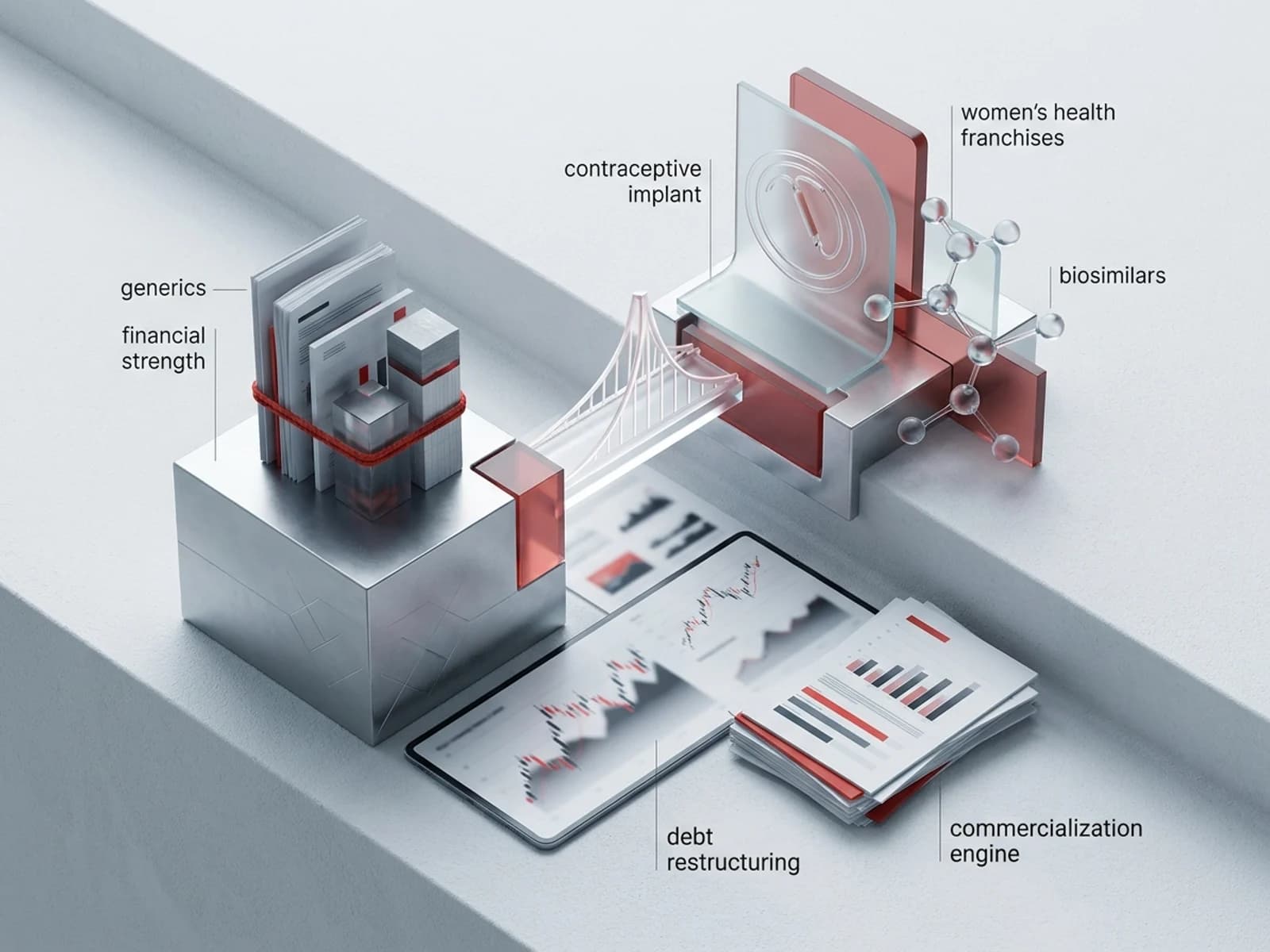
This transaction represents a major structural shift in the global pharmaceutical landscape. Sun Pharma, historically known as a dominant player in generic drugs and active pharmaceutical ingredients (APIs), is executing a pivot toward high-margin specialty brands, innovative therapeutics, and global biosimilars. By absorbing Organon—a company spun out of Merck & Co. in 2021—Sun Pharma is not merely expanding its pipeline; it is gaining a mature, global commercial infrastructure that spans roughly 150 countries, establishes a top-3 global presence in women's health, and secures an active biosimilars commercialization engine.
For corporate strategy teams, healthcare investors, and business development (BD) leads, the Sun-Organon deal is a masterclass in strategic fit and financial restructuring. While the transaction relieves Organon of an unsustainable $8.6 billion debt overhang inherited from its Merck spin-out, it provides Sun Pharma with established specialty franchises that would take decades and billions of dollars to build from scratch.
Deconstructing the Transaction Terms
The financial architecture of the Sun-Organon transaction reflects a highly structured valuation agreement:
Offer Price: Sun Pharma will acquire all outstanding shares of Organon common stock for $14.00 per share in cash.
Enterprise Value (EV): The total transaction value is approximately $11.75 billion, which accounts for both the equity purchase price and the assumption of Organon's outstanding net debt.
Board Approval: The boards of directors of both companies have unanimously approved the transaction.
Expected Closing: The deal is scheduled to close in early 2027, pending approval by Organon shareholders, regulatory clearances under the Hart-Scott-Rodino (HSR) Act, and customary closing conditions.
Financing: Sun Pharma plans to fund the acquisition using a combination of cash on hand and newly committed debt facilities.
To put this deal in context, we can compare it to other major acquisitions in the 2026 M&A wave. As tracked in our aggregate 2026 biopharma M&A by the numbers, the year has been characterized by intense licensing and pipeline acquisitions. While oncology and immunology platforms have commanded high valuations—such as the Novartis Myricx ADC acquisition and the immunology-focused AbbVie Apogee acquisition—the Sun-Organon deal is unique because it is an acquisition of a mature, cash-generating commercial enterprise rather than a clinical-stage pipeline.
The Strategic Fit: Resolving the Mature Brand Conundrum
In the modern biopharma landscape, mature brands present a unique management challenge. Large multinational developers (like Merck, Pfizer, and GSK) are increasingly focused on high-margin, innovative therapeutic classes such as oncology, rare diseases, and cell/gene therapies. Branded specialty products that have lost patent exclusivity or face generic competition are often treated as "legacy" assets. While these products continue to generate significant cash, they require commercial maintenance and dilute the parent company's revenue growth rates.
Merck's solution in 2021 was to bundle its women's health, biosimilars, and legacy established brands into Organon. As an independent company, Organon could focus entirely on maximizing the value of these mature assets. However, Organon was capital-constrained due to its massive post-spin debt.
By acquiring Organon, Sun Pharma solves this mature brand conundrum. Sun operates under a lower cost structure than big pharma, allowing it to harvest legacy cash flows more efficiently. Additionally, Sun has a proven track record of acquiring underperforming assets and optimizing their operations through vertical integration.
The Prize Assets: Nexplanon and the Women's Health Franchise
The core commercial driver of the acquisition is Organon's established specialty portfolio, which is heavily anchored in women's health. In the biopharma sector, women's health has long been viewed as a high-barrier-to-entry market. Establishing relationships with obstetricians, gynecologists, and specialty clinics requires a specialized sales force and deep regulatory experience.
Organon's crown jewel is Nexplanon (etonogestrel implant), a long-acting reversible contraceptive (LARC) that is inserted subcutaneously in the upper arm.
Commercial Performance: Nexplanon is a blockbuster asset, generating over $800 million in annual sales.
Market Position: Nexplanon holds a near-monopoly in the subdermal contraceptive implant segment. Because it requires clinical training for insertion and removal, it enjoys strong physician loyalty and a highly defensible market position.
Patent Protection: Unlike traditional oral contraceptives that face rapid generic erosion, Nexplanon is protected by a dense estate of device and formulation patents, securing its revenue stream into the next decade.
Nexplanon Clinical and Regulatory Profile
Nexplanon is a radiopaque, non-biodegradable, single-rod subdermal implant containing 68 mg of etonogestrel. It provides continuous, highly effective contraception for up to three years. The clinical trial data supporting Nexplanon demonstrates an efficacy rate exceeding 99%, making it one of the most reliable contraceptive options on the market. Clinical guidelines from the American College of Obstetricians and Gynecologists (ACOG) and the World Health Organization (WHO) recommend LARCs like Nexplanon as first-line contraceptive options due to their high compliance rate, as they eliminate the risk of user error associated with daily oral pills.
From a manufacturing perspective, Nexplanon is not a simple small-molecule tablet; it is a drug-device combination product. The manufacturing process requires specialized polymer extrusion technology to ensure constant, controlled hormone release over a 36-month window. This device barrier prevents generic competitors from filing simple Abbreviated New Drug Applications (ANDAs), creating a durable commercial moat.
Payer Dynamics and the Affordable Care Act (ACA)
In the United States, Nexplanon benefits from specific regulatory mandates. Under the Affordable Care Act (ACA) contraceptive coverage mandate, most private health insurance plans must cover at least one product per FDA-approved contraceptive method without cost-sharing. Because subdermal implants represent a distinct contraceptive method, payers are required to cover Nexplanon on their formularies at zero copay for patients. This regulatory mandate insulates Nexplanon from typical payer-driven tier exclusions, ensuring steady commercial volume.
Beyond Nexplanon, Organon's women's health portfolio includes a suite of established contraceptives (including the NuvaRing vaginal ring and the Cerazette progestin-only pill) and fertility treatments (such as Follistim AQ). By acquiring this franchise, Sun Pharma immediately vaults into the top tier of women's health providers globally.
This matches Sun's stated long-term strategy of expanding its "Specialty Medicines" segment. Over the past decade, Sun has successfully commercialized specialty dermatology (Ilumya) and ophthalmology (Cequa) brands in the United States. Integrating Organon's women's health portfolio gives Sun a third major specialty pillar, allowing it to leverage its existing commercial infrastructure in North America and Western Europe.
The Biosimilar Platform: Organon's Commercialization Engine
While women's health represents the largest slice of Organon's revenue, the biosimilar segment represents its fastest-growing commercial vector. Organon does not manufacture biosimilars; instead, it operates as a specialized commercialization partner, licensing assets from leading global developers (primarily Samsung Bioepis) and commercializing them under its own brand names.
Organon's biosimilar business represents approximately $660 million in annual sales, driven by several high-volume assets:
1. Hadlima (adalimumab-bwwd)
Hadlima is a biosimilar version of AbbVie's Humira. Organon launched Hadlima in the U.S. in July 2023 in both high-concentration (100 mg/mL) and low-concentration (50 mg/mL) formulations. The product has successfully secured formulary placement across multiple major commercial insurers and state Medicaid programs by utilizing a dual-pricing strategy (offering both a high-wholesale-acquisition-cost option with high rebates and a low-wholesale-acquisition-cost option with low rebates).
2. Ontruzant (trastuzumab-dttb)
A biosimilar version of Roche's breast cancer blockbuster Herceptin. Ontruzant is commercialized across the U.S. and Europe. In the hospital outpatient buy-and-bill channel, Ontruzant has maintained steady market share by competing on Average Sales Price (ASP) discounts. The comparative clinical trials supporting its approval demonstrated equivalent efficacy and safety in patients with HER2-positive early breast cancer.
3. Renflexis (infliximab-abda)
A biosimilar version of Janssen's Remicade. Launched in the U.S. in 2017, Renflexis was one of the earliest infliximab biosimilars. It has demonstrated long-term volume stability in infusion centers, where physician switching inertia is high. The clinical dataset proving biosimilarity was anchored by a randomized double-blind trial showing equivalent clinical response in rheumatoid arthritis patients.
4. Brenzys (etanercept)
A biosimilar version of Amgen's Enbrel, commercialized primarily in Canada and Australia. It has achieved dominant market share in territories that utilize centralized public bidding systems.
5. Aybintio (bevacizumab)
A biosimilar version of Roche's oncology biologic Avastin, active in the EU and select international markets.
This commercialization engine has shown strong momentum, logging 19% revenue growth in the third quarter of 2025. For more context on biosimilar competitive dynamics, see biosimilar competition decoded.
Samsung Bioepis Partnership Architecture
The commercial relationship between Organon and Samsung Bioepis is governed by a long-term commercialization agreement. Under this contract:
Samsung Bioepis is responsible for clinical development, regulatory submissions, and global manufacturing operations.
Organon is responsible for commercialization, sales force deployment, payer contracting, and distribution.
Financial Terms: Net profits from product sales are split between the two companies according to pre-negotiated percentages, with Organon paying milestone payments upon the achievement of specific regulatory and sales targets.
Payer Exclusion Lists and the Rebate Wall
One of the most significant challenges in the U.S. biosimilar market is the "rebate wall" constructed by originator manufacturers. To defend Humira's market share, AbbVie offered deep rebates to pharmacy benefit managers (PBMs) like CVS Caremark, Express Scripts, and OptumRx, on the condition that they exclude or limit biosimilars.
PBMs build exclusion lists based on these rebate economics. If a PBM includes a biosimilar on its formulary, it risks losing the substantial rebates paid on the originator product. Consequently, many biosimilars, despite having a lower list price, have struggled to secure preferred formulary status.
To overcome this rebate wall, Organon has had to offer deep net price discounts and alternative pricing models for Hadlima, negotiating case-by-case formulary placements. This intense payer contracting battle represents a significant commercial challenge that Sun Pharma is now inheriting.
For Sun Pharma, the acquisition of this portfolio immediately solves a major strategic gap. While Sun Pharma has advanced its own biosimilar candidates in early-stage development, it lacked a commercialization platform in the U.S. and Europe. By acquiring Organon, Sun gains an active sales force that is already contracting with PBMs and payers for biosimilar access. This commercial engine can be used to launch Sun's own pipeline candidates in the future, creating a vertically integrated biosimilars business.
Financial Engineering: Deconstructing Organon's $8.6B Debt Pile
To understand why Organon's board agreed to an acquisition at $14.00 per share—a valuation that some analysts viewed as conservative relative to the company's revenue—one must analyze Organon's balance sheet.
When Merck & Co. spun off Organon in June 2021, it structured the transaction to extract maximum value for the parent company. Merck loaded Organon with approximately $9.5 billion in gross debt, using the proceeds to distribute roughly $9.0 billion back to Merck. This left the newly independent Organon with a net leverage ratio of roughly 4.0x EBITDA — a level that remained near 4.3x at year-end 2025.
Although Organon's business remained highly cash-generative, the interest expense required to service this debt severely restricted its strategic flexibility.
Debt Overhang: As of early 2026, Organon's outstanding net debt remained at approximately $8.6 billion.
Interest Burden: A significant portion of Organon's operating cash flow was consumed by interest payments rather than being reinvested in R&D or business development.
Refinancing Risk: With global interest rates rising relative to the 2021 baseline, Organon faced the prospect of refinancing its maturing term loans and senior notes at much higher yields, threatening its net margins.
Organon Debt Structure & Capital Constraints
Organon's debt structure consisted of a mix of variable-rate senior secured term loans and fixed-rate senior notes issued at the 2021 spin-off. Specifically, the capital structure included:
A $3.0 billion U.S. dollar Term Loan B facility due in 2028, alongside a roughly €750 million euro-denominated term loan, carrying variable interest tied to SOFR/EURIBOR.
About $3.6 billion in Senior Secured Notes due in 2028 (a $2.1 billion 4.125% tranche plus a €1.25 billion 2.875% euro tranche).
$2.0 billion in 5.125% Senior Unsecured Notes due in 2031.
As interest rates climbed through the mid-2020s, the variable-rate Term Loan B became a major drain on free cash flow. In fiscal year 2025, Organon's annual interest expense exceeded $500 million, representing a severe burden on its $1.9 billion EBITDA. This cash outflow prevented Organon from executing licensing deals for late-stage pipeline assets, limiting its long-term growth prospects.
The acquisition by Sun Pharma resolves this financial bottleneck. Sun Pharma maintains an exceptionally clean balance sheet, characterized by low leverage and strong cash generation from its core Indian and emerging-market generics businesses. Sun Pharma's superior credit profile allows it to refinance Organon's debt at lower interest rates, instantly unlocking hundreds of millions of dollars in annual free cash flow. For Organon shareholders, the $14.00 all-cash price provides immediate liquidity and eliminates the long-term risk of debt amortization in a high-rate environment.
Combined Entity Profile: Creating a Top-25 Global Pharma
The integration of Sun Pharma and Organon will create a diversified pharmaceutical giant with a unique geographic and therapeutic footprint.
Combined Financial and Operating Metrics
| Metric | Sun Pharma (Pre-Deal) | Organon (Pre-Deal) | Combined Entity |
|---|---|---|---|
| Annual Revenue | ~$6.2 Billion | ~$6.2 Billion | ~$12.4 Billion |
| Annual EBITDA | ~$1.8 Billion | ~$1.9 Billion | ~$3.7 Billion |
| Global Ranking | Top 40 Pharma | Top 35 Pharma | Top 25 Global Pharma |
| Geographic Reach | Dominated by India & US | Strong in US, EU, & LATAM | ~150 Countries |
| Specialty Focus | Dermatology, Ophthalmology | Women's Health, Biosimilars | Integrated Specialty Leader |
This combined profile positions Sun Pharma to achieve its strategic goal of increasing its Innovative and Specialty Medicines segment toward 27% of total revenue. Historically, generics represented over 80% of Sun's business. Post-acquisition, specialty brands and biosimilars will represent nearly half of the combined revenue, insulating the company from the severe price erosion that characterizes the U.S. generic market.
Furthermore, the combined entity's scale will allow it to compete for larger licensing deals. A top-25 global pharma company with $3.7 billion in EBITDA has the financial capacity to fund Phase III clinical trials and acquire late-stage clinical assets, shifting Sun from a regional generics player to a global innovator.
Strategic Rationale: Generic Defense and Innovative Growth
The strategic logic of the Sun-Organon deal can be summarized in three distinct categories:
1. Channel Synergy and Geographic Arbitrage
Sun Pharma has a massive commercial footprint in India and emerging markets, but has struggled to launch high-cost specialty drugs in these regions due to pricing constraints. Organon has a highly efficient commercial structure in Europe, Latin America, and the Asia-Pacific region. Sun can leverage Organon's international channels to launch its own specialty dermatology and ophthalmology products, while using its low-cost manufacturing capabilities in India to improve Organon's margins.
2. Vertical Integration in Biosimilars
Organon's biosimilar model relies on licensing assets from third parties. Sun Pharma's manufacturing network includes FDA-approved biologics facilities in India. Over time, Sun can transition Organon's commercial pipeline from in-licensed assets to internally developed biosimilars, capturing the full margin from manufacturing to final dispensing.
3. Cash Flow Diversification
The acquisition combines two highly complementary cash-flow streams. Sun's core generics business is highly stable but low-margin. Organon's specialty women's health portfolio is high-margin and protected by device barriers, but capital-constrained. The combined cash flow can be allocated dynamically to the highest-return segments, whether that represents funding clinical trials for new contraceptives or building generic manufacturing capacity.
4. Competitive Dynamics in the Indian Pharma Sector
In the Indian pharmaceutical sector, Sun Pharma has long maintained the top position in terms of domestic market share, but faces intense competition from Biocon and Dr. Reddy's Laboratories in the high-value biosimilars space. Biocon, for instance, acquired Viatris's global biosimilars business in 2022 for $3.33 billion to establish its own direct commercial footprint in the United States and Europe. Similarly, Dr. Reddy's has partnered with various global developers to expand its oncology biosimilar pipeline. By acquiring Organon, Sun Pharma secures an immediate, massive global commercialization vehicle that neutralizes Biocon's first-mover advantage and establishes Sun as the 7th-largest global biosimilars player. This acquisition signals a new phase of outbound M&A for Indian pharmaceutical companies, transitioning from regional low-cost API suppliers to globally integrated specialty innovators capable of competing directly for market-access and PBM contracting positions.
Frequently Asked Questions
Is the Sun Pharma Organon deal the largest biopharma deal of 2026?
Yes. With an enterprise value of approximately $11.75 billion, the acquisition of Organon by Sun Pharma is the largest biopharmaceutical transaction announced in 2026. It surpasses other high-profile clinical-stage acquisitions, including AbbVie's acquisition of Apogee and GSK's acquisition of Nuvalent, representing a significant consolidation of commercial-stage assets.
When is the Sun Pharma Organon acquisition expected to close?
The transaction is expected to close in early 2027. The closing is subject to standard conditions, including approval by a majority of Organon's outstanding shareholders, antitrust clearance from regulatory authorities in the United States and other key jurisdictions, and the completion of financing arrangements.
Why does an Indian generics company want a U.S. women's health franchise?
Sun Pharma has spent the past decade executing a strategic pivot away from low-margin, commoditized generic drugs and toward high-barrier "Specialty Medicines." Acquiring Organon's women's health portfolio—specifically the blockbuster contraceptive implant Nexplanon—instantly gives Sun Pharma an established specialty brand with strong physician loyalty, long-term patent protection, and a commercial team that would take decades to build organically.
What happens to Organon's biosimilar business under Sun Pharma?
Organon's biosimilar commercialization platform will be integrated into Sun Pharma's global operations. Sun Pharma will maintain Organon's existing partnerships (including the commercialization agreement with Samsung Bioepis for Hadlima and Ontruzant) while using Organon's commercial sales force to prepare for the future launch of Sun's own internally developed biosimilar candidates.
Sources
Sun Pharmaceutical Industries Ltd. & Organon & Co. Joint Press Release: Sun Pharma to Acquire Organon in $11.75 Billion Transaction. Sun-Organon Press Release
U.S. Securities and Exchange Commission (SEC). Organon & Co. Form 10-K: Annual Report for the Fiscal Year Ended December 31, 2025. Organon 10-K Filing
U.S. Food and Drug Administration (FDA). Purple Book: Database of Licensed Biological Products (Biosimilar and Interchangeable Approvals). FDA Purple Book Database
ClinicalTrials.gov. Etonogestrel Subdermal Implant Clinical Trials and Efficacy Study Registry. ClinicalTrials.gov Registry
Fierce Pharma. Sun Pharma strikes biopharma's largest deal of '26 with $11.75B buyout of Organon. Fierce Pharma Coverage
BioWorld. Sun Pharma to acquire Merck spinoff Organon for $11.75B. BioWorld Analysis
Bloomberg News. Sun Pharma to acquire US-listed Organon in $12B all-cash deal. Bloomberg Markets
Organon & Co. Q1 2026 Earnings Release and Financial Disclosures. Organon Investor Relations
Drug Discovery & Development. Pharma 50: The world's largest pharmaceutical companies (2025/2026 Rankings). Pharma 50 Rankings