Generalized myasthenia gravis (gMG) is a chronic, rare, and debilitating autoimmune neuromuscular junction disease characterized by fluctuating skeletal muscle weakness, progressive bulbar fatigue, dysphagia, dysarthria, diplopia, and life-threatening respiratory decompensation (myasthenic crisis). The pathophysiology of gMG is primarily driven by pathogenic immunoglobulin G (IgG) autoantibodies that target components of the postsynaptic membrane. In approximately 85% of cases, these autoantibodies target the acetylcholine receptor (AChR), leading to complement-mediated destruction of the post-synaptic folds, receptor endocytosis, and blockade of neuromuscular transmission. In a smaller subset of patients (roughly 5% to 8%), the autoantibodies target muscle-specific kinase (MuSK), which prevents the essential clustering of AChRs and impairs structural synaptic integrity.
Historically, pharmacological management was limited to symptomatic treatment with acetylcholinesterase inhibitors (pyridostigmine), systemic corticosteroids, non-selective oral immunosuppressive therapies (ISTs) like azathioprine, mycophenolate mofetil, cyclosporine, tacrolimus, or methotrexate, and acute rescue therapies like intravenous immunoglobulin (IVIG) and plasma exchange (PLEX). While these interventions managed symptoms, they carried significant long-term toxicity and failed to address the underlying immunopathology of refractory cases.
However, between December 2021 and April 2025, gMG experienced the most rapid targeted-therapy approval wave in the history of neurology. Clinicians, specialty pharmacies, and payers now navigate seven distinct targeted formulations across two major classes of biologic and peptide mechanisms: neonatal Fc receptor (FcRn) blockers and terminal complement C5 inhibitors.
While this rapid expansion offers unprecedented clinical benefits, it presents significant market-access, reimbursement, and pricing challenges. Access teams, specialty pharmacies, and pharmacy directors must navigate antibody-stratified clinical eligibility, cycle-based dosing versus continuous maintenance, buy-and-bill Healthcare Common Procedure Coding System (HCPCS) codes, and restrictive payer utilization-management (UM) criteria.
This guide maps the access, coding, pricing, and safety landscape of the seven approved targeted therapies for gMG, incorporating the latest regulatory data and a computed post-marketing safety review from the FDA Adverse Event Reporting System (FAERS).
Quick answer
Scenario question: For a generalized myasthenia gravis patient in 2026, which targeted therapy is appropriate based on antibody status, what do they cost and bill under, and what prior-authorization rules apply?
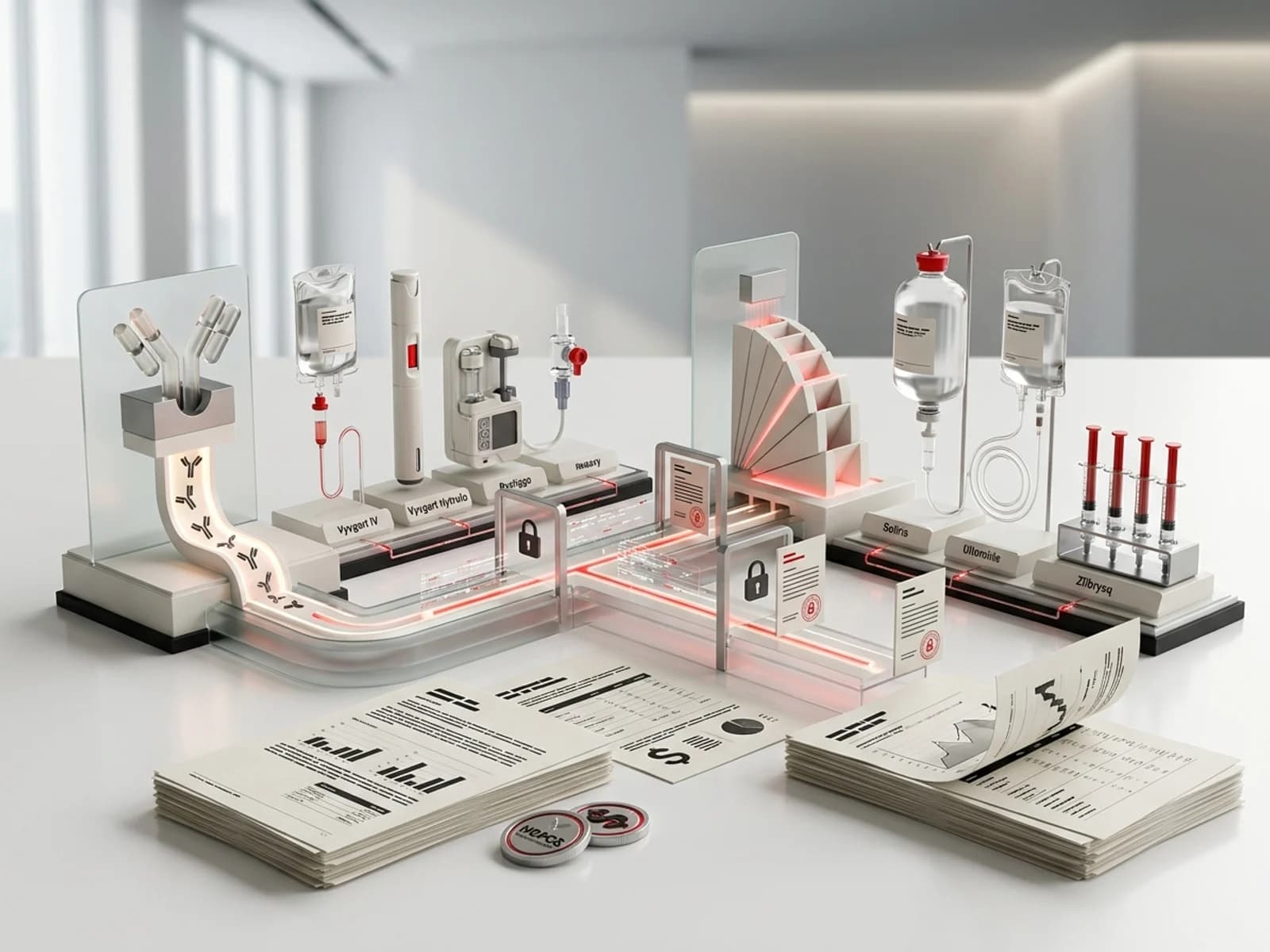
Direct answer: Targeted gMG therapies are split into two mechanisms. FcRn blockers (which lower pathogenic IgG autoantibodies) are approved for all antibody-positive patients: efgartigimod alfa (Vyvgart IV, J9332) and its subcutaneous formulation efgartigimod alfa/hyaluronidase-qvfc (Vyvgart Hytrulo SC, J9334), rozanolixizumab-noli (Rystiggo SC, J9333, approved for both AChR+ and MuSK+ gMG), and the newest entrant nipocalimab-aahu (Imaavy IV, approved April 29, 2025, for both AChR+ and MuSK+ gMG in adults and adolescents aged 12 and older). Terminal complement C5 inhibitors are approved only for AChR-positive gMG and include eculizumab (Soliris IV, J1299), ravulizumab-cwvz (Ultomiris IV, J1303), and the daily self-administered subcutaneous peptide zilucoplan (Zilbrysq SC, J3490). Payers restrict targeted therapies to patients with documented antibody positivity, moderate-to-severe disease (MG-ADL ≥ 6, MGFA class II–IV), and failure of at least one conventional IST or chronic IVIG. Payers strictly deny combination therapy (e.g., combining an FcRn blocker and a C5 inhibitor). Complement inhibitors require meningococcal vaccination under a REMS. Pricing is high: Rystiggo costs $3,155.37 per mL WAC, and Zilbrysq costs $1,047.19 per syringe (about $31,000 per 30-day supply), with annual costs varying based on weight and cycle frequency.
FcRn Blockers versus Complement C5 Inhibitors: Mechanism, Antibody Status, and Dosing
Reimbursement and clinical eligibility for targeted gMG therapies turn on three primary axes: mechanism of action, antibody status (AChR vs. MuSK), and dosing/administration logistics.
1. Neonatal Fc Receptor (FcRn) Blockers (IgG Depletion)
FcRn blockers bind to the Fc receptor, preventing it from recycling IgG antibodies back into circulation. This leads to a rapid, selective clearance of all IgG subclasses, including pathogenic AChR and MuSK autoantibodies, mimicking the clinical effect of plasma exchange.
Efgartigimod alfa (Vyvgart IV): Approved on December 17, 2021, for AChR-positive gMG. It is administered as an IV infusion (10 mg/kg, capped at 1,200 mg for patients weighing 120 kg or more) weekly for a four-week cycle. Additional cycles are administered based on clinical symptom recurrence (requiring a minimum 50-day window from the start of the previous cycle). Billed under HCPCS code J9332.
Efgartigimod alfa / hyaluronidase-qvfc (Vyvgart Hytrulo SC): Approved on June 20, 2023, for AChR-positive gMG (and expanded to CIDP in 2024). It is administered as a single, fixed-dose subcutaneous injection (1,008 mg / 11,200 units) weekly for four weeks per cycle. It utilizes hyaluronidase to allow rapid subcutaneous absorption. Billed under HCPCS code J9334.
Rozanolixizumab-noli (Rystiggo SC): Approved on June 26, 2023, for both AChR-positive and MuSK-positive gMG in adults. It is administered subcutaneously via an infusion pump weekly for a six-week cycle, with dosing stratified by body weight (<50 kg: 280 mg; 50 to <100 kg: 560 mg; ≥100 kg: 840 mg). Billed under HCPCS code J9333.
Nipocalimab-aahu (Imaavy IV): Approved on April 29, 2025, for both AChR-positive and MuSK-positive gMG in adults and pediatric patients aged 12 years and older. Administered as an IV infusion (weight-based) every two weeks, Imaavy represents the newest FcRn blocker, offering continuous maintenance dosing rather than cyclic PRN administration, and is the first targeted biologic approved for adolescent gMG.
2. Terminal Complement C5 Inhibitors (Intravascular Blockade)
Complement C5 inhibitors block the cleavage of C5, stopping MAC assembly and preventing the localized destruction of the postsynaptic membrane at the neuromuscular junction. Crucially, C5 inhibitors are only effective and approved for AChR-positive gMG (which is a complement-mediated process). They do not work for MuSK-positive gMG (which is driven by IgG4 antibodies that do not bind complement).
Eculizumab (Soliris): Approved for refractory AChR-positive gMG in 2017. Billed under HCPCS code J1299.
Ravulizumab-cwvz (Ultomiris): Approved on June 22, 2022, for AChR-positive gMG. Following an IV loading dose, maintenance infusions are administered once every eight weeks. Billed under HCPCS code J1303.
Zilucoplan (Zilbrysq SC): Approved on October 17, 2023. It is a self-administered, daily subcutaneous macrocyclic peptide (dosed weight-based: 16.6 mg, 23 mg, or 32.4 mg). Billed under unclassified code J3490 as a pharmacy-benefit drug.
Pivotal Clinical Trials and Efficacy Benchmarks
The commercial positioning and clinical choice among these agents are heavily driven by their registrational trial data. Market access teams must be familiar with the primary efficacy endpoints that established these therapies:
Efgartigimod (ADAPT and ADAPT+ Trials)
In the phase 3 ADAPT trial, efgartigimod demonstrated a highly rapid clinical response. Among AChR-antibody-positive patients:
MG-ADL Responder Rate: 68% of efgartigimod-treated patients achieved a sustained reduction of $\ge 2$ points on the MG-ADL score for at least 4 consecutive weeks, compared to 30% of the placebo group.
QMG Responder Rate: 63% of patients achieved a sustained reduction of $\ge 3$ points on the Quantitative Myasthenia Gravis (QMG) score, compared to 14% of placebo-treated patients.
Time to Response: Over 84% of responders achieved clinically meaningful improvement within the first two weeks of starting the cycle. Long-term extension data (ADAPT+) confirmed that efficacy was maintained over multiple cycles.
Rozanolixizumab (MyCarInG Trial)
The registrational MyCarInG trial randomized 200 patients with AChR- and MuSK-antibody-positive gMG 1:1:1 to weight-based subcutaneous rozanolixizumab (Rystiggo) at 7 mg/kg or 10 mg/kg, or placebo, for a six-week cycle (these weight-based trial doses map roughly to the 560 mg and 840 mg weekly weight-band doses in the Rystiggo label). At day 43:
MG-ADL Reduction: Least-squares mean MG-ADL change was -3.37 for 7 mg/kg and -3.40 for 10 mg/kg, versus -0.78 for placebo (both P < 0.0001).
QMG Reduction: Least-squares mean QMG change was -5.4 for 7 mg/kg and -6.7 for 10 mg/kg, versus -1.9 for placebo.
MuSK Subset: Importantly, rozanolixizumab demonstrated robust clinical efficacy in the MuSK-antibody-positive subgroup (n=21), with MG-ADL reductions matching or exceeding those of the AChR-antibody-positive patients.
Nipocalimab (Vivacity-MG3 Trial)
The FDA approval of nipocalimab (Imaavy) was supported by the Phase 3 Vivacity-MG3 study. Administered as a continuous bi-weekly IV regimen:
IgG and Autoantibody Reduction: Nipocalimab achieved a rapid, sustained mean reduction in total IgG and pathogenic autoantibodies of up to 75% from baseline.
Sustained Disease Control: Unlike cyclic therapies where patients experience a "wear-off" effect between cycles, the continuous dosing of nipocalimab provided stable, long-term disease control, meeting the primary endpoint of statistically significant improvement in the MG-ADL score from baseline to week 24.
Ravulizumab (CHAMPION-MG Trial)
The long-acting C5 inhibitor ravulizumab (Ultomiris) was evaluated in the CHAMPION-MG study, which enrolled AChR-antibody-positive patients. At week 26:
MG-ADL Change: Ravulizumab achieved a least-squares mean reduction in the MG-ADL score of -3.1 points compared to -1.4 points for the placebo group (P < 0.001).
QMG Change: QMG score reductions were -2.8 points for ravulizumab versus -0.8 points for placebo (P < 0.001).
Dosing Moat: The primary differentiator is convenience; ravulizumab maintained these clinical improvements with a maintenance infusion schedule of once every 8 weeks, compared to once every 2 weeks for eculizumab.
Zilucoplan (RAISE Trial)
The daily subcutaneous C5 inhibitor zilucoplan (Zilbrysq) was evaluated in the Phase 3 RAISE study. At week 12:
MG-ADL Reduction: Zilucoplan achieved a mean change of -4.39 points from baseline compared to -2.30 points for placebo ($p < 0.0001$).
QMG Reduction: Mean QMG change was -6.19 points for zilucoplan versus -3.25 points for placebo.
Rapidity: Rapid clinical improvement was observed as early as week 1, establishing daily subcutaneous peptide blockade as a highly responsive alternative to intravenous complement inhibitors.
HCPCS Coding, Pricing, and Administration Metrics
Provider-administered biologics require buy-and-bill coding under the medical benefit, while self-administered subcutaneous products are managed under the pharmacy benefit. The following table provides a comprehensive coding, pricing, and administration reference:
| Product Name | HCPCS Code | Dosing Modality | WAC Pricing Basis | Key Admin Metric | Exclusivity / Moat (Purple Book) |
|---|---|---|---|---|---|
| Vyvgart IV | J9332 | IV weekly x4 (Cyclic) | Specialty IV WAC | 1-hour infusion | Orphan exp. Dec 17, 2028 |
| Vyvgart Hytrulo | J9334 | SC weekly x4 (Cyclic) | Specialty SC WAC | 90-sec injection | Orphan exp. Jun 21, 2031 |
| Rystiggo SC | J9333 | SC weekly x6 (Cyclic) | $3,155.37 / mL WAC | SC pump infusion | Orphan exp. Jun 26, 2030 |
| Imaavy IV | J3490 / NOC | IV every 2 weeks | Launch WAC | IV infusion | Orphan exp. Apr 29, 2032 |
| Soliris IV | J1299 | IV every 2 weeks | ~$509,000 / year | 35-min infusion | Biosimilars (Q5152/Q5151) active |
| Ultomiris IV | J1303 | IV every 8 weeks | ~$493,000 / year | 1-2 hour infusion | Orphan exp. Jun 7, 2028 (PNH) |
| Zilbrysq SC | J3490 / NOC | SC daily (Continuous) | $1,047.19 / syringe | Daily self-injection | NCE exp. Oct 17, 2028 |
Billing and Pricing Specifics
Rystiggo WAC Anchor: Rozanolixizumab (Rystiggo) is priced at $3,155.37 per mL WAC (as of December 2025). The total cost per cycle depends on the patient's weight, which determines whether they receive a 2 mL (560 mg) or 3 mL (840 mg) weekly infusion for six weeks.
Zilbrysq WAC Anchor: Zilucoplan (Zilbrysq) is priced at $1,047.19 per prefilled syringe (across all three strengths). A 30-day supply (30 syringes) has a WAC of approximately $31,415, leading to an annual cost of roughly $382,000 for continuous daily dosing.
HCPCS Billing Units: J9332 (Vyvgart) is defined as "2 mg" per unit. A standard 10 mg/kg dose for a 70 kg patient (700 mg) equals 350 billing units per claim. J9333 (Rystiggo) is billed as "1 mg" per unit (effective January 1, 2024), meaning a 560 mg dose equals 560 units.
Payer Prior-Authorization and Step-Therapy Rules
Because gMG targeted therapies represent a massive specialty spend, commercial insurers and Medicare Advantage plans enforce strict prior-authorization (PA) criteria.
Prior-Authorization Criteria for Initiation
To secure approval for a targeted gMG therapy, the clinical documentation must show:
Prescribing Specialist: The prescription must be written by, or in consultation with, a neurologist.
Definitive Diagnosis: Documented myasthenia gravis with positive serology for AChR antibodies (or MuSK antibodies for Rystiggo and Imaavy).
Baseline Disease Severity:
Myasthenia Gravis Foundation of America (MGFA) Clinical Classification Class II, III, or IV (mild, moderate, or severe weakness affecting non-ocular muscles).
A baseline Myasthenia Gravis Activities of Daily Living (MG-ADL) total score of at least 6.
Step-Therapy Rejection: Inadequate response, contraindication, or intolerance to at least one conventional therapy, defined as:
Cholinesterase inhibitors (pyridostigmine), AND
At least one oral immunosuppressive therapy (e.g., azathioprine, mycophenolate mofetil, cyclosporine, tacrolimus, methotrexate) for at least 6 to 12 months, OR
Requirement for chronic, recurrent IVIG or plasma exchange.
No Combination Policy: Payers strictly prohibit the concurrent use of more than one targeted biologic or peptide for gMG (e.g., a patient cannot receive Vyvgart and Zilbrysq simultaneously).
Meningococcal REMS (for C5 inhibitors only): Verification of meningococcal vaccination at least 14 days prior to first dose for Soliris, Ultomiris, and Zilbrysq.
Reauthorization and Continuation of Therapy
To renew coverage (typically every 6 to 12 months), the provider must document a positive clinical response, defined as:
A sustained reduction of at least 2 points from baseline in the MG-ADL score, OR
A reduction of at least 3 points from baseline in the Quantitative Myasthenia Gravis (QMG) score, OR
A documented reduction in myasthenic crisis frequency, hospitalization, or corticosteroid dosing.
Sibling Commercial Payer Criteria Comparison
Reimbursement rules vary slightly across major payers. The following table summarizes the prior authorization requirements for three leading commercial insurers:
| Payer | Antibody Requirement | Severity / Score | Failed Prior Therapy | Reauthorization Rule |
|---|---|---|---|---|
| Aetna (CPB 1035) | AChR+ (all), MuSK+ (Rystiggo/Imaavy) | MG-ADL $\ge 6$ and MGFA II–IV | Pyridostigmine + $\ge 1$ oral IST (azathioprine, mycophenolate, cyclosporine, tacrolimus) for $\ge 12$ months, or chronic IVIG | Re-review at 6 months; requires documented reduction of $\ge 2$ points in MG-ADL or $\ge 3$ points in QMG |
| UnitedHealthcare (UHC) | AChR+ or MuSK+ (per FDA label) | MG-ADL $\ge 6$ | Pyridostigmine + $\ge 1$ oral IST for $\ge 6$ months, or contraindication | Re-review at 12 months; requires clinical benefit (stability or improvement) and no combination use |
| Cigna | AChR+ or MuSK+ (per FDA label) | MG-ADL $\ge 6$ and MGFA II–IV | Inadequate response or intolerance to at least two immunosuppressive treatments (including corticosteroids or oral ISTs) | Re-review at 12 months; requires positive clinical response (MG-ADL improvement of $\ge 2$ points) |
What does the FAERS post-marketing profile show for the gMG-specific agents?
To evaluate the real-world safety performance of the gMG-specific targeted therapies (the FcRn blockers efgartigimod and rozanolixizumab, plus the subcutaneous C5 peptide zilucoplan), we computed the safety profile across the public openFDA FAERS database.
The gMG-specific cohort yielded a cumulative 5,619 any-role-named reports (export dated June 8, 2026).
| Metric | Computed Value | Clinical Interpretation |
|---|---|---|
| Total gMG Cohort Reports | 5,619 | Rising rapidly, reflecting the 2021–2024 launch timeline |
| Serious Reports | 4,929 (87.7%) | Extremely high seriousness share; typical for acute neuromuscular disease |
| Death Outcomes | 430 (7.7%) | Reflects myasthenic crisis mortality and elderly polypharmacy |
| Lawyer-Reporter Cases | 2 (0.04%) | Clean clinical profile; no litigation noise |
Substance-Level Reporting Volume
Reporting is heavily concentrated on the first approved agent, reflecting Vyvgart's market lead:
Efgartigimod alfa (Vyvgart/Hytrulo): 4,049 reports (72.1% of the cohort)
Rozanolixizumab (Rystiggo): 858 reports (15.3% of the cohort)
Zilucoplan (Zilbrysq): 494 reports (8.8% of the cohort)
Safety Signal Families and the "Seriousness" Paradox
The gMG cohort shows a unique safety profile. The top MedDRA reactions are:
Myasthenia gravis: 1,198 reports (indication-as-event).
Fatigue: 536 reports.
Myasthenia gravis crisis (myasthenic crisis): 497 reports.
Dyspnoea: 382 reports.
Dysphagia: 230 reports.
Muscular weakness: 223 reports.
Fall: 280 reports.
Infection (652 reports): Urinary tract infections (207) and pneumonia (183).
The 87.7% seriousness share and the 430 death reports represent a "seriousness paradox." In clinical trials, FcRn blockers and zilucoplan demonstrated excellent safety profiles, with the primary side effects being mild headache and transient nasopharyngitis. Why does post-marketing data show such high severity?
This is because gMG is an unstable, severe disease. Pathogenic IgG depletion or complement blockade takes time to achieve therapeutic thresholds. Patients started on these therapies are often in clinical decline, having failed conventional drugs. If a patient experiences a disease flare, myasthenic crisis (leading to respiratory failure and mechanical ventilation), or pneumonia (a frequent complication of bulbar weakness and aspiration), the event is classified as serious and is reported to the FDA. The high seriousness share reflects the intrinsic severity of the disease and its clinical complications, rather than direct drug toxicity.
The infection signal (652 reports) is a direct extension of the mechanism of action. By clearing IgG, FcRn blockers temporarily lower protective antibodies, increasing susceptibility to upper respiratory and urinary tract infections, which clinicians must monitor.
How does the April 2025 approval of nipocalimab (Imaavy) reshape the FcRn class?
The FDA approval of nipocalimab-aahu (Imaavy) on April 29, 2025, represents a major milestone that alters the commercial dynamics of the FcRn class. Developed by Johnson & Johnson, Imaavy entered a market previously dominated by argenx's efgartigimod franchise.
Imaavy distinguishes itself from Vyvgart and Rystiggo through three key clinical and access lenses:
1. Broadest Eligible Population
While Vyvgart and Vyvgart Hytrulo are only approved for adults, Imaavy's label extends to pediatric patients aged 12 years and older as well as adults. This makes it the first targeted biologic approved for adolescent gMG, addressing a significant unmet need.
2. Dual AChR and MuSK Antibody Coverage
Like UCB's Rystiggo, Imaavy is approved for both AChR-positive and MuSK-positive gMG. This stands in contrast to the efgartigimod franchise, which remains restricted to AChR-positive patients in the United States, giving J&J a significant clinical advantage in the MuSK subgroup (which represents roughly 5% to 8% of the gMG population).
3. Continuous IV Dosing Schedule
While Vyvgart and Rystiggo utilize cyclic dosing (weekly infusions for 4 to 6 weeks, followed by variable drug-free holidays until symptoms return), Imaavy is administered as a continuous IV infusion every two weeks. For payers, this continuous schedule provides a highly predictable annual drug spend, avoiding the "PRN spike" patterns of cyclic therapy, though it increases the long-term infusion-chair burden for patients.
Frequently Asked Questions
Which gMG therapies work for MuSK-positive myasthenia gravis?
Only rozanolixizumab (Rystiggo) and nipocalimab (Imaavy) are FDA-approved for MuSK-positive generalized myasthenia gravis. The efgartigimod franchise (Vyvgart and Vyvgart Hytrulo) and all complement C5 inhibitors (Soliris, Ultomiris, Zilbrysq) are restricted by their FDA labels to AChR-antibody-positive disease. Complement inhibitors do not work in MuSK gMG because the MuSK autoantibodies belong to the IgG4 subclass, which does not activate the complement cascade.
Can Vyvgart and Rystiggo or Zilbrysq be used together?
No. Payer policies and FDA labels strictly prohibit the concurrent use of multiple targeted gMG therapies. Combining an FcRn blocker (which clears IgG) with a complement C5 inhibitor is clinically redundant and has not been evaluated in clinical trials. It would also double the already substantial specialty drug spend without proven therapeutic benefit.
What is Imaavy (nipocalimab) and how is it different from Vyvgart?
Imaavy (nipocalimab) is a monoclonal antibody that blocks the neonatal Fc receptor (FcRn), similar to Vyvgart (efgartigimod). However, Imaavy differs in its clinical label and administration: it is approved for adults and adolescents aged 12 and older (Vyvgart is adults-only), it covers both AChR and MuSK antibodies (Vyvgart covers AChR only), and it is administered continuously every two weeks (Vyvgart is administered in weekly 4-dose cycles followed by treatment holidays).
Sources
FDA Orange Book: Approved Drug Products with Therapeutic Equivalence Evaluations (NDA 216834)
Johnson & Johnson Press Release: FDA Approves Imaavy (nipocalimab) for gMG (April 30, 2025)
Aetna Clinical Policy Bulletin 1035: Rozanolixizumab-noli (Rystiggo) and FcRn Blockers
argenx Vyvgart Billing and Coding Guide (HCPCS J9332 and J9334)