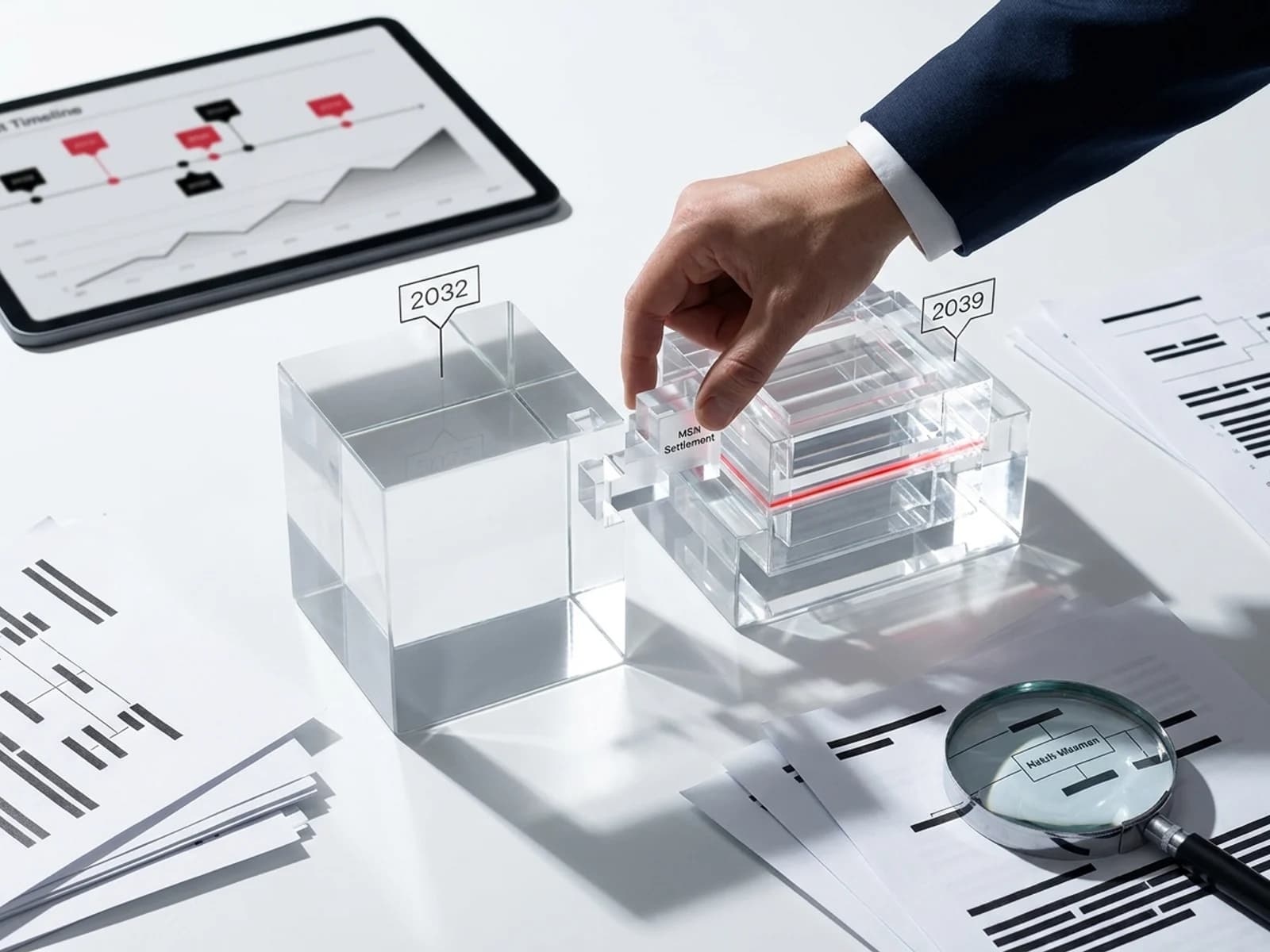
On August 19, 2026, South Korea's SK Biopharmaceuticals announced that it has executed a confidential settlement agreement with generic manufacturer MSN Laboratories — the brand's first resolved U.S. patent dispute over Xcopri (cenobamate tablets; NDA 212839), an infringement suit pending in the U.S. District Court for the District of Delaware.
The agreement represents a pivotal milestone for SK Biopharmaceuticals' commercial crown jewel. Approved by the FDA on November 21, 2019, for the treatment of partial-onset (focal-onset) seizures in adults, Xcopri generated 630 billion Korean won (~$430 million USD) in 2025 revenue — up 44% year-over-year — out of SK Biopharmaceuticals' 707 billion KRW (~$480 million USD) total revenue (up 29%), and the drug still accounted for 98.5% of company sales in the first half of 2026. Because Xcopri accounts for nearly all of SK Biopharmaceuticals' operating revenue, the longevity and integrity of its U.S. patent estate is an existential commercial priority.
Trade press summaries immediately framed the settlement as "extending Xcopri's exclusivity." That shorthand is only half right: the deal resolves SK's litigation over the follow-on method-of-use patent, while the underlying composition-of-matter wall — which runs to October 2032 — was never the patents at stake in this suit.
For generic launch strategists, brand lifecycle directors, and central nervous system (CNS) market-access leads, evaluating the real commercial impact of this settlement requires an exact, document-level read of the FDA Orange Book patent fence, Hatch-Waxman 180-day exclusivity rules, and the ongoing parallel litigations against follow-on ANDA filers Aurobindo Pharma and Zydus Lifesciences.
What did SK and MSN actually settle on August 19?
According to SK Biopharmaceuticals' official disclosure and primary reporting from The Korea Herald, the settlement terms between SK and MSN Laboratories contain three structural components:
| Settlement Component | Disclosed Terms & Legal Scope | Commercial & Regulatory Impact |
|---|---|---|
| Litigation Scope | Resolves SK's Delaware suit asserting follow-on patent US 11,654,133 against MSN's ANDA (Civil Action No. 1:24-cv-01270, filed November 2024) | Ends the patent infringement litigation triggered by MSN's Paragraph IV certification notice |
| Compound Patent Status | US Patent No. 7,598,279 remains fully in effect through October 30, 2032 | The composition-of-matter wall is untouched by the settlement; nothing in the disclosed terms concedes or shortens it |
| Generic Entry License | Grants MSN a licensed right to launch generic cenobamate in the U.S. at a confidential future date | Launch timing is strictly contingent on FDA final ANDA approval and confidential contractual conditions |
| Parallel Defendants | Excludes Aurobindo Pharma and Zydus Lifesciences | SK's patent infringement litigations against Aurobindo and Zydus remain active in federal court |
By executing a licensed entry agreement, SK Biopharmaceuticals followed the standard playbook for brand pharmaceutical lifecycle management: resolving a Paragraph IV challenger through a negotiated, certainty-defining future entry date rather than risking a district court trial on the validity of its follow-on use patent.
┌─────────────────────────────────────────────────────────────────────────────────┐
│                    SK BIOPHARMACEUTICALS XCOPRI LITIGATION MAP                  │
├─────────────────────────────────────────────────────────────────────────────────┤
│                                                                                 │
│   [ NDA 212839: XCOPRI (cenobamate tablets) Approved Nov 21, 2019 ]            │
│                                                                                 │
│         ┌───────────────────────┬───────────────────────┐                       │
│         ▼                       ▼                       ▼                       │
│   ┌───────────┐           ┌───────────┐           ┌───────────┐                 │
│   │ Aurobindo │           │   Zydus   │           │ MSN Labs  │                 │
│   │  Pharma   │           │Lifescience│           │           │                 │
│   └─────┬─────┘           └─────┬─────┘           └─────┬─────┘                 │
│         │ Sued June 2024        │ Sued June 2024        │ Sued Nov 2024         │
│         ▼                       ▼                       ▼                       │
│   ┌───────────┐           ┌───────────┐           ┌───────────┐                 │
│   │  ACTIVE   │           │  ACTIVE   │           │  SETTLED  │                 │
│   │LITIGATION │           │LITIGATION │           │(Aug 19,26)│                 │
│   └───────────┘           └───────────┘           └─────┬─────┘                 │
│                                                         │                       │
│                                                         ▼                       │
│                                             Licensed Future Entry Date          │
│                                             (Confidential; Post-Oct 2032 Wall)  │
└─────────────────────────────────────────────────────────────────────────────────┘
What does the Orange Book show—the two-patent cenobamate fence
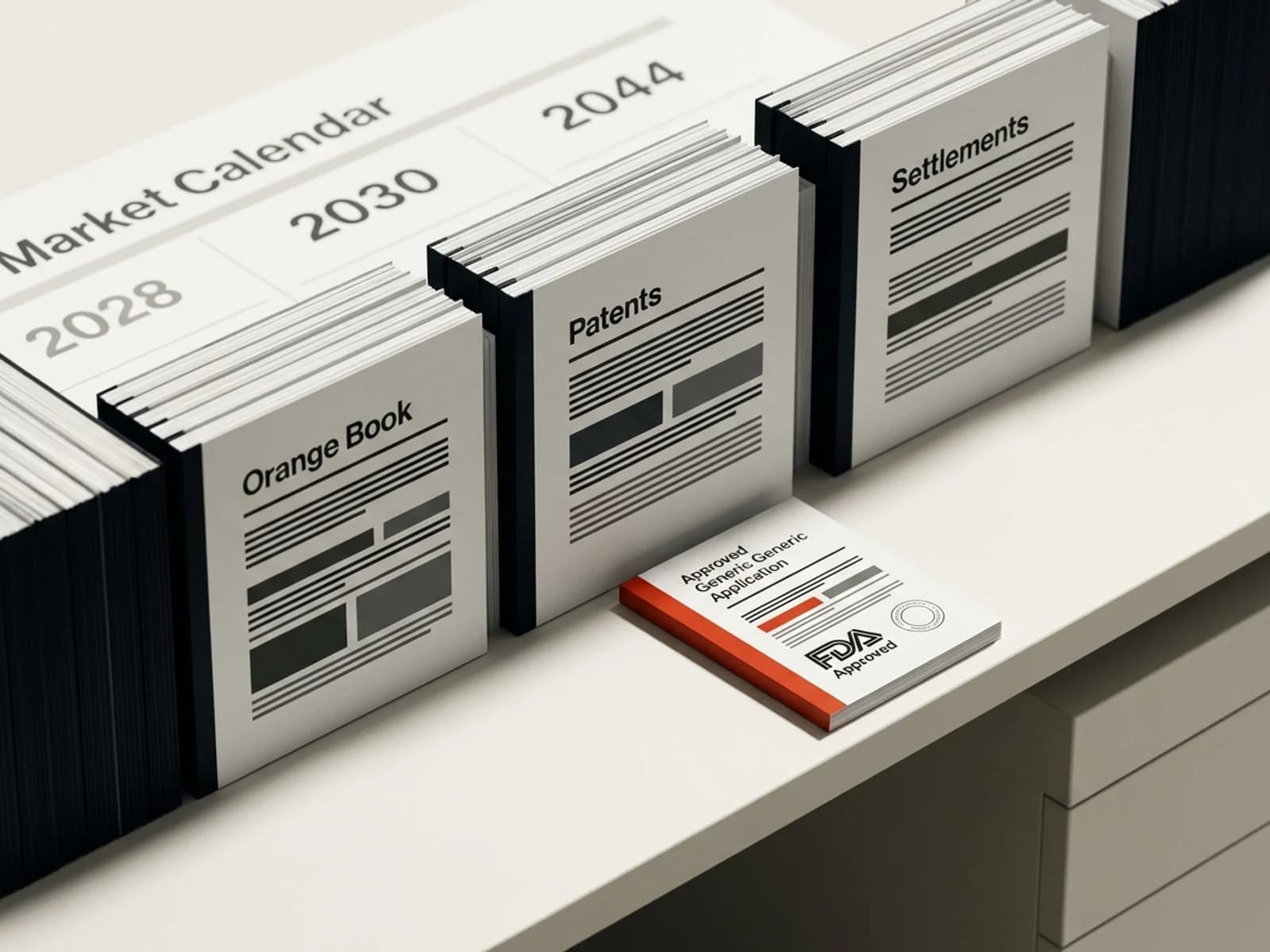
An inspection of the FDA Orange Book (snapshot 2026-07-25 and live FDA records) reveals that Xcopri is protected by an unusually clean, compact patent estate consisting of exactly two distinct patents across all six approved dosage strengths (12.5 mg, 25 mg, 50 mg, 100 mg, 150 mg, and 200 mg tablets):
| Patent Number | Claim Type / Coverage | Drug Substance Flag | Drug Product Flag | Patent Use Code | Expiration Date | PED Extension | Legal / Strategic Role |
|---|---|---|---|---|---|---|---|
| US 7,598,279 | Carbamate compounds for CNS diseases | Y | N | None | Oct 30, 2032 | None | Primary Composition Wall: Covers the cenobamate molecule; includes Patent Term Extension (PTE) |
| US 11,654,133 | Methods of administering cenobamate | N | N | U-3610 | Jun 16, 2039 | None | Follow-On Use Patent: Method of use patent; prime target for section viii skinny-label carve-out |
                               XCOPRI ORANGE BOOK PATENT TIMELINE

  2019        2024                     2032                               2039
   ├─── NCE ───┼────────────────────────┼──────────────────────────────────┤
   │ Exclusivity                        │                                  │
   │ Expired                            ▼                                  ▼
   │ Nov 21, 2024             US 7,598,279 (Oct 30, 2032)        US 11,654,133 (Jun 16, 2039)
   │                          Composition of Matter Wall         Method of Use Patent (U-3610)
   │                          (Drug Substance Flag)              (Section viii Carve-out Candidate)
In addition to the patent listings, the regulatory exclusivity records show:
NCE Exclusivity (5-Year): Cenobamate was a new active moiety, so five-year new chemical entity exclusivity ran from the November 21, 2019 approval and expired on November 21, 2024. This expiration opened the statutory window for generic applicants to submit ANDAs containing Paragraph IV certifications against Orange Book-listed patents.
Approval-Date Discrepancy Worth Knowing: Drugs@FDA records Xcopri's original approval action on November 21, 2019, while a date field in the Orange Book data file reads March 10, 2020 — consistent with initial U.S. marketing rather than approval. Analysts reconciling approval-based exclusivity clocks should anchor on the Drugs@FDA action date.
Orphan Drug Exclusivity (ODE): Xcopri was not approved under an orphan designation for its initial adult partial-onset seizure indication; zero ODE rows exist in the Orange Book.
Approved ANDAs: There are zero approved generic cenobamate ANDAs in the FDA database as of August 2026. All pending ANDAs (MSN, Aurobindo, Zydus) remain under active FDA review.
Why the 2039 use patent is probably carve-outable (and when it is not)
A central strategic question for generic developers is whether US Patent No. 11,654,133 (expiring June 16, 2039) represents a genuine commercial barrier capable of preventing generic entry until 2039, or whether it can be bypassed via a section viii carve-out under 21 U.S.C. § 355(j)(2)(A)(viii).
1. The Absence of Substance and Product Flags
Under FDA Orange Book listing rules (21 CFR § 314.53), patents protecting the active drug molecule or the finished dosage formulation must carry Drug Substance (Y) or Drug Product (Y) flags. The '133 patent carries neither; it is listed solely with Patent Use Code U-3610.
2. Section viii "Skinny Label" Mechanics
Under the Hatch-Waxman Act, when an Orange Book patent claims only a specific method of use or a specific indication rather than the underlying chemical compound, an ANDA applicant is not required to submit a Paragraph IV patent certification challenging the patent's validity.
Instead, the generic filer may file a Section viii statement, certifying to the FDA that it is not seeking approval for the patented method of use and omitting the patented indication or dosing instructions from its generic prescribing information (creating a "skinny label").
SECTION VIII CARVE-OUT VS. PARAGRAPH IV CERTIFICATION
| Paragraph IV Patent Challenge | Section viii "Skinny Label" Carve-Out |
|---|---|
| • Required for Composition '279 | • Available for Method-of-Use '133 |
| • Asserts patent invalid / not | • Certifies generic will NOT market |
| infringed by generic active entity | for the specific patented use code |
| • Triggers 30-month statutory stay | • Bypasses patent litigation entirely; |
| under 21 U.S.C. § 355(j)(5)(B)(iii) | no 30-month stay on FDA approval |
| • Hard compound wall: Oct 30, 2032 | • Generic enters upon compound expiry |
3. When is Carve-Out Not Possible?
A section viii carve-out succeeds only if the remaining, unpatented portion of the FDA-approved label describes a viable, safe, and effective clinical use.
If Use Code U-3610 claims the core adult partial-onset seizure indication itself, carving out that indication would leave the generic label with zero approved indications, rendering the ANDA unapprovable. However, if U-3610 claims a specific dosing titration regimen, a specific co-administration protocol, or an adjunctive maintenance sub-population, generic applicants can readily carve out the claimed text while retaining broad general approval for partial-onset seizures.
By settling with MSN and granting a licensed future entry date, SK recognized that relying solely on the '133 method-of-use patent to hold off generic entry between 2032 and 2039 carried high litigation risk.
What remains live: the Aurobindo and Zydus cases and the ANDA pipeline
While MSN has resolved its litigation, SK Biopharmaceuticals' legal battles over cenobamate are far from over.
In June 2024, SK filed separate patent infringement complaints in the U.S. District Court for the District of Delaware against Aurobindo Pharma and Zydus Lifesciences, alleging infringement of US Patent No. 7,598,279 and follow-on patent rights.
PARALLEL LITIGATION & EXCLUSIVITY SCENARIOS
| Litigant / Defendant | Current Status & Forward Scenarios |
|---|---|
| **MSN Laboratories** (Later Paragraph IV Filer) | • **Settled (Aug 19, 2026)** • Entered behind the first filer's 180-day exclusivity unless that exclusivity is forfeited • Bound by confidential licensed launch date |
| **Aurobindo Pharma** (Early ANDA Filer) | • **Active in D. Del. (1:24-cv-00718,** **sued June 18, 2024)** • Presumptive first filer for 180-day exclusivity (filing order vs. Zydus not public) • Could settle on similar terms to MSN |
| **Zydus Lifesciences** (Early ANDA Filer) | • **Active in D. Del. (Sued June 2024)** • Litigating composition '279 & use '133 • Trial decision could set precedent for all filers |
Hatch-Waxman 180-Day Exclusivity Interplay
Under 21 U.S.C. § 355(j)(5)(B)(iv), the first generic applicant to submit a substantially complete ANDA containing a Paragraph IV certification is awarded 180 days of market exclusivity, during which the FDA cannot approve subsequent generic ANDAs.
MSN's Paragraph IV notice came in late 2024 — months after SK sued Aurobindo and Zydus in June 2024, which places MSN behind at least one earlier filer. The 180-day exclusivity therefore presumptively belongs to the earliest filer or filers among Aurobindo and Zydus (the exact filing order is not public), and MSN cannot launch until that exclusivity is exhausted or forfeited.
Under our Hatch-Waxman 180-day exclusivity forfeiture guide, when a first filer settles with the brand manufacturer and agrees to delay its market entry, it generally retains its 180-day exclusivity unless a statutory forfeiture trigger occurs under Section 505(j)(5)(D)—such as failing to obtain tentative FDA approval within 30 months of filing, or failing to launch within 75 days of a final, unappealable court decision in another defendant's case finding the patents invalid or not infringed.
If Aurobindo or Zydus—whichever holds first-filer status—refuses to settle and takes the '279 composition patent to trial, a final court decision invalidating it starts the first filer's forfeiture clock: launch within 75 days or lose the 180-day exclusivity entirely, opening the market to immediate multi-source generic competition including MSN.
How big is the prize: Xcopri revenue concentration and the PGTC expansion
To understand why SK Biopharmaceuticals is defending the cenobamate patent fence so vigorously, one must examine the brand's revenue trajectory and lifecycle pipeline.
XCOPRI (CENOBAMATE) COMMERCIAL PROFILE
| Annual Revenue (2025) | **707 billion KRW (~$480M USD)** total company |
|---|---|
| Xcopri Revenue (2025) | **630 billion KRW (~$430M USD)** (+44% YoY) |
| H1 2026 Concentration | Cenobamate = **98.5% of SK Biopharm sales** |
| Current Approved Indication | Partial-onset (focal-onset) seizures in adults |
| Target Pipeline Expansion | Primary Generalized Tonic-Clonic (PGTC) seizures |
| Phase 3 PGTC Status | **Met Primary Endpoint; sNDA submission planned** |
1. Epilepsy Market Access Context
In current clinical practice, Xcopri occupies a premium, highly effective position for refractory adult epilepsy. As detailed in our comprehensive epilepsy treatment access landscape, commercial payers and Medicare Part D plans typically place Xcopri on Tier 3 (Non-Preferred Brand) or Tier 4 (Specialty), requiring step therapy through two generic anti-seizure medications (such as levetiracetam, lamotrigine, or lacosamide) and prior authorization documentation of seizure frequency.
Xcopri is dosed once daily at bedtime, but requires a mandatory, slow bi-weekly titration schedule (starting at 12.5 mg/day and titrating over 10 to 12 weeks to 200 mg/day) to minimize the risk of serious hypersensitivity reactions, including Drug Reaction with Eosinophilia and Systemic Symptoms (DRESS). Because of this specialized titration and Schedule V controlled-substance status, brand loyalty and physician comfort are high.
2. The PGTC Label Expansion Strategy
SK Biopharmaceuticals has completed a positive Phase 3 global clinical trial evaluating cenobamate as adjunctive therapy in patients with primary generalized tonic-clonic (PGTC) seizures. The trial achieved statistically significant reductions in seizure frequency compared to placebo, and SK plans to submit a supplemental New Drug Application (sNDA) to the FDA.
Approval of the PGTC indication will deliver two critical strategic benefits:
Market Expansion: Broadens the label beyond partial-onset seizures to primary generalized tonic-clonic seizures—a patient population Xcopri cannot reach today—supporting management's push toward blockbuster-scale annual revenue.
New Regulatory Exclusivity & Patents: Under 21 U.S.C. § 355(c)(3)(E)(iv), an sNDA approved with new clinical investigations is entitled to 3 years of Hatch-Waxman clinical investigation exclusivity for the new indication. Furthermore, SK can obtain new method-of-use patents covering PGTC seizure administration, extending an additional protective patent layer into the 2040s.
Realistic generic-entry scenarios and what to watch next
Based on Orange Book patent mechanics, Hatch-Waxman statutory exclusivity, and district court litigation timelines, generic launch teams and brand lifecycle planners should model the following cenobamate entry scenarios:
CENOBAMATE GENERIC ENTRY SCENARIO MATRIX
| Scenario | Projected Window | Key Determining Conditions |
|---|---|---|
| **Scenario A** *(Baseline / Most Likely)* | **Late 2032** (Nov / Dec 2032) | • MSN licensed date aligned with US 7,598,279 expiry (Oct 30, 2032) • '133 use patent carved out via section viii skinny label |
| **Scenario B** *(Early Litigation Invalidation)* | **Mid-to-Late 2027–2029** | • Aurobindo / Zydus win court ruling invalidating '279 patent • Generic launches at-risk or under appellate court affirmance |
| **Scenario C** *(Long-Term Fence Hold)* | **June 2039+** | • '133 use patent held non-carve- outable; blocks broad focal label • New PGTC use patents extend fence |
Scenario A: The October 2032 Composition Wall (80% Probability Baseline)
In the overwhelming majority of Hatch-Waxman settlements involving a valid, unexpired composition-of-matter patent, the confidential licensed entry date is set either exactly at the expiration of the composition patent (October 30, 2032) or a few months prior. Whichever filer holds qualifying 180-day exclusivity enters the market in late 2032, carving out the '133 method-of-use patent via a section viii statement, followed by the remaining filers—including MSN under its license—in 2033 (see our comparative benchmark on generic Imbruvica availability and generic Wakix Orange Book launch dates).
Scenario B: Accelerated Litigation Victory (15% Probability)
If Aurobindo or Zydus takes the '279 composition patent to trial in Delaware and successfully proves obviousness or non-infringement, generic cenobamate could theoretically enter years ahead of 2032, triggering forfeiture of MSN's 180-day exclusivity and opening the market to immediate price competition.
Scenario C: The 2039 Method-of-Use Hold (5% Probability)
If FDA determines that Use Code U-3610 cannot be carved out without making the generic label unsafe, or if SK obtains new PGTC indication patents that withstand Paragraph IV challenge, brand exclusivity could hold into the late 2030s.
What to Watch Next
Aurobindo and Zydus Litigation Dockets (D. Del.): Monitor whether Aurobindo and Zydus follow MSN into settlement or proceed through expert discovery toward trial.
Tentative ANDA Approvals from FDA: Watch the FDA Paragraph IV Certifications database and ANDA approval logs for tentative approvals granted to MSN, Aurobindo, or Zydus, confirming bioequivalence and manufacturing compliance.
PGTC sNDA Submission & Approval: Track SK Biopharmaceuticals' regulatory filing for primary generalized tonic-clonic seizures, which will trigger 3-year exclusivity and potential new Orange Book patent listings.
SEC / D. Del. Disclosures: Any public disclosure or antitrust review filings regarding MSN's licensed launch date will establish the definitive timeline for generic market access.
Frequently Asked Questions
When will generic Xcopri (cenobamate) be available?
Generic cenobamate is expected to launch in the United States in late 2032 (after October 30, 2032) upon the expiration of Xcopri's primary composition-of-matter patent (US Patent No. 7,598,279). Under the August 2026 settlement, MSN Laboratories received a licensed right to launch at a confidential date, which industry benchmarks indicate is anchored near the 2032 composition expiration.
What patents protect Xcopri and when do they expire?
According to the FDA Orange Book (NDA 212839), Xcopri is protected by exactly two patents:
US Patent No. 7,598,279: Composition of matter / drug substance; expires October 30, 2032.
US Patent No. 11,654,133: Method of use (Patent Use Code U-3610); expires June 16, 2039.
Does the MSN settlement mean a generic launch date was set?
Yes, but the exact date is confidential. SK Biopharmaceuticals granted MSN a licensed right to launch generic cenobamate in the future, subject to FDA approval and confidential contractual conditions. The agreement resolved the patent lawsuit between SK and MSN in Delaware federal court.
Why is SK still suing Aurobindo and Zydus?
Aurobindo Pharma and Zydus Lifesciences filed their own independent ANDAs seeking FDA approval for generic cenobamate. Because the August 19 settlement was negotiated exclusively with MSN Laboratories, SK's patent infringement lawsuits against Aurobindo and Zydus remain active in the U.S. District Court for the District of Delaware.
Could generic entry happen before October 2032?
Early generic entry before October 2032 could occur only if Aurobindo or Zydus successfully invalidates the '279 composition patent at trial in federal court, or if SK negotiated an authorized generic or early-entry license in exchange for substantial royalty payments.
What does Xcopri's PGTC label expansion mean for generic timing?
SK Biopharmaceuticals has completed a successful Phase 3 trial in primary generalized tonic-clonic (PGTC) seizures. An FDA approval for PGTC seizures will grant 3 years of new clinical investigation exclusivity and allow SK to list new method-of-use patents in the Orange Book, providing additional lifecycle protection for the expanded indication.
Sources
The Korea Herald — SK Biopharmaceuticals Settles First US Patent Dispute Over Xcopri. Published August 19, 2026. Available at: koreaherald.com/article/10845774.
U.S. Food and Drug Administration (FDA) — Orange Book: Approved Drug Products with Therapeutic Equivalence Evaluations (NDA 212839: Xcopri). Patent and Exclusivity Records, snapshot July 2026. Available at: accessdata.fda.gov/scripts/cder/ob/index.cfm.
U.S. Food and Drug Administration (FDA) — Drugs@FDA: FDA-Approved Drugs (NDA 212839 Cenobamate Tablets Approval History). Original approval action November 21, 2019. Available at: accessdata.fda.gov/scripts/cder/daf.
National Institutes of Health (NIH) / DailyMed — Xcopri (Cenobamate Tablets) Prescribing Information. SK Life Science, Inc. Available at: dailymed.nlm.nih.gov/dailymed/search.cfm?label=xcopri.
U.S. Food and Drug Administration (FDA) — Paragraph IV Patent Certifications Monthly Listing. Available at: fda.gov/media/166048/download.
U.S. District Court for the District of Delaware — SK Biopharmaceuticals Co., Ltd. and SK Life Science, Inc. v. MSN Laboratories Private Ltd. et al., Civil Action No. 1:24-cv-01270 (Filed November 19, 2024, Judge Jennifer L. Hall; resolved by the August 2026 settlement).
Fierce Pharma — SK Strikes Settlement with MSN Over Future Xcopri Generic: Reports. Published August 20, 2026. Available at: fiercepharma.com/pharma/sk-strikes-patent-infringement-settlement-msn-over-future-blockbuster-xcopri.
Korea Biomedical Review — SK Biopharmaceuticals Settles US Xcopri Patent Dispute with MSN. Published August 20, 2026. Available at: koreabiomed.com/news/articleView.html?idxno=32832.