Generic, launch, portfolio, and business-development teams at Abbreviated New Drug Application (ANDA) sponsors and 505(b)(2) developers face a critical strategic decision: which loss-of-exclusivity (LOE) molecules in the 2026–2027 cohort are genuinely worth filing for, and which represent commoditized traps?
Branded pharmaceutical developers frequently highlight the sheer volume of revenue at risk, but for an entering challenger, brand revenue is a secondary metric. The primary determinants of launch profitability are ANDA-pipeline depth (how many competitors have already secured or filed for approvals), the technical and regulatory complexity of the barrier, and the exact timing of clean patent expiries. When a patent cliff is crowded with dozens of approved ANDAs or blocked by the Inflation Reduction Act (IRA) negotiations, price erosion is immediate and severe, leaving zero margin for late entrants.
This scorecard cross-joins the FDA Drugs@FDA database, the FDA Orange Book (patents, products, and exclusivities), the FDA Purple Book, and CMS National Average Drug Acquisition Cost (NADAC) data to evaluate the 2026–2027 small-molecule cohort. The goal is to provide a decision-grade framework to distinguish between thin-pipeline opportunities and crowded market traps.
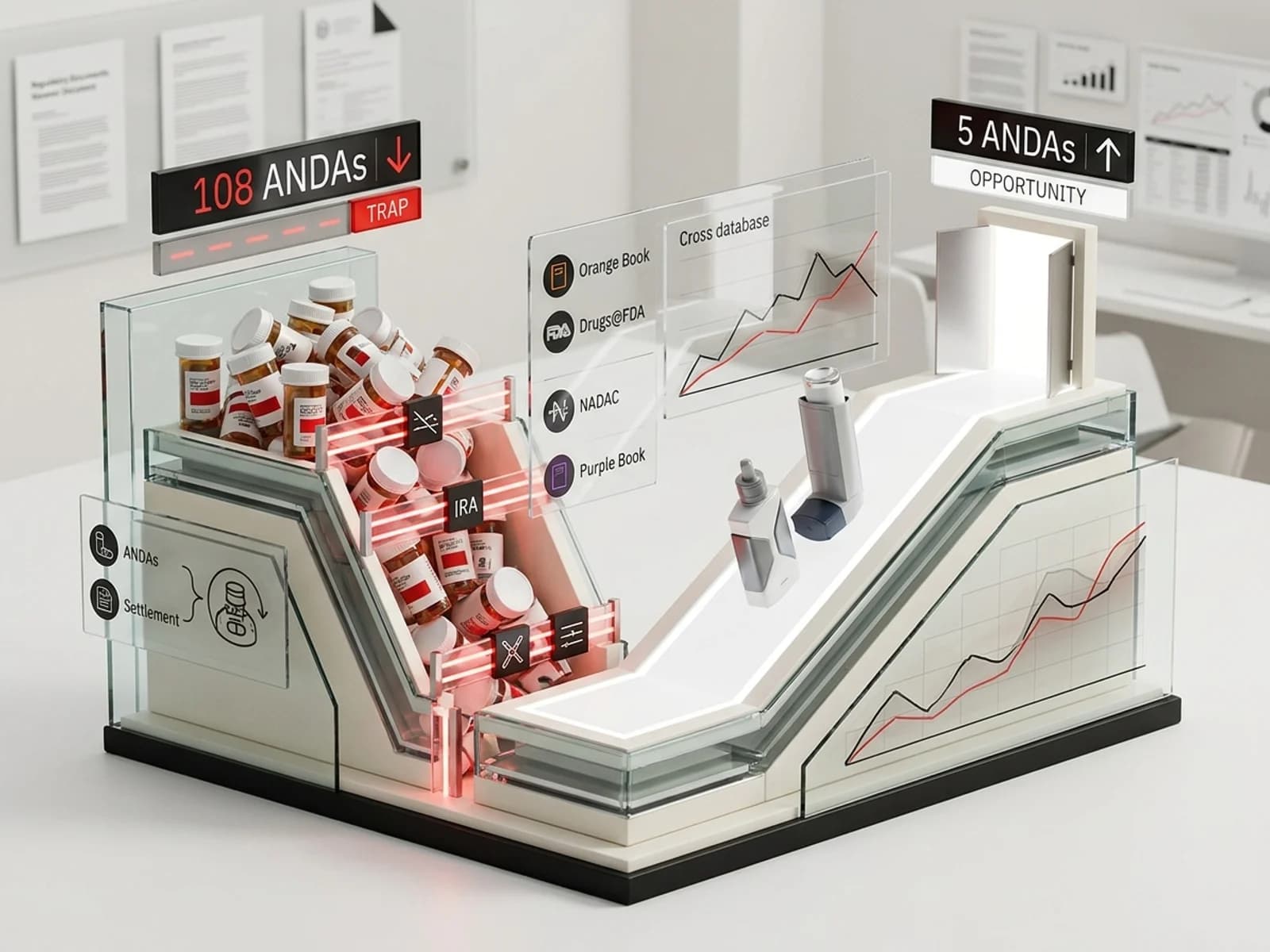
The short answer: most of the headline 2026–2027 cliffs are traps for a new filer. Januvia (108 ANDAs/27 sponsors), Xarelto (76/21, already generic since 2025), Jardiance (54/15, approved-but-blocked to 2029–2034), Eliquis (45/23, IRA-delayed to 2028), Xeljanz (44/23), Otezla (42/14), and Tradjenta (41/16) are saturated or blocked. The genuine openings sit in the thin field of linaclotide (no active generic, but a formulation-patent thicket to the 2030s), enzalutamide and palbociclib (where a design-around beats a crowded tablet queue), and the zero-ANDA complex generics and 351(k) biologics.
Why the biggest 2026–2027 cliffs are generic traps (the crowded-and-IRA-blocked tier)
The most heavily publicized patent cliffs of 2026–2027 are characterized by saturated ANDA pipelines. In these markets, the number of approved generic products and distinct sponsors is so high that the post-launch price will rapidly converge on marginal manufacturing cost. In several cases, government price negotiations under the IRA have further complicated the commercial landscape.
Januvia (sitagliptin) and Tradjenta (linagliptin)
Sitagliptin represents the most crowded cliff in the entire cohort. In the FDA Drugs@FDA database, sitagliptin has 108 approved ANDA products spanning 27 distinct sponsors. The basic compound patent (US 6,699,871) expired in 2022, but Merck held a phosphate-salt patent (US 7,326,708, expiring November 24, 2026, with pediatric exclusivity to May 24, 2027) and combination-product coverage, and it settled its Paragraph IV litigation to allow a staggered wave of generic entry beginning in 2026. Watson, Sandoz, Apotex, and Teva were among the first sponsors to receive generic sitagliptin approvals and to launch from late 2025 into 2026. For any new applicant arriving now, the field is already a highly commoditized, multi-supplier grid. Similarly, linagliptin (Tradjenta) carries 41 approved ANDA products from 16 distinct sponsors.
For a late filer, entering a market with 27 sponsors means competing on price alone, where the brand acquisition cost (Januvia 100 mg at roughly $10.55 per tablet in CMS NADAC) is already collapsing toward the marginal cost of a saturated generic field. Januvia is also on the IRA's first negotiated-price list, with a 2026 Medicare Maximum Fair Price of $113 per 30-day supply, which compresses the brand baseline further.
For Tradjenta (linagliptin), Boehringer Ingelheim held a comparable estate: the M-295 marketing exclusivity runs to June 20, 2026, with pediatric exclusivity extending to December 20, 2026. Because 16 sponsors already hold tentative or full approvals, the post-expiry market will be commoditized quickly.
Jardiance (empagliflozin)
Empagliflozin is the clearest illustration of why a "2026 exclusivity date" is not a launch opportunity. The RLD (NDA 204629) carries a New Patient Population exclusivity (NPP) expiring June 20, 2026, with pediatric exclusivity to December 20, 2026. But the patent estate — not the exclusivity — controls entry here: the compound patent (US 7,579,449) runs to August 1, 2028 (with pediatric exclusivity to February 1, 2029), and a dense set of method-of-use patents (including US 8,551,957, US 9,949,998, and US 10,258,637) extends to 2034.
The result is that generic empagliflozin is approved but not launched (a pattern we dissect in detail for why generic Jardiance has not launched despite the empagliflozin patent cliff). Drugs@FDA shows roughly 54 ANDA products referencing empagliflozin across the monotherapy and combination NDAs, but those approvals are tentative or enjoined: Boehringer Ingelheim has settled each challenger on terms that defer launch until the compound and method patents expire, with earliest realistic entry around 2029 and the outer bound in 2034. CMS NADAC lists only brand Jardiance (about $11.19 per unit for the 10 mg strength), confirming no generic is on the market. A sponsor filing a new ANDA today is arriving into a queue that is already deep and cannot monetize until the end of the decade at the earliest.
Xarelto (rivaroxaban) and Xeljanz (tofacitinib)
Rivaroxaban and tofacitinib show identical pipeline saturation, and both have already begun going generic. Rivaroxaban has 76 approved ANDA products from 21 distinct sponsors, and the first generic Xarelto (rivaroxaban tablets) was approved and launched in March 2025, with reported acquisition costs falling on the order of 80–90% off brand as competition scaled in. Tofacitinib has 44 approved ANDA products from 23 distinct sponsors.
For tofacitinib, Pfizer's compound reissue patent (US RE41,783) expires December 8, 2025, with pediatric exclusivity to June 8, 2026, opening the immediate-release tablet market, while extended-release formulation patents (including US 11,253,523 and US 10,639,309) run to March 2034. The standard immediate-release tablets are heavily saturated; the entry of 23 distinct sponsors guarantees that the brand price (Xeljanz 5 mg at roughly $73.57 per tablet in NADAC) collapses quickly.
The Eliquis (apixaban) trap
Apixaban is the highest-spend drug in Medicare Part D — gross spending reached about $18.3 billion in 2023 — and it is frequently cited as the largest revenue cliff of the decade. For a generic developer planning a new launch, however, apixaban is a strategic trap.
First, the pipeline is extremely deep: there are 45 approved ANDA products from 23 distinct sponsors awaiting launch. Second, the timing of generic entry is not driven by the compound patent expiry alone. Under the terms of patent litigation settlements, generic entry has been delayed until 2028 (with non-project exclusivity expiring April 17, 2028, and pediatric exclusivity extending to October 17, 2028).
Furthermore, Eliquis was selected in the first round of the Medicare Drug Price Negotiation Program under the IRA. The negotiated Maximum Fair Price (MFP) effective January 1, 2026 is $231 per 30-day supply, a 56% reduction from the 2023 list price of $521 (we cover the IRA-and-settlement mechanics behind why Eliquis generics are blocked until 2028 separately). This government-mandated discount compresses branded revenue and establishes a lower pricing baseline years before the generic wave crests in late 2028. Consequently, any generic sponsor entering in 2028 will face compressed margins and a 23-sponsor generic price war.
| Brand Name | Active Ingredient | Brand NADAC (CMS, 2026) | Approved ANDAs | Distinct Sponsors | Primary Exclusivity / Patent Status |
|---|---|---|---|---|---|
| Januvia | sitagliptin | ~$10.55 / 100 mg tablet | 108 | 27 | Salt patent 7,326,708 to Nov 24, 2026 (PED May 24, 2027); generics launching 2026 |
| Xarelto | rivaroxaban | generic launched Mar 2025 (2.5 mg) | 76 | 21 | First generic rivaroxaban approved/launched March 2025 |
| Jardiance | empagliflozin | ~$11.19 / 10 mg tablet | 54 | 15 | NPP Jun 20, 2026; compound patent 7,579,449 to 2028–2029; method patents to 2034 — no launch |
| Eliquis | apixaban | ~$9.69 / 2.5 mg tablet | 45 | 23 | NP Apr 17, 2028 + PED Oct 17, 2028; IRA MFP $231 (2026) |
| Xeljanz | tofacitinib | ~$73.57 / 5 mg tablet | 44 | 23 | Compound RE41,783 to Dec 8, 2025 (PED Jun 8, 2026); XR patents to 2034 |
| Otezla | apremilast | ~$94 / starter pack | 42 | 14 | M-299 Jul 20, 2026; orphan and method patents beyond |
| Tradjenta | linagliptin | ~$16.80 / 5 mg tablet | 41 | 16 | M-295 Jun 20, 2026 + PED Dec 20, 2026 |
The thin-pipeline tier: Linzess, Xtandi, Ibrance and what their patent thickets and exclusivities actually permit
In contrast to the crowded blockbusters, a small subset of the 2026–2027 LOE cohort features thin ANDA pipelines. These molecules represent the highest-value opportunities for generic sponsors, but they are protected by complex patent thickets and staggered exclusivity codes that require careful regulatory navigation.
Linzess (linaclotide)
Linaclotide (NDA 202811, Ironwood / AbbVie) is the thinnest small-molecule field in the cohort: only 5 ANDA products from 3 distinct sponsors (Mylan, Actavis, and Aurobindo) reference it in Drugs@FDA — and as of the current dataset every one of those is either discontinued (Mylan, Aurobindo) or tentatively approved (Actavis). In other words, there is no active generic linaclotide marketer today. That thinness is the opportunity, but it exists for a reason.
The regulatory path requires separating exclusivity from patents:
Exclusivity: The I-921 exclusivity (related to the pediatric program) expires June 12, 2026; a newer New Patient Population (NPP) exclusivity blocks the pediatric labeling expansions (IBS-C in patients ≥7 years, approved November 2025, and functional constipation in patients 2–5 years, approved May 2026) until November 4, 2028, with pediatric exclusivity to May 4, 2029.
Patents: A compound patent (US 7,304,036) expires August 30, 2026, but a formulation and method patent thicket — including US 8,933,030 (February 17, 2031), US 8,748,573 (October 30, 2031), and US 9,708,371 (August 16, 2033) — runs well past the exclusivity dates.
The Actionable Opportunity: A generic filer can use a "skinny label" under 21 U.S.C. § 355(j)(5)(G)(viii) to carve out the pediatric indications covered by the NPP exclusivity and target the adult chronic idiopathic constipation (CIC) and IBS-C label (145 mcg and 290 mcg strengths). But the skinny label solves only the exclusivity problem — it does not clear the formulation patent thicket that runs to 2031–2033, which is precisely why the three existing filers never reached an active launch. The real opening is a design-around or settlement that clears the 2031–2033 formulation patents, after which a sponsor enters an adult market with no active generic competitor at all — high margin, but a 2030s timeline, not a 2026 launch.
Xtandi (enzalutamide)
Enzalutamide (NDAs 203415 and 213674) has a relatively thin pipeline of 10 approved ANDAs from 7 distinct sponsors. The compound patents (US 9,126,941 and US 8,183,274) expire on May 15, 2026, and August 24, 2026, respectively.
However, Astellas and Pfizer have constructed a formulation and method-of-use patent thicket that extends much further:
Formulation patents (e.g., US 12,502,357 and US 12,447,128) run until September 11, 2033.
Additional crystalline form patents (e.g., US 12,161,628) extend to February 23, 2037.
Exclusivity code I-926 (covering the treatment of non-metastatic castration-sensitive prostate cancer) runs until November 17, 2026.
The Actionable Opportunity: To bypass the 2033–2037 formulation patents, generic entrants must develop non-infringing solid dispersions or amorphous formulations. Enzalutamide is highly insoluble in water, and the branded product utilizes a specific liquid-filled soft gelatin capsule or a solid dispersion using a polyvinylpyrrolidone-vinyl acetate (PVP-VA) copolymer to achieve bioequivalence.
Generic sponsors must design alternative amorphous solid dispersions (ASDs)—for example, using hypromellose acetate succinate (HPMCAS) or copovidone carriers via hot-melt extrusion (HME) or spray-dried dispersion (SDD) technologies. Developing these alternative formulations is technically challenging and requires significant R&D investment. However, the reward is substantial: sponsors who successfully achieve bioequivalence with a non-infringing formulation will bypass the 2033 patents and launch years ahead of competitors who must wait for the formulation patents to expire.
Ibrance (palbociclib)
Palbociclib (NDA 207103) is a blockbuster CDK4/6 inhibitor with 24 approved ANDAs from 10 distinct sponsors. The compound reissue patent (US RE47,739) expires March 5, 2027, with pediatric exclusivity to September 5, 2027.
Pfizer has layered additional protections:
Exclusivity code M-14 expires on September 16, 2028.
Pediatric exclusivity (PED) extends the regulatory block to March 16, 2029.
A formulation/polymorph patent (US 10,723,730) runs to February 8, 2034 — so the exclusivity cliff and the patent cliff do not coincide.
The Actionable Opportunity: Twenty-four approved products is moderate competition, far less crowded than the diabetes drugs, and Ibrance carries a high brand price that leaves margin even in a 10-player market. But the March 16, 2029 date is the exclusivity cliff, not a clean launch date: a filer must also clear or design around the formulation patent that runs to 2034. Sponsors who can build a non-infringing polymorph can launch at the exclusivity cliff; those who cannot must wait until 2034 or settle. The therapeutic-class dynamic favors whichever sponsor reaches the market first — generic palbociclib will pull aggressive step-therapy protocols ahead of brand-name Kisqali (ribociclib) and Verzenio (abemaciclib).
Complex generics and biologics: where zero ANDAs means opportunity, not absence of interest
The absolute highest-barrier opportunities in 2026–2027 carry an approved ANDA count of zero. In these therapeutic areas, the barrier is either technical (drug-device combination products) or regulatory (biologics migrating to the 351(k) biosimilar pathway).
Inhaled drug-device combinations
Single-source inhaled products, such as Trelegy Ellipta (fluticasone furoate/umeclidinium/vilanterol) and Breo Ellipta, have zero approved ANDAs. The compound patents are expiring, but the dry-powder inhaler (DPI) device patents (specifically the Ellipta device mechanics and multi-dose strip alignment) run into the 2030s.
To win these markets, generic sponsors cannot simply show chemical bioequivalence of the active ingredients. They must design a customized DPI device that replicates the inhalation resistance, dose consistency, and ease of use of the reference product without infringing the device patents.
Furthermore, generic developers must run expensive clinical endpoints (pharmacodynamic bioequivalence) rather than simple in vitro dissolution tests. In vitro testing requires demonstrating equivalent aerodynamic particle size distribution (APSD) via cascade impaction under varying flow rates, while in vivo testing requires conducting clinical trials in asthma or COPD patients to prove equivalent bronchodilation (FEV1 endpoints). This technical and regulatory moat keeps competitor counts at zero, securing 100% of the generic market share for the first mover.
The biologic transition (Purple Book)
Several major biologics face loss of exclusivity in 2026–2027. Because these are biologics, they are completely absent from the Drugs@FDA ANDA pipeline and the Orange Book. Instead, they are governed by the Purple Book and require a 351(k) Biologics License Application (BLA).
Denosumab (Prolia/Xgeva): Denosumab carries zero ANDAs because it is a biologic on the 351(k) route. The U.S. franchise is multi-billion-dollar, and the biosimilar field has already moved: Sandoz's Wyost and Jubbonti (denosumab-bbdz) were approved March 5, 2024 as the first interchangeable denosumab biosimilars and launched in the U.S. on June 2, 2025; Samsung Bioepis's SB16 (denosumab-dssb) was approved February 2025; and Celltrion and Fresenius Kabi reached settlements setting 2025 launch windows. Interchangeability — which permits pharmacy-level substitution subject to state law — was granted through the standard 351(k) pathway and the post-2022 statutory framework that no longer requires dedicated switching studies, not a special 2026 program.
Vedolizumab (Entyvio): Takeda’s Entyvio is another high-value biologic with zero ANDAs. Biosimilar development is underway, but developers face a dual challenge: replicating both the intravenous (IV) formulation and the newer subcutaneous (SC) pen formulation. The SC formulation, approved for maintenance therapy, represents the higher-margin segment and is protected by device-specific patents that run into the 2030s.
| Target Brand | Reference Ingredient | Pathway | Approved ANDAs | Biosimilar Pipeline (351(k)) | Key Moat / Barrier |
|---|---|---|---|---|---|
| Trelegy Ellipta | fluticasone/umec/vilanterol | 505(j) | 0 | None | DPI device engineering & device patents |
| Prolia / Xgeva | denosumab | 351(k) | 0 | 4+ Pending | Biologic manufacturing & interchangeability |
| Entyvio | vedolizumab | 351(k) | 0 | 2+ Pending | Cell-line scale-up & SC device replication |
Strategic Pricing and PBM Formulary Negotiation for Generic Entrants
Filing and securing approval for a thin-pipeline generic molecule is only half the battle. To generate sustainable cash flow, generic sponsors must navigate the pricing structures and rebate systems managed by Pharmacy Benefit Managers (PBMs). In the U.S., the three largest PBMs—CVS Caremark, Express Scripts, and OptumRx—control over 80% of prescription drug volume.
WAC, NADAC, and the rebate wall
When a generic launch occurs, the sponsor must establish the Wholesale Acquisition Cost (WAC). For a crowded generic (e.g., sitagliptin), the WAC is immediately set at an 80% to 90% discount relative to the branded drug's WAC. This is necessary because PBMs will quickly move the generic to the lowest pricing tier, and pharmacies will purchase based on the National Average Drug Acquisition Cost (NADAC) to maximize their retail margins.
However, for a thin-pipeline generic (e.g., linaclotide adult launch), the sponsor can utilize a "high-WAC, high-rebate" or "low-WAC, low-rebate" dual pricing strategy.
High-WAC Strategy: Under this model, the generic sponsor lists a WAC close to the branded WAC but offers steep rebates to the PBMs. PBMs often prefer this strategy because they retain a portion of the rebate spread, which they pass to employers or keep as administrative fees. This "rebate wall" is a major reason why generic entrants fail to capture volume despite having a lower net price; if the generic does not offer enough rebate dollars, the PBM will keep the branded drug on the preferred formulary status.
Low-WAC Strategy: Under this model, the sponsor lists a very low WAC and offers zero or minimal rebates, targeting cash-pay channels (e.g., Mark Cuban Cost Plus Drugs) and independent pharmacies that purchase based on NADAC. This bypasses the PBM rebate loop entirely but limits access to commercial insurance plan designs.
Generic launch teams must analyze their cost of goods sold (COGS) and plan their pricing strategies at least 12 months before launch to align with PBM annual formulary selection cycles.
The Role of 505(b)(2) Hybrid Applications in Exclusivity Strategies
When a generic developer cannot meet the strict bioequivalence standards of a standard 505(j) ANDA, or when the Orange Book patent estate is too dense to design around, the sponsor should consider a 505(b)(2) New Drug Application.
A 505(b)(2) application allows the sponsor to rely on the FDA's findings of safety and efficacy for an existing approved drug (the reference listed drug, or RLD) while submitting new clinical or manufacturing data to support a modification.
Bypassing moats via formulation and delivery changes
The 505(b)(2) pathway is a powerful tool to bypass formulation and device patent moats:
Excipient and Form Modifications: If a brand holds patents on a specific amorphous solid dispersion carrier (e.g., Xtandi's copovidone carrier), a sponsor can submit a 505(b)(2) application using a different polymer carrier. Even if the FDA requires a small clinical safety study to confirm the absorption profile, the cost is far lower than a full BLA/NDA, and it allows the sponsor to secure approval without waiting for the formulation patents to expire.
Alternative Dosage Forms: A sponsor can convert a hard-to-manufacture oral capsule (e.g., palbociclib) into an oral suspension or a fast-dissolving tablet. By targeting a different patient subpopulation (e.g., patients with dysphagia or pediatric patients), the sponsor can secure 3 years of clinical Hatch-Waxman exclusivity for the new dosage form, preventing other generics from copying the modified version.
Fixed-Dose Combinations: Combining two generic APIs into a single combination tablet allows a sponsor to create a proprietary brand with its own patent listings, escaping the commodity pricing of standard generics.
Understanding FDA Exclusivity Codes and Their Blocking Rules
To schedule generic launches accurately, portfolio teams must map the exact type of FDA market exclusivity protecting the reference drug. These exclusivities run independently of patents and are enforced directly by the FDA's Office of Generic Drugs (OGD), which will refuse to grant final approval to an ANDA if an exclusivity is active.
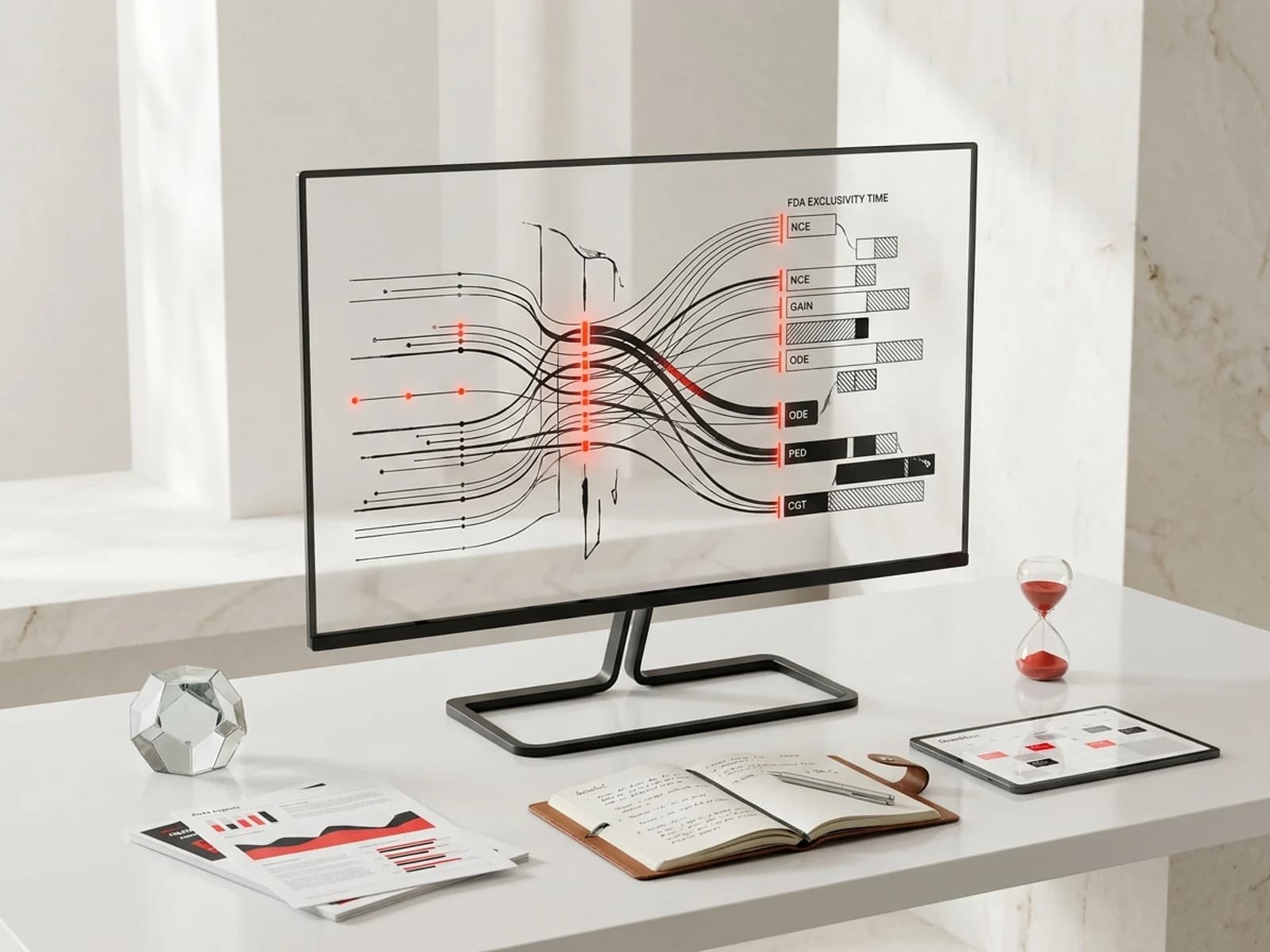
The five primary exclusivity codes listed in the Orange Book are:
NCE (New Chemical Entity - 5 Years): Under the Hatch-Waxman Act, a drug approved with an active ingredient that has not been previously approved by the FDA receives 5 years of market exclusivity. During this period, no sponsor can file an ANDA referencing the RLD, except that a Paragraph IV ANDA may be filed after 4 years if it challenges a listed patent. This is known as the "NCE 1-year window."
NPP / NP (New Product / New Product Period - 3 Years): Granted for supplements or NDAs that introduce a new indication, a new dosage strength, or a new formulation that required new clinical trials. The NPP blocks the FDA from approving any ANDA for that specific modification for 3 years.
ODE (Orphan Drug Exclusivity - 7 Years): Granted to drugs designated and approved to treat a rare disease or condition (affecting fewer than 200,000 patients in the U.S.). The ODE is a highly potent blocker: it prevents the FDA from approving another drug containing the same active moiety for the same orphan indication for 7 years, unless the entrant can show clinical superiority.
GAIN (Generating Antibiotic Incentives Now - 5 Years): Under the 2012 GAIN Act, drugs designated as Qualified Infectious Disease Products (QIDPs)—typically novel antibacterials or antifungals—receive an automatic 5-year extension added to any NCE, NPP, or pediatric exclusivity.
PED (Pediatric Exclusivity - 6 Months): As discussed, the BPCA grants a 6-month extension that is appended to the end of all listed patents and existing exclusivities if the sponsor successfully completes pediatric trials requested by the FDA.
Generic sponsors must identify which exclusivities block the whole molecule (such as NCE or NCE+PED) versus those that only block specific indications (such as NPP or ODE). For indication-specific exclusivities, sponsors can draft a skinny label to bypass the blocker, whereas molecule-level exclusivities represent hard, un-bypassable walls.
Paragraph IV Litigation Workflows and the 30-Month Stay
Filing an ANDA that challenges a listed Orange Book patent under a Paragraph IV certification (asserting that the patent is invalid, unenforceable, or will not be infringed by the generic product) triggers a highly structured statutory legal battle.
The workflow proceeds through three major phases:
The Notice Letter: Within 20 days of receiving a filing acceptance from the FDA, the ANDA applicant must send a detailed Paragraph IV Notice Letter to the NDA sponsor and the patent owner. This letter must outline the factual and legal basis for the generic sponsor's claim of invalidity or non-infringement for every challenged patent.
The 45-Day Litigation Trigger: Upon receiving the Notice Letter, the branded manufacturer has 45 days to file a patent infringement lawsuit against the ANDA applicant in federal district court.
The 30-Month Stay: If the brand files the lawsuit within the 45-day window, the FDA is automatically prohibited from granting final approval to the ANDA for 30 months (or until the district court decides the case or the patent expires, whichever occurs first).
Managing the 30-month stay window
The 30-month stay is the brand's primary weapon to delay generic entry, as it prevents launch even if the ANDA is technically ready for approval. Generic sponsors have three primary options to manage this stay:
Fast-Track Litigation: Cooperate during court discovery to expedite the trial and secure a district court decision before the 30 months expire.
Launch at Risk: If the 30-month stay expires before the district court renders a decision, the FDA can grant final approval to the ANDA. The generic sponsor can choose to launch the product "at risk." If the court subsequently finds the patent valid and infringed, the generic sponsor can be liable for massive treble damages based on the brand's lost profits. This is a high-risk strategy reserved for well-capitalized sponsors.
Settlement: The vast majority of Paragraph IV lawsuits are resolved through settlement agreements. The generic sponsor agrees to delay its launch to a specific date (often years before the final patent expires) in exchange for the brand dismissing the lawsuit and permitting licensed entry.
A scoring rubric: ANDA depth, barrier complexity, time-to-clean-cliff, and IRA/settlement overlays
To help portfolio planning teams prioritize development and filing capital, we have constructed a quantitative Generic Launch Opportunity Score.
The scoring formula is defined as: $$\text{Opportunity Score} = \text{ANDA Depth Score} \times \text{Barrier Score} \times \text{Clean-Cliff Score} \times \text{IRA/Settlement Modifier}$$
ANDA Depth Score (1 to 10): 10 representing 0 approved ANDAs; 1 representing >40 approved ANDAs.
Barrier Score (1 to 10): 10 representing complex device/biologic scaling; 1 representing simple immediate-release tablets.
Clean-Cliff Score (1 to 10): 10 representing a clean, near-term patent/exclusivity expiry; 1 representing a distant or highly uncertain cliff.
IRA/Settlement Modifier (0.1 to 1.0): 0.1 representing immediate IRA Maximum Fair Price price-compression or major litigation delays; 1.0 representing no IRA or settlement delays.
The 2026–2027 Portfolio Opportunity Scorecard
| Molecule | Brand | ANDA Count / Sponsors | Barrier Class | Clean Cliff Date | IRA / Settlement Risk | Opportunity Score (Max 10) | Tactical Recommendation |
|---|---|---|---|---|---|---|---|
| Linaclotide | Linzess | 5 / 3 (all discontinued/tentative) | Complex Oral Peptide | Formulation patents to 2031–2033 | Low (No IRA selection) | 7.5 / 10 | Thin field, 2030s entry: Use a skinny label to drop the pediatric NPP indications, then design around the formulation patents (to 2031–2033) or settle. No active generic competitor exists today. |
| Enzalutamide | Xtandi | 10 / 7 | Amorphous Solid Dispersion | Compound patents May/Aug 2026 (method patents to 2033–2037) | Low (No near-term IRA impact) | 7.2 / 10 | Formulation Design-Around: Develop a non-infringing solid dispersion to bypass the 2033–2037 formulation patents. High oncology margins. |
| Palbociclib | Ibrance | 24 / 10 | Standard Oral Capsule | Exclusivity Mar 16, 2029; formulation patent to Feb 8, 2034 | Low (No near-term IRA impact) | 6.3 / 10 | Conditional Wave 1 Entry: March 16, 2029 is the exclusivity cliff, but only sponsors with a non-infringing polymorph clear the 2034 formulation patent; others wait to 2034 or settle. |
| Denosumab | Prolia / Xgeva | 0 (Biologic) | BLA / Cell-line Scaling | First wave already launched (Sandoz Jun 2025) | Moderate (later-wave entrants face price erosion) | 5.0 / 10 | Late-wave 351(k) only: The interchangeable first wave (Sandoz, Samsung Bioepis, Celltrion, Fresenius Kabi) has launched; a new filer is now a 5th-plus mover on a biosimilar route. |
| Rivaroxaban | Xarelto | 76 / 21 | Simple Tablet | Generic launched March 2025 | High (price already collapsed ~80–90%) | 2.1 / 10 | Divest / De-prioritize: The price is already destroyed by the 2025 launch and 21 competitors. |
| Sitagliptin | Januvia | 108 / 27 | Simple Tablet | Salt patent Nov 24, 2026; generics launching 2026 | High (Severe multi-supplier erosion; IRA MFP $113) | 1.8 / 10 | Divest / Avoid: Saturated pipeline guarantees immediate margin collapse. High distribution costs relative to return. |
| Apixaban | Eliquis | 45 / 23 | Simple Tablet | Oct 17, 2028 | High (IRA MFP $231 effective 2026) | 1.2 / 10 | Avoid / Trap: The Maximum Fair Price starting in 2026 compresses the margin baseline years before the 23-competitor generic wave hits in 2028. |
Portfolio Planning Decision Matrix
To assist in systematic product selection, generic sponsors should execute the following decision workflow when evaluating any candidate molecule in the 2026–2027 LOE cohort:
[Candidate LOE Molecule]
         │
         ├─► [Are there >= 40 approved ANDAs?] ──► YES ──► [Reject / Divest Opportunity]
         │                                                      (Commodity Trap)
         │
         └─► NO
              │
              ├─► [Is the drug selected for IRA MFP?] ──► YES ──► [Compress Margin Models]
              │                                                        (Eliquis/Apixaban Class)
              │
              └─► NO
                   │
                   ├─► [Are there formulation/device patents?]
                   │         │
                   │         ├─► YES ──► [Can we design a non-infringing ASD or DPI device?]
                   │         │                 │
                   │         │                 ├─► YES ──► [Target as High-Value Thin Pipeline]
                   │         │                 │                (Xtandi/Linzess Class)
                   │         │                 │
                   │         │                 └─► NO ──► [Delay Entry / Settle Date]
                   │         │
                   │         └─► NO
                   │              │
                   │              └─► [Check for Pediatric/NPP Exclusivity Overlays]
                   │                        │
                   │                        ├─► [Can we skinny label?] ──► YES ──► [Launch Immediate]
                   │                        │                                           (Linaclotide Adult)
                   │                        │
                   │                        └─► NO ──► [Target Hard Expiry Date]
                   │                                         (Palbociclib 2029)
Failure cases: molecules that looked open but were blocked by NPP/pediatric exclusivity, device patents, or settlements
A common error in generic portfolio planning is relying solely on compound patent expiration dates listed in the Orange Book. Several molecules in the 2026–2027 cohort appeared to be open but have proven to be commercial dead-ends or required long delays.
The pediatric exclusivity extension trap
Under the Best Pharmaceuticals for Children Act (BPCA), a branded sponsor who completes pediatric studies requested by the FDA receives a six-month extension of all existing patents and exclusivities listed in the Orange Book.
For example, linagliptin (Tradjenta) compound patent expiries were set for mid-2026. However, Boehringer Ingelheim secured a pediatric extension (PED) that pushed the regulatory blocker to December 20, 2026. This six-month window represents a significant delay that can throw off a generic sponsor's launch logistics and cash flow if not factored into the initial filing timeline. Generic sponsors must monitor the FDA's Pediatric Written Request database to anticipate these six-month extensions before they are officially listed in the Orange Book.
Label-carve-out (skinny label) rejection
While 21 U.S.C. § 355(j)(5)(G)(viii) allows generic sponsors to carve out patented indications, branded sponsors have successfully countered this by amending their labels to merge patented indications with generic ones, or by arguing that the carved-out label renders the generic drug unsafe or ineffective for the remaining indications.
In the case of linaclotide, the brand has positioned pediatric functional constipation (protected by NPP exclusivity to 2028) as a critical safety parameter. Generic developers must ensure that their carved-out labeling does not omit key safety warnings or instructions, which would prompt the FDA to refuse ANDA approval on safety grounds. Furthermore, patent litigation (such as the landmark GlaxoSmithKline v. Teva skinny-label inducement case) has increased the risk that generic sponsors may be held liable for patent infringement if their marketing materials or medical affairs activities induce physicians to prescribe the generic for the carved-out, patented indication.
Device-patent blockades
Branded manufacturers of drug-device combination products (such as dry-powder inhalers, auto-injectors, and nasal sprays) frequently list patents in the Orange Book that cover the physical device rather than the drug substance.
Generic sponsors who fail to perform a comprehensive device patent search often develop a bioequivalent formulation only to find themselves blocked by device patents that do not expire for a decade after the compound patent. This has occurred repeatedly in the epinephrine auto-injector market, where device patents have repeatedly delayed or blocked generic entrants despite the epinephrine molecule itself being over a century old. Sponsors must establish a dedicated device IP clearance workflow to complement their API clearance processes.
FAQ
Which 2026–2027 patent cliff has the fewest generic competitors filed?
Among the major small-molecule cliffs, Linzess (linaclotide) has the fewest ANDA products on file — only 5, from 3 sponsors (Mylan, Actavis, and Aurobindo) — and all of those are discontinued or tentatively approved, so there is no active generic linaclotide on the market. That thin field is attractive, but entry is gated by the formulation patent thicket that runs to 2031–2033, so the realistic launch window is the 2030s unless a sponsor designs around or settled.
Why can't I just launch a generic Eliquis or Januvia in 2026?
Januvia's basic compound patent expired in 2022, but its phosphate-salt patent (US 7,326,708) runs to late 2026, and Merck settled to begin generic sitagliptin launches in 2026 — into a field already holding 108 approved ANDAs from 27 sponsors, which is why it is a commoditized trap for a late filer. Eliquis is legally blocked from generic launch until late 2028 under patent litigation settlements, and its IRA Maximum Fair Price ($231 per 30-day supply, effective 2026) compresses margins years before the 23-sponsor generic wave arrives.
What makes a complex generic like an inhaled combination a better opportunity than a small-molecule tablet?
Complex generics, such as dry-powder inhaler (DPI) combinations (e.g., Trelegy or Breo Ellipta), have zero approved ANDAs. Their primary barrier is not active ingredient synthesis, but the physical engineering of the inhaler device and the need to run costly clinical endpoint bioequivalence trials. This technical and patent barrier prevents the margin-eroding competitor rush seen in standard tablets, protecting the developer's margins and market share post-launch.
Sources
FDA Orange Book (Approved Drug Products with Therapeutic Equivalence Evaluations): July 8, 2026 export edition. Used for patent expiration dates, exclusivity codes (NCE, NPP, NP, PED), RLD designations, and total cohort counts (575 exclusivities expiring in 2026; 537 in 2027; 1,609 patents expiring in 2026; 2,157 in 2027). FDA Orange Book Portal
FDA Drugs@FDA Database: July 9, 2026 export edition. Source for ANDA-product counts, NDA reference listings, and sponsor-name aggregations. openFDA Drugs@FDA Portal
CMS National Average Drug Acquisition Cost (NADAC): July 8, 2026 registry. Used for brand-versus-generic drug acquisition cost comparisons (Januvia 100 mg ~$10.55/tablet, Jardiance 10 mg ~$11.19/tablet, Eliquis 2.5 mg ~$9.69/tablet, Xeljanz 5 mg ~$73.57/tablet, Tradjenta 5 mg ~$16.80/tablet). Medicaid.gov NADAC Portal
FDA Purple Book (Database of Licensed Biological Products): July 8, 2026 export. Used to cross-reference biologic-route cliffs and biosimilar filings for denosumab and vedolizumab. FDA Purple Book Database
CMS Inflation Reduction Act (IRA) Medicare Drug Price Negotiation Program: Reference for Eliquis (apixaban) Maximum Fair Price effective date (2026) and pricing baseline. CMS IRA Program Guidance
Think Global Health: "Importing Generic Drugs Could Ease U.S. Shortages" (2025). Reference for average shortage durations and FDA importation actions. Think Global Health
Springer Drug Safety 2026: "US REMS with ETASU: A Longitudinal Analysis of REMS Modifications (2008–2022)". Source for active REMS program counts (71 active, 65 with ETASU). Springer Link
HHS ASPE: "US Biosimilar Market Entry Challenges and Facilitating Factors" (August 18, 2025). Reference for ASPE findings on REMS sample obstruction tactics. HHS ASPE Report