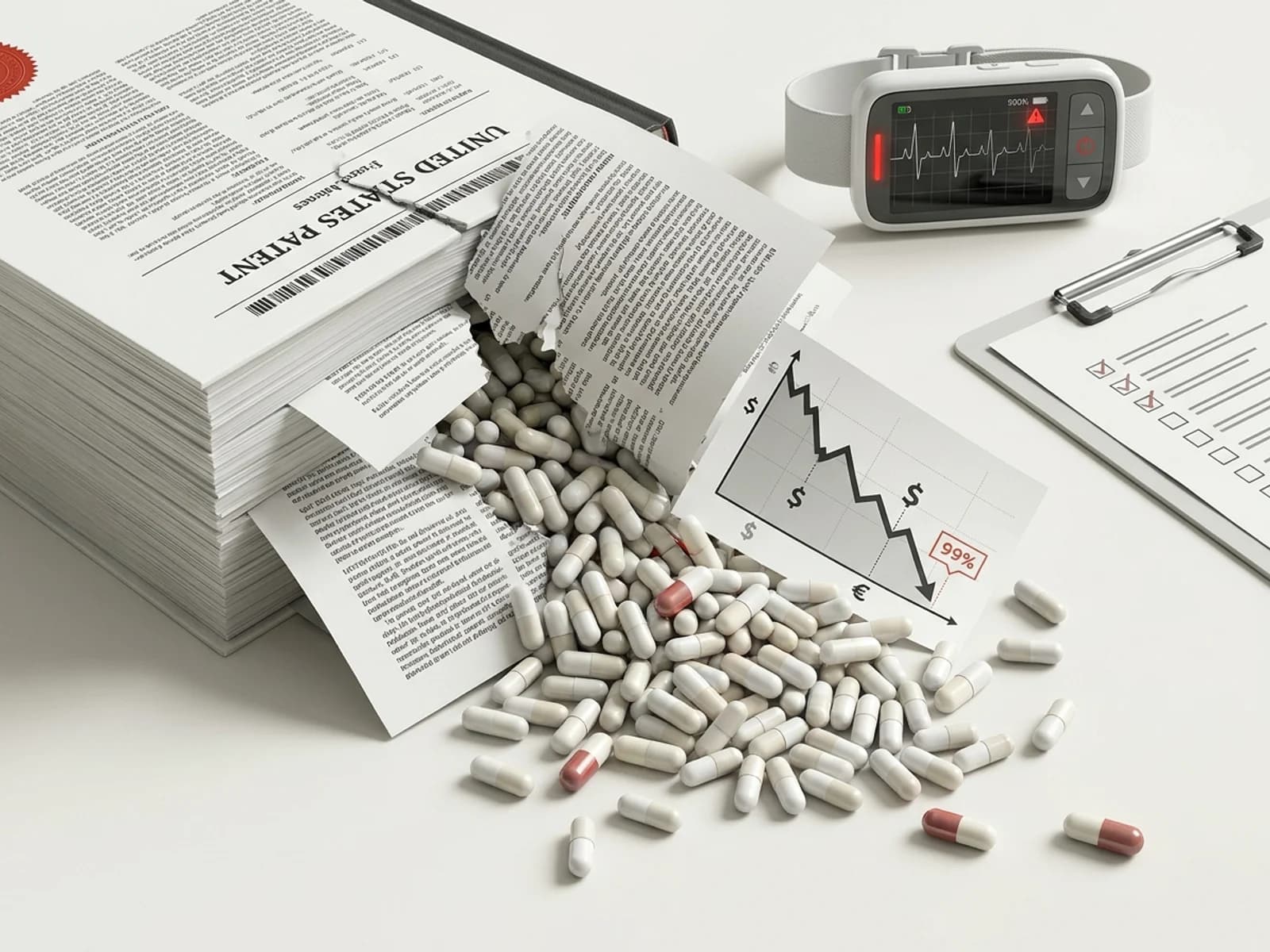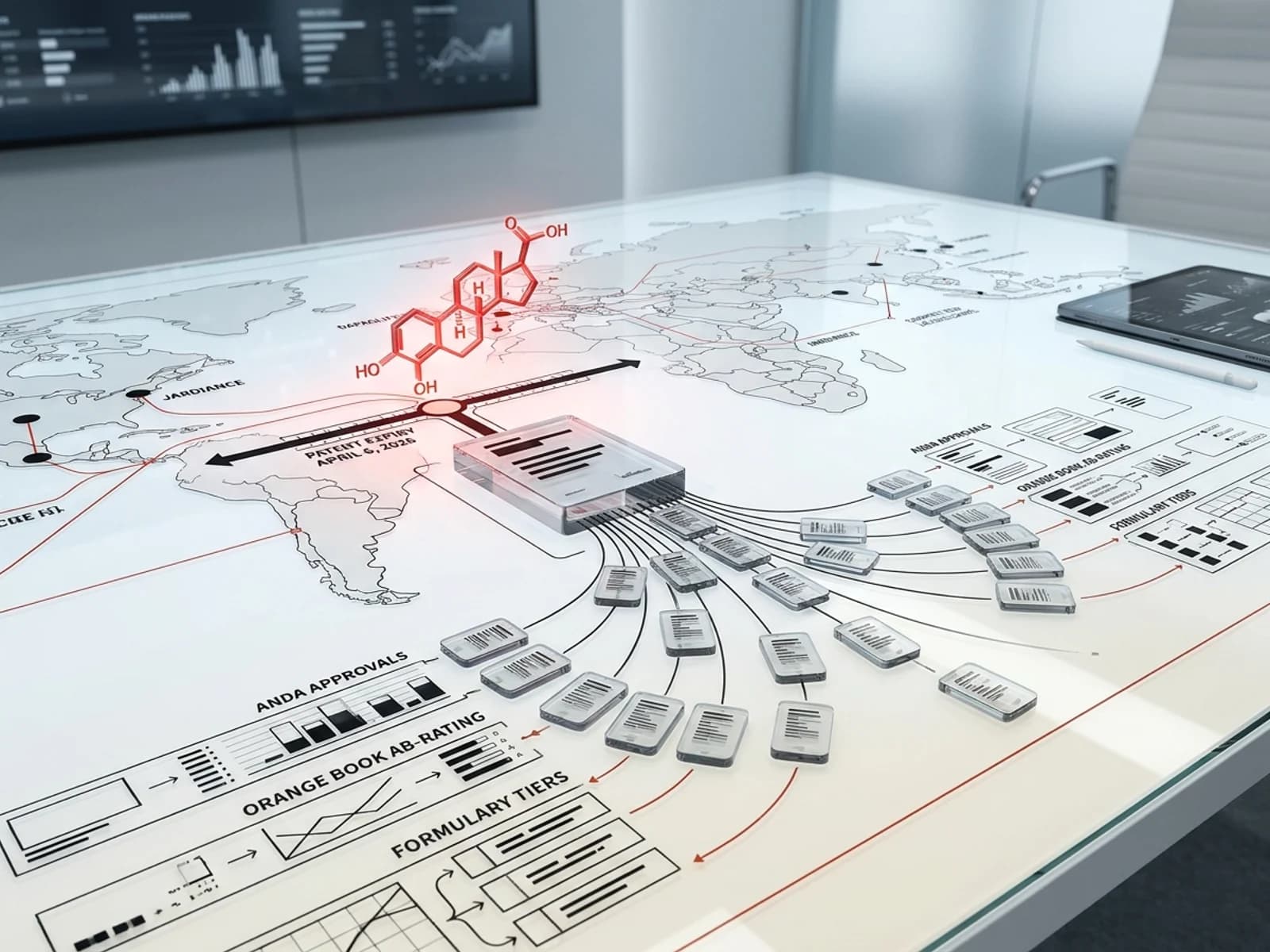
As of the June 10, 2026 FDA Orange Book snapshot, Boehringer Ingelheim holds five empagliflozin originator NDAs: 204629 for Jardiance (10 mg and 25 mg tablets) monotherapy, plus 206073, 206111, 208658, and 212614 for the Glyxambi, Synjardy, Synjardy XR, and Trijardy XR combinations. Zydus Pharmaceuticals is the only generic manufacturer with approved empagliflozin ANDAs in the Orange Book: ANDA 212138 for Jardiance 10 mg and 25 mg monotherapy, and ANDA 212198 for the empagliflozin/metformin combinations. Despite these FDA approvals, no generic empagliflozin has launched.
The reason for this lag is a dense patent estate associated with the originator NDAs—GreyB tracks 28 active US patents spanning the active compound, crystalline forms, formulations, and methods of use. Boehringer Ingelheim sued Zydus within the statutory 45-day Paragraph IV window over the '449 (US 7,579,449), '938 (US 7,713,938), and '998 (US 9,949,998) patents, and that consolidated District of Delaware action (Civil Action No. 18-1689) was subsequently dismissed after the parties resolved it. Zydus's ANDA therefore carries final FDA approval but no current launch right: the compound and substance patents remain in force, and the negotiated entry terms defer a launch until those rights expire.
The compound and product patents run from an April 15, 2027 drug-substance expiry on the '938 patent through method-of-treatment patents extending to 2034. Modeling a first-filer license lag of roughly six months after the August 1, 2028 compound-patent ('449) expiry puts earliest realistic entry in early 2029, while the full method-of-use estate—GreyB estimates a latest-case launch date of December 11, 2034—sets the outer bound. Boehringer Ingelheim has separately blocked other challengers, obtaining a consent judgment against USV, an early settlement with Sun Pharmaceutical, a December 2025 UK High Court interim injunction against Dr. Reddy's (followed by a Q1 2026 settlement of the parallel US Delaware case), and a settlement with Granules. CMS NADAC continues to list only brand Jardiance at approximately $11.19 per unit for the 10 mg strength and $11.20 per unit for the 25 mg strength, with no generic empagliflozin lines present, confirming the launch remains blocked.
Which empagliflozin ANDAs are approved in the Orange Book and who holds them?
In the FDA's Approved Drug Products with Therapeutic Equivalence Evaluations (commonly known as the Orange Book), the landscape for empagliflozin is bifurcated between the originator's NDAs and a single, first-wave generic filer. Boehringer Ingelheim, in alliance with Eli Lilly, holds the five originator NDAs that define the brand franchise:
NDA 204629: Jardiance (empagliflozin) tablets, 10 mg and 25 mg, approved on August 1, 2014.
NDA 206073: Glyxambi (empagliflozin and linagliptin) tablets, approved on January 30, 2015.
NDA 206111: Synjardy (empagliflozin and metformin hydrochloride) tablets, approved on August 27, 2015.
NDA 208658: Synjardy XR (empagliflozin and metformin hydrochloride) extended-release tablets, approved on December 9, 2016.
NDA 212614: Trijardy XR (empagliflozin, linagliptin, and metformin hydrochloride) extended-release tablets, approved on January 27, 2020.
Under the Hatch-Waxman Act, generic developers seeking to market empagliflozin must file an Abbreviated New Drug Application (ANDA) demonstrating bioequivalence to one of these reference listed drugs (RLDs). While many companies have submitted ANDAs, only one applicant has successfully secured final FDA approval:
ANDA 212138: Held by Zydus Pharmaceuticals (USA) Inc., approved for empagliflozin monotherapy (10 mg and 25 mg strengths), bioequivalent to Jardiance.
ANDA 212198: Also held by Zydus Pharmaceuticals, approved for the combination strengths of empagliflozin and metformin (5 mg/500 mg, 5 mg/1000 mg, 12.5 mg/500 mg, and 12.5 mg/1000 mg), bioequivalent to Synjardy.
This exclusive approval status makes Zydus the sole manufacturer positioned to launch a generic alternative to Jardiance. However, the presence of a "final approval" status in the Orange Book does not translate to immediate market availability. In the pharmaceutical industry, a generic filer may secure FDA approval but remain enjoined from launching due to unresolved patent litigation or settlement terms that defer launch to a specific future date, creating the approved-but-blocked status that characterises the empagliflozin market.
Why have the approved Zydus ANDAs not launched: the '449, '938, and '998 patent estate?
The barrier preventing Zydus from launching its approved generic products is the extensive patent estate that Boehringer Ingelheim has compiled around empagliflozin. Across the five originator NDAs, the Orange Book lists a multi-layer estate of patents—GreyB tracks 28 active US patents—covering the active chemical compound, crystalline forms, manufacturing methods, formulations, and methods of therapeutic use.
Under Hatch-Waxman rules, when a generic applicant files an ANDA containing a Paragraph IV certification (asserting that the originator's patents are invalid, unenforceable, or will not be infringed by the generic product), they must notify the patent holder. This notification triggers a 45-day window in which the originator can file a patent infringement lawsuit, which automatically stays the FDA from granting final approval for 30-months, or until a court resolves the dispute.
Boehringer Ingelheim aggressively defended its franchise, filing infringement suits against Zydus and other ANDA applicants. The litigation focused on several key patents:
US Patent 7,713,938 (the '938 patent): Covering the empagliflozin chemical substance and product. This crystalline form patent carries a drug-substance and drug-product flag in the Orange Book and is scheduled to expire on April 15, 2027 (including pediatric exclusivity).
US Patent 7,579,449 (the '449 patent): Covering the active chemical compound itself. This basic compound patent has a drug-substance flag and is scheduled to expire on August 1, 2028.
US Patent 9,949,998 (the '998 patent): Covering methods of treating type 2 diabetes and associated cardiovascular risks. This method-of-use patent extends through December 11, 2034.
Empagliflozin Key Patent Expiries
The table below lists the primary patents from the Orange Book that control the loss of exclusivity (LOE) timeline for the empagliflozin NDAs:
| RLD NDA | Patent Number | Expiry Date | Drug Substance Flag | Drug Product Flag | Patent Type / Subject |
|---|---|---|---|---|---|
| 204629 (Jardiance) | 7713938 | Apr 15, 2027 | Y | Y | Active crystalline substance form |
| 204629 (Jardiance) | 7579449 | Aug 1, 2028 | Y | -- | Basic chemical compound molecule |
| 206073 (Glyxambi) | 11033552 | May 4, 2027 | -- | Y | Linagliptin combination formulation |
| 206073 (Glyxambi) | 9173859 | May 4, 2027 | -- | Y | Method of combination treatment |
| 206073 (Glyxambi) | 8551957 | Oct 14, 2029 | -- | Y | Dual mechanism formulation method |
| 206111 (Synjardy) | 10610489 | Sep 30, 2030 | -- | Y | Metformin combination formulation |
| 208658 (Synjardy XR) | 10596120 | Mar 7, 2032 | -- | Y | Extended-release matrix formulation |
| 212614 (Trijardy XR) | 10022379 | Apr 2, 2029 | -- | Y | Triple combination product |
| 212614 (Trijardy XR) | 10406172 | Jun 15, 2030 | -- | Y | Method of triple therapy treatment |
| 212614 (Trijardy XR) | 11564886 | Mar 7, 2032 | -- | Y | Extended-release multi-layer tablet |
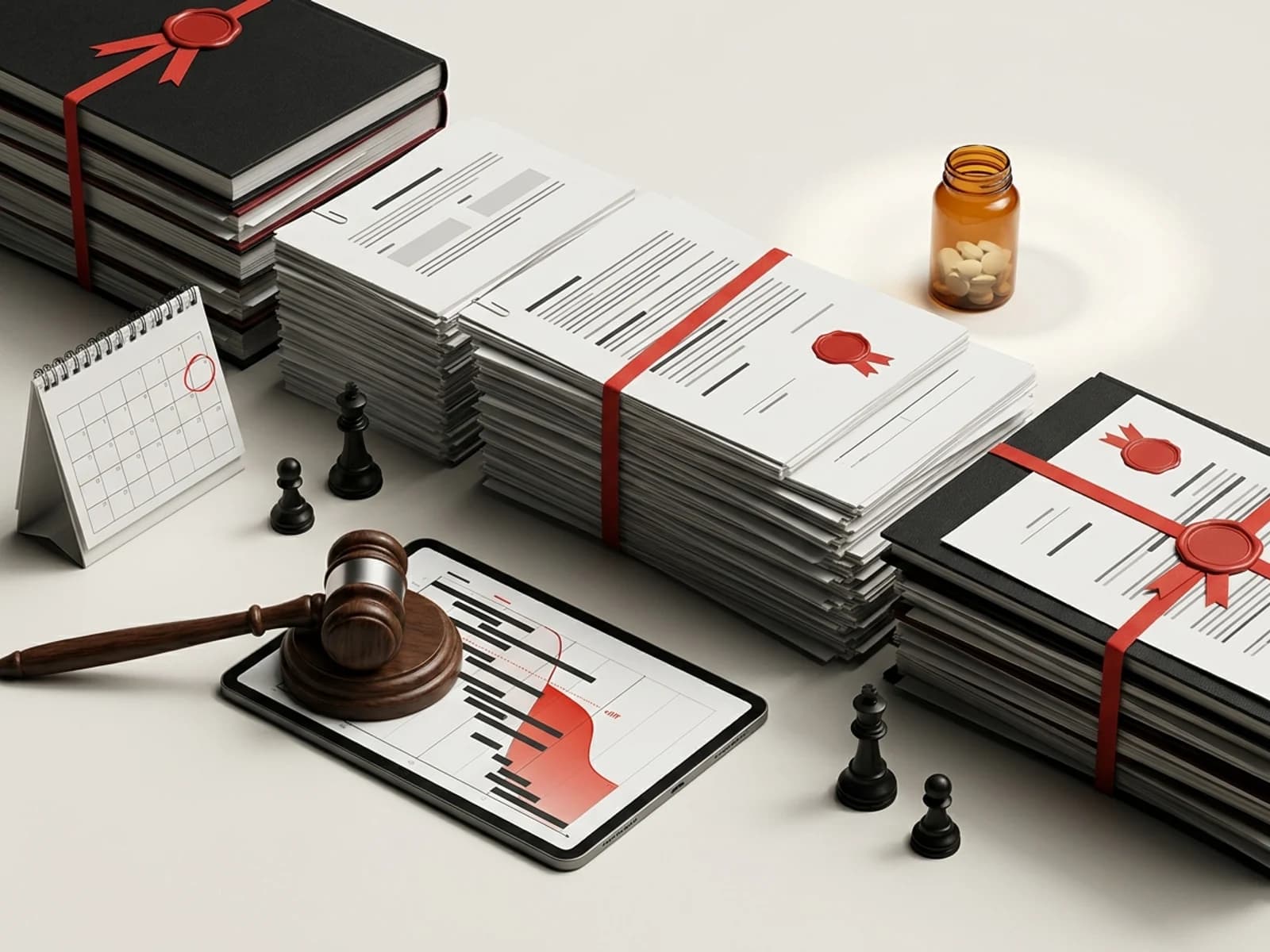
By asserting these patents in federal district court, Boehringer Ingelheim established a multi-layered legal barrier. Even if a generic manufacturer could challenge the compound patent ('449) or the substance patent ('938), they would still face infringement claims on the formulation and method-of-use patents that extend into the 2030s. This multi-layered defense is a classic example of how ANDA and Paragraph IV entry works, requiring generic challengers to prevail on every single patent or settle for a delayed launch date.
What do the Zydus Paragraph IV resolution and the USV, Dr. Reddy's, Sun, and Granules cases say about entry timing?
Rather than risking an adverse court ruling that could invalidate its patents or lead to an immediate at-risk launch by a generic competitor, Boehringer Ingelheim has systematically resolved its Hatch-Waxman disputes with each challenger.
The Zydus Paragraph IV Resolution
Zydus was the first applicant to secure final FDA approval for empagliflozin (ANDA 212138, approved in 2022) after filing Paragraph IV certifications against the '449, '938, and '998 patents. Boehringer Ingelheim sued within the statutory 45-day window in the US District Court for the District of Delaware (Civil Action No. 18-1689, consolidated with the Mankind Pharma action), and the FDA's 2022 ANDA approval letter records that the case was dismissed after the parties resolved it. The practical effect is that Zydus holds an approved ANDA and shared 180-day exclusivity eligibility, but no current right to launch: entry is tied to the negotiated license date, which falls well after the '938 substance expiry (April 15, 2027) and the '449 compound expiry (August 1, 2028). (Zydus did file a separate Q1 2026 settlement, but that one resolved mirabegron / Myrbetriq litigation with Astellas—not empagliflozin.)
The Challenger Field: USV, Sun, Dr. Reddy's, and Granules
Boehringer Ingelheim has pursued a similar strategy of aggressive litigation followed by settlement with other generic manufacturers:
USV Private Limited: Sued by Boehringer over its proposed generic ANDA. USV entered into a Q1 2026 consent judgment (D. Del., Civil Action No. 25-0862) in which it admitted that the '957, '323, and '12,115,179 patents are valid, enforceable, and infringed by its ANDA product, agreeing not to launch until patent expiry.
Sun Pharmaceutical (with Ohm Laboratories): Settled with Boehringer in July 2025, resolving the consolidated Delaware action over the formulation patent US 10,258,637 ('637), which protects both Jardiance and the Glyxambi combination. The commercial entry date was not disclosed.
Dr. Reddy's Laboratories: In December 2025, the UK High Court (EWHC 2834 (Pat)) granted Boehringer an interim injunction restraining Dr. Reddy's from launching its generic empagliflozin in the UK ahead of a scheduled October 2026 trial. The parallel US Delaware action (Civil Action Nos. 18-1779 and 22-1102) over the '998, '637, and '323 patents was settled in the first quarter of 2026, with Dr. Reddy's enjoined until patent expiry.
Granules India: Settled its patent dispute with Boehringer in the third quarter of 2025. As with the other settlements, the agreement permits Granules to enter the market at a designated, confidential future date, preventing an early or at-risk generic launch.
This pattern of systematic resolutions and court injunctions has eliminated the possibility of an early generic launch. The originator has successfully protected its franchise, ensuring that no generic competitor will enter the market before the agreed-upon license dates tied to patent expiry.
When can generic Jardiance actually launch: the 2029 to 2034 estimate range?
Because the settlement terms between Boehringer Ingelheim and the generic challengers are confidential, the exact launch date of generic empagliflozin is not publicly disclosed. However, patent attorneys, market analysts, and formulary planners have established a realistic entry-date range based on the expirations of the controlling patents and historical settlement patterns in the SGLT2 inhibitor class.
The projected timeline is framed by two primary dates:
The Earliest Entry Estimate (February 1, 2029): Published by DrugPatentWatch, this date assumes that Zydus and other early filers negotiated a license start date approximately six months after the expiration of the basic compound patent (US 7,579,449) on August 1, 2028. Payers and access teams should use early 2029 as the baseline for modeling potential generic SGLT2 price erosion on commercial formularies.
The Late Entry Estimate (December 11, 2034): Published by GreyB, this date reflects the expiration of the final method-of-use patent (US 9,949,998) covering the cardiovascular risk reduction indication. If Boehringer refused to grant early licenses for the cardiovascular indication (a "skinny label" carve-out), generic entry could be delayed until the expiration of this patent in late 2034.
This timeline stands in contrast to the rapid generic erosion seen in other drug classes. While the SGLT2 class has seen some generic activity, Jardiance’s extensive patent estate and the Q1 2026 settlement pattern mean that brand Jardiance will retain market exclusivity for several years. This delay is a core component of the 2026 to 2032 patent cliff, which outlines the loss-of-exclusivity timelines for major pharmaceuticals and underscores why payers must plan for extended brand lifecycles in the SGLT2 space.
What does CMS NADAC show about the brand-only price lag?
To verify the real-world status of generic empagliflozin, we look to the National Average Drug Acquisition Cost (NADAC) database, published weekly by the Centers for Medicare & Medicaid Services (CMS). NADAC reflects the average price retail pharmacies pay to acquire drug products from wholesalers, serving as a real-world indicator of generic availability.
In the June 10, 2026 NADAC snapshot, the data for Jardiance shows the following:
Jardiance 10 mg: Average wholesale acquisition cost of approximately $11.19 per unit (tablet).
Jardiance 25 mg: Average wholesale acquisition cost of approximately $11.20 per unit (tablet).
Generic Empagliflozin: No generic empagliflozin entries appear in the NADAC database.
The absence of a generic line item in NADAC confirms that despite Zydus holding approved ANDAs, no generic product has been shipped to wholesalers or pharmacies. By comparison, generic dapagliflozin (Farxiga) has been available in the NADAC database since its launch, with prices demonstrating standard generic erosion. The brand-only status of empagliflozin reinforces that the patent thicket remains intact, and payers must continue to reimburse Jardiance at brand-level pricing.
How should generics, payer, and 340B teams plan around an approved-but-blocked SGLT2?
The delayed launch of generic Jardiance has strategic implications for market access, pharmacy benefits, and clinical pathways:
1. The Payer and PBM Formulary Management
Because generic dapagliflozin (Farxiga) became available in April 2026, payers now have access to a generic SGLT2 inhibitor with a full label, including heart failure and chronic kidney disease indications. This creates a major competitive shift:
Preferred Tiering and Exclusions: Payers are increasingly implementing step-therapy edits requiring patients to fail generic dapagliflozin before approving brand Jardiance. PBM giants like CVS Caremark and Express Scripts may move Jardiance to a non-preferred status or exclude it entirely from their basic commercial formularies, directing patients to the lower-cost generic alternative.
Rebate Dynamics: Boehringer Ingelheim and Eli Lilly must negotiate rebate contracts to maintain Jardiance's position on preferred commercial brand tiers, balancing generic dapagliflozin's lower net price. This tension is explored in detail in the Jardiance versus Farxiga access comparison.
2. 340B Covered Entities
Under the 340B Drug Pricing Program, safety-net providers (such as Federally Qualified Health Centers and disproportionate share hospitals) purchase brand Jardiance at heavily discounted 340B ceiling prices. Because generic empagliflozin is blocked, these entities will continue to manage patients on the brand drug:
Inventory Audits: 340B teams must ensure strict compliance with patient-eligibility and duplicate-discount rules for brand Jardiance.
Contract Pharmacy Restrictions: Originator restrictions on contract pharmacy use will continue to affect brand Jardiance distribution, requiring 340B entities to route prescriptions through in-house pharmacies to capture savings.
In addition to compliance audits, safety-net providers face significant administrative burdens managing contract pharmacy relationships. Under the restrictions introduced by major manufacturers, entities are often forced to choose a single contract pharmacy location if they do not have an in-house pharmacy. This restriction severely limits patient access in rural or underserved areas, as patients may have to travel long distances to access their 340B-priced medications. Covered entities must implement rigorous tracking systems to prevent double-discounting with Medicaid rebates while maximizing their capture of 340B discounts for brand Jardiance.
3. SGLT2 Generic Entry Modeling
For generics developers and portfolio managers, the empagliflozin litigation provides a template for managing SGLT2 pipelines. Manufacturers must coordinate their clinical development and bioequivalence studies to align with the 2029-plus entry window, avoiding premature ANDA approvals that remain blocked by patent settlements. The broader implications of this timing are detailed in the SGLT2 generic-entry playbook, which serves as a planning guide for market entrance and competitive positioning in the cardiovascular-metabolic space.
4. Commercial and Clinical Trial Comparators in the SGLT2 Class
PBM and formulary committees evaluate Jardiance not in isolation, but relative to the entire SGLT2 class. The six FDA-approved SGLT2 inhibitors represent different pricing, clinical indications, and generic status:
Farxiga (dapagliflozin): Generic dapagliflozin approved in April 2026. This has immediately shifted PBM preferences. With a generic SGLT2 available, payers can demand higher rebates from Boehringer to keep brand Jardiance on preferred tiers, or implement step therapy.
Invokana (canagliflozin): Sponsored by Janssen. It was the first-in-class agent approved in 2013, but its market share has declined due to safety warnings regarding amputations and bone fractures, which have since been downgraded by the FDA but left a lasting prescriber bias.
Steglatro (ertugliflozin): Merck/Pfizer's SGLT2. It features lower list pricing but lacks the extensive heart failure and kidney outcomes data that Jardiance and Farxiga boast, limiting its uptake on specialty cardiovascular pathways.
Brenzavvy (bexagliflozin) and Inpefa (sotagliflozin): Recent approvals. Brenzavvy is marketed at a low-cost cash-pay price via Mark Cuban Cost Plus Drug Company, bypassing traditional PBM rebates. Inpefa is a dual SGLT1/SGLT2 inhibitor specifically positioned for heart failure.
5. Detailed Breakdown of the Paragraph IV Litigation and Consents
The legal battle over generic empagliflozin involved multiple parallel challenges that Boehringer consolidated in the US District Court for the District of Delaware. The litigation timeline illustrates how the 30-month Hatch-Waxman stay operated to protect the brand:
Consolidated Infringement Actions: Boehringer filed suits in the District of Delaware against Zydus (Mankind), Dr. Reddy's, USV, Sun, and others, immediately triggering the automatic 30-month FDA approval stay.
The Consent Judgments: Generic manufacturers such as USV entered into consent judgments (for example, D. Del. Civil Action No. 25-0862), admitting the validity of asserted patents and agreeing to stay off the market until specific licensed dates, avoiding the risk of triple damages from an at-risk launch.
The Dr. Reddy's Injunction (December 2025): The UK High Court (EWHC 2834 (Pat)) granted Boehringer an interim injunction restraining Dr. Reddy's from launching its generic empagliflozin in the UK ahead of an October 2026 trial; the parallel US Delaware action over the '998, '637, and '323 patents was subsequently settled in the first quarter of 2026.
FAQs
Is generic Jardiance (empagliflozin) available in the United States yet?
No. There is currently no generic version of Jardiance (empagliflozin) available on the US market. While generic manufacturer Zydus Pharmaceuticals has received final FDA approval for its ANDAs, patent litigation and subsequent settlements with the originator, Boehringer Ingelheim, have blocked the launch. CMS NADAC data lists only brand Jardiance as of mid-2026.
Why does the Orange Book list approved Zydus empagliflozin ANDAs if no generic has launched?
The FDA reviews and approves ANDAs based on scientific and bioequivalence standards. An ANDA can receive final approval if it meets these technical requirements and any statutory patent stays (such as the 30-month Hatch-Waxman stay) have expired. However, the approved generic manufacturer cannot market the drug if it is subject to a private patent licensing agreement or settlement that delays launch to a future date. This creates an approved-but-blocked status.
Which Boehringer Ingelheim patents block empagliflozin generic entry and when do they expire?
Generic entry is blocked by a dense patent estate (GreyB tracks 28 active US patents across the five originator NDAs). The primary controlling patents are:
US Patent 7,713,938: Covering the crystalline substance, expiring April 15, 2027.
US Patent 7,579,449: Covering the active chemical compound, expiring August 1, 2028.
US Patent 9,949,998: Covering the cardiovascular risk reduction indication, expiring December 11, 2034. The negotiated Hatch-Waxman settlements defer generic entry to a licensed date, likely within the 2029 to 2034 window.
Sources
FDA. Approved Drug Products with Therapeutic Equivalence Evaluations (Orange Book): empagliflozin products, patents, and exclusivities. U.S. Food and Drug Administration. June 10, 2026. FDA Orange Book
FDA. Approval letter, ANDA 212138 (Zydus Pharmaceuticals), Empagliflozin Tablets 10 mg and 25 mg: Paragraph IV litigation (Civil Action No. 18-1689) and listed patent expiry dates. U.S. Food and Drug Administration. 2022. FDA ANDA 212138 Approval Letter
CMS. National Average Drug Acquisition Cost (NADAC) weekly files. Centers for Medicare & Medicaid Services. June 10, 2026. CMS NADAC Database
JD Supra. ANDA Litigation Settlements - First Quarter 2026. April 2026. JD Supra Settlement Review
Robins Kaplan. Hatch-Waxman Bulletin Q3 2025: Granules empagliflozin ANDA settlement. October 2025. Robins Kaplan Generic Bulletin
Herbert Smith Freehills Kramer. Preserving the status quo: Boehringer Ingelheim awarded interim injunction against Dr. Reddy's Laboratories (empagliflozin). December 2025. HSF Kramer Litigation Note
DrugPatentWatch. Jardiance (empagliflozin) Patent Expirations and Generic Entry Profile. 2026. DrugPatentWatch Profile
GreyB. Jardiance patent expiration and litigation timeline analysis. 2026. GreyB Patent Analysis
Drugs.com. Generic Jardiance Availability and Release Date. 2026. Drugs.com Reference