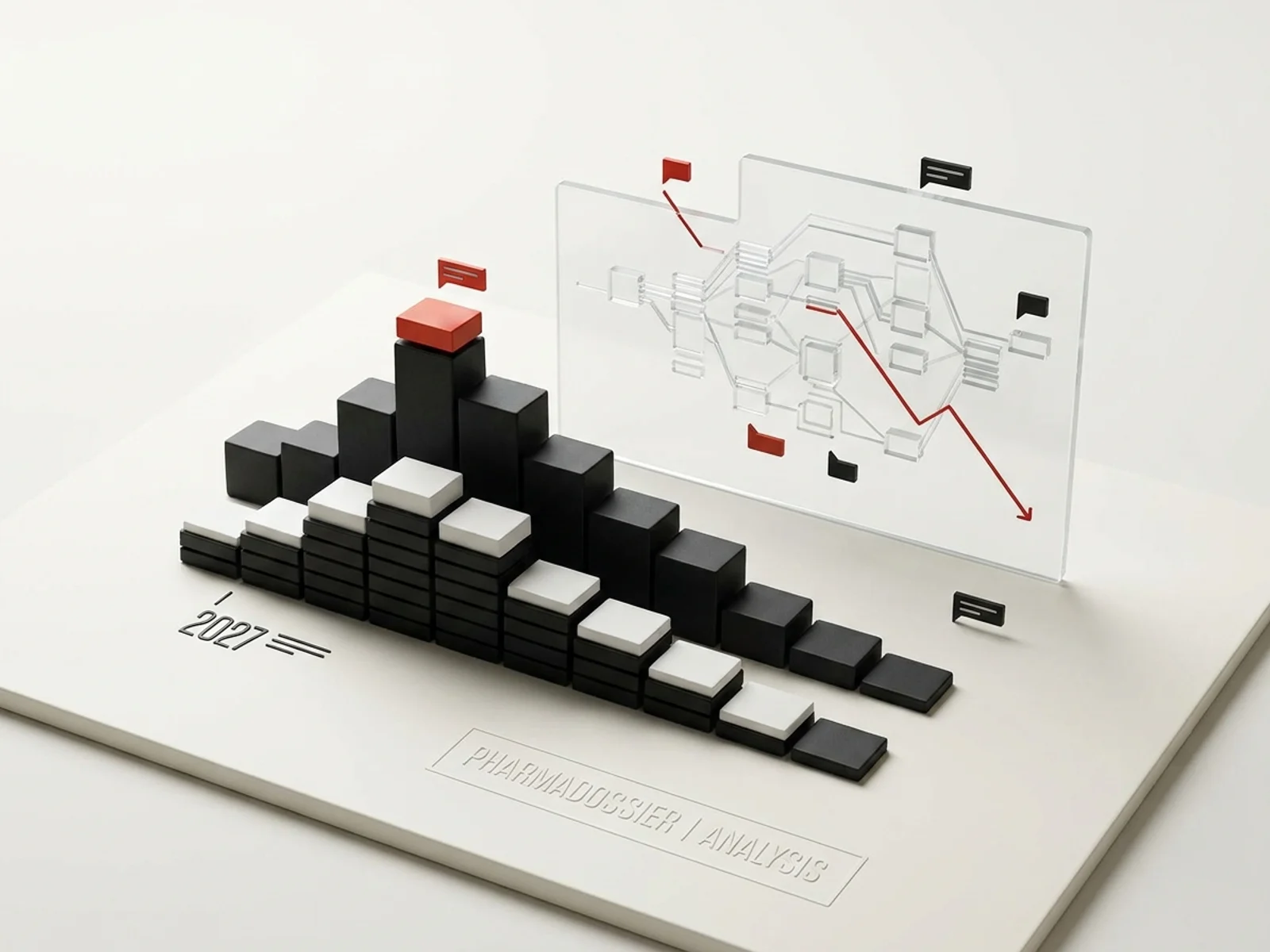
Between 2026 and 2032, more than 11,000 patent listings in the FDA Orange Book will expire, exposing branded drug revenues that industry analysts estimate at $200 billion or more globally. The cliff is not uniform: it peaks in 2027, concentrates in a handful of large applicants, and falls hardest on cystic fibrosis, oncology, and antiviral franchises.
This analysis joins the FDA Orange Book products, patents, and exclusivity files to quantify what is actually at stake — year by year, molecule by molecule, and company by company. Every number below is computed from the current Orange Book dataset.
How the cliff is distributed
| Year | Patent listings expiring | Exclusivity listings expiring | Unique products losing any protection |
|---|---|---|---|
| 2026 | 1,559 | 560 | 407 |
| 2027 | 2,140 | 486 | 400 |
| 2028 | 1,220 | 413 | 387 |
| 2029 | 1,597 | 200 | 356 |
| 2030 | 1,660 | 184 | 327 |
| 2031 | 1,682 | 165 | 272 |
| 2032 | 1,213 | 28 | 198 |
| Total | 11,071 | 2,036 | — |
2027 is the peak. That year alone carries 2,140 patent expirations — more than any other year in the window. The front-loading is even starker for exclusivity: 2026–2028 together account for 71% of all exclusivity listings expiring in the seven-year span.
The "unique products" column counts distinct ingredient–trade-name–applicant combinations. It runs 400 per year through 2028 before tapering, reflecting both the size of the aging branded portfolio and the density of patent thickets that have accumulated around each product.
The biggest molecules at risk
Patent-listing counts are not a proxy for revenue, but they do indicate which products have built the densest IP estates — and therefore face the most complex generic-entry landscape.
Top 10 branded products by patent listings expiring, 2026–2032
| Brand | Ingredient | Patents expiring | Primary years | Applicant |
|---|---|---|---|---|
| Imbruvica | ibrutinib | 522 | 2026, 2027, 2031 | Pharmacyclics |
| Orkambi | ivacaftor/lumacaftor | 220 | 2026–2031 | Vertex |
| Trikafta | elexacaftor/ivacaftor/tezacaftor | 190 | 2026, 2027, 2029, 2031 | Vertex |
| Jakafi | ruxolitinib | 145 | 2026–2028 | Incyte |
| Hysingla ER | hydrocodone bitartrate | 133 | 2027, 2031 | Purdue |
| Kalydeco | ivacaftor | 125 | 2026–2030 | Vertex |
| Harvoni | ledipasvir/sofosbuvir | 120 | 2028–2032 | Gilead |
| Lynparza | olaparib | 111 | 2027, 2029, 2031 | AstraZeneca |
| Vraylar | cariprazine | 106 | 2028–2030 | AbbVie |
| OxyContin | oxycodone HCl | 102 | 2027, 2030 | Purdue |
Vertex Pharmaceuticals dominates the list, with 666 patent listings expiring across its full portfolio — the most of any single applicant in the Orange Book. The cystic fibrosis franchise (Trikafta, Orkambi, Kalydeco, and Alyftrek) alone accounts for 611 of those listings and will face a sustained multi-year erosion of its IP wall.
Imbruvica (ibrutinib), the Bruton tyrosine kinase inhibitor co-marketed by Pharmacyclics/J&J, carries 522 patent listings — including 250 that expire in 2031 alone — reflecting one of the thickest patent estates in the dataset.
Gilead's hepatitis C portfolio (Harvoni, Epclusa, Sovaldi, and Vosevi) accounts for 306 patent listings in the 2028–2032 window. Across all Gilead products — which also include HIV regimens and remdesivir — the company carries 407 combined patent listings expiring in the seven-year span.
The drugs to watch, year by year
2026: Semaglutide, Rexulti, and the first wave
Ozempic (semaglutide) has 59 patent listings expiring in 2026, with key composition-of-matter protections ending January 20, 2026. That does not mean generic entry is immediate — formulation, device, and method-of-use patents extend protection further — but the clock has started. This is the first inflection point for the GLP-1 market that is reshaping diabetes and obesity care.
Rexulti (brexpiprazole) loses 66 patent listings in 2026, and its exclusivity (NPP code) also expires this year, opening the door to generic alternatives for the antipsychotic and adjunctive depression indication.
Imbruvica leads the year with 152 expirations, followed by Trikafta (39), Orkambi (36), and Latuda (lurasidone, 35).
2027: The peak cliff year
Two products dominate: OxyContin (98 patents) and Trikafta (98 patents). Imbruvica adds another 113, and Lynparza begins its patent erosion with 63 listings.
Eliquis (apixaban) loses its NPP exclusivity in 2028, but the broader patent cliff begins building in 2027, consistent with industry analyst expectations of generic entry for the $20 billion anticoagulant.
Mounjaro (tirzepatide) and Zepbound (tirzepatide) both lose NCE exclusivity in 2027, making this the year when the legal pathway opens for biosimilar or follow-on competition against Lilly's dual GIP/GLP-1 agonist.
2028: Jakafi, Eliquis, and Paxlovid
Jakafi (ruxolitinib) sees 90 patent listings expire in 2028, the single largest one-year drop for that product. Eliquis (apixaban) loses NPP exclusivity. Paxlovid (nirmatrelvir/ritonavir) drops its NCE exclusivity.
Wegovy (semaglutide for obesity) loses NP exclusivity in 2028, meaning the obesity-specific formulation faces its first regulatory opening for generic competition.
2029–2032: Vraylar, Xpovio, and the long tail
Vraylar (cariprazine) carries 81 patent listings into 2029, its biggest single-year drop. Xpovio (selinexor) has 81 listings concentrated in 2032. Vascepa (icosapent ethyl) peaks with 76 listings in 2030.
Applicant concentration: who has the most to lose
| Applicant | Patent listings expiring |
|---|---|
| Vertex Pharmaceuticals | 666 |
| Pharmacyclics | 522 |
| Gilead Sciences | 407 |
| AbbVie | 386 |
| Boehringer Ingelheim | 360 |
| Novartis | 348 |
| AstraZeneca | 281 |
| Otsuka | 272 |
| Takeda | 267 |
| Purdue Pharma | 235 |
The top five applicants alone account for 2,341 of the 11,071 patent listings — 21% of the total. This concentration means that generic and biosimilar entry decisions by a handful of challengers could reshape entire therapeutic categories.
Exclusivity codes: what type of protection is ending
| Code | Meaning | Listings expiring |
|---|---|---|
| NCE | New chemical entity | 363 |
| PED | Pediatric exclusivity | 313 |
| NPP | New product period | 126 |
| NP | New product | 124 |
| ODE* | Orphan drug exclusivity | 82 |
| M-14 | 14-year transition | 44 |
| CGT | Competitive generic therapy | 30 |
| PC | Patent challenge (180-day) | 29 |
| GAIN | GAIN Act (antibacterial) | 29 |
NCE exclusivity, which provides five years of protection from generic filing, is the single most commercially consequential code. The 363 NCE listings expiring in 2026–2032 include Eliquis (NPP, 2028), Mounjaro and Zepbound (NCE, 2027), and dozens of specialty drugs approved in the early 2020s.
What this means for formulary strategy
1. 2026–2028 is the action window for generics and biosimilars. With 4,919 patent listings and 1,459 exclusivity listings expiring in the first three years, the pace of generic and biosimilar opportunity is faster now than it will be later. Payers and formulary committees should expect a wave of new ANDA approvals and biosimilar launches concentrated in this period.
2. The GLP-1 patent landscape is fragmenting early. Ozempic patents are already expiring, but Novo Nordisk has layered device, formulation, and method-of-use patents that push effective generic entry further out. Wegovy and Mounjaro/Zepbound lose regulatory exclusivity in 2027–2028. Payers tracking GLP-1 cost management should monitor ANDA and 351(k) filing activity against these dates.
3. Vertex's CF monopoly erodes slowly but relentlessly. Trikafta, Orkambi, Kalydeco, and Alyftrek together have 611 patent listings expiring across the entire seven-year window. No single year is a cliff for the franchise — it is a gradual descent. Generic entry will likely be staggered across products and formulations.
4. Eliquis generic entry is the single largest near-term revenue shift. The apixaban composition-of-matter patent combined with NPP exclusivity expiring in 2026–2028 sets up a multi-generic event. With $20 billion in annual global revenue at stake, payers should prepare for rapid formulary conversion.
5. Patent thickets delay real generic entry beyond expiry dates. Imbruvica's 522 listings illustrate how a single product can amass a dense IP estate spanning composition, formulation, method of use, and polymorph claims. Actual generic entry typically lags the first patent expiry by several years, depending on Paragraph IV litigation outcomes and settlement timing.
Sources
FDA Orange Book (Approved Drug Products with Therapeutic Equivalence Evaluations), current edition; analysis by PharmaDossier, run date 2026-06-10. Patent, exclusivity, and product files joined on Appl_Type + Appl_No + Product_No. https://www.fda.gov/drugs/drug-approvals-and-databases/approved-drug-products-therapeutic-equivalence-evaluations-orange-book
IntuitionLabs, "Drug Patents Expiring in 2026: A Comprehensive Guide." https://intuitionlabs.ai/articles/drug-patent-expirations-2026
Genetic Engineering & Biotechnology News, "Top 20 Drugs Heading for the Patent Cliff, 2026–2029." https://www.genengnews.com/topics/drug-discovery/top-20-drugs-heading-for-the-patent-cliff-2026-2029
Drug Discovery News, "Blockbuster drugs face a massive patent cliff in 2026." https://www.drugdiscoverynews.com/blockbuster-drugs-face-a-massive-patent-cliff-in-2026-17019
Optum, "Blockbuster Drug Patent Expirations in 2026 & What They Mean." https://business.optum.com/en/insights/blockbuster-drug-patent-expirations-2026-what-they-mean.html