For market access professionals, pharmacy directors, and commercial payers, managing oncology drug spend is a constant balancing act between utilization management and forecasting loss of exclusivity (LOE) events. Among small-molecule blockbusters, few represent a larger financial footprint or a more complex patent landscape than Imbruvica (ibrutinib), the Bruton's tyrosine kinase (BTK) inhibitor co-developed and co-marketed by AbbVie's Pharmacyclics and Johnson & Johnson's Janssen Biotech.
With billions of U.S. healthcare dollars flowing toward this single therapy annually, the question of when a generic alternative will enter the market is a multi-million-dollar query. However, any payer team expecting near-term generic competition based on composition patent expirations is in for a rude awakening. While the primary composition-of-matter patents for ibrutinib are set to expire in late 2026 and 2027, the commercial reality has been deferred by nearly half a decade.
This deep dive examines the "patent wall" surrounding Imbruvica, analyzes the Hatch-Waxman Paragraph IV litigation history, reviews the settlement agreements that dictate the actual generic entry window, and explains the pricing and access dynamics of this specialty oral oncology agent.
Executive Summary & Scenario Analysis
To understand the market entry timeline for generic Imbruvica, we must address the specific questions facing formulary designers and PBM access teams.
Scenario Question
When will generic Imbruvica (ibrutinib) become available in the United States, and what settled agreements delay its launch?
Direct Answer
Generic Imbruvica (ibrutinib) is not expected to launch in the United States until March 30, 2032, assuming pediatric exclusivity is granted. Although the core composition-of-matter patent (US 7,514,444) expires on December 28, 2026 (extended to June 28, 2027, with pediatric exclusivity) and US 8,008,309 expires on November 13, 2027 (extended to May 13, 2028), AbbVie/Pharmacyclics settled patent litigation with multiple generic manufacturers (including Zydus, Alvogen, Natco, and Shilpa) to delay entry. Because Imbruvica is a specialty oral oncology product distributed through closed specialty pharmacy channels, it is not tracked in the CMS National Average Drug Acquisition Cost (NADAC) retail pharmacy database; the June 2026 snapshot records remain empty. Consequently, payer formulary teams must plan for brand-only access until early 2032, requiring continued utilization management rather than near-term generic transition planning.
Why Composition Patent Expirations in 2026/2027 Do Not Trigger Entry
A common pitfall in generic forecasting is looking solely at the expiration date of the primary compound patent. In the case of Imbruvica, this compound patent is US Patent No. 7,514,444 (the '444 patent), which claims the active ibrutinib molecule.
The '444 patent is set to expire on December 28, 2026. With the standard six-month pediatric exclusivity extension (designated in the Orange Book as 7514444*PED), this protection extends to June 28, 2027. The second major composition patent, US Patent No. 8,008,309 (the '309 patent), expires on November 13, 2027 (pediatric extension to May 13, 2028).
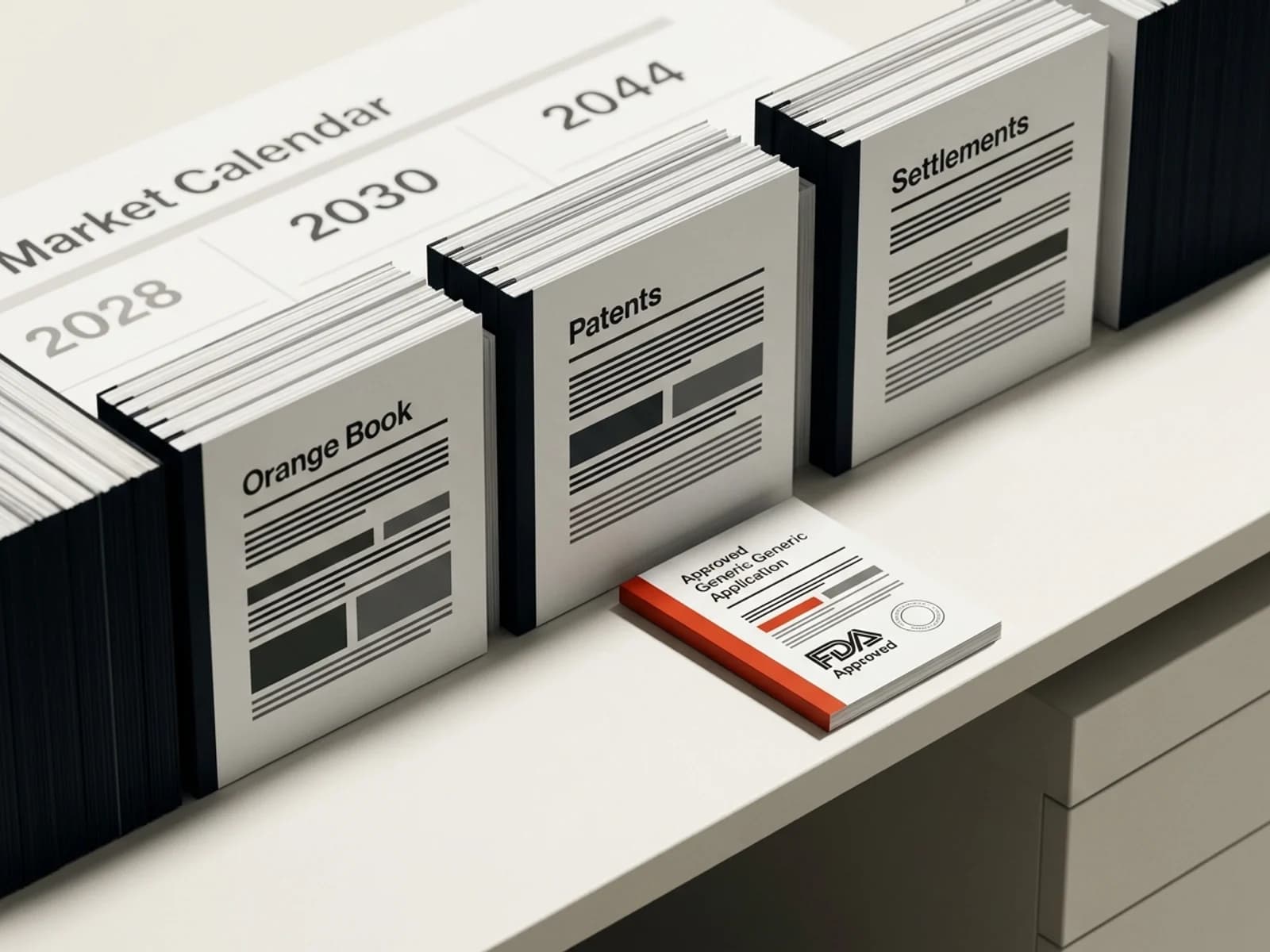
Under normal circumstances, the expiration of these core composition-of-matter patents would clear the runway for generic drug developers. However, AbbVie and Pharmacyclics have spent more than a decade building a dense "patent thicket" around ibrutinib.
The Patent Thicket in Numbers
According to our analysis of the FDA Orange Book (specifically the June 10, 2026 database snapshot), Imbruvica's patent estate is one of the most heavily fortified in history:
NDAs under protection: Imbruvica is approved under three separate New Drug Applications (NDAs) held by Pharmacyclics:
NDA 205552: Oral Capsules (originally approved on November 13, 2013)
NDA 210563: Oral Tablets (approved on February 16, 2018)
NDA 217003: Oral Suspension (approved on August 24, 2022)
Distinct Patents: Across these three NDAs, the Orange Book lists 44 distinct patent numbers, recorded as 84 separate listings once pediatric-exclusivity extensions (the
*PEDentries) are counted individually.Patent-Product Rows: Because these listings are mapped across multiple strengths and dosage forms, they generate a total of 706 active patent-product rows in the Orange Book. Of those, 522 fall inside the 2026–2032 loss-of-exclusivity window.
Staggered Expirations: The expiration dates of these patents range from December 2026 out to June 2039, with large clusters landing in 2026, 2027, 2031, 2033, and 2036.
This massive patent estate covers not just the active ingredient, but also polymorphic forms of the ibrutinib crystalline structure, specific oral formulations (such as tablets and oral suspensions), methods of using ibrutinib to treat different cancers (mantle cell lymphoma, chronic lymphocytic leukemia, small lymphocytic lymphoma, Waldenström’s macroglobulinemia, marginal zone lymphoma), and methods of treating chronic graft-versus-host disease (cGVHD).
A generic manufacturer cannot launch an alternative version of Imbruvica without either waiting for all relevant patents to expire, successfully challenging them in court, or reaching a settlement. For a broader overview of how these dense patent estates shape U.S. healthcare costs, see Imbruvica's position as the most heavily patented small molecule facing a cliff — it carries 522 Orange Book patent-product listings expiring inside the 2026–2032 window alone.
Key Imbruvica Patents and Expiration Timelines
Below is a structured analysis of representative patents from each layer of the Imbruvica wall (verified against the FDA Orange Book, June 10, 2026 snapshot).
| Patent Number | Coverage Layer | Expiration Date | Pediatric Exclusivity Expiration | Key Coverage Description |
|---|---|---|---|---|
| US 7,514,444 | Composition of Matter | Dec 28, 2026 | Jun 28, 2027 | Active ibrutinib compound structure and synthesis |
| US 8,008,309 | Composition of Matter | Nov 13, 2027 | May 13, 2028 | Ibrutinib composition and method of treating hematological malignancies |
| US 8,476,284 | Method of Use | Dec 28, 2026 | Jun 28, 2027 | Use-code-listed treatment protocols (multiple use codes) |
| US 8,497,277 | Method of Use | Dec 28, 2026 | Jun 28, 2027 | Combination and indication-specific use codes (14 use codes) |
| US 8,754,091 | Drug Product / Form | Dec 28, 2026 | Jun 28, 2027 | Drug-product (formulation) claims |
| US 8,957,079 | Composition / Form | Dec 28, 2026 | Jun 28, 2027 | Drug-substance and drug-product claims on the active form |
| US 8,563,563 | Method of Use | Apr 26, 2027 | Oct 26, 2027 | Indication-specific treatment use codes |
| US 9,125,889 | Method of Use / Formulation | Jun 3, 2031 | Dec 3, 2031 | Part of the 2031-expiring formulation and use-code cluster |
| US 9,540,382 | Method of Use | Aug 18, 2033 | Feb 18, 2034 | Later indication and dosing use codes |
| US 9,296,753 | Composition / Form | Oct 30, 2033 | Apr 30, 2034 | Drug-substance (composition) claims |
| US 10,010,507 | Drug Product / Formulation | Mar 3, 2036 | Sep 3, 2036 | Drug-product (formulation) claims |
| US 12,201,690 | Drug Product / Formulation | Jun 14, 2039 | — | Late-expiring drug-product claims (no pediatric extension listed) |
As the table shows, even if a generic challenger successfully designs around the composition patents expiring in 2026 and 2027, they must navigate a wall of method-of-use and drug-product patents that extend well into the 2030s — with the final listings not falling until 2039.
Which Generic Developers Have Settled Paragraph IV Litigation?
Under the Hatch-Waxman Act, a generic developer can submit an Abbreviated New Drug Application (ANDA) to the FDA certifying that the patents listed in the Orange Book are invalid, unenforceable, or will not be infringed by the generic product. This is known as a Paragraph IV certification, which typically triggers an immediate patent infringement lawsuit by the brand-name manufacturer.
For details on the mechanics of Hatch-Waxman exclusivity, refer to Hatch-Waxman patent challenges and litigation settlements.
AbbVie, through Pharmacyclics and in coordination with J&J's Janssen, has aggressively defended Imbruvica's patent wall. Following Paragraph IV filings by several generic developers, Pharmacyclics initiated patent infringement suits in the U.S. District Court for the District of Delaware against Zydus Lifesciences (formerly Cadila Healthcare), Alvogen Pine Brook LLC, Natco Pharma Ltd., Shilpa Medicare Ltd., Sandoz Inc., and Lupin Ltd.
The Litigation Settlement Timeline
Rather than risk a court ruling that could invalidate key patents, AbbVie opted for a series of settlements with these generic challengers. These agreements followed a common pattern: the generic developers agreed to license AbbVie’s patents and delay their U.S. market entry in exchange for the dismissal of the lawsuits.
The Zydus Settlement (2020): Zydus was one of the earliest generic developers to file an ANDA for ibrutinib capsules. In September 2020, Pharmacyclics resolved the patent dispute with Zydus. In its subsequent SEC filings, AbbVie disclosed that Zydus received a license to launch its generic version of ibrutinib in the United States on March 30, 2032, or earlier under certain undisclosed commercial conditions.
The Alvogen, Natco, and Shilpa Settlements (2021–2022): Following the Zydus agreement, Pharmacyclics settled litigation against Alvogen, Natco, and Shilpa Medicare. In these cases, the generic companies consented to the validity of the patents and agreed to similar licensed entry dates, also aligned with the late March 2032 timeframe.
FDA Tentative Approvals: Because of these settlements, several generic developers have received "tentative approval" from the FDA. For example, Zydus received tentative approval for its ANDA 211344 (for 70mg and 140mg capsules) as early as March 31, 2021. However, tentative approval simply means the FDA has determined the generic drug is safe and effective, but cannot grant final marketing approval until the settled license date of March 30, 2032, is reached.
The SEC Disclosures
For confirmation of the March 30, 2032 launch date, one needs only to review AbbVie's annual reports. In its filings with the Securities and Exchange Commission, AbbVie discloses that, as a result of its settlement agreements with generic manufacturers over ibrutinib, no generic entry for any Imbruvica product is expected prior to March 30, 2032 (a date AbbVie has cited consistently across multiple 10-K reporting periods, subject to any regulatory exclusivity extensions).
This official SEC disclosure confirms that the patent wall has functioned exactly as AbbVie intended: it converted a potential 2026/2027 patent cliff into a managed, contractually secured market exclusivity that extends into 2032.
Bioequivalence Requirements and FDA ANDA Standards for Ibrutinib
For generic ibrutinib to secure final FDA approval under the ANDA pathway, generic manufacturers must meet stringent regulatory standards to prove that their product is therapeutically equivalent to the reference listed drug (RLD), Imbruvica.
FDA Bioequivalence Guideline for Ibrutinib
The FDA publishes product-specific bioequivalence guidelines to direct generic developers. For ibrutinib, these requirements are complex due to the drug’s pharmacokinetic characteristics:
Study Design: The FDA recommends a randomized, two-period, two-treatment, two-sequence, crossover bioequivalence study comparing generic ibrutinib to reference Imbruvica.
Fasting and Fed Conditions: The studies must be conducted under both fasting and fed conditions (using a high-fat meal), because food intake significantly increases ibrutinib absorption and bio-availability.
Measurement Analytes: Generic developers must measure ibrutinib and its active metabolite, PCI-45227, in the plasma. Bioequivalence is established based on the 90% confidence intervals for the geometric mean ratios of the Area Under the Curve (AUC) and the maximum concentration (Cmax) falling within the standard bioequivalence range of 80% to 125%.
Because ibrutinib is a BCS Class II drug (low solubility, high permeability) and exhibits high inter-individual pharmacokinetic variability, generic developers face significant formulation hurdles to match the absorption profile of the brand name, requiring extensive pilot studies before starting pivotal clinical bioequivalence trials.
How Pediatric Exclusivity Extends Imbruvica's Patent Wall
Pediatric exclusivity is one of the most important mechanisms a brand manufacturer can layer on top of a patent estate, and it is central to understanding why Imbruvica's effective generic-entry gate sits years after the headline 2026/2027 composition-patent dates.
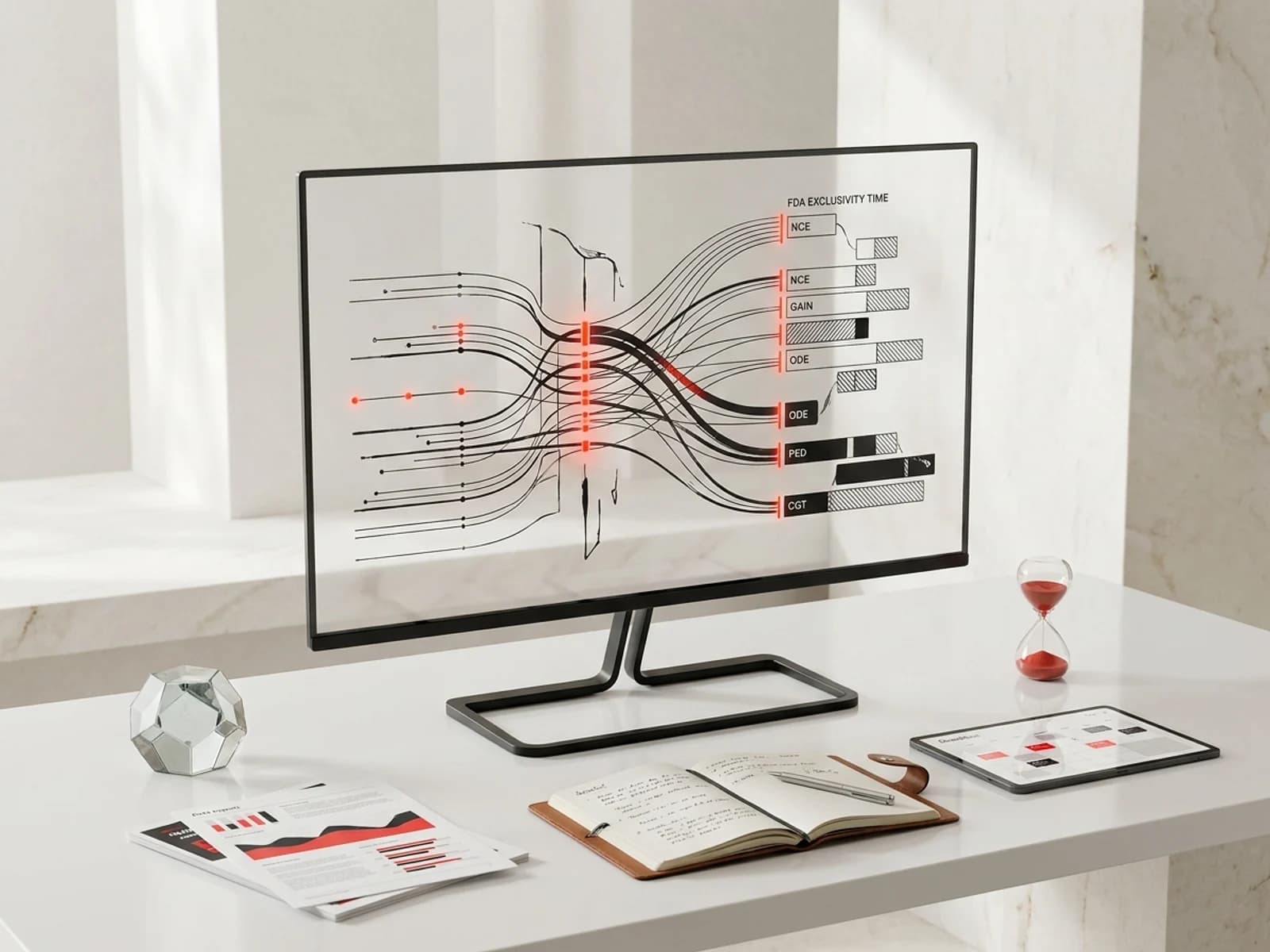
Under Section 505A of the Federal Food, Drug, and Cosmetic Act, if a brand-name drug manufacturer conducts pediatric studies in response to a written request from the FDA, the drug receives an additional six months of marketing exclusivity. This exclusivity does not add to the patent term itself; instead, it blocks the FDA from approving any generic ANDA for an additional six-month period beyond the expiration of each patent or exclusivity to which it attaches.
AbbVie and Janssen actively pursued pediatric indications for Imbruvica, and the resulting six-month pediatric block (*PED) is visible across the estate in the Orange Book. Two worked examples show how it shifts the effective FDA approval gate:
Composition patent US 7,514,444: base expiration December 28, 2026 → with pediatric exclusivity, the FDA approval gate moves to June 28, 2027 (Dec 28, 2026 + 6 months).
The 2031 method-of-use / formulation cluster (e.g., US 9,125,889): base expiration June 3, 2031 → with pediatric exclusivity, the gate moves to December 3, 2031 (Jun 3, 2031 + 6 months).
Why the Settlement Lands on March 30, 2032
It is tempting to assume the March 30, 2032 launch date is the exact arithmetic output of one patent's expiration plus pediatric exclusivity. It is not. No single Imbruvica patent expires on a date that, plus six months, equals March 30, 2032. Instead, March 30, 2032 is a negotiated settlement date that the parties agreed would stand as the earliest licensed entry — set far enough out to clear the dense 2031 method-of-use and formulation cluster (and their pediatric extensions), while also giving AbbVie a contractually fixed, court-enforceable exclusivity tail regardless of how any later-expiring patents (the estate runs to 2039) might be challenged.
In other words, the patent estate supplies the leverage; the settlement supplies the date. AbbVie's 2025 Form 10-K confirms the commercial reality: "no generic entry for any Imbruvica product is expected prior to March 30, 2032." That is a settlement outcome, not a patent-expiry calculation.
Why Ibrutinib Is Missing From Retail Pharmacy Acquisition Databases
Another point of confusion for market analysts is the absence of ibrutinib from certain retail drug pricing databases. The most notable example is the National Average Drug Acquisition Cost (NADAC) database, published weekly by the Centers for Medicare & Medicaid Services (CMS).
Formulary managers routinely use the NADAC database to evaluate the average price retail pharmacies pay to acquire drugs from wholesalers, using it as a benchmark for reimbursement rates. However, a query of the June 10, 2026 NADAC file reveals:
Total rows for "ibrutinib": 0
Total rows for "Imbruvica": 0
The Specialty Pharmacy Closed-Loop Dynamic
The explanation for this missing data lies in how Imbruvica is distributed. Unlike standard cardiovascular or diabetes medications that are dispensed at local retail pharmacies (such as Walgreens or CVS), oral oncology therapies are classified as specialty drugs.
Imbruvica is distributed through a closed-loop specialty pharmacy network. AbbVie and Janssen restrict distribution of the drug to a select few accredited specialty pharmacies (e.g., Accredo, CVS Specialty, AllianceRx Walgreens Pharmacy).
Because these specialty pharmacies operate under direct contracts with the manufacturers and do not report pricing through standard retail pharmacy surveys, their acquisition costs are excluded from the CMS retail NADAC survey. Payer teams who rely solely on retail database feeds to monitor drug costs will fail to capture the pricing dynamics of ibrutinib, which must be tracked through specialized medical-benefit or specialty-pharmacy contract feeds.
The Medicare Maximum Fair Price (MFP) Inflection Point
Although generic competition is delayed until 2032, Imbruvica's pricing is facing a different, government-mandated regulatory pressure.
Under the Inflation Reduction Act (IRA) of 2022, the U.S. government established a Drug Price Negotiation Program. Ibrutinib was selected as one of the first 10 drugs subject to Medicare price negotiation because of its high total spend under Medicare Part D.
The negotiated Medicare Maximum Fair Price (MFP) for Imbruvica took effect on January 1, 2026.
Commercial Impact: The MFP represents a significant discount (exceeding 38% from the list price) for Medicare Part D beneficiaries.
Payer Strategy: Payer formulary teams must manage two distinct pricing structures: the government-negotiated MFP for their Medicare lines of business, and commercial contracting for employer-sponsored plans.
Duration: This MFP structure will remain the primary cost-control mechanism for ibrutinib for six years, spanning from 2026 until the generic entry date of March 30, 2032.
Formulary Management Strategy: 2026–2032
Given a confirmed brand-only window of March 30, 2032, payer formulary committees and clinical pharmacy directors should structure their oncology strategies around the following guidelines:
1. Maintain Strict Utilization Management (UM)
Because generic substitution is off the table, payers must rely on clinical criteria to manage ibrutinib spend. This includes:
Prior Authorization (PA): Restricting ibrutinib to FDA-approved indications or guidelines-supported oncology pathways (e.g., NCCN Category 1 recommendations).
Step Therapy: Requiring patients with CLL/SLL to trial preferred, more cost-effective alternatives (such as next-generation BTK inhibitors like acalabrutinib or zanubrutinib) before approving ibrutinib, where clinically appropriate.
Quantity Limits: Restricting refills to 30-day supplies to minimize waste due to dose reductions or treatment discontinuation.
2. Segment Medicare vs. Commercial Contracting
Medicare Part D: PBMs must ensure their claim adjudication engines are properly configured to capture the Maximum Fair Price (MFP) for Medicare members starting in 2026.
Commercial Plans: Payers should maximize rebate agreements with AbbVie/Janssen, leveraging the market share competition between Imbruvica and newer competitors (Brukinsa, Calquence) to secure favorable pricing.
3. Specialty Pharmacy Channel Audits
Payers should conduct regular audits of their contracted specialty pharmacies to ensure:
Split-Fill Programs: Implementing split-fill programs (e.g., dispensing 14-day supplies for the first two months of therapy) to prevent wasting expensive oral oncology capsules.
Co-Pay Assistance: Managing co-pay accumulator and maximizer programs to ensure manufacturer copay assistance is properly applied without inflating the plan's net cost.
FAQ Section
Does the FDA's tentative approval of generic ibrutinib allow immediate launch?
No. An FDA tentative approval indicates that the generic drug has met all safety, efficacy, and manufacturing standards, but cannot be commercially marketed due to active patents or exclusivity blocks. In the case of generic ibrutinib, final marketing approval and launch are blocked by Paragraph IV litigation settlements until the agreed-upon date of March 30, 2032.
How does pediatric exclusivity extend Imbruvica's patent wall?
Pediatric exclusivity is a statutory six-month marketing extension granted to manufacturers who complete FDA-requested pediatric clinical trials under Section 505A. This exclusivity does not extend the patents themselves; instead, it blocks the FDA from approving any generic ANDA for an additional six months after each attached patent or exclusivity expires. For Imbruvica, this six-month block is layered across the estate — pushing the 2026 composition patents to mid-2027 and the dense 2031 method-of-use/formulation cluster to late 2031. The negotiated settlement then fixes the earliest licensed U.S. entry at March 30, 2032, as disclosed in AbbVie's SEC filings.
Why is ibrutinib missing from retail pharmacy acquisition databases like NADAC?
Ibrutinib is an oral specialty oncology medication distributed exclusively through a closed-loop network of specialty pharmacies. Because it is not sold through standard retail community pharmacies, it is not surveyed by the CMS retail NADAC pricing program, resulting in zero records in the retail pricing database. Payers must monitor specialty contract pricing instead.
Will the Medicare negotiated Maximum Fair Price (MFP) apply to commercial plans?
No. Under the Inflation Reduction Act, the negotiated Maximum Fair Price (MFP) is legally mandated only for Medicare lines of business (Part D and Part B). Commercial employer-sponsored plans are excluded from these negotiated rates, meaning commercial payers must continue to negotiate rebates and discounts directly with the manufacturers.
Who are the primary generic developers with tentative approvals for generic Imbruvica?
Zydus Lifesciences (under ANDA 211344) and other developers such as Alvogen, Natco, and Shilpa Medicare have pursued generic approvals. Due to Paragraph IV litigation settlements, their launches are deferred until March 30, 2032.
Sources
FDA Orange Book: Approved Drug Products with Therapeutic Equivalence Evaluations, NDAs 205552, 210563, and 217003. U.S. Food and Drug Administration. Accessed June 2026. https://www.accessdata.fda.gov/scripts/cder/ob/results_patent.cfm?Appl_No=205552&Appl_Type=N
AbbVie Inc. Annual Report 2025 (Form 10-K). Filed with the U.S. Securities and Exchange Commission on February 20, 2026. Legal Proceedings and Patent Settlements section. https://www.sec.gov/ix?doc=/Archives/edgar/data/0001551154/000155115426000007/abbv-20251231.htm
Pharmacyclics LLC et al v. Zydus Pharmaceuticals (USA) Inc., No. 1:19-cv-00434 (D. Del. 2020). U.S. District Court for the District of Delaware.
Centers for Medicare & Medicaid Services (CMS). National Average Drug Acquisition Cost (NADAC) Files, weekly update dated June 10, 2026. Prescription Drug Resources. https://www.medicaid.gov/medicaid/prescription-drugs/pharmacy-pricing/index.html
U.S. Department of Health and Human Services (HHS). Inflation Reduction Act (IRA) Selected Drug Negotiation Program. Medicare Drug Price Negotiation. https://www.cms.gov/inflation-reduction-act-and-medicare/medicare-drug-price-negotiation
I-MAK (Initiative for Medicines, Access & Knowledge). "Overpatented, Overpriced: How AbbVie and J&J Delayed Generic Imbruvica." Specialty Drug Patent Estates. https://www.i-mak.org/imbruvica-patent-wall/