For pharmaceutical manufacturers, generic producers, and biosimilar developers seeking commercial access across Europe, hospital tendering represents the single largest market-access gatekeeper. In European public healthcare systems, public procurement rules govern how national health authorities, regional purchasing consortia, and individual hospital networks purchase prescription medicines.
To understand the volume, geography, winning entities, and financial scale of European drug tendering, we conducted a comprehensive empirical analysis of Tenders Electronic Daily (TED)—the official online supplement to the Journal of the European Union—filtering public procurement notices under Common Procurement Vocabulary (CPV 33600000: Pharmaceutical Products).
Where, how, and from whom do European hospitals actually buy drugs through public procurement?
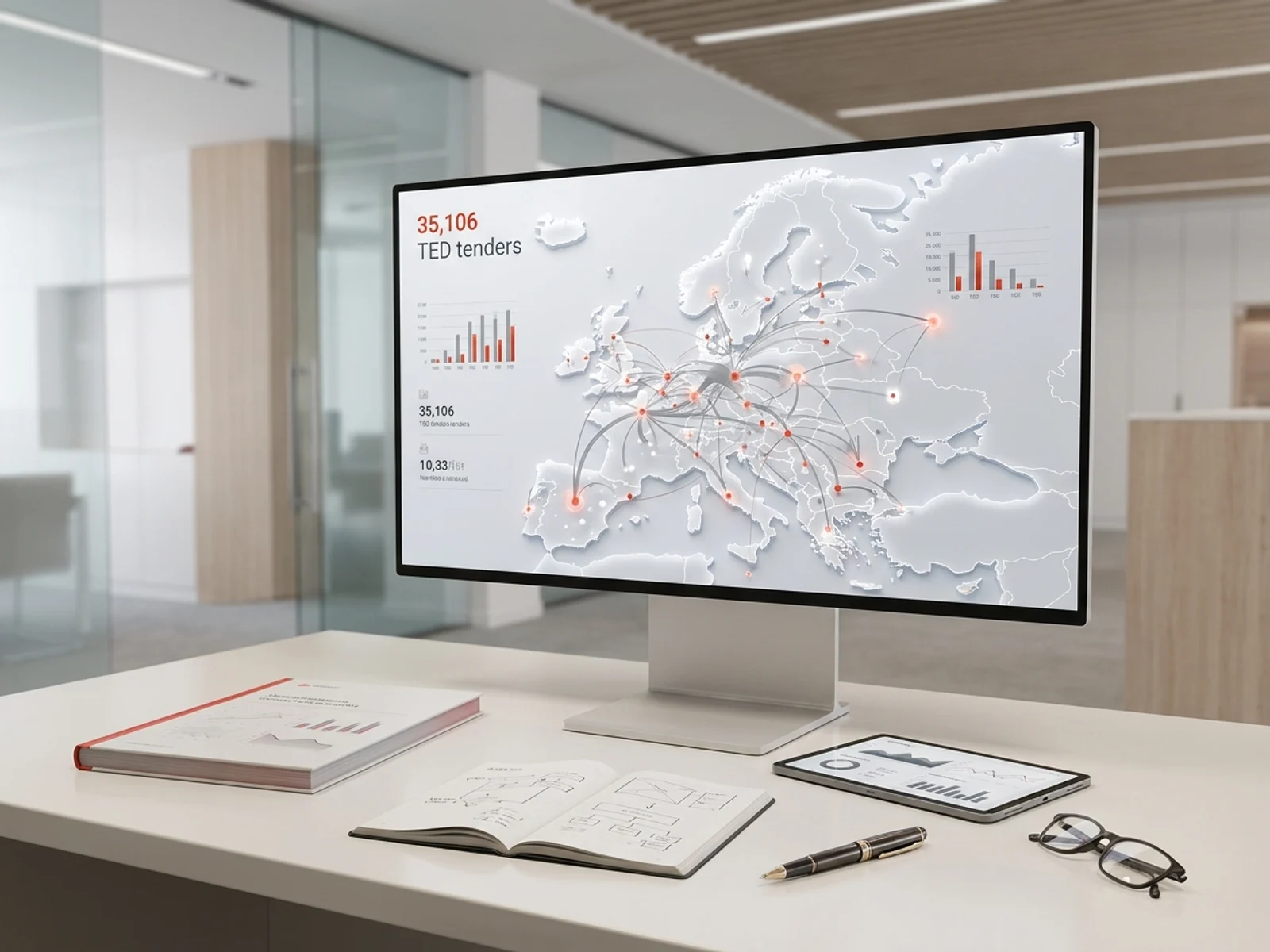
In 2025, the TED database logged 107,147 total procurement notices across all public procurement sectors in the EU single market. Of these, 35,106 notices (32.8%) concerned pharmaceutical products (CPV 33600000).
================================================================================
EU PHARMACEUTICAL PROCUREMENT SNAPSHOT (TED DATABASE, 2025)
================================================================================
Total TED Public Procurement Notices:    107,147
Pharmaceutical Notices (CPV 33600000):   35,106 (32.8% of all EU tenders)

Key Financial & Operational Metrics:
  ├── Median Framework Value per Notice:  €1.04 Million
  ├── 90th Percentile (p90) Value:        €24.74 Million
  └── Primary Notice Types:              Contract Award (57.2%), Contract Notice (36.3%)

Tender Winner Structure:
  └── The largest recipients of contract awards are Pharmaceutical Wholesalers
      & Distributors (e.g., Farmexim, Alliance Healthcare, PHOENIX Group, Urtica, Dr. Max)
================================================================================
Tender values vary widely based on contract design. Across 24,492 notices with a plausible reported value (filtered to €1,000–€5 billion to remove aggregation and currency artefacts), the median framework value was €1.04 million and the mean was €21.78 million (skewed by a long tail), while large national frameworks reached a 90th percentile ($\text{p}_{90}$) of €24.74 million. These figures are framework ceilings — often multi-year maximum values, not annual procurement spend — so they describe the scale of an individual lot but should not be summed into a "total EU drug spend" figure.
| Metric / Parameter | 2025 Value | Strategic / Market Access Meaning |
|---|---|---|
| Total Pharma Notices | 35,106 | Captures all above-threshold EU public drug tenders |
| Contract Award Notices (CAN) | 20,089 (57.2%) | Completed procurement contracts with identified winners |
| Contract Notices (CN) | 12,752 (36.3%) | Active open RFPs accepting manufacturer bids |
| Contract Modifications (CAN-Modif) | 1,355 (3.9%) | Scope/price adjustments to existing tender frameworks |
| Voluntary Ex-Ante (VEAT) | 333 (0.9%) | Direct single-source awards bypassing open competition |
| Median Tender Value | €1.04 Million | Operational size of typical hospital framework lot |
This procurement structure sits downstream from drug regulatory approvals. While regulatory teams track how many biosimilars are approved in the EU, commercial market-access teams must navigate TED tendering to capture actual hospital purchasing volume.
Multi-Year Procurement Volume Trajectory (2023–2026 YTD)
Tracking TED notice volume over time reveals shifting administrative dynamics across European purchasing authorities:
| Calendar Year | Total TED Notices | Pharma Notices (CPV 336) | Pharma Share (%) | YoY Pharma Change |
|---|---|---|---|---|
| 2023 | 84,249 | 29,129 | 34.6% | Baseline Year |
| 2024 | 68,477 | 14,229 | 20.8% | -51.2% (Portal Migration Lag) |
| 2025 | 107,147 | 35,106 | 32.8% | +146.7% (Catch-Up Spike) |
| 2026 (YTD) | 67,545 | 20,624 | 30.5% | Partial Year Snapshot |
Note: The drop in 2024 TED notice counts reflected the transition to eForms metadata standards, causing administrative reporting delays that caught up in 2025.
How TED CPV Codes Segment Pharmaceutical Procurement
A finer therapeutic-area breakdown is not reliably available from TED's pharmaceutical notices. Because European hospital framework lots bundle dozens of drug lines into a single award, the great majority of notices are filed under broad, multi-product Common Procurement Vocabulary (CPV) codes rather than a single therapeutic class. In the 2025 cohort, the dominant 8-digit codes are the parent CPV 33600000 (Pharmaceutical products, 14,815 notices) and the "various medicinal products" family (CPV 3369xxxx, roughly 10,000+ notices combined).
The largest disease-specific subgroup that can be isolated is antineoplastic and immunosuppressive agents (CPV 33652100 / 33652000, ~1,680 notices combined) — consistent with high-cost oncology biologics flowing through specialized university cancer-center tenders rather than general hospital bundles:
| CPV Code | Category | 2025 Notices | Typical Contracting Venue |
|---|---|---|---|
| CPV 33600000 | Pharmaceutical products (parent code) | 14,815 | General hospital framework bundles |
| CPV 3369xxxx family | "Various medicinal products" (multi-product lots) | ~10,000+ | Regional/municipal hospital networks |
| CPV 33652100 / 33652000 | Antineoplastic & immunosuppressive agents | ~1,680 (combined) | Specialized university cancer centers |
Because the broad codes dominate, market-access teams should segment EU tender opportunities by buyer country and contracting authority (below) rather than expecting a clean therapeutic-class split from the CPV field.
Which EU countries publish the most pharmaceutical tenders?
A common misconception among biopharma commercial leaders is that tender volume correlates directly with national population or total pharmaceutical spend. In reality, TED tender volume is driven primarily by procurement governance structure: fragmented, hospital-level tendering creates high notice counts, whereas centralized purchasing bodies consolidate volume into fewer, larger tenders.
EU PHARMACEUTICAL TENDER NOTICE SHARE BY COUNTRY (2025)
--------------------------------------------------------------------------------
Poland (POL)          ██████████████████████████████ (10,620 notices | 30.3%)
Romania (ROU)         ███████████████ (5,267 notices | 15.0%)
Bulgaria (BGR)        █████████ (3,197 notices | 9.1%)
Czechia (CZE)         ████████ (2,866 notices | 8.2%)
Spain (ESP)           ████████ (2,810 notices | 8.0%)
Germany (DEU)         █████ (1,985 notices | 5.7%)
Portugal (PRT)        ███ (1,078 notices | 3.1%)
Croatia (HRV)         ███ (1,045 notices | 3.0%)
Italy (ITA)           ██ (729 notices | 2.1%)
Lithuania (LTU)       ██ (659 notices | 1.9%)
France (FRA)          █ (564 notices | 1.6%)
Belgium (BEL)         █ (495 notices | 1.4%)
--------------------------------------------------------------------------------
Five EU member states account for 70.6% of all public pharmaceutical tender notices:
Country Volume Breakdown & National Legal Frameworks (2025 TED Data)
| Country | 2025 Pharma Notices | Share of EU Total | National Transposition & Governance Structure |
|---|---|---|---|
| Poland (POL) | 10,620 | 30.3% | Prawo zamówień publicznych; voivodeship hospitals issue separate lots |
| Romania (ROU) | 5,267 | 15.0% | Law No. 98/2016; hospital tenders alongside central health programs |
| Bulgaria (BGR) | 3,197 | 9.1% | Public Procurement Act; fragmented hospital tenders with distributor bidding |
| Czechia (CZE) | 2,866 | 8.2% | Act No. 134/2016 Coll.; university and regional hospital networks |
| Spain (ESP) | 2,810 | 8.0% | Ley 9/2017 de Contratos del Sector Público; Autonomous Communities (17 regions) |
| Germany (DEU) | 1,985 | 5.7% | Gesetz gegen Wettbewerbsbeschränkungen (GWB); SHI discount agreements |
| Portugal (PRT) | 1,078 | 3.1% | Código dos Contratos Públicos; SPMS central procurement |
| Croatia (HRV) | 1,045 | 3.0% | Public Procurement Act (ZJN 2016); clinical hospital center tenders |
| Italy (ITA) | 729 | 2.1% | Codice dei contratti pubblici; regional agencies (ARIA, SoReSa) |
| France (FRA) | 564 | 1.6% | Code de la commande publique; purchasing groups (UniHA, Resah) |
Centralized procurement nations—such as Denmark (where Amgros I/S negotiates national hospital drug supply in single multi-million euro tenders)—publish very few total notices, but each notice represents massive drug volume. Conversely, Eastern European nations publish thousands of small hospital-level tenders per year.
Understanding these international differences is essential for evaluating global manufacturing footprints, similar to our cross-border analysis of FDA-registered device establishments by country (2026).
Deep-Dive Comparison of National Procurement Bodies
To illustrate how governance models dictate bidding strategy, we compare three distinct European procurement archetypes:
================================================================================
NATIONAL PURCHASING ARCHETYPE COMPARISON
================================================================================
Parameter                Amgros I/S (Denmark)        UniHA (France)            Voivodeship Hospitals (Poland)
--------------------------------------------------------------------------------
Purchasing Scope         100% Public Hospitals       ~1,100 Public Hospitals   Single Voivodeship Hospital
Annual Drug Spend        ~€1.2 Billion               ~€3.8 Billion             €2M – €15M per hospital
Annual TED Notices       1 – 5                       10 – 30                   10,620 (nationwide)
Winner Model             Single or Dual Winner       Multi-lot frameworks      Single-lot per drug line
Primary Criterion        Lowest Evaluated Price      MEAT (Price + Quality)    Lowest Price Only
Biosimilar Switch Speed  <60 Days (Mandatory)        120–180 Days              30–90 Days (Tender Dependent)
================================================================================
How Public Tendering Impacts Biosimilar Market Penetration
The structure of European hospital tenders is the primary determinant of how quickly biosimilars displace originator biologics after patent expiration:
Rapid Switch Central Tenders (Nordic Model): Centralized buyers like Amgros (Denmark) execute mandatory switching tenders within 30 to 60 days of biosimilar approval. The winning biosimilar frequently captures 80% to 95% market share within three months of tender execution.
Framework Agreement Models (France / UK): Multi-winner framework agreements allow individual hospital pharmacists to select among top-ranked biosimilars. Conversion is gradual (50% to 70% share over 12 months), preserving secondary options for prescribers concerned about immunogenicity.
Fragmented Local Tenders (Poland / Romania): Individual hospital tenders create regional variation. Biosimilar adoption depends on whether individual hospital pharmaceutical committees issue tenders immediately or wait for annual budget cycles.
Who actually wins pharma tenders: manufacturers or wholesalers?
Analysis of awardee entities in Contract Award Notices (CAN) reveals an essential structural reality of European pharmaceutical trade: the vast majority of tender awards are won by pharmaceutical wholesalers and logistics distributors, not by originators or generic drug manufacturers directly.
Because hospital tenders frequently bundle dozens of drug lines into single administrative packages, hospital buyers rely on licensed full-line wholesalers to guarantee supply chain integrity, cold-chain storage, and daily delivery logistics.
TOP PHARMACEUTICAL TENDER WINNERS IN EUROPE (2025 CAN NOTICES)
--------------------------------------------------------------------------------
1. Farmexim / Mediplus (Romania)           ██████████████ 622 awards
2. Alliance Healthcare (Multi-Country EU)  █████████████ 598 awards
3. PHOENIX Group (Multi-Country EU)        █████████ 421 awards
4. Urtica Sp. z o.o. (Poland)              ████████ 345 awards
5. Salus International Sp. z o.o. (Poland)  ██████ 274 awards
6. PHOENIX Pharma EOOD (Bulgaria)          ██████ 268 awards
7. Danson Trading EOOD (Bulgaria)          █████ 250 awards
8. Dr. Max Group (Central/Eastern EU)      █████ 229 awards
9. Sopharma Trading AD (Bulgaria)          ████ 204 awards
10. Medika d.d. (Croatia)                  ████ 196 awards
--------------------------------------------------------------------------------
Key Wholesaler / Distributor Networks
Pan-European Integrated Wholesalers: Groups like PHOENIX Group (including Phoenix Pharma EOOD in Bulgaria and local subsidiaries across 29 countries) and Alliance Healthcare win hundreds of tender lots annually, serving as the logistics conduit for both brand-name biologics and generic oral solids.
National Distribution Champions: In high-notice markets like Poland and Romania, specialized pharmaceutical logistics firms dominate:
Farmexim / Mediplus: Won 622 tender awards in Romania alone in 2025.
Urtica Sp. z o.o. & Salus International: Combined for over 600 awards in Poland, serving as primary suppliers to state and university hospitals.
Dr. Max Group: Captures significant tender volume across Central Europe alongside its retail pharmacy operations.
For generic manufacturers planning European launches—such as those evaluated in our generic launch opportunity scorecard (2026-2027)—partnering with dominant regional wholesalers is often a prerequisite for participating in hospital tender awards.
Comparative Bidding Evaluation: Price-Only vs. MEAT Scoring Criteria
European contracting authorities differ fundamentally in how they evaluate tender bids:
================================================================================
TENDER EVALUATION COMPARISON: PRICE-ONLY VS. MEAT
================================================================================
Evaluation Model          Geographic Dominance       Bidding Strategy Implication
--------------------------------------------------------------------------------
Lowest Price Only         Poland, Romania, Bulgaria  Aggressive discount bidding;
                          (High-Notice Markets)      relies on low COGS supply

Most Economically         Nordics, France, UK,       Requires non-price scoring:
Advantageous (MEAT)       Germany (Central Buyers)   supply safety, eco-packaging,
                                                     FMD compliance, rapid delivery
================================================================================
In Nordic countries (Denmark, Sweden, Norway), MEAT scoring incorporates mandatory stock-holding commitments (e.g., holding 3 months of buffer inventory within national borders) to mitigate drug shortage risks. Manufacturers unable to meet supply-security requirements are disqualified even if they offer the lowest unit price.
Voluntary Ex-Ante Transparency (VEAT) Notices in Drug Shortages
While open competitive tenders account for 93.5% of TED publications (Contract Notices and Award Notices), contracting authorities utilized Voluntary Ex-Ante Transparency (VEAT) notices (333 cases in 2025) under statutory emergency provisions of Directive 2014/24/EU (Article 32):
Single-Source Patented Biologics: When a breakthrough drug holds valid patent protection with no therapeutic alternative, hospitals publish a VEAT notice before awarding a direct contract to the patent holder.
Critical Drug Shortage Mitigations: During acute hospital supply shortages (e.g., sterile injectable antibiotics or oncology supportive care drugs), health authorities use VEAT notices to execute rapid direct purchases from secondary international wholesalers or compounding centers.
Life Cycle of a European Hospital Tender
Navigating TED procurement requires commercial teams to track notices across a defined multi-stage operational lifecycle:
================================================================================
EUROPEAN PHARMACEUTICAL TENDER LIFECYCLE
================================================================================
Stage 1: Prior Information Notice (PIN)
  └── Contracting authority announces upcoming annual drug purchasing pipeline

Stage 2: Contract Notice (CN)
  └── Official RFP published on TED; specs, lot divisions & deadlines set (30-45 days)

Stage 3: Bidding & Evaluation
  └── Manufacturers / Wholesalers submit pricing bids; MEAT criteria applied

Stage 4: Contract Award Notice (CAN)
  └── Winning entity published on TED; standstill period begins (10-15 days)

Stage 5: Framework Execution & Contract Modifications (CAN-Modif)
  └── Order fulfillment occurs; scope or price adjustments logged via CAN-Modif
================================================================================
Strategic Risk Matrix for Tender Bidders
================================================================================
TENDER BIDDING RISK MATRIX FOR MANUFACTURERS
================================================================================
Risk Category            Operational Impact                  Mitigation Strategy
--------------------------------------------------------------------------------
Single-Winner Lockout    Losing tender excludes product from Dual-sourcing lots &
                         hospital formulary for 2-3 years    MEAT non-price scoring

Stockout Penalty Clause  Severe financial penalties or       Maintain 3-month safety
                         contract termination for delays    stock at local wholesaler

Price Erosion Cascade    Tender price publishes on TED;     Use confidential rebate
                         triggers international referencing  structures where permitted

Wholesaler Insolvency    Logistics breakdown derails         Contract with multi-regional
                         hospital order fulfillment          established distributors
================================================================================
Centralized vs. Fragmented Procurement Models
European drug procurement operates across a spectrum between two distinct organizational models:
--------------------------------------------------------------------------------
CENTRALIZED VS. FRAGMENTED EU TENDERING MODELS
--------------------------------------------------------------------------------
[Model A: Centralized Single-Buyer]
Example: Amgros (Denmark), Socialstyrelsen (Sweden), SPMS (Portugal)
  ├── Characteristics: Single national tender for all public hospitals
  ├── Notice Count: Very Low (1–10 per year)
  ├── Tender Value: Very High (€50M – €200M per tender)
  └── Market Risk: Winner-take-all; losing means total market exclusion

[Model B: Fragmented Multi-Buyer]
Example: Voivodeship Hospitals (Poland), Regional Health Authorities (Spain/Italy)
  ├── Characteristics: Hundreds of independent hospital RFPs
  ├── Notice Count: Very High (1,000–10,000 per year)
  ├── Tender Value: Low-to-Moderate (€100k – €2M per lot)
  └── Market Risk: Diversified; losing one tender leaves other regional opportunities
--------------------------------------------------------------------------------
Directive 2014/24/EU and Revised 2026 Thresholds
Public drug procurement in the EU is governed by Directive 2014/24/EU, which requires all contracts exceeding specific financial thresholds to be advertised publicly on TED to ensure non-discrimination and transparency.
For the 2026–2027 threshold period, the European Commission updated public procurement thresholds:
Central Government Authorities: €143,000 (for supply and service contracts).
Sub-Central Contracting Authorities (e.g., regional hospitals): €221,000.
Contracts below these thresholds do not require TED publication and are handled via local quotation procedures, explaining why smaller municipal drug purchases do not appear in the TED database.
Strategic Takeaways for Market-Access Teams
Map Country-Specific Bidding Venues: Biopharma commercial teams cannot adopt a uniform EU tendering strategy. Markets like Poland require high-frequency, localized bidding operations, while markets like Denmark demand single, highly competitive national tender submissions.
Build Distribution Partnerships Early: Because wholesalers (Alliance Healthcare, PHOENIX, Farmexim, Urtica) dominate tender award volumes, manufacturers should negotiate distribution-for-tender agreements prior to patent expiry or biosimilar launch.
Monitor Contract Modification Notices (CAN-Modif): Contract modifications (1,355 notices in 2025) signal volume expansions or price adjustments in ongoing multi-year tenders. Tracking modifications provides early competitive intelligence on shifting hospital demand.
Frequently Asked Questions
Does TED capture all EU drug procurement, or only above-threshold notices?
TED captures public pharmaceutical tenders that exceed EU threshold amounts under Directive 2014/24/EU (€143,000 for central authorities; €221,000 for sub-central hospital authorities for 2026–2027). Below-threshold micro-purchases and private hospital procurement are excluded.
Why does Eastern Europe dominate TED tender notice counts?
Eastern European countries like Poland, Romania, Czechia, and Bulgaria use decentralized procurement models where individual public hospitals issue separate tenders for their annual drug supplies. This generates thousands of distinct notices on TED, compared to centralized systems like Denmark's Amgros that negotiate national demand in a single tender.
What do TED notice types (CAN, CN, PIN, VEAT) mean?
CN (Contract Notice): An open invitation to tender where suppliers can submit bids.
CAN (Contract Award Notice): The final announcement detailing which entity won the tender and the contract value.
PIN (Prior Information Notice): An advance notice signaling an upcoming tender.
VEAT (Voluntary Ex-Ante Transparency): A notice declaring an intent to award a contract directly without prior open competition under specific statutory exceptions.
What is a Voluntary Ex-Ante Transparency (VEAT) notice in drug procurement?
A VEAT notice (333 notices in 2025) is published when a contracting authority intends to award a contract directly to a single supplier without holding an open competitive tender. In pharma procurement, VEAT notices are typically used for single-source patented drugs with no therapeutic alternatives, emergency drug shortages, or specialized vaccine procurements.
How do multi-winner lot divisions work in European tenders?
To reduce single-source supply shortage risks, many European hospital buyers split high-volume drug tenders into multi-winner lots (e.g., 60% volume to the 1st place bidder, 40% to 2nd place). This prevents total market lockout for secondary suppliers while maintaining competitive downward price pressure.
Sources
European Union. Tenders Electronic Daily (TED) — Supplement to the Official Journal of the EU. Common Procurement Vocabulary (CPV 33600000: Pharmaceutical Products). https://ted.europa.eu
European Parliament & Council. Directive 2014/24/EU on Public Procurement. EUR-Lex (2014/2026). https://eur-lex.europa.eu/legal-content/EN/TXT/?uri=celex%3A32014L0024
Gesundheit Österreich GmbH (GÖG) / PPRI. Pharmaceutical Tendering and Public Procurement in Europe. PPRI Policy Report. https://ppri.goeg.at
European Federation of Pharmaceutical Industries and Associations (EFPIA). EFPIA Principles for Public Procurement of Medicines. https://www.efpia.eu
Amgros I/S. Pharmaceutical Procurement for Danish Public Hospitals. Annual Report & Tendering Guidelines. https://amgros.dk/en
National Center for Biotechnology Information (NCBI / PubMed). Pharmaceutical Tendering and Pricing in European Public Hospitals. NCBI / PubMed Central. https://www.ncbi.nlm.nih.gov/pmc/articles/PMC6283733