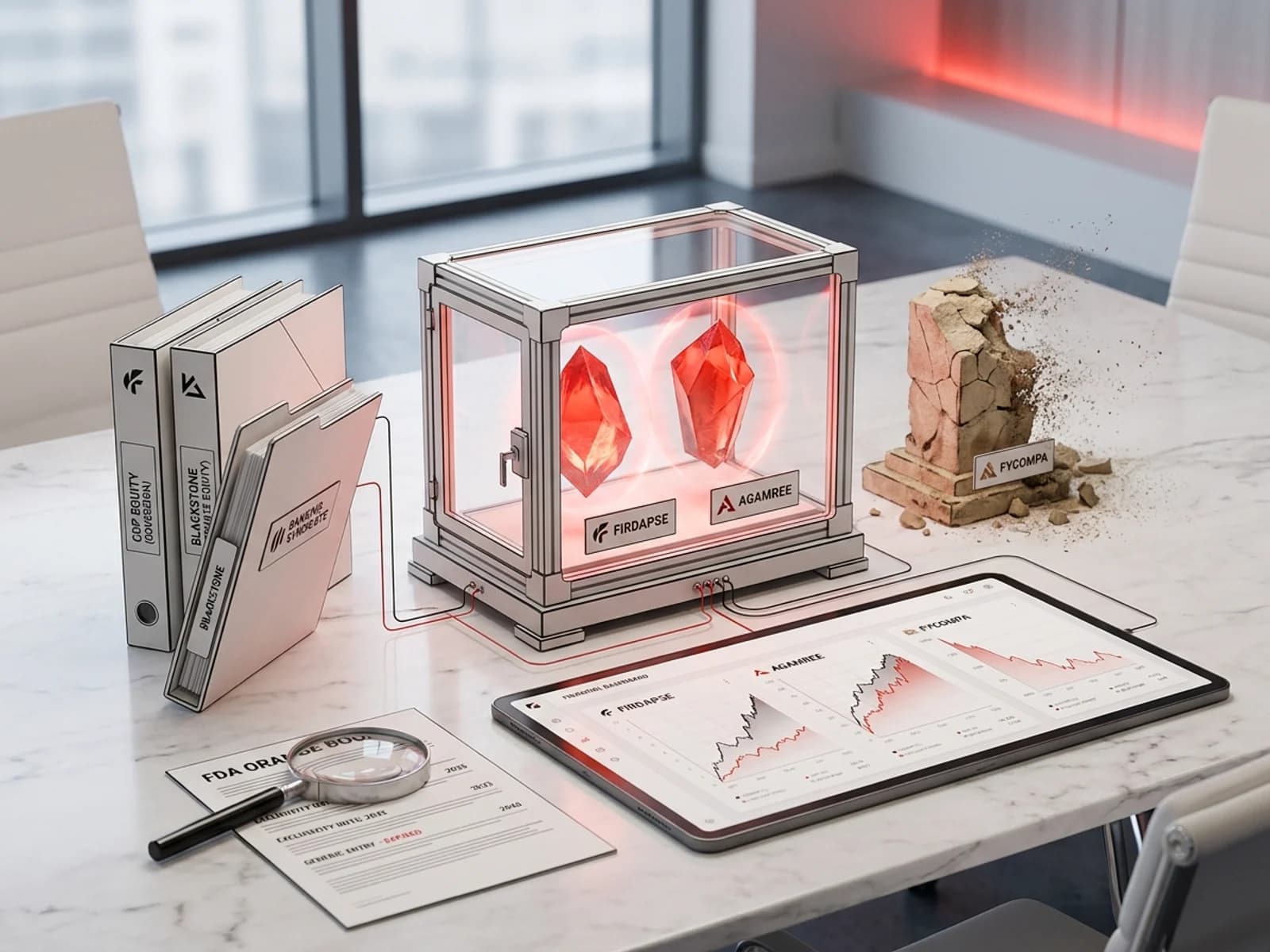
Biogen's strategic transformation took a definitive step in the second quarter of 2026 with the formal inclusion of Apellis Pharmaceuticals into its consolidated financial results. Announced on March 31, 2026, and closed on May 14, 2026, Biogen’s acquisition of Apellis for an upfront value of ~$5.6B represents one of the largest biopharma M&A transactions of the year.
With the release of Biogen's Q2 2026 earnings report, investors and commercial strategy teams have received their first empirical look at how the deal is performing. Behind headline numbers lies a critical portfolio rotation: revenues from acquired complement therapies (Syfovre and Empaveli) pushed Biogen's designated "growth portfolio" past $1B for the first time, surpassing its declining legacy multiple sclerosis (MS) franchise and providing crucial top-line support while the anti-amyloid Alzheimer's launch (Leqembi) builds momentum.
Direct Answer: Deal Anatomy and Q2 Financial Contribution
The financial terms and initial accounting disclosures of the Biogen-Apellis transaction reveal the exact scope of the acquisition and its immediate contribution to Biogen’s Q2 2026 performance:
Transaction Consideration: Biogen acquired Apellis for $41.00 per share in cash plus a non-transferable Contingent Value Right (CVR) of up to $4.00 per share tied to specified Syfovre net sales milestones. According to Biogen’s Q2 2026 Form 10-Q filing, total purchase consideration was $5,410.1M ($5,406.0M cash and $4.1M estimated fair value of contingent consideration), an 86% premium to Apellis's 90-day volume-weighted average price (and 35% above the 52-week high).
Financing Structure: The upfront cash was funded through cash on hand, a new $2.0B 2026 term loan facility, and a $400M draw on Biogen’s revolving credit facility.
Purchase Price Allocation: Biogen allocated $4,630.0M to completed technology intangible assets, $712.0M to inventory (including step-up fair value adjustments), and $501.5M to goodwill.
Total vs. Recognized Quarterly Product Revenue:
Syfovre (pegcetacoplan intravitreal): Total Q2 product revenue across the full quarter was $162M (+8% YoY, commercial injections +13%). Biogen recognized $97.4M in net revenue for the partial period from the May 14 acquisition close through June 30.
Empaveli (pegcetacoplan subcutaneous): Total Q2 product revenue was $46M (+123% YoY, driven by C3 glomerulopathy and primary IC-MPGN launch expansion). Biogen recognized $30.4M in net revenue post-close.
Strategic Growth Alignment: Driven by the addition of Syfovre and Empaveli, Biogen’s growth portfolio expanded 24% YoY to >$1.0B, officially overtaking legacy MS revenues ($963M, down 13% YoY).
Guidance & EPS Impact: Biogen raised full-year 2026 total revenue guidance to mid-single-digit growth. FY2026 Non-GAAP diluted EPS guidance was adjusted to $12.00–$13.00 (reflecting ~$3.00 in upfront IPR&D charges and ~$0.85 per share of net dilution from Apellis integration), while underlying operational EPS guidance was raised $0.60 to $15.85–$16.85. Management targets ≥$250M in annual run-rate synergies exiting 2027 and expects the deal to become accretive to Non-GAAP EPS in 2027.
Biogen Portfolio Revenue Shift (Q2 2026)
┌─────────────────────────────────────────────────────────┐
│ Growth Portfolio (Syfovre, Empaveli, Skyclarys, Vumerity│
│   & Leqembi): >$1,000M (+24% YoY)                       │
├─────────────────────────────────────────────────────────┤
│ Legacy MS Franchise (Tecfidera, Avonex, Tysabri, etc.): │
│   $963M (-13% YoY)                                      │
├─────────────────────────────────────────────────────────┤
│ Anti-CD20 Royalties (Ocrevus / Rituxan):                │
│   $513.5M (+10% YoY)                                    │
└─────────────────────────────────────────────────────────┘
For broader perspective on biopharma M&A deal structures, premium distributions, and asset valuation benchmarks, consult our overview of biopharma M&A deals by the numbers.
What Were the Biogen-Apellis Deal Economics and How Was It Financed?
The acquisition of Apellis represents a bold leverage play by Biogen to secure late-stage commercial assets. When the transaction was announced on March 31, 2026, Apellis had established pegcetacoplan as a targeted C3 complement inhibitor across two major therapeutic categories: geographic atrophy (GA) secondary to age-related macular degeneration (Syfovre) and rare complement-mediated hematologic and renal diseases (Empaveli).
| Deal Parameter | Disclosed Terms / SEC 10-Q Breakdown |
|---|---|
| Upfront Cash Offer | $41.00 per share in cash |
| Contingent Value Right (CVR) | Non-transferable CVR up to $4.00 per share based on Syfovre net sales milestones |
| Total Equity / Enterprise Value | ~$5.6B total upfront enterprise value; $5,410.1M net consideration in SEC 10-Q |
| Unaffected Premium | 86% premium to 90-day VWAP (35% above 52-week high) |
| Debt Financing Drawn | $2.0B 2026 senior term loan facility + $400M revolving credit facility draw |
| Intangible Asset Valuation | $4,630.0M (completed technology, amortized over 12–15 years) |
| Inventory Fair Value Step-Up | $712.0M recognized in purchase price allocation |
| Goodwill Recorded | $501.5M |
| Acquisitions & Target 2025 Revenue | $689M combined 2025 net product sales (Syfovre + Empaveli) |
To fund the ~$5.4B cash consideration, Biogen utilized existing cash balances alongside a structured debt package. The 10-Q discloses a new 2026 term loan credit agreement (a ~$2.0B facility structured as a $800M 364-day tranche and a $1,000M two-year tranche), and the cash-flow statement reports $2,400.0M in "proceeds from borrowings, net" for the six months—consistent with the term loan plus a revolver draw, net of fees. Biogen also fully liquidated its marketable-securities portfolio, taking cash and marketable securities from $4,247.6M at year-end 2025 to $1,285.0M at June 30, 2026.
The transaction structure also features a contingent payout mechanism: the CVR provides Apellis shareholders up to an additional $4.00 per share if Syfovre achieves specific multi-year commercial sales thresholds, aligning total acquisition cost with long-term commercial execution in retina care.
Scientific and Clinical Foundation of the Target Assets: C3 Inhibition Platform
To evaluate why Biogen was willing to commit $5.6B to acquire Apellis, biopharma strategy teams must examine the underlying biochemistry and clinical trial evidence supporting pegcetacoplan.
Pegcetacoplan is a targeted C3 inhibitor designed to regulate excessive activation of the complement cascade, a critical component of the innate immune system. Unlike terminal C5 inhibitors (such as Alexion/AstraZeneca's Soliris and Ultomiris), which only block the cleavage of C5 into C5a and C5b, pegcetacoplan binds to complement protein C3 and its activation fragment C3b.
By controlling C3, pegcetacoplan regulates all three activation pathways of the complement system: classical, lectin, and alternative.
Complement Cascade Target Inhibition: C3 vs. C5
┌───────────────────────────────────────────────────────────┐
│ Classical Pathway │ Lectin Pathway │ Alternative Pathway  │
└─────────────────────┬─────────────────────────────────────┘
                      ▼
┌───────────────────────────────────────────────────────────┐
│ C3 Convertase ──► C3 Protein ──► Pegcetacoplan (Syfovre / │
│                                  Empaveli) Target Gate    │
└─────────────────────┬─────────────────────────────────────┘
                      ▼
┌───────────────────────────────────────────────────────────┐
│ C5 Convertase ──► C5 Protein ──► Eculizumab / Ravulizumab │
│                                  Target Gate              │
└───────────────────────────────────────────────────────────┘
1. Syfovre (intravitreal pegcetacoplan) Clinical Profile in Geographic Atrophy
Approved by the FDA in February 2023, Syfovre became the first therapy available for geographic atrophy (GA), an advanced form of dry age-related macular degeneration that causes irreversible vision loss through retinal pigment epithelium (RPE) degeneration.
Pivotal Evidence (OAKS and DERBY Phase 3 Trials): Across 1,258 total patients evaluated over 24 months, Syfovre demonstrated a statistically significant, progressive reduction in GA lesion growth rate compared to sham control. In monthly dosing, Syfovre reduced GA lesion growth by up to 22% in OAKS and 19% in DERBY at Month 24.
Treatment Effect Acceleration: The clinical effect accelerated over time: between Months 18 and 24, monthly Syfovre reduced extra-foveal GA lesion growth by up to 36% in OAKS.
Dosing Flexibility: Syfovre is approved for flexible administration every 25 to 60 days (every 1 to 2 months), giving retina specialists operational flexibility in clinic scheduling.
2. Empaveli (subcutaneous pegcetacoplan) Clinical Profile in Rare Hematology & Nephrology
Approved by the FDA in May 2021 for paroxysmal nocturnal hemoglobinuria (PNH) and expanded in 2025/2026 into C3 glomerulopathy (C3G) and primary immune complex-mediated membranoproliferative glomerulonephritis (IC-MPGN), Empaveli operates in high-value orphan indications.
PEGASUS Phase 3 Trial (PNH): In a head-to-head study against eculizumab (Soliris) in PNH patients with persistent anemia despite C5 inhibition, Empaveli demonstrated statistical superiority in hemoglobin improvement (adjusted mean increase of 3.8 g/dL vs. eculizumab, p<0.0001) and transfusion independence (85% vs. 15%).
VALIANT Phase 3 Trial (C3G & IC-MPGN): Empaveli achieved a statistically significant 68% reduction in proteinuria (log-transformed urine protein-to-creatinine ratio, UPCR) compared to placebo at Week 26 (p<0.0001), alongside stabilization of estimated glomerular filtration rate (eGFR).
This dual clinical footprint across high-prevalence retina care (Syfovre) and high-value rare disease (Empaveli) gave Biogen a multi-pronged commercial driver.
What Did Syfovre and Empaveli Contribute in the First Quarter (and Total vs. Recognized Revenue)?
A common trap when reviewing post-acquisition earnings is confusing total target product revenue across the full calendar quarter with recognized revenue recorded on the acquirer’s income statement from the transaction closing date forward.
Because the Apellis transaction closed on May 14, 2026, Biogen’s Q2 2026 financial results include approximately six weeks of operational revenue from the acquired assets.
Q2 2026 Revenue Reporting Distinction (~6 Weeks Post-Close)
┌───────────────────────────────────────────────────────────┐
│ Syfovre Total Q2 Revenue: $162M (+8% YoY)                │
│  ├── Pre-Close Apellis Period: ~$64.6M                     │
│  └── Biogen Recognized Post-Close: $97.4M                 │
├───────────────────────────────────────────────────────────┤
│ Empaveli Total Q2 Revenue: $46M (+123% YoY)              │
│  ├── Pre-Close Apellis Period: ~$15.6M                     │
│  └── Biogen Recognized Post-Close: $30.4M                 │
└───────────────────────────────────────────────────────────┘
1. Syfovre (pegcetacoplan intravitreal injection)
Total Q2 Product Revenue: $162M, representing an 8% increase year-over-year. Commercial vial injections grew 13% YoY, reflecting expanding clinical adoption among retina specialists.
Biogen Recognized Revenue: $97.4M for the period from May 14 to June 30.
Commercial Dynamics: Syfovre remains the leading FDA-approved therapy for geographic atrophy. Despite competition from Astellas's Izervay (avacincaptad pegol), Syfovre's flexible dosing regimen (every 25 to 60 days) and established buy-and-bill accounts have preserved market leadership.
2. Empaveli (pegcetacoplan subcutaneous infusion)
Total Q2 Product Revenue: $46M, a dramatic 123% YoY surge.
Biogen Recognized Revenue: $30.4M for the post-close partial period.
Commercial Dynamics: Growth was driven by label expansions into C3 glomerulopathy (C3G) and primary immune complex-mediated membranoproliferative glomerulonephritis (IC-MPGN), supplementing its core indication in paroxysmal nocturnal hemoglobinuria (PNH). Sobi continues to market the drug ex-US under the brand name Aspaveli.
Together, the two products contributed $127.8M in recognized net product revenue to Biogen’s Q2 top line, providing immediate revenue scale that offset weakness in legacy business units.
To understand how Empaveli competes against intravenous C5 inhibitors and oral factor B/D agents, see our detailed guide to the PNH complement-inhibitor access landscape.
Detailed Biogen Product Portfolio Analysis: Growth Engine vs. Legacy Contraction
To appreciate the strategic necessity of the Apellis transaction, commercial analysts must evaluate Biogen's full product portfolio performance in Q2 2026 (per the product-revenue table in the Form 10-Q):
| Product / Line | Indication Scope | Q2 2026 Net Revenue | Q2 2025 Net Revenue | YoY |
|---|---|---|---|---|
| Multiple Sclerosis franchise (total) | All MS products | $963.3M | $1,107.2M | −13% |
| ├── Tecfidera | RRMS | $90.9M | $193.6M | −53% |
| ├── Vumerity | RRMS | $196.5M | $212.3M | −7% |
| ├── Avonex | RRMS | $170.0M | $177.7M | −4% |
| ├── Plegridy | RRMS | $55.1M | $69.0M | −20% |
| └── Tysabri | RRMS | $450.8M | $454.6M | −1% |
| Spinraza | SMA | $401.9M | $392.7M | +2% |
| Skyclarys | Friedreich's ataxia | $167.9M | $130.3M | +29% |
| Qalsody | SOD1-ALS | $31.9M | $20.0M | +60% |
| Syfovre (recognized) | Geographic atrophy | $97.4M | — | acquired |
| Empaveli (recognized) | PNH, C3G, IC-MPGN | $30.4M | — | acquired |
| Zurzuvae | Postpartum depression | $70.8M | $46.4M | +53% |
| Total product revenue, net | $1,916.4M | $1,878.7M | +2% | |
| Anti-CD20 programs | Ocrevus / Rituxan royalty + profit share | $513.5M | $467.3M | +10% |
| Alzheimer's collaboration (Leqembi) | Early Alzheimer's (Biogen share) | $63.7M | $54.9M | +16% |
| Total revenue | $2,736.0M | $2,645.5M | +3% |
Biogen's management-defined Growth Portfolio—which bundles Spinraza, Skyclarys, Vumerity, Qalsody, Syfovre, Empaveli, Zurzuvae, plus Biogen's Leqembi share—generated about $1.06 billion in the quarter, up 24% year-over-year, while the Legacy MS Portfolio (Tecfidera, Avonex, Plegridy, Tysabri, excluding Vumerity) was roughly $767 million and contracting. In other words, the designated growth engines now comfortably out-earn the legacy MS products, with the Apellis assets adding $127.8M of recognized revenue on top.
As shown in the table, the total MS franchise declined by about $144M YoY in Q2 2026 alone. Without the $127.8M in recognized revenues from Syfovre and Empaveli, alongside growth from Skyclarys (acquired via Reata) and Leqembi, Biogen's overall corporate top line would have contracted rather than growing 3% to $2.736B.
Product Performance Trajectory: Legacy vs. Acquired
┌───────────────────────────────────────────────────────────┐
│ Legacy MS Franchise (Tecfidera/Tysabri/Avonex/Plegridy)   │
│  - Q2 2025: $1,107M  ──►  Q2 2026: $963M (-13%)          │
├───────────────────────────────────────────────────────────┤
│ Growth Portfolio (Skyclarys/Syfovre/Empaveli/Spinraza…)   │
│  - Q2 2025: ~$855M   ──►  Q2 2026: $1.06B (+24%)         │
└───────────────────────────────────────────────────────────┘
International Licensing Framework: The Sobi Ex-US Partnership Model
An essential structural detail of the Apellis transaction is the existing international licensing agreement with Swedish Orphan Biovitrum AB (Sobi).
Under a 2020 collaboration agreement, Apellis granted Sobi exclusive rights to develop and commercialize systemic pegcetacoplan (Empaveli / Aspaveli) outside the United States. The arrangement carries through to Biogen as Apellis's successor:
Territorial Split: Biogen retains 100% of US commercial rights for both Syfovre and Empaveli, plus worldwide rights for intravitreal Syfovre in geographic atrophy (subject to regional regulatory filings). Sobi holds ex-US commercialization rights for systemic pegcetacoplan (Aspaveli) in PNH, C3G, and IC-MPGN.
Royalty Stream: Sobi pays the Apellis estate tiered royalties on ex-US Aspaveli net sales in the high teens to high twenties percent, alongside regulatory and sales milestones.
2025 Royalty Buy-Down: In July 2025, Sobi paid Apellis $275 million upfront (plus up to $25 million on EMA approval of Aspaveli in C3G/IC-MPGN, which followed in January 2026) to reduce its royalty obligation by 90%, subject to performance caps; once caps are hit, the full royalty reverts. Biogen therefore inherits a materially smaller near-term ex-US royalty stream than the original agreement provided, in exchange for the $300 million of non-dilutive cash Apellis booked upfront.
Co-Development: The two companies hold global co-development rights for systemic pegcetacoplan, sharing development responsibilities for trials such as VALIANT in C3G/IC-MPGN.
This partnership reduces Biogen's international commercial launch expenditure for Empaveli in rare nephrology, allowing Biogen to focus its direct sales force on US market execution while collecting ex-US economics from Sobi—though the 2025 buy-down means that economics is now a thinner, capped royalty plus a one-time cash infusion rather than a full double-digit stream.
Why Is Biogen Rotating from MS and Leqembi into Complement and Ophthalmology?
The acquisition of Apellis must be viewed through the lens of Biogen's ongoing corporate portfolio rotation. For over two decades, Biogen relied on its multiple sclerosis (MS) franchise—anchored by Tecfidera, Avonex, Plegridy, Vumerity, and Tysabri—as its primary earnings engine. However, generic erosion, competitive pressure from Roche's Ocrevus (an anti-CD20 monoclonal antibody), and market saturation have driven steady double-digit declines in MS revenues.
In Q2 2026, Biogen's total MS revenues dropped 13% YoY to $963M. While Vumerity maintained stability, core oral and injectable MS therapies continued to cede volume.
Concurrently, Biogen’s high-profile neurodegeneration launch—Leqembi (lecanemab-irmb), co-developed with Eisai for early Alzheimer's disease—has experienced a deliberate, complex commercial ramp. Leqembi achieved $184M in global Q2 sales (+15% YoY), but the requirement for PET scan/CSF biomarker confirmation, bi-weekly IV infusion capacity, and frequent MRI monitoring for amyloid-related imaging abnormalities (ARIA) has capped short-term revenue velocity.
By acquiring Apellis, Biogen instantly added $689M+ in annual high-margin product revenues with projected mid-to-high-teens growth through 2028. The deal effectively "papers over" the near-term revenue valley caused by MS contract contraction and Leqembi’s gradual rollout, allowing Biogen to present a growing top line to capital markets.
The access and diagnostic requirements governing anti-amyloid therapies are analyzed in depth in our comparison of Leqembi vs. Kisunla anti-amyloid monoclonal antibody access.
What Are the Synergy Targets and the 2027 EPS Accretion Path?
While the Apellis transaction boosts top-line growth immediately, it creates short-term margin compression due to acquisition accounting, financing costs, and operational integration expenses.
FY2026 Guidance Revisions:
Total Revenue: Raised to mid-single-digit growth YoY.
Non-GAAP Diluted EPS: Revised to $12.00–$13.00, cut from Biogen's prior FY2026 outlook by roughly $2 per share.
What drove the cut: about $3.00 per share in upfront IPR&D and milestone charges (including deal-related obligations) and roughly $0.85 per share of net operational dilution from Apellis in 2026, partially offset by about +$0.60 per share of core operational outperformance. Stripping out the IPR&D and Apellis dilution, Biogen's underlying operational EPS guidance is $15.85–$16.85.
2026 Non-GAAP Diluted EPS Bridge
 Core operational outperformance          +$0.60  ──► Underlying operational EPS: $15.85–$16.85
 Less: Upfront IPR&D & milestones          -$3.00
 Less: Net Apellis integration dilution    -$0.85
                                          ───────
 Revised FY2026 Non-GAAP EPS guidance     $12.00–$13.00
Synergy Targets & 2027 Accretion:
Biogen management has committed to capturing ≥$250M in annual run-rate operational synergies by the time the company exits FY2027. Synergy capture will focus on consolidating corporate overhead, streamlining redundant commercial field forces in rare disease, and integrating medical affairs and R&D functions.
Driven by these cost synergies, the burn-off of initial inventory fair-value step-up charges, and continued expansion of Syfovre and Empaveli, Biogen expects the transaction to become accretive to Non-GAAP Diluted EPS in FY2027.
Financial Debt Profile and Capital Allocation Strategy (2026–2030)
To fund the Apellis acquisition, Biogen significantly altered its capital structure. SEC disclosures outline the resulting debt profile and liquidity constraints facing the company:
| Debt Instrument | Carrying Value (Jun 30, 2026) | Rate / Structure | Maturity | Notes |
|---|---|---|---|---|
| 2026 Term Loan — 364-day tranche | $800.0M | Floating (credit-agreement rate) | ~May 2027 | Classified current; Apellis financing |
| 2026 Term Loan — two-year tranche | $1,000.0M | Floating (credit-agreement rate) | ~May 2028 | Non-current; Apellis financing |
| Revolving credit facility | Drawn (part of financing) | Floating | Per facility | The 10-Q reports aggregate "proceeds from borrowings, net" of $2,400.0M for the six months, consistent with the ~$2.0B term loan plus a revolver draw net of fees |
| Senior notes (7 tranches) | ~$6,290.2M | Fixed 2.25% – 6.45% | 2030 – 2055 | Largest: 2.25% 2030 ($1,496.2M); 3.15% 2050 ($1,476.0M); 5.20% 2045 ($1,101.7M); plus 2031/2035/2051/2055 tranches |
| Total borrowings | $8,090.3M | Mixed fixed / floating | 2027 – 2055 | Up $1,803.5M (+28.7%) from $6,286.8M at year-end 2025 |
| Cash, equivalents & marketable securities | $1,285.0M | Liquid | N/A | Down from $4,247.6M at year-end 2025; marketable securities fully liquidated to help fund the deal |
Biogen Debt Maturity Profile (Post-Acquisition)
┌───────────────────────────────────────────────────────────┐
│ Near-term (~2027–2028): $800M 364-day + $1,000M 2-year    │
│   term-loan tranches, plus revolver draw                  │
├───────────────────────────────────────────────────────────┤
│ 2030–2031: $1,496M (2.25% 2030) + $398M (5.05% 2031)      │
├───────────────────────────────────────────────────────────┤
│ 2035–2055: $646M (2035), $1,102M (2045), $1,476M (2050),  │
│   $482M (2051), $690M (2055) senior notes                 │
└───────────────────────────────────────────────────────────┘
This debt load requires Biogen to prioritize debt paydown over aggressive share buybacks through 2028. Management indicated that free cash flow generated by Syfovre, Empaveli, and Skyclarys will be directed toward retiring the term-loan facility—the $800M 364-day tranche comes due around May 2027 and the $1,000M two-year tranche around May 2028—before those maturities.
How Does the Deal Connect to the Broader Complement and Retina Access Landscape?
The commercial success of Biogen’s newly acquired assets depends on navigating distinct market-access environments across ophthalmology clinics and specialty hematology networks.
1. Syfovre and Retina Buy-and-Bill Economics
Intravitreal Syfovre is administered directly by retina specialists in office settings. Like anti-VEGF therapies, Syfovre operates under a traditional buy-and-bill reimbursement model.
Clinics purchase inventory upfront and seek reimbursement from Medicare Part B and commercial health plans under HCPCS code J2781. Retina practices face substantial working capital exposure, requiring predictable payer coverage, robust co-pay assistance programs, and minimal claim denial rates to maintain inventory flow.
Operational risks and inventory management in retina care are covered in our analysis of retina buy-and-bill inventory risk and payer preference changes.
Furthermore, competitive dynamics in the retina space are evolving with the launch of new ophthalmic biologics, as detailed in our coverage of Lytenava and the ophthalmic anti-VEGF access landscape.
2. Empaveli and Specialty Pharmacy Access
Unlike Syfovre, Empaveli is a self-administered subcutaneous infusion delivered via an on-body injector. Reimbursement flows primarily through Medicare Part D and commercial pharmacy benefit managers (PBMs).
Because Empaveli treats ultra-rare conditions like PNH and C3G, PBMs impose strict Prior Authorization (PA) requirements, requiring documentation of lactate dehydrogenase (LDH) elevation, transfusion dependence, or specific renal biopsy criteria. Biogen’s specialty pharmacy hub must manage complex PA workflows and copay assistance to prevent prescription abandonment.
Syfovre vs. Empaveli Commercial Access Mechanics
| Syfovre (Retina GA) | Empaveli (PNH / C3G / MPGN) |
|---|---|
| • Medical Benefit (Part B) | • Pharmacy Benefit (Part D) |
| • Buy-and-Bill clinic model | • Specialty Pharmacy Hub |
| • HCPCS Code: J2781 | • NDC-level PBM adjudication |
| • Practice inventory capital | • Strict PA / Re-auth rules |
What Are the Integration and Pipeline Risks (Discontinued Programs, Debt, CVR)?
While the Apellis transaction provides strategic top-line support, it introduces notable operational and financial risks that Biogen management must navigate over the next 24 months:
Leverage and Debt Service: Total borrowings jumped $1,803.5M (+28.7%) to $8,090.3M, and cash and marketable securities fell to $1,285.0M—leaving Biogen with a thinner liquidity cushion at a time when interest rates remain elevated. Debt reduction will compete with internal R&D funding through 2027.
CVR Payout Triggers: The non-transferable CVR of up to $4.00 per share presents a deferred liability. If Syfovre sales hit top-tier growth milestones, Biogen will face multi-hundred-million-dollar cash payouts to former Apellis shareholders.
Safety and Pharmacovigilance Monitoring: Syfovre's commercial trajectory faced headwinds in 2023 following rare reports of ischemic retinal vasculitis. While real-world data and label updates have stabilized clinical confidence, ongoing safety surveillance remains vital for maintaining market share against Astellas's Izervay.
Pipeline Prioritization: Integrating Apellis requires Biogen to rationalise redundant pipeline programs. Biogen has already indicated it will trim early-stage, non-core complement discovery projects to focus resources on pegcetacoplan line extensions and high-margin phase 3 assets.
Frequently Asked Questions (FAQ)
How much did Biogen pay for Apellis and what is the CVR tied to?
Biogen acquired Apellis for $41.00 per share in cash upfront, representing an enterprise value of ~$5.6B, with net financial consideration of $5,410.1M recorded in Biogen's Q2 10-Q filing.
The deal includes a non-transferable Contingent Value Right (CVR) paying up to an additional $4.00 per share to former Apellis shareholders. The CVR payout is tied to Syfovre achieving specific multi-year net sales thresholds in geographic atrophy.
What is the difference between Syfovre's total Q2 revenue and what Biogen recognized?
Total Q2 product revenue for Syfovre across the entire three-month period was $162M (+8% YoY). However, because the transaction closed mid-quarter on May 14, 2026, Biogen only recognized revenue generated during its approximately six weeks of ownership.
Biogen’s Q2 income statement records $97.4M in recognized net revenue for Syfovre and $30.4M for Empaveli (out of $46M total Q2 Empaveli sales).
When does the Apellis deal become accretive to Biogen's earnings?
Biogen expects the Apellis acquisition to be dilutive to Non-GAAP EPS in FY2026 (contributing ~$0.85 per share in net operational dilution, alongside ~$3.00 per share in upfront IPR&D and milestone charges).
However, with the capture of ≥$250M in annual run-rate operational synergies exiting 2027 and continued product expansion, management projects the deal will become accretive to Non-GAAP Diluted EPS in FY2027.
Sources
U.S. Food and Drug Administration (FDA). Drugs@FDA Approval History & Regulatory Documentation for Syfovre (pegcetacoplan injection, NDA 217171). FDA Center for Drug Evaluation and Research. Available at: https://www.accessdata.fda.gov/scripts/cder/daf/index.cfm?event=overview.process&ApplNo=217171
U.S. Food and Drug Administration (FDA). Drugs@FDA Approval History & Regulatory Documentation for Empaveli (pegcetacoplan injection, NDA 215013). FDA Center for Drug Evaluation and Research. Available at: https://www.accessdata.fda.gov/scripts/cder/daf/index.cfm?event=overview.process&ApplNo=215013
National Institutes of Health (NIH) / DailyMed. Syfovre (pegcetacoplan injection) Prescribing Information. U.S. National Library of Medicine. Available at: https://dailymed.nlm.nih.gov/dailymed/drugInfo.cfm?setid=a01d51a6-f281-424d-b6bd-e7379f826359
Biogen Inc.. Form 10-Q Quarterly Report for the Period Ended June 30, 2026 (Q2 2026 SEC Filing). Note 3: Business Combinations (Apellis Acquisition Accounting). Filed July 2026. Available at SEC EDGAR / StockTitan: https://www.stocktitan.net/sec-filings/BIIB/10-q-biogen-inc-quarterly-earnings-report-f4375f414825.html
Biogen Inc.. Biogen Reports Second Quarter 2026 Financial Results. Form 8-K Press Release, Issued July 23, 2026. Available at: https://www.stocktitan.net/sec-filings/BIIB/8-k-biogen-inc-reports-material-event-63cf1ef30bfe.html
Biogen Inc. & Apellis Pharmaceuticals, Inc.. Biogen to Acquire Apellis, Enhancing Growth Portfolio in Immunology and Rare Disease. GlobeNewswire Joint Press Release, March 31, 2026. Available at: https://www.globenewswire.com/news-release/2026/03/31/3265288/0/en/Biogen-to-Acquire-Apellis-Enhancing-the-Company-s-Growth-Portfolio-in-Immunology-and-Rare-Disease-Bolstering-Growth-Outlook-and-Accelerating-Expansion-into-Nephrology.html
Endpoints News. Biogen counts on drugs from Apellis deal to paper over Leqembi's slow sales. Financial & Corporate Strategy Analysis, Published July 23, 2026. Available at: https://endpoints.news/biogen-counts-on-drugs-from-apellis-deal-to-patch-leqembis-slow-sales