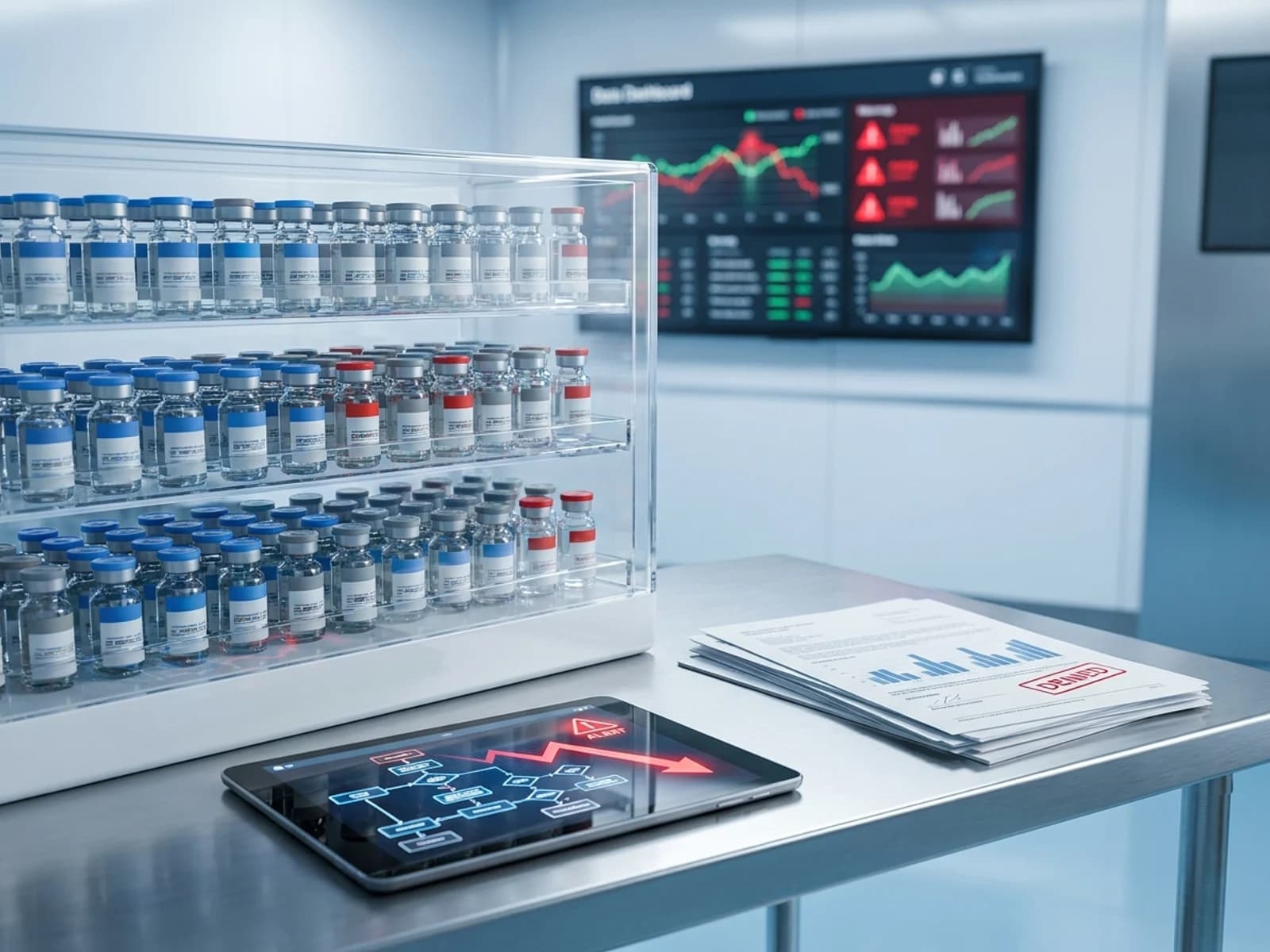
Anti-VEGF agents are the second-largest category of Medicare Part B drug spending. A PubMed study of Medicare utilization from 2014 to 2023 documented over 36 million intravitreal anti-VEGF injections, with aflibercept use growing from 619,000 injections in 2014 to 1.7 million in 2023 and faricimab showing rapid early uptake after its 2022 introduction. A single retina physician may administer dozens of injections per day, each involving a drug costing $950 to $2,000 per dose. Multiplied across hundreds of doses per month, drug inventory represents the majority of a retina practice's financial throughput.
When a payer changes its preferred anti-VEGF product mid-quarter—adding an aflibercept biosimilar step edit, switching from reference aflibercept (Eylea) to a biosimilar, or repositioning faricimab (Vabysmo) as preferred—the practice holding inventory of the newly disfavored product faces three intersecting risks: reimbursement denial for the non-preferred product, wastage of drug that cannot be used before its expiration date, and reauthorization delays while the payer processes requests under updated criteria.
This article is for retina practice administrators, buy-and-bill operations teams, manufacturer market access staff, specialty distributors, and group purchasing organization (GPO) representatives who need to understand the financial exposure created by mid-quarter payer preference changes and how to manage it.
Why payer preference changes happen mid-quarter
Payer preference changes in the anti-VEGF category are driven by several forces converging in 2024–2026:
Biosimilar entry
Five aflibercept biosimilars received FDA approval in 2024, with a sixth (Eydenzelt) approved in October 2025:
| Biosimilar (aflibercept suffix) | Brand name | Manufacturer | FDA approval |
|---|---|---|---|
| aflibercept-jbvf | Yesafili | Biocon Biologics / Viatris | May 2024 |
| aflibercept-yszy | Opuviz | Samsung Bioepis | May 2024 |
| aflibercept-mrbb | Ahzantive | Formycon | July 2024 |
| aflibercept-abzv | Enzeevu | Sandoz | August 2024 |
| aflibercept-ayyh | Pavblu | Amgen | August 2024 |
| aflibercept-boav | Eydenzelt | Celltrion | October 2025 |
Ranibizumab biosimilar Byooviz (ranibizumab-nuna) entered earlier. The AAO's 2022 clinical statement on biosimilar use in ophthalmic practice noted that biosimilar pricing may undercut the reference product but may not be the cheapest option available—off-label compounded bevacizumab remains the lowest-cost anti-VEGF agent.
Step-therapy policy updates
Blue Cross Blue Shield of Michigan and Blue Care Network announced in 2024–2025 that new patient approval for aflibercept requires prior failure of both off-label bevacizumab and ranibizumab-nuna. A Retina Today analysis noted that payers are already applying utilization-management mechanisms to the anti-VEGF category, and the incorporation of biosimilars into step therapy should be anticipated.
Formulary repositioning
Payers periodically reposition anti-VEGF products on their formularies, moving drugs between preferred and non-preferred tiers, adding or removing step-therapy requirements, and changing prior authorization criteria. These changes can take effect at any point in a plan year, not only at the January 1 renewal.
The financial mechanics of mid-quarter inventory risk
How buy-and-bill works in retina
In the buy-and-bill model, the retina practice purchases anti-VEGF drug from a specialty distributor, stocks it in office refrigerators, and bills for the drug plus its administration using HCPCS J-codes. The practice is reimbursed at the higher of Average Sales Price (ASP) plus 4.3% (for Medicare Part B) or the payer's contracted rate.
Key financial dynamics:
ASP lags purchase price. Medicare's ASP is based on manufacturer sales data from two quarters prior. If a biosimilar launches at a discount to reference product, the reference product's ASP may not yet reflect the competitive pressure. The practice purchases at current acquisition cost but is reimbursed at the lagging ASP rate—creating a margin squeeze.
Inventory represents working capital. A retina practice with four physicians may hold 200–400 doses of anti-VEGF drug at any given time, representing $200,000–$800,000 in working capital tied up in drug inventory.
Wastage cannot be recovered. Anti-VEGF drugs are single-use vials. If a practice cannot use a dose before its expiration date, the cost is a total loss. Unlike tablet medications, there is no return or credit mechanism for expired biologic vials.
What happens when payer preference changes mid-quarter
Claims denial for non-preferred product. The payer's updated policy requires use of the preferred product (e.g., an aflibercept biosimilar) before the non-preferred product (e.g., reference Eylea). If the practice submits a claim for the non-preferred product without documentation of step-therapy failure or a medical exception, the claim is denied. The practice has already purchased and administered the drug—it cannot recover the acquisition cost from a denied claim.
Prior authorization for previously exempt product. A product that previously did not require PA may suddenly require it. The practice must obtain PA before administering the drug, which delays treatment. If the practice administered the drug before the PA requirement was identified—because the policy change was not yet communicated—the claim is denied retroactively.
Reauthorization under new criteria. Patients already on therapy with the non-preferred product must be reauthorized under the payer's new criteria when their current authorization period expires. If the new criteria require a switch to the preferred product, the practice must transition the patient, potentially losing inventory of the non-preferred drug allocated to that patient.
J-code and billing modifier changes. Aflibercept biosimilars may have separate Q-codes (or share the reference product's J-code with a modifier). CMS Medicare Coverage Database article A53387, revised in December 2024, documents that J0178 (injection, aflibercept, 1 mg) is used for the reference product, while biosimilar products may require separate coding. A companion CMS article (A52451) covers billing and coding for all ranibizumab and aflibercept products including biosimilars, with specific ICD-10 code requirements per indication. If the payer's system is not configured to recognize the correct code for the preferred biosimilar, claims are denied even when the practice has complied with the preference policy. A Retina Today coding advisory noted that "missing a crucial update to a prior authorization or step-therapy policy will result in denied claims, often without retroactive resolution or appeal options."
The Biosimilars Council's 2025 analysis of buy-and-bill biosimilar pricing documented that under ASP + 6% reimbursement, providers are reimbursed based on a drug's reported average sales price plus a fixed percentage. Because a reference biologic with a higher ASP generates a larger add-on payment than a cheaper biosimilar, the system incentivizes providers to prefer high-cost brands. The report warned that biosimilar manufacturers offering substantial rebates to gain formulary placement drive ASPs downward, but the acquisition cost for providers does not always reflect these reductions—leaving providers "underwater," reimbursed less than the drug cost them to acquire. This creates a direct financial disincentive for practices to stock and use lower-cost biosimilars, even when payers mandate them.
Inventory management strategies for mid-quarter changes
Maintain conservative inventory levels
An Ophthalmology Management report on retina drug inventory management emphasized that practices using spreadsheets for inventory tracking face significant risks including billing errors and expired vials. Dedicated inventory management systems that track lot numbers, expiration dates, and NDC codes provide better visibility.
Practices should avoid overstocking any single anti-VEGF product. In a period of frequent payer preference changes, the optimal inventory strategy is:
Order more frequently in smaller quantities. Reduce the interval between orders from biweekly to weekly, and reduce the order size accordingly.
Diversify across products. If the practice uses multiple anti-VEGF agents (bevacizumab, ranibizumab, aflibercept, aflibercept biosimilar, faricimab, aflibercept 8 mg), stock proportionally to expected utilization rather than purchasing in bulk for discounts.
Track expiration dates rigorously. Use first-expired, first-out (FEFO) allocation. An inventory management system that scans NDC and lot numbers at receipt and again at administration provides real-time visibility into expiration risk.
Monitor payer policy changes proactively
Retina practices cannot wait for claim denials to learn about policy changes. Monitoring strategies include:
Subscribe to payer policy bulletins. Most major payers publish policy updates on their websites or through email alerts. Assign a staff member to review updates weekly.
Monitor Medicare LCD/NCD changes. Medicare Administrative Contractors publish Local Coverage Determinations that may change anti-VEGF coverage criteria.
Engage GPO and distributor intelligence. GPOs and specialty distributors often learn about payer preference changes before they take effect. An AllyGPO/BioCareSD industry survey of retina practices found that practices want "strategic guidance, not just product delivery" from their GPO partners, including tools to "evaluate procurement scenarios and intelligently adapt their drug purchasing" as biosimilars emerge and payer dynamics shift.
Build payer-specific treatment tracks
When a payer changes its preferred anti-VEGF product, the practice should have a protocol for each affected payer:
Identify affected patients. Query the practice management system for patients on the non-preferred product who are covered by the payer that changed its policy.
Determine reauthorization timing. For each affected patient, identify when the current authorization expires. Initiate the reauthorization or transition process before the expiration date.
Document medical necessity for continuation. If the practice believes the patient should remain on the non-preferred product, document the clinical rationale (e.g., stable disease on current therapy, prior failure of the preferred product, documented adverse reaction to the preferred product).
Reallocate inventory. Redirect non-preferred product inventory to patients covered by payers that still cover it, or accelerate utilization before expiration.
Coding and billing implications
J-codes and Q-codes for anti-VEGF agents
Anti-VEGF drugs are billed under HCPCS Level II codes. Key codes as of 2026:
| Drug | HCPCS code | Notes |
|---|---|---|
| Bevacizumab (Avastin, compounded) | J9035 | Off-label ophthalmic use; compounded by specialty pharmacies |
| Ranibizumab (Lucentis) | J2778 | Reference product |
| Ranibizumab-nuna (Byooviz) | Q5121 | Biosimilar |
| Aflibercept (Eylea 2 mg) | J0178 | Reference product |
| Aflibercept 8 mg (Eylea HD) | J0179 | High-dose formulation |
| Aflibercept biosimilars | Q-codes (varies) | Each biosimilar may have a unique Q-code or share J0178 with a modifier |
| Faricimab-svoa (Vabysmo) | J2777 | Permanent J-code, effective October 2022 |
When a payer adds a step edit requiring biosimilar use before reference aflibercept, the practice must bill with the correct Q-code for the biosimilar. Using J0178 (reference aflibercept) for a biosimilar dose—or vice versa—creates a coding mismatch that triggers denial.
Wastage billing
When a single-use vial is partially administered and the remainder is discarded, Medicare allows billing for the discarded amount using the JW modifier (or the JZ modifier to attest that no drug was discarded). Proper wastage documentation requires:
The exact amount administered and the exact amount discarded.
The NDC, lot number, and expiration date of the vial.
The date and time of administration.
An Ophthalmology Management inventory report noted that bidirectional inventory systems give practices "visibility into where each dose sits in the reimbursement pipeline—was it billed? Paid? Pending prior auth? Sitting in a denial queue?" Without this visibility, wastage documentation is often incomplete or inaccurate.
What manufacturer access teams should understand
The provider's financial exposure is real
Retina practices operate on margins that depend on drug-spread revenue. A mid-quarter payer preference change can reduce or eliminate that spread for the affected product. If the practice holds $100,000 worth of inventory that is suddenly non-preferred, it faces the choice of using the drug and fighting denials, or transitioning patients and absorbing the wastage cost.
Transition friction affects your brand
When a payer mandates a switch to a biosimilar, the transition friction—reauthorization delays, inventory losses, patient anxiety—creates negative sentiment toward the mandated product, not just the payer. Manufacturer access teams should:
Provide transition support resources (coding guides, sample PA letters, patient communication templates) at the time of the payer change, not weeks later.
Work with specialty distributors to offer flexible return or exchange programs for practices affected by mid-quarter preference changes.
Engage GPOs to communicate policy changes to practices before they take effect, giving practices time to adjust purchasing.
Biosimilar adoption is not automatic
An Ophthalmology Management review of biosimilars in retina care noted that "it is unlikely that retina specialists will switch among biosimilars every quarter or every year" because "many doctors wouldn't switch the therapy that they and the patient have confidence in and are comfortable with." Payer-mandated switches create compliance-driven adoption, not clinical preference, which has implications for persistence and outcomes tracking.
What to monitor
Aflibercept biosimilar ASP trends. As biosimilar market share grows, the reference product's ASP will decline, compressing buy-and-bill margins for practices that continue purchasing reference product. Monitor quarterly ASP files from CMS.
New anti-VEGF product launches. DURAVYU (epoctinidur) is in Phase 3 trials for wet AMD and DME. Additional biosimilar entries are expected. Each new product creates formulary uncertainty.
Payer step-therapy cascades. The progression from bevacizumab-first → ranibizumab-biosimilar-first → aflibercept-biosimilar-first creates an increasingly complex step-therapy ladder that practices must navigate.
Medicare Physician Fee Schedule changes. CMS's 2026 MPFS final rule included facility-payment adjustments that may affect practice economics and the relative attractiveness of buy-and-bill versus other practice arrangements.
DSCSA exemption status. Retina practices are currently exempt from Drug Supply Chain Security Act tracking requirements because they buy and bill drugs and administer them in the office. Monitor for any changes to this exemption.
Last updated: May 31, 2026. This article is for informational purposes only and does not constitute medical, legal, or reimbursement advice. It is not intended for individual patient treatment decisions.
Sources
PubMed. "Medicare Trends in Intravitreal Anti-VEGF Use: A Population-Based Study (2014–2023)." Published 2026. https://pubmed.ncbi.nlm.nih.gov/41812994/
Retina Today. "The Effect of Biosimilars on Clinical Practice." May/June 2023. https://retinatoday.com/articles/2023-may-june/the-effect-of-biosimilars-on-clinical-practice
Ophthalmology Management. "Biosimilars in Retina Care." 2026. https://ophthalmologymanagement.com/issues/2026/retina/biosimilars-in-retinacare
Ophthalmology Management. "Optimizing Your Retina Drug Inventory Process." 2026. https://ophthalmologymanagement.com/issues/2026/retina/optimizing-your-retina-drug-inventory-process
Retinal Physician. "Industry Insights: Inventory to Impact." November/December 2025. https://www.retinalphysician.com/issues/2025/novemberdecember/industry-insights-inventory-to-impact
Retina Today. "Coding and Reimbursement for New Drugs." April 2023. https://retinatoday.com/articles/2023-apr/coding-and-reimbursement-for-new-drugs
American Academy of Ophthalmology. "The Use of Biosimilars in Ophthalmic Practice." 2022. https://www.aao.org/education/clinical-statement/use-of-biosimilars-in-ophthalmic-practice
CMS. "2026 OPPS Final Rule." November 2025. Referenced in retinalphysician.com coverage.
CMS. "Billing and Coding: Aflibercept (EYLEA®) — Article A53387." Revised December 2024. https://www.cms.gov/medicare-coverage-database/view/article.aspx?articleId=53387
CMS. "Billing and Coding: Ranibizumab and Biosimilars, Aflibercept, Aflibercept HD, Brolucizumab-dbll, Faricimab-svoa, and Aflibercept Biosimilars — Article A52451." https://www.cms.gov/medicare-coverage-database/view/article.aspx?articleId=52451
Biosimilars Council. "How to Solve the Buy-and-Bill Biosimilar Pricing Puzzle?" 2025. https://biosimilarscouncil.org/wp-content/uploads/2025/08/AAM-BC-How-to-Solve-the-Buy-and-Bill-Biosimilar-Pricing-Puzzle.pdf
IQVIA. "Modeling Policy Proposals for Medical Benefit Biosimilar Reimbursement in the U.S." 2025. https://www.iqvia.com/insights/the-iqvia-institute/reports-and-publications/reports/modeling-policy-proposals-for-medical-benefit-biosimilar-reimbursement-in-the-us
Review of Ophthalmology. "Coding and Reimbursement: 2026 Update." January 2026. https://www.reviewofophthalmology.com/article/coding-and-reimbursement-2026-update
Retina Today. "Using Category III Codes." April 2026. https://retinatoday.com/articles/2026-apr/using-category-iii-codes
Molina Healthcare. "Eylea (Aflibercept) and Biosimilars Coverage Criteria C5674-A." Q1 2026 revision. https://www.molinahealthcare.com/providers/oh/medicaid/policies/-/media/Molina/PublicWebsite/PDF/Providers/oh/medicaid/policies/6-1-26-MHO-UM-C5674-A-Eylea-aflibercept-and-Biosimilars-508.pdf