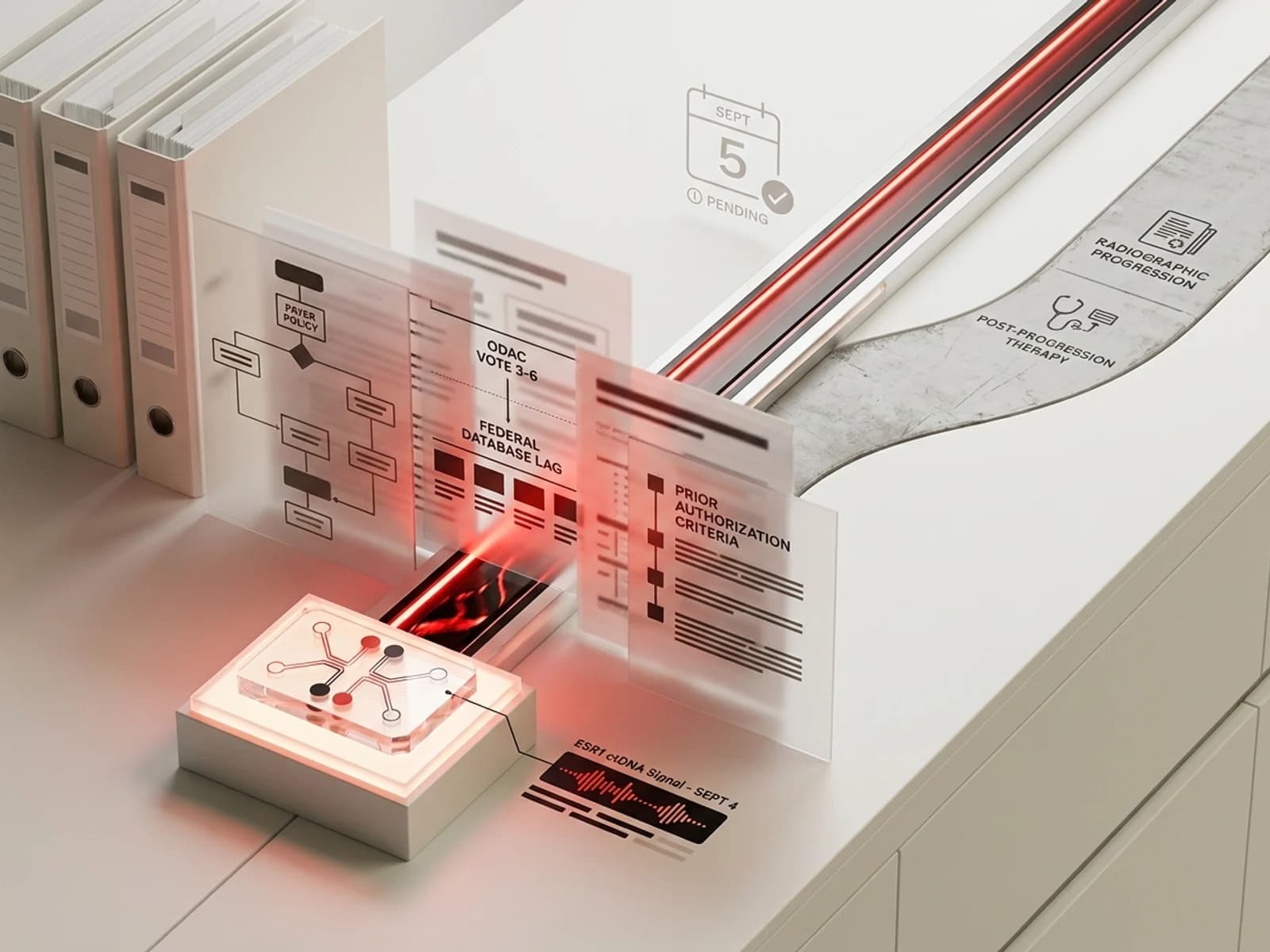
On June 30, 2026, the FDA is expected to decide on Viridian Therapeutics' Biologics License Application (BLA) for veligrotug, an anti-insulin-like growth factor-1 receptor (IGF-1R) monoclonal antibody for the treatment of thyroid eye disease (TED). If approved, veligrotug would be only the second FDA-approved therapy for TED — after Amgen's Tepezza (teprotumumab-trbw), which launched in January 2020 and generated $1.85 billion in 2024 revenue.
The BLA was accepted under Priority Review and veligrotug holds Breakthrough Therapy Designation, reflecting the FDA's recognition that a second TED treatment option addresses a significant unmet need. The application is supported by two phase 3 trials — THRIVE (active TED) and THRIVE-2 (chronic TED) — both of which met all primary and secondary endpoints with high statistical significance (p < 0.0001).
For ophthalmology and endocrinology practices, specialty pharmacies, and payer organizations, the potential arrival of veligrotug raises immediate questions about formulary positioning, prior authorization criteria, buy-and-bill economics, and how the two IGF-1R therapies will compete. This guide covers the evidence, the access landscape, and what stakeholders should be preparing.
Short answer
| Parameter | Veligrotug | Tepezza (teprotumumab-trbw) |
|---|---|---|
| Generic name | Veligrotug | Teprotumumab-trbw |
| Drug class | Anti-IGF-1R monoclonal antibody | Anti-IGF-1R monoclonal antibody |
| Sponsor | Viridian Therapeutics | Amgen (acquired from Horizon Therapeutics) |
| Application type | BLA (new) | Approved January 2020 |
| PDUFA date | June 30, 2026 | N/A |
| Designations | Breakthrough Therapy, Priority Review | Orphan Drug |
| Indication sought | Active and chronic TED | Active TED only |
| Dosing | Five 30-minute IV infusions, every 3 weeks | Eight 60–90-minute IV infusions, every 3 weeks |
| Treatment duration | 12 weeks | 21–24 weeks |
| Pivotal trials | THRIVE, THRIVE-2 | OPTIC, OPTIC-X |
| Benefit type | Medical benefit (buy-and-bill) | Medical benefit (buy-and-bill) |
| HCPCS code | TBD (likely new J-code) | J2781 |
Thyroid eye disease: the clinical landscape
Thyroid eye disease (TED) is an autoimmune condition in which inflammatory cells attack the tissues around the eyes, causing proptosis (eye bulging), diplopia (double vision), pain, redness, and in severe cases, vision loss. TED occurs most commonly in patients with Graves' disease and hyperthyroidism, though it can also appear in hypothyroid and euthyroid patients.
Before Tepezza's approval in 2020, treatment options were limited to corticosteroids, orbital radiation, and surgery — all of which carry significant morbidity and do not directly address the underlying IGF-1R-mediated inflammation. Tepezza transformed TED management by demonstrating meaningful reductions in proptosis and diplopia, but access has been constrained by cost, infusion logistics, and prior authorization requirements.
THRIVE and THRIVE-2: the pivotal evidence
THRIVE — active TED (NCT05176639)
THRIVE was a global, randomized, double-blind, placebo-controlled phase 3 trial in 75 patients with active TED. Key results:
Primary endpoint: Proptosis response (≥ 2 mm reduction) at week 15 — met with high statistical significance (p < 0.0001)
Secondary endpoints: Met all secondary endpoints including diplopia response, Clinical Activity Score (CAS) improvement, and overall response
Rapid onset: Clinical benefit was observed early in the treatment course
Safety: Generally well tolerated
THRIVE-2 — chronic TED (NCT06021054)
THRIVE-2 was a global, randomized, double-blind, placebo-controlled phase 3 trial in 125 patients with chronic TED. This is particularly notable because Tepezza is approved only for active TED, leaving chronic TED patients without an FDA-approved targeted therapy.
Primary endpoint: Proptosis response at week 15 — met with high statistical significance (p < 0.0001)
Secondary endpoints: Met all secondary endpoints including diplopia response and resolution
Diplopia resolution: Statistically significant improvement in double vision, a functional endpoint that matters to patients and payers
Safety: Generally well tolerated
Clinical advantages over Tepezza
Comparing veligrotug's profile to Tepezza, several differentiating features emerge:
Fewer infusions: Five infusions versus eight, reducing infusion center utilization and patient burden
Shorter infusion time: 30-minute infusions versus 60–90 minutes for Tepezza
Shorter treatment course: 12 weeks total treatment duration versus 21–24 weeks for Tepezza
Broader indication: THRIVE-2 supports a chronic TED indication, which Tepezza does not carry. Many TED patients have chronic disease at presentation
Higher IGF-1R affinity: Veligrotug has a greater binding affinity for IGF-1R, which may translate to efficacy differences, though head-to-head data does not exist
Durability data: Viridian presented long-term durability data in May 2025, which may support the BLA
These advantages could position veligrotug as the preferred IV therapy for TED if payers provide access, though Tepezza's established market presence and Amgen's commercial infrastructure should not be underestimated.
Access implications: what payers and providers should prepare for
Medical benefit and buy-and-bill
Like Tepezza, veligrotug will be administered as an intravenous infusion in a clinical setting, placing it squarely in the medical benefit with buy-and-bill reimbursement. Key considerations:
HCPCS coding: Veligrotug will need a new HCPCS code (J-code or temporary Q-code). Amgen's Tepezza uses J2781 (teprotumumab-trbw, 1 mg). CMS typically assigns temporary codes for new products, with permanent J-codes arriving in the annual January update cycle. If approved June 30, veligrotug could receive a temporary Q-code by Q4 2026 or a permanent J-code in January 2027
Interim billing risk: Between FDA approval and HCPCS code assignment, providers may need to bill using an unlisted code (J3590 or J9999), which creates reimbursement delays and denials
ASP-based reimbursement: Once a code is assigned, reimbursement will follow the Medicare Part B Average Sales Price (ASP) methodology — ASP + 6% for physician-administered drugs
Buy-and-bill economics: Providers will purchase veligrotug up front and seek reimbursement through claims. The fewer number of infusions (5 vs 8) could improve provider margin per treatment course if acquisition cost is competitive
Prior authorization considerations
Payers that currently manage Tepezza access through prior authorization will need to develop criteria for veligrotug. Expected PA requirements:
Diagnosis confirmation: Documentation of TED diagnosis, including clinical activity score (CAS) and proptosis measurement
TED classification: Whether the patient has active or chronic TED (relevant for veligrotug vs Tepezza)
Prior treatment: Documentation of prior corticosteroid use or clinical rationale for targeted therapy
Ophthalmology or endocrinology specialist: PA likely restricted to prescribing by relevant specialists
Imaging: May require orbital imaging (CT or MRI) to confirm TED diagnosis and severity
Formulary positioning: veligrotug vs Tepezza
Payers face a formulary decision that does not yet exist in TED — choosing between two IGF-1R antibodies:
Preferred product strategy: PBMs and health plans may designate one product as preferred, requiring step therapy or prior authorization for the other
Clinical differentiation: Veligrotug's chronic TED indication (if granted) and shorter treatment course could justify preferred status for patients where those factors are relevant
Cost competition: Amgen may respond to veligrotug's entry with pricing concessions or enhanced rebate offers to protect Tepezza's market position
Site-of-care considerations: Fewer and shorter infusions may reduce total treatment cost (infusion center overhead, nursing time, monitoring), which payers will evaluate in total cost-of-care calculations
Biosimilar threat: Tepezza's composition-of-matter patent expires in the 2032–2034 timeframe. Veligrotug's competitive pressure could accelerate Amgen's lifecycle planning
Specialty pharmacy and REMS considerations
Neither Tepezza nor veligrotug is expected to require REMS, but specialty distribution logistics will still apply:
Buy-and-bill purchasing: Providers purchase through specialty distributors (e.g., McKesson, AmerisourceBergen, Cardinal Health)
Limited distribution network: Amgen uses a limited distribution network for Tepezza. Viridian may pursue a similar strategy or a broader open-network model
Patient support programs: Viridian will need to establish patient assistance, copay support, and benefit investigation services to compete with Amgen's established infrastructure
The pipeline beyond veligrotug: elegrobart (VRDN-003)
Viridian is not stopping with veligrotug. The company is also advancing elegrobart (VRDN-003), a subcutaneous anti-IGF-1R antibody for TED that would eliminate the need for IV infusion entirely. Key milestones:
REVEAL-1 (active TED): Positive topline results reported in Q1 2026, meeting the primary endpoint
REVEAL-2 (chronic TED): Positive topline results reported in Q1 2026, meeting the primary endpoint
Administration: Subcutaneous autoinjector, self-administered by patients
Potential advantage: If approved, elegrobart could shift TED treatment from the medical benefit to the pharmacy benefit, fundamentally changing the access and reimbursement landscape
Elegrobart could represent the most significant competitive disruption to both Tepezza and veligrotug, as a self-administered subcutaneous injection would be far more convenient than either IV product. Viridian plans to file a BLA for elegrobart in Q1 2027, with potential approval in late 2027 or early 2028.
However, Amgen is not standing still. The company reported positive phase 3 results for a subcutaneous formulation of Tepezza using a wearable on-body injector, with proptosis response rates near 77% — comparable to the IV formulation. The subcutaneous Tepezza is administered as a two-weekly injection rather than three-weekly IV infusions. If approved, subcutaneous Tepezza would compete directly with elegrobart and potentially limit veligrotug's window of competitive advantage on convenience.
The TED market is therefore heading toward a four-product competitive landscape: IV Tepezza, IV veligrotug, subcutaneous Tepezza, and subcutaneous elegrobart — with timing, convenience, and payer positioning determining market share.
What to watch
June 30, 2026: PDUFA target action date for veligrotug BLA
Labeling language: Whether the FDA grants a broader label covering both active and chronic TED, or restricts to active TED like Tepezza
Pricing announcement: Viridian's WAC for veligrotug will determine the competitive dynamic with Tepezza
HCPCS code assignment: Timing of temporary and permanent codes will affect reimbursement speed
PBM formulary decisions: CVS Caremark, Express Scripts, and OptumRx will need to decide how to position two IV TED therapies
Elegrobart phase 3 results: Both REVEAL-1 and REVEAL-2 reported positive topline data in Q1 2026, supporting a planned BLA submission in Q1 2027
Amgen's competitive response: Tepezza pricing, rebate, and contracting strategy in response to new competition
Sources
Viridian Therapeutics. "Veligrotug BLA Accepted and Priority Review for Thyroid Eye Disease." December 22, 2025. https://investors.viridiantherapeutics.com/news/news-details/2025/Viridian-Therapeutics-Announces-BLA-Acceptance-and-Priority-Review-for-Veligrotug-for-the-Treatment-of-Thyroid-Eye-Disease-TED/default.aspx
Viridian Therapeutics. "Viridian Therapeutics Prepares for Transformational 2026." January 6, 2026. https://investors.viridiantherapeutics.com/news/news-details/2026/Viridian-Therapeutics-Prepares-for-Transformational-2026/default.aspx
Healio Ophthalmology. "Thyroid Eye Disease Treatment Granted Priority Review." December 23, 2025. https://www.healio.com/news/ophthalmology/20251223/thyroid-eye-disease-treatment-receives-priority-review-pdufa-date
Viridian Therapeutics. "Positive Topline Results from Elegrobart Phase 3 REVEAL-1 Clinical Trial." Q1 2026. https://investors.viridiantherapeutics.com
Fierce Biotech. "Viridian's Tepezza Rival Racks Up Second Phase 3 Win." May 5, 2026. https://www.fiercebiotech.com/biotech/viridians-tepezza-rival-racks-second-phase-3-win-clearing-path-fda
Ophthalmology Times. "What's Ahead in Ophthalmology: Pipeline Milestones for Q2 2026." https://www.ophthalmologytimes.com/view/ophthalmology-pipeline-milestones-for-q2-2026
ClinicalTrials.gov. THRIVE: NCT05176639. THRIVE-2: NCT06021054. https://clinicaltrials.gov
MPR (Haymarket Media). "FDA Drug Approval Decisions Expected in June 2026." https://www.empr.com/news/fda-drug-approval-decisions-expected-in-june-2026
Pharmaphorum. "Amgen Scores with New Thyroid Eye Disease Formulation." https://pharmaphorum.com/news/amgen-scores-new-thyroid-eye-disease-formulation
Amgen. "Amgen Reports Fourth Quarter and Full Year 2024 Financial Results." February 4, 2025. https://www.amgen.com/newsroom/press-releases/2025/02/amgen-reports-fourth-quarter-and-full-year-2024-financial-results
Amgen. "Amgen Announces Positive Topline Phase 3 Results for Subcutaneous Tepezza." April 6, 2026. https://www.prnewswire.com/news-releases/amgen-announces-positive-topline-phase-3-results-for-subcutaneous-tepezza-in-adults-living-with-moderate-to-severe-active-thyroid-eye-disease-302734375.html
Viridian Therapeutics. "Viridian Therapeutics Reports First Quarter 2026 Financial Results and Highlights Recent Progress." https://investors.viridiantherapeutics.com/news/news-details/2026/Viridian-Therapeutics-Reports-First-Quarter-2026-Financial-Results-and-Highlights-Recent-Progress/default.aspx