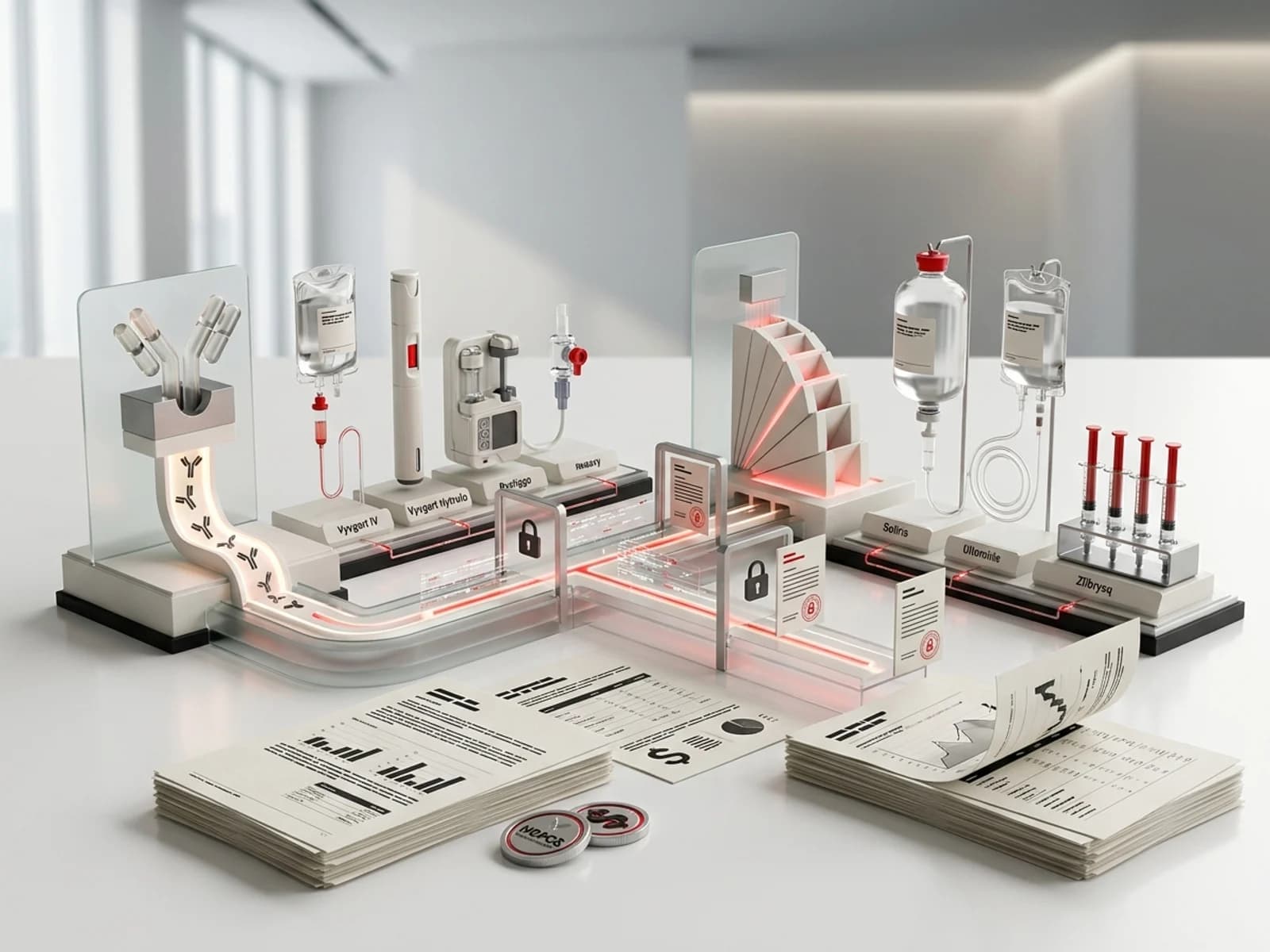
The therapeutic class for moderate-to-severe atopic dermatitis (AD) is undergoing a significant transformation. What was once a market dominated by topical corticosteroids and a single blockbuster biologic, Dupixent (dupilumab), has expanded into a complex ecosystem featuring four approved targeted biologics, three oral JAK inhibitors, a topical JAK inhibitor, and a robust pipeline of late-stage assets.
For pharmacy and therapeutics (P&T) committees, commercial payers, and health-system pharmacy leaders, managing atopic dermatitis spend requires balancing clinical efficacy, safety profiles (such as the class-wide JAK Boxed Warnings), specialty pharmacy benefit routing, and long-term patent or biosimilar cliffs. Because all modern systemic therapies bypass traditional retail channels and are absent from public retail acquisition benchmarks, payers must construct highly structured step-therapy sequences to control double-digit annual category growth.
This landscape analysis details the current FDA-approved moderate-to-severe atopic dermatitis armamentarium, examining WAC-based specialty pricing, Medicaid acquisition costs, Orange Book patent walls, Purple Book biosimilar statuses, clinical trial data, and real-world safety signals. It complements our single-drug Dupixent coverage guide, the Dupixent vs Ebglyss head-to-head, and the Rinvoq coverage guide, and it extends the mechanism-wide JAK inhibitor access landscape and the severe asthma biologic access landscape to the dermatology indication.
Short answer
A payer's dermatology P&T committee managing moderate-to-severe atopic dermatitis spend in 2026 must evaluate a dense class of four approved biologics—Dupixent (dupilumab), Adbry (tralokinumab-ldrm), Ebglyss (lebrikizumab-lbkz), and Nemluvio (nemolizumab-ilto)—alongside three oral JAK inhibitors—Rinvoq (upadacitinib), Cibinqo (abrocitinib), and Olumiant (baricitinib)—and one topical JAK, Opzelura (ruxolitinib).
As of mid-2026, none of these modern brand systemic or specialty topical agents appear in the CMS National Average Drug Acquisition Cost (NADAC) database. They are WAC-based specialty drugs distributed through exclusive or limited pharmacy networks under pharmacy or medical benefit structures. Payers rely on a cheap, generic topical backbone (e.g., generic triamcinolone at $0.022/g, pimecrolimus at $2.67/g, or tacrolimus capsule/ointment) as the mandatory step-therapy baseline.
Exclusivity protections remain robust: there are zero FDA-approved biosimilars for any AD biologic in the Purple Book. Dupixent’s composition-of-matter patent (with patent term extension) runs to March 2031, Rinvoq has 97 Orange Book patents extending to March 2038, and Opzelura has 39 patents running to May 2041. The earliest generic entry in the class is Olumiant (baricitinib), with its latest patent expiring in November 2032 and generic ANDAs already filed by Aurobindo and MSN.
Which systemic atopic dermatitis agents are FDA-approved and how do their mechanisms differ?
Targeted therapies for moderate-to-severe atopic dermatitis fall into two broad mechanism-of-action categories: biologic monoclonal antibodies targeting specific cytokines/receptors involved in type 2 helper T-cell (Th2) pathways, and small-molecule Janus kinase (JAK) inhibitors blocking intracellular cytokine signaling.
Biologic Monoclonal Antibodies (BLA Reference Products)
Biologics offer highly targeted, extracellular inhibition of type 2 inflammation. Their long half-lives allow for less frequent dosing (typically every two to four weeks) and they do not require routine laboratory monitoring due to their lack of systemic immunosuppression.
1. Dupixent (dupilumab, Sanofi/Regeneron)
Approved in March 2017, Dupixent is a human monoclonal IgG4 antibody that binds to the IL-4 receptor alpha (IL-4Rα) subunit. By blocking IL-4Rα, it inhibits dual signaling of interleukin-4 (IL-4) and interleukin-13 (IL-13), key drivers of Th2-mediated inflammation. It is FDA-approved for patients as young as 6 months with moderate-to-severe AD.
Pivotal Trials: SOLO 1, SOLO 2, and CHRONOS. In SOLO 1 and SOLO 2 (adults, monotherapy), about 37% of patients receiving Dupixent 300 mg Q2W achieved clear or almost clear skin (IGA 0/1) at week 16, compared to 8-10% on placebo. EASI-75 (a 75% reduction in the Eczema Area and Severity Index) was achieved by approximately 51% of patients on Dupixent.
Maintenance Profile: Administered as a subcutaneous injection of 300 mg every 2 weeks for adults (or weight-based dosing for pediatric patients). Its long-term safety profile is supported by over nine years of real-world clinical experience.
2. Adbry (tralokinumab-ldrm, LEO Pharma)
Approved in December 2021, Adbry is a human IgG4 monoclonal antibody that binds specifically to the IL-13 cytokine, preventing its interaction with the IL-13 receptor alpha-1 (IL-13Rα1) and alpha-2 (IL-13Rα2) subunits. Unlike Dupixent, it does not target IL-4. Adbry is approved for adults and pediatric patients aged 12 years and older.
Pivotal Trials: ECZTRA 1, ECZTRA 2, and ECZTRA 3. In the monotherapy trials (ECZTRA 1 and 2), approximately 16% to 22% of patients achieved IGA 0/1 at week 16, and 25% to 33% achieved EASI-75. When combined with topical corticosteroids (ECZTRA 3), the IGA 0/1 rate rose to 39% and EASI-75 reached 56%.
Maintenance Profile: Administered as a subcutaneous injection. The maintenance dose is 300 mg (two 150 mg injections) every 2 weeks, which can be extended to every 4 weeks for patients who achieve clear or almost clear skin after 16 weeks of treatment.
3. Ebglyss (lebrikizumab-lbkz, Eli Lilly)
FDA-approved in September 2024, Ebglyss is a humanized IgG4 monoclonal antibody that binds with high affinity to soluble IL-13, specifically blocking the formation of the active IL-13Rα1/IL-4Rα heterodimer. Ebglyss is approved for adults and adolescents aged 12 and older weighing at least 40 kg.
Pivotal Trials: ADvocate 1 and ADvocate 2. In these 52-week monotherapy studies, approximately 38% to 43% of patients achieved IGA 0/1 at week 16, and 51% to 58% achieved EASI-75. Ebglyss features a slow dissociation rate, allowing for monthly maintenance dosing (Q4W) in many patients after a biweekly loading phase.
Maintenance Profile: After a 250 mg biweekly loading phase (weeks 0 to 16), the standard maintenance dose is 250 mg every 4 weeks (Q4W). This monthly schedule offers a significant convenience advantage over Dupixent's standard biweekly (Q2W) schedule.
4. Nemluvio (nemolizumab-ilto, Galderma)
Initially approved for prurigo nodularis in August 2024, Nemluvio’s label expanded to moderate-to-severe atopic dermatitis in December 2024 for adults and adolescents aged 12 and older. The atopic dermatitis indication is specifically for use in combination with topical corticosteroids and/or topical calcineurin inhibitors when the disease is not adequately controlled with topical prescription therapies. Nemluvio is a humanized monoclonal antibody targeting the interleukin-31 receptor alpha (IL-31Rα). Interleukin-31 (IL-31) is a neuroimmune cytokine that directly stimulates sensory neurons to drive severe itch (pruritus) and promotes skin barrier dysfunction and local inflammation.
Pivotal Trials: ARCADIA 1 and ARCADIA 2 (both with background topical therapy). In these phase 3 trials in moderate-to-severe AD, Nemluvio delivered rapid itch relief with onset as early as week 1. By week 16, approximately 36% to 38% of patients achieved IGA 0/1 (vs about 25% to 26% on placebo plus topicals), and about 42% to 44% achieved EASI-75 (vs about 29% to 30% on placebo plus topicals). A 4-point or greater itch-score (PP-NRS) reduction was achieved by roughly 48% of Nemluvio-treated patients by week 16.
Maintenance Profile: Administered as a subcutaneous injection. The recommended initial dose is 60 mg (two 30-mg injections), followed by 30 mg once every 4 weeks; patients who reach clear or almost clear skin after 16 weeks may extend to 30 mg every 8 weeks.
Small-Molecule Intracellular Pathways (Janus Kinase Inhibitors)
JAK inhibitors block intracellular signaling downstream of multiple cytokine receptors by binding to the ATP-binding site of Janus kinases (JAK1, JAK2, JAK3, and TYK2). They offer rapid clinical response (often within days) and oral convenience, but require baseline and periodic lab monitoring (CBC, lipids, hepatic enzymes, renal function) due to systemic immunosuppression.
1. Rinvoq (upadacitinib, AbbVie)
Approved for moderate-to-severe AD in January 2022, Rinvoq is an oral, highly selective JAK1 inhibitor. It is approved for adults and adolescents aged 12 years and older whose disease is not adequately controlled with other systemic drugs.
Pivotal Trials: Measure Up 1, Measure Up 2, and AD Up. In the monotherapy trials (Measure Up 1 & 2), the 15 mg daily dose achieved EASI-75 in 60% to 70% of patients at week 16, while the 30 mg daily dose reached 73% to 80% EASI-75. The head-to-head Heads Up trial compared Rinvoq 30 mg daily directly to Dupixent 300 mg Q2W. Rinvoq achieved a significantly higher EASI-75 rate at week 16 (71.0% vs. 61.1%, p < 0.001) and faster itch reduction, though it was associated with higher rates of acne, serious infections, and laboratory abnormalities.
Maintenance Profile: Dosed once daily at 15 mg or 30 mg. It is restricted to refractory cases due to the class-wide JAK Boxed Warning.
2. Cibinqo (abrocitinib, Pfizer)
Approved in January 2022, Cibinqo is another oral, selective JAK1 inhibitor approved for adults and adolescents aged 12 years and older with refractory, moderate-to-severe AD.
Pivotal Trials: JADE MONO-1, JADE MONO-2, and JADE COMPARE. In JADE COMPARE, which evaluated Cibinqo 200 mg or 100 mg daily alongside active comparator Dupixent 300 mg Q2W (all with background topical therapy), the 200 mg dose of Cibinqo was statistically superior to Dupixent in itch response at week 2, though at week 16, skin clearance rates (EASI-75 and IGA 0/1) were comparable between Cibinqo 200 mg and Dupixent.
Maintenance Profile: Dosed once daily at 100 mg or 200 mg. Like Rinvoq, it is reserved for second-line or third-line systemic therapy.
3. Olumiant (baricitinib, Eli Lilly)
Olumiant is a selective JAK1/JAK2 inhibitor. While approved in the United States for rheumatoid arthritis, alopecia areata, and COVID-19, its US approval for atopic dermatitis was rejected by the FDA due to safety concerns regarding the JAK2 pathway (which is linked to anemia and neutropenia). However, it is used off-label in refractory cases and is approved for AD in the European Union (BREEZE-AD trials). Its presence in generic ANDA pipelines remains an important cost checkpoint for payers.
4. Opzelura (ruxolitinib, Incyte)
Approved in September 2021, Opzelura is a topical 1.5% cream formulation of the JAK1/JAK2 inhibitor ruxolitinib. It is approved for the short-term and non-continuous chronic treatment of mild-to-moderate atopic dermatitis in non-immunocompromised patients aged 12 years and older.
Pivotal Trials: TRuE-AD1 and TRuE-AD2. In these studies, approximately 50% to 54% of patients using Opzelura cream achieved IGA 0/1 at week 8, compared to 8-15% on vehicle cream.
Maintenance Profile: Cream is applied twice daily to affected areas up to 20% of BSA. Though topical, it carries the same class-wide JAK Boxed Warning due to potential systemic absorption when applied over large surface areas.
What do AD biologics and JAK pills cost, and why are none of them in NADAC?
The National Average Drug Acquisition Cost (NADAC) is a CMS-published database reflecting the average invoice price paid by retail community pharmacies to acquire prescription drugs (see our CMS NADAC drug acquisition costs by the numbers for the methodology). For high-cost specialty drug categories, NADAC is a poor indicator of true cost.
The NADAC Specialty Drug Exclusion
An audit of the July 8, 2026 CMS NADAC database reveals that all 11 modern, branded systemic or specialty topical atopic dermatitis agents are completely absent from the file. This includes:
Biologics: dupilumab (Dupixent), tralokinumab (Adbry), lebrikizumab (Ebglyss), nemolizumab (Nemluvio).
Oral JAKs: upadacitinib (Rinvoq), abrocitinib (Cibinqo), baricitinib (Olumiant).
Topicals/Brands: ruxolitinib (Opzelura cream), crisaborole (Eucrisa ointment), difamilast (Adquey ointment), tapinarof (Vtama cream).
The absence of these drugs from NADAC is due to their distribution channels. These therapies are classified as specialty drugs and are routed through restricted or exclusive specialty pharmacy networks (e.g., CVS Specialty, Accredo, AllianceRx Walgreens). Specialty pharmacies do not report invoice data to the CMS retail pharmacy survey, meaning there is zero retail acquisition cost visibility.
Instead, payers and providers must negotiate pricing relative to the Wholesale Acquisition Cost (WAC), which serves as the list price before rebates.
| Drug | Formulation | Typical Dosing (AD Maintenance) | WAC (List Price) Est. 2026 | Benefit Routing |
|---|---|---|---|---|
| Dupixent | Subcutaneous Injection | 300 mg Q2W (every 2 weeks) | ~$4,200 / carton (2 syringes) | Pharmacy / Medical |
| Adbry | Subcutaneous Injection | 300 mg Q2W (or 300 mg Q4W) | ~$3,950 / carton (2 syringes) | Pharmacy / Medical |
| Ebglyss | Subcutaneous Injection | 250 mg Q4W (after load) | ~$4,100 / single dose | Pharmacy / Medical |
| Nemluvio | Subcutaneous Injection | 30 mg Q4W (once monthly) | ~$4,050 / single dose | Pharmacy / Medical |
| Rinvoq | Oral Tablet | 15 mg or 30 mg once daily | ~$6,800 / 30-day supply | Pharmacy Benefit |
| Cibinqo | Oral Tablet | 100 mg or 200 mg once daily | ~$5,900 / 30-day supply | Pharmacy Benefit |
| Opzelura | Topical Cream (1.5%) | Apply BID up to 60g tube | ~$2,350 / 60g tube | Pharmacy Benefit |
Note: WAC estimates represent standard wholesale list prices prior to PBM rebate negotiations. Actual commercial plan costs are heavily discounted via formulary rebates.
The Generic Topical Backbone in NADAC
In contrast to branded specialty drugs, the older, non-targeted topical therapies used as the baseline for step-therapy protocols are widely available in retail pharmacy channels and have highly accurate, transparent NADAC pricing. Payers use these low-cost options to establish step-therapy requirements before authorizing specialty medications.
Tacrolimus (Generic Protopic): A topical calcineurin inhibitor. Retail NADAC shows generic oral capsules (often used as reference, e.g.,
TACROLIMUS 0.5 MG CAPSULE) priced at $0.13274 per unit, while topical generic tacrolimus 0.03% and 0.1% ointments average $0.80 to $1.20 per gram.Pimecrolimus (Generic Elidel 1% cream): A non-steroidal topical calcineurin inhibitor. The retail NADAC is $2.66593 per gram (approximately $80 per 30g tube), representing a highly cost-effective step option.
Triamcinolone Acetonide (0.1% cream): A medium-potency topical corticosteroid. Retail NADAC is $0.02220 per gram, representing a nearly negligible cost to plans (approximately $1.76 for an 80g tube).
Hydrocortisone (1% OTC/Rx cream): Low-potency corticosteroid. Retail NADAC averages $0.04000 per gram.
Roflumilast (Generic/Branded Zoryve): Oral generic roflumilast 500 mcg tablets (used for COPD/severe asthma) are priced at $0.31183 per tablet in the NADAC database, though topical Zoryve cream (approved for plaque psoriasis and seborrheic dermatitis) remains a branded, WAC-based specialty topical absent from retail NADAC.
How do payers sequence Dupixent against the IL-13 biologics and oral JAKs?
Because of the high cost of specialty atopic dermatitis therapies, payers construct strict prior authorization (PA) and step-therapy algorithms. The sequencing strategy balances therapeutic efficacy, safety risks, and net cost (after rebates).
Payer Step-Therapy Sequencing Workflow
First-Line (Generic Topical Backbone): Trial of high-potency topical corticosteroids (TCS) daily for $\ge 14$ to 28 days OR topical calcineurin inhibitors (pimecrolimus 1% cream or tacrolimus 0.03%/0.1% ointment) for $\ge 28$ days.
Second-Line (Preferred Biologics):
Pediatric (6 months to 11 years): Preferred biologic is Dupixent (dupilumab).
Adolescents and Adults ($\ge 12$ years): Preferred biologics are Dupixent or Ebglyss (offering monthly maintenance convenience).
Third-Line (Second-line Biologics and Oral JAKs): Requires failure of, or intolerance to, preferred biologics.
IL-13 Specific Option: Adbry (tralokinumab).
IL-31R Specific Option (Severe Itch): Nemluvio (nemolizumab).
Oral JAK1 Inhibitor Options (High-Clearance, High-Risk): Rinvoq (upadacitinib) or Cibinqo (abrocitinib).
Standard Prior Authorization Criteria
To qualify for any systemic biologic or oral JAK inhibitor, payers typically enforce the following baseline criteria:
Documented Severity: Moderate-to-severe disease defined by clinical metrics:
Body Surface Area (BSA) involvement of $\ge 10%$ (some plans require $\ge 20%$).
Investigator Global Assessment (IGA) score of 3 (moderate) or 4 (severe).
Eczema Area and Severity Index (EASI) score of $\ge 16$.
Topical Step Therapy Failure: Documented failure, contraindication, or intolerance to a minimum trial of:
At least one medium-to-high potency prescription topical corticosteroid (TCS) daily for $\ge 14$ to 28 days.
At least one topical calcineurin inhibitor (TCI), such as generic pimecrolimus 1% cream or tacrolimus 0.03%/0.1% ointment, for $\ge 28$ days.
Age Restrictions: Dupixent is preferred for pediatric patients under 12, as it is the only biologic approved down to 6 months of age. Adbry, Ebglyss, Nemluvio, Rinvoq, and Cibinqo are restricted to patients aged $\ge 12$ years.
Biomarker and Target Matching: Payers do not currently require blood-based biomarkers (such as serum IgE or eosinophil counts) for AD approvals. However, for patients reporting severe pruritus as the primary disabling symptom, payers may route approval toward Nemluvio (nemolizumab) due to its IL-31 target specificity.
Biologic vs. JAK Sequencing
Most commercial payers place Dupixent on the preferred specialty tier. Following Ebglyss's approval, some pharmacy benefit managers (PBMs) have co-preferred Ebglyss alongside Dupixent to leverage manufacturer price concessions. Because of Ebglyss’s once-monthly maintenance dosing, it offers a lower administration burden than Dupixent's biweekly schedule.
Oral JAK inhibitors (Rinvoq, Cibinqo) are rarely positioned as first-line systemic options. Payers typically require the failure of at least one systemic biologic (Dupixent or Ebglyss) before approving Rinvoq or Cibinqo, citing the class-wide JAK Boxed Warnings. Oral JAKs are reserved for patients requiring rapid clearance, those who fail biologics, or patients with needle phobia who refuse injections.
Concrete Step-Therapy Pathways (Major Payers)
Payers like Express Scripts, CVS Caremark, and OptumRx implement distinct tiering pathways:
CVS Caremark: Dupixent is positioned on the preferred specialty tier. In 2026, Ebglyss has gained co-preferred status on several national formularies. Adbry and Nemluvio are placed on non-preferred tiers, requiring a double-step failure of Dupixent and Ebglyss. Oral JAKs (Rinvoq and Cibinqo) require prior biologic failure plus a secondary cardiovascular risk assessment.
Express Scripts: Dupixent remains the preferred biologic. Rinvoq is preferred on the oral specialty tier but requires documentation of biologic failure or clinical reasons why biologic therapy is inappropriate. Cibinqo is non-preferred, requiring failure of both a biologic and Rinvoq.
OptumRx: Implements a strict "biologic-first" policy for moderate-to-severe AD. Biologics (Dupixent/Ebglyss) require failure of topical prescription therapies. JAK inhibitors require a secondary prior authorization confirming the patient does not have underlying cardiovascular risk factors, thrombosis history, or active serious infections.
When do atopic dermatitis biosimilars and generics arrive?
The long-term cost containment of the atopic dermatitis class depends on the entry of biosimilars (for monoclonal antibodies) and generics (for small-molecule JAK inhibitors). Payers track the FDA Purple Book and Orange Book to map these exclusivity cliffs, and these agents feed into the broader 2026-2032 patent cliff by the numbers.
Purple Book Biologic Protections
An inspection of the July 8, 2026 FDA Purple Book confirms that there are zero licensed biosimilars or interchangeable products in the United States for any approved atopic dermatitis biologic:
Dupixent (dupilumab, BLA 761055): Regeneron/Sanofi’s reference product has no biosimilar competitors. The composition-of-matter patent (US 7,608,693) was granted a patent term extension and expires March 28, 2031; Sanofi has also disclosed formulation and method-of-use patents running further out. Given the complexity of biologic manufacturing and the litigation surrounding the later formulation and method-of-use patents, biosimilar entry is not anticipated until the 2031–2032 window.
Adbry (tralokinumab-ldrm, BLA 761180): Reference product licensed to LEO Pharma. Core patents run into the mid-2030s.
Ebglyss (lebrikizumab-lbkz, BLA 761306): Reference product licensed to Eli Lilly. Under 351(a) rules, it is protected by a 12-year reference product exclusivity period from its September 2024 approval date, preventing any biosimilar launch until at least September 2036.
Nemluvio (nemolizumab-ilto, BLA 761390): Reference product licensed to Galderma. Protected by 12-year reference product exclusivity extending to August 2036.
Orange Book Small-Molecule Patent Cliffs
For small-molecule JAK inhibitors and topicals, patent expirations and Abbreviated New Drug Applications (ANDAs) define the timeline for generic entry.
Rinvoq (upadacitinib) NDA 211675 (AbbVie): AbbVie has constructed a dense patent wall around upadacitinib. The Orange Book lists 97 patents linked to NDA 211675, with the latest listed patent expiring March 9, 2038. AbbVie also holds Orphan Drug Exclusivities, including
ODE-481(adolescent AD and other indications) extending to April 26, 2031, andODE-538to April 28, 2032. Generic entry is blocked well into the next decade.Opzelura (ruxolitinib topical) NDA 215309 (Incyte): Opzelura cream is protected by 39 listed patents in the Orange Book, with the latest listed patent expiring May 5, 2041. Ruxolitinib is also marketed as Jakafi (oral) for myelofibrosis, but the topical formulation patents prevent generic substitution in dermatology.
Olumiant (baricitinib) NDA 207924 (Eli Lilly): Baricitinib represents the first generic cliff in the JAK class. The latest patent listed in the Orange Book expires on November 30, 2032. Generic developers are already active: Aurobindo Pharma (
ANDA 217542) and MSN Laboratories (ANDA 217585) have filed ANDAs containing Paragraph IV patent certifications. A generic launch is expected by late 2032, which will introduce low-cost oral options to the class.Eucrisa (crisaborole) NDA 207695 (Pfizer): This non-steroidal topical PDE4 inhibitor has 8 listed patents; the core composition patent expires June 29, 2029, while a method-of-use patent (with pediatric extension) runs to mid-2030. A related Orange Book exclusivity (
D-191) expired on April 3, 2026. Generic developers are expected to enter the market around the 2029–2030 window.Adquey (difamilast) NDA 219474 (Acrotech Biopharma): Approved in February 2026 as a topical PDE4 inhibitor. Under Hatch-Waxman rules, it has new chemical entity (NCE) exclusivity to February 12, 2031, preventing generic filings until then.
How do the safety signals compare between the biologics and the oral JAKs?
Safety differences are a primary driver of payer step-therapy designs. Monoclonal antibodies target specific cytokines, resulting in localized adverse events, while oral JAK inhibitors block broader pathways and carry systemic safety warnings.
To compare these therapies, we analyzed adverse event reports from the openFDA FAERS database (covering 2018 through 2025), using the same any-role methodology described in our analysis of 20 million FAERS reports. Payers evaluate the proportion of serious adverse events and deaths to understand real-world risk.
[!IMPORTANT] FAERS Role-SET Limitation Disclosure: The FAERS reporting system is based on passive surveillance. These statistics represent cases where the drug was listed in any role (primary suspect, secondary suspect, concomitant, or interacting). They do not prove direct causality, and the reported adverse events may be related to the patient's underlying disease or other concurrent therapies. Additionally, JAK inhibitor data is indication-agnostic and includes high-risk patient groups, such as those with rheumatoid arthritis.
| Drug | Class / Route | Total FAERS Reports (2018-2025) | Serious Reports (%) | Death Reports (%) | Most Common Reported Reactions (FAERS) |
|---|---|---|---|---|---|
| Dupixent (dupilumab) | IL-4Rα Biologic (SC) | 410,609 | 10.9% | 0.4% | Pruritus, Atopic dermatitis flare, Rash, Injection site pain, Drug ineffective, Conjunctivitis |
| Adbry (tralokinumab) | IL-13 Biologic (SC) | 4,994 | 14.1% | 1.3% | Atopic dermatitis flare, Drug ineffective, Pruritus, Rash, Injection site pain, Eczema |
| Ebglyss (lebrikizumab) | IL-13 Biologic (SC) | 1,077 | 11.0% | 0.4% | Injection site pain, Pruritus, Drug ineffective, Rash, Conjunctivitis, Atopic dermatitis flare |
| Rinvoq (upadacitinib) | Oral JAK1 | 69,179 | 65.5% | 3.4% | Pain, Arthralgia, Drug ineffective, COVID-19, Rheumatoid arthritis flare, Pain in extremity |
| Cibinqo (abrocitinib) | Oral JAK1 | 3,666 | 33.6% | 1.6% | Drug ineffective, Condition aggravated, Off-label use, Pruritus, Incomplete therapeutic effect, Rash |
| Olumiant (baricitinib) | Oral JAK1/2 | 9,251 | 68.7% | 9.3% | Drug ineffective, Off-label use, COVID-19, Pulmonary embolism, Rheumatoid arthritis flare, Pneumonia |
Key Safety Differences
1. Biologic Safety Profile
Dupixent, Adbry, and Ebglyss show a low rate of serious adverse events (10% to 14%) and extremely low mortality rates (0.4% to 1.3%) in real-world reports. The most common issues are localized injection site pain and transient conjunctivitis (eye irritation), which is a known side effect of IL-4/IL-13 inhibitors.
Eye Irritation Hook: Conjunctivitis occurs in 5% to 15% of biologic-treated AD patients. In FAERS,
Conjunctivitisappears as a top reaction for both Dupixent and Ebglyss, but is less common for Adbry.Lack of Systemic Suppression: Biologics do not block broad inflammatory pathways, meaning they do not require routine blood monitoring.
2. Oral JAK Inhibitor Safety Profile
Oral JAK inhibitors show much higher rates of serious adverse events (65.5% for upadacitinib, 68.7% for baricitinib) and higher death rates (3.4% for upadacitinib, 9.3% for baricitinib). This is because oral JAK inhibitors carry the FDA class-wide Boxed Warning for:
Major Adverse Cardiovascular Events (MACE): Myocardial infarction and stroke.
Thrombosis: Deep vein thrombosis (DVT) and pulmonary embolism (PE).
Malignancies: Lymphoma and lung cancers.
Serious Infections: Active tuberculosis, invasive fungal infections, and shingles (herpes zoster).
All-Cause Mortality.
Selectivity Nuance: Cibinqo (abrocitinib) has a lower serious report rate in FAERS (33.6%) compared to Rinvoq (65.5%), which may reflect its higher selectivity for JAK1 over JAK2, though it still carries the same class-wide safety warnings.
Laboratory Monitoring: Patients on oral JAKs require regular blood tests for lipid elevation, liver enzyme changes, and cytopenias.
FAQ
Is there a Dupixent biosimilar available in the US in 2026?
No. There are no approved or licensed biosimilars for Dupixent (dupilumab) in the FDA Purple Book. Sanofi and Regeneron hold composition and formulation patents protecting the drug — the composition-of-matter patent (with patent term extension) expires March 28, 2031, with formulation and method-of-use patents running later — preventing biosimilar competition for the next several years.
What is the difference between Ebglyss, Adbry, and Dupixent for atopic dermatitis?
While all three are subcutaneous biologics targeting type 2 inflammation, they differ in their molecular targets and dosing:
Dupixent targets the IL-4Rα subunit, blocking both IL-4 and IL-13. It is dosed every 2 weeks and is approved for patients as young as 6 months.
Adbry targets the IL-13 ligand directly, preventing it from binding to the IL-13 receptors. It is approved for patients aged 12 and older and is dosed every 2 weeks.
Ebglyss targets the IL-13 ligand with high binding affinity. It is approved for patients aged 12 and older (weighing $\ge 40$ kg). After a biweekly loading phase, Ebglyss can be dosed once every 4 weeks for maintenance, offering a more convenient dosing schedule than Dupixent.
Are oral JAK inhibitors (Rinvoq, Cibinqo) preferred before or after Dupixent for eczema?
Payers place oral JAK inhibitors after Dupixent in the treatment sequence. Due to the class-wide JAK Boxed Warnings, P&T committees require patients to fail or show intolerance to atopic dermatitis biologics (like Dupixent) before authorizing oral JAK inhibitors.
Does Nemluvio (nemolizumab) treat atopic dermatitis or only prurigo nodularis?
Nemluvio is approved to treat both conditions. It received its initial FDA approval for prurigo nodularis in August 2024 and expanded its indications to include moderate-to-severe atopic dermatitis in patients aged 12 and older in December 2024 (in combination with topical corticosteroids and/or calcineurin inhibitors). It targets the IL-31Rα receptor to treat pruritus and skin lesions.
Are there any other topical options for milder cases?
Yes. Aside from Opzelura (ruxolitinib cream), payers cover other non-steroidal topicals like Eucrisa (crisaborole ointment) and Vtama (tapinarof cream). The newly approved Adquey (difamilast ointment, approved Feb 2026) is also entering the landscape, expanding the range of non-steroidal topical choices.
Sources
FDA Drugs@FDA Catalog: Approved drug labels for Dupixent (BLA 761055), Adbry (BLA 761180), Ebglyss (BLA 761306), Nemluvio (BLA 761390), Rinvoq (NDA 211675), Cibinqo (NDA 213871), and Opzelura (NDA 215309). FDA Approved Drugs.
FDA Purple Book database: Database of Licensed Biological Products. FDA Purple Book.
FDA Orange Book database: Approved Drug Products with Therapeutic Equivalence Evaluations (20260708 snapshot). FDA Orange Book.
CMS NADAC Pricing database: National Average Drug Acquisition Cost (20260708 snapshot). Medicaid NADAC.
openFDA FAERS Adverse Event database: openFDA public snapshot for adverse event reports (2018-2025 data). openFDA FAERS.
Nemluvio Prescribing Information: Galderma Laboratories, L.P., August 2024. Nemluvio FDA Label.