The CMS National Average Drug Acquisition Cost (NADAC) dataset is the closest thing the US has to a national wholesale benchmark for what pharmacies actually pay for drugs. The June 2026 extract contains 696,293 unit-level pricing records spanning 6,261 unique drug descriptions and 31,712 distinct National Drug Codes. The median cost per unit is $0.19. The mean is $26.47 — a 141× gap between median and mean that tells you almost everything you need to know about drug pricing in the United States.
NADAC is not a list price, an average wholesale price (AWP), or a wholesale acquisition cost (WAC). It is a survey-based estimate of the price pharmacies pay to acquire a drug from a wholesaler, collected by CMS from a nationally representative sample of retail pharmacies. It is used primarily to set Medicaid reimbursement rates, but its granularity — pricing per NDC, per unit, per week — makes it the best publicly available window into the actual acquisition cost layer of the US drug supply chain.
This analysis processes the full June 10, 2026 NADAC extract. Every figure below represents an actual surveyed acquisition cost, not a manufacturer list price or a chargeback-adjusted invoice price. Unless otherwise noted, "cost" means NADAC per unit.
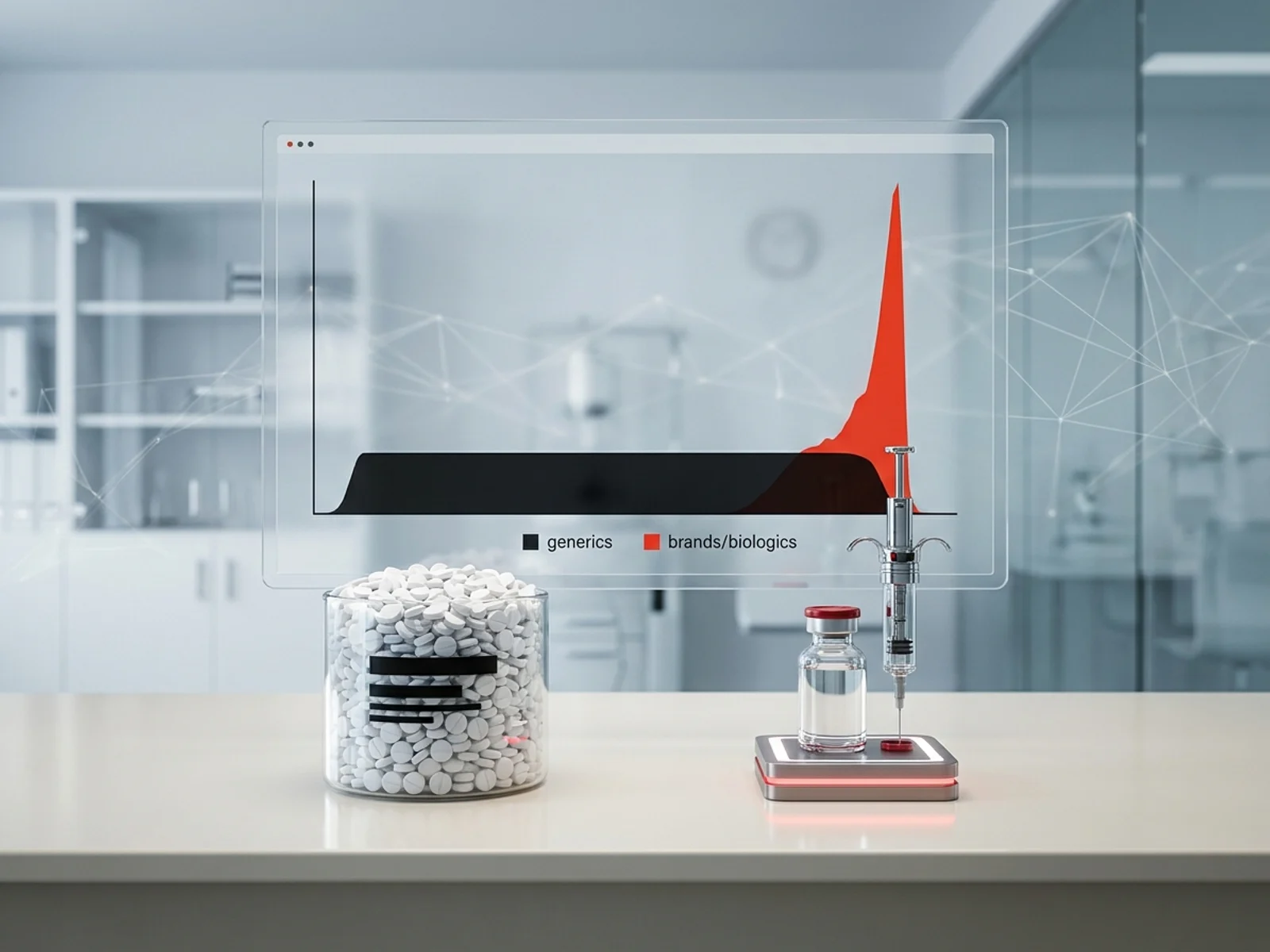
The cost distribution: three-quarters of drug units cost less than $1
| Cost per unit | Records | Share |
|---|---|---|
| Under $1 | 525,926 | 75.5% |
| $1–$10 | 113,679 | 16.3% |
| $10–$100 | 45,727 | 6.6% |
| $100–$1,000 | 8,115 | 1.2% |
| Over $1,000 | 2,846 | 0.4% |
Three-quarters of all NADAC records are priced under $1 per unit. The median generic drug costs $0.16. But the distribution has an extreme right tail: 2,846 records exceed $1,000 per unit, concentrated in biologics, specialty injectables, and oncology products.
Classification: generic, brand, authorized generic, biologic
| Classification | Records | Share | Median cost/unit | Mean cost/unit |
|---|---|---|---|---|
| Generic (G) | 640,317 | 92.0% | $0.16 | $2.40 |
| Brand (B) | 53,189 | 7.6% | $13.23 | $306.10 |
| Authorized generic (B-ANDA) | 2,167 | 0.3% | $2.22 | $15.34 |
| Biologic/biosimilar (B-BIO) | 620 | 0.09% | $604.15 | $939.54 |
Generics dominate the NADAC dataset at 92% of records, with a median cost of $0.16 per unit. Brand-name drugs — 7.6% of records — carry a median of $13.23, or roughly 81 times the generic median. The biologic/biosimilar classification (B-BIO), while accounting for only 620 records (0.09%), has a median of $604.15 per unit and a mean of $939.54, reflecting the high per-unit cost of injectable biologics where a single dose may consist of multiple billable units.
Authorized generics (B-ANDA) occupy a middle ground at a median of $2.22 — roughly 14× the generic median but only one-sixth the brand median. This confirms the well-established pattern: authorized generics are priced below their brand-name counterparts but above independent generic competitors, reflecting the dual incentive of maintaining brand revenue while capturing generic-market share.
The most expensive drugs per unit
Top brand drugs by cost per EA (each)
| Drug | Cost per EA | Classification |
|---|---|---|
| Avonex Pen (interferon beta-1a) | $8,809 | B |
| Humira (adalimumab) | $6,745 | B |
| Sandostatin LAR (octreotide) | $6,681 | B |
| Lupron Depot (leuprolide) | $6,503 | B |
| Cimzia (certolizumab) | $6,101 | B |
| Prolia (denosumab) | $4,879 | B |
| Enbrel (etanercept) | $4,773 | B |
| Xgeva (denosumab) | $4,651 | B |
| Aimovig (erenumab) | $4,429 | B |
| Repatha (evolocumab) | $4,208 | B |
Top brand drugs by cost per ML
| Drug | Cost per ML | Classification |
|---|---|---|
| Stelara (ustekinumab) | $29,780 | B |
| Kesimpta (ofatumumab) | $24,377 | B |
| Skyrizi (risankizumab) | $22,882 | B |
| Tremfya (guselkumab) | $14,617 | B |
| Dupixent (dupilumab) | $6,283 | B |
| Keytruda (pembrolizumab) | $5,253 | B |
| Opdivo (nivolumab) | $4,766 | B |
Stelara's $29,780/mL reflects the high concentration and dosing of its subcutaneous formulation. The ML-based costs for immunology drugs (Stelara, Kesimpta, Skyrizi, Tremfya) consistently exceed oncology costs per milliliter because they are high-concentration, low-volume biologics administered in small volumes at long intervals.
Top biosimilars by cost per EA
| Drug (biosimilar) | Cost per EA | Reference product |
|---|---|---|
| Cyltezo (adalimumab-adbm) | $3,200 | Humira |
| Fulphila (pegfilgrastim-jmdb) | $3,186 | Neulasta |
| Yesintek (adalimumab-aaty) | $2,902 | Humira |
| Hadlima (adalimumab-bwwd) | $2,739 | Humira |
| Hyrimoz (adalimumab-adaz) | $2,678 | Humira |
| trazecto (pegfilgrastim-fpgk) | $2,412 | Neulasta |
| Simlandi (adalimumab-ryvk) | $2,386 | Humira |
The Humira biosimilar cluster (Cyltezo, Yesintek, Hadlima, Hyrimoz, Simlandi) shows meaningful price dispersion: Cyltezo at $3,200 versus Simlandi at $2,386, a 34% spread within the same reference-product class. This dispersion reflects different manufacturer pricing strategies, supply contract timing, and wholesale acquisition cost positioning rather than clinical differentiation — all of these biosimilars have the same FDA-approved interchangeability or biosimilarity designation relative to Humira.
Brand vs. generic: the markup picture
NADAC includes a "Corresponding Generic Drug NADAC Per Unit" field for brand-name drugs that have a generic equivalent. Across 24,133 brand records with a generic comparator:
Median brand cost: $13.23/unit
Median generic cost: $0.16/unit
Median markup ratio: 1,129% (brand is 12.3× the generic price)
Mean markup ratio: 67.76×
The mean is skewed by extreme outliers. Norvasc (amlodipine) 2.5 mg tablets illustrate the ceiling: the brand costs $8.70 per tablet while the generic equivalent costs $0.01 — an 840× markup. This is not because the generic is unusually cheap (though $0.01 is near the floor); it is because the brand price has been maintained at its pre-generic-competition level for decades through supply chain inertia and remaining brand-loyal prescription volume.
Selected brand-to-generic comparisons
| Drug | Brand cost | Generic cost | Ratio |
|---|---|---|---|
| Norvasc 2.5 mg (amlodipine) | $8.70 | $0.01 | 840× |
| Glucophage 500 mg (metformin) | $4.82 | $0.03 | 161× |
| Lipitor 20 mg (atorvastatin) | $19.15 | $0.03 | ~630× |
| Zoloft 50 mg (sertraline) | $3.47 | $0.04 | 87× |
| Synthroid 50 mcg (levothyroxine) | $1.37 | $0.24 | 5.7× |
The ratio varies enormously by molecule. Levothyroxine (Synthroid) has a relatively modest 5.7× brand premium, reflecting the fact that Synthroid has maintained significant market share through physician familiarity and narrow therapeutic index concerns. Amlodipine (Norvasc), by contrast, has been off-patent since 2007 and the generic market has driven acquisition costs to near-zero.
OTC vs. prescription
| Type | Records | Share | Median cost/unit |
|---|---|---|---|
| Prescription | 635,188 | 91.2% | $0.20 |
| OTC | 61,105 | 8.8% | $0.08 |
Over-the-counter products account for 8.8% of NADAC records and carry a median cost of $0.08 per unit — roughly 40% of the prescription median. OTC products are almost entirely in the generic classification and concentrated in analgesics, antacids, antihistamines, and topical preparations.
Specialty drug acquisition costs
| Product/Class | Records | Median cost/unit |
|---|---|---|
| Enbrel (etanercept) | 92 | $2,081 |
| Humira (adalimumab) | 171 | $3,368 |
| Remicade (infliximab) | 10 | $1,136 |
| Insulin class | 487 | $8.96 |
| Enoxaparin | 2,691 | $8.54 |
| Heparin | 822 | $2.20 |
Humira's NADAC median of $3,368 per unit reflects the branded reference product; the biosimilar cluster (Cyltezo, Yesintek, Hadlima, etc.) prices 17–42% below this level. Insulin, despite intense political and regulatory scrutiny, carries a median NADAC of $8.96 per unit across 487 records — substantially above the $35/month out-of-pocket cap established by the Inflation Reduction Act for Medicare Part D, but the NADAC reflects acquisition cost, not patient cost-sharing.
What this means for pricing and access teams
1. NADAC is the acquisition-cost truth layer, not the reimbursement layer. NADAC captures what pharmacies pay wholesalers, not what Medicaid pays pharmacies, not what patients pay at the counter, and not what PBMs reimburse after rebates. It sits one step above WAC and one step below actual reimbursement. For market access teams, NADAC is the most reliable publicly available benchmark for comparing your product's acquisition cost against competitors and generics.
2. The brand-to-generic cliff is real and permanent. When a drug goes generic, its NADAC typically falls by 80–99% within a few years. The brand name may persist at a high price for a residual loyalist market, but the volume shifts to generics almost completely. This is the fundamental economic dynamic behind the patent cliff, and it is visible at the acquisition-cost level in every therapeutic area.
3. Biosimilar pricing is converging but not commoditized. The 34% spread within the Humira biosimilar cluster suggests that biosimilar competition is working — driving prices below the brand — but has not yet reached the commodity pricing seen in small-molecule generics. The B-BIO classification median of $604/unit confirms that biologics remain in a fundamentally different cost tier.
4. The $1-per-unit threshold is a meaningful boundary. Three-quarters of all drug units are priced below $1. Drugs above this threshold — specialty injectables, biologics, and certain branded small molecules — are the ones that drive Medicaid spending growth, PBM formulary disputes, and patient affordability crises. NADAC makes this boundary line visible at the NDC level.
5. Insulin and GLP-1 cost structures will diverge further. Insulin has a median NADAC of $8.96/unit, while GLP-1 receptor agonists (exenatide at $291/unit, liraglutide at $40–72/unit) operate in a different cost stratosphere. As GLP-1 indications expand beyond diabetes to obesity, cardiovascular risk reduction, and potentially kidney disease, the acquisition-cost gap between insulin and GLP-1 therapies will become a central issue for Medicaid budgeting and formulary design.
Sources
CMS Medicaid Drug Rebate Program, National Average Drug Acquisition Cost (NADAC), weekly file, June 10, 2026. Analysis by PharmaDossier, run date 2026-06-12. 696,293 records, 31,712 unique NDCs. https://www.medicaid.gov/medicaid/prescription-drugs/state-medicaid-prescription-drug-programs-and-data/national-average-drug-acquisition-cost-nadac
CMS, "NADAC for Medicaid Covered Outpatient Drugs — Methodology." https://www.medicaid.gov/medicaid/prescription-drugs/state-medicaid-prescription-drug-programs-and-data/national-average-drug-acquisition-cost-nadac/methodology
Drug Channels Institute, "NADAC: The Best Public Benchmark for Pharmacy Acquisition Costs," 2025. https://www.drugchannels.net/2025/01/nadac-best-public-benchmark-for.html
KFF, "Medicaid Drug Pricing." https://www.kff.org/medicaid/issue-brief/medicaid-prescription-drug-pricing/
PMC, "Cost-Effectiveness Analysis Using Real-World Drug Acquisition Cost Data." https://pmc.ncbi.nlm.nih.gov/articles/PMC10929873