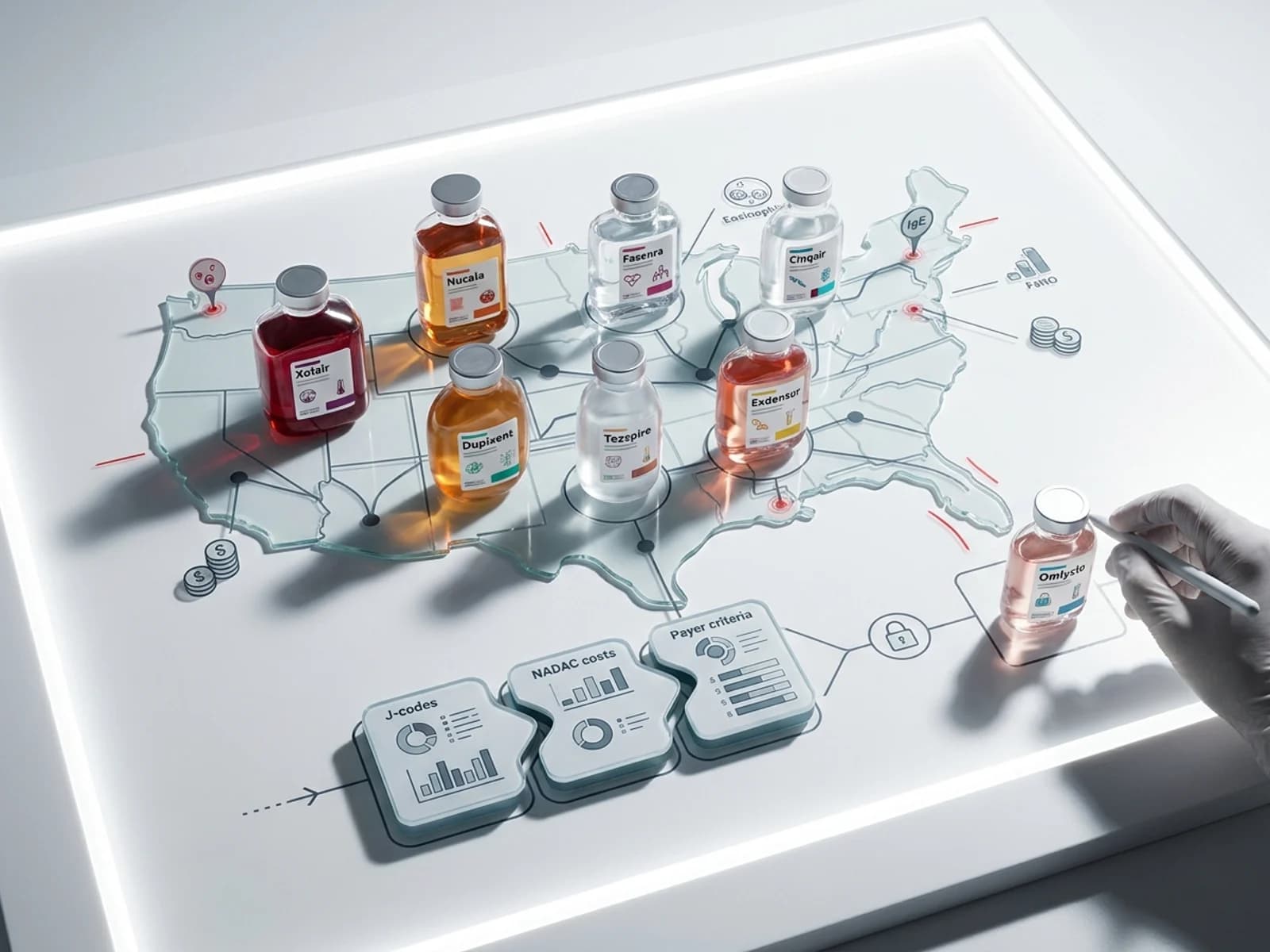
The management of severe, uncontrolled asthma has been transformed by the development of targeted monoclonal antibodies. Historically, patients who failed high-dose inhaled corticosteroids and long-acting beta-agonists (ICS/LABA) were reliant on oral corticosteroids, which carry significant systemic side effects. Today, seven FDA-approved biologics define the severe asthma therapeutic category: Xolair (omalizumab), Nucala (mepolizumab), Fasenra (benralizumab), Cinqair (reslizumab), Dupixent (dupilumab), Tezspire (tezepelumab-ekko), and the newly approved Exdensur (depemokimab-ulaa).
In 2026, clinical and market-access teams must navigate a complex decision-making process. Monoclonal antibodies are among the largest drivers of specialty drug spend for commercial and government payers. Choosing the right biologic requires matching the patient's biomarker profile to the drug's mechanism of action, verifying medical versus pharmacy benefit routing, securing prior authorization (PA) approval, and evaluating new biosimilar economics.
This article provides a comprehensive guide to severe asthma biologics. It profiles all seven approved products, details their clinical evidence and J-codes, maps payer step-therapy criteria, and discusses the entry of the first interchangeable omalizumab biosimilar. Every database metric cited is anchored in primary sources, including the FDA Purple Book database (snapshot current to July 8, 2026) and the CMS National Average Drug Acquisition Cost (NADAC) database.
For manufacturer-specific portfolios and commercial contexts, see the GSK portfolio dossier, the AstraZeneca portfolio dossier, and the Sanofi portfolio dossier. For related clinical developments in Type-2 inflammatory pathways, see the cendakimab eosinophilic esophagitis PDUFA preview.
Which seven biologics are FDA-approved for severe asthma and how do their mechanisms differ?
To compare these seven therapies, we must first look at their licensing and exclusivity profiles. The table below represents a descriptive BLA summary for the severe asthma biologics, including approval dates, orphan exclusivity, and therapeutic mechanisms:
| Proprietary Name (Generic Name, Sponsor) | BLA Number & BLA Type | FDA Approval Date (First Licensure) | Orphan Exclusivity Expiration Date | Mechanism of Action & Target Pathway |
|---|---|---|---|---|
| Xolair (omalizumab, Genentech/Novartis) | BLA 103976 351(a) Biologic | June 20, 2003 | Expired | Recombinant humanized IgG1k monoclonal antibody; binds to free IgE, blocking IgE-mediated allergic cascades. |
| Nucala (mepolizumab, GSK) | BLA 125526 351(a) Biologic | November 4, 2015 | September 25, 2027 (Refers to severe asthma in pediatric patients aged 6-11) | Humanized IgG1k monoclonal antibody; binds directly to the interleukin-5 (IL-5) ligand, blocking B-cell and eosinophil maturation. |
| Cinqair (reslizumab, Teva) | BLA 761033 351(a) Biologic | March 23, 2016 | Expired | Humanized IgG4k monoclonal antibody; binds to the IL-5 ligand, inhibiting eosinophil survival and activation. |
| Fasenra (benralizumab, AstraZeneca) | BLA 761070 351(a) Biologic | November 14, 2017 | September 17, 2031 | Humanized IgG1k monoclonal antibody; binds directly to the alpha subunit of the IL-5 receptor (IL-5R$\alpha$) on eosinophils, recruiting NK cells to induce antibody-dependent cell-mediated cytotoxicity (ADCC) and deplete eosinophils. |
| Dupixent (dupilumab, Sanofi/Regeneron) | BLA 761055 351(a) Biologic | October 19, 2018 (Asthma indication) | January 25, 2031 | Recombinant human IgG4 monoclonal antibody; binds to the IL-4 receptor alpha (IL-4R$\alpha$) subunit, blocking both IL-4 and IL-13 signaling, which are key drivers of broad Type-2 helper T-cell (Th2) inflammation. |
| Tezspire (tezepelumab-ekko, AZ/Amgen) | BLA 761224 351(a) Biologic | December 17, 2021 | None | Human monoclonal antibody (IgG2l); binds to thymic stromal lymphopoietin (TSLP), an epithelial cytokine, blocking it from interacting with its receptor and preventing upstream inflammatory cascades. |
| Exdensur (depemokimab-ulaa, GSK) | BLA 761458 351(a) Biologic | December 16, 2025 | December 16, 2032 | Ultra-long-acting humanized monoclonal antibody (IgG1); targets the IL-5 ligand, containing a modified Fc domain (Fc-YTE half-life extension) that allows dosing once every 6 months. |
Mechanism of Action Groupings
These seven agents can be divided into four distinct mechanistic groups:
Anti-IgE (Xolair): Omalizumab binds to IgE in the circulation, preventing it from binding to high-affinity IgE receptors ($Fc\epsilon RI$) on mast cells and basophils. This blocks the release of inflammatory mediators in response to allergens.
Anti-IL-5/IL-5R (Nucala, Cinqair, Fasenra, Exdensur): Eosinophils are key cells in Type-2 asthma. IL-5 is the main cytokine responsible for eosinophil differentiation, activation, and survival. Nucala, Cinqair, and Exdensur bind directly to the IL-5 ligand, preventing it from binding to its receptor. Fasenra binds to the alpha subunit of the IL-5 receptor itself, inducing rapid cell depletion through natural killer (NK) cell activation.
Anti-IL-4R$\alpha$ (Dupixent): By blocking the IL-4R$\alpha$ receptor, dupilumab inhibits both IL-4 and IL-13 signaling. This dual blockade suppresses downstream inflammatory pathways, including IgE production, eosinophil recruitment, and mucus hypersecretion.
Anti-TSLP (Tezspire): Tezepelumab targets TSLP, an "alarmin" released by the airway epithelium in response to environmental triggers. Because TSLP sits at the top of the inflammatory cascade, blocking it prevents both Type-2 (allergic and eosinophilic) and non-Type-2 (neutrophilic and paucibacillary) inflammation.
How do you match a biologic to an asthma phenotype?
Payer coverage policies are aligned with the biomarker ranges and clinical phenotypes established in the pivotal trials for each drug. The table below outlines the patient selection criteria and trial evidence for each biologic:
| Biologic (Brand) | Target Phenotype | Required Biomarkers (FDA Label & Payer Policies) | Pivotal Clinical Trial Anchors | Key Clinical Efficacy Data |
|---|---|---|---|---|
| Xolair (omalizumab) | Severe Allergic Asthma | Elevated IgE ($\ge 30$ to $\le 700$ IU/mL); positive perennial aeroallergen skin test or in vitro reactivity. | ALTO, INNOVATE | Reduced asthma exacerbations by 26% to 50%; significantly reduced hospitalizations and emergency department visits. |
| Nucala (mepolizumab) | Severe Eosinophilic Asthma | Blood eosinophils $\ge 150$ cells/mcL at initiation or $\ge 300$ cells/mcL in the past 12 months. | MENSA (NCT01691521), SIRIUS (NCT01902472) | MENSA: 100 mg SC reduced annual exacerbation rate by 53% vs placebo. SIRIUS: Allowed a 50% median reduction in oral corticosteroid dose. |
| Cinqair (reslizumab) | Severe Eosinophilic Asthma | Blood eosinophils $\ge 400$ cells/mcL prior to treatment. Approved only for adults $\ge 18$ years. | 3082, 3083 (NCT01287039) | Billed under J2786 as weight-based IV infusion (3 mg/kg); reduced annual exacerbation rate by 50% to 59% in patients with $\ge 400$ cells/mcL. |
| Fasenra (benralizumab) | Severe Eosinophilic Asthma | Blood eosinophils $\ge 150$ cells/mcL at initiation or $\ge 300$ cells/mcL in the past 12 months. | SIROCCO (NCT01928745), CALIMA (NCT01914757) | Dosed 30 mg SC every 4 weeks for 3 doses, then every 8 weeks; reduced annual exacerbations by up to 51%; improved FEV1 by up to 159 mL. |
| Dupixent (dupilumab) | Moderate-to-Severe Eosinophilic or Oral-Steroid-Dependent Asthma | Blood eosinophils $\ge 150$ cells/mcL or fractional exhaled nitric oxide (FeNO) $\ge 25$ ppb. No biomarker minimum required if oral-corticosteroid dependent. | QUEST (NCT02414854), VENTURE (NCT02528214) | QUEST: 200 mg SC reduced exacerbations by 56% in patients with eosinophils $\ge 300$ cells/mcL; improved FEV1 by 240 mL overall (320 mL in the eosinophilic cohort). VENTURE: Reduced oral corticosteroid use by 70% median. |
| Tezspire (tezepelumab-ekko) | Severe Uncontrolled Asthma (Unrestricted) | No biomarker minimum or phenotype restriction. Indicated for all patients with severe asthma regardless of eosinophil or IgE levels. | NAVIGATOR (NCT03406078), SOURCE (NCT03406091) | Dosed 210 mg SC monthly; reduced annual exacerbations by 56% overall, including a 41% reduction in patients with baseline eosinophils $< 150$ cells/mcL. |
| Exdensur (depemokimab-ulaa) | Severe Eosinophilic Asthma (Long-Acting) | Blood eosinophils $\ge 150$ cells/mcL at initiation or $\ge 300$ cells/mcL in the past 12 months. | SWIFT-1 (NCT05243524), SWIFT-2 (NCT05243537) | Dosed 100 mg SC once every 6 months; SWIFT trials showed a 54% reduction in exacerbations over 52 weeks compared to placebo. |
Clinical Selection Rules
Type-2-High Eosinophilic Patients: Patients with high blood eosinophils ($\ge 300$ cells/mcL) or elevated FeNO ($\ge 25$ ppb) respond well to the IL-5 inhibitors (Nucala, Fasenra, Exdensur) or the IL-4R$\alpha$ blocker (Dupixent). Payer policies require documentation of these biomarkers before approving therapy.
The "Broad Type-2" Option (Dupixent): Dupixent is effective in patients with concurrent Type-2 conditions, such as chronic rhinosinusitis with nasal polyps (CRSwNP) or atopic dermatitis. It also has no biomarker minimum if the patient is dependent on oral corticosteroids.
The Allergic Patient (Xolair): Xolair is reserved for patients with demonstrated perennial IgE-mediated allergy. Payer policies require a positive skin test or RAST for a perennial aeroallergen, along with baseline IgE levels between 30 and 700 IU/mL.
Biomarker-Negative or Mixed Phenotypes (Tezspire): Tezspire is the only biologic approved with no biomarker restrictions. For patients with T-helper-2-low (neutrophilic or paucibacillary) asthma, who typically do not respond to IL-5 or IgE blockers, Tezspire is the preferred option. It is also used when a patient's biomarker levels are variable.
Adherence and Convenience (Exdensur): Approved in late 2025, depemokimab (Exdensur) is the first long-acting IL-5 inhibitor. Its half-life extension allows dosing once every 6 months. This is a convenient option for patients who struggle with monthly subcutaneous injections or have adherence issues.
Detailed Efficacy Profiles: Pivotal Trial Data for Asthma Biologics
To assist clinical pharmacists and formulary committees in comparing me-too mechanisms, the clinical evidence from pivotal registrational programs provides critical points of differentiation.
The IL-5 Class: Nucala vs. Fasenra vs. Exdensur
While all three agents target the eosinophilic pathway, their clinical trial data show differences in efficacy and administration intervals:
Mepolizumab (Nucala): In the MENSA trial (NCT01691521), 576 patients with severe eosinophilic asthma were randomized. Subcutaneous mepolizumab 100 mg every 4 weeks reduced the annualized rate of clinically significant exacerbations by 53% compared to placebo ($p < 0.001$). The SIRIUS trial (NCT01902472) demonstrated that mepolizumab allowed patients to reduce their daily oral corticosteroid (OCS) dose by a median of 50% while maintaining asthma control.
Benralizumab (Fasenra): The SIROCCO (NCT01928745) and CALIMA (NCT01914757) trials randomized over 2,500 patients. Dosed at 30 mg SC every 4 weeks for the first 3 doses, and then every 8 weeks, benralizumab reduced the annualized exacerbation rate by up to 51% ($p < 0.001$) in patients with baseline blood eosinophils $\ge 300$ cells/mcL. It also led to a significant increase in pre-bronchodilator $FEV_1$ (up to 159 mL).
Depemokimab (Exdensur): The SWIFT-1 (NCT05243524) and SWIFT-2 (NCT05243537) trials evaluated depemokimab 100 mg administered subcutaneously once every 6 months. In these 52-week trials, depemokimab reduced the annualized rate of clinically significant exacerbations by 54% overall compared to placebo ($p < 0.001$). This long-acting profile is enabled by a modified Fc domain (Fc-YTE half-life extension) that increases the drug's affinity for the neonatal Fc receptor, extending its half-life to approximately 70 days.
Dupilumab (Dupixent): Broad Type-2 Efficacy
Dupilumab was evaluated in the phase 3 QUEST trial (NCT02414854), which randomized 1,902 patients with uncontrolled moderate-to-severe asthma. Patients received either dupilumab 200 mg or 300 mg every 2 weeks or matching placebo.
Exacerbation Reduction: In patients with baseline blood eosinophils $\ge 300$ cells/mcL, dupilumab 200 mg reduced severe exacerbations by 56% (PMID: 29782217) compared to placebo ($p < 0.001$).
Lung Function Improvement: The trial demonstrated an increase in pre-bronchodilator $FEV_1$ of 320 mL (29% improvement) at week 12 in the eosinophilic cohort.
Steroid Sparing: In the VENTURE trial (NCT02528214), dupilumab allowed a 70% median reduction in daily oral corticosteroid doses, with 80% of patients achieving a dose reduction of $\ge 50%$.
Tezepelumab (Tezspire): The Upstream TSLP Advantage
Because TSLP is an epithelial "alarmin" released upstream of Type-2 and non-Type-2 cascades, tezepelumab's registrational program focused on a broad patient population. The phase 3 NAVIGATOR trial (NCT03406078) randomized 1,061 patients with severe, uncontrolled asthma, with no minimum biomarker entry requirements.
Overall Efficacy: Tezepelumab 210 mg SC monthly reduced the annualized asthma exacerbation rate by 56% (PMID: 33979488) over 52 weeks compared to placebo ($p < 0.001$).
Biomarker-Negative Subgroups: In patients with baseline blood eosinophil counts $< 150$ cells/mcL, tezepelumab still achieved a clinically significant 41% reduction in exacerbations ($p < 0.001$). In patients with baseline eosinophils $\ge 300$ cells/mcL, the reduction was 70%. This broad efficacy makes Tezspire the preferred option for patients with mixed or low-biomarker phenotypes.
What are the verified HCPCS codes and WAC/NADAC costs for each agent?
Reimbursement pathways differ depending on how the drug is administered. Drugs administered by a healthcare provider in a clinic (such as IV infusions or provider-administered subcutaneous injections) are typically billed under the medical benefit using HCPCS J-codes. Self-administered subcutaneous injections are typically billed under the pharmacy benefit.
The table below details the billing codes and costs for each agent:
| Proprietary Name (Generic Name) | HCPCS Codes (Medical Billing) | Primary Benefit Channel | Wholesale Acquisition Cost (WAC) / List Price (2025-2026) | CMS NADAC Retail Price (as of July 8, 2026) |
|---|---|---|---|---|
| Xolair (omalizumab) | J2357 (Injection, omalizumab, 5 mg) | Pharmacy (for self-administered PFS) or Medical (for clinic injection) | WAC: ~$1,416 per 150 mg dose (ranges higher for 300 mg dosing). | No retail NADAC available (specialty distribution). |
| Nucala (mepolizumab) | J2182 (Injection, mepolizumab, 1 mg) | Medical (for clinic injection) or Pharmacy (for autoinjector) | GSK WAC (July 2025): $3,837.48 per 100 mg autoinjector/syringe; $3,602.82 per vial. List Price (2026): $3,990.98 per dose. | No retail NADAC available (specialty distribution). |
| Cinqair (reslizumab) | J2786 (Injection, reslizumab, 1 mg) | Medical (requires IV infusion clinic) | WAC: ~$1,050 per 100 mg/10 mL vial (weight-based: standard 3-vial dose is ~$3,150) | No retail NADAC available. |
| Fasenra (benralizumab) | J0517 (Injection, benralizumab, 1 mg) | Medical (clinic injection) or Pharmacy (for self-administered pen) | AstraZeneca RedBook WAC (January 2026): $6,022.46 per 30 mg/mL prefilled syringe. | No retail NADAC available. |
| Dupixent (dupilumab) | Primarily Pharmacy Benefit (no permanent J-code for outpatient asthma) | Pharmacy Benefit (dispensed via specialty pharmacy for home use) | WAC: ~$3,910 per carton of 2 syringes (200 mg or 300 mg; dosed every 2 weeks). | NADAC (07/08/2026): $1,009.29 per mL for 300 mg/2 mL pen (approx. $2,018.59 per dose); $1,777.89 per mL for 200 mg/1.14 mL pen (approx. $2,026.79 per dose). |
| Tezspire (tezepelumab-ekko) | J2356 (Injection, tezepelumab-ekko, 1 mg) | Medical (clinic injection) or Pharmacy (for autoinjector) | WAC: ~$4,120 per 210 mg dose | No retail NADAC available. |
| Exdensur (depemokimab-ulaa) | J2361 (Injection, depemokimab-ulaa, 1 mg) (New code for 2026) | Medical Benefit (must be administered by healthcare provider) | WAC: GSK had not published a stable WAC at launch; confirm current WAC/ASP before contracting. Dosed 100 mg SC once every 6 months. | No retail NADAC available (medical-only). |
Cost-source note: Nucala WAC (GSK WAC guide, July 2025), Fasenra WAC (AstraZeneca RedBook, January 2026), and Dupixent NADAC (CMS, July 8, 2026) are primary-source verified. The Xolair, Cinqair, and Tezspire figures are approximate list prices that reset periodically and should be confirmed against the current manufacturer WAC or CMS ASP before buy-and-bill contracting.
Key Access and Pricing Insights
Dupixent is the only retail-monitored agent: Because dupilumab is widely dispensed for multiple outpatient indications (atopic dermatitis, asthma, prurigo nodularis) and self-administered at home, it is the only asthma biologic tracked in the CMS retail NADAC database. The NADAC pricing of ~$2,018 to ~$2,026 per dose translates to an annual cost of approximately $52,500.
The buy-and-bill dynamics of Fasenra and Nucala: Fasenra ($6,022.46 per syringe) and Nucala ($3,837.48 per syringe) represent a significant financial commitment for clinics. Clinics purchase these drugs upfront, administer them, and bill payers under HCPCS J0517 and J2182. Any coding or NDC mismatches can result in significant financial liability.
Exdensur’s Administration Advantage: Depemokimab’s main access differentiator is dosing frequency rather than list price: at 100 mg subcutaneously once every 6 months, it cuts covered administration events from 12-13 per year (monthly biologics) to two, reducing clinic visits, J2361 buy-and-bill cycles, and specialty-pharmacy touches. Its WAC had not been stabilized at launch, so access teams should contract against the current WAC/ASP rather than a published list price.
What step-therapy and prior-authorization criteria do UHC, Cigna, and Medicaid plans apply?
Payer policies (such as UnitedHealthcare's Commercial Medical Benefit Policy for Respiratory Interleukins, effective October 1, 2025, and Cigna's specialty policies) require patients to meet strict clinical criteria before approving coverage:
Failure of Conventional Therapy: Patients must have documented adherence to high-dose inhaled corticosteroids (ICS) combined with a long-acting beta-agonist (LABA) for at least three consecutive months, while still experiencing poor asthma control.
Documented Asthma Control Failure: Payer policies require evidence of uncontrolled disease, defined as:
Two or more systemic corticosteroid bursts (requiring prednisone or equivalent for $\ge 3$ days) in the past 12 months; OR
One or more asthma-related hospitalizations, emergency department visits, or urgent care visits in the past 12 months; OR
A baseline pre-bronchodilator $FEV_1 < 80%$ predicted ($< 30%$ for children).
Phenotype and Biomarker Gating:
IL-5/IL-5R blockers (Nucala, Fasenra, Cinqair, Exdensur): Eosinophil count must be documented $\ge 150$ cells/mcL at initiation or $\ge 300$ cells/mcL within the past 12 months. (Cinqair requires $\ge 400$ cells/mcL).
Xolair: Positive IgE test and perennial allergen reactivity.
Dupixent: Eosinophils $\ge 150$ cells/mcL or FeNO $\ge 25$ ppb.
Tezspire: Approved for patients who fail ICS/LABA, with no biomarker minimums.
No Biologic Duplication: Payers do not cover the concurrent use of multiple asthma biologics.
Reauthorization Gating: Initial approvals are limited to 12 months. Reauthorization requires documented clinical benefit, defined as a $\ge 50%$ reduction in annual asthma exacerbation rates, a reduction in daily oral corticosteroid doses, or a clinically significant improvement in $FEV_1$ or asthma control questionnaires (ACQ/ACT).
Market Access Workflows: White Bagging vs. Buy-and-Bill
Payer preferences for specialty channels also shape patient access. For provider-administered agents (such as Fasenra, Nucala, or Exdensur in the clinic), payers are increasingly enforcing white bagging policies over traditional buy-and-bill:
Buy-and-Bill: The clinic purchases the biologic from a specialty distributor, stores it in their inventory, administers it, and bills the payer under the medical benefit (using J0517, J2182, or J2361). This allows the clinic to manage the inventory and receive reimbursement, but it carries financial risk if the claim is denied.
White Bagging: The clinic submits the prescription to a payer-designated specialty pharmacy. The specialty pharmacy bills the patient's pharmacy benefit, prepares the drug, and ships it to the clinic for administration. While this removes the clinic's inventory risk, it introduces logistical friction, including shipping delays, cold-chain preservation risks, and administrative burden for clinic staff who must track patient-specific shipments.
Access teams must evaluate each patient's plan design to determine the required channel.
How does the Omlyclo omalizumab biosimilar change access and cost in 2026?
The severe asthma biologic market has historically consisted of high-cost, branded products. However, this is changing with the entry of biosimilars.
On March 7, 2025, the FDA approved Omlyclo (omalizumab-igec) under BLA 761399, developed by Celltrion. Referencing Xolair, Omlyclo was approved as the first interchangeable biosimilar for all of Xolair's indications: severe allergic asthma, chronic spontaneous urticaria (CSU), and chronic rhinosinusitis with nasal polyps (CRSwNP).
Access and Economic Implications
The approval of Omlyclo is significant for three reasons:
Interchangeable Status: As a 351(k) interchangeable biologic, Omlyclo can be substituted for Xolair at the pharmacy counter without a new prescription in most states. This allows immediate cost savings for pharmacy-benefit plans.
PBM Formulary Preference: Pharmacy benefit managers (PBMs) are using Omlyclo to negotiate lower prices. By placing the biosimilar on preferred tiers and excluding or restricting branded Xolair, PBMs are driving adoption.
Pressure on the Asthma Biologic Category: The lower cost of Omlyclo is changing the dynamics of the entire category. Payers are beginning to require a step through the omalizumab biosimilar for allergic phenotype patients before approving me-too IL-5 biologics or Dupixent. This is compressing the gross-to-net margins of branded competitors.
For clinics utilizing buy-and-bill pathways, this biosimilar entry introduces billing complexity. Clinics must ensure that the correct J-code and NDC are documented to prevent claims denials as payers transition their preferred-product policies.
Access Triage: A Step-by-Step Workflow for Access Teams
To successfully navigate the severe asthma biologic landscape, market access and clinical teams should follow a structured patient-routing workflow:
Biomarker and Indication Triage: Gather baseline labs (complete blood count with differential, IgE levels, FeNO, and perennial allergen panels).
Biologic Selection: Match the patient to the appropriate agent:
Allergic IgE-Positive: Select Omlyclo (omalizumab-igec) or branded Xolair.
Eosinophilic (Eos $\ge 300$ cells/mcL): Select Fasenra, Nucala, or Exdensur.
Broad Type-2 (Eos $\ge 150$ or FeNO $\ge 25$ ppb with comorbid eczema/polyps): Select Dupixent.
Low-Biomarker or Mixed Phenotype: Select Tezspire.
Benefit Investigation (BI): Determine if the chosen agent will be billed under the pharmacy benefit (home self-injection) or the medical benefit (provider administration).
Prior-Authorization Submission: Compile the required clinical documentation (3 months of ICS/LABA adherence, exacerbation history, and matching lab values).
Channel Determination: If provider-administered, verify whether the payer requires white bagging via a designated specialty pharmacy or permits buy-and-bill.
Copay and Patient Assistance: Route eligible commercial patients to manufacturer copay cards to assist with out-of-pocket costs, while monitoring for payer copay accumulator or maximizer programs.
FAQs
Which asthma biologic has no phenotype or biomarker restriction?
Tezspire (tezepelumab-ekko) is the only severe asthma biologic approved without any phenotype or biomarker restrictions. It blocks TSLP upstream, making it effective for eosinophilic, allergic, and biomarker-negative (neutrophilic or paucibacillary) severe asthma.
Is Dupixent or Nucala better for eosinophilic asthma, and how do payers decide?
Both Dupixent and Nucala are highly effective for severe eosinophilic asthma. Payers typically decide based on concurrent conditions and cost. Dupixent is preferred for patients with comorbid Type-2 diseases (atopic dermatitis or nasal polyps) and is self-administered at home. Nucala is preferred for patients with high eosinophil counts who prefer provider administration, or when the clinic utilizes buy-and-bill pathways. Payers often place both on preferred tiers, requiring failure of ICS/LABA before approving either.
Why is Cinqair the only intravenous asthma biologic?
Cinqair (reslizumab) is formulated as an intravenous infusion dosed at 3 mg/kg every 4 weeks. It requires an infusion clinic setting and is billed under J2786. The other six approved biologics are formulated for subcutaneous injection, which can be self-administered at home (for Xolair, Nucala, Fasenra, Dupixent, and Tezspire) or administered in a provider's office.
Sources
US FDA, Purple Book Database of Licensed Biological Products (snapshot current to July 8, 2026). https://www.fda.gov/vaccines-blood-biologics/purple-book-database-license-biological-products
US FDA, Xolair (omalizumab) prescribing information (BLA 103976, initial approval June 20, 2003). https://www.accessdata.fda.gov/drugsatfda_docs/label/2021/103976s125lbl.pdf
US FDA, Nucala (mepolizumab) prescribing information (BLA 125526, initial approval November 4, 2015). https://www.accessdata.fda.gov/drugsatfda_docs/label/2021/125526s022lbl.pdf
US FDA, Fasenra (benralizumab) prescribing information (BLA 761070, initial approval November 14, 2017). https://www.accessdata.fda.gov/drugsatfda_docs/label/2021/761070s016lbl.pdf
US FDA, Dupixent (dupilumab) prescribing information (BLA 761055, asthma indication approved October 19, 2018). https://www.accessdata.fda.gov/drugsatfda_docs/label/2021/761055s031lbl.pdf
US FDA, Tezspire (tezepelumab-ekko) prescribing information (BLA 761224, approval December 17, 2021). https://www.accessdata.fda.gov/drugsatfda_docs/label/2021/761224s000lbl.pdf
US FDA, Omlyclo (omalizumab-igec) interchangeable biosimilar approval (BLA 761399, March 7, 2025). https://www.fda.gov/drugs/biosimilars/biosimilar-product-information
CMS, 2026 HCPCS Application Summary, Quarter 1 - depemokimab-ulaa (Exdensur) HCPCS J2361 coding determination (BLA 761458 approved December 16, 2025). https://www.cms.gov/files/document/2026-hcpcs-application-summary-quarter-1-2026-drugs-biologicals.pdf
UnitedHealthcare, Respiratory Interleukins Commercial Medical Benefit Drug Policy (effective October 1, 2025). https://www.uhcprovider.com/content/dam/provider/docs/public/policies/comm-medical-drug/respiratory-interleukins.pdf
US Centers for Medicare & Medicaid Services, National Average Drug Acquisition Cost (NADAC) database, weekly pricing files (pricing effective July 8, 2026). https://www.medicaid.gov/medicaid/prescription-drugs/pharmacy-pricing/index.html
GSK, Nucala WAC Pricing Guide (as of July 2025). https://assets.gskstatic.com/pharma/us/veeva/NUCALA-WAC.pdf
AstraZeneca, Fasenra Cost and Affordability Guide (RedBook pricing current to January 1, 2026). https://www.fasenra.com/cost-affordability
Menzies-Gow A, et al. Tezepelumab in Adults and Adolescents with Severe, Uncontrolled Asthma (NAVIGATOR). N Engl J Med. 2021;384:1800-1809. (PMID: 33979488) https://pubmed.ncbi.nlm.nih.gov/33979488
Castro M, et al. Dupilumab Efficacy and Safety in Moderate-to-Severe Uncontrolled Asthma (QUEST). N Engl J Med. 2018;378:2486-2496. (PMID: 29782217) https://pubmed.ncbi.nlm.nih.gov/29782217