On August 21, 2026, the U.S. Food and Drug Administration (FDA) posted a final guidance for industry titled "Evaluation of Therapeutic Equivalence" (content current as of August 21, 2026). The Federal Register availability notice (2026-17215; 91 FR 54721–54722; Docket No. FDA-2022-D-0528) is dated for publication in the August 24, 2026 issue.
The document finalizes the agency's July 21, 2022 draft guidance (87 FR 43529). In the notice of availability, FDA identified the single substantive modification from the 2022 draft: the addition of a formal administrative process by which applicants of certain New Drug Applications (NDAs) submitted under section 505(b)(2) of the Federal Food, Drug, and Cosmetic Act (FD&C Act) can affirmatively request a Therapeutic Equivalence (TE) evaluation.
For generic manufacturers, 505(b)(2) hybrid sponsors, hospital pharmacy directors, and state substitution compliance teams, the immediate operational question is straightforward:
Does the August 2026 final guidance automatically assign AB therapeutic equivalence ratings to follow-on 505(b)(2) products listed in the Orange Book, and how should pharmacies treat products that currently display a blank TE field?
The direct regulatory answer is no. The final guidance is a procedural request framework, not an automated decoding engine. FDA does not retroactively evaluate or assign TE ratings to approved 505(b)(2) drugs upon finalization of this document.
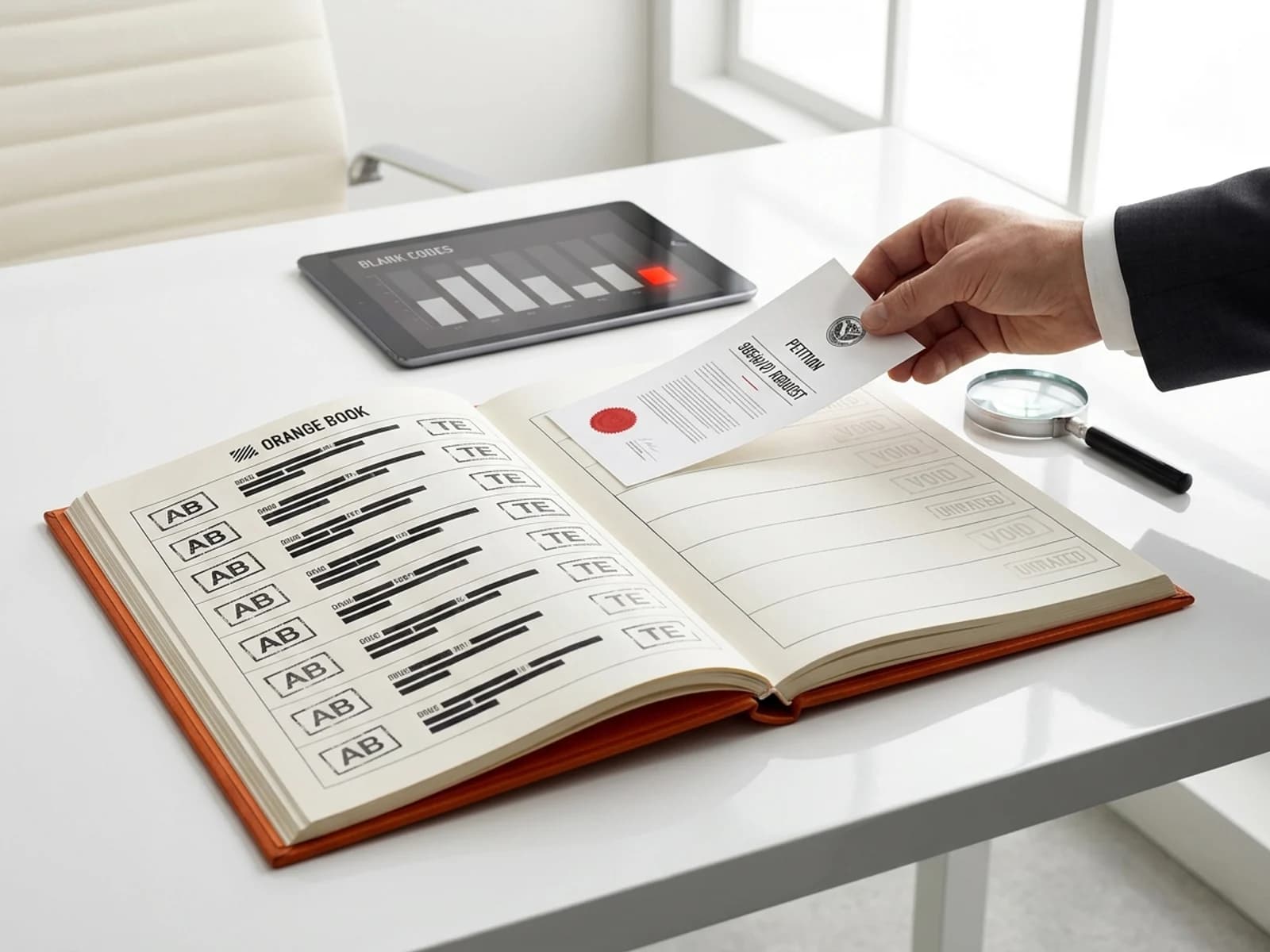
Unless an approved 505(b)(2) holder submits a formal citizen petition under 21 CFR 10.25(a) and 21 CFR 10.30—or meets narrow statutory criteria under FD&C Act § 505(j)(7)(A)(v)(I)—the product will remain in the Orange Book with a blank TE code. Under the pharmacy practice acts of virtually every U.S. state, a drug with a blank TE code cannot be substituted by a dispensing pharmacist without an explicit prescription from the authorized prescriber.
FDA AUGUST 2026 TE FINAL GUIDANCE: SUMMARY AT A GLANCE
| Parameter | Published Status / Regulatory Citation |
|---|---|
| Document Title | Evaluation of Therapeutic Equivalence (Final Guidance) |
| Federal Register Notice | FR Doc. 2026-17215; 91 FR 54721–54722 |
| Content Current Date | August 21, 2026 |
| Federal Register Publication Date | August 24, 2026 |
| Agency Docket Number | Docket No. FDA-2022-D-0528 |
| Primary Substantive Addition | Formal 505(b)(2) TE evaluation request process (FAQ 5) |
| Default Administrative Mechanism | Citizen Petition under 21 CFR 10.25(a) & 10.30 |
| Statutory Carve-Out Pathway | FD&C Act § 505(j)(7)(A)(v)(I) (inactive-ingredient exception) |
| Legal Effect under 21 CFR 10.115 | Non-binding Good Guidance Practices (GGP); advice only |
| State Substitution Linkage | TE codes inform state law; substitution is state-level |
Below, we examine the structural differences between the 2022 draft and the August 2026 final, detail the exact administrative pathways for 505(b)(2) TE requests, present a fresh census of blank TE fields across the August 14, 2026 Orange Book dataset, and outline the commercial and legal ramifications for market access.
What FDA Finalized: The 505(b)(2) Request Addition
FDA's therapeutic equivalence ratings—published in Approved Drug Products with Therapeutic Equivalence Evaluations, commonly known as the Orange Book—serve as the scientific foundation for generic drug substitution across the United States.
Under Hatch-Waxman statutory mechanics, Abbreviated New Drug Applications (ANDAs) submitted under section 505(j) receive therapeutic equivalence evaluations as an intrinsic component of the approval review. Because an ANDA must demonstrate identical active ingredient(s), dosage form, strength, route of administration, and labeling (subject to permissible carve-outs) alongside bioequivalence to the Reference Listed Drug (RLD), FDA assigns an "A" rating (such as AB, AN, AT, or AP) at the moment of approval.
In contrast, section 505(b)(2) applications are full NDAs that rely in part on FDA's prior findings of safety and efficacy for a listed drug or on published literature. Because 505(b)(2) products frequently feature differences in formulation, inactive ingredients, dosage form, or indication, FDA has historically declined to assess therapeutic equivalence during the initial NDA review unless specifically prompted.
The Substantive Evolution from the 2022 Draft
When FDA released its draft guidance in July 2022 (87 FR 43529), the agency synthesized decades of Orange Book preambles and policy memos into a single reference document explaining multi-letter coding conventions (e.g., AB1 vs AB2, BX ratings, and reference standards). However, that draft offered no clear procedural roadmap for how an approved 505(b)(2) sponsor could request a therapeutic equivalence rating if FDA had not assigned one at approval.
In the final version released on August 21, 2026, FDA introduced Question & Answer 5, explicitly establishing how 505(b)(2) applicants may obtain a TE code:
General Rule: FDA evaluates therapeutic equivalence for a 505(b)(2) application only after receiving an explicit request from the applicant or a third party.
Standard Administrative Submission: An applicant seeking a TE evaluation for an approved 505(b)(2) product must submit a Citizen Petition in accordance with 21 CFR 10.25(a) and 21 CFR 10.30. The Paperwork Reduction Act (PRA) information collection burden is governed under OMB Control No. 0910-0191.
Statutory Non-Petition Exception: In specific circumstances, a sponsor may request a TE evaluation under section 505(j)(7)(A)(v)(I) of the FD&C Act. This pathway is restricted to products where the sole pharmaceutical difference from the listed drug involves inactive ingredients that would not have been permissible in an ANDA under 21 CFR 314.94(a)(9)(iii) through (iv) (e.g., certain parenteral, ophthalmic, or otic preservative, buffer, or antioxidant variations).
Reliance on Existing Dossier Data: FDA indicated that when reviewing a TE citizen petition for an approved 505(b)(2), the agency will utilize data already residing in the NDA file where applicable, minimizing the need to duplicate in vivo pharmacokinetic or in vitro dissolution submissions if bioequivalence was established during the primary review.
505(b)(2) THERAPEUTIC EQUIVALENCE REQUEST PATHWAYS
| Request Pathway | Operational Scope & Criteria |
|---|---|
| Pathway 1: Citizen Petition (21 CFR 10.25(a) & 10.30) | • Standard mechanism for approved 505(b)(2) NDAs. • Requires public docket submission. • FDA reviews existing NDA bioequivalence & CMC files. • Public comment and stakeholder response window applies. |
| Pathway 2: Statutory Carve-Out (Inactive Ingredient Exception) | • Narrow exception under FD&C Act § 505(j)(7)(A)(v)(I). • Product must be pharmaceutically equivalent to RLD. • Sole difference is inactive ingredients outside 21 CFR 314.94(a)(9)(iii)–(iv) ANDA constraints. • FDA evaluates without requiring full citizen petition. |
Technical Citation Note: Practitioners downloading the final guidance from FDA's website should note that the agency reused the media URL (
https://www.fda.gov/media/160054/download), which previously hosted the 2022 draft. Regulatory submissions and legal briefs should cite "Evaluation of Therapeutic Equivalence (August 2026 Final)" and Federal Register notice 2026-17215 (91 FR 54721) to avoid confusion with the superseded 2022 draft.
Orange Book Blank-Code Census: Quantifying the 505(b)(2) Landscape
To assess the scale of approved products affected by this guidance, we executed an independent recomputation of the official FDA Orange Book data files (snapshot dated August 14, 2026).
The Orange Book dataset contains 48,664 product rows across prescription and over-the-counter pharmaceuticals:
ORANGE BOOK THERAPEUTIC EQUIVALENCE CENSUS (AUGUST 14, 2026)
| Category / Subset | Row Count | % of Respective Base |
|---|---|---|
| Total Listed Product Rows • ANDA Product Rows (Appl_Type A) • NDA Product Rows (Appl_Type N) | 48,664 37,795 10,869 | 100.0% 77.7% of all rows 22.3% of all rows |
| Therapeutic Equivalence Coding • Blank TE Field (No Rating) • TE-Coded Product Rows • Exact "AB" Rated Rows • All "AB-Prefix" Rows (AB, AB1–4) • "B" Rated Rows (BX, BP, BD, etc.) | 26,731 21,933 14,933 16,120 61 | 54.9% of all rows 45.1% of all rows 68.1% of coded rows 73.5% of coded rows 0.3% of coded rows |
| NDA Follow-On Proxy Analysis • Total Unique NDA Applications • Total Unique ANDA Applications • Non-RLD NDA Product Rows – Non-RLD NDA Rows with TE Code – Non-RLD NDA Rows with Blank TE • Unique Non-RLD NDA Applications – Unique NDAs with Any TE Code – Unique NDAs with Blank TE Only | 5,517 21,816 3,311 188 3,123 1,705 87 1,618 | — — 30.5% of all NDA rows 5.7% of non-RLD NDA rows 94.3% of non-RLD NDA rows Unique NDAs with no RLD=Yes rows 5.1% of non-RLD NDAs 94.9% of non-RLD NDAs |
Methodological Insights from the Data
The Overwhelming Prevalence of Blank Codes: More than half (54.9%) of all Orange Book product rows carry no TE evaluation. This occurs because innovator NDAs designated as Reference Listed Drugs (RLDs) do not receive TE codes (they serve as the reference standard against which others are evaluated), discontinued products frequently lose active coding, and follow-on NDAs enter the market unrated.
The Non-RLD NDA Proxy: The Orange Book database schema classifies applications using only two values for
Appl_Type:N(New Drug Application) andA(Abbreviated New Drug Application). It does not maintain a discrete field identifying whether an NDA was approved under section 505(b)(1) or section 505(b)(2). However, by isolating non-RLD NDAs (NDA products that are not designated as the reference standard), we establish a robust empirical proxy for follow-on, hybrid, and secondary NDA approvals.The 505(b)(2) Coding Deficit: Across 1,705 unique non-RLD NDA applications, 1,618 applications (94.9%) carry no TE rating on any row. Only 87 unique follow-on NDA applications have successfully obtained a TE code (representing 188 individual product rows). This illustrates that prior to the August 2026 final guidance, TE evaluations for 505(b)(2) products were exceptional rather than routine.
B-Rated Products Remain Rare: Only 61 product rows carry a "B" rating across the entire Orange Book, dominated by BX (52 rows, indicating specific bioequivalence deficiencies where data was insufficient to demonstrate equivalence), BP (5 rows, potential bioequivalence problems), BD (2 rows, active ingredient/dosage form with documented BE issues), BC (1 row, controlled-release), and BS (1 row, standard deficiency).
This census updates and expands the baseline established in this site's Orange Book therapeutic equivalence by the numbers analysis, reflecting the August 14, 2026 snapshot.
State Substitution Law vs. FDA Therapeutic Equivalence
A critical principle of pharmaceutical law—reiterated in the final guidance—is that FDA's therapeutic equivalence ratings are advisory. FDA does not regulate the practice of pharmacy or mandate drug substitution.
Under the U.S. regulatory structure:
Federal Role: FDA provides scientific evaluations under Good Guidance Practices (21 CFR 10.115). A TE code signifies that FDA considers the multi-source product to be pharmaceutically equivalent (same active ingredient, dosage form, strength, and route) and bioequivalent, with an expectation of identical therapeutic effect and adverse reaction profile when administered under label conditions.
State Role: Individual state pharmacy practice acts govern whether a dispensing pharmacist is permitted or required to substitute a generic or follow-on drug for a prescribed brand name.
STATE PHARMACY SUBSTITUTION ARCHITECTURE
| State Legal Framework | Pharmacist Substitution Requirement |
|---|---|
| Mandatory Substitution States (e.g., NY, MA, FL) | Pharmacist MUST substitute an Orange Book "A-rated" generic unless prescriber writes "Dispense as Written". Blank TE codes CANNOT be substituted automatically. |
| Permissive Substitution States (e.g., CA, TX) | Pharmacist MAY substitute an Orange Book "A-rated" generic with patient/prescriber consent. Blank TE codes CANNOT be substituted automatically. |
| Positive Formulary States | State maintains a list of specific substitutable drugs; overwhelmingly relies on Orange Book "A" ratings. |
| Negative Formulary States | Substitution permitted for all drugs EXCEPT those on the state negative list (often narrow therapeutic index). |
Because state laws almost universally tie automatic pharmacy-level substitution to an "A" rating in the Orange Book, an approved 505(b)(2) product with a blank TE field is commercially treated as a single-source brand at the retail counter. A pharmacist receiving a prescription for the reference brand cannot legally dispense the 505(b)(2) alternative unless the physician specifically prescribes the 505(b)(2) by name.
For a detailed walkthrough of how retail and specialty pharmacies process these codes, see the Orange Book TE-code generic substitution workflow.
The Lanreotide Case Study: The Commercial Cost of a Blank Code
The practical commercial consequences of launching a 505(b)(2) product without an AB rating are demonstrated by the market entry of lanreotide acetate (Somatuline Depot).
CASE STUDY: LANREOTIDE 505(b)(2) VS AB-RATED ANDA
| Parameter | Historical Commercial Trajectory |
|---|---|
| Innovator Reference Product | Somatuline Depot (Ipsen, NDA 022074) |
| Initial 505(b)(2) Entry | Lanreotide Injection (InvaGen/Cipla, NDA 215395) |
| Initial Orange Book TE Status | Blank TE Field (No automated substitution) |
| Commercial Operating Requirement | Field sales force, physician detailing, buy-and-bill |
| contracting, and medical-benefit PA navigation. | |
| Subsequent 505(j) ANDA Entry | Generic Lanreotide Acetate (AB-rated ANDAs) |
| Subsequent TE Status | AB Rated (Automated pharmacy substitution enabled) |
| Market Access Disruption | Rapid specialty channel conversion; payer preferred |
| tiering without dedicated field-sales detailing. |
When InvaGen (a Cipla subsidiary) secured approval for its 505(b)(2) lanreotide formulation (NDA 215395), the product entered the market without an AB rating. Consequently:
Specialty pharmacies and clinic dispensaries could not substitute Cipla's product for Somatuline Depot prescriptions.
The sponsor had to deploy dedicated specialty sales forces, negotiate provider buy-and-bill discounts, and convince oncologists and endocrinologists to write prescriptions specifically for the hybrid brand.
When true AB-rated ANDA generics later emerged under section 505(j), automated substitution immediately redirected volume at the PBM and specialty pharmacy level, compressing margins and illustrating why 505(b)(2) sponsors actively seek TE determinations.
See this site's deep dive on generic lanreotide acetate market access and the broader generic entry ANDA vs 505(b)(2) playbook.
Same-Week Companion: ANDA vs. 505(b)(2) Pathway Guidance
The release of the therapeutic equivalence final guidance coincided with another major FDA regulatory action: on August 18, 2026, FDA published a revised draft guidance titled "Determining Whether to Submit an ANDA or a 505(b)(2) Application".
These two documents form an integrated regulatory architecture:
The August 18 Pathway Draft: Advises sponsors at the development stage on whether their proposed drug modifications (e.g., changes in dosage form, strength, route, formulation, or dosing regimen) exceed the statutory boundaries of an ANDA under 505(j)—requiring a 505(b)(2) NDA—or whether they can be accommodated via an ANDA Suitability Petition under FD&C Act § 505(j)(2)(C).
The August 21 TE Final: Advises sponsors who were forced onto the 505(b)(2) pathway on how to subsequently obtain the therapeutic equivalence rating that ANDAs receive automatically.
When read together, FDA's policy message is clear: if a sponsor must utilize section 505(b)(2) due to minor formulation differences that preclude 505(j) filing, the sponsor is not permanently locked out of generic substitution. However, the sponsor must affirmatively petition the agency and prove that those differences do not compromise therapeutic equivalence in clinical practice.
Decision Framework: When Should a 505(b)(2) Sponsor File a TE Citizen Petition?
For biopharma regulatory and commercialization executives, deciding whether to submit a citizen petition under 21 CFR 10.30 to request a TE rating requires evaluating clinical, legal, and payer trade-offs:
                                  505(b)(2) Product Approved
                                              │
                                              ▼
                             Is the product pharmaceutically
                             equivalent to the listed RLD?
                             (Same active, strength, form, route)
                                      /               \
                                    NO                 YES
                                    /                   \
                                   ▼                     ▼
                        Ineligible for TE Code     Are differences limited
                        Must market as branded     to permitted inactive
                        specialty / hybrid drug.   ingredients under 314.94?
                                                         /         \
                                                       YES          NO
                                                       /             \
                                                      ▼               ▼
                                            Request TE via        File Citizen Petition
                                            § 505(j)(7)(A)(v)(I)  under 21 CFR 10.30
                                            if the inactive-      (180-day response
                                            ingredient exception  clock; interim
                                            applies               responses common)
Strategic Evaluation Matrix
| Decision Factor | Pursue TE Citizen Petition | Maintain Blank TE Field |
|---|---|---|
| Commercial Model | High-volume, low-margin generic channel; automated retail/PBM substitution. | Differentiated hybrid brand; dedicated field sales; value-added delivery system. |
| Bioequivalence Evidence | Robust in vivo PK study already in NDA file demonstrating bioequivalence. | Clinical efficacy study conducted; bioequivalence not directly bridged to RLD. |
| Formulation Differences | Minor inactive ingredient variations with no impact on absorption rate/extent. | Novel release mechanism, altered bioavailability, or differentiated Cmax/AUC profile. |
| Payer Positioning | Seeking mandatory generic formulary placement and step-therapy parity. | Seeking branded formulary placement, proprietary J-code/HCPCS, or orphan carve-out. |
| Timeline & Resource Risk | Willing to manage a public citizen-petition docket. 21 CFR 10.30 generally contemplates a 180-day response, though FDA often issues interim responses. | Need immediate commercial launch without exposing NDA bioequivalence data to docket challenges. |
Frequently Asked Questions
Does FDA's August 2026 TE final automatically assign AB ratings to 505(b)(2) products?
No. The final guidance explicitly confirms that FDA evaluates therapeutic equivalence for 505(b)(2) applications only upon receipt of a formal request. Approved 505(b)(2) products listed in the Orange Book without a TE code will remain blank until the sponsor successfully submits a citizen petition under 21 CFR 10.30 or qualifies under FD&C Act § 505(j)(7)(A)(v)(I).
Is therapeutic equivalence the same as permission to substitute under state law?
No. Therapeutic equivalence is an FDA scientific determination indicating that two products are pharmaceutically equivalent and can be expected to have the same clinical effect and safety profile. However, legal authority to substitute a drug at the pharmacy is governed exclusively by individual state pharmacy practice acts, which generally permit automatic substitution only when an Orange Book "A" rating is present.
Why would an approved 505(b)(2) have no TE code in the Orange Book?
FDA assigns TE ratings automatically to ANDAs (505(j)) because identical active ingredients, dosage forms, strengths, and bioequivalence are statutory prerequisites for approval. In contrast, 505(b)(2) NDAs can be approved based on clinical safety and efficacy studies without proving bioequivalence to an RLD. Unless the sponsor requested a TE evaluation during review or via post-approval petition, FDA leaves the TE column blank.
Can a sponsor request a TE code before its 505(b)(2) application is approved?
FDA's FAQ 5 states that the agency generally evaluates TE only after receiving a request, and that it generally makes those evaluations after the product is approved. A pending 505(b)(2) applicant with questions about whether additional data will be needed can contact the review-division regulatory project manager. If FDA does not assign a code at approval, the post-approval citizen-petition pathway in the August 2026 final is the standard route.
Sources
U.S. Food and Drug Administration. "Evaluation of Therapeutic Equivalence; Guidance for Industry; Availability." Federal Register Notice 2026-17215 (91 FR 54721–54722, Docket No. FDA-2022-D-0528), filed August 21, 2026; published August 24, 2026. https://www.federalregister.gov/documents/2026/08/24/2026-17215/evaluation-of-therapeutic-equivalence-guidance-for-industry-availability
U.S. Food and Drug Administration. "Evaluation of Therapeutic Equivalence; Guidance for Industry." Center for Drug Evaluation and Research (CDER), August 2026. https://www.fda.gov/regulatory-information/search-fda-guidance-documents/evaluation-therapeutic-equivalence
U.S. Food and Drug Administration. "Evaluation of Therapeutic Equivalence (Final Guidance PDF)." FDA Document Media ID 160054, August 2026. https://www.fda.gov/media/160054/download
U.S. Food and Drug Administration. "Approved Drug Products with Therapeutic Equivalence Evaluations (Orange Book) Data Files." Products, Exclusivity, and Patent datasets, snapshot dated August 14, 2026. https://www.fda.gov/drugs/drug-approvals-and-databases/orange-book-data-files
U.S. Food and Drug Administration. "Determining Whether to Submit an ANDA or a 505(b)(2) Application; Draft Guidance for Industry." CDER, August 18, 2026. https://www.fda.gov/regulatory-information/search-fda-guidance-documents/determining-whether-submit-anda-or-505b2-application
Code of Federal Regulations. "Title 21, Food and Drugs; Part 10—Administrative Practices and Procedures; Section 10.30—Citizen Petition." https://www.ecfr.gov/current/title-21/chapter-I/subchapter-A/part-10/subpart-B/section-10.30