The FDA Orange Book contains 48,215 approved drug products across 2,730 unique active ingredients and 1,912 applicants. More than half — 26,498 products, or 55% — carry no therapeutic equivalence code at all, meaning they are single-source innovator products with no approved generic equivalent. The remaining 45% carry a TE code that determines whether pharmacists can automatically substitute a generic at the point of dispensing.
This analysis is based on the FDA Orange Book (Approved Drug Products with Therapeutic Equivalence Evaluations), run date June 10, 2026. Every product record was included regardless of approval pathway (NDA, ANDA, or OTC). The TE code distribution, generic competition metrics, and applicant rankings below reflect the full active-section dataset.
TE code distribution
The Orange Book assigns therapeutic equivalence codes to help states implement generic substitution laws. A-rated products are considered therapeutically equivalent to the reference listed drug and can be substituted at the pharmacy level under state law. B-rated products are not considered therapeutically equivalent and cannot be automatically substituted. Products with no TE code are typically single-source innovator drugs still under exclusivity or with no approved ANDA.
| TE code | Count | Share | Meaning |
|---|---|---|---|
| N/A (no code) | 26,498 | 55.0% | Single-source, no TE evaluation |
| AB | 14,798 | 30.7% | Therapeutically equivalent, multi-source |
| AP | 3,755 | 7.8% | A-rated, injectable |
| AA | 1,029 | 2.1% | A-rated, solution or other non-problematic |
| AB1 | 580 | 1.2% | AB subgroup 1 |
| AT | 508 | 1.1% | A-rated, topical |
| AB2 | 286 | 0.6% | AB subgroup 2 |
| AN | 130 | 0.3% | A-rated, nasal or inhalation |
| AB3 | 129 | 0.3% | AB subgroup 3 |
| BX | 84 | 0.2% | B-rated, data insufficient |
| AB1,AB2,AB3,AB4 | 72 | 0.1% | Multiple AB subgroups |
| AO | 71 | 0.1% | A-rated, ophthalmic or otic |
| AP1 | 65 | 0.1% | AP subgroup 1 |
| AT1 | 43 | 0.1% | AT subgroup 1 |
| AP2 | 37 | 0.1% | AP subgroup 2 |
| AB1,AB2,AB3 | 36 | 0.1% | Multiple AB subgroups |
| AB4 | 30 | 0.1% | AB subgroup 4 |
| AT2 | 21 | 0.0% | AT subgroup 2 |
| AB1,AB2 | 12 | 0.0% | Multiple AB subgroups |
| AB1,AB3 | 11 | 0.0% | Multiple AB subgroups |
The AB code alone accounts for 30.7% of all products, but the full AB family — including AB1 through AB4 and all combinations — totals 15,954 products, or 33.1% of the Orange Book. These are the products that trigger automatic generic substitution in all 50 states.
The A-rated and B-rated groupings
Collapsing the TE codes into broader categories reveals the structural shape of generic eligibility:
| Grouping | Count | Share |
|---|---|---|
| Single-source / no TE code | 26,498 | 55.0% |
| AB-rated (all AB variants) | 15,954 | 33.1% |
| A-rated non-AB (AA, AN, AO, AP, AT and subgroups) | 5,670 | 11.8% |
| B-rated (BX and other B codes) | 93 | 0.2% |
B-rated products are rare. Only 93 products in the entire Orange Book carry a B rating, meaning FDA has determined that actual or potential bioequivalence problems have not been resolved by adequate evidence. For generic developers, a BX code is a warning flag: it means the reference product has known formulation or bioavailability complexity, and the pathway to an AB-rated ANDA may require additional bioequivalence studies or reformulation.
A-rated non-AB products (5,670) outnumber B-rated by 61 to 1. These are mostly injectable (AP) and topical (AT) products that are therapeutically equivalent but do not fall into the oral-solid-dosage-form AB system. Hospital procurement teams and GPO formularies rely on these codes for therapeutic interchange programs, even though they do not trigger retail pharmacy auto-substitution in the same way AB codes do.
Generic competition: 50.9% of ingredients now have ANDA products
Of the 2,730 unique active ingredients in the Orange Book, 1,258 appear only as NDA products — meaning no ANDA has been approved for that ingredient. Another 1,389 ingredients have at least one ANDA product alongside the originator NDA, indicating active generic competition. (The remaining 83 ingredients carry only BLA, ANDA-without-NDA, or OTC listings and fall outside the NDA-versus-ANDA comparison.)
| Metric | Count |
|---|---|
| Total unique active ingredients | 2,730 |
| Single-source (NDA only, no ANDA) | 1,258 |
| Ingredients with generic competition (NDA + ANDA) | 1,389 |
| Share with ANDA competition | 50.9% |
The 50.9% figure is a useful proxy for how far generic penetration has progressed across the approved-drug landscape. More than half of all distinct active ingredients that have an innovator product now also have at least one approved generic. But the flip side matters equally: 1,258 ingredients — 46.1% — remain single-source. Many of these are protected by ongoing exclusivity, complex formulation barriers, or limited commercial demand that does not justify an ANDA filing.
The Competitive Generic Therapy (CGT) pathway, created by FDARA 2017, targets this gap. A drug qualifies for the CGT pathway if there is not more than one approved drug in the active section of the Orange Book for that ingredient. CGT-designated ANDAs receive a 180-day exclusivity incentive intended to attract generic manufacturers to markets with inadequate competition. The 1,258 single-source ingredients represent the eligible pool, though not all will attract ANDA filers — some because the addressable market is too small, others because the formulation challenges are disproportionate to the revenue opportunity.
The most competitive generic ingredients
The top 15 ingredients by ANDA product count show where generic saturation is deepest:
| Active ingredient | ANDA products |
|---|---|
| Pregabalin | 308 |
| Acetaminophen; Hydrocodone Bitartrate | 251 |
| Amphetamine Aspartate; Amphetamine Sulfate; Dextroamphetamine Saccharate; Dextroamphetamine Sulfate | 250 |
| Levetiracetam | 226 |
| Metformin Hydrochloride | 220 |
| Ibuprofen | 220 |
| Amitriptyline Hydrochloride | 211 |
| Lamotrigine | 211 |
| Potassium Chloride | 207 |
| Methylphenidate Hydrochloride | 203 |
| Risperidone | 202 |
| Diltiazem Hydrochloride | 200 |
| Olanzapine | 189 |
| Quetiapine Fumarate | 187 |
| Propranolol Hydrochloride | 177 |
Pregabalin leads with 308 ANDA products. The combination of Lyrica patent expiry, high pre-generic revenue, and straightforward solid oral dosage form made it one of the most attractive ANDA targets of the past decade. For generic companies, 308 approved ANDAs for a single ingredient means the profit per unit has been compressed to the margin. The competitive lesson is clear: by the time ANDA counts reach triple digits, the financial return for additional filers approaches commodity pricing.
CNS drugs dominate the list. Levetiracetam, lamotrigine, methylphenidate, risperidone, olanzapine, and quetiapine are all CNS agents. Amphetamine-based ADHD products and hydrocodone combination analgesics also rank in the top three. These therapeutic areas combine large patient populations, patent cliffs on blockbuster brands, and relatively well-characterized bioequivalence pathways — conditions that attract dense ANDA filing.
For market access teams, high ANDA counts are a pricing signal. When an ingredient has more than 200 approved ANDAs, procurement can expect aggressive competitive bidding, rapid price erosion, and thin wholesale acquisition cost margins. Payers should reflect this in formulary assumptions: the generic discount for these ingredients is typically 80–95% below brand reference price, and preferred generic positioning on Part D and commercial formularies is won almost entirely on rebate and supply-chain terms rather than clinical differentiation.
Top 20 applicants by product count
The Orange Book lists 1,912 unique applicants. The top 20 by product count are predominantly generic manufacturers:
| Applicant | Products |
|---|---|
| Watson Labs | 1,090 |
| Hikma | 906 |
| Chartwell Rx | 848 |
| Hospira | 735 |
| Sandoz | 686 |
| Rising | 630 |
| Pharmobedient | 585 |
| Teva | 572 |
| Fresenius Kabi USA | 558 |
| Zydus Pharms | 553 |
| Aurobindo Pharma Ltd | 530 |
| Apotex | 506 |
| Aurobindo Pharma | 494 |
| Mylan | 466 |
| Lupin | 456 |
| Ani Pharms | 449 |
| Alembic | 447 |
| PH Health | 401 |
| Pfizer | 388 |
| Macleods Pharms Ltd | 379 |
Watson Labs leads with 1,090 products. The portfolio reflects decades of ANDA accumulation, including the legacy Actavis and Watson Pharmaceuticals product lines. Hikma (906) and Chartwell Rx (848) round out the top three, followed by Hospira (735), whose portfolio is dominated by injectable hospital products that fall under AP-rated TE codes rather than AB.
Pfizer (388) is the only originator company in the top 20. Its position reflects a combination of legacy innovator NDAs, acquired Upjohn and Hospira products, and a substantial ANDA portfolio through its generics division. The next closest originator would fall well outside the top 20, underscoring that the Orange Book product-count ranking is structurally weighted toward generic companies filing many ANDAs for a smaller number of high-volume ingredients.
The Aurobindo split is notable. Aurobindo Pharma Ltd (530) and Aurobindo Pharma (494) appear as separate applicants, likely reflecting different manufacturing site registrations or legal entities. Combined, Aurobindo would rank third with 1,024 products. Similar entity-splitting may affect other applicants in this ranking, and M&A activity continues to reshuffle the list — Mylan is now part of Viatris, for example, but the Orange Book still carries the original applicant name for legacy approvals.
Implications for generic strategy
The AB substitution machine is working. With 15,954 AB-rated products covering 1,389 active ingredients, the Orange Book's TE code system is the regulatory backbone of generic substitution in the United States. All 50 states have automatic substitution laws that require pharmacists to dispense an AB-rated generic when one is available, unless the prescriber explicitly writes "dispense as written." For generic companies, obtaining an AB rating is the commercial gateway to pharmacy-level market share.
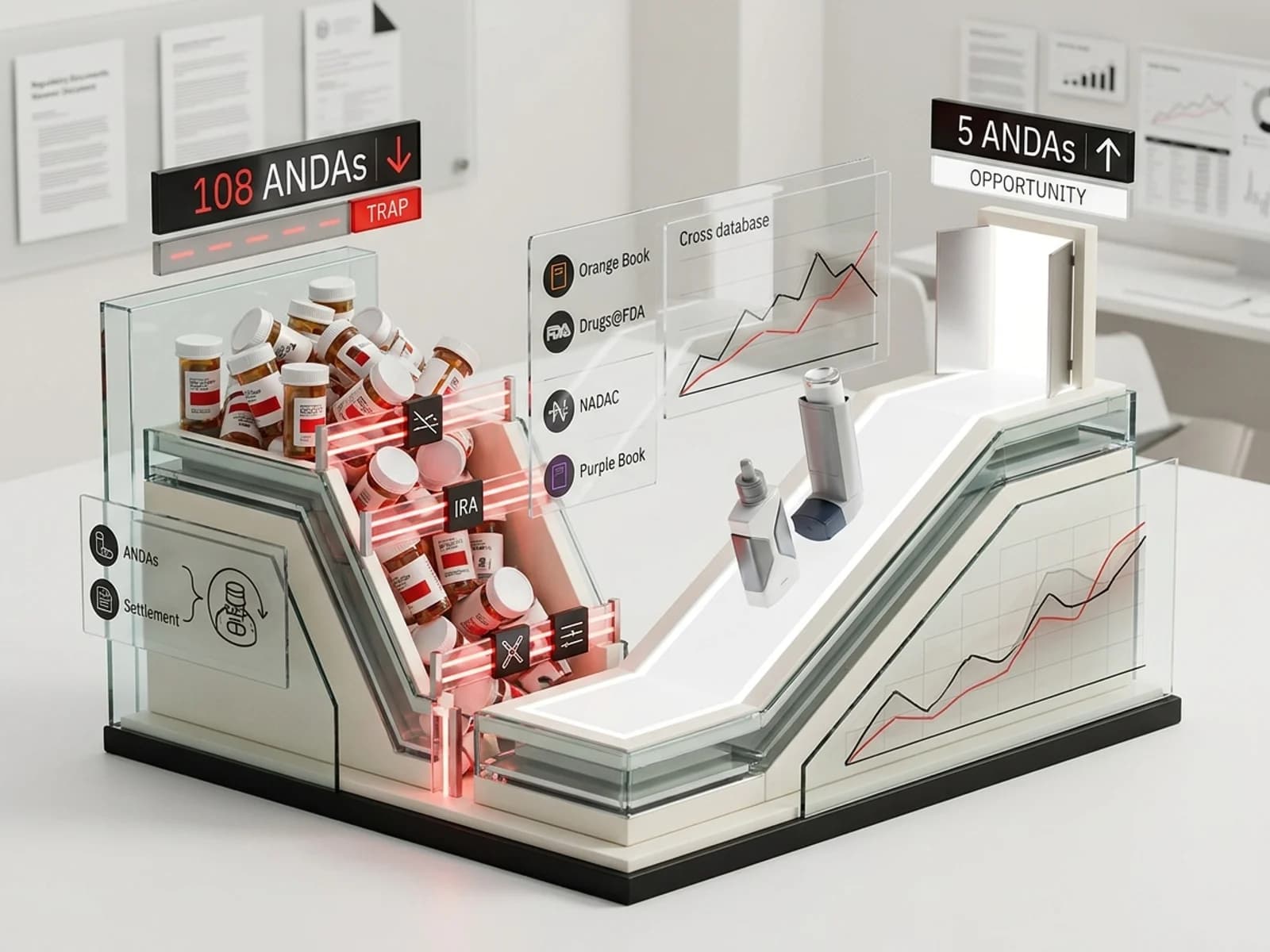
The single-source pool is the next competitive frontier. The 1,258 ingredients without ANDA competition include complex generics (inhalers, injectable suspensions, transdermal patches), products with remaining exclusivity, and niche molecules with limited commercial appeal. The CGT pathway and FDA's ongoing guidance on complex generic development are designed to chip away at this pool, but progress is slow. Generic companies with complex-formulation capabilities — particularly in injectables, ophthalmics, and inhalation products — are better positioned to capture ANDA opportunities in this segment.
BX codes deserve attention from pipeline planners. The 84 BX-rated products represent reference drugs where bioequivalence is unresolved. Some of these will eventually see AB-rated generics as analytical methods and FDA guidance catch up. Others — particularly complex modified-release formulations and combination products — may remain BX-rated for years. Pipeline planners should track BX-to-AB transitions as early indicators of upcoming generic entry windows.
High ANDA saturation compresses margins to commodity levels. Ingredients with more than 200 ANDA approvals have moved beyond competitive generic markets into near-commodity pricing. The commercial play at this level is not product differentiation but supply-chain efficiency, vertically integrated manufacturing, and portfolio breadth that spreads fixed costs across hundreds of SKUs. Generic companies without scale in these ingredients are better served focusing on the 1,258 single-source molecules where margins remain defensible.
Sources
FDA Orange Book (Approved Drug Products with Therapeutic Equivalence Evaluations). https://www.fda.gov/drugs/drug-approvals-and-databases/approved-drug-products-therapeutic-equivalence-evaluations-orange-book
FDA Orange Book TE code definitions. https://www.fda.gov/drugs/drug-approvals-and-databases/therapeutic-equivalence-TE-codes
FDA Competitive Generic Therapy (CGT) pathway guidance. https://www.fda.gov/regulatory-information/search-fda-guidance-documents/competitive-generic-therapies
FDARA 2017 (FDA Reauthorization Act), Title I, Section 804 — Competitive Generic Therapies. https://www.congress.gov/bill/115th-congress/house-bill/2430
FDA guidance on bioequivalence studies for ANDAs (June 2026). https://www.fda.gov/regulatory-information/search-fda-guidance-documents/product-specific-guidances-generic-drug-development
National Conference of State Legislatures, state generic substitution laws. https://www.ncsl.org/health/state-pharmacist-substitution-laws