Across the United States, community pharmacies, health-system outpatient dispensaries, and mail-order pharmacy benefit managers (PBMs) face a severe, persistent supply crunch for estradiol transdermal systems (estrogen patches). Manufacturers report rolling backorders — with several presentations carrying no estimated release date at all — and pharmacy counters routinely turn away patients seeking routine hormone replacement therapy (HRT).
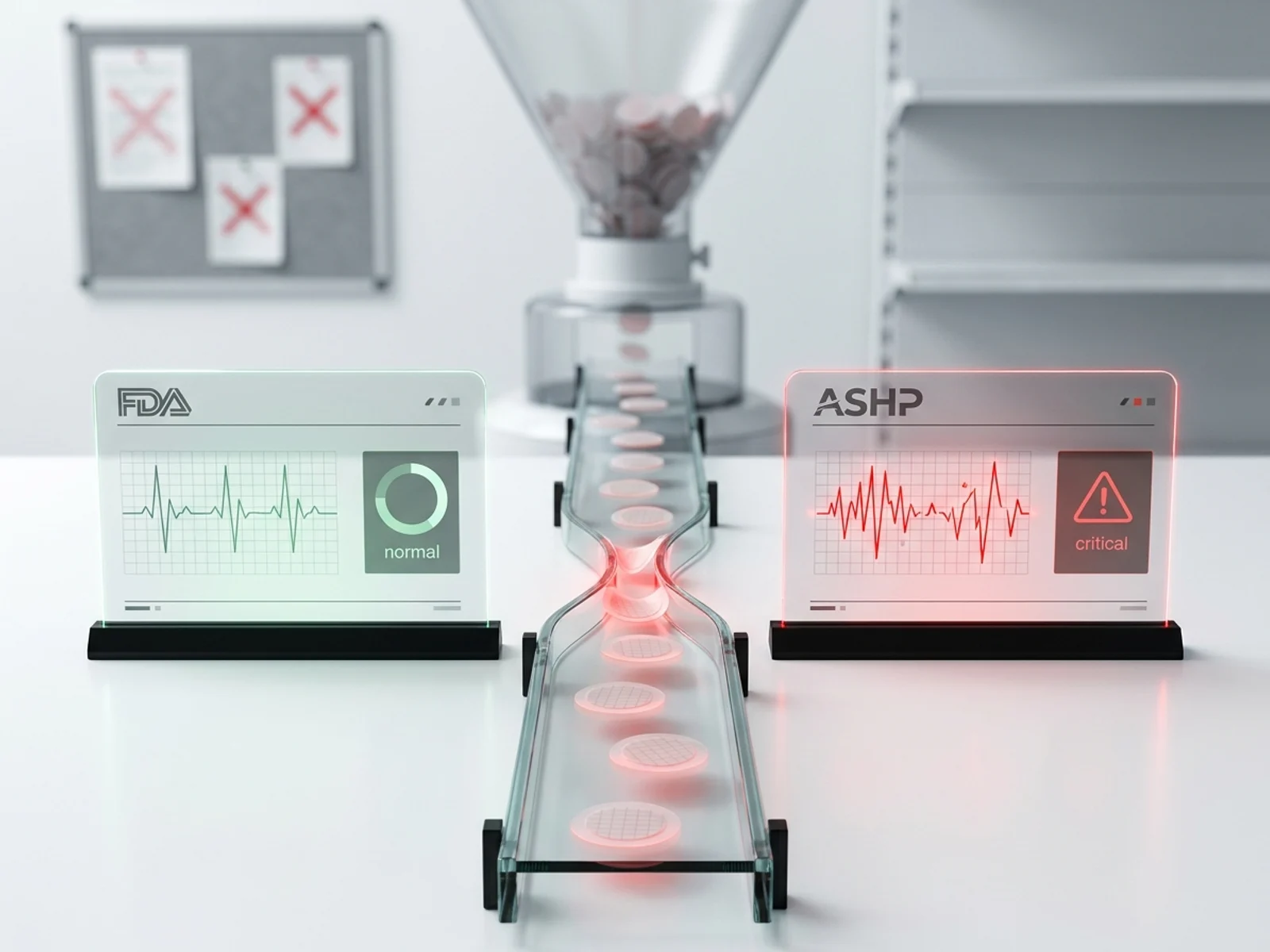
Yet a search of the U.S. Food and Drug Administration's (FDA) official Drug Shortages database reveals a striking regulatory paradox: as of August 21, 2026, estradiol transdermal system is not listed as a shortage drug. Not a single transdermal product of any kind appears among the FDA database's current shortage entries (the database's separate discontinuations tab carries scopolamine transdermal — a market exit, not a current shortage).
In contrast, the American Society of Health-System Pharmacists (ASHP), in partnership with the University of Utah Drug Information Service, has classified estradiol transdermal patches as an active national drug shortage since January 30, 2026, with ongoing bulletin updates through August 12, 2026 documenting widespread allocations across Amneal, Mylan/Viatris, Noven, Sandoz, and Zydus product lines.
Why does this divergence exist, how did a major regulatory safety action trigger a category-wide demand shock, and what does the structural concentration of the generic transdermal market mean for procurement teams?
The shortage divergence: FDA database vs ASHP bulletins
To understand the operational disconnect between pharmacy shelves and federal regulatory lists, procurement and market-access teams must parse the differing methodologies and statutory definitions governing FDA and ASHP tracking systems.
FDA DRUG SHORTAGES DATABASE VS ASHP SHORTAGE BULLETIN
| Dimension | FDA Drug Shortages Database | ASHP / Univ of Utah Shortage Bull |
|---|---|---|
| Listing Status (As of Aug 21, 2026) | NOT LISTED (0 estradiol entries; no transdermal currently listed) | ACTIVE NATIONAL SHORTAGE Listed since Jan 30, 2026 |
| Governing Standard & Baseline | Section 506E-1 of the FD&C Act; demand/proj. demand vs supply assessed nationally | Practice-based definition; Inability of pharmacies to procure drug through normal trade channels |
| Primary Data Source | Mandatory manufacturer reports (21 CFR 314.81 / CARES Act) | Practitioner reports, wholesaler backorder data, maker outreach |
| Regulatory Relief Triggered | Unlocks 503A/503B compounding exemptions, expedited site lines | None (Advisory clinical and procurement guidance only) |
| Transdermal Scope | None currently listed Estradiol absent | Multiple strengths & brands (Amneal, Noven, Sandoz, Viatris, Zydus) |
1. FDA's Section 506E-1 Statutory Standard
Under Section 506E-1 of the Federal Food, Drug, and Cosmetic Act (FD&C Act), a drug shortage is "a period of time when the demand or projected demand for the drug within the United States exceeds the supply of the drug." FDA operationalizes that definition nationally: a drug is listed when supply is not meeting current demand, or is not forecast to meet projected demand, across all manufacturers. The friction point for patches is that demand has shifted sharply upward from its historical baseline — and critics (ASHP among them) contend the agency's assessments lean on manufacturers' historical production and demand data, which can lag a genuine demand shock. When makers run approved lines at full historical volumes while new prescribing runs far above that baseline, the statutory threshold can go unmet even as pharmacy shelves empty.
For an in-depth breakdown of agency intake criteria, see our guide on how the FDA drug shortage list works and our aggregate overview of the current FDA drug shortage landscape.
2. ASHP's Practice-Based Metric
ASHP and the University of Utah Drug Information Service define a shortage from the perspective of the practicing clinician and supply-chain buyer: any supply disruption that impacts how pharmacies prepare and dispense medications or forces clinical substitution. Because ASHP captures real-time wholesaler allocation limits and inventory depletion, its bulletins reflect pharmacy counter reality months before federal databases reflect structural shifts.
How a label safety action became a national demand shock
The root cause of the 2026 estradiol patch shortage is not a catastrophic manufacturing plant contamination, API adulteration, or hurricane-related facility closure. Instead, it is the direct consequence of a federal regulatory milestone that unlocked unprecedented clinical demand across a fragile, highly specialized manufacturing base.
       LABEL ACTION TO SUPPLY SHORTAGE CAUSAL CHAIN
  NOV 10, 2025 ──► FDA Drug Safety Communication (DSC)
                   Requests removal of broad boxed warnings on
                   menopausal hormone therapy (MHT) formulations.

  FEB 12, 2026 ──► FDA Approves First 6 Revised Product Labels
                   29 generic and brand manufacturers file revised
                   DailyMed labeling removing cardiovascular/dementia boxes.

  SPRING 2026  ──► Massive Demand Acceleration
                   • Truveta data: +20% MHT prescriptions (Jul 2025–Feb 2026)
                   • +184% rise among women aged 45–54 since 2018
                   • Clinical preference shifts decisively to transdermal

  SUMMER 2026  ──► Generic Transdermal Capacity Wall
                   10 approved ANDAs across only 3 generic applicants
                   hit maximum fill-finish and matrix lamination capacity.
1. The Boxed-Warning Removal Wave
For more than two decades following the initial 2002 Women's Health Initiative (WHI) readouts, menopausal hormone therapy labels carried sweeping class-wide boxed warnings highlighting risks of coronary heart disease, stroke, invasive breast cancer, pulmonary embolism, and probable dementia.
On November 10, 2025, FDA issued a landmark Drug Safety Communication (DSC) requesting manufacturers remove the generalized boxed warnings for menopausal hormone therapy products, citing modern epidemiological and clinical trial data demonstrating that transdermal estradiol initiated near menopause onset carries a favorable benefit-risk profile with minimal thrombotic risk compared to oral estrogens.
On February 12, 2026, FDA approved the first batch of six revised product labeling supplements across major sponsors, with 29 manufacturers submitting corresponding labeling revisions under 21 CFR 314.70. (For workflows on tracking post-approval label revisions, see our guide on reading FDA drug labels).
2. The Prescription Demand Surge
The removal of boxed warnings triggered immediate clinical re-evaluation by professional societies (including the Menopause Society and the American College of Obstetricians and Gynecologists), physician prescribers, and direct-to-consumer digital health platforms:
Truveta analytics reported a 20% increase in estrogen-based therapy prescriptions between July 2025 and February 2026 alone.
This short-term surge compounded a longer-term trend: the number of US women aged 45 to 54 prescribed estrogen-based therapies rose 184% between 2018 and early 2026.
Because clinical guidelines strongly favor transdermal patches over oral tablets to bypass first-pass hepatic metabolism and avoid prothrombotic coagulation factor induction, demand concentrated almost entirely on transdermal patch delivery.
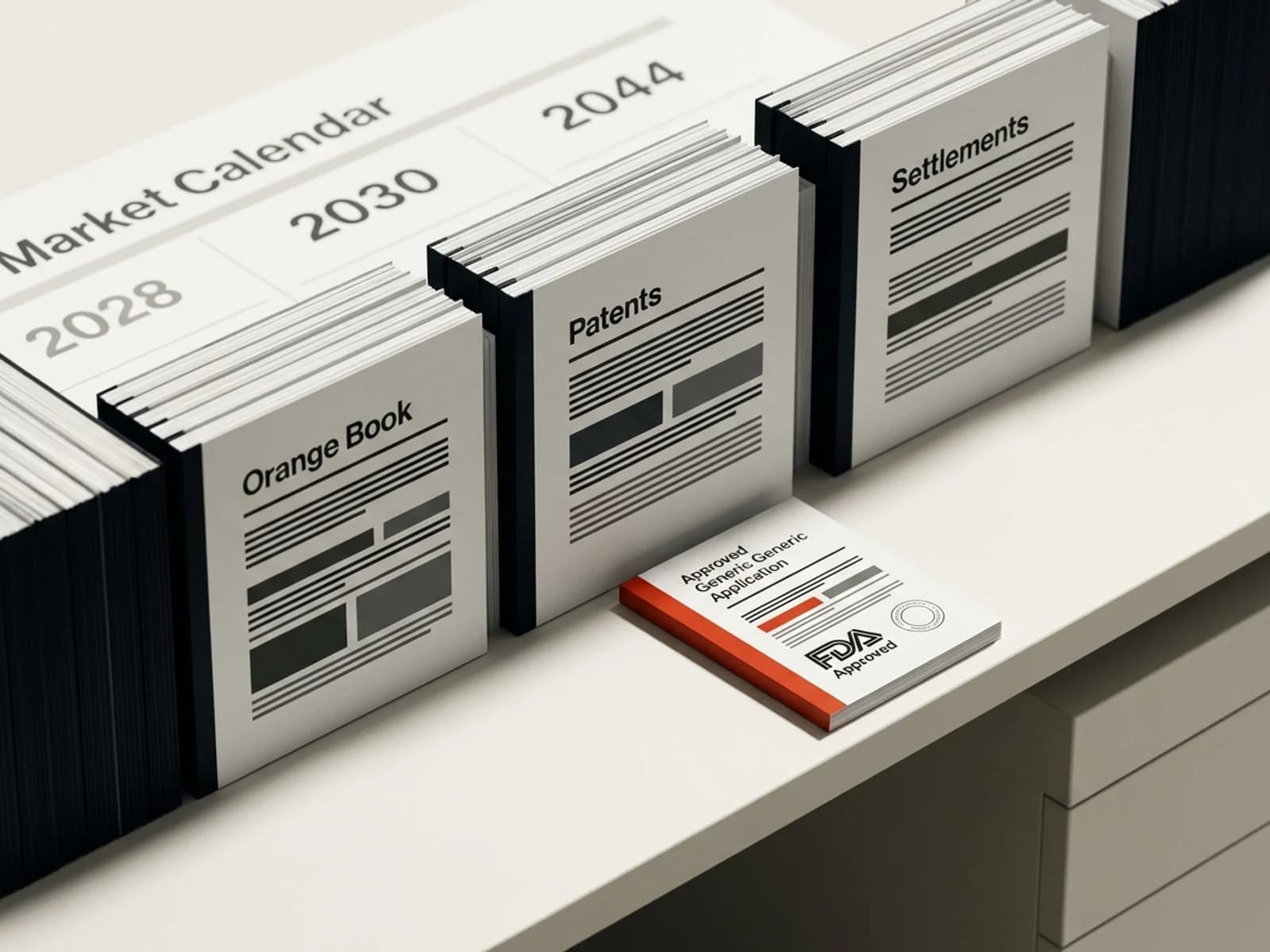
The Orange Book landscape: 10 ANDAs, but only 3 generic suppliers
Why could the generic pharmaceutical supply chain not absorb a 20% prescription surge? The answer lies in the structural barrier of transdermal patch manufacturing and extreme corporate consolidation.
A recomputation of the FDA Drugs@FDA and Orange Book data files (snapshot August 2026; estradiol monoproduct patch applications only—transdermal systems and films, excluding gels, sprays, and combination products) reveals that the U.S. estradiol patch market is far narrower than it appears:
ESTRADIOL TRANSDERMAL SYSTEM ORANGE BOOK MARKET STRUCTURE
| Application Type | Total Applications | Active / Marketed | Discontinued Lines |
|---|---|---|---|
| NDAs (Brand / RLD) | 12 NDAs | 6 NDAs | 6 NDAs Discontinued |
| ANDAs (Generic) | 10 ANDAs | 10 ANDAs (All Rx) | 0 ANDAs Discontinued |
| Total Market Scope | 22 Applications | 16 Active | 6 Discontinued |
ACTIVE GENERIC ANDA CONCENTRATION (10 APPROVED APPLICATIONS)
| Generic Applicant Entity | Approved ANDA Count | Brand / Product Equivalent Families |
|---|---|---|
| Amneal Pharmaceuticals | 2 ANDAs | Dotti (twice-weekly, ANDA 211293) Lyllana (twice-weekly, ANDA 211396) |
| Mylan / Viatris Entities (Mylan Pharmaceuticals and Mylan Technologies) | 5 ANDAs | Twice-weekly & once-weekly matrix systems (e.g., ANDA 201675, 075182, 206685) |
| Zydus Lifesciences | 3 ANDAs | Once-weekly & twice-weekly matrix equivalents (e.g., ANDA 202985, 206241) |
1. The Three-Entrant Bottleneck
While 10 ANDAs remain active in the Orange Book, they are held by exactly three corporate entities:
Amneal Pharmaceuticals (2 ANDAs controlling the widely prescribed Dotti and Lyllana lines);
Mylan / Viatris (5 ANDAs manufactured through its specialized Mylan Technologies transdermal division); and
Zydus Lifesciences (3 ANDAs).
2. Contract Manufacturing Site Overlap
Even more critically, application ownership overstates physical manufacturing diversity. Transdermal drug delivery systems (TDDS) require specialized drug-in-adhesive matrix compounding, high-precision slot-die coating, protective release liner lamination, and specialized pouching equipment.
A significant portion of the brand and generic market relies on contract manufacturing by Noven Pharmaceuticals (the original developer of Vivelle-Dot and Minivelle), meaning that a disruption or capacity ceiling at a single facility impacts multiple distinct labelers simultaneously.
For cross-category context on transdermal vulnerabilities, see our empirical analysis of single-source transdermal patch analysis.
3. The Discontinued Brand Tail
Six of the 12 original brand NDAs have been permanently discontinued over the past two decades—including legacy formulations of Alora, Estraderm, Esclim, Fempatch, Sandoz's original Vivelle, and an early Ortho-McNeil estradiol system. The departure of these historical manufacturers leaves the modern supply chain with zero spare surge capacity.
Manufacturer availability scorecard: What ASHP records
The ASHP drug shortage detail page (updated August 12, 2026) provides a product-by-product operational snapshot across key manufacturers and strengths:
ESTRADIOL PATCH MANUFACTURER AVAILABILITY STATUS
| Manufacturer / Brand | Regimen & Strengths | ASHP Current Supply Status |
|---|---|---|
| Amneal (Dotti) | Twice-weekly (0.025, 0.0375, 0.05, 0.075, 0.1 mg/day) | PARTIAL SHORTAGE: 0.0375 and 0.1 mg 8-count in shortage with no estimated release date; 0.025/0.05/ 0.075 mg available |
| Amneal (Lyllana) | Twice-weekly (All strengths) | AVAILABLE: All strengths reported in stock |
| Bayer (Climara) | Once-weekly (0.025 to 0.1 mg/day) | AVAILABLE: All six strengths |
| Noven Pharmaceuticals | Twice-weekly (Vivelle-Dot / Generic) (All strengths) | SHORTAGE: Company cites increased demand; all presentations on intermittent back order with weekly releases |
| Sandoz | Once-weekly (0.025 to 0.1 mg/day) | SHORTAGE: All six strengths; 0.0375 and 0.1 mg have no estimated release date; others on allocation |
| Mylan / Viatris | Once-weekly & Twice-weekly (Various strengths) | MOSTLY AVAILABLE: One 0.05 mg 8-count NDC on intermittent back order; 4-count cartons available |
| Zydus Lifesciences | Twice-weekly (0.05, 0.075, 0.1 mg/day) | SHORTAGE / ALLOCATION: 0.05, 0.075, and 0.1 mg on allocation |
The generic substitution trap: Orange Book TE codes and regimen mismatch
When a patient's prescribed estradiol patch is unavailable, retail pharmacists face complex legal and regulatory boundaries governing generic substitution under state pharmacy practice acts and the FDA Orange Book.
       ORANGE BOOK THERAPEUTIC EQUIVALENCE BOUNDARIES
  ┌────────────────────────────────────────────────────────┐
  │ CLIMARA & EQUIVALENTS (ONCE-WEEKLY)                   │
  │ TE Code: AB2 (Mylan 075182, Zydus 202985)              │
  └───────────────────────────┬────────────────────────────┘
                              │
                    CANNOT INTERCHANGE AT
                     PHARMACY DISCRETION
                              │
                              ▼
  ┌────────────────────────────────────────────────────────┐
  │ VIVELLE-DOT / MINIVELLE & EQUIVALENTS (TWICE-WEEKLY)  │
  │ TE Code: AB1 (Vivelle-Dot family: Mylan 201675,       │
  │ Zydus 206241, Amneal Dotti 211293); AB3 (Minivelle    │
  │ family: Mylan 206685, Amneal Lyllana 211396)           │
  └────────────────────────────────────────────────────────┘
1. Regimen Incompatibility: Once-Weekly vs Twice-Weekly
The estradiol patch market is split into two non-interchangeable application frequencies:
Once-Weekly Systems (e.g., Climara and its AB1-rated generic equivalents): Designed with larger reservoir or thicker matrix patches delivering continuous hormone release over a 7-day period.
Twice-Weekly Systems (e.g., Vivelle-Dot, Minivelle, Dotti, Lyllana, and AB2/AB3/AB4 equivalents): Designed with ultra-thin matrix technology delivering targeted hormone release over 3.5 days (applied every 3 to 4 days).
Under FDA Orange Book rules and state substitution laws, a pharmacist cannot substitute a once-weekly patch for a twice-weekly prescription without a new prescription from the authorized prescriber.
For a detailed review of therapeutic equivalence rules, see our explainer on orange book TE codes and substitution.
2. Multi-Tiered AB Codes Within Twice-Weekly Formulations
Even among twice-weekly formulations, different brand products anchor distinct Reference Listed Drug (RLD) families with their own TE-code groups in the Orange Book:
Vivelle-Dot family products carry AB1 ratings (Mylan ANDA 201675, Zydus ANDA 206241, and Amneal's Dotti ANDA 211293).
Minivelle family products carry AB3 ratings (Mylan ANDA 206685 and Amneal's Lyllana ANDA 211396).
Menostar's 0.014 mg/day system stands alone with an unrated-subscript AB code.
While many generic lines cross-reference multiple RLDs, pharmacies utilizing automated dispense systems frequently encounter electronic claim rejections when attempting cross-RLD substitution.
The clinical spillover: Pediatric endocrinology and non-menopause indications
While the public conversation focuses primarily on menopausal symptom management, the patch shortage has created acute clinical crises in specialized non-menopause populations:
PEDIATRIC AND ADOLESCENT ENDOCRINE SPILLOVER
| Clinical Indication | Specific Formulation Need & Shortage Impact |
|---|---|
| Turner Syndrome & Hypogonadism Pubertal Induction | Requires ultra-low micro-dosing (e.g., 0.025 mg/day patch cut into 1/4 or 1/2 segments, or 0.014 mg/day systems) to mimic normal physiological pubertal progression without premature bone fusion. |
| Pediatric Society Action (June 2026) | Pediatric Endocrine Society issued urgent clinical bulletins warning of severe developmental disruption due to low-dose patch stockouts and recommending temporary transition protocols. |
| Transgender & Gender- Affirming Care | Relies heavily on twice-weekly high-strength transdermal patches (0.1 mg/day) to maintain stable systemic serum estradiol levels. |
The Pediatric Endocrine Society (PES) highlighted in its June 2026 shortage update that pediatric patients undergoing pubertal induction cannot simply switch to oral estrogen tablets or commercial gels due to erratic hepatic clearance, dosing precision limits, and adverse impacts on linear growth and bone mineral density accrual.
Comparing demand-driven shortages: Estradiol vs GLP-1s and ADHD stimulants
The estradiol patch crisis exemplifies a growing modern category of drug shortages: regulatory- or guideline-driven demand shocks colliding with inflexible generic manufacturing infrastructure.
COMPARISON OF DEMAND-DRIVEN U.S. DRUG SHORTAGES
| Characteristic | Estradiol Patches (2026) | GLP-1 Agonists (Semaglutide/Tirzep) | ADHD Stimulants (Amphetamine / MPH) |
|---|---|---|---|
| Primary Demand Trigger | FDA boxed-warning removal (Nov 2025) | Clinical trial data for obesity (STEP) | Telehealth prescribing expansion & diagnosis |
| FDA Shortage Status | NOT LISTED | Listed 2022–2025; resolved Dec 2024 (tirzepatide)–Feb 2025 (semaglutide) | Listed (2022–present) |
| Manufacturing Bottleneck | Transdermal matrix coating & lamination | Aseptic auto-injector device fill-finish | DEA controlled substance API quotas |
| Compounding Relief Unlocked | UNAVAILABLE (Not on FDA list) | Massive 503A/503B compounding scale | UNAVAILABLE (DEA quota limits) |
| Supplier Diversity | 3 Generic Entrants (10 ANDAs total) | 2 Brand Innovators (Novo, Lilly) | Multiple generic solid-dose makers |
Why Compounding Relief Is Blocked
During the GLP-1 shortage, FDA's official Section 506E shortage designation allowed compounding pharmacies under Section 503A and outsourcing facilities under Section 503B to prepare compounded versions of semaglutide and tirzepatide without violating statutory prohibitions against copying commercially available drugs.
Because FDA has not placed estradiol patches on its official shortage list, 503A and 503B compounders cannot legally produce generic copycat transdermal patches at commercial scale. Furthermore, compounding transdermal drug-in-adhesive matrix systems requires multi-million-dollar specialized machinery that compounding pharmacies do not possess.
Strategic takeaways for pharmacy buyers and health systems
Supply-chain leaders, health-system P&T committees, and community pharmacy networks should implement five concrete operational strategies:
Rely on ASHP Bulletins for Operating Reality: Do not wait for FDA database updates to initiate allocation workflows. Treat ASHP and University of Utah bulletins as the authoritative operational benchmark for procurement planning.
Establish Pre-Approved Prescriber Substitution Protocols: Work with health-system medical directors and local obstetric/endocrine clinics to establish standing collaborative practice agreements allowing pharmacists to switch between once-weekly and twice-weekly regimens without delay when specific NDCs run dry.
Audit Wholesaler Secondary Sources: Establish direct purchasing accounts across secondary generic distributors to bypass single-wholesaler allocation caps on Amneal, Mylan, and Zydus NDCs.
Reserve Low-Dose Patches for Pediatric Induction: Prioritize 0.025 mg/day and 0.0375 mg/day patch inventory for pediatric endocrine clinics where clinical alternatives (gels, sprays) are clinically inappropriate.
Monitor ANDA Approvals and Line Transfers: Track FDA approval supplements for new generic entrants or contract manufacturing line transfers that could introduce incremental patch coating capacity by late 2026.
Frequently Asked Questions
Is FDA going to declare an official estradiol patch shortage?
FDA continues to monitor manufacturer reporting under the FD&C Act's shortage provisions (Sections 506J notification and 506E-1 definition). As long as FDA's national assessment concludes that supply is meeting — or forecast to meet — demand on the manufacturers' reported basis, the agency has resisted declaring a shortage. However, if backorders persist and total distribution falls demonstrably below current demand, an official listing could occur, which would also unlock 503A/503B compounding flexibility.
Which estradiol patch products are in shortage on ASHP bulletins?
ASHP lists shortages across Sandoz once-weekly patches (all strengths), Amneal Dotti (0.0375 and 0.1 mg), Noven patches (all presentations, intermittent back order), Zydus (0.05, 0.075, and 0.1 mg on allocation), and a single Mylan/Viatris 0.05 mg 8-count NDC. Bayer's Climara line and Amneal's Lyllana are reported as available, as are Dotti's 0.025, 0.05, and 0.075 mg strengths.
Can a pharmacist automatically switch a patient from a once-weekly patch to a twice-weekly patch?
No. Once-weekly patches (e.g., Climara and its AB2-rated generics) and twice-weekly patches (e.g., Vivelle-Dot and its AB1-rated generics) have different dosing dynamics, patch sizes, and application instructions. A pharmacist cannot legally substitute between them without obtaining a new prescription order from the prescriber.
Why can't compounding pharmacies make estradiol patches?
First, because estradiol transdermal systems are not on the official FDA drug shortage list, compounders are legally restricted from making regular copies of commercially available drugs. Second, transdermal matrix patch manufacturing requires complex, high-precision industrial coating and lamination machinery not found in standard 503A or 503B compounding pharmacies.
When do manufacturers expect estradiol patch supply to normalize?
ASHP's August 12, 2026 bulletin offers no aggregate end date: several presentations (including Dotti 0.0375 and 0.1 mg and two Sandoz strengths) carry no estimated release date, while others are on allocation or intermittent back order with weekly releases. A June 23, 2026 Pediatric Endocrine Society update cited ASHP resupply estimates that had already slipped from mid-March to mid-April 2026, which suggests buyers should plan for constrained allocation into at least late 2026.
Sources
U.S. Food and Drug Administration (FDA): FDA Drug Shortages Database (Current Entries Application). Accessdata Database Search, August 21, 2026. accessdata.fda.gov.
American Society of Health-System Pharmacists (ASHP): Drug Shortage Detail: Estradiol Transdermal System. University of Utah Drug Information Service, Posted January 30, 2026; Updated August 12, 2026. ashp.org.
U.S. Food and Drug Administration (FDA): FDA Requests Labeling Changes Related to Safety Information to Clarify Benefit/Risk Considerations for Menopausal Hormone Therapy Products. Drug Safety Communication, November 10, 2025. fda.gov.
U.S. Food and Drug Administration (FDA): FDA Approves Labeling Changes to Menopausal Hormone Therapy Products. Press Announcement, February 12, 2026. fda.gov.
U.S. Food and Drug Administration (FDA): Orange Book Data Files (Products, Patent, Exclusivity) and Drugs@FDA Data Files (Applications, Products, Marketing Status, TE). August 2026 Datasets. Orange Book data files; Drugs@FDA data files.
Pediatric Endocrine Society (PES): Drugs and Therapeutics Shortage Update: Estradiol Transdermal Patch. June 23, 2026. pedsendo.org.
NBC News: FDA Claims There's No Estrogen Patch Shortage as Women Struggle to Get Prescriptions Filled. July 2026. nbcnews.com.