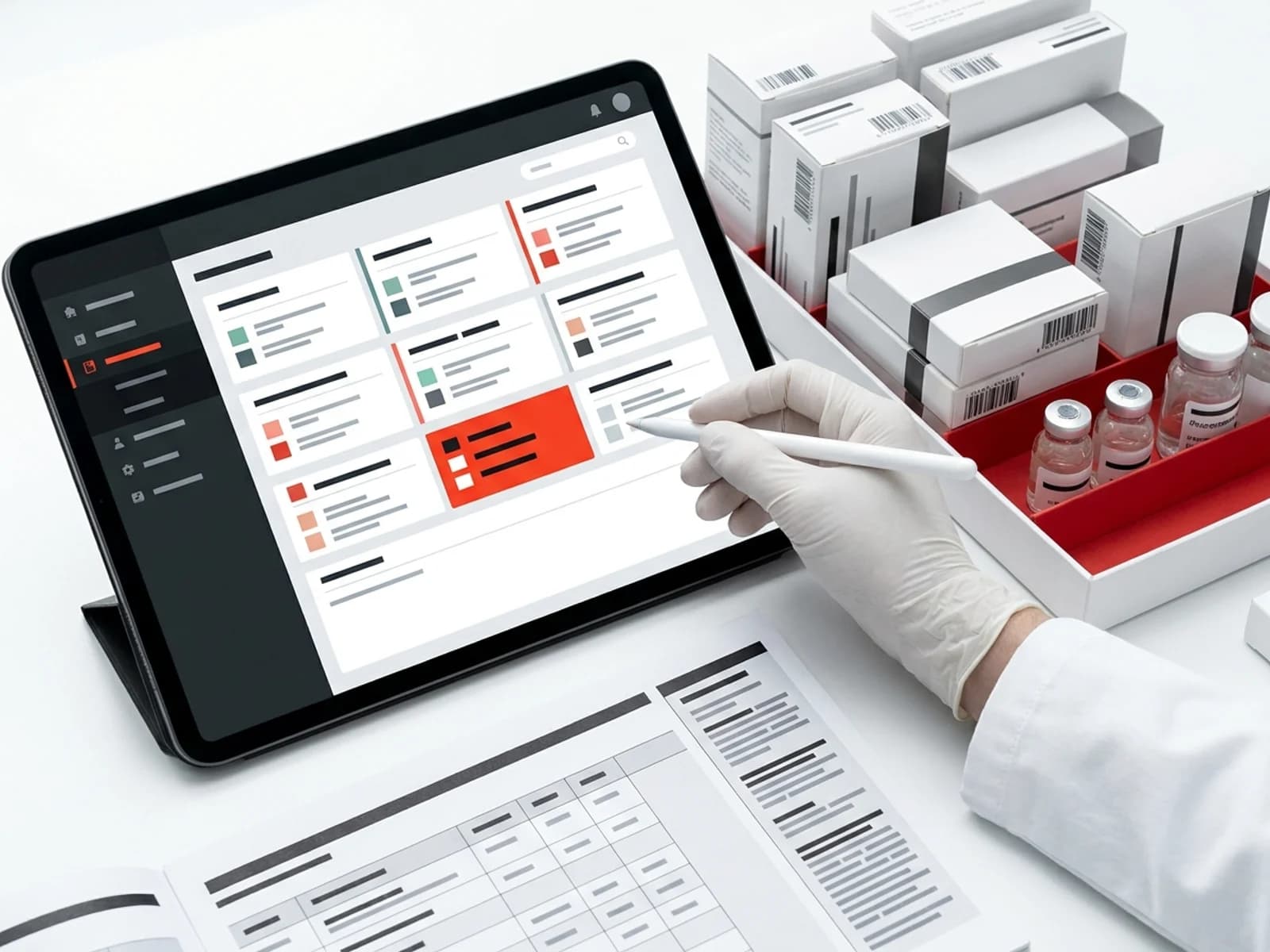
A hospital pharmacy buyer opens the FDA Drug Shortage Database to check on an injectable that is running low. The record says Current, availability Unavailable, reason Requirements related to complying with good manufacturing practices. Two rows down, the same molecule from a different manufacturer reads Current and Available. A third reads To Be Discontinued with a date six weeks out. Each of those field combinations points to a different sourcing action — place a backorder hold, switch to the available competitor, or line up a therapeutic alternative before the discontinuation date. Misread any one field and the pharmacy either over-orders into a product that will not arrive or waits on a presentation that has already been discontinued.
The FDA Drug Shortage Database is the authoritative public source for drug supply disruption in the United States, and it is dense with fields that each carry a distinct operational signal: status, availability, reason, posting and update dates, presentation, and the distinction between a temporary shortage and a permanent discontinuation. Reading the list well means reading each field in order and knowing which one answers which question.
This article is a field-by-field reading workflow for the Drug Shortage Database, written for pharmacy operations, hospital supply chain, 340B and group purchasing teams, and manufacturer market-access teams who monitor competitor supply disruption. It covers what each field means, how to tell a shortage from a discontinuation, the legal notification framework behind the data, and the worked examples that show how a sourcing decision follows from the fields. It is not a treatment advisory. For the aggregate picture — which therapeutic categories and manufacturers dominate the shortage list — see the companion what's in short supply analysis; this article stays on the field-level read a sourcing team performs on a single record.
The legal framework behind the list: Section 506C
The shortage list exists because manufacturers are legally required to tell FDA about disruptions. Under Section 506C of the Federal Food, Drug, and Cosmetic Act, manufacturers of covered prescription drugs — life-supporting, life-sustaining, or used to prevent or treat a debilitating disease or condition, including drugs used in emergency care or surgery — must notify FDA of:
A permanent discontinuance in the manufacture of the finished drug or biologic;
An interruption in manufacture likely to lead to a meaningful disruption in U.S. supply;
A permanent discontinuance of the active pharmaceutical ingredient (API) for such a drug; or
An interruption in API manufacture likely to meaningfully disrupt supply.
The notification must disclose the reason and is required six months in advance where possible, or as soon as practicable, but in no case later than five business days after the discontinuance or interruption. FDA posts non-compliance letters publicly when firms fail to notify, and those letters — for products like vincristine, etoposide, and paclitaxel — are themselves a sourcing signal that a supply disruption went unreported until it was already acute. Understanding this framework matters because it explains why some fields are reliably populated (status, presentation, dates) while others are often blank (reason): manufacturers must report the disruption, but FDA publishes the reason manufacturers provide, and firms frequently cite "Other" or give no reason at all.
The fields, in the order a sourcing team should read them
Field 1 — Status: Current, Resolved, or To Be Discontinued
Status is the first filter and the one most often misread. In the shortage data analyzed for this article (1,680 total records as of June 2026, of which 1,146 are active Current shortages), the status distribution is:
| Status | Records | Share | What it means operationally |
|---|---|---|---|
| Current | 1,146 | ~68% | An active shortage FDA is tracking; supply is disrupted |
| To Be Discontinued | 505 | ~30% | A permanent market exit; plan for absence, not recovery |
| Resolved | 29 | ~2% | The disruption is over; supply has resumed |
The critical distinction is between Current and To Be Discontinued. A Current shortage is, by FDA's framing, a disruption the agency is actively working with manufacturers to mitigate — the expectation is eventual recovery. A To Be Discontinued record is a permanent market exit: the manufacturer is leaving that product, and the field to watch is the discontinued_date, not a recovery estimate. Confusing the two is the most expensive reading error a buyer can make, because it produces opposite sourcing strategies (bridge to recovery vs. find a permanent alternative).
A Resolved status is rarer than buyers expect — only about 2% of records — and it usually carries a resolved_note confirming availability has resumed. Treat a freshly resolved record with the same sourcing caution as a Current one until inventory actually moves, because the resolution may be limited to specific NDCs or presentations.
Field 2 — Availability: the granularity status lacks
Status tells you whether FDA considers the shortage active; availability tells you whether the specific presentation can actually be sourced. The availability field carries four operational values:
| Availability | Meaning for the buyer |
|---|---|
| Available | This presentation is on the market and orderable |
| Limited Availability | Orderable but rationed, allocated, or backordered |
| Unavailable | Cannot be sourced at this time |
| (blank) | FDA has no current availability statement — do not assume available |
In the data analyzed here, among Current shortages roughly 731 records read Available, 127 Limited, 286 Unavailable, and over 500 carried no availability statement at all. The blank-availability count is the trap: a missing field does not mean the product is fine — it usually means the most recent manufacturer update did not include an availability assertion, and the buyer should treat it as unconfirmed. A single generic can have multiple rows by presentation (strength, vial size, NDC), and availability can differ row to row — one strength Unavailable while another is Available. Always read availability at the presentation level, not the molecule level.
Field 3 — Reason: the "why," often missing
The reason field is the least reliable and most informative field. Manufacturers must disclose a reason, but the disclosed values cluster heavily:
| Reason | Records (Current) | Operational read |
|---|---|---|
| (blank / none) | ~1,256 | No reason given — supply risk is opaque |
| Other | ~133 | Disclosed but unclassified |
| Demand increase for the drug | ~106 | Demand-driven; may ease as capacity scales |
| Discontinuation of the manufacture of the drug | ~68 | Supply is leaving, not just interrupted |
| Shortage of an active ingredient | ~67 | Upstream API constraint; affects all makers sourcing that API |
| Requirements related to complying with good manufacturing practices | ~22 | Quality/GMP remediation; timeline depends on reinspection |
| Delay in shipping of the drug | ~21 | Logistics-driven; typically shorter-lived |
| Shortage of an inactive ingredient component | ~4 | Excipient constraint |
| Regulatory delay | ~3 | Approval or inspection timing |
The reason reshapes the recovery timeline and the sourcing response. A GMP reason (quinapril, for example) implies the maker must remediate a quality issue and often pass reinspection before resuming — a longer, less predictable recovery. An API shortage (lisdexamfetamine from one maker) signals an upstream constraint that may hit other manufacturers sourcing the same API, so switching to a competitor is not automatically safe. A demand increase (methylphenidate) suggests the disruption may be transient and capacity-led rather than a quality failure. The heavy blank count means buyers frequently have no reason at all and must infer the timeline from availability and update cadence.
Field 4 — The dates: initial posting, update, and discontinued
Three date fields anchor the record in time:
initial_posting_date— when the shortage first appeared on the list. A record posted in 2023 and still Current in 2026 is a chronic, structural shortage, not an acute event; its sourcing strategy is permanent-alternative, not bridge.update_date— the most recent manufacturer or FDA update. Stale update dates (months old) on a Current record are a warning that no one is actively reporting status.discontinued_date— present on To Be Discontinued records; the planned or effective exit date. This is the deadline for sourcing a replacement.
A fourth signal sits in the update_type field: New (first listing), Revised (details changed), or Reverified (FDA confirmed the record is still accurate without changes). In the data analyzed here, roughly 800 records are Reverified, 505 New, and 375 Revised. A Reverified record is FDA confirming the disruption is still live as of the update date — useful confirmation that a status is not stale.
Field 5 — Presentation: the unit the shortage actually applies to
The presentation field names the exact product, strength, and package — typically including the NDC — that the record describes. This is where the shortage is actually localized. A buyer scanning at the molecule level will miss that only one strength, one vial size, or one NDC is affected. Reading the presentation against your own purchase-history NDCs is the step that determines whether your supply is disrupted at all.
What the status field legally enables: compounding a shortage copy
One operational consequence of the status field is not obvious until a pharmacy reads it closely. A Section 503A compounding pharmacy may compound a copy of an FDA-approved drug only while the specific approved product — its API and dosage form, not just the API — appears on the FDA shortage list as currently in shortage. The governing language is precise: it is the approved drug product (API plus dosage form) listed as in shortage that opens the compounding pathway, not a generic "the molecule is hard to get." The moment the product is removed from the shortage list, compounding copies of it must stop. For a pharmacy reading the list, the workflow is therefore: confirm the exact approved product and dosage form is the item marked Current, document that status at the time of compounding (for inspection), and re-check the list before every subsequent fill, because a Resolved status closes the authority retroactively.
Worked examples: how the fields drive a sourcing decision
These are real records from the shortage data analyzed for this article.
Example 1 — A Resolved record: Solu-Cortef (hydrocortisone sodium succinate)
Status Resolved, presentation "Solu-cortef, Injection, 500 mg/vial (NDC 0009-0016-12)," initial posting March 2023, resolved note "Available." This is a closed disruption: supply has resumed and the buyer can return to standard ordering. The risk is over-correcting — buyers who built a large safety stock during the shortage should draw it down rather than perpetuate a hoarded inventory position.
Example 2 — To Be Discontinued: tobramycin solution
Status To Be Discontinued, presentation "Tobramycin, Solution, 300 mg/4 mL (NDC 0093-3750-28)," discontinued date the same as the posting date. This is a permanent exit. The correct action is to identify a therapeutic alternative or a different manufacturer's tobramycin presentation now, not to backorder, because the product is not coming back.
Example 3 — Current + Unavailable + GMP: quinapril tablets
Status Current, availability Unavailable, reason Requirements related to complying with good manufacturing practices, presentation "Quinapril Hydrochloride, Tablet, 20 mg (NDC 68180-558-09)," originally posted January 2023, reverified into June 2026. This is a chronic, quality-driven disruption in one manufacturer's line. The buyer should source the same strength from a different labeler (different NDC) and treat recovery as contingent on the maker's GMP remediation — not predictable from the record alone.
Example 4 — Current + Limited + Demand increase: methylphenidate ER
Status Current, availability Limited Availability, reason Demand increase for the drug, presentation "Methylphenidate Hydrochloride, Tablet, Extended Release, 54 mg (NDC 13811-709-10)." This is a demand-led allocation. A different manufacturer's ER methylphenidate may be fully available; the buyer's action is to qualify an alternate NDC while allocation persists, with a reasonable expectation that the original presentation recovers as demand stabilizes.
Example 5 — Current + Limited + API shortage: lisdexamfetamine capsules
Status Current, availability Limited Availability, reason Shortage of an active ingredient, presentation "Lisdexamfetamine Dimesylate, Capsule, 40 mg (NDC 43547-605-10)." An API constraint at the upstream level means competitors sourcing the same API could be affected next. The buyer should not assume every lisdexamfetamine labeler is a safe switch — verify each candidate manufacturer's availability independently.
The reading workflow, before any sourcing change
Filter by status. Separate Current (active disruption) from To Be Discontinued (permanent exit) from Resolved (closed). These need different playbooks.
Read availability at the presentation level. Do not read at the molecule level; one NDC can be Unavailable while another is Available.
Read the reason for the recovery signal. GMP and discontinuation reasons imply long or permanent timelines; demand and shipping reasons imply shorter ones; API reasons can cascade to other makers.
Check the dates. An initial posting years old with a recent Reverified update is a chronic shortage; a stale update date is a warning to confirm status directly.
Match the presentation NDC to your purchase history. Confirm whether your specific presentation is the one affected before triggering a sourcing change.
Verify candidate alternatives independently. For API-driven and GMP-driven shortages, do not assume competitor availability — check each alternate NDC's availability field.
Check FDA's extended-use-date and non-compliance lists. Extended use dates can legally extend stock on hand for specific lots, and non-compliance letters flag disruptions that went unreported.
What access and supply-chain teams should monitor
For pharmacy operations and 340B/GPO supply-chain teams, the discipline is cadence: re-read Current records at a set interval rather than reactively, because availability and recovery estimates change between Reverified updates. For manufacturer market-access teams, a competitor's To Be Discontinued record is a formulary-opening signal — the exit creates a substitution window for a therapeutic equivalent, and the discontinued date is the lead time to position supply and payer messaging. And for any team building a shortage monitoring process, the heavy blank and "Other" reason counts are the reason the list is necessary but not sufficient: pair it with the FDA extended-use-date list, the non-compliance letter postings, and direct manufacturer confirmation before committing a sourcing change.
One companion source fills the gap the FDA list does not. The FDA Drug Shortage Database tells you what is disrupted and why, but it deliberately offers no clinical guidance on what to use instead. The American Society of Health-System Pharmacists (ASHP) maintains a parallel drug shortage resource that lists more products than FDA and, crucially, supplies alternative agents, references, and purchasing guidance for managing each shortage — the clinical and operational bridge that FDA's status fields point to but do not provide. A complete reading workflow uses the FDA list for status, reason, and dates, and ASHP for the therapeutic alternative when one is needed.
This article is for informational purposes only and does not constitute medical advice, treatment guidance, or procurement direction for any specific facility. Shortage status, availability, and recovery estimates change frequently; always verify current records in the FDA Drug Shortage Database and confirm availability with manufacturers or distributors before making sourcing decisions.
Last updated: June 13, 2026.
Sources
FDA. "Drug Shortages." fda.gov
FDA. "Frequently Asked Questions about Drug Shortages" (Section 506C notification requirements; 6-month / 5-business-day framework). fda.gov
FDA. "Drug Shortages: Non-Compliance With Notification Requirement." fda.gov
FDA. "Managing Drug Shortages" (FDA Drug Info Rounds; status, reason, anticipated availability, resolved and discontinued lists). fda.gov
FDA. "Search List of Extended Use Dates to Assist with Drug Shortages." fda.gov
FDA. "Drug Shortages: Report New Drug Shortage / Status Information" (CDER Direct NextGen Portal; drugshortages@fda.hhs.gov). fda.gov
openFDA. "Drug Shortages API — Overview." open.fda.gov
Hyman, P. "Why, Who, When, Where and More: New Draft Guidance on Notifying FDA about Discontinuance or Interruption in Manufacturing," The FDA Law Blog, March 2024. thefdalawblog.com
Hyman, P. "Drug Amount Reporting: FDA Publicly Identifies over 7,700 Noncompliant Companies," The FDA Law Blog, May 2026. thefdalawblog.com
ASHP. "Understanding and Managing Drug Product Shortages" (FDA site vs. ASHP resource; alternative agents; shortage reporting). ashp.org
Alliance for Pharmacy Compounding (APC). "Best Practices When Compounding FDA-Approved Drugs Listed in Shortage" (503A compounding gated on "currently in shortage" status). join.a4pc.org