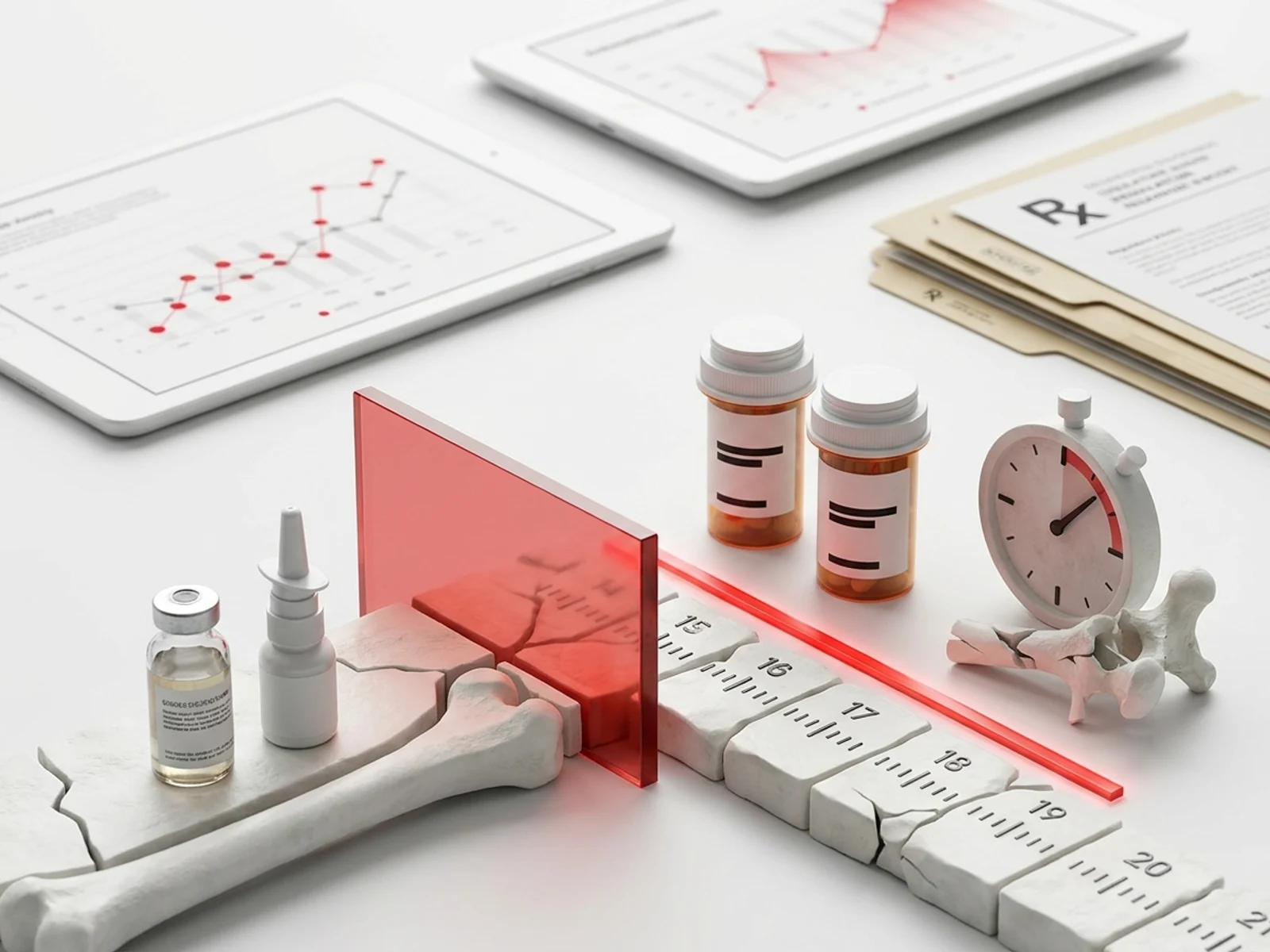
Pharmacologic management of moderate-to-severe endometriosis-associated pain splits into two clinical eras and access models: an older base of injectable gonadotropin-releasing hormone (GnRH) receptor agonists and androgenic synthetics available as generic drugs, and a modern layer of oral GnRH receptor antagonists restricted by specialty pricing and strict duration caps.
At the generic foundation, injectable leuprolide acetate (Lupron Depot, AbbVie; multiple original NDAs approved since 1985) has 10 approved ANDAs with CMS National Average Drug Acquisition Cost (NADAC) benchmarks ranging from $1,740.67 for a 3.75mg 1-month kit to $6,205.99 for a 22.5mg 3-month depot kit. Oral danazol (Danocrine, NDA 017557) provides a generic androgenic option with 3 approved ANDAs at a NADAC of $1.74 to $3.29 per capsule. In contrast, nasal nafarelin acetate (Synarel, Pfizer, NDA 019886, approved 1990) remains brand-only.
The modern specialty layer centers on two oral non-peptide GnRH antagonists: elagolix (Orilissa, AbbVie, NDA 210450, approved July 23, 2018) and the fixed-dose combination of relugolix, estradiol, and norethindrone acetate (Myfembree, Sumitomo/Myovant/Pfizer, NDA 214846, approved May 2021 for fibroids and August 2022 for endometriosis). Both products lack generic ANDAs but carry published brand NADAC benchmarks (roughly $41.71 per Orilissa 150 mg tablet and $45.24 per Myfembree tablet), reflecting specialty-tier oral pricing. Crucially, access to both oral GnRH antagonists is governed by FDA-mandated 24-month lifetime duration limits driven by hypoestrogenic bone mineral density (BMD) loss. Payers strictly manage access through prior-authorization (PA) gates requiring a confirmed surgical or clinical diagnosis, documented failure of combination oral contraceptives (COCPs) or NSAIDs, exclusion of thrombotic risks, and automated duration tracking.
Which drugs are FDA-approved for endometriosis pain?
Endometriosis affects approximately 10% of reproductive-age women, characterized by ectopic endometrial-like tissue growth responsive to estrogen stimulation. FDA-approved options target ovarian estrogen suppression across three pharmacological classes:
| Drug Name & Active Ingredient | Original NDA & Year | Generic ANDA Roster | Mechanism & Route | FDA Duration Cap & Restrictions |
|---|---|---|---|---|
| Leuprolide Acetate (Lupron Depot) | NDA 019010 / 019732 (1985) | 10 Approved ANDAs | GnRH Agonist (IM Depot Injection) | 6 months initial; 6 months retreatment with add-back |
| Danazol (Danocrine) | NDA 017557 (1976) | 3 Approved ANDAs | Synthetic Androgen / Steroid (Oral) | Typically 3 to 6 months (androgenic side effects) |
| Nafarelin Acetate (Synarel) | NDA 019886 (1990) | 0 ANDAs (Brand-only) | GnRH Agonist (Nasal Spray) | Maximum 6 months lifetime duration |
| Elagolix (Orilissa) | NDA 210450 (2018) | 0 ANDAs (Brand-only) | Oral GnRH Antagonist (Monotherapy) | 150mg: Max 24 months; 200mg: Max 6 months |
| Relugolix / Estradiol / Norethindrone (Myfembree) | NDA 214846 (2021/2022) | 0 ANDAs (Brand-only) | Oral GnRH Antagonist + Add-Back Therapy | Max 24 months total duration |
Injectable GnRH agonists (leuprolide) and nasal agonists (nafarelin) initially stimulate pituitary GnRH receptors, causing a transient flare of luteinizing hormone (LH) and follicle-stimulating hormone (FSH) before down-regulating pituitary receptors to produce profound hypoestrogenism (chemical menopause).
Conversely, oral GnRH antagonists (elagolix, relugolix) cause immediate, dose-dependent competitive blockade of GnRH receptors in the anterior pituitary without an initial hormonal flare. This allows rapid suppression of LH, FSH, and estradiol ($\text{E}_2$), providing rapid relief from dysmenorrhea and non-menstrual pelvic pain.
Why are Orilissa and Myfembree limited to 24 months of use?
The primary safety concern and access barrier associated with long-term GnRH inhibition is progressive bone mineral density (BMD) loss. Estrogen plays a critical role in bone remodeling by inhibiting osteoclast activity. Suppressing serum estradiol levels below $30\text{ pg/mL}$ accelerates trabecular and cortical bone resorption, placing premenopausal women at risk for early-onset osteopenia and osteoporosis.
                   Bone Mineral Density (BMD) Access Gate
                                     │
     ┌───────────────────────────────┴───────────────────────────────┐
     │                                                               │
[Orilissa (Elagolix)]                                    [Myfembree (Relugolix Combo)]
     │                                                               │
 ┌───┴─────────────────────────┐                           ┌─────────┴─────────────────────┐
 │ 150 mg QD: Max 24 Months    │                           │ 40mg / 1mg / 0.5mg QD         │
 │ (Estrogen 20-50 pg/mL)      │                           │ Built-in Add-Back Therapy     │
 ├─────────────────────────────┤                           ├───────────────────────────────┤
 │ 200 mg BID: Max 6 Months    │                           │ **Max 24 Months Total**       │
 │ (Full Suppression <10 pg/mL)│                           │ Mitigates BMD Loss & Flashes  │
 └─────────────────────────────┘                           └───────────────────────────────┘
Because bone loss acquired during GnRH therapy may not be fully reversible after drug discontinuation, the FDA imposed strict, non-negotiable lifetime duration limits:
Orilissa 150 mg once daily: Capped at a maximum duration of 24 months. The 150mg daily dose produces partial estrogen suppression (maintaining serum $\text{E}_2$ between $20\text{ and }50\text{ pg/mL}$), balancing pain relief with manageable bone loss. In patients with moderate hepatic impairment (Child-Pugh Class B), the 150mg dose is capped at 6 months.
Orilissa 200 mg twice daily: Capped at a maximum duration of 6 months. The higher dose causes near-complete estrogen suppression ($\text{E}_2 < 10\text{ pg/mL}$), producing superior dyspareunia and pelvic pain suppression but accelerating bone loss. Retreatment with the 200mg dose is not recommended by the FDA.
Myfembree once daily: Capped at a maximum duration of 24 months. Myfembree combines $40\text{ mg}$ of relugolix with exogenous "add-back" hormonal therapy ($1.0\text{ mg}$ estradiol and $0.5\text{ mg}$ norethindrone acetate). The exogenous estrogen/progestin component maintains serum $\text{E}_2$ in a therapeutic window ($30\text{ to }50\text{ pg/mL}$) that minimizes bone turnover and hot flashes while preserving relugolix's pelvic pain efficacy. Despite built-in add-back protection, clinical trials demonstrated ongoing gradual bone loss, prompting the FDA to enforce a strict 24-month hard ceiling.
Payers maintain automated pharmacy claims accumulators that track lifetime month counts for elagolix and relugolix prescriptions. Once a patient reaches 24 cumulative months of paid claims, subsequent PA renewals are automatically rejected.
Is leuprolide (Lupron Depot) generic, and what does it cost?
Injectable GnRH agonists provide a deep generic option, though acquisition costs vary based on depot formulation strength and administration frequency.
Orange Book & NADAC Benchmarking
Analysis of the U.S. FDA Orange Book (20260725 snapshot) and CMS NADAC (20260724 dataset) highlights the pricing structure across generic and brand-only endometriosis therapies:
| Active Ingredient & Formulation | Brand Reference Drug | Total Active ANDAs | Representative NADAC Benchmark (2026) | Channel & Pricing Status |
|---|---|---|---|---|
| Leuprolide Acetate (3.75mg Depot Kit) | Lupron Depot (NDA 019732) | 10 Approved ANDAs | $1,740.67 / kit (1-month) | Medical Benefit / Buy & Bill |
| Leuprolide Acetate (7.5mg Depot Kit) | Lupron Depot (NDA 020011) | 10 Approved ANDAs | $2,070.64 / kit (1-month) | Medical Benefit / Buy & Bill |
| Leuprolide Acetate (11.25mg Depot Kit) | Lupron Depot (NDA 020263) | 10 Approved ANDAs | $5,203.86 / kit (3-month) | Medical Benefit / Buy & Bill |
| Leuprolide Acetate (22.5mg Depot Kit) | Lupron Depot (NDA 020263) | 10 Approved ANDAs | $6,205.99 / kit (3-month) | Medical Benefit / Buy & Bill |
| Leuprolide Acetate (14mg/2.8mL Vial) | Daily SubQ (NDA 019010) | 10 Approved ANDAs | $258.87 / 2.8 mL vial | Retail / Specialty Generic |
| Danazol (100mg / 200mg Capsule) | Danocrine (NDA 017557) | 3 Approved ANDAs | $1.74429 – $3.28692 / cap | Retail Pharmacy Generic |
| Elagolix (Orilissa 150mg / 200mg) | Orilissa (NDA 210450) | 0 ANDAs (Brand-only) | ~$41.71 (150mg) / ~$20.87 (200mg) per tab | Specialty Pharmacy Channel |
| Relugolix / E2 / NETA (Myfembree) | Myfembree (NDA 214846) | 0 ANDAs (Brand-only) | ~$45.24 per tab | Specialty Pharmacy Channel |
While leuprolide acetate has 10 approved ANDAs, depot injection formulations (Lupron Depot 3.75mg, 7.5mg, 11.25mg, 22.5mg) are manufactured as complex microsphere suspensions requiring specialized sterile fill-finish facilities. Consequently, acquisition prices remain high compared to small-molecule oral tablets, with 1-month depot kits costing $1,740 to $2,070 in NADAC and 3-month depot kits costing over $5,200 to $6,200. Furthermore, because depot injections are administered in clinical settings by healthcare providers, claims process through the medical benefit under HCPCS J-codes (e.g., J1950) rather than the retail pharmacy benefit.
Danazol represents the lowest-cost oral generic option at $1.74 to $3.29 per capsule. However, its clinical use has declined significantly due to androgenic adverse effects, including voice deepening, hirsutism, acne, weight gain, and hepatotoxicity.
Orilissa and Myfembree carry published brand NADAC benchmarks — Orilissa 150 mg at about $41.71 per tablet and Myfembree at about $45.24 per tablet — which translates to roughly $1,100 to $1,400 per month (~$13,000 to $17,000 annually) before payer rebates. Both are dispensed through retail and specialty pharmacies under commercial drug coverage plans.
How do Orilissa and Myfembree differ as oral GnRH antagonists?
Although both Orilissa and Myfembree belong to the non-peptide oral GnRH antagonist class, their drug design and clinical administration strategies reflect distinct commercial philosophies:
| Clinical & Commercial Parameter | Orilissa (Elagolix) | Myfembree (Relugolix / Estradiol / NETA) |
|---|---|---|
| Sponsor / Developer | AbbVie | Sumitomo Pharma / Myovant Sciences / Pfizer |
| Active Ingredients | Elagolix sodium (Monotherapy) | Relugolix 40mg + Estradiol 1mg + Norethindrone 0.5mg |
| Dosing Regimen | 150mg QD (with food/without) OR 200mg BID | 1 tablet daily (taken at any time of day) |
| Co-Prescribed Add-Back | Optional (physician must prescribe separately) | Built-in Fixed-Dose Combination |
| Initial FDA Approval Date | July 23, 2018 (Endometriosis) | May 26, 2021 (Fibroids); August 2022 (Endometriosis) |
| Hepatic Metabolism & Dosing | Capped at 6 months for 150mg in Child-Pugh B | Contraindicated in severe hepatic impairment |
| Drug Interaction Warnings | Strong CYP3A4 inducer & P-gp inhibitor | P-gp substrate (avoid strong P-gp inhibitors) |
Orilissa offers dosing flexibility. Clinicians can start patients on the lower 150mg daily dose to preserve partial endogenous estrogen production or titrate up to the 200mg twice-daily dose for severe dyspareunia. However, if clinicians choose to add low-dose estrogen/progestin add-back therapy to mitigate hot flashes or bone loss, it must be co-prescribed as a separate prescription (e.g., norethindrone acetate 0.5mg daily), introducing secondary copays and prescription fill friction.
Myfembree simplifies regimen delivery by integrating fixed-dose add-back therapy directly into every tablet. Relugolix provides potent GnRH receptor blockade while the fixed $1.0\text{ mg}$ estradiol and $0.5\text{ mg}$ norethindrone acetate prevent severe hypoestrogenic symptoms, improving long-term adherence.
As documented in corporate filings analyzed in our AbbVie portfolio dossier, AbbVie pioneered the oral GnRH market with Orilissa in 2018. However, Myfembree's fixed-dose add-back combination (approved for endometriosis in August 2022) has captured significant market share among OB-GYNs seeking to minimize bone density drop-offs and vasomotor side effects without dual-prescription writing.
How do Payers Prior-Authorize Orilissa and Myfembree?
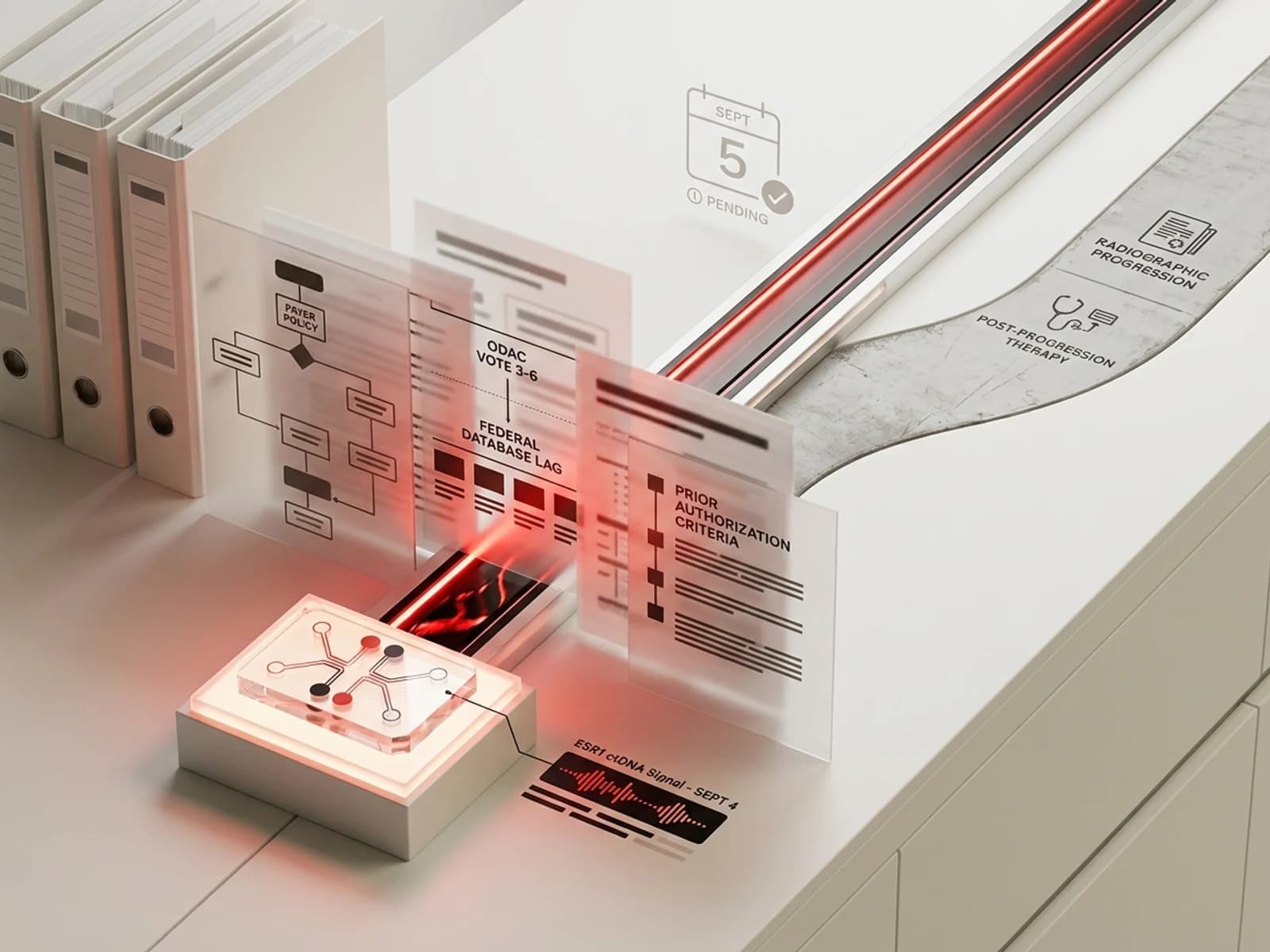
Due to monthly costs exceeding $1,000 and mandatory 24-month duration ceilings, commercial health plans and Medicaid programs implement stringent prior-authorization (PA) criteria.
Synthesizing pharmacy policy guidelines across state Medicaid formularies (Alaska Medicaid, Oregon ORPDL) and commercial plans (Mass General Brigham Health Plan), payer approval protocols enforce a strict four-stage access gate:
                      Payer Prior-Authorization Pipeline
                                       │
     ┌─────────────────────────────────┼─────────────────────────────────┐
     │                                 │                                 │
[Gate 1: Clinical Diagnosis]   [Gate 2: Generic Step]        [Gate 3: Contraindications]
     │                                 │                                 │
 Surgical laparoscopic proof   Documented failed trial        Screen for thrombotic hx,
 OR clinical diagnosis by      of combination oral            osteoporosis, pregnancy,
 OB-GYN; age >= 18 years       contraceptives or NSAIDs       or strong P-gp inhibitors
1. Diagnostic & Age Boundaries
Age Requirement: Patient must be $\ge 18$ years of age (safety and efficacy have not been established in pediatric or adolescent patients prior to epiphyseal closure).
Confirmed Diagnosis: Requires documentation of moderate-to-severe pain associated with endometriosis, confirmed either via surgical laparoscopy, pelvic ultrasound, or a formal diagnostic evaluation by a board-certified OB-GYN.
2. Mandatory Step Therapy
Payers require documented treatment failure, inadequate pain relief, or intolerable side effects from at least a 3-month trial of first-line conservative therapies:
Combination oral contraceptives (COCPs) or progestin-only therapies (medroxyprogesterone acetate, norethindrone, or levonorgestrel IUDs).
Prescription-strength Nonsteroidal Anti-inflammatory Drugs (NSAIDs) such as naproxen or ibuprofen.
Utilizing our framework for step-therapy exception evidence for specialty drugs is critical when submitting appeals for patients with contraindications to estrogen-containing contraceptives (e.g., migraine with aura, uncontrolled hypertension).
3. Contraindication Screening & Safety Checks
Prior authorization forms explicitly check for key clinical safety exclusions:
Thrombotic Risk: For Myfembree (due to its estrogen/progestin add-back component), coverage is denied if the patient has a history of deep vein thrombosis (DVT), pulmonary embolism (PE), arterial thromboembolic disease, or known thrombophilic disorders.
Bone Mineral Density Status: Known osteoporosis or severe metabolic bone disease.
Pregnancy Status: Pregnancy is an absolute contraindication for all GnRH antagonists; female patients must undergo negative pregnancy testing prior to initiation and use non-hormonal barrier contraception during treatment.
Concomitant Drug Interactions: Avoid co-administration with oral P-glycoprotein (P-gp) inhibitors (e.g., erythromycin, clarithromycin, itraconazole) which significantly increase relugolix and elagolix exposure.
4. Duration Accumulator Tracking & Reauthorization
Initial Approval: Granted for 6 months.
Reauthorization (Up to 24 Months): Requires documentation of clinical improvement in pelvic pain scores. Approval extended up to a maximum lifetime total of 24 cumulative months across all elagolix and relugolix products.
Managing out-of-pocket exposure under commercial specialty tiers often requires applying for manufacturer copay cards or submitting appeals against payer copay accumulators, as detailed in our guide to specialty-drug copay accumulator appeal workflow and our broader Parkinson's disease treatment access landscape.
Sources
U.S. Food and Drug Administration (FDA) Prescribing Information: ORILISSA (elagolix) tablets, for oral use, NDA 210450. Available at: Drugs@FDA
FDA Prescribing Information: MYFEMBREE (relugolix, estradiol, and norethindrone acetate) tablets, NDA 214846. Available at: Drugs@FDA
FDA Orange Book Database: Approved Drug Products with Therapeutic Equivalence Evaluations, Snapshot July 2026. Available at: FDA Orange Book
Centers for Medicare & Medicaid Services (CMS): National Average Drug Acquisition Cost (NADAC) Benchmark Files, July 2026. Available at: CMS Data
Alaska Department of Health & Social Services: Alaska Medicaid Prior Authorization Criteria: Orilissa, Oriahnn, and Myfembree, Coverage Policy Document. Available at: Alaska Medicaid
Mass General Brigham Health Plan: Pharmacy Coverage Guidelines: Elagolix and Relugolix Containing Products, Commercial Prior Authorization Criteria (2025–2026). Available at: Mass General Brigham
Oregon Pharmacy & Therapeutics Committee (ORPDL): GnRH Receptor Antagonist Prior Authorization Update, Meeting Records & Clinical Review. Available at: ORPDL