One infusion, three coverage decisions
When a specialty pharmacy or hospital outpatient clinic arranges to administer an infused therapy in a patient's living room, clinical access teams commonly ask a single question: Is home infusion covered by the patient's insurance? Under traditional Medicare fee-for-service, that single question is an administrative trap. Fee-for-service Medicare does not recognize a unified home infusion therapy benefit. Instead, every home infusion episode is fractured across three distinct statutory and operational coverage decisions, each governed by separate statutory authorities, billed to different claims contractors, adjudicated under incompatible coding formats, and linked by strict cross-claim timing rules.
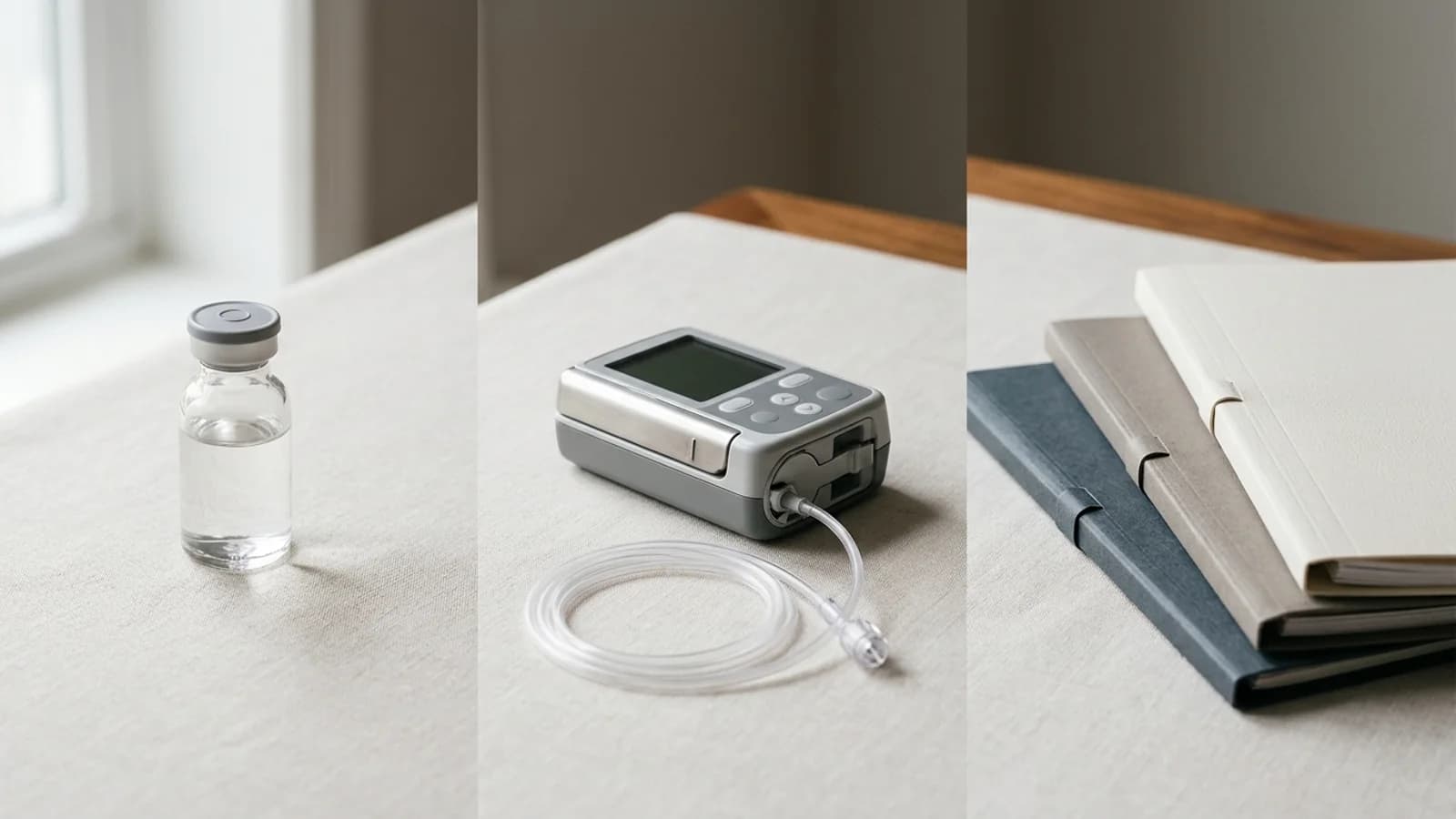
To verify and bill home infusion correctly, reimbursement teams must dissect the therapy into three discrete components:
The pump, administration supplies, and qualifying drug: Covered under the Medicare Part B Durable Medical Equipment (DME) benefit and adjudicated by regional DME Medicare Administrative Contractors (DME MACs). Only drugs explicitly specified on the CMS External Infusion Pump Local Coverage Determination (LCD L33794, revision R33 effective January 25, 2026) that require a covered external pump for administration qualify.
The nursing visit, training, and clinical monitoring: Covered under the standalone Part B Home Infusion Therapy (HIT) services benefit (enacted by Section 5012 of the 21st Century Cures Act and effective January 1, 2021). These professional services are reimbursed via bundled G-codes processed by Part A/B MACs, payable exclusively to accredited Qualified Home Infusion Therapy Suppliers (QHITS) under a signed physician plan of care.
Off-list infusion drugs and alternative nursing coverage: When a home-infused drug is not on the Medicare DME pump list, which is true for many common IV antibiotics and for many specialty biologics, the medication can route to Medicare Part D, subject to that plan's formulary. Part D does not pay for administration supplies, infusion equipment, or nursing visits. Nursing and supplies then depend on Medicare home health if the patient is eligible, an MA-PD supplemental bundle only where the plan sets $0 cost sharing, Medicaid, or other secondary coverage.
Under federal regulations (42 CFR 486.505 and 42 CFR Part 414 Subpart P), a statutory home infusion drug is narrowly defined as a parenteral drug or biological administered intravenously or subcutaneously for an administration period of 15 minutes or more in the home through an external infusion pump that meets the statutory definition of durable medical equipment. Insulin pump systems and medications placed on local Medicare Self-Administered Drug (SAD) exclusion lists are expressly excluded from this framework.
Understanding this three-bucket division is essential for access navigators. A failure to separate the medication from the pump and the nursing visit before scheduling therapy causes claim rejections, delayed starts of care, or recoupments. Commercial plans often bill with per-diem S-codes that fold routine supplies into the infusion payment, so the same three elements are not split the way fee-for-service Medicare splits them. That commercial pattern is plan-specific; it is not a substitute for the member's benefit booklet.
flowchart TD
    Prescription["Physician Orders Home Infusion"] --> CheckList{"Is drug listed on DME LCD L33794?"}

    CheckList -- "YES (Pump-List Drug)" --> PumpPath["Part B DMEPOS Pathway"]
    PumpPath --> DMEClaim["DME MAC Claim: Pump (E-code), Supplies (A-code), Drug (J-code)"]
    PumpPath --> LinkClock["30-Day Cross-Claim Synchronization Window"]
    LinkClock --> HITClaim["A/B MAC Claim: Nursing Visit (G0068-G0070 / G0088-G0090)"]

    CheckList -- "NO (Off-List / Standard Antibiotic / Biologic)" --> PartDPath["Part D Drug-Only Pathway"]
    PartDPath --> DrugClaim["Part D PDP / PBM Claim: Medication Only (Formulary / Prior Auth)"]
    PartDPath --> ExcludeWarning["Statutory Exclusion: Part D pays $0 for supplies and nursing"]
    ExcludeWarning --> NurseRouting{"Eligible for Medicare home health?"}
    NurseRouting -- "YES" --> HomeHealth["Medicare home health: nursing and supplies"]
NurseRouting -- "NO" --> Alternative["MA-PD $0 bundle, Medicaid, secondary, or self-pay"]Bucket one: the pump, the supplies, and the drug stay in the DME benefit
The foundational pillar of Medicare fee-for-service home infusion is the durable medical equipment benefit. Long before Congress created a separate services benefit in 2021, Medicare paid for select infused medications exclusively as supplies necessary for the effective use of durable medical equipment under Social Security Act section 1861(s)(6). That historical construct remains fully in force today.
Under this statutory framework, the external infusion pump, administration supplies, and the qualifying medication are billed to the regional DME MAC. The LCD covers pumps described by E0779 (ambulatory mechanical, reusable, for infusions of 8 hours or more), E0780 (ambulatory mechanical, reusable, for infusions of less than 8 hours), E0781 (ambulatory electric or battery pump worn by the patient), and E0791 (stationary parenteral infusion pump). Disposable administration sets, tubing, cassettes, needles, and dressings that are accessories to a covered pump travel with that claim. Compounding and dispensing remain DME-benefit services. They are not paid a second time under the home infusion therapy G-code. The CMS FAQ does not convert them into a separate professional dispensing fee on the nursing claim.
The covered drug roster in Policy Article A52507 is narrow. Examples that meet specified indications include continuous subcutaneous or intravenous treprostinil for pulmonary arterial hypertension, inotropes such as milrinone and dobutamine for end-stage heart failure, deferoxamine for chronic iron overload, selected chemotherapeutic agents such as fluorouracil and cladribine, continuous narcotic analgesics for intractable terminal pain, and subcutaneous immune globulin when it is on the pump list and not on a self-administered-drug exclusion list. The National Home Infusion Association reports that the Medicare DMEPOS benefit covers just over 35 DME-infused drugs, plus a limited number of parenteral-nutrition ingredients and IVIG products, against more than 300 drugs on NHIA's home infusion list. The examples above are not a substitute for the current policy article.
Disposable drug delivery systems fail the DME test. Policy Article A52507 treats A4305, A4306, and A9274 as disposable drug delivery systems, including elastomeric infusion pumps. They do not meet the definition of durable medical equipment in 42 CFR 414.202 because they cannot withstand repeated use. Drugs and supplies used with those systems are non-covered as well. If a drug that would otherwise qualify is infused through one of those disposable systems rather than a covered reusable pump, both the device and the drug are rejected. Even if milrinone or continuous chemotherapy would otherwise qualify, placing it in an elastomeric infuser destroys Part B DME coverage entirely.
When billing pump-list medications to the DME MAC, suppliers report the appropriate HCPCS J-code with the equipment and supplies. If a qualifying drug has no specific code, J7799 (not otherwise classified drugs, other than inhalation drugs, administered through DME) or J7999 (compounded drug, not otherwise classified) may be used. On the professional HIT claim, the CMS FAQ requires the drug name in the comment field: 837P data element 2400/SV101-7, or Item 19 of the CMS-1500. Confirm any extra narrative the DME MAC requires on the drug claim, including NDC detail, rather than treating brand, manufacturer, dosage, and NDC as mandatory fields on the G-code claim. Teams handling access transitions still need the dispensing pharmacy's NDC and distribution path, especially when navigating limited-distribution specialty pharmacy networks and manufacturer distribution restrictions.
Bucket two: the nursing visit is one bundled payment per day
Prior to 2021, Medicare Part B provided no explicit reimbursement mechanism for skilled nursing visits, patient training, or clinical monitoring when an infusion was delivered in the home. Home infusion pharmacies routinely subsidized visiting nursing services or partnered with home health agencies under complex contractual arrangements. Section 5012 of the 21st Century Cures Act established the standalone Part B Home Infusion Therapy services benefit, codified at 42 CFR Part 414 Subpart P, effective January 1, 2021.
The HIT services benefit reimburses professional services including skilled nursing, caregiver training and education not covered by DME, remote monitoring, and clinical coordination. Crucially, the payment unit is defined under 42 CFR 414.1550(b) as a single bundled payment per infusion drug administration calendar day for each payment category. This means payment is triggered only when an authorized representative of a qualified supplier is physically present in the patient's home on the day the infusion drug is administered.
Services are billed using specialized HCPCS G-codes structured across three distinct payment categories based on therapy complexity:
Category 1 (G0068 subsequent / G0088 initial): Covers administration of anti-infective, pain management, chelation, pulmonary hypertension, inotropic, or other intravenous infusion drugs that are home infusion drugs on LCD L33794, excluding chemotherapy and other highly complex drugs. The descriptor does not pull every IV antibiotic onto Part B. Billed under G0068 for subsequent visits and G0088 for the initial visit.
Category 2 (G0069 subsequent / G0089 initial): Covers subcutaneous infusions, including subcutaneous immunoglobulin (SCIG) and subcutaneous immunotherapy. Billed under G0069 for routine visits, and G0089 for the initial visit.
Category 3 (G0070 subsequent / G0090 initial): Covers intravenous chemotherapy, complex biologic response modifiers, and other highly complex antineoplastic agents. Billed under G0070 for routine visits, and G0090 for the initial visit.
Although suppliers must submit claims reporting 15-minute increments (to document face-to-face visit time for clinical records), Medicare's claims adjudication system pays exactly one single bundled unit per calendar day. Regardless of whether a skilled nurse spends 45 minutes or 4 hours in the residence, the payment remains identical. Under 42 CFR 414.1550(c), the statutory daily bundle is calibrated to the payment equivalent of 5 hours of physician office infusion therapy (mapping directly to physician fee schedule codes 96365 plus four units of 96366 for Category 1; 96369 plus four units of 96370 for Category 2; and 96413 plus four units of 96415 for Category 3).
The initial-visit codes G0088, G0089, and G0090 pay a higher amount for the first visit in a course of home infusion therapy. That higher amount is available only for a new patient, or after a gap of more than 60 days when the previous claim indicates discharge. Under 42 CFR 414.1550(c)(4), a later initial-visit payment requires both a gap of more than 60 days since the last home infusion therapy services claim and a patient status code showing discharge on the previous claim. CMS's June 2022 FAQ also states that an initial-visit claim is rejected if any HIT G-code is already in the beneficiary's claims history within the prior 60 days. The gap is measured in claims history, not only against the same supplier.
Medicare pays 80 percent of the lesser of the actual charge or the fee schedule amount under 42 CFR 414.1550(a). The beneficiary is responsible for 20 percent coinsurance. Medicare.gov states that the Part B deductible applies to the equipment and supplies. The annual update is the CPI-U increase minus a productivity adjustment, and that update can be negative. Change Request 14308 (Transmittal 13512, December 5, 2025) sets the final CY 2026 update at 2.0 percent: a 2.7 percent CPI-U increase minus a 0.7 percent productivity adjustment. CMS posted the CY 2026 national rates, geographic adjustment factors, and locality-adjusted initial and subsequent rates on December 2, 2025. Locality adjustment changes the dollar amount, so a national percentage is not a local allowable.
| Payment Category | Subsequent Code | Initial Visit Code | Eligible Clinical Drug Classes | Physician Office 5-Hour Benchmark | CY 2026 Payment Rule |
|---|---|---|---|---|---|
| Category 1 | G0068 | G0088 | LCD-listed IV anti-infectives, inotropes (milrinone, dobutamine), chelation (deferoxamine), pulmonary hypertension (treprostinil), and pain drugs. Not all IV antibiotics. | CPT 96365 (1 hr) + 96366 x 4 (4 hrs) | CY 2026 update 2.0%; locality GAF; one unit per infusion day; covered DME pump required; initial visit only if new or >60-day gap with discharge on the prior claim |
| Category 2 | G0069 | G0089 | Subcutaneous immunotherapy or other subcutaneous infusions on the pump list and off the SAD exclusion list. CMS added J1551 (cutaquig) to category 2. | CPT 96369 (1 hr) + 96370 x 4 (4 hrs) | CY 2026 update 2.0%; locality GAF; one unit per infusion day; covered DME pump required; initial visit only if new or >60-day gap with discharge on the prior claim |
| Category 3 | G0070 | G0090 | Intravenous chemotherapy, antineoplastics, complex biological response modifiers | CPT 96413 (1 hr) + 96415 x 4 (4 hrs) | CY 2026 update 2.0%; locality GAF; one unit per infusion day; covered DME pump required; initial visit only if new or >60-day gap with discharge on the prior claim |
The 30-day rule that links the nursing claim to the drug claim
The most technically demanding operational requirement in Medicare home infusion is the cross-claim adjudication dependency between the Part A/B MAC and the DME MAC. Because the nursing visit is processed by the local Part A/B MAC while the drug claim is adjudicated by the regional DME MAC, Medicare's Common Working File (CWF) performs an automated cross-contractor audit to ensure that Medicare does not pay for skilled nursing visits when no eligible Part B drug was administered.
Codified in the Medicare Claims Processing Manual (Publication 100-04, Chapter 20), this mechanism is known operationally as the 30-day hold-and-recycle rule. When a qualified supplier submits a professional G-code claim (G0068-G0070 or G0088-G0090) to the A/B MAC, the Common Working File looks for a claim containing the qualifying J-code on that claim or in claims history.
If the J-code is not on the same claim and is not in claims history for the prior 30 days, the A/B MAC does not deny the nursing claim immediately. Chapter 20 of the Medicare Claims Processing Manual sends it through this hold:
Automated Hold and Recycle: The professional visit claim recycles three times, with a 30-day look-back, for a total of 15 business days. The manual does not set a five-business-day interval between those recycles.
30-Day Look-Back Window: On each recycle, the CWF looks for a J-code with a date of service on the nursing visit date or up to 30 calendar days prior to the nursing visit.
Claim Denial Upon Exhaustion: After 15 business days, if no J-code claim is in claims history, the G-code claim is denied. Visits are denied when the appropriate drug for the visit is not billed. The manual does not describe this denial as an automatic beneficiary-liability event, and it does not condition payment on an Advance Beneficiary Notice.
This 30-day rule creates severe cash-flow and denial risks for access teams. If the dispensing pharmacy delays billing the DME drug claim—due to medical necessity documentation delays, missing certificate of medical necessity details, or slow NDC validation—the visiting nursing agency's claims will systematically fail in the CWF. To prevent linkage denials, suppliers must establish strict billing cadence rules: bill the drug with the visit, or no more than 30 days before the visit.
The financial consequences of documentation and linkage errors are substantial. According to CMS's 2024 Medicare Fee-for-Service Supplemental Improper Payment Data, infusion pumps and related drugs exhibited a 14.1% improper payment rate, representing approximately $89.5 million in projected improper payments. On the same MLN compliance page, insufficient documentation accounted for 72.5 percent of those improper payments. Medical necessity was 6.9 percent, incorrect coding 2.2 percent, no documentation 1.1 percent, and other errors 17.3 percent. That published split is for infusion pumps and related drugs. It does not assign the rate to cross-claim timing or to verbal eligibility checks. A missing plan of care is one documentation defect that can deny a visit; it is not, by itself, the 72.5 percent figure. Access teams still have to keep the J-code and the G-code inside the 30-day window, just as they monitor payer site-of-care steerage edits and hospital-versus-home reimbursement differentials.
Who can bill the visit: supplier, plan of care, and home health boundaries
The right to bill Medicare for home infusion therapy services is restricted by statute to enrolled, accredited entities. Under 42 CFR 486.505 and section 1861(iii)(3)(D) of the Act, only a Qualified Home Infusion Therapy Supplier (QHITS) may bill G0068-G0090 codes. To qualify, an organization must satisfy three mandatory statutory requirements:
CMS-Approved Accreditation: The supplier must be accredited by a CMS-recognized home infusion therapy accreditation organization. The Medicare Program Integrity Manual lists the Joint Commission, URAC, the Accreditation Commission for Health Care (ACHC), the Community Health Accreditation Partner (CHAP), the National Association of Boards of Pharmacy (NABP), and The Compliance Team.
Specialty D6 Enrollment: The entity must enroll as a Part B supplier under the specialized Provider Enrollment, Chain, and Ownership System (PECOS) specialty designation D6 (Home Infusion Therapy). CMS maintains a public, searchable directory of enrolled QHITS suppliers on data.cms.gov.
24/7 Service Capability: Under 42 CFR 486.505, a qualified supplier must ensure the safe and effective provision and administration of home infusion therapy on a 7-day-a-week, 24-hour-a-day basis for the period the patient is on the therapy.
The physician plan of care is a payment condition. Under 42 CFR 414.1515 and 42 CFR 486.520, and in the CMS FAQ, the beneficiary must be under the care of a physician, nurse practitioner, or physician assistant and under a physician-established plan of care. Before a HIT claim is submitted, that plan must prescribe the type, amount, and duration of the services, including monitoring; the specific medication, dosage, and frequency; and the professional services to be furnished. Orders must specify how often services are furnished and which discipline furnishes them. Pump settings belong in the equipment record. They are not an extra element the FAQ adds to the plan-of-care list.
Home infusion therapy services and home health services are not interchangeable. Effective January 1, 2021, the Cures Act excluded home infusion therapy services from the Medicare home health benefit.
This means that if a Medicare beneficiary is receiving home health care under a 30-day home health period, a nurse visit conducted solely to administer a covered home infusion drug cannot be billed under the home health benefit or folded into the home health payment. That visit is billed under the HIT services benefit by an enrolled qualified supplier. If the home health agency is not enrolled as a qualified supplier, it cannot bill that exclusive administration visit under either benefit. It must tell the beneficiary that the service is no longer covered as home health and offer care from a qualified supplier. A visit unrelated to administering the home infusion drug stays on the home health claim. Administration of a drug that is not a home infusion drug can also remain under home health when the patient is eligible for that benefit.
When the drug is not on the pump list: Part D pays the drug and nothing else
The most frequent coverage crisis encountered by specialty access navigators occurs when a patient requires home infusion of a drug that is not on LCD L33794. This applies to the vast majority of outpatient parenteral antimicrobial therapies (such as IV vancomycin, daptomycin, ceftriaxone, or ertapenem) as well as numerous infused specialty biologics that are administered via gravity drip, IV push, or non-covered disposable infusers.
When an infused medication does not qualify under the Part B DME pump benefit, coverage shifts to Medicare Part D. Chapter 6 of the Medicare Prescription Drug Benefit Manual limits Part B home coverage to drugs that require an infusion pump and are on the DME MAC local coverage policy. Agents given at home by IV drip or push fall under Part D, including some drugs that would be Part B only when given through a covered pump. Part D coverage of the drug still follows the plan formulary, tier, and any prior authorization. The same chapter then draws a hard line on everything around the drug:
Professional services and supplies for administering the infused drug are not payable under Part D. Section 10.12 of that manual states that the services and supplies necessary for home infusion are never covered under Part D. Part D can pay for the drug. It does not pay for the infusion pump, IV tubing, catheter flushes, dressing kits, or the skilled nurse who administers the drug.
This creates an acute financial and logistical coverage void for traditional Medicare beneficiaries. When an off-list drug is routed through Part D, the patient and care team must identify an alternative mechanism to fund the nursing visits and administration supplies:
The Part A Homebound Pathway: If the patient is certified homebound, needs intermittent skilled nursing, and otherwise qualifies for Medicare home health, a home health agency can furnish the nursing visits for a drug that is not a home infusion drug, while the pharmacy bills the drug to Part D. Homebound status alone does not open the benefit. CMS describes this path as the Part A home health benefit in the HIT FAQ; beneficiaries who qualify for home health under Part B follow that program's rules instead.
Medicare Advantage Supplemental Benefits: Medicare Advantage plans must still cover the Part B home infusion therapy benefit for pump-list drugs, because that benefit is a Part B service. For drugs that are Part D home infusion drugs, an MA-PD sponsor may instead bundle a particular drug with administration and supplies as a mandatory supplemental benefit under Part C. Chapter 6, section 10.12, conditions the waiver that allows that bundle on zero cost sharing. The plan must show $0 cost sharing for the bundle on its plan benefit package. Reduced cost sharing does not meet that waiver. In a given contract year the sponsor must apply the choice consistently for that drug, either always under the Part C bundle or always under Part D.
Out-of-Pocket or Secondary Commercial Coverage: If a fee-for-service beneficiary is not eligible for home health (for example, an ambulatory patient who can leave home and needs weeks of daily IV antibiotics that are not on the pump list), Medicare does not pay for the nurse or the supplies. The Part D manual points to Medicaid or secondary commercial coverage as other possible sources. Otherwise the patient pays the nursing and supply charges or receives the doses in a hospital outpatient department or infusion suite. This is a coverage gap, not a quote of a national nursing per-diem rate.
Access teams coordinating complex care transitions must verify the patient's homebound status and plan design weeks before discharge. Navigators must avoid assuming that obtaining a Part D prior authorization approval implies that the patient's home infusion is fully funded. Teams frequently encounter similar coordination barriers when evaluating medical versus pharmacy benefit verification and analyzing whether to route high-cost therapies through white bagging versus buy-and-bill dispensing channels.
The home IVIG exception
For years, intravenous immune globulin (IVIG) administered in the home represented one of the most frustrating statutory anomalies in Medicare reimbursement. Under Section 1861(s)(2)(Z) of the Social Security Act, Medicare Part B covered the IVIG drug itself for patients diagnosed with primary immune deficiency disease (PIDD). However, the statute explicitly omitted coverage for the infusion pump, supplies, and nursing services required to infuse it in the home.
Before the permanent items-and-services benefit, beneficiaries who needed home IVIG for primary immune deficiency often paid out of pocket for nursing and supplies, switched to a subcutaneous product, or traveled to an outpatient infusion suite. Congress used the temporary Medicare IVIG Demonstration, beginning in 2014 and later extended, to pay for those items and services. Permanent fee-for-service coverage of the administration items and services was still absent.
That statutory gap was permanently closed by Section 4134 of the Consolidated Appropriations Act (CAA), 2023. Amending section 1861(s)(2)(Z), Section 4134 established permanent Medicare Part B coverage for items and services furnished on or after January 1, 2024, in connection with the administration of in-home IVIG for beneficiaries with primary immune deficiency diseases.
Under this permanent benefit, items and services—including tubing, infusion supplies, catheter maintenance, and nursing administration—are paid through a dedicated Part B payment rate for beneficiaries who meet DME MAC LCD L33610 (Intravenous Immune Globulin) coverage criteria. CMS posted the finalized CY 2026 National Home IVIG Items and Services payment rate on November 28, 2025. As a result, in-home IVIG for primary immunodeficiency now represents the rare clinical exception where both the drug and the comprehensive in-home administration services travel together under a unified Part B reimbursement pathway.
What one commercial policy bundles into the per diem
Commercial plans do not use the Medicare contractor split. Many bill home infusion with HCPCS per-diem S-codes, and the National Home Infusion Association describes that as the usual commercial pattern. A per diem is still a contract and a medical policy, not a promise that every plan bundles drug, pump, supplies, and nursing the same way. The worked contrast below is one published policy, Blue Cross and Blue Shield of North Carolina's Infusion Therapy in the Home, last reviewed February 2026, with a coding update dated March 11, 2026.
The published policy used here is Blue Cross and Blue Shield of North Carolina's Infusion Therapy in the Home. Policy guidelines say home infusion therapy includes all of the components related to the therapy, such as, but not limited to, the items below. The policy does not name cleanroom operations, cold-chain transport, or personal protective equipment:
Nursing services
Durable medical equipment
Supplies
Prescription and non-prescription legend drugs and solutions
Pharmacy compounding and dispensing
Specimen collection
Patient and family education
Delivery of drugs and supplies
Management of emergencies arising from the therapy
Blue Cross NC's billing section lists CPT 99506, 99601, and 99602 together with per-diem S-codes. Examples that remain on the March 11, 2026 code list include S9338 (immunotherapy), S9348 (parenteral nutrition), and S9500 (antibiotic therapy). That update removed S5035, S5036, and S5518. The policy says inclusion of a code does not guarantee reimbursement. Routine supplies included in the infusion reimbursement are gauze, infusion sets, needles, cassettes, tape, cleansing solutions, heparin and saline flushes, diluents, and splints.
On this policy, line-maintenance heparin and other anticoagulants are part of the home infusion service and are not paid again. IV hydration given as part of a continuous IV drug is also treated as integral to that drug. Catheter care may be reported separately when it is stand-alone therapy or on days not covered under a per diem for another therapy. PICC line care is allowed as a separate charge only if there was no other therapy in the home in the last 30 days. The policy does not create a separate declotting or catheter-repair rule. It also sets nursing-visit limits, such as a training visit plus a weekly hour cap for some therapies and daily RN visits of up to two hours for IV dobutamine, so the per diem is not unlimited nursing. Pumps may be considered medically necessary for named drugs that include vancomycin. That commercial list does not place vancomycin on Medicare LCD L33794.
| Therapy Element | Medicare FFS Benefit | Billing Contractor | Primary HCPCS/CPT Codes | Controlling Authority / Policy | Key Verification Requirement |
|---|---|---|---|---|---|
| Home Infusion Drug (Pump-List) | Part B DME | DME MAC (Jurisdiction A/B/C/D) | LCD-listed J-codes; J7799 or J7999 if no specific code | LCD L33794 / Policy Article A52507 | Must be listed on LCD; NDC and drug name in narrative if NOC code |
| External Infusion Pump | Part B DME | DME MAC | HCPCS E0779, E0780, E0781, E0791 | 42 CFR 414.202 / LCD L33794 | Must be durable reusable device; disposable/elastomeric pumps non-covered |
| Infusion Administration Supplies | Part B DME | DME MAC | HCPCS A-codes (cassettes, tubing sets, dressings) | LCD L33794 | Reimbursed only as accessory to a covered durable pump |
| Pharmacy Compounding & Dispensing | Part B DME | DME MAC | Stays in the DME benefit; not paid again on the G-code | CMS HIT FAQs (June 2022) | Confirm the DME drug payment file; do not add a professional dispensing line to the HIT claim |
| Skilled Nursing Visit | Part B HIT Services | Part A/B MAC | HCPCS G0068-G0070 (subsequent) / G0088-G0090 (initial) | 42 CFR 414 Subpart P / 42 CFR 486 Subpart I | Accredited QHITS, Specialty D6; signed plan of care; 30-day cross-claim match |
| Patient Education & Training | Part B HIT Services | Part A/B MAC | Bundled into daily G-code (G0088-G0090 initial visit) | 42 CFR 414.1550(b) | Paid only on calendar days clinician is physically in home |
| Remote Patient Monitoring | Part B HIT Services | Part A/B MAC | Bundled into daily G-code | 42 CFR 486.525 | Cannot be billed separately on non-visit days; bundled into visit rate |
| Off-List Infusion Drug (e.g. Antibiotics) | Part D (Drug Only) | Part D Plan Sponsor / PBM | Standard Pharmacy NDC Billing | Medicare Prescription Drug Benefit Manual Ch. 6 | Part D pays $0 for supplies and nursing; requires HHA homebound or MA coverage |
A worked verification record
Before the first home infusion visit, access teams need a source-documented check of the drug list, the pump, the supplier, the plan of care, and the cross-claim clock. A verbal eligibility statement or a pharmacy eligibility ping does not answer those questions. It is also not the cause of the 14.1 percent improper-payment rate for infusion pumps and related drugs. That rate is a DME program-integrity statistic, and insufficient documentation is the largest published share of it.
The following worked verification record illustrates the five sequential compliance gates required before initiating home infusion for a Medicare fee-for-service beneficiary, contrasted with commercial per-diem validation:
Step 1: Drug List and Pump Verification (The Binary Gate): Obtain the prescription, HCPCS code, and NDC. Read LCD L33794 and Policy Article A52507 at revision R33, effective January 25, 2026, and confirm both the drug and the indication. Continuous milrinone or treprostinil can stay on the Part B path only when the indication matches the LCD. Daptomycin or vancomycin, which are not pump-list drugs, leave the Part B HIT path: the drug is a Part D question, and nursing depends on home health eligibility or another non-Part-B source. Do not treat a Blue Cross NC pump example for vancomycin as a Medicare listing.
Step 2: Delivery Hardware Qualification: Verify the device. A Part B DME external pump claim uses a covered reusable pump: E0779, E0780, E0781, or E0791. The span E0779-E0791 is not a safe shorthand, because codes inside that numeric span include implantable pumps and the external insulin pump, which are outside this benefit. Do not bill a disposable drug delivery system, A4305, A4306, or A9274, as the pump. Covered administration cassettes are supplies to a durable pump; they are not themselves the DME.
Step 3: Supplier Enrollment and Accreditation Audit: Look up the visiting provider in the CMS home infusion therapy supplier directory on data.cms.gov. Confirm active accreditation from a CMS-recognized organization, including the Joint Commission, URAC, ACHC, CHAP, NABP, or The Compliance Team, and active Medicare enrollment under specialty D6. A home health agency without that enrollment cannot bill the HIT visit. For a visit that is only administration of a home infusion drug, the agency must notify the beneficiary and offer an enrolled supplier.
Step 4: Physician Plan of Care Execution: Obtain a physician-established plan of care that is signed and dated before the HIT claim is submitted, and signed again if the plan changes. It must prescribe the type, amount, and duration of services, the medication, dosage, and frequency, and the professional services and discipline. The 15-minute threshold is part of the definition of a home infusion drug, not a sentence the plan of care has to recite. The ordering physician must consult the DME supplier and the HIT supplier. Getting the signature before the first visit is an operational precaution. The regulatory deadline is before claim submission.
Step 5: Cross-Claim Synchronization and 30-Day Clock Management: Establish an automated tracking alert between the dispensing pharmacy and the nursing billing team. The pharmacy must submit its Part B DME drug claim (J-code) and equipment claim (E-code) to the DME MAC simultaneously with medication delivery. The nursing agency must confirm that the drug claim has posted to the Common Working File before releasing its G-code visit claim, ensuring the visit date is within 30 days of the drug date of service.
| Verification Gate | Controlling Document | Responsible Entity | Verification Action Before Day 1 | Failure Risk / Audit Consequence |
|---|---|---|---|---|
| 1. Formulary / LCD List Check | LCD L33794 & Policy Article A52507 | Specialty Hub / Intake Coordinator | Verify drug and diagnosis match LCD list; identify Part B vs Part D route | Total claim denial; drug unbillable under Part B; patient unexpected out-of-pocket |
| 2. Infusion Hardware Check | 42 CFR 414.202 (DME definition) | Dispensing Pharmacy / DME Coordinator | Covered reusable pump E0779, E0780, E0781, or E0791; reject A4305, A4306, and A9274 | DME MAC denies entire equipment and drug claim as non-covered disposable system |
| 3. Supplier Credentialing Check | CMS QHITS Directory (data.cms.gov) | Nursing Agency Billing Office | Verify active accreditation and PECOS Specialty D6 provider enrollment | Part A/B MAC rejects G0068-G0070 claims; supplier cannot bill Medicare |
| 4. Plan of Care Signature Check | 42 CFR 414.1515 & 486.520 | Ordering Physician & HIT Supplier | Confirm physician signature and date on Plan of Care prior to claim submission | Unsigned plan fails 42 CFR 414.1515; insufficient documentation is 72.5% of the pump improper-payment rate |
| 5. 30-Day Cross-Claim Match | Medicare Claims Processing Manual Ch. 20 | Revenue Cycle Management | Synchronize DME MAC J-code submission; bill G-code within 30 days of drug date | CWF holds claim 15 business days and denies G-code for missing J-code link |
These five checks follow the documents that actually decide a fee-for-service home infusion claim: the pump-list LCD, the DME definition, supplier enrollment, the signed plan of care, and the 30-day J-code link. They do not promise coverage, a paid claim, or an uninterrupted start of care. Commercial per-diem policies, including the Blue Cross NC example, still have to be read from the member's own booklet.
Sources
Home Infusion Therapy Services, Equipment & Supplies — Centers for Medicare & Medicaid Services (Medicare.gov consumer coverage guidance).
Home Infusion Therapy / Home IVIG Services — Centers for Medicare & Medicaid Services fee-for-service provider payment overview and monitoring reports.
Home Infusion Therapy Services Benefit Beginning 2021, Frequently Asked Questions — Centers for Medicare & Medicaid Services (comprehensive supplier billing and coverage FAQ).
42 CFR Part 414 Subpart P — Home Infusion Therapy Services Payment — Electronic Code of Federal Regulations, payment methodology, calendar day definition, and payment categories.
42 CFR Part 486 Subpart I — Requirements for Home Infusion Therapy Suppliers — Electronic Code of Federal Regulations, health and safety standards, accreditation, and plan of care rules.
Home Infusion Therapy Billing and Rates — Centers for Medicare & Medicaid Services, CY 2026 HIT national fee schedule files, GAFs, and Home IVIG payment rates.
Medicare Claims Processing Manual, Chapter 20 — Durable Medical Equipment, Prosthetics, Orthotics, and Supplies (DMEPOS) — Centers for Medicare & Medicaid Services, instructions on cross-claim matching and the 30-day recycling hold.
Home Infusion Therapy Legislation — Centers for Medicare & Medicaid Services, statutory summaries of 21st Century Cures Act Section 5012 and Consolidated Appropriations Act, 2023 Section 4134.
Local Coverage Determination (LCD) L33794 — External Infusion Pumps — CMS Medicare Coverage Database, DME MACs (revision R33 effective January 25, 2026, and companion Policy Article A52507).
MLN Provider Compliance Tips: Infusion Pumps & Related Drugs — Medicare Learning Network, CMS, analysis of improper payment findings and clinical documentation compliance.
Home Infusion Therapy (HIT) — Noridian Healthcare Solutions, Medicare Part B Jurisdiction JF operational billing guidelines and code schedules.
DME MAC Jurisdiction C Supplier Manual — CGS Administrators, Spring 2025 edition, operational guidance on DME pump and supply billing.
Medicare Prescription Drug Benefit Manual, Chapter 6 — Part D Drugs Covered Under Part B or Part D — Centers for Medicare & Medicaid Services, statutory boundaries of Part D and exclusion of supplies and administration.
Infusion Therapy in the Home Provider Policy — Blue Cross and Blue Shield of North Carolina, commercial per-diem S-code bundling rules and catheter care coverage criteria.
Medicare Coverage for Home Infusion — National Home Infusion Association, industry analysis of DMEPOS coverage limitations and fragmented FFS payment structures.
Reimbursement Considerations for Home Infusions and Injections — Xcenda / AmerisourceBergen white paper on multi-benefit reimbursement routing and cross-claim timing.
CY 2026 Home Infusion Therapy Services Payment Rates Transmittal — AAPC reproduction of CMS transmittal confirming the 2.0% CY 2026 payment rate update.