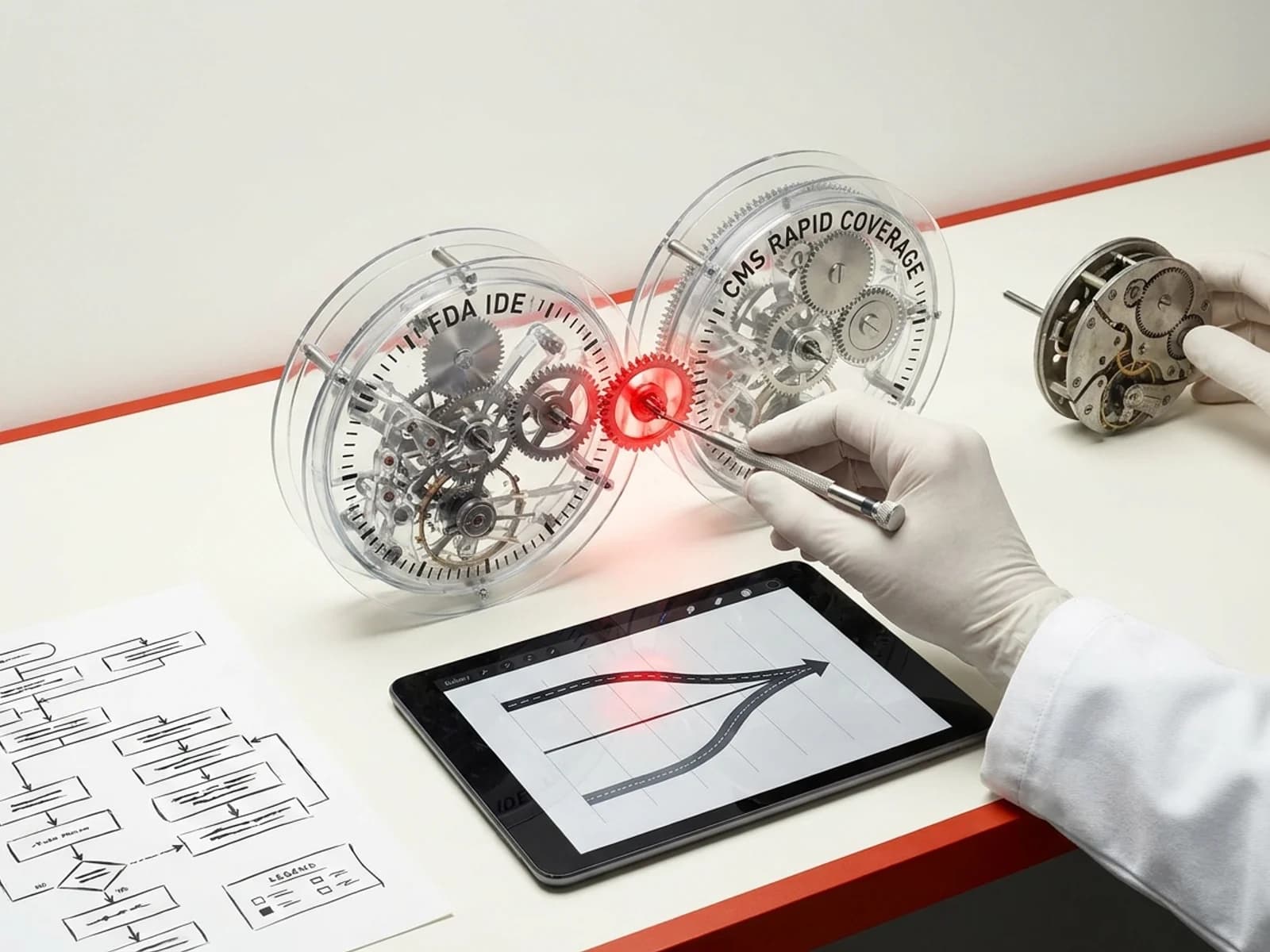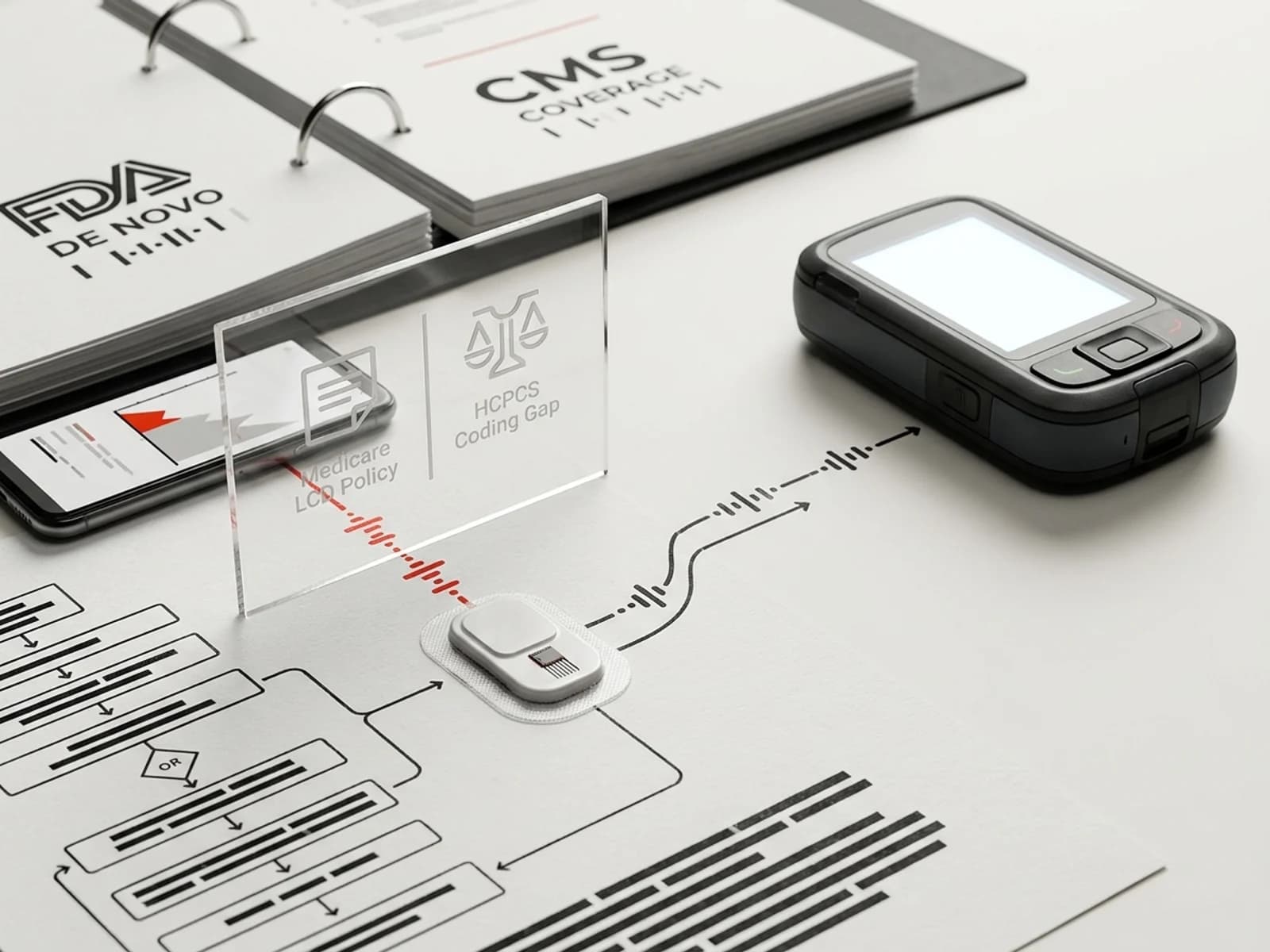
On August 25, 2026, the U.S. Food and Drug Administration (FDA) granted marketing authorization for the Libre Duo 10 Day Continuous Dual Glucose Ketone Monitoring System (Abbott Diabetes Care), the first wearable sensor in the United States that continuously monitors ketone levels and the first in the world, according to FDA, to measure both glucose and ketone concentrations in a single wearable device. The action used the De Novo classification pathway after Breakthrough Device designation and was tied by the agency to its Home as a Health Care Hub Initiative.
For durable medical equipment (DME) Medicare Administrative Contractors (MACs), commercial health plan medical directors, diabetes specialty pharmacies, and endocrinology access teams, this device introduces a novel clinical diagnostic modality. However, translating this regulatory milestone into covered reimbursement requires navigating the strict boundaries of Medicare DME policy and Healthcare Common Procedure Coding System (HCPCS) definitions:
Does FDA De Novo marketing authorization automatically create Medicare DME coverage under existing continuous glucose monitor (CGM) codes, is continuous ketone tracking covered under HCPCS A4239, and can suppliers bill Medicare for smartphone-only sensor use?
The direct operational answers establish critical boundaries for reimbursement, coding, and clinical documentation:
De Novo authorization is not a Medicare coverage determination. FDA marketing authorization under Section 513(f)(2) of the Federal Food, Drug, and Cosmetic Act (FD&C Act) confirms reasonable assurance of safety and effectiveness, establishing a new device type and special controls (integrated continuous glucose and ketone monitoring, or iCGK). It does not create a National Coverage Determination (NCD), does not modify Local Coverage Determinations (LCDs), and does not guarantee insurance payment.
Medicare DME coverage requires meeting all LCD L33822 criteria. Under CMS LCD L33822 (Glucose Monitors), a continuous monitor and its monthly supply allowance are covered only when initial criteria (1) through (5) are documented: a diagnosis of diabetes mellitus, sufficient training evidenced by a prescription, use in accordance with FDA indications, insulin treatment or documented problematic hypoglycemia, and a treating-practitioner visit within six months before the order.
No dedicated HCPCS code exists for continuous ketone monitoring. Incumbent CGM codes—durable receivers (E2102, E2103) and monthly non-adjunctive supply allowances (A4238, A4239)—were created and priced exclusively for continuous glucose monitoring. Continuous ketone sensing is not an established benefit feature within A4239.
Standalone smartphone displays fail the statutory DME definition. Policy Article A52464 states that CGM devices that solely display results on a smartphone and do not have a stand-alone receiver or integration into an insulin infusion pump do not meet the definition of DME. A supply allowance (A4238 or A4239) is available when the beneficiary uses a stand-alone receiver or insulin pump classified as DME, including when a phone or watch is used in conjunction with that durable display. FDA’s August 25 press announcement describes Libre Duo readings as sent wirelessly to a compatible smartphone.
Federal registry databases reflect expected post-authorization lag. As of August 30, 2026, live queries to openFDA device endpoints return zero results for brand name "Libre Duo" in the Global Unique Device Identification Database (GUDID), zero 510(k) clearances, and zero Premarket Approvals (PMAs). DME compliance auditors must reject unrelated 510(k) records for surgical illumination systems or legacy devices sharing the "Duo" name.
LIBRE DUO 10 DAY REGULATORY & DME REIMBURSEMENT SCORECARD
| Dimension / Parameter | Regulatory Fact / Reimbursement Status |
|---|---|
| FDA Action Date | August 25, 2026 (De Novo Marketing Authorization) |
| Regulatory Pathway | De Novo Classification Request (Section 513(f)(2)); Class II |
| Special Designations | Breakthrough Device Designation; Home as a Health Care Hub Initiative |
| Special Controls | iCGM Standard + New iCGK (Integrated Dual Glucose-Ketone) Standard |
| Clinical Trial Program | 6 clinical studies; >600 participants (pediatric & adult); 10-day wear |
| Target Population | Individuals aged 2 years and older living with diabetes |
| CMS DME Policy Matrix | LCD L33822 & Policy Article A52464 (Glucose Monitors) |
| Governing HCPCS Codes | Receivers: E2102, E2103 | Supply Allowance: A4238, A4239 |
| Ketone Coding Status | NO dedicated HCPCS code for continuous ketone supplies (Gap) |
| Display Hardware Rule | Requires durable receiver (E2102/E2103); smartphone-only fails DME |
| Registry Status | openFDA UDI / 510(k) / PMA queries return 0 hits on 2026-08-30 (lag) |
What Did FDA Authorize on August 25: De Novo vs. 510(k) Line Extension
A common error across trade press coverage is describing Libre Duo as an "FDA approval" (PMA) or a standard "510(k) clearance" of the FreeStyle Libre 3 sensor.
1. The De Novo Classification Mechanism
Unlike the FreeStyle Libre 2 and Libre 3 sensors, which were cleared under Section 510(k) by demonstrating substantial equivalence to predicate continuous glucose monitors, continuous ketone monitoring had no legally marketed predicate device in the United States.
Under Section 513(f)(2) of the Federal Food, Drug, and Cosmetic Act, novel medical devices of low-to-moderate risk that lack a predicate are automatically categorized into Class III by default. The sponsor submits a De Novo classification request seeking reclassification into Class II with special controls. FDA's August 25 authorization:
Grants marketing authorization for the Libre Duo 10 Day Continuous Dual Glucose Ketone Monitoring System.
Establishes a new device classification regulation under Title 21 of the Code of Federal Regulations and creates a dedicated product code.
Establishes special controls combining the integrated continuous glucose monitoring (iCGM) standard with the new integrated continuous glucose and ketone monitoring (iCGK) standard.
FDA DEVICE REGULATORY PATHWAY COMPARISON
| Device / System | Regulatory Path | Classification | Predicate / Standard |
|---|---|---|---|
| FreeStyle Libre 3 (Glucose Only) | 510(k) Clearance (Premarket Notif) | Class II (21 CFR § 862.1355) | Substantial Equivalence to FreeStyle Libre 2 / iCGM std |
| Libre Duo 10 Day (Glucose + Ketone) | De Novo Request (Sec. 513(f)(2)) | Class II (New Reg & Product Code) | Novel Dual Sensor; Breakthrough Device; New iCGK Standard |
| Class III PMA (e.g. Total Artif.) | Premarket Approval (Section 515) | Class III | High-risk life-sustaining/life- supporting; full safety review |
2. The Clinical Evidence Base and Analytical Performance
FDA's authorization was supported by six clinical studies that together enrolled more than 600 participants aged 2 years and older. FDA states the results showed the device accurately tracked clinically meaningful differences in ketone levels across its 10-day wear period, including identifying elevated ketone levels before the onset of diabetic ketoacidosis. That is FDA press language about analytical performance, not a treatment protocol.
Abbott confirmed that Libre Duo integrates with the latest-generation U.S. Libre mobile application, LibreView cloud reporting, and LibreLinkUp caregiver sharing, with commercial rollout scheduled for later in 2026. Trade reports citing planned automated insulin delivery (AID) integrations—such as Beta Bionics iLet, Sequel twiist, Insulet Omnipod, and Tandem Control-IQ—represent manufacturer commercial roadmaps, not labeled device integrations authorized in the initial De Novo package.
What FDA’s Special Controls Actually Establish (and What the IFU Has Not Yet Shown)
The establishment of integrated continuous glucose and ketone monitoring (iCGK) special controls is the regulatory architecture of the De Novo decision. FDA’s press announcement states that, along with the authorization, the agency is establishing special controls that define requirements including those related to labeling and performance testing. When met, those special controls plus general controls provide reasonable assurance of safety and effectiveness.
Abbott states that Libre Duo is the first system to meet both the existing iCGM special-control standard and the new iCGK standard. That is a company characterization of the authorization, not a published decision-summary table of alarm set-points.
What the FDA press does support, and what matters for DME:
The device continuously measures ketone and glucose in interstitial fluid, with readings sent wirelessly to a compatible smartphone every minute.
It can send automatic alerts if ketone levels reach a concerning threshold. FDA does not publish those thresholds in the press announcement.
“Ketone information should always be interpreted in the context of glucose readings and symptoms.”
Until CDRH posts the De Novo decision summary, DEN number, and Instructions for Use, coverage dossiers should not invent enzymatic electrode chemistry, equilibration lag times, or specific mmol/L alarm ladders from trade recaps. Those details belong as labeled limitations once the IFU is public.
CMS LCD L33822 Criteria: Why FDA Authorization Does Not Equal DME Coverage
In durable medical equipment reimbursement, the primary operational rule is that FDA marketing authorization is a necessary condition for coverage, but never a sufficient one.
┌──────────────────────────────────────────────────────────────────────────────────────────────────┐
│                   MEDICARE LCD L33822 CGM COVERAGE DOCUMENTATION WORKFLOW                        │
├──────────────────────────────────────────────────────────────────────────────────────────────────┤
│                                                                                                  │
│                    [ Beneficiary with Diabetes Mellitus ]                                        │
│                                      │                                                           │
│                                      ▼                                                           │
│                    [ Criterion 1: Documented Diagnosis ]                                         │
│                                      │                                                           │
│                                      ▼                                                           │
│                    [ Criterion 2: Sufficient Training ]                                          │
│                    (Evidenced by providing a prescription)                                       │
│                                      │                                                           │
│                                      ▼                                                           │
│                    [ Criterion 3: FDA Indication Match ]                                         │
│                    (Prescribed per Labeled Indications)                                          │
│                                      │                                                           │
│                                      ▼                                                           │
│                    [ Criterion 4: Clinical Severity Gate ]                                       │
│                                      │                                                           │
│                  ┌───────────────────┴───────────────────┐                                       │
│                  ▼                                       ▼                                       │
│     [ Insulin-Treated Patient ]            [ Non-Insulin Problematic Hypoglycemia ]              │
│     (Any insulin regimen)                  • Recurrent Level 2 (<54 mg/dL) despite               │
│                  │                           multiple treatment adjustments; OR                  │
│                  │                         • ≥1 Level 3 event (altered mental/physical           │
│                  │                           state requiring third-party assistance)             │
│                  │                                       │                                       │
│                  └───────────────────┬───────────────────┘                                       │
│                                      │                                                           │
│                                      ▼                                                           │
│                    [ Criterion 5: In-Person/Telehealth Visit ]                                   │
│                    (Within 6 Months Prior to Initial Order)                                      │
│                                      │                                                           │
│                                      ▼                                                           │
│                    [ Approved for DME CGM Reimbursement ]                                        │
│                                                                                                  │
└──────────────────────────────────────────────────────────────────────────────────────────────────┘
The Five Mandatory Coverage Criteria
Under LCD L33822, DME MACs (Noridian Healthcare Solutions and CGS Administrators) provide coverage for therapeutic continuous monitors and related supply allowances only when the medical record establishes that all five criteria are satisfied:
Diagnosis: The beneficiary has diabetes mellitus (LCD text points to the ICD-10 list in related Policy Article A52464).
Training: The treating practitioner has concluded that the beneficiary (or caregiver) has sufficient training using the prescribed CGM, evidenced by providing a prescription.
FDA Indication: The CGM is prescribed in accordance with its FDA indications for use.
Clinical Severity: The beneficiary meets at least one of two clinical thresholds:
Is insulin-treated; OR
Has a history of problematic hypoglycemia, documented as recurrent (more than one) level 2 events (glucose <54 mg/dL [3.0 mmol/L]) that persist despite multiple attempts to adjust medications and/or modify the diabetes treatment plan, or a history of one level 3 event (glucose <54 mg/dL) characterized by altered mental and/or physical state requiring third-party assistance.
Clinical Evaluation: Within six months prior to ordering the CGM, the treating practitioner has an in-person or Medicare-approved telehealth visit with the beneficiary to evaluate diabetes control and determine that criteria (1)-(4) are met.
While Libre Duo satisfies Criterion 3 for individuals aged 2 and older with diabetes, the addition of continuous ketone sensing does not bypass the insulin or problematic hypoglycemia documentation requirements of Criterion 4. Patients managed exclusively on non-insulin oral agents who do not experience severe hypoglycemia remain ineligible for Medicare DME coverage.
HCPCS Coding Gaps: A4238, A4239, and the Smartphone Display Rule
Specialty pharmacy billing departments and DME suppliers face significant billing compliance friction when processing dual-analyte wearables under current HCPCS definitions.
1. The Existing CGM HCPCS Coding Structure
The Centers for Medicare & Medicaid Services maintains four primary HCPCS codes for continuous glucose monitors:
E2103: Non-adjunctive continuous glucose monitor, durable receiver.
A4239: Supply allowance for non-adjunctive continuous glucose monitor, includes all supplies and accessories, 1 month supply = 1 unit of service.
E2102: Adjunctive continuous glucose monitor, durable receiver.
A4238: Supply allowance for adjunctive continuous glucose monitor, 1 month supply = 1 unit of service.
Crucially, code A4239 was created and fee-scheduled solely for interstitial glucose sensing. There is no modifier, add-on HCPCS code, or separate DME fee schedule allowance for continuous ketone sensor supplies. Suppliers that bill A4239 for Libre Duo are billing a glucose-calibrated monthly fee schedule that does not account for dual-analyte manufacturing economics.
DME DISPLAY HARDWARE COMPLIANCE MATRIX
| Hardware Configuration | Statutory Benefit Status | Reimbursement & Audit Risk |
|---|---|---|
| Dedicated DME Receiver (E2103 Standalone) | Fully eligible for Medicare DME reimbursement (E2103 + Monthly A4239 Allowance) | Compliant under Social Security Act § 1861(n); meets LCD L33822 and Policy Article A52464 requirements. |
| Dedicated Receiver + Smartphone Mirroring | Fully eligible for Medicare DME reimbursement | Compliant; smartphone serves as non-DME secondary display. |
| Smartphone-ONLY (No Dedicated Receiver Billed or Dispensed) | INELIGIBLE for Medicare DME reimbursement under A4239 | High Audit Risk: Standalone smartphones are non-DME items; supply allowance cannot be billed without durable base. |
2. The Smartphone-Only Display Restriction
Policy Article A52464 states:
"CGM devices that solely display results on a smartphone and do not have a stand-alone receiver or integration into an insulin infusion pump do not meet the definition of DME and will be denied as non-covered (no benefit)."
The same article allows the supply allowance when a non-DME device (watch, smartphone, tablet, laptop) is used in conjunction with a durable CGM receiver (E2102 or E2103) or an insulin pump classified as DME. If a beneficiary never uses a DME receiver or insulin pump to display CGM data, the supply allowance is not covered.
That collision is sharper for Libre Duo because FDA’s August 25 press announcement describes readings as sent to a compatible smartphone. Until Abbott’s commercial configuration and PDAC Product Classification List (PCL) listing are public, suppliers should not assume a phone-only launch configuration is a covered DME CGM.
LCD L33822 also requires that devices billed as E2103 (and, from July 1, 2022, E2102) appear on the PDAC PCL for that code. A newly authorized De Novo system will not be payable as E2103 merely because it meets iCGM performance language in a press release.
Pharmacy Benefit vs. Medical DME Adjudication Channels
Access teams must evaluate the two distinct distribution and adjudication channels for Libre Duo, as commercial payers and Medicare Advantage plans frequently route sensor reimbursement through pharmacy benefit managers (PBMs) rather than traditional DME suppliers:
PHARMACY BENEFIT VS. DME ADJUDICATION CHANNEL COMPARISON
| Channel Attribute | Retail / Specialty Pharmacy | Durable Medical Equipment (DME) Supplier |
|---|---|---|
| Billing Standard | NCPDP Telecommunication D.0 | ANSI ASC X12N 837P Professional / CMS1500 |
| Primary Identifier | National Drug Code (11-digit) | HCPCS Level II Code (A4239, E2103) |
| Adjudication Speed | Real-time electronic point-of-sale | Post-service claims processing (14–30d) |
| Prior Authorization | PBM electronic PA (ePA / CoverMyMeds) | DME MAC Certificate of Medical Necessity |
| Copay Mechanics | Fixed tier copay / Coinsurance; | Part B 20% coinsurance (after deductible) |
| Manufacturer copay cards apply | Supplemental / Medigap insurance covers | |
| Hardware Base Rule | Does not require durable base | Strictly requires durable receiver E2103 |
| Audit Risk Focus | Refill timing, day-supply limits | Chart notes within 6m, insulin dosing log |
1. Pharmacy Benefit Point-of-Sale Routing
For commercially insured patients, the vast majority of continuous sensor claims are adjudicated at retail or mail-order pharmacies using National Drug Codes (NDCs) under NCPDP standards. In this channel:
Claims adjudicate in real time against formulary tier placement.
Commercial manufacturer copay assistance programs can reduce out-of-pocket costs for eligible commercially insured patients.
Patients are not required to obtain a physical standalone receiver if their health plan covers the sensor as a pharmacy benefit item.
2. DME Channel Requirements
For Medicare fee-for-service beneficiaries and commercial plans that restrict diabetes hardware to the medical benefit:
Suppliers must collect a signed treating-practitioner order prior to delivery.
Medical records must contain explicit clinical documentation verifying that the patient meets all LCD L33822 severity gates.
Failure to document insulin administration logs or precise hypoglycemic episodes in clinical notes creates recoupment exposure during Comprehensive Error Rate Testing (CERT) audits.
Comparison with Capillary Blood and Urine Ketone Monitoring
To understand the clinical differentiation of continuous interstitial ketone monitoring, access teams must contrast the technology with legacy ketone diagnostic modalities:
KETONE MONITORING MODALITY COMPARATIVE MATRIX
| Measurement Method | Analyte Detected | Clinical Latency | Key Limitations |
|---|---|---|---|
| Continuous Wearable (Libre Duo 10 Day) | Interstitial ketones and glucose | Trend and alerts per FDA press | Sensor wear period; IFU thresholds not yet posted |
| Point-of-Care Blood (e.g. Precision) | Capillary Blood Beta-hydroxybutyrate | Immediate snapshot (intermittent only) | Painful fingersticks; strips are expensive; no automated alarms |
| Urine Dipstick (e.g. Ketostix) | Acetoacetate in Urine | Delayed by 2 to 4 hours (Lag phase) | Reflects historical bladder pool; false negatives during recovery |
1. Interstitial vs. Blood vs. Urine Kinetics
Beta-hydroxybutyrate (BOHB) is the predominant circulating ketone body during ketoacidosis. Urine test strips detect acetoacetate in a bladder pool that can lag blood changes. Point-of-care capillary meters measure blood BOHB only when a patient tests. FDA’s Libre Duo press announcement describes continuous interstitial ketone and glucose readings with trend alerts, not a comparison trial against urine dipsticks.
SGLT2 Inhibitor DKA-Monitoring Documentation vs. Clinical Protocols
A major clinical catalyst for continuous ketone monitoring is the documented risk of euglycemic diabetic ketoacidosis (euDKA) associated with sodium-glucose cotransporter-2 (SGLT2) inhibitors (empagliflozin, dapagliflozin, canagliflozin, sotagliflozin).
1. The Payer Documentation Opportunity
In patients receiving SGLT2 inhibitor therapy—particularly those with type 2 diabetes with marked insulinopenia or individuals using SGLT2 inhibitors off-label in type 1 diabetes—ketoacidosis frequently develops in the presence of normal or only modestly elevated blood glucose concentrations (<250 mg/dL). This euglycemic presentation often leads patients and triage nurses to discount metabolic decompensation, delaying life-saving emergency evaluation.
Continuous ketone tracking provides an objective diagnostic data stream for access teams documenting high-risk metabolic management. When submitting prior-authorization appeals or coverage exception requests for patients on dual insulin-SGLT2 regimens who have experienced recurrent hospitalizations or emergency visits for metabolic acidosis, medical records containing continuous ketone tracings provide verifiable evidence of metabolic instability.
2. Strict Boundary: Documentation vs. Treatment Advice
Health plans and utilization review entities must clearly distinguish between coverage documentation criteria and patient treatment algorithms. Payer medical policies should reference FDA-approved Instructions for Use (IFU) alarm thresholds rather than establishing proprietary clinical intervention protocols. Editorial teams must not publish prescriptive DKA treatment steps, insulin titration instructions, or emergency department referral guidelines.
Coverage Models P&T May Consider (Not Observed Plan Policies)
Public sources for this authorization do not include payer medical policies or survey data. The following are structural options a P&T committee can evaluate once list price, PDAC coding, and the IFU are posted—not a description of policies already in force:
Parity with incumbent iCGM: Place Libre Duo on the same pharmacy or DME tier as FreeStyle Libre 3 or Dexcom G7 if the plan already covers those sensors and the dual analyte is treated as a glucose CGM with extra labeled features.
Restricted dual-analyte criteria: Require extra documentation (insulin plus SGLT2, recurrent DKA admissions, or similar) before paying a dual sensor instead of a glucose-only CGM. Any such criteria would be plan-designed, not CMS-mandated.
Non-coverage until coding exists: Decline DME payment until a ketone-specific HCPCS or PDAC PCL listing exists, while still adjudicating commercial pharmacy claims if an NDC is loaded.
Hospital discharge and LibreLinkUp caregiver setup are operational workflow issues at launch. They are not coverage determinations.
Detailed Failure Modes in Device Reimbursement and Dispensing
Access teams, hospital discharge planners, and specialty pharmacies must prepare for several common operational breakdown points during commercial launch:
OPERATIONAL FAILURE MODES IN DUAL SENSOR REIMBURSEMENT
| Failure Point | Operational Root Cause | Corrective Compliance Action |
|---|---|---|
| Missing Receiver Documentation | Supplier bills A4239 for patient using smartphone app only | Ensure durable receiver E2103 is dispensed and documented in chart. |
| SGLT2-Only Coverage Denial under Part B | Clinician orders sensor for non-insulin T2D on SGLT2i | Educate prescribers that LCD L33822 requires insulin or severe hypoglycemia. |
| PBM Prior Auth Formulation Mismatch | Automated ePA fails to recognize new dual glucose-ketone NDC | Submit manual PA appeal citing De Novo authorization rather than a 510(k). |
| False Predicate Registry Hits | Compliance audit flags surgical "Duo" 510(k) in device dossier | Correct regulatory cross-references to cite De Novo marketing authorization. |
| Missing PDAC PCL listing | Claim uses E2103/A4239 before the system is listed for that HCPCS code | Confirm PDAC Product Classification List before billing Medicare DME. |
1. Billing Denials for Standalone App Users
Suppliers frequently encounter claim denials when dispensing continuous sensors to tech-savvy patients who decline physical receivers. Under Medicare Part B rules, dispensing supplies without a corresponding durable base is considered non-covered. Suppliers must maintain proof of delivery for the physical receiver to defend against post-payment audit clawbacks.
2. Unmet Severity Criteria in Oral-Only Regimens
Clinicians managing patients on SGLT2 inhibitors may seek to prescribe Libre Duo purely for ketone safety monitoring. If the patient is not taking insulin and has no documented history of Level 2 or Level 3 hypoglycemia, Medicare DME claims will be denied. In such cases, patients must be transitioned to commercial pharmacy benefit coverage or self-pay arrangements.
3. Electronic Prior Authorization Nomenclature Errors
When newly authorized medical devices enter commercial distribution, PBM drug compendia (First Databank, Medi-Span) can require several weeks to establish standardized terminology. During this onboarding interval, automated electronic prior authorization systems may reject claims due to NDC-HCPCS crosswalk mismatches. Specialty pharmacy intake staff must be prepared to submit manual prior-authorization appeal packets referencing the FDA De Novo marketing grant.
Registry Indexing and MAUDE Safety Context
Compliance and surveillance teams investigating Libre Duo must account for standard indexing delays across federal device repositories:
FEDERAL DEVICE DATABASE SYNCHRONIZATION AUDIT
| Federal Database | Query & Status (2026-08-30) | Compliance Interpretation |
|---|---|---|
| openFDA GUDID (UDI Repository) | brand_name: "Libre Duo" Total Results: 0 | 0 Matches. Device identifier (DI) records populate upon commercial market entry. |
| openFDA 510(k) Premarket Database | device_name: "Libre Duo" Total Results: 0 | 0 Matches. Device was authorized via De Novo, NOT 510(k) clearance. |
| openFDA PMA Premarket Approval | trade_name: "Libre Duo" Total Results: 0 | 0 Matches. Device is Class II De Novo, NOT a Class III Premarket Approval. |
| openFDA MAUDE Adverse Event Index | "ketone" AND "CGM" query Total Results: 430 reports | 430 total reports. Text-mention count reflecting historical pump/meter cases; NOT product-specific incidence. |
1. Registry Lag and False Predicate Hits
On August 30, 2026, live API queries confirmed zero records for Libre Duo across openFDA UDI, 510(k), and PMA databases. Furthermore, the openFDA API does not maintain a dedicated /device/denovo.json endpoint.
Compliance officers must be vigilant: broad searches for "Duo" in 510(k) databases return unrelated surgical luminaires, dental devices, or legacy diagnostic kits. These unrelated clearances must never be cited in coverage dossiers.
2. MAUDE Passive Surveillance Mentions
A live search of the FDA Manufacturer and User Facility Device Experience (MAUDE) database for records mentioning both "ketone" and "CGM" returned 430 individual report entries.
As detailed in our foundational analysis of MAUDE drug-delivery adverse events, passive reporting database counts represent voluntary and mandatory narrative mentions, not epidemiologic incidence, device failure rates, or causal proof. These historical reports primarily describe insulin pump infusion set occlusions and glucose sensor calibration discrepancies, not performance data for the newly authorized Libre Duo system.
Interacting Analyses: Prior PharmaDossier Studies
To evaluate Libre Duo within the broader medical device regulatory and commercial ecosystem, consult our companion analyses:
For a comprehensive SKU-level census of continuous glucose monitors and insulin pump device identifiers in GUDID, see our analysis of the diabetes device UDI landscape.
For a quantitative breakdown of passive adverse event reporting patterns across insulin delivery systems and sensor interfaces, see our study on MAUDE drug-delivery adverse events.
For a longitudinal evaluation of De Novo authorizations, 510(k) clearance timelines, and Breakthrough Device conversion rates, consult our FDA device pathway census.
Frequently Asked Questions
Is Libre Duo a 510(k) clearance of Libre 3 with a ketone feature?
No. Libre Duo received marketing authorization through the FDA De Novo classification pathway (Section 513(f)(2)) after receiving Breakthrough Device designation. Because continuous ketone monitoring had no predicate device, FDA established a new Class II regulation with special controls (iCGM plus iCGK).
Does Medicare DME automatically cover Libre Duo because it meets iCGM?
No. Meeting FDA iCGM and iCGK standards establishes regulatory safety and accuracy, but Medicare DME coverage requires meeting all five clinical criteria under LCD L33822, including insulin treatment or documented problematic hypoglycemia.
Is there a HCPCS code for continuous ketone monitoring?
No. Existing CGM codes—E2103 (receiver) and A4239 (monthly supply allowance)—were established and priced exclusively for glucose monitoring. Continuous ketone sensing currently has no separate HCPCS code or fee schedule add-on.
Does a MAUDE count of 430 ketone-plus-CGM reports measure DKA incidence?
No. MAUDE records are passive, unverified adverse event reports. A mention count of 430 reflects historical narrative text across pumps and glucose sensors, not clinical DKA incidence or Libre Duo safety data.
Sources
U.S. Food and Drug Administration: FDA Authorizes First Wearable Device That Continuously Monitors Both Ketone Levels and Blood Sugar. Press Announcement. Published August 25, 2026. https://www.fda.gov/news-events/press-announcements/fda-authorizes-first-wearable-device-continuously-monitors-both-ketone-levels-and-blood-sugar
Abbott Laboratories: Abbott receives FDA authorization for world's first dual glucose-ketone sensing technology for people with diabetes. Abbott MediaRoom. Issued August 25, 2026. https://abbott.mediaroom.com/2026-08-25-Abbott-receives-FDA-authorization-for-worlds-first-dual-glucose-ketone-sensing-technology-for-people-with-diabetes
Centers for Medicare & Medicaid Services (CMS): Local Coverage Determination (LCD): Glucose Monitors (L33822). Medicare Coverage Database. Effective 2024–2026. https://www.cms.gov/medicare-coverage-database/view/lcd.aspx?LCDId=33822
Centers for Medicare & Medicaid Services (CMS): Local Coverage Article: Glucose Monitors – Policy Article (A52464). Medicare Coverage Database. https://www.cms.gov/medicare-coverage-database/view/article.aspx?articleId=52464
U.S. Food and Drug Administration / openFDA: Device Databases: UDI, 510(k), PMA, and MAUDE Event APIs. Queried August 30, 2026. https://open.fda.gov/apis/device/
U.S. Social Security Administration (SSA): Social Security Act § 1861(n) – Definition of Durable Medical Equipment. 42 U.S.C. § 1395x(n). https://www.ssa.gov/OP_Home/ssact/title18/1861.htm