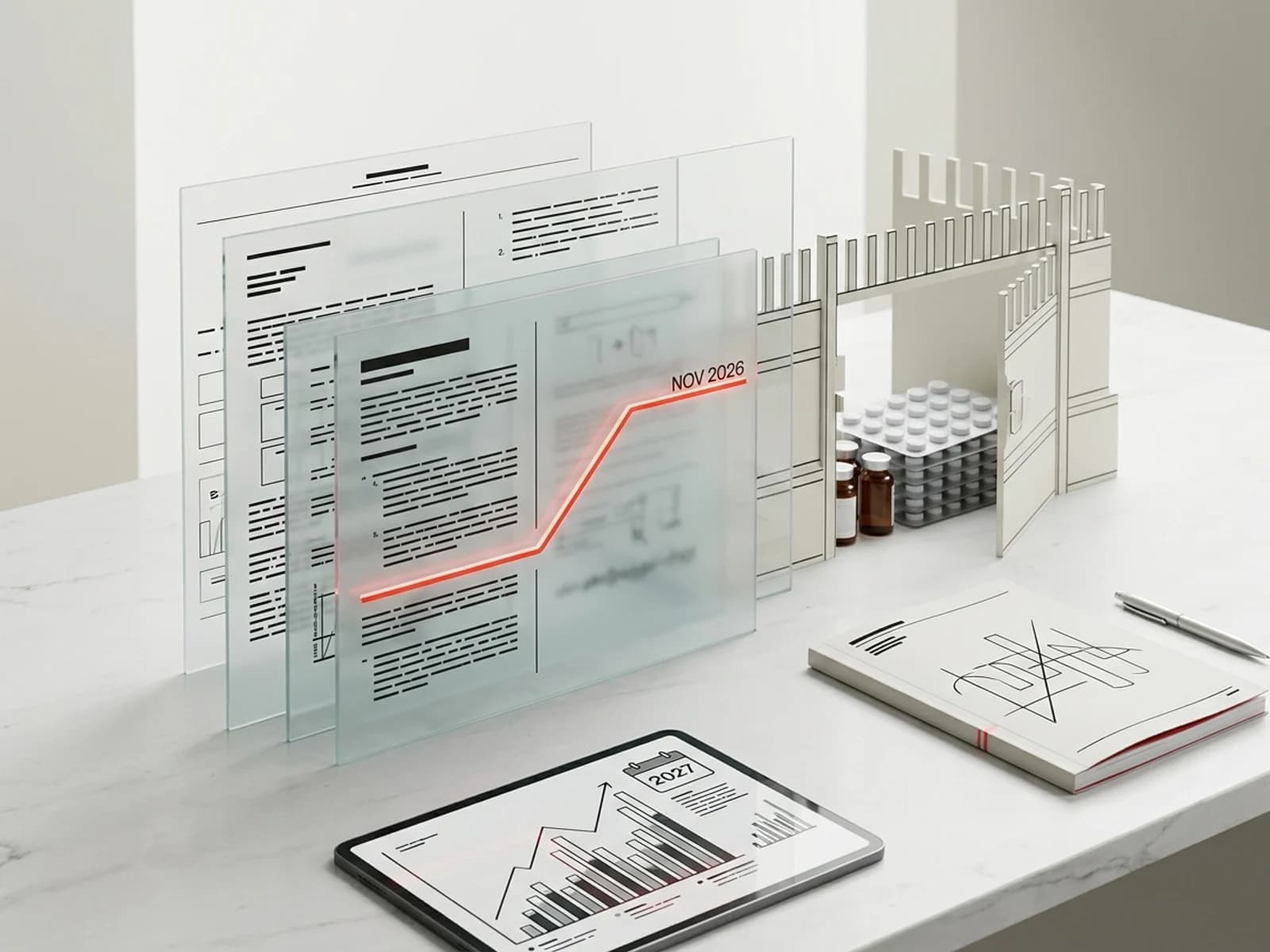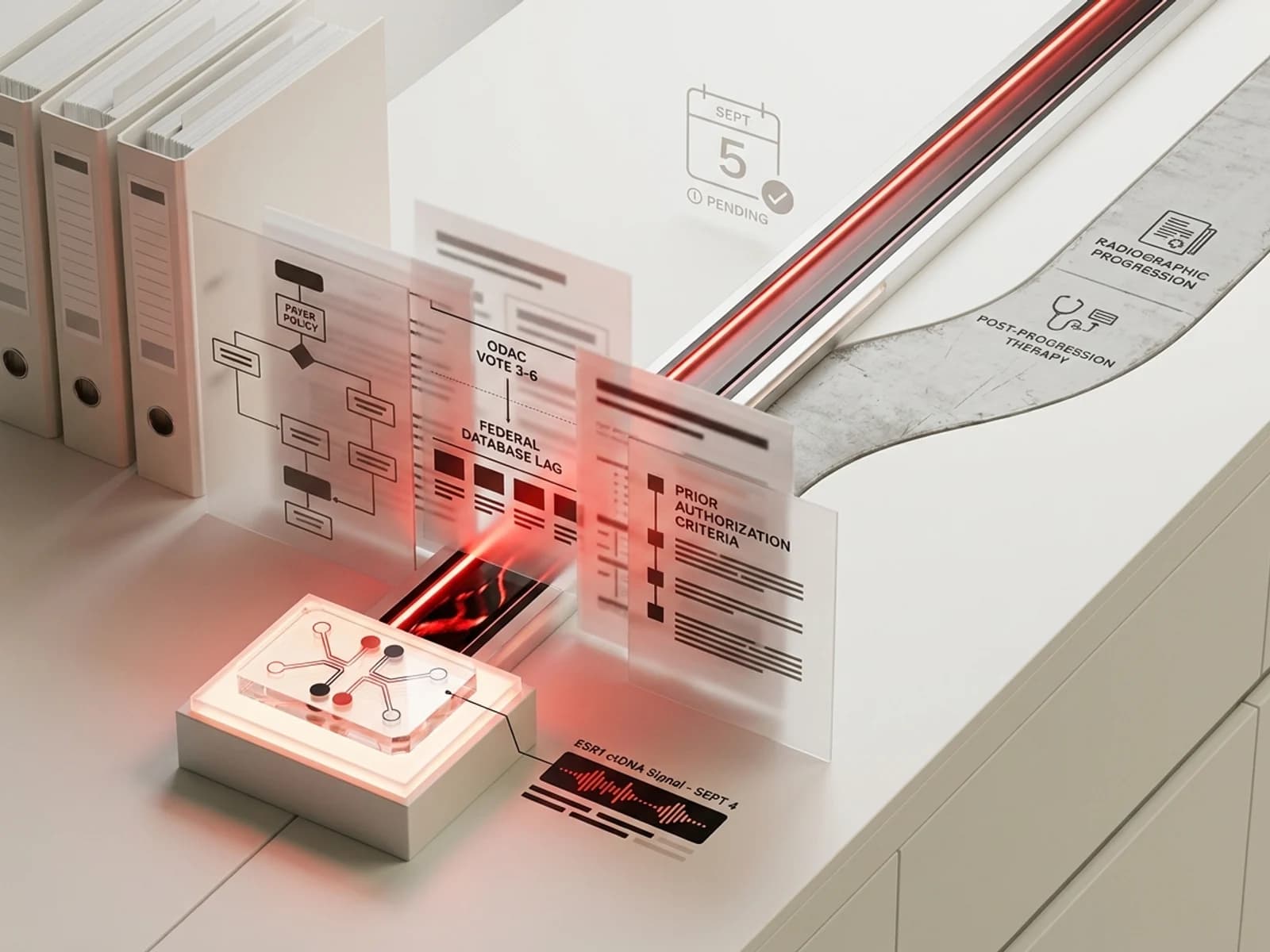
Zydus has FDA approval for 60 mg apalutamide. That is not the same as a U.S. commercial launch—and it is not the whole competitive story. PharmaDossier joined 30 quarters of Part D formulary data with FDA product, patent, NDC, Medicaid, litigation, and company evidence to identify what is known, what remains hidden, and which signals would change the market. This dossier is the apalutamide companion to our prostate-cancer access analysis of Xtandi and generic enzalutamide, built on the same evidence system.
Evidence cutoff: August 31, 2026. Structured FDA and payer data are through August 25, 2026 unless otherwise stated.
The answer in five lines
Approved? Yes. FDA finally approved Zydus's 60 mg apalutamide ANDA on March 17, 2025.
Commercially available? We found no corroborated U.S. launch as of August 25, 2026: no finished generic prescription-product NDC appeared in the current NDC snapshot.
More competitors? Yes. Public FDA records show tentative approvals for Sandoz and Lupin at 60 mg and Hetero at 240 mg; litigation reveals additional strength-specific programs.
When will it launch? The public record does not disclose the confidential settlement dates that matter. March 2027 is a patent-expiry cluster, not a reliable launch date; January 2041 is the last currently listed patent, not a reliable no-entry-until date.
Why does it matter beyond Erleada? A 60 mg-only launch, a 240 mg launch, and broad multi-source entry create different substitution and payer effects across Erleada, Nubeqa, and Xtandi.
TL;DR
Generic apalutamide is best described as regulatory-ready but not observably
launched. The Orange Book shows one finally approved generic—Zydus 60 mg—but an
Orange Book row is not proof of pharmacy inventory, and the RX field means
prescription product rather than “actively marketed.” FDA also excludes tentative
approvals from the Orange Book, so the database understates the technically ready
applicant set when read alone.[1][2][3]
The strength split is commercially decisive. Erleada's recommended dose is 240 mg once daily, supplied as either one 240 mg tablet or four 60 mg tablets. Zydus is AB-rated to the 60 mg reference product, not the 240 mg tablet. A 60 mg launch can serve prescriptions already written at that strength, reduced-dose patients, and new prescriptions written as four 60 mg tablets—but it does not create automatic same-strength substitution for a prescription written for one 240 mg tablet. Hetero's tentative 240 mg approval is therefore a separate escalation point, not an administrative footnote.[4][5][6]
The patent estate is also not a single wall. The August 2026 Orange Book contains 14 distinct patents with expiry clusters in 2027, 2032, 2033, 2035, 2038, 2040, and 2041. Applicant-specific judgments and confidential settlements overlay those dates. J&J disclosed confidential settlements with Zydus in November 2024 and with Hetero's 240 mg program in May 2026. A public Hetero 60 mg consent judgment enjoins that product until the relevant patents expire except as authorized by the brand parties. That exception is where a confidential licensed-entry date could sit.[7][8][9]
Finally, this is a growing class. PharmaDossier calculated $1.386 billion in 2024 Medicare Part D gross spending for Erleada, $998 million for Nubeqa, and $3.401 billion for Xtandi. Our Q2 2026 formulary join found all three AR inhibitors on all 5,517 observed plan options, but roughly 98% of those covered options carried prior authorization and about 80% carried quantity limits. Protected-class status makes simple formulary exclusion a poor model of payer behavior; new-start criteria, strength, quantity, tier, and net cost are the more important levers.[10][11][12]
Why “FDA-approved generic” is an incomplete answer
FDA's current Orange Book product file contains three apalutamide rows:
| Product | Applicant | Strength | Application | Approval date | Current FDA status |
|---|---|---|---|---|---|
| Erleada | Janssen Biotech | 60 mg | NDA 210951-001 | Feb. 14, 2018 | Reference listed drug; AB reference |
| Erleada | Janssen Biotech | 240 mg | NDA 210951-002 | Feb. 17, 2023 | Reference listed drug and reference standard |
| Apalutamide | Zydus Lifesciences | 60 mg | ANDA 217113 | Mar. 17, 2025 | Final approval; AB-rated |
The Zydus row answers a regulatory question: FDA has approved the ANDA and judged the 60 mg product therapeutically equivalent to the 60 mg reference product. FDA's Competitive Generic Therapy table confirms the date and says the product was not eligible for CGT exclusivity.[2] Zydus separately announced final approval and the right to manufacture the product.[13]
It does not answer four different commercial questions:
Has the applicant activated a finished prescription-product NDC and label?
Has sellable inventory reached a wholesaler or specialty pharmacy?
Does a patent settlement authorize commercial entry now?
Have payers processed the first generic claim?
FDA says an approved ANDA allows an applicant to manufacture and market a generic, but “may” is not “has.”[14] Launch can follow approval immediately, years later, or not at all, depending on litigation, settlement rights, manufacturing, inventory, channel, and strategy.
There is a second blind spot. Tentatively approved ANDAs do not appear in the Orange Book. FDA uses tentative approval when an application otherwise meets the approval standard but cannot yet receive final approval because of patent or exclusivity conditions; tentative approval does not authorize marketing.[3][15] Reading only the Orange Book therefore produces both a false positive risk (equating final approval with launch) and a false negative risk (missing technically ready tentative applicants).
What PharmaDossier actually analyzed
This report is not a patent-list summary. We built a product-level evidence model from six independent lanes:
FDA products and patents: August 2026 Orange Book product, patent, and exclusivity files.
FDA application readiness: final and tentative approval records by applicant and strength.
Commercial product signals: the current openFDA NDC Directory, with finished prescription products separated from bulk ingredients, premixes, and drugs for further processing.
Legal status: public consent judgments and J&J SEC litigation disclosures.
Access and economics: CMS Part D spending plus 30 nationwide quarterly formulary releases from 2019 Q1 through 2026 Q2.
Independent utilization and price analogues: Medicaid State Drug Utilization Data and NADAC acquisition-cost records.
The formulary pipeline alone parsed 81.97 GB of source archives, 43,982,692 Basic Drugs Formulary rows, and 2,523,437 plan rows. We exact-matched 67 current target NDCs, yielding 105,312 target drug-formulary observations. For the Q2 2026 cross-section, county-level repetitions were deduplicated to 5,517 unique contract-plan-segment-formulary options across 328 formularies. These are plan-option prevalence results, not enrollment-weighted covered lives.[1][9][10][11][16][17][18]
All calculations use immutable source snapshots with recorded checksums. We separate four evidence types throughout: observed fact, PharmaDossier calculation, evidence-weighted inference, and scenario. That distinction is essential because the most valuable missing datum—the licensed launch date in a confidential settlement—cannot be recovered by adding more public patent rows.
The current U.S. entry dashboard
The observable applicant set is wider than the single approved Orange Book row.
| Applicant / distributor | Strength | ANDA | Highest public regulatory signal | Public legal signal | Commercial status we can support |
|---|---|---|---|---|---|
| Zydus | 60 mg | 217113 | Final approval, Mar. 17, 2025 | Confidential settlement in Nov. 2024; cases dismissed | No corroborated finished-product launch found by Aug. 25, 2026 |
| Sandoz | 60 mg | 216431 | Tentative approval in 2023 | Earlier Paragraph IV litigation disclosed | Technically ready at time of letter; no final approval in current Orange Book |
| Lupin | 60 mg | 217084 | Tentative approval in Oct. 2023 | Earlier Paragraph IV litigation disclosed | Technically ready at time of letter; no final approval in current Orange Book |
| Hetero | 60 mg | 217185 | ANDA visible through litigation | Oct. 2024 consent judgment; J&J says confidential settlement | Entry controlled by judgment/authorization; no final approval in current Orange Book |
| Hetero | 240 mg | 220525 | Tentative approval, Feb. 11, 2026 | Confidential settlement in May 2026 | Technically ready; no marketable final approval |
| MSN / Novadoz | 60 mg + 240 mg | Not disclosed in the cited filing | ANDA disclosed by J&J | U.S. case initiated Jun. 2026 and ongoing at quarter-end | Pipeline signal, not approval or launch |
FDA's Sandoz and Lupin letters show bioequivalence and therapeutic equivalence for 60 mg, while Hetero's February 2026 letter does the same for 240 mg. Each letter also states that patent conditions prevented final approval at that time.[4][19][20] Tentative approval is a meaningful capability signal, but it is not permanent proof of launch readiness: an applicant may need updated labeling, patent certifications, facility information, or other changes before final approval.
The latest J&J filing adds two important facts. First, Hetero's 240 mg litigation settled in May 2026. Second, the newest disclosed MSN/Novadoz program covers both 60 mg and 240 mg, and J&J asserted four current patents in the June 2026 case.[9] That makes the long-run direction clearer even though timing remains unclear: competition is progressing from 60 mg-only programs toward multi-strength programs.
Commercial-launch cross-check
Our current ARPI NDC extract contained 135 records, 17 of them apalutamide-related. For apalutamide it found:
Janssen's finished Erleada 60 mg product (product NDC 59676-600);
Janssen's finished Erleada 240 mg product (product NDC 59676-604);
several bulk-ingredient, premix, export, or drug-for-further-processing records;
zero finished generic prescription ANDA product records.
That last count is an original PharmaDossier computation from the August 25, 2026 openFDA NDC snapshot.[16] It should be read as a strong negative launch signal, not legal proof of non-marketing. Directory updates can lag, and a product could move through a narrow channel before every structured source catches up. However, upstream apalutamide API or further-processing records do not turn that negative into a launch: they show supply-chain activity, not a sellable U.S. generic prescription product.
The conclusion is therefore deliberately precise: we found no corroborated U.S. commercial launch of generic apalutamide by the evidence cutoff. A finished generic NDC plus label, wholesaler availability, or a paid claim would falsify that statement immediately.
Why 60 mg and 240 mg are different commercial events
The current Erleada label recommends 240 mg orally once daily. The dose can be administered as one 240 mg tablet or four 60 mg tablets. The 60 mg strength also supports reduced doses of 180 mg or 120 mg when clinically warranted, and the current label specifies 120 mg for severe hepatic impairment.[5]
This creates three distinct pools:
Current 60 mg prescriptions. An AB-rated 60 mg generic can be eligible for same-strength substitution, subject to the prescription and state law.
Current 240 mg prescriptions. A 60 mg generic is not the same strength as a 240 mg tablet. Converting one 240 mg tablet to four 60 mg tablets generally requires a prescription and benefit pathway that supports the different strength and quantity; it is not ordinary same-strength substitution.
New starts and dose reductions. Prescribers and payers can intentionally write or authorize 60 mg tablets for a 240 mg daily regimen or reduced dosing, making this the most flexible segment for a 60 mg generic.
FDA's therapeutic-equivalence framework is built around pharmaceutical equivalence, including the same active ingredient, dosage form, route, and strength. Generic labeling must generally remain the same as the reference labeling except for permitted differences.[3][6] The practical commercial point is not that 60 mg cannot pressure 240 mg; it can. The point is that the mechanism is prescription conversion or new-start steering, not automatic one-for-one substitution.
This makes 240 mg a second trigger with potentially greater near-term effect on the current one-tablet installed base. It also makes quantity limits unusually important. A standard 30-day regimen uses 30 tablets at 240 mg but 120 tablets at 60 mg. If a payer or pharmacy's quantity rules are not aligned, a low unit price alone does not create a frictionless conversion.
For competitive intelligence, “generic apalutamide entry” should therefore never be modeled as one binary variable. At minimum, the model needs separate fields for 60 mg final approval, 60 mg physical launch, 240 mg final approval, 240 mg physical launch, source count by strength, and prescription mix by strength.
The patent estate is a sequence of gates, not a 2041 cliff
The August 2026 Orange Book lists 14 distinct patents against both Erleada strengths. They fall into seven timing clusters:
| Current expiry cluster | Patents | Orange Book characterization | What it does—and does not—tell us |
|---|---|---|---|
| Mar. 27, 2027 | 8,802,689; 9,388,159; 9,987,261 | Method, drug substance/drug product, and drug product | First cluster to expire; does not clear later product or method layers |
| Feb. 14, 2032 | 8,445,507 | Drug substance, drug product, and two use codes | Broad early product/use gate in the current record |
| Jun. 4, 2033 | 9,481,663 | Drug substance, drug product, and two use codes | Later compound/crystalline-form and use layer |
| Sep. 23, 2033 | 9,884,054; RE49,353; 10,849,888; RE50,642 | Multiple use codes | Dense method-of-use cluster; applicant labeling matters |
| Dec. 3, 2035 | 12,303,493 | Drug product | Later formulation/product layer |
| Apr. 30, 2038 | 10,702,508 | Use code | Later treatment-method layer |
| Jan. 30, 2040–Jan. 14, 2041 | 11,963,952; 12,303,497; 11,723,898 | Multiple use codes | Latest currently listed method layers |
Two nuances matter.
First, patent data move. Older tentative-approval letters displayed a September 2030 date for patent 8,445,507; the current August 2026 Orange Book snapshot shows February 14, 2032. The live monthly record, not a saved approval letter or an old blog post, is the right source for current monitoring.[1][4][19] The record moves in both directions: the estate gained later-listed records during 2025 and 2026, while patent 10,052,314—listed in FDA's 2023 tentative-approval letters with a September 2033 expiry—no longer appears in the current patent file at all.[1][19] A static “patents expire in…” article ages quickly.
Second, Orange Book flags are not a legal freedom-to-operate opinion. A drug substance or drug product flag shows what the NDA holder submitted for listing. A use code describes a claimed method. Whether a particular ANDA can omit protected labeling, design around a product claim, prevail in litigation, or launch under a license depends on product- and applicant-specific facts. This report does not offer a patent-validity, infringement, or carve-out conclusion.
The first 2027 expiry cluster can remove some gates. It does not itself create an unlicensed right to launch through the 2032/2033 product layers, and it tells us nothing about a confidential authorization. Conversely, the last 2041 method patent does not mean all competition must wait until 2041. The honest timing model must combine patent cluster + ANDA design/label + judgment + settlement license + final approval + physical launch.
Litigation changes the meaning of the FDA record
Zydus submitted the 60 mg program that eventually received final approval. J&J's 2024 annual report says the parties entered confidential settlements in November 2024 and the cases were dismissed.[7] The current public record confirms that a settlement occurred but does not disclose the date on which Zydus may commercially enter. FDA's March 2025 approval did not make that missing term public.
Hetero's 60 mg consent judgment is more explicit about the structure. Hetero admitted that the remaining patent claims were valid and enforceable as to its ANDA product and that commercial activity before expiry would infringe; the court enjoined the product until the relevant patents expire, including extensions, other than as authorized by the plaintiffs.[8] That final clause preserves the possibility of an earlier licensed launch. The authorization itself is not in the public judgment.
Hetero then pursued 240 mg. FDA tentatively approved ANDA 220525 on February 11, 2026, and J&J disclosed a confidential settlement and dismissal in May 2026.[4][9] Again, technical readiness is public; the commercial license term is not.
Finally, J&J disclosed a new June 2026 case against MSN and Novadoz covering both 60 mg and 240 mg. The asserted patents—9,481,663, 11,963,952, 12,303,493, and 12,303,497—span the 2033, 2035, and 2040 layers.[9] That selection is more informative than the last patent date alone: it identifies the current dispute perimeter around a multi-strength product.
The pattern is consistent across the file:
technical ANDA readiness
        ↓
patent notice / litigation
        ↓
judgment or confidential settlement
        ↓
final FDA approval when legally available
        ↓
finished-product activation and distribution
        ↓
first paid claim and payer response
The market is currently between the fourth and fifth steps for Zydus 60 mg, and between earlier steps for the other programs. That is a much more useful status description than “generic approved.”
The economic exposure is already large—and still growing
PharmaDossier calculated the following from CMS's Medicare Part D Spending by Drug files. CMS defines these amounts as gross prescription-claim cost including Medicare, plan, and beneficiary payments; they are before rebates and should not be read as manufacturer net sales.[10]
| Drug | 2020 Part D gross spending | 2024 Part D gross spending | 2024 claims | 2024 beneficiaries |
|---|---|---|---|---|
| Erleada | $469.3M | $1,386.3M | 95,580 | 13,253 |
| Nubeqa | $99.9M | $998.1M | 78,077 | 11,577 |
| Xtandi | $1,968.6M | $3,400.8M | 255,669 | 35,367 |
| Generic abiraterone | $386.2M | $692.9M | 389,368 | 55,274 |
From 2020 through 2024:
Erleada gross spending increased 195.4%, a 31.1% CAGR.
Erleada's reported Part D beneficiary count increased 128.2%, a 22.9% CAGR.
Nubeqa gross spending increased roughly tenfold, from $99.9 million to $998.1 million.
Xtandi remained the largest branded AR inhibitor in Part D by gross spending.
The same CMS file also shows what multi-source generic competition does to class economics once it arrives. Generic abiraterone's Part D gross spending fell 21.0% in a single year—from $877.0 million in 2023 to $692.9 million in 2024—while dispensed dosage units rose 22.6% and reported beneficiaries rose 21.1% to 55,274. CMS's weighted average spend per dosage unit dropped 34.2% in that year, from $33.62 to $22.11.[10] More patients, more tablets, materially less money: that is the end state a multi-source apalutamide market would move toward, and it sits in the same spending file as the branded growth figures above.
We deliberately do not compare “average spend per dosage unit” for Erleada across the full period. The 240 mg tablet was approved in February 2023, so a dosage unit can represent one 60 mg tablet or one 240 mg tablet as product mix changes. A sharp change in spend per tablet would partly be a denominator artifact. Gross spend, claims, and beneficiaries are more stable measures for this question.
Company disclosures show the same growth from a different angle. J&J reported worldwide Erleada sales of $3.574 billion in 2025, up 19.2% from 2024.[21] In H1 2026, worldwide sales reached $1.944 billion, up 15.8%; U.S. H1 sales were $738 million, up 10.2%. J&J attributed growth to continued share gains and market growth, partly offset by mix and inventory.[9]
Bayer reported Q1 2026 Nubeqa sales of €749 million, up 45.4% reported and 57.1% currency- and portfolio-adjusted. The company said volume growth was especially strong in the United States and Europe.[22] FDA's June 2025 approval expanded Nubeqa to mCSPC without requiring docetaxel, so its U.S. label now overlaps Erleada in both nmCRPC and mCSPC.[23][24]
The strategic takeaway is not merely that Erleada has revenue at risk. It is that generic apalutamide would enter while both Erleada and Nubeqa are still growing and while Xtandi remains the largest Part D cost center. The shock would propagate through a live competitive class.
Part D data reveal the real payer battleground
In the Q2 2026 cross-section, Erleada, Nubeqa, Xtandi, and generic abiraterone each appeared on every one of the 5,517 observed plan options. That broad presence is not surprising: antineoplastics are one of Medicare Part D's six protected classes, for which plans generally must cover all or substantially all drugs.[12]
Broad formulary presence did not mean open access:
| Drug | Observed coverage | PA among covered plan options | Quantity limit among covered options | Step therapy flag | Most common tier |
|---|---|---|---|---|---|
| Erleada | 100.0% | 98.2% | 80.7% | 0.0% | 5 |
| Nubeqa | 100.0% | 97.9% | 80.4% | 0.0% | 5 |
| Xtandi | 100.0% | 98.2% | 80.6% | 0.0% | 5 |
| Generic abiraterone | 100.0% | 98.2% | 93.1% | 0.0% | 5 |
The percentages are PharmaDossier calculations from CMS Basic Drugs Formulary and Plan Information files.[11] We counted a restriction conservatively when any mapped strength/NDC in a formulary carried the flag and weighted each unique plan option once after removing county repetitions. We did not weight by enrollment. A “0.0% step therapy” result means no step-therapy flag appeared in this structured extract; it does not mean plans lack other clinical criteria.
The longitudinal data make the pattern clearer. At the formulary level, Erleada's prior-authorization prevalence rose from 96.7% at year-end 2019 to 99.4% in Q2 2026. Quantity-limit prevalence rose from 51.2% to 85.7%. Nubeqa followed a similar path. The observed formulary universe itself consolidated from 457 formularies at year-end 2019 to 328 in Q2 2026, so the controls tightened across a shrinking set of larger formularies. Coverage remained broad while explicit controls intensified.
CMS policy permits prior authorization or step therapy for new starts in five of the six protected classes but protects continuity for patients stabilized on therapy.[12] That produces a more nuanced generic-entry mechanism than “payer drops the brands”:
Existing patients: continuity protections and clinical inertia reduce the likelihood of abrupt molecule switching solely for price.
New starts: plans have more ability to apply indication, sequencing, and cost criteria.
Same-molecule substitution: a launched AB-rated generic can move volume within the same strength more directly than a payer can interchange different AR inhibitors.
Strength conversion: moving a 240 mg prescription to four 60 mg tablets requires quantity and prescription mechanics to align.
Contracting: the generic's actual acquisition cost will compete against branded net economics, not headline WAC alone.
This is why a payer analysis based only on covered/not covered would miss the commercial decision. In this class, the useful fields are new-start PA criteria, grandfathering, tier, tablet quantity, same-strength substitution, and net cost.
Medicaid and NADAC add two independent cross-checks
Medicaid State Drug Utilization Data provide a second utilization lane. We summed reported fee-for-service and managed-care prescriptions and excluded suppressed rows rather than imputing them. The resulting totals are lower bounds, not complete national utilization.[17]
Reported Erleada prescriptions increased from 2,224 in 2020 to 6,857 in 2025. Reported Nubeqa prescriptions increased from 67 to 16,975 over the same period. Xtandi remained larger at 21,231 reported prescriptions in 2025. Reported reimbursement dollars tell the same story more sharply: reported Medicaid spending on Nubeqa reached $226.9 million in 2025—more than double Erleada's $103.4 million—after being barely 6% of it in 2021. Because state suppression differs across products and time, these figures should not be used for exact share. They do independently confirm that the Erleada–Nubeqa competitive set expanded materially before generic apalutamide appeared.
The NADAC lane answers a different question. Our 2018–2026 ARPI extract contained no Erleada or generic apalutamide acquisition-cost observations. That absence is only a weak corroborating launch signal because NADAC is pharmacy-survey-based and specialty distribution can be underrepresented.[18]
NADAC is more useful here as an analogue. The annual median published NADAC for generic abiraterone fell from $4.9008 per unit in 2020 to $0.8502 in 2026—an 82.7% decline in our calculation. The path was not monotonic: the annual median rose from $0.98 in 2024 to $1.14 in 2025 before falling to $0.85 in 2026, a reminder that generic deflation arrives in waves rather than a smooth curve. That history demonstrates the acquisition-cost compression possible in a mature, multi-source oral oncology market. It is not a generic apalutamide price forecast: the molecules, manufacturers, time periods, channel mix, and competitive density differ.
2027 creates a class-wide price reset even without apalutamide launch
Two dates will draw attention in 2027:
January 1, 2027: Medicare's negotiated price for Xtandi takes effect.
March 27, 2027: the first three currently listed Erleada patents expire.
CMS set Xtandi's negotiated price at $7,004 per 30-day supply, 48% below the CMS-reported 2024 list price of $13,480.[25] Medicare drug-price negotiation is not generic substitution, and the negotiated price does not apply identically to every market segment. It nevertheless creates a transparent public benchmark inside the same prostate-cancer class.
The March patent date is also not a launch forecast. It removes the earliest cluster, but current product and method layers remain, and confidential settlement authorization can be earlier or later than a public expiry milestone. Treating March 28, 2027 as a presumed launch date would substitute a visible date for an unknown contract term.
Together, however, the events change payer comparisons. The 2027 decision frame will include:
Xtandi's effective Medicare negotiated price.
Erleada and Nubeqa contracted net economics.
The actual price and source count of any launched apalutamide strength.
New-start PA criteria and indication overlap.
The operational burden of 60 mg versus 240 mg dispensing.
If generic apalutamide remains unlaunched, Xtandi's negotiated price still alters the class reference point. If a single 60 mg source launches at a modest discount, its advantage may be narrower than “generic” implies. If multiple 60 mg sources enter and acquisition cost falls rapidly, new-start steering becomes more attractive. If 240 mg also launches, the same-strength substitution channel becomes substantially more direct.
Five entry states—not one forecast date
The public evidence supports scenario triggers more strongly than probability percentages. The table below is a decision tree, not a prediction.[1][9][11][16]
| State | Observable trigger | Immediate commercial mechanism | Likely payer focus | Cross-ARPI implication |
|---|---|---|---|---|
| 0. Regulatory-ready, no observed launch (current) | Final 60 mg approval but no finished generic NDC/distributor/claim | No generic substitution; optionality only | Prepare criteria and contracts; watch Xtandi 2027 benchmark | Brands compete as brands; apalutamide launch overhang persists |
| 1. Single-source 60 mg launch | Finished 60 mg NDC + label + channel availability | Same-strength substitution for 60 mg scripts; conversion opportunity for new starts | Tablet quantity, PA wording, tier, actual acquisition cost | Erleada pressure begins but 240 mg installed base is partly insulated operationally |
| 2. Multi-source 60 mg market | Second/third 60 mg final approval and physical launch | Greater generic price competition and supply redundancy | New-start preference and four-tablet economics become more credible | Adjacent ARPIs face a lower-cost molecular alternative, especially in overlapping indications |
| 3. 240 mg launch | Final approval and finished 240 mg product | Same-strength substitution against one-tablet Erleada prescriptions | Direct generic substitution, one-tablet convenience, source reliability | Larger and faster exposure of the current Erleada base; stronger payer benchmark |
| 4. Broad multi-strength competition | Multiple manufacturers across 60 mg and 240 mg | Commodity-like molecule competition with dose flexibility | Net cost, supply, PA criteria, and indication-specific positioning | Class strategy shifts from “is generic available?” to “which patients remain differentiated by product?” |
State 0: the current state
The organization should treat launch as an event to detect, not a date already known. The leading indicators are a finished prescription NDC, Structured Product Label, wholesaler listing, applicant launch announcement, and first paid claim. An API record or final approval alone is insufficient.
State 1: why a single 60 mg entrant may be slower than expected
One source can still price rationally rather than aggressively. Existing 240 mg prescriptions do not automatically convert, and four-tablet quantity limits need to work. A brand could retain the convenience segment, while the generic captures reduced-dose use and deliberately written 60 mg regimens. The impact will depend more on prescribing and benefit operations than a simple generic penetration curve suggests.
State 2: why source count changes the economics
The Sandoz and Lupin tentative approvals and Hetero 60 mg program show that Zydus is not the only technically advanced 60 mg path. Final approval and licensed entry remain applicant-specific, but multiple sources would increase supply confidence and normally strengthen price competition. The NADAC abiraterone analogue shows the direction such competition can take without supplying an apalutamide discount assumption.
State 3: why 240 mg is the more direct substitution trigger
Hetero's tentative approval demonstrates that a 240 mg generic can meet FDA's technical standard. The settlement controls when Hetero may obtain final approval and launch, and those terms are not public. When any 240 mg generic does launch, the payer and pharmacy no longer need a four-for-one strength conversion for the standard daily dose. That can materially change uptake speed.
State 4: the class-strategy end state
Broad multi-strength competition would not make apalutamide interchangeable with darolutamide or enzalutamide. These remain different active ingredients with different labels and clinical profiles. It would, however, give payers a lower-cost AR inhibitor option in indications where products overlap. Commercial defense would need to be patient- and evidence-specific, supported by contracting, rather than relying on broad formulary availability that all three products already have.
What this means for an adjacent ARPI portfolio
The most important implication is asymmetric timing.
Before commercial launch, generic apalutamide is an overhang that affects planning but not claims. At 60 mg launch, it becomes a new-start and prescription-conversion issue. At 240 mg launch, it becomes a direct same-strength substitution issue for the standard one-tablet regimen. At multi-source entry, it becomes a class price benchmark.
For Nubeqa specifically, the competitive overlap widened when FDA approved darolutamide for mCSPC without required docetaxel in June 2025; Nubeqa and Erleada now share nmCRPC and mCSPC label territory.[23][24] That does not mean a generic apalutamide automatically displaces darolutamide. It means payer and prescriber comparisons can increasingly occur in the same patient settings.
Four strategic questions follow:
How much of the addressable market is actually new-start versus stable therapy? Protected-class continuity reduces the immediate switch pool.
What share of Erleada use is 60 mg versus 240 mg at the prescription level? Gross molecule sales do not answer the strength-conversion question.
Can the generic's acquisition cost beat the relevant benchmark after brand contracting? “Generic” is not itself a net-price estimate.
Which patient or operational attributes remain differentiating when price pressure rises? Any clinical claim requires product-label and evidence support; the correct response is not an unsupported cross-trial superiority narrative.
Xtandi adds a further complication. Its current U.S. label spans castration-resistant prostate cancer, mCSPC, and high-risk biochemical-recurrence nmCSPC.[26] Its 2027 negotiated Medicare price can influence payer thinking before generic apalutamide has a claim. The competitive set is therefore a three-body problem: generic readiness at Erleada, rapid growth at Nubeqa, and a public Medicare price reset at Xtandi.
A monitoring system that will catch the launch before a quarterly report
A useful watchlist should be strength-specific, event-driven, and auditable. Its trigger design follows the same regulatory, product, legal, and payer evidence lanes used in this report.[1][9][11][16]
| Signal | Source | Cadence | Why it matters | Escalation rule |
|---|---|---|---|---|
| Final/tentative ANDA status | FDA monthly approvals, Orange Book, approval letters | Weekly/monthly | Identifies regulatory state by applicant/strength | Escalate on any 240 mg final approval or new 60 mg final approval |
| Finished product and label | openFDA NDC, DailyMed/SPL | Daily/weekly | Strongest structured evidence that a sellable package is being activated | Move from “ready” to “launch validation” on generic ANDA product NDC |
| Channel availability | Major wholesalers, specialty pharmacies, applicant release | Daily after NDC signal | Confirms inventory rather than paperwork | Verify NDC, package, price, and ship date through two sources |
| Legal authorization | SEC filings, court dockets, settlement disclosures | Event-driven | Can reveal or constrain entry rights | Escalate on amended judgment, dismissal, or disclosed licensed date |
| Payer mechanics | CMS formulary, plan policy documents, commercial policies | Monthly/quarterly | Shows PA, tier, and quantity response | Flag any new-start preference or four-60 mg quantity accommodation |
| Real uptake | Paid claims, prescription data, Medicaid/Part D lagged files | Weekly if available; quarterly public | Distinguishes stocked launch from meaningful adoption | Confirm first claim, then track strength-specific source count and share |
The state transition should require evidence, not intuition:
Ready → Activated → Stocked → Paid → Scaled
  FDA      NDC/SPL    channel   claim   repeat claims + payer change
No single signal is sufficient for every transition. An NDC without stock is activation; a press release without a package is intent; a paid claim is launch; repeat claims across channels are scale.
Five actions to take now
Split every forecast by strength. Keep separate 60 mg and 240 mg launch states, source counts, and addressable prescription pools.
Obtain strength-level prescribing mix. This is the most important missing commercial denominator in public data.
Pre-build payer policy diffs. Capture PA language, grandfathering, tier, and quantity limits before launch so post-launch changes are detectable.
Model prices as ranges, not one discount. Use single-source, multi-source, and 240 mg scenarios, with Xtandi's 2027 MFP as one Medicare benchmark—not as a universal net price.
Define the falsification event. A finished generic prescription NDC plus channel stock or first paid claim immediately ends the current-state thesis.
What remains unknown
Several decision-critical fields are not public:
the licensed-entry dates in the Zydus and Hetero settlements;
whether and when Sandoz, Lupin, Hetero 60 mg, or MSN/Novadoz will receive final approval;
current launch-ready inventory and channel contracts;
current U.S. Erleada prescription mix by 60 mg versus 240 mg;
brand net prices and rebates;
payer enrollment weights behind the public formulary structures;
the price and package configuration of any future generic launch.
These are not reasons to abandon a view. They are reasons to express the view as a state machine with observable triggers. The current evidence supports a medium-high-confidence conclusion of no corroborated launch, a high-confidence conclusion that 60 mg is ahead of 240 mg, and a low-confidence basis for any exact launch date.[7][9][16]
Bottom line
The correct answer to “Is there a generic Erleada analysis?” is not a one-line patent date.
Zydus has an FDA-approved 60 mg generic, but approval has not yet become an observable U.S. commercial launch. The competitive pipeline is deeper than the Orange Book suggests: two additional 60 mg products and one 240 mg product have public tentative approvals, while litigation reveals more strength-specific programs. The patent estate has multiple product and method gates through 2041, but confidential authorizations—not the last patent—may determine actual entry.
The market impact will arrive in stages. A 60 mg launch pressures new starts, reduced doses, and existing 60 mg prescriptions first. A 240 mg launch opens a more direct substitution route for the standard one-tablet regimen. Multi-source, multi-strength entry turns apalutamide into a stronger payer benchmark for the whole ARPI class.
The actionable intelligence product is therefore not “generic date: 2027” or “patent expiry: 2041.” It is a live, strength-specific launch system that connects FDA status, settlement rights, physical product activation, payer mechanics, and first claims. That system will identify the market transition earlier—and with far fewer false alarms—than any single database.[1][2][4][9][16][19][20]
Every calculation in this dossier is reproducible from checksummed public-data snapshots—the same pipeline behind our Xtandi and generic enzalutamide analysis. If your team wants this watchlist operated for apalutamide, or the same evidence system built around another molecule, talk to PharmaDossier.
Frequently asked questions
Has FDA approved a generic version of Erleada?
Yes. FDA finally approved Zydus Lifesciences' apalutamide 60 mg ANDA 217113 on March 17, 2025, with an AB therapeutic-equivalence code to the 60 mg reference product.[1][2]
Is generic apalutamide available in U.S. pharmacies now?
We found no corroborated commercial launch through August 25, 2026. The current NDC join contains no finished generic prescription-product ANDA record, although it does contain brand products and upstream bulk/further-processing records. NDC absence can lag and is not proof by itself, so the conclusion should be monitored against labels, wholesalers, and paid claims.[16]
Why can a generic receive final approval before it launches?
FDA approval establishes that the application meets the regulatory standard and permits marketing. A company may still wait because of a court judgment, settlement license, manufacturing or inventory decisions, distribution readiness, or launch strategy.[14]
Are other generic apalutamide products close?
Public FDA records show tentative approvals for Sandoz 60 mg, Lupin 60 mg, and Hetero 240 mg. Tentative approval means FDA completed the substantive review at that time but could not grant final approval because of patent or exclusivity conditions; it does not permit marketing.[4][19][20]
Will generic Erleada launch when the first patents expire in March 2027?
Not necessarily. Three current patents expire on March 27, 2027, but other product and method patents remain. Applicant-specific settlement rights may permit or delay entry independently of that visible cluster. The public record does not disclose Zydus's licensed-entry date.
Does the January 2041 patent mean no generic can launch until 2041?
No. January 2041 is the latest current Orange Book expiry, not a universal launch date. Earlier entry can depend on claim scope, labeling, litigation outcomes, patent expiry clusters, and licenses. This report does not offer a legal opinion.
Can a pharmacist replace one 240 mg Erleada tablet with four generic 60 mg tablets?
Not as ordinary same-strength substitution. FDA therapeutic equivalence is strength-specific, and actual substitution also depends on the prescription and state law. A prescriber or payer may create a four-tablet 60 mg pathway, but that is a prescription/benefit conversion and must accommodate tablet quantity.[3][5]
How large is the Medicare exposure?
PharmaDossier calculated $1.386 billion in 2024 Part D gross spending for Erleada across 13,253 reported beneficiaries. The figure is gross claim cost before rebates, not J&J net revenue.[10]
Would Part D plans simply remove Erleada or Nubeqa after generic entry?
That is not the most likely structural mechanism. Antineoplastics are protected class drugs, and our Q2 2026 data show broad formulary presence for Erleada, Nubeqa, Xtandi, and generic abiraterone. The more relevant levers are PA for new starts, tier, quantity limits, same-strength substitution, and net cost.[12]
What is the single best launch signal to monitor?
A finished generic prescription-product NDC plus a corresponding label is the best structured early signal. It should then be confirmed with channel inventory or a paid claim. Final approval alone is not enough.
Methodology and limitations
The calculations below combine FDA, CMS, Medicaid, and NADAC source structures; each inference is bounded by the limits of its underlying public dataset.[1][10][11][17][18]
Regulatory snapshot: August 25, 2026 Orange Book and openFDA NDC files.
Formulary period: 30 nationwide CMS quarterly archives, 2019 Q1–2026 Q2.
Formulary matching: exact normalized 11-digit NDC matching from the current openFDA target set.
Current plan denominator: 5,517 unique contract-plan-segment-formulary combinations after deduplicating county rows, including 21 plan options CMS marks as display-suppressed; no enrollment weighting.
Restriction rule: a plan option is flagged if any mapped strength/NDC in its formulary has the PA, quantity-limit, or step-therapy indicator.
Part D spending: CMS “Overall” manufacturer aggregates; gross claim cost before rebates.
Medicaid SDUD: FFS plus managed-care reported rows; suppressed records are excluded rather than imputed, so totals are lower bounds.
NADAC: annual medians of published per-unit observations; descriptive only.
Launch status: absence of a structured product record is evidence, not proof. Commercial status should be triangulated with labels, distributors, inventory, and claims.
Legal limitation: patent flags, judgments, and settlements are described for competitive-intelligence purposes and are not legal advice.
Clinical limitation: this report analyzes market structure. It does not recommend treatment or claim comparative clinical superiority.
Sources
1. U.S. Food and Drug Administration, Orange Book Data Files, current monthly products, patents, and exclusivity files.
2. U.S. Food and Drug Administration, Competitive Generic Therapy Approvals, including Zydus ANDA 217113.
3. U.S. Food and Drug Administration, Orange Book Preface, 46th edition.
4. U.S. Food and Drug Administration, Tentative Approval Letter for Hetero ANDA 220525, apalutamide tablets 240 mg.
5. U.S. Food and Drug Administration, Erleada (apalutamide) Prescribing Information, revised June 2026.
6. U.S. Food and Drug Administration, Generic Drugs—Specific Labeling Resources.
7. Johnson & Johnson, 2024 Annual Report, Erleada patent-litigation disclosures.
8. U.S. District Court for the District of New Jersey, Consent Judgment and Order, Aragon Pharmaceuticals et al. v. Hetero Labs, No. 2:22-cv-03212, October 15, 2024.
9. Johnson & Johnson, Form 10-Q for the quarter ended June 28, 2026, Erleada sales and litigation disclosures.
10. Centers for Medicare & Medicaid Services, Medicare Part D Spending by Drug, 2020–2024 files.
11. Centers for Medicare & Medicaid Services, Part D Formulary Guidance and Public-Use Files, 2019–2026.
12. Centers for Medicare & Medicaid Services, Medicare Advantage and Part D Drug Pricing Final Rule—Part D Protected Classes, May 16, 2019.
13. Zydus Lifesciences, Zydus receives final approval from USFDA for Apalutamide Tablets, 60 mg, March 2025.
14. U.S. Food and Drug Administration, Abbreviated New Drug Application (ANDA), generic approval overview.
15. U.S. Food and Drug Administration, GDUFA Glossary—Tentative Approval Letter for an ANDA.
16. U.S. Food and Drug Administration, openFDA National Drug Code Directory, current product-listing data.
17. Medicaid.gov, State Drug Utilization Data, 2012–2026 releases.
18. Medicaid.gov, Methodology for Calculating the National Average Drug Acquisition Cost, NADAC pharmacy survey methodology.
19. U.S. Food and Drug Administration, Tentative Approval Letter for Sandoz ANDA 216431, apalutamide tablets 60 mg.
20. U.S. Food and Drug Administration, Tentative Approval Letter for Lupin ANDA 217084, apalutamide tablets 60 mg.
21. Johnson & Johnson, 2025 Annual Report, Erleada sales.
22. Bayer AG, Quarterly Statement Q1 2026—Pharmaceuticals, Nubeqa sales.
23. U.S. Food and Drug Administration, FDA approves darolutamide for metastatic castration-sensitive prostate cancer, June 3, 2025.
24. U.S. Food and Drug Administration, Nubeqa (darolutamide) Prescribing Information, revised June 2025.
25. Centers for Medicare & Medicaid Services, Negotiated Prices for Initial Price Applicability Year 2027, including Xtandi.
26. U.S. National Library of Medicine, DailyMed—Xtandi (enzalutamide), current prescribing information.