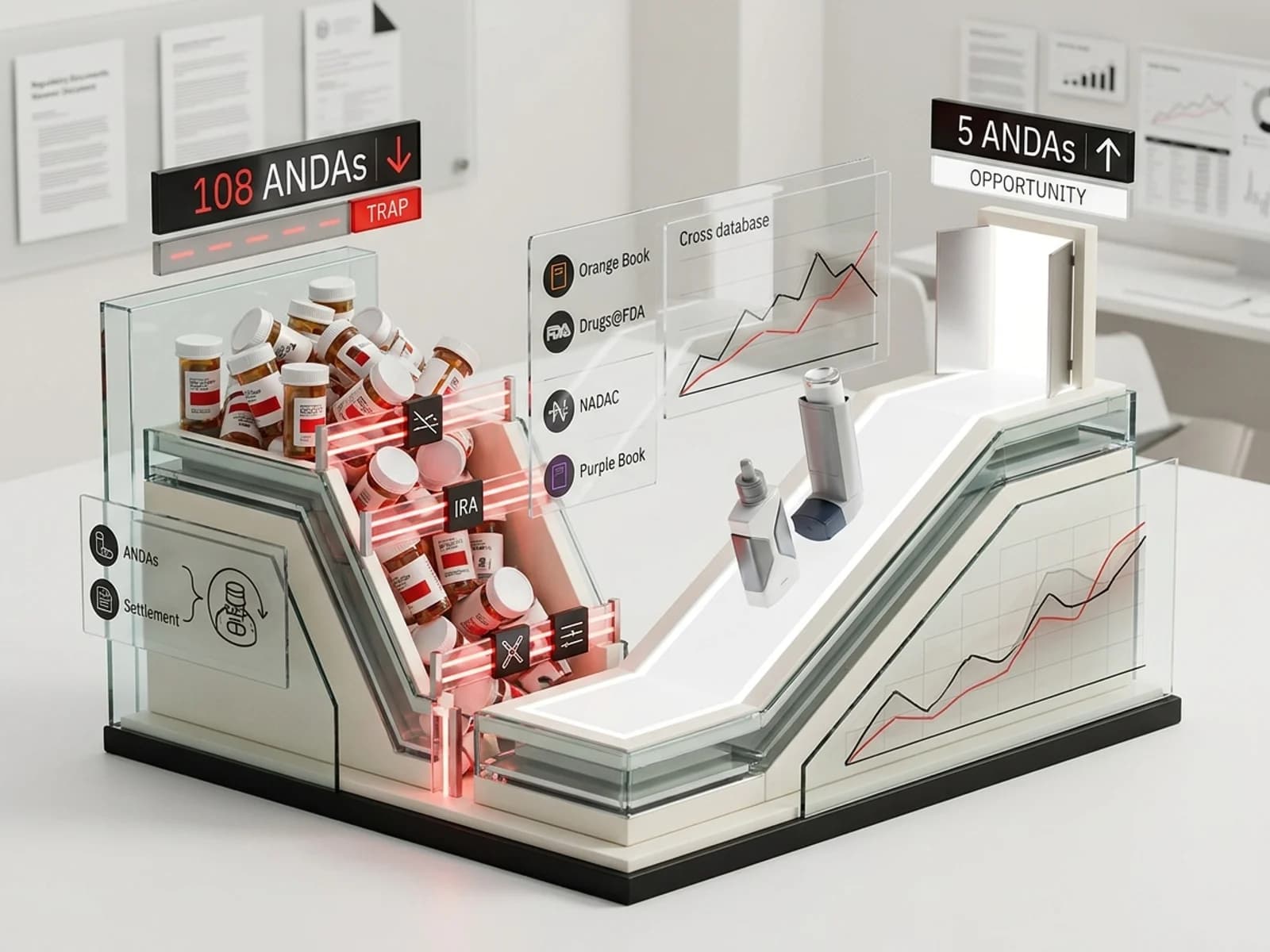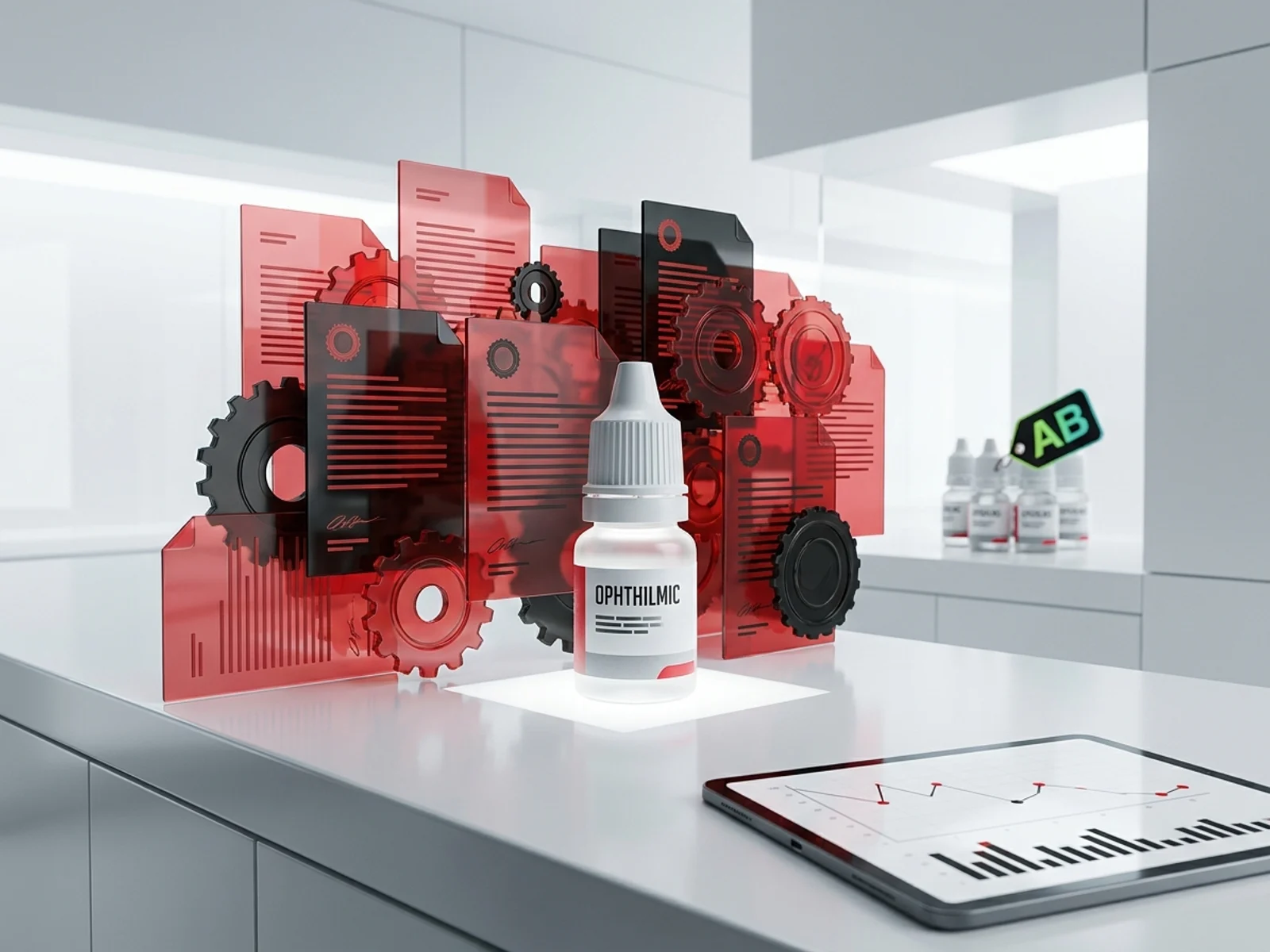
The FDA Orange Book lists 834 ophthalmic drug products across 153 distinct active ingredients (run date June 10, 2026). Of those ingredients, 67 — 43.8% of the ophthalmic formulary — are single-source: they have a brand NDA on file but no approved ANDA, so no generic competitor exists at any strength. Only 93 of the 834 ophthalmic products, 11.1%, carry an AB therapeutic-equivalence code that lets a pharmacist automatically substitute a generic at the point of dispensing; 508 carry no TE code at all and 233 carry a B code that blocks automatic substitution. And the recent single-source NDA launches that launch and access teams are watching — Xdemvy (lotilaner, 2023), Miebo (perfluorohexyloctane, 2023), Ryzumvi (phentolamine, 2023), and Omlonti (omidenepag, 2022) — sit behind a mix of regulatory exclusivity and patent estates that pushes realistic generic entry into the late 2030s.
This is a narrow, route-specific read of the FDA Orange Book for the topical ophthalmic segment, written for generic-entry planners, formulary managers, and launch teams that model ophthalmic price erosion and pharmacy-substitution assumptions. Every figure is computed from the public FDA Orange Book (Approved Drug Products with Therapeutic Equivalence Evaluations), run date June 10, 2026. For the database-wide Orange Book picture, see the companion therapeutic-equivalence analysis of 48,000 products; for the TE-code substitution workflow, see Orange Book TE codes and generic substitution. This article stays on the topical ophthalmic niche.
Methodology, in one paragraph
"Ophthalmic" is defined as any product whose Orange Book dosage-form-and-route field carries the route token OPHTHALMIC, which captures topical drops, ointments, gels, emulsions, and suspensions and excludes intravitreal and intraocular injections (those carry a route of INTRAVITREAL or INTRAOCULAR). An active ingredient is counted as single-source when the active Orange Book section lists at least one NDA product for that ingredient but zero ANDA products — that is, no approved generic exists at any strength or for any applicant. Therapeutic-equivalence counts use the TE_Code field on each product row: products beginning "AB" are counted as pharmacy-substitutable, products beginning with a B (BC, BX, B*, and so on) are counted as non-substitutable, and empty TE_Code fields are counted as single-source. Ingredient strings are normalized to upper case; combination ingredients are treated as a single ingredient string. Patent and exclusivity context is drawn from the Orange Book patents file joined to the single-source NDA set by application number.
The headline picture
| Metric | Count |
|---|---|
| Ophthalmic product records | 834 |
| Distinct ophthalmic active ingredients | 153 |
| NDA (brand) product records | 245 |
| ANDA (generic) product records | 589 |
| Single-source ingredients (NDA, no ANDA) | 67 (43.8%) |
| Ingredients with generic competition | 86 (56.2%) |
| AB-coded products (pharmacy-substitutable) | 93 (11.1%) |
| B-coded products (non-substitutable) | 233 |
| Products with no TE code | 508 |
The single most counterintuitive number in the ophthalmic segment is the AB share. Across the whole Orange Book, AB-rated products are roughly a third of the file and dominate the substitutable landscape. In ophthalmics, AB products are 11.1% of the segment. The reason is structural: ophthalmic solutions and suspensions are sensitive to formulation variables (pH, preservative, tonicity, viscosity, drop size) that drive bioequivalence disputes, and a large share of the ophthalmic formulary is older brand or legacy product that never attracted an ANDA. Published physicochemical comparisons of generic versus branded ophthalmic products find measurable differences in pH, buffer capacity, viscosity, and drop volume even after FDA bioequivalence clearance — differences that ophthalmologists cite when disputing automatic substitution of glaucoma drops, and that help explain why a therapeutic-equivalence code on paper does not always translate to a friction-free switch in practice. The practical consequence for formulary teams is that the pharmacy auto-substitute assumption that drives generic-savings models in oral solids does not transfer cleanly to eye drops — for most ophthalmic molecules, there is no AB-rated interchangeable at the counter.
Single-source means two different things
The 67 single-source ophthalmic ingredients fall into two very different commercial buckets, and access teams should not pool them.
Legacy and niche products with no economic ANDA pull. A large share of the single-source set is older product — by approval decade, 39 single-source ophthalmic NDA products were approved before 1990 — including decades-old miotics, mydriatics, diagnostic dyes, and anti-infectives (Phospholine Iodide, Achromycin, Floropryl, Humorsol, Vira-A). These molecules are off-patent but carry no ANDA because the market is too small to justify a bioequivalence program. They are technically single-source but are not where generic-entry or payer-savings attention belongs.
Recent single-source NDAs inside an exclusivity-and-patent fence. The commercially significant single-source set is the post-2015 NDA launches, where exclusivity and patents — not market economics — are what keep an ANDA off the file. A useful caveat for this group: only some of these are true new molecular entities (NCEs) that earn five-year exclusivity and an NCE-1 paragraph-IV window. Several are 505(b)(2) applications or fixed-dose combinations built on older, already-approved moieties (clobetasol, articaine, cetirizine, oxymetazoline, chloroprocaine, phentolamine, cysteamine, the carbachol/brimonidine and phenylephrine/tropicamide pairs). Those are single-source because no ANDA has been filed or approved, and they are protected by a mix of three-year new-clinical-investigation exclusivity, orphan exclusivity, and patents — not by five-year NCE exclusivity. The distinction matters for paragraph-IV timing: the NCE-1 window only opens for the true NCEs. These are the molecules that drive near-term formulary spend, and they are listed below.
The recent single-source NDAs, and when generics can actually file
| Brand | Ingredient | Approval year | Why no generic yet |
|---|---|---|---|
| Yuvezzi | Brimonidine tartrate; carbachol | 2026 | Fixed-dose combo of two older glaucoma drugs; NDA 220142; no ANDA |
| Tryptyr | Acoltremon | 2025 | NCE (TRPM8 agonist); NDA 217370; 5-yr exclusivity to 2030 |
| Epioxa HD / Epioxa kit | Riboflavin 5'-phosphate sodium | 2025 | 505(b)(2) of prior riboflavin moiety; NDA 219910; orphan; no ANDA |
| Cyklx | Articaine hydrochloride | 2025 | 505(b)(2) relying on Septocaine; NDA 218643; no ANDA |
| Vizz | Aceclidine hydrochloride | 2025 | New NDA (aceclidine not previously US-marketed); NDA 218585; no ANDA |
| Byqlovi | Clobetasol propionate | 2024 | 505(b)(2) of long-approved corticosteroid; NDA 218158; no ANDA |
| Xdemvy | Lotilaner | 2023 | NCE exclusivity to 2028; 9 patents; generic est. 2038 |
| Miebo | Perfluorohexyloctane | 2023 | NCE exclusivity to 2028; 6 patents; generic est. 2037 |
| Mydcombi | Phenylephrine; tropicamide | 2023 | Fixed-dose combo of OTC mydriatics; NDA 215352; no ANDA |
| Ryzumvi | Phentolamine mesylate | 2023 | 505(b)(2) of older alpha-blocker; ~3-yr exclusivity to 2026; 11 patents |
| Omlonti | Omidenepag isopropyl | 2022 | NCE (EP2 agonist); NDA 215092; no ANDA |
| Iheezo | Chloroprocaine hydrochloride | 2022 | 505(b)(2) of older anesthetic; NDA 216227; no ANDA |
| Upneeq | Oxymetazoline hydrochloride | 2020 | 505(b)(2) of older decongestant; NDA 212520; no ANDA |
| Cystadrops | Cysteamine hydrochloride | 2020 | Orphan (nephropathic cystinosis); NDA 211302; no ANDA |
| Rocklatan | Latanoprost; netarsudil | 2019 | Fixed-dose combo; NDA 208259; no ANDA |
| Rhopressa | Netarsudil mesylate | 2017 | NCE exclusivity (expired); NDA 208254; no ANDA |
| Zerviate | Cetirizine hydrochloride | 2017 | 505(b)(2) of cetirizine; NDA 208694; no ANDA |
The pattern is consistent, but the regulatory mechanism splits two ways. For the true new molecular entities — Xdemvy (lotilaner), Miebo (perfluorohexyloctane), Omlonti (omidenepag), Rhopressa (netarsudil), and Tryptyr (acoltremon) — five-year new-chemical-entity exclusivity blocks ANDA approval for five years from approval (four years before a paragraph-IV filer can submit), and a patent estate layered on top extends the practical no-generic window by another decade. Xdemvy is the cleanest example: approved July 25, 2023, with NCE exclusivity running to July 2028 and nine listed patents, the earliest ANDA challenge window opens in mid-2027 but realistic generic entry, on third-party patent-cliff tracking, lands in late 2038. Miebo (perfluorohexyloctane for dry eye disease) follows the same shape. The 505(b)(2) and combination products — Ryzumvi (phentolamine), Byqlovi (clobetasol), Cyklx (articaine), Zerviate (cetirizine), Upneeq (oxymetazoline) — do not carry five-year NCE exclusivity or an NCE-1 window; they are single-source because no ANDA has been filed, held in place by three-year or orphan exclusivity plus the patent estate (Ryzumvi's eleven listed patents are the reason its generic horizon stretches to the late 2030s despite phentolamine being an older drug). For a payer building a five-year ophthalmic cost curve, both groups of molecules are single-source for the entire horizon.
The patent and use-code picture
The Orange Book's patent file gives a second view of how the single-source fence is built. Across the single-source ophthalmic NDA applications, 129 patents are listed, spread across 21 applications, and 19 of those applications carry at least one method-of-use (U-code) patent in addition to any substance or product claim.
| Patent use code (selected) | Listings |
|---|---|
| U-1524 | 27 |
| U-1900 | 10 |
| U-3454 | 9 |
| U-3741 | 8 |
| U-2849 | 7 |
| U-3674 | 5 |
| U-3804 | 5 |
| Substance/product claim (no use code) | 37 |
Method-of-use patents matter for generic timing because an ANDA filer must certify against each listed use-code patent — either by carving the patented use out of its labeling or by challenging the patent. For combination and indication-specific ophthalmic products, a U-code on a specific indication can force a generic to launch with a narrower label, fragmenting the substitutable market even after the substance patent expires. The 37 substance-or-product patents without a use code are the straightforward composition-of-matter and formulation claims; the U-code layer is where the timing and labeling traps live.
What this means for launch, formulary, and generic-entry teams
Pharmacy-substitution savings models need an ophthalmic haircut. With only 11.1% of ophthalmic products AB-rated, the auto-substitute assumption that underwrites generic-savings projections in oral solids overstates ophthalmic substitution. Build the ophthalmic line item from molecule-level TE-code reality, not from a portfolio average.
Single-source ≠ price-protected. 43.8% of ophthalmic ingredients are single-source, but most of that volume is low-revenue legacy product. The molecules that actually drive ophthalmic spend — Xdemvy, Miebo, Vabysmo's topical cousins, the netarsudil franchise — are the recent NCEs, and they are protected by exclusivity-plus-patent structures that run into the late 2030s, not by economic disinterest.
Track the NCE-1 and paragraph-IV calendar — but only for the true NCEs. The actionable date is not the patent's last expiry; it is the earliest paragraph-IV filing window (NCE-1), which opens four years after approval and applies only to the new molecular entities. For Xdemvy that is mid-2027; for the 2025 NCE Tryptyr (acoltremon) it falls in 2030. The 505(b)(2) and combination products (Byqlovi, Cyklx, Epioxa, Ryzumvi, Yuvezzi, Mydcombi) have no NCE-1 window — for those, generic timing turns on patent expiry, three-year or orphan exclusivity, and FDA product-specific guidance, not the NCE-1 clock.
Method-of-use patents can narrow a generic label. The 19 single-source ophthalmic applications carrying U-code patents mean a follow-on competitor may have to launch with a carved-out label, which fragments substitution and slows erosion even after composition patents fall.
Sources
US FDA, Approved Drug Products with Therapeutic Equivalence Evaluations (Orange Book), active section, run date June 10, 2026 — products, patents, and exclusivity files. Aggregates computed by PharmaDossier from the public Orange Book extract. https://www.accessdata.fda.gov/scripts/cder/ob/default.cfm
US FDA, "Frequently Asked Questions about Therapeutic Equivalence (TE) Codes." https://www.fda.gov/drugs/development-approval-process-drugs/frequently-asked-questions-about-therapeutic-equivalence-te-codes
US FDA, Orange Book patent and exclusivity information; 180-day exclusivity and paragraph-IV certification framework. https://www.fda.gov/drugs/development-approval-process-drugs/orange-book-preface
Kolko M et al., "The physical properties of generic latanoprost ophthalmic solutions in comparison with Xalatan" (measured differences in pH, buffer capacity, viscosity, and drop volume between branded and generic ophthalmic products, and the bioequivalence implications for glaucoma substitution). https://www.aoa.org/assets/documents/EBO/930-146KOLKO2017.pdf
"Branded Compared with Generic Latanoprost in Glaucoma Therapy: Where Do We Stand?" (preservative and physicochemical considerations in branded-versus-generic ophthalmic substitution). https://pmc.ncbi.nlm.nih.gov/articles/PMC12909429
Tarsus Pharmaceuticals, "FDA Approves XDEMVY (lotilaner ophthalmic solution) 0.25% for Demodex Blepharitis," July 25, 2023; NDA 217603. https://ir.tarsusrx.com/news-releases/news-release-details/fda-approves-xdemvytm-lotilaner-ophthalmic-solution-025
DailyMed, XDEMVY (lotilaner) ophthalmic solution labeling, NDA 217603. https://dailymed.nlm.nih.gov/dailymed/drugInfo.cfm?setid=ccd9e37c-654e-4e84-8c85-6523457df979
US FDA, Drugs@FDA approval histories for ophthalmic NCEs (Miebo/NDA 216675, Ryzumvi, Omlonti/NDA 215092, Iheezo/NDA 216227, Rhopressa/NDA 208254, Rocklatan/NDA 208259). https://www.accessdata.fda.gov/scripts/cder/daf/