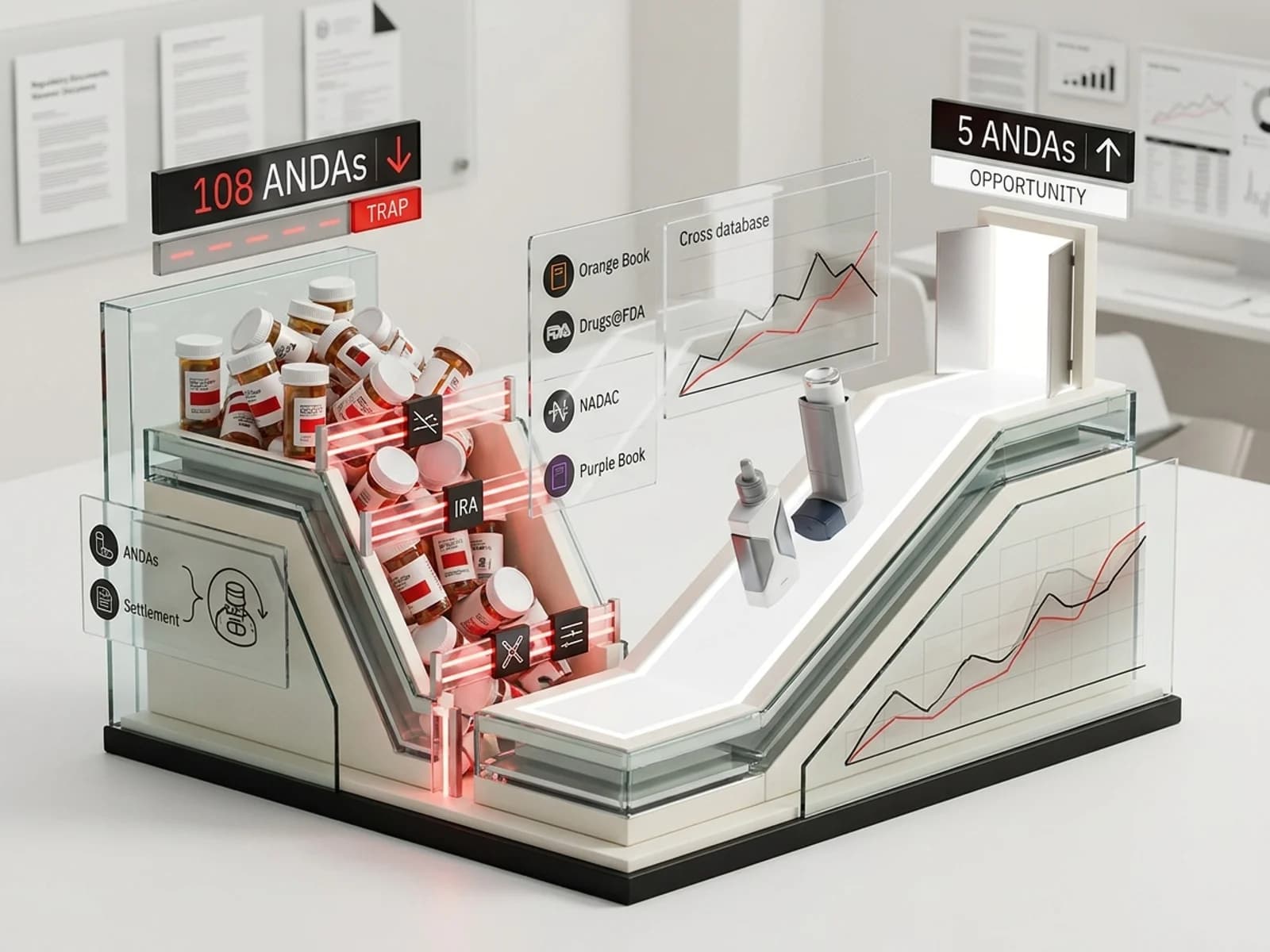
The FDA Orange Book lists 506 orally inhaled drug products across 83 distinct active ingredients and fixed-dose combinations (run date June 10, 2026). Of those 83 molecules, 54 — 65.1 percent — are single-source: a brand NDA is on file but no ANDA has been approved at any strength, so no FDA-rated generic exists. Only 34 of the 506 inhaled products, 6.7 percent, carry an AB therapeutic-equivalence code that lets a pharmacist automatically substitute a generic at the point of dispensing; 339 carry no TE code at all. And the modern respiratory platforms that drive spending — Trelegy, Breo, Anoro, Breztri, Symbicort Aerosphere, Tyvaso DPI, Ohtuvayre — combine device patents and exclusivity that push realistic generic entry deep into the 2030s and 2040s.
This is a narrow, route-specific read of the FDA Orange Book for the orally inhaled (pulmonary) segment — MDIs, DPIs, and nebulized solutions used in asthma, COPD, pulmonary hypertension, and airway infection. Every figure is computed from the public FDA Orange Book (Approved Drug Products with Therapeutic Equivalence Evaluations), run date June 10, 2026. For the database-wide Orange Book picture, see the companion therapeutic-equivalence analysis of 48,000 products; for the route-parallel topical ophthalmic niche, see single-source ophthalmic drops. This article stays on pulmonary inhalation.
Methodology, in one paragraph
The source is the Orange Book products.csv (48,215 total products), filtered to records whose route contains INHALATION (506 products; nasal-route products are excluded). "Distinct molecule" means a distinct Ingredient string, which treats fixed-dose combinations (for example, fluticasone furoate; umeclidinium bromide; vilanterol trifenatate) as their own molecule, separate from each component. An ingredient is single-source when the Orange Book contains at least one NDA (Appl_Type = N) product for it but no ANDA (Appl_Type = A) product at any strength — that is, no FDA-approved generic exists. AB-substitutability is read from the TE_Code field: a product beginning with AB is rated therapeutically equivalent and pharmacy-substitutable. Patent and exclusivity cliffs come from joining each single-source molecule's NDA application numbers to the patents.csv and exclusivity.csv files; "latest expiry" is the maximum patent-expiry year across all patents on those NDAs, excluding the device-only patents that recent FTC and district-court actions have stripped from several listings.
The headline picture
Inhaled products make up a small share of the Orange Book by count — 506 of 48,215 products, just over 1 percent — but they are disproportionately single-source and disproportionately unsubstitutable:
Single-source molecules: 54 of 83 (65.1%). For comparison, the same method on the ophthalmic segment finds 43.8 percent single-source. Pulmonary inhalation is the most concentrated single-source route in the Orange Book.
AB-coded products: 34 of 506 (6.7%). Another 133 carry a non-AB TE code (mostly
AN,AA), and 339 — two thirds of the segment — carry no TE code at all, meaning automatic pharmacy substitution is not permitted even where a second product exists.Products with any generic (ANDA) competition: only 29 of 83 molecules (34.9%) have an approved ANDA at any strength.
The dosage-form mix explains part of the concentration: 89 of the 506 are metered-dose inhalers (AEROSOL, METERED), 71 are dry-powder inhalers (POWDER), and 254 are nebulized solutions. The generic competition that does exist clusters heavily in the nebulized solutions and the older MDIs — albuterol, budesonide, ipratropium, acetylcysteine — while the modern multi-ingredient DPI and MDI platforms remain almost entirely brand-only.
Single-source means two different things here
A molecule can be single-source for two very different reasons, and the Orange Book makes the distinction visible:
Single-source behind an active patent thicket. Trelegy Ellipta (NDA 209482, fluticasone furoate / umeclidinium / vilanterol) carries 15 listed patents with the latest expiring in April 2031. Breo Ellipta (NDA 204275) lists 30 patents, also to 2031. These are on-patent single-source molecules: an ANDA sponsor can file but will face paragraph-IV litigation and cannot launch until the patents expire or are invalidated.
Single-source with no listed patents at all. Mometasone furoate (Asmanex), formoterol/mometasone (Dulera), and fluticasone furoate (Arnuity Ellipta) each have zero patents in the current Orange Book extract. The composition patents have expired, yet no generic has cleared FDA. The barrier here is not IP — it is the combination-product complexity of matching an MDI or DPI device, formulation, and aerodynamic particle-size profile closely enough to demonstrate bioequivalence. FDA regulates orally inhaled products as drug-device combination products with full device design-control requirements, which is why the first generic Flovent HFA only arrived in March 2026 and the first generic Atrovent HFA in February 2026.
The access implication is that patent-cliff modeling alone under-predicts generic entry for inhalers. A molecule can pass its last patent expiry and still stay single-source for years because the device and bioequivalence bar, not the Orange Book patent column, is the binding constraint.
The patent and use-code picture for the modern platforms
The single-source respiratory drugs that drive formulary spending sort cleanly by how far out their protection runs:
| Brand (molecule) | NDA | Listed patents | Latest patent expiry | Generic entry reality |
|---|---|---|---|---|
| Ohtuvayre (ensifentrine) | 217389 | 5 | Jun 2044 | NCE exclusivity to 2029; newest inhaled mechanism (PDE3/4), no generic until 2040s |
| Tyvaso (treprostinil) | 022387 / 214324 | 36 | Feb 2042 | Inhaled prostacyclin for PAH; deep thicket |
| Yupelri (revefenacin) | 210598 | 10 | Oct 2039 | Once-daily nebulized LAMA; use-code U-2440 |
| Arikayce (amikacin liposomal) | 207356 | 13 | May 2035 | GAIN exclusivity to 2030 (orphan/QIDP) |
| Trelegy Ellipta (FF/UMEC/VI) | 209482 | 15 | Apr 2031 | Triple ICS/LAMA/LABA; Ellipta device |
| Breo Ellipta (FF/VI) | 204275 | 30 | Apr 2031 | Ellipta device platform |
| Airsupra (albuterol/budesonide) | 214070 | 1 | May 2030 | Rescue ICS/SABA combo, 2024 launch |
| Anoro Ellipta (UMEC/VI) | 203975 | 6 | Nov 2030 | LAMA/LABA |
| Incruse Ellipta (umeclidinium) | 205382 | 1 | Dec 2027 | LABA component patents expiring first |
| Striverdi Respimat (olodaterol) | 203108 | 1 | Jan 2027 | Respimat device; near-term opening |
Two structural points fall out of this table. First, the Ellipta and Respimat device platforms concentrate the cliff: umeclidinium and olodaterol see their component patents expire in late 2026–2027, but the combination products that actually hold market share (Anoro, Trelegy, Breo) run to 2030–2031 because the vilanterol and fluticasone-furoate patents sit behind them. Second, the newest entrants have the longest runways: Ohtuvayre (approved 2024) and Tyvaso DPI carry protection into the 2040s, so a payer modeling the inhaled pipe over the next decade should assume the single-source layer thickens, not thins.
The device-patent layer is also where regulators are now pushing back. In 2024 the Federal Circuit removed five device patents from Teva's Orange Book listing for the ProAir HFA albuterol inhaler after a challenge from Amneal and the FTC (affirmed by a court in June 2024), and the FTC has separately accused Boehringer Ingelheim of using inhaler-device patents to block generics for Spiriva Respimat and Combivent Respimat. The FTC has also formally notified GSK that device patents on Anoro Ellipta (NDA 203975) and Trelegy Ellipta (NDA 209482) — the very combination DPIs in the table above — are improperly listed, which exposes the 2030–2031 Ellipta cliff to earlier delisting. Those actions trim the patent column for specific products but do not by themselves approve an ANDA — the bioequivalence and device-sameness bar still has to be cleared.
What generics do exist, and where the openings are
The 29 molecules that already have an ANDA define the substitutable layer of the inhaled market, and they cluster in older, simpler products:
Nebulized solutions: albuterol (40 ANDAs), budesonide (18), acetylcysteine (15), levalbuterol (27), arformoterol (17), ipratropium (13) — these are where the AB codes concentrate.
Combination DPI/MDI: fluticasone/salmeterol (11 ANDAs — the generic Advair Diskus, Wixela and others), budesonide/formoterol (5 ANDAs — generic Symbicort, Breyna) — the only multi-ingredient inhalers with generic competition today.
Recent first-generic openings: generic Flovent HFA (fluticasone propionate MDI, Glenmark, approved March 3, 2026 with 180-day Competitive Generic Therapy exclusivity) and generic Atrovent HFA (ipratropium MDI, Armstrong, approved February 23, 2026).
The pattern is that generic entry reaches the inhaled market roughly a decade behind oral solids, and it reaches the simple single-molecule MDIs and nebulized solutions before it reaches the multi-ingredient DPIs. The big-ticket single-source triples and duals — Trelegy, Breztri, Breo, Anoro, Dulera — have no ANDA today, and for Trelegy and Breo none can launch before 2031.
What this means for launch, formulary, and generic-entry teams
For formularies, "off-patent" does not equal "generic available" in inhalation. Mometasone, formoterol/mometasone, and fluticasone-furoate monoproducts have no listed patents and no generic. Do not model automatic substitution or price erosion for inhaled molecules based on patent expiry alone — confirm an AB-coded ANDA exists first.
For payer rebate and WAC-erosion modeling, weight the Ellipta cluster to 2031 and the newer entrants to the late 2030s–2040s. The realistic inflection for the largest respiratory spend (Trelegy, Breo, Anoro) is the 2030–2031 patent cohort, not the 2026–2027 expiry of the individual LABA/LAMA components.
For generic-entry planners, the device-sameness and bioequivalence bar is the real gate, not the Orange Book patent column. Candidates with a clear regulatory pathway (Q1/Q2 formulation sameness, an RLD with a non-complex device, and existing product-specific FDA guidance) are the actionable set — the recent Flovent HFA and Atrovent HFA first generics show the cadence.
For launch teams on the brand side, the device-patent layer is weakening as a defensive tool. The ProAir HFA delisting and the FTC actions against Boehringer Ingelheim mean device patents listed in the Orange Book are no longer reliable exclusivity; the durable protection sits in the active-ingredient and use-code patents plus any regulatory exclusivity (Ohtuvayre's NCE, Arikayce's GAIN).
For 340B and buy-and-bill respiratory programs, expect the single-source layer to keep nebulized-versus-MDI/DPI cost differentials wide through the decade. Generic nebulized solutions will stay cheap; the branded DPI/MDI combinations that hold share will not face generic pressure until their platform patents turn in the early 2030s.
Sources
US FDA, Approved Drug Products with Therapeutic Equivalence Evaluations (Orange Book), active section, run date June 10, 2026 — products, patents, and exclusivity files. Aggregates computed by PharmaDossier from the public Orange Book extract. https://www.accessdata.fda.gov/scripts/cder/ob/default.cfm
US FDA, "First Generic Drug Approvals" (generic Flovent HFA / fluticasone propionate aerosol, Glenmark, March 3, 2026; generic Atrovent HFA / ipratropium bromide aerosol, Armstrong, February 23, 2026). https://www.fda.gov/drugs/drug-and-biologic-approval-and-industry-activity-reports/first-generic-drug-approvals
US FDA, Draft Guidance for Industry, "Metered Dose Inhaler (MDI) and Dry Powder Inhaler (DPI) Drug Products" (drug-device combination-product and design-control requirements for inhaled products). https://www.fda.gov/media/70851/download
US FDA, "Generic Drug Development for Respiratory Drug Products" — Complex Generics briefing (Q1/Q2 sameness, weight-of-evidence bioequivalence, product-specific guidance for orally inhaled and nasal drug products). https://www.complexgenerics.org/wp-content/uploads/crcg/prsnt-Witzmann20190519-ATS.pdf
IntuitionLabs, "Drug Patents Expiring in 2026" (FTC action and 2024 district-court removal of five Teva ProAir HFA device patents; Boehringer Ingelheim Spiriva Respimat / Combivent Respimat device-patent dispute). https://intuitionlabs.ai/articles/drug-patent-expirations-2026
US Federal Trade Commission, warning letter to GlaxoSmithKline Intellectual Property Development regarding improper Orange Book device-patent listings for Anoro Ellipta (NDA 203975) and Trelegy Ellipta (NDA 209482). https://www.ftc.gov/system/files/ftc_gov/pdf/gsk-intel-prop-dev-anoro-and-trelegy-ellipta-4302024.pdf
US Federal Circuit / "Patents on Inhaler Devices Can't Block Generics: Federal Circuit Clarifies Orange Book Listings" (Teva v. Amneal; only patents claiming the active ingredient may be listed). https://www.uspatent.com/2024/12/patents-on-inhaler-devices-cant-block-generics-federal-circuit-clarifies-orange-book-listings
Drugs.com, "Generic Tyvaso DPI Availability" (no generic treprostinil DPI approved; treprostinil device and method-of-use patents). https://www.drugs.com/availability/generic-tyvaso-dpi.html
US FDA, Drugs@FDA approval records for inhaled NCEs and combination products (Ohtuvayre/ensifentrine NDA 217389; Trelegy Ellipta NDA 209482; Breo Ellipta NDA 204275; Airsupra NDA 214070; Arikayce NDA 207356). https://www.accessdata.fda.gov/scripts/cder/daf/
"Regulatory Considerations for Approval of Generic Inhalation Drug Products in the US, EU, Brazil, China, and India" (Q1 sameness, device and formulation equivalence barriers to generic DPI/MDI approval). https://pmc.ncbi.nlm.nih.gov/articles/PMC4540743/