Radioligand therapy (RLT)—also referred to as therapeutic radiopharmaceuticals—has transitioned from a niche sector of nuclear medicine into one of the most heavily capitalized frontiers in oncology. By combining a targeting molecule (such as a monoclonal antibody, small molecule, or peptide) with a therapeutic radioisotope via a chelator-linker, RLTs deliver ionizing radiation directly to tumor cells. To map the global development landscape of this modality, we conducted a rigorous, reproducible analysis of the ClinicalTrials.gov registry (snapshot dated July 9, 2026, encompassing 593,126 registered studies — see our broader ClinicalTrials.gov registry by the numbers and the companion cell and gene therapy trials by the numbers for the full-registry and advanced-modality context).
Our analysis identified a specific cohort of 1,270 therapeutic radioligand/radiopharmaceutical trials globally, after explicitly excluding 1,994 diagnostic-only nuclear imaging trials (such as those utilizing fluorine-18, gallium-68, technetium-99m, or iodine-123). The data reveals a rapidly maturing field: trial starts peaked at 124 in 2024, with 96 new trials initiated in 2026 through the July snapshot date. However, the commercial reality of the field is highly concentrated: only two systemic radioligand therapies are currently FDA-approved (both marketed by Novartis), and the entire pipeline is constrained by a global isotope-supply bottleneck, particularly for the promising alpha-emitter actinium-225 and high-purity no-carrier-added lutetium-177.
How many radioligand therapy trials are there, and how are therapy trials separated from diagnostic imaging?
Of the 593,126 trials in the registry, 1,270 are focused on radiopharmaceutical therapy. A critical challenge in analyzing the radiopharmaceutical space is the concept of "theranostics"—the use of the same targeting ligand for both diagnostic imaging (paired with a positron or gamma emitter) and therapy (paired with a beta or alpha emitter).
To build a clean, therapy-only cohort, we developed a query that filtered out diagnostic-only isotope trials. We excluded 1,994 registered trials that exclusively used diagnostic isotopes:
Technetium-99m (Tc-99m) & Indium-111 (In-111): Used for single-photon emission computed tomography (SPECT) imaging.
Fluorine-18 (F-18) & Gallium-68 (Ga-68): Used for positron emission tomography (PET) imaging (such as 68Ga-PSMA-11 or 18F-FDG).
Iodine-123 (I-123): Used for diagnostic thyroid or adrenal imaging.
By excluding these imaging trials, the remaining 1,270-trial cohort represents the true therapeutic pipeline, where the radioisotope is selected to destroy tumor tissue via beta, alpha, or Auger electron emission.
Longitudinal Growth and Annual Trial Starts
The annual run-rate of therapeutic radioligand trials shows a steady upward trajectory over the past decade, driven by Novartis's landmark approvals and subsequent large-scale acquisitions (such as Eli Lilly acquiring Point Biopharma and Bristol Myers Squibb acquiring RayzeBio — deal activity tracked in our 2026 biopharma M&A by the numbers).
| Year of Trial Initiation | Number of RLT Trial Starts |
|---|---|
| 2018 | 55 |
| 2019 | 65 |
| 2020 | 79 |
| 2021 | 67 |
| 2022 | 75 |
| 2023 | 97 |
| 2024 | 124 (Peak Year) |
| 2025 | 94 |
| 2026 (YTD through July 9) | 96 |
The 96 trial starts initiated in the first half of 2026 indicate that the full-year run-rate is projected to match or exceed the 2024 peak. This growth reflects the clinical expansion of RLTs from late-line metastatic castration-resistant prostate cancer (mCRPC) into earlier, hormone-sensitive settings, as well as the initiation of Phase 1/2 trials for novel targeting ligands and alpha-emitting isotopes.
Clinical Phase Distribution and Trial Status
The clinical phase mix of the 1,270-trial therapy cohort illustrates the unique regulatory and operational characteristics of radiopharmaceuticals.
Not Applicable (NA): 326 trials (25.7% — primarily investigator-initiated studies, academic dose-finding protocols, or diagnostic-therapeutic comparison trials that do not follow traditional pharmaceutical development phases).
Phase 2: 318 trials (25.0%)
Phase 1: 271 trials (21.3%)
Phase 1/2 (Combined): 139 trials (10.9%)
Phase 3: 114 trials (9.0%)
Early Phase 1: 70 trials (5.5%)
Phase 4: 19 trials (1.5%)
Phase 2/3 (Combined): 13 trials (1.0%)
The high proportion of "NA" phase designations (25.7%) is a key differentiator from the ADC pipeline (where NA represents only 10.8%). This is due to the historical role of academic medical centers and hospital radiopharmacies, which often initiate investigator-sponsored trials (ISTs) using locally compounded radiopharmaceuticals under local institutional review board (IRB) oversight before industrial sponsors file Investigational New Drug (IND) applications.
The median enrollment across the RLT cohort is 35 patients, reflecting the localized nature of early radiopharmaceutical testing and the strict patient selection protocols required for isotope therapies.
In terms of recruitment status:
Completed: 473 trials (37.2%)
Recruiting: 292 trials (23.0%)
Unknown Status: 128 trials (10.1%)
Terminated: 116 trials (9.1%)
Active, Not Recruiting: 110 trials (8.7%)
Not Yet Recruiting: 62 trials (4.9%)
Withdrawn: 58 trials (4.6%)
Suspended/Other: 31 trials (2.4%)
The 9.1% termination rate (116 trials) is higher than that seen in the general oncology pipeline, reflecting the unique logistical challenges of radiopharmaceuticals. Many trials are terminated not due to clinical failure, but because of an inability to secure a consistent supply of the required radioisotope, or because of last-mile logistical failures (such as the decay of the isotope during shipping).
Which radioisotopes dominate the therapeutic pipeline?
The clinical and commercial profile of a radioligand therapy is defined by the physical characteristics of its isotope payload. We mapped the specific radioisotopes utilized across the 1,270-trial cohort.
| Radioisotope | Number of Clinical Trials | Emission Type | Half-Life | Primary Clinical Indications |
|---|---|---|---|---|
| Lutetium-177 (Lu-177) | 346 | Beta | 6.6 days | Prostate (PSMA), GEP-NETs (SSTR), Solid Tumors |
| Yttrium-90 (Y-90) | 304 | Beta | 2.7 days | Hepatic Tumors (SIRT/TARE), Lymphoma |
| Iodine-131 (I-131) | 208 | Beta / Gamma | 8.0 days | Thyroid Cancer, Neuroblastoma (MIBG) |
| Radium-223 (Ra-223) | 108 | Alpha | 11.4 days | Prostate Cancer Bone Metastases |
| Actinium-225 (Ac-225) | 56 | Alpha | 9.9 days | Prostate, Hematologic, Solid Tumors |
| Astatine-211/Copper-67 (At-211/Cu-67) | 11 | Alpha / Beta | Variable | Glioblastoma, Lymphoma, Solid Tumors |
Lutetium-177: The Beta-Emitting Workhorse
With 346 trials (27.2% of the cohort), Lutetium-177 is the dominant isotope in RLT development. Lu-177 is a beta emitter with a maximum tissue penetration of approximately 2 mm, making it ideal for treating small-to-medium-sized tumor deposits while sparing surrounding healthy tissue. Its half-life of 6.6 days is long enough to allow for centralized manufacturing and global distribution, yet short enough to prevent prolonged patient hospitalization. The clinical and commercial success of Novartis's Pluvicto and Lutathera has established Lu-177 as the industry baseline.
Yttrium-90 and Iodine-131: The Legacy Isotopes
It is important to contextualize the high trial counts for Y-90 (304 trials) and I-131 (208 trials). These are largely legacy cohorts:
Y-90: The majority of Y-90 trials evaluate selective internal radiation therapy (SIRT) or transarterial radioembolization (TARE) using Y-90-labeled glass or resin microspheres (such as Sir-Spheres or TheraSphere) for primary or metastatic liver tumors. This is a localized, device-like administration rather than a systemic targeted RLT.
I-131: Primarily represents legacy thyroid ablation therapies or older peptide-targeted therapies like I-131 MIBG for neuroblastoma. I-131 emits high-energy gamma rays alongside beta particles, requiring strict patient isolation due to external radiation risks.
The Alpha-Emitting Frontier: Actinium-225
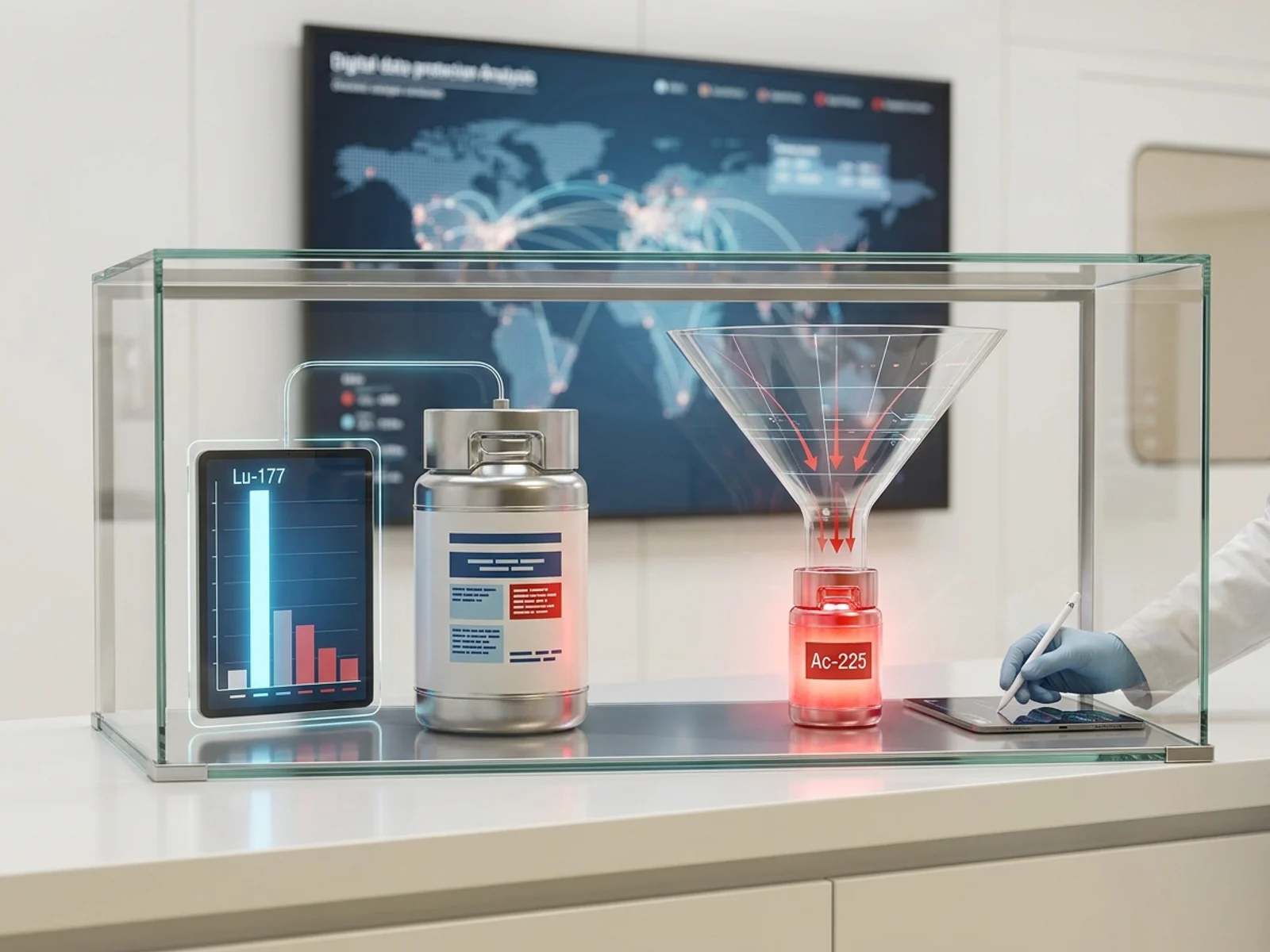
The most significant pipeline growth is in alpha-emitting isotopes, led by Actinium-225 (56 trials). Alpha particles are high-energy helium nuclei that deposit their energy over a very short distance (40–100 μm, or 2–10 cell diameters). Unlike beta particles (which cause single-strand DNA breaks that tumor cells can often repair), alpha radiation induces high-density double-strand DNA breaks, which are almost universally lethal to the cell.
Because of this high linear energy transfer (LET), alpha-emitting RLTs are highly effective against tumors that have become resistant to beta-emitting therapies. The 56 trials targeting Ac-225 represent the vanguard of this new class, targeting PSMA, HER2, and other solid tumor antigens.
Which companies are running the most radioligand trials?
Sponsorship of radioligand trials is heavily weighted toward academic and public institutions, reflecting the clinical origins of the field in academic medical centers.
Sponsor Class Split
Of the 1,270 trials in the cohort:
Academic / Other: 793 trials (62.4%) — Led by major research institutions and university medical centers (particularly in Germany, Australia, and China, where regulatory frameworks historically permitted investigator-initiated RLT testing).
Industry: 408 trials (32.1%) — Funded by commercial biopharmaceutical firms.
National Institutes of Health (NIH): 40 trials (3.1%)
Other Government: 15 trials (1.2%)
Network: 12 trials (0.9%)
Federal (non-NIH): 2 trials (0.2%)
The 62.4% academic share is significantly higher than that of the general oncology pipeline, underscoring the collaborative nature of RLT development, where industrial sponsors often license compounds that have already undergone initial human proof-of-concept testing in academic centers.
Top Industrial and Institutional Sponsors
We mapped the top sponsors within the RLT cohort.
| Sponsor Name | Number of RLT Clinical Trials | Sponsor Category |
|---|---|---|
| Eli Lilly and Company | 53 | Industry |
| Bayer | 50 | Industry |
| AstraZeneca | 43 | Industry |
| Novartis Pharmaceuticals | 42 | Industry |
| Peking Union Medical College Hospital | 28 | Academic / Other |
| National Cancer Institute (NCI) | 23 | NIH |
| M.D. Anderson Cancer Center | 19 | Academic / Other |
| Memorial Sloan Kettering (MSKCC) | 19 | Academic / Other |
| Weill Medical College of Cornell University | 18 | Academic / Other |
| Central Hospital, Nancy, France | 14 | Academic / Other |
| University of California, San Francisco (UCSF) | 12 | Academic / Other |
| Mayo Clinic | 12 | Academic / Other |
| Peter MacCallum Cancer Centre, Australia | 12 | Academic / Other |
| Gilead Sciences | 11 | Industry |
| City of Hope Medical Center | 11 | Academic / Other |
| IRST Dino Amadori (Italy) | 11 | Academic / Other |
| GlaxoSmithKline | 10 | Industry |
| Sidney Kimmel Comprehensive Cancer Center | 10 | Academic / Other |
Eli Lilly, Bayer, and AstraZeneca Lead Industry Sponsorship
While Novartis is the commercial market leader in radioligand therapy (Pluvicto and Lutathera anchor its oncology franchise), other pharmaceutical giants lead in terms of active trial sponsorship:
Eli Lilly and Company: Leads with 53 trials, a footprint significantly expanded by its $1.4 billion acquisition of Point Biopharma in late 2023. Lilly’s portfolio includes PNT2002 (Lu-177-PSMA-I&T) in Phase 3 for prostate cancer and multiple early-stage alpha-emitting programs.
Bayer: Holds 50 trials, driven by its legacy commercial asset Xofigo (Radium-223 dichloride) and its expansion into targeted thorium-227 and lutetium-177 conjugates.
AstraZeneca: Holds 43 trials, expanding rapidly through internal development and partnerships targeting targeted radiopharmaceuticals.
Novartis: Spans 42 trials, focused on lifecycle management for Pluvicto and Lutathera (such as moving Pluvicto into hormone-sensitive prostate cancer in the Phase 3 PSMAddition trial) and its emerging actinium-225 pipeline (evaluated in the Phase 1/2 AcTION trial).
What is approved today, and what is the near-term regulatory pipeline?
Currently, only two systemic, targeted radioligand therapies are FDA-approved, both developed by Novartis and both utilizing Lutetium-177:
Lutathera (lutetium Lu 177 dotatate): Approved in 2018 for somatostatin receptor (SSTR)-positive gastroenteropancreatic neuroendocrine tumors (GEP-NETs).
Pluvicto (lutetium Lu 177 vipivotide tetraxetan): Approved in 2022 for prostate-specific membrane antigen (PSMA)-positive metastatic castration-resistant prostate cancer (mCRPC) after treatment with androgen receptor pathway inhibition and taxane-based chemotherapy.
These two commercial assets generated combined global sales of approximately $2.8 billion in 2025, demonstrating the massive market potential of the class.
Near-Term Regulatory Milestones (2026)
The RLT market is poised to expand significantly in late 2026, driven by several major regulatory events:
ITM-11 (n.c.a. 177Lu-edotreotide): Developed by ITM Isotope Technologies Munich, this no-carrier-added Lu-177-labeled peptide targeting SSTR has an FDA PDUFA action date of August 28, 2026, for GEP-NETs. If approved, it will represent the first direct commercial competitor to Lutathera.
PNT2003 (lutetium Lu 177 dotatate): Developed by Point Biopharma (Eli Lilly) and licensed to Lantheus. In March 2026, the FDA granted tentative approval to PNT2003, a generic/radioequivalent version of Lutathera. The tentative approval is subject to patent litigation resolution, but it represents the first biosimilar-like competitor in the targeted radiopharmaceutical space.
Pluvicto PSMAddition Readout: Novartis is seeking label expansion into metastatic hormone-sensitive prostate cancer (mHSPC) based on the Phase 3 PSMAddition trial. Regulatory submission is expected in late 2026, which would double the eligible patient population for Pluvicto.
Why is actinium-225 (and no-carrier-added Lu-177) supply the industry bottleneck?
The principal constraint on the expansion of targeted radiopharmaceuticals is not biology, but manufacturing and supply chain logistics. Unlike traditional small molecules or biologics, radiopharmaceuticals cannot be stockpiled. They have an expiration date measured in hours or days due to radioactive decay.
The Pluvicto Shortage of 2023
The vulnerability of the RLT supply chain was exposed in early 2023 when Novartis was forced to suspend new patient starts for Pluvicto. The drug was placed on the FDA’s drug shortage list due to manufacturing outages at its single approved facility in Ivrea, Italy. Patients with advanced prostate cancer faced weeks of delays as the company struggled to scale up production.
In response, Novartis expanded its manufacturing footprint. By 2026, the company established four global radioligand manufacturing sites (Ivrea, Italy; Millburn, New Jersey; Zaragoza, Spain; and a new high-capacity facility in Indianapolis, Indiana) with a combined capacity exceeding 250,000 doses per year.
The Isotope Supply Race: Actinium-225 and n.c.a. Lutetium-177
The current battleground is the supply of raw radioisotopes:
No-Carrier-Added (n.c.a.) Lu-177: Traditional carrier-added Lu-177 contains trace amounts of the long-lived, radioactive impurity lutetium-178m, which requires specialized, high-cost medical waste disposal. No-carrier-added Lu-177 avoids this issue. SHINE Technologies' Cassiopeia facility in Janesville, Wisconsin, is currently the largest North American producer of n.c.a. Lu-177, helping stabilize the supply chain for Pluvicto and emerging pipeline candidates.
Actinium-225 (Ac-225): The supply of Ac-225 is exceptionally scarce. Historically, the global supply of Ac-225 was limited to "milking" clinical-grade thorium-229 generators (primarily at Oak Ridge National Laboratory and the Joint Research Centre in Karlsruhe, Germany), producing only enough isotope to treat a few thousand patients annually.
To support the 56 clinical trials currently underway (and the projected commercial launches of alpha therapies in the late 2020s), multiple firms are racing to scale Ac-225 production using cyclotrons or linear accelerators:
Cardinal Health: By early 2026, Cardinal Health had quadrupled its weekly output of Ac-225 at its Center for Theranostics Advancement (CTA) in Indianapolis, Indiana, following the start of routine at-scale production in late 2024, and it expects to continue expanding capacity with a planned multi-year investment.
PanTera: A joint venture between IBA and the Belgian nuclear research center SCK CEN, PanTera raised EUR 93 million in an oversubscribed Series A round (September 2024, plus debt financing for roughly EUR 134 million in total funding) to scale its proprietary photo-nuclear actinium-225 production process, targeting commercial-scale output by 2028-2029.
TerraPower & US DOE: Actively collaborating to harvest thorium-229 from legacy nuclear materials to increase global generator-derived Ac-225 output.
For biopharma BD and strategy teams, securing a dedicated, long-term supply agreement for Ac-225 and n.c.a. Lu-177 is now a mandatory prerequisite for advancing any radioligand program into Phase 2 or Phase 3 trials.
Frequently Asked Questions
What is the difference between radioligand therapy and diagnostic nuclear imaging, and why does it matter for the trial count?
Radioligand therapy uses high-energy beta or alpha-emitting isotopes (such as Lu-177 or Ac-225) to destroy cancer cells by inducing DNA double- or single-strand breaks. Diagnostic nuclear imaging uses low-energy gamma or positron-emitting isotopes (such as Ga-68 or F-18) to detect tumor cells via PET or SPECT scans. Separating them is critical because including diagnostic imaging trials would inflate the trial count by nearly 2,000 studies, masking the true therapeutic pipeline size and the specific logistics of therapeutic isotope supply.
Which radioligand therapies are FDA-approved as of 2026?
Only two targeted systemic radioligand therapies are FDA-approved: Novartis's Lutathera (approved 2018 for SSTR+ GEP-NETs) and Pluvicto (approved 2022 for PSMA+ mCRPC). Bayer's Xofigo (Radium-223) is approved for bone-metastatic prostate cancer but is a localized bone-seeking agent rather than a targeted systemic ligand.
It is important to note the registrational basis for these approvals:
Lutathera: Approved based on the pivotal NETTER-1 Phase 3 trial, which demonstrated a 79% reduction in the risk of disease progression or death for Lutathera plus best supportive care compared to high-dose octreotide LAR alone ($p < 0.0001$). More recently, the NETTER-2 trial demonstrated that Lutathera in the first-line setting significantly extended progression-free survival (PFS) in patients with high-grade gastroenteropancreatic neuroendocrine tumors, highlighting the trend toward moving RLT into earlier lines.
Pluvicto: Approved based on the VISION Phase 3 trial in patients with progressive PSMA-positive mCRPC. The trial demonstrated that adding Pluvicto to best supportive care significantly improved overall survival (OS) compared to best supportive care alone, with a median OS of 15.3 months vs. 11.3 months ($p < 0.001$).
Why is everyone racing to secure actinium-225 supply?
Actinium-225 is a highly potent alpha-emitting isotope that can deliver lethal double-strand DNA breaks to tumor cells within a short range, sparing surrounding tissue. It is highly effective in patients who have become resistant to traditional beta-emitting therapies like Lu-177. However, the global supply of Ac-225 is currently extremely limited, and clinical development is constrained by this shortage, creating a race to secure commercial-scale production.
Furthermore, the physical properties of Ac-225 create a distinct advantage over beta emitters. While beta particles require thousands of radiation hits to kill a cell, just one to ten alpha particle hits from Ac-225 can cause irreparable double-strand DNA breaks, leading to cell death. This high cytotoxicity makes alpha therapies highly promising for targeting small clusters of micrometastatic disease and circulating tumor cells.
How does this radioligand trial count compare to external market trackers?
Our count of 1,270 trials is derived directly from ClinicalTrials.gov and represents registered clinical-stage therapeutic trials. External market trackers often report higher numbers because they include preclinical drug candidate profiles, patent filings, and diagnostic-only imaging protocols under a broad "radiopharmaceutical" umbrella.
What are the main isotope production methods, and why are they difficult to scale?
Radioisotope production is highly complex and requires specialized nuclear infrastructure.
Lu-177 is produced via two main reactor routes:
Indirect (Carrier-Added) Route: Produced by neutron irradiation of target materials containing ytterbium-176. This method creates stable Lu-177 but also generates trace amounts of the long-lived, radioactive impurity lutetium-178m, which has a half-life of 160 days and complicates waste disposal.
Direct (No-Carrier-Added) Route: Produced by irradiating highly enriched ytterbium-176 and then using chemical separation to isolate n.c.a. Lu-177. This creates high-purity isotope with no long-lived impurities, but the chemical separation process is technically demanding and produces lower initial yields.
Ac-225 is produced via:
Generator (Milking) Route: Derived from the decay of thorium-229. While this yields high-purity Ac-225, the global inventory of thorium-229 is extremely small, capping annual production.
Cyclotron (Proton Bombardment) Route: Bombardment of radium-226 targets in high-energy cyclotrons. This route has the potential to produce commercial-scale quantities but requires handling highly radioactive radium targets and separating radium isotopes from actinium.
Sources
U.S. National Institutes of Health (NIH) ClinicalTrials.gov: Database of Clinical Trials, Registry Snapshot July 9, 2026. URL: clinicaltrials.gov.
BioSpace: "Radiopharma Sector Races to Secure Actinium-225 Supply as Pipelines Expand," April 2026. URL: biospace.com.
Novartis Media Release: "Novartis Highlights Pluvicto PSMAddition Efficacy and Phase 1 AcTION Data at ASCO 2026," June 2026. URL: novartis.com.
ITM Isotope Technologies Munich: "FDA Acceptance of NDA for ITM-11 in GEP-NETs," March 2026. PDUFA August 28, 2026.
IMV / Science and Medicine Group: "Radiopharmaceutical Supply Chain Under Pressure: Can Infrastructure Keep Up with Demand?" February 2026. URL: scienceandmedicinegroup.com.
Fortune Business Insights: "Radioligand Therapies Market Size, Share, and Growth Report 2026." URL: fortunebusinessinsights.com.
IBA / PanTera Press Release: "IBA's joint venture PanTera secures EUR 93 million in oversubscribed Series A round to accelerate global actinium-225 production," September 2024.