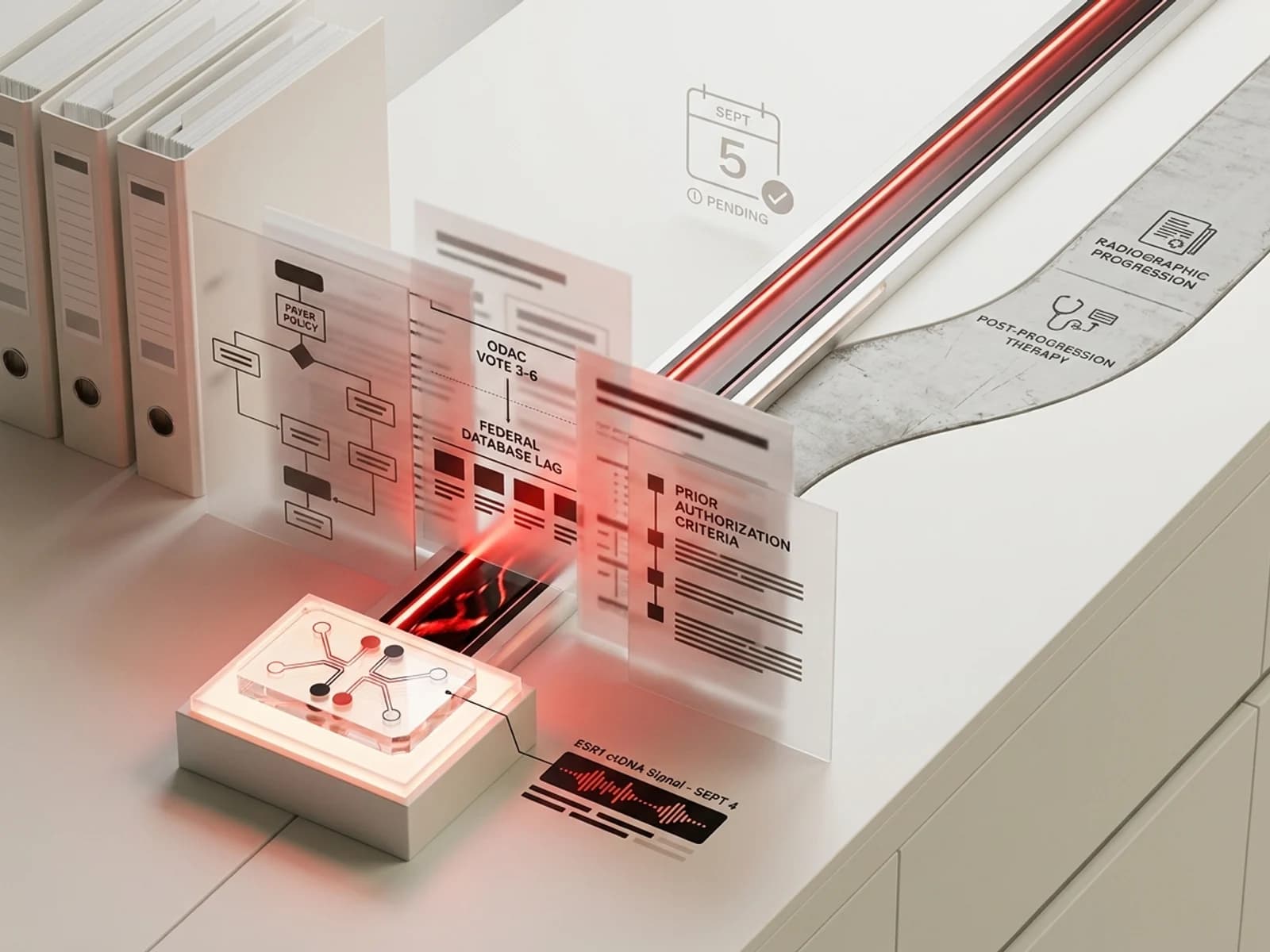
Radioligand therapies (RLTs) represent one of the fastest-growing modalities in precision oncology, combining target-seeking vectors with therapeutic beta- or alpha-emitting radioisotopes. However, scaling commercial patient access for approved RLTs such as Pluvicto (lutetium Lu 177 vipivotide tetraxetan) and Lutathera (lutetium Lu 177 dotatate) requires navigating a complex matrix of buy-and-bill specialty drug reimbursement, strict diagnostic companion PET scan authorization, and stringent Nuclear Regulatory Commission (NRC) radiation safety compliance. As ITM Isotope Technologies Munich approaches an August 28, 2026 FDA PDUFA goal date for 177Lu-edotreotide (ITM-11), the neuroendocrine tumor (NET) market is poised for its first head-to-head radiopharmaceutical competition, challenging Novartis's long-standing monopoly.
+-----------------------------------------------------------------------------------+
|                        RADIOLIGAND THERAPY CARE DELIVERY PIPELINE                  |
+-----------------------------------------------------------------------------------+
|                                                                                   |
|   1. DIAGNOSTIC IMAGING    ──► 2. PRIOR AUTHORIZATION  ──► 3. RADIOPHARMACY LOGISTICS |
|   • 68Ga-PSMA-11 / PET        • Payer PSMA/SSTR Positivity • Short Half-Life (6.6d)  |
|   • 68Ga-DOTATATE / PET       • Step-Therapy Verification  • Just-in-Time Delivery    |
|                                                                                   |
|   4. SITE-OF-CARE ADMIN    ──► 5. REIMBURSEMENT BILLING                             |
|   • NRC Licensed Site         • HCPCS A-Codes (A9607 / A9513)                     |
|   • Authorized User (AU)      • JW / JZ Waste Modifiers                           |
|                                                                                   |
+-----------------------------------------------------------------------------------+
Direct Commercial & Regulatory Answer
How do commercial payers and Medicare cover radioligand therapies, what site-of-care constraints govern patient delivery, and how will ITM's pending PDUFA for 177Lu-edotreotide alter the market access landscape? Approved RLTs operate under a specialized buy-and-bill reimbursement structure utilizing dedicated Healthcare Common Procedure Coding System (HCPCS) A-codes (A9607 for Pluvicto, whose wholesale acquisition cost is about $51,000 per 7.4 GBq dose as of early 2026 — it launched at $42,500 in 2022; A9513 for Lutathera, about $61,000 per dose). Commercial and Medicare Advantage prior authorization requires mandatory diagnostic PET imaging confirmation—demonstrating PSMA-positive lesions via 68Ga-PSMA-11 or 18F-DCFPyL PET for Pluvicto, or somatostatin receptor (SSTR) expression via 68Ga-DOTATATE PET for Lutathera—alongside step-therapy failure of prior ARDT (and taxane chemotherapy for Pluvicto). Administration is legally restricted to medical centers possessing Nuclear Regulatory Commission (NRC) broad-scope or specific byproduct material licenses under 10 CFR 35.390, creating severe site-of-care capacity bottlenecks. ITM's pending PDUFA for 177Lu-edotreotide (ITM-11 / Solucin, PDUFA date August 28, 2026) introduces the first direct Lu-177 SSTR competitor to Lutathera in gastroenteropancreatic neuroendocrine tumors (GEP-NETs): the Phase 3 COMPETE trial showed median PFS of 23.9 vs 14.1 months versus everolimus (HR 0.67, p=0.022), positioning it to challenge Novartis's long-standing single-source position in the NET market.
Commercial & Medicare Reimbursement Architecture for Approved RLTs
Reimbursement for radioligand therapies differs fundamentally from conventional intravenous chemotherapy or biologic infusions. Because radiopharmaceuticals contain short-lived radioactive isotopes bound to targeting ligands, they are classified as therapeutic radiopharmaceuticals and billed under specific HCPCS Level II codes.
Detailed HCPCS Billing & Reimbursement Coding Matrix
| Drug / Radiopharmaceutical | HCPCS Code | Billing Unit | Wholesale Acquisition Cost (WAC) | Medicare HOPPS Status |
|---|---|---|---|---|
| Pluvicto (177Lu-vipivotide tetraxetan) | A9607 | Therapeutic radiopharmaceutical, 1 mCi (7.4 GBq / ~200 mCi per dose) | ~$51,000 per dose (early 2026; launched at $42,500 in 2022) | Status Indicator K — pass-through expired Sept 30, 2025; now separately payable off ASP |
| Lutathera (177Lu-dotatate) | A9513 | Lutetium Lu 177, dotatate, therapeutic, 1 mCi (200 mCi per dose) | ~$61,000 per dose (early 2026) | Status Indicator K — separately payable radiopharmaceutical |
| Locametz (68Ga gozetotide / PSMA-11) | A9591 | Gallium Ga-68, PSMA-11, diagnostic, 1 mCi | Priced per diagnostic injection | Diagnostic PET agent (packaged/contracted) |
| Pylarify (18F-DCFPyL / piflufolastat) | A9595 | Piflufolastat F-18, diagnostic, 1 mCi | Priced per diagnostic injection | Diagnostic PET agent (packaged/contracted) |
| Netspot (68Ga-DOTATATE) | A9587 | Gallium Ga-68, dotatate, diagnostic, 0.1 mCi | Priced per diagnostic injection | Diagnostic PET agent (packaged/contracted) |
Therapeutic radiopharmaceuticals bill per millicurie under their A-code rather than under a J-code (the convention for most infused oncology drugs). The administration itself is billed separately under CPT 79101 (radiopharmaceutical therapy, intravenous). WAC is a manufacturer-set list price; actual hospital acquisition cost and net reimbursement vary by ASP-based reporting and payer contract, and very few patients pay list price.
                       REIMBURSEMENT CODE FLOW (PLUVICTO INFUSION)
  ┌──────────────────────────────────────────────────────────────────────────┐
  │ HCPCS A9607: Pluvicto Dose (7.4 GBq / 200 mCi) ────────► ~$51,000 (WAC) │
  ├──────────────────────────────────────────────────────────────────────────┤
  │ CPT 79101: Radiopharmaceutical Admin (IV) ─────────────► $280–$420     │
  ├──────────────────────────────────────────────────────────────────────────┤
  │ JW / JZ Modifiers: Waste Documentation ────────────────► Mandatory       │
  └──────────────────────────────────────────────────────────────────────────┘
Key Reimbursement Mechanics & Waste Billing (JW/JZ Modifiers)
HOPPS Pass-Through Status Expiration: Pluvicto originally enjoyed transitional pass-through payment status under the Medicare Hospital Outpatient Prospective Payment System (HOPPS). Following pass-through expiration, Medicare reclassified A9607 under Status Indicator K, paying hospitals a bundled or separately calculated rate based on Average Sales Price (ASP). Under current CMS rules, ASP calculation for radiopharmaceuticals presents financial risk to outpatient clinics if acquisition costs exceed the ASP + 6% allowance.
JW and JZ Waste Modifier Compliance: Because radioactive decay reduces effective dose activity over time, radiopharmacies must calibrate doses precisely for patient administration windows. CMS mandates the use of modifier JZ (attesting to zero wasted radioisotope) or modifier JW (reporting discarded single-dose waste volume). Failure to submit correct JW/JZ modifiers results in immediate claim rejection by Medicare Administrative Contractors (MACs).
Navigating the financial architecture of radiopharmaceutical administration requires healthcare systems to establish dedicated revenue cycle management teams specialized in nuclear medicine billing. Unlike oral targeted therapies or standard biologic infusions routed through pharmacy benefit managers, radioligand therapies are predominantly acquired under the medical benefit via buy-and-bill mechanics. Outpatient cancer centers must float significant working capital to purchase individual ~$51,000 to ~$61,000 doses upfront, creating cash-flow risks if commercial claims encounter delays, pre-authorization disputes, or unexpected audit holdbacks.
Site-of-Care & Nuclear Regulatory Infrastructure Bottlenecks
Unlike conventional infusion clinics, facilities administering radioligand therapies must comply with stringent federal regulations enforced by the Nuclear Regulatory Commission (NRC) under 10 CFR Part 35 or equivalent Agreement State regulations (site-of-care edits).
                      NRC REGULATORY & FACILITY REQUIREMENT MATRIX
  ┌──────────────────────────────────────────────────────────────────────────┐
  │ REQUIREMENT 1: 10 CFR 35.390 Authorized User (AU) Designation             │
  │ Board-certified Nuclear Medicine Physician or Radiation Oncologist       │
  │ Requires 700 hours of structured training + classroom work               │
  ├──────────────────────────────────────────────────────────────────────────┤
  │ REQUIREMENT 2: Radioactive Material License (RML) Broad-Scope            │
  │ Issued by NRC or Agreement State for handling 177Lu (beta-emitter)      │
  ├──────────────────────────────────────────────────────────────────────────┤
  │ REQUIREMENT 3: Specialized Hot-Lab & Radiation Shielding Infrastructure    │
  │ Lead-shielded infusion bays, dose calibrators, decay storage facilities  │
  ├──────────────────────────────────────────────────────────────────────────┤
  │ REQUIREMENT 4: Patient Release Criteria (10 CFR 35.75)                   │
  │ Total effective dose equivalent to other individuals <=5 mSv (0.5 rem)   │
  └──────────────────────────────────────────────────────────────────────────┘
Site-of-Care Capacity Bottlenecks & Commercial Access Implications
Authorized User (AU) Shortage: Under 10 CFR 35.390, RLT administration requires an Authorized User designation. Medical oncologists who manage prostate cancer and NET patients typically lack AU certification, forcing patient referrals to academic medical centers or specialized nuclear medicine departments.
Just-In-Time Radiopharmacy Logistics: Lutetium-177 has a physical half-life of 6.64 days. Doses are manufactured at centralized nuclear reactors or cyclotrons and shipped directly to the treating facility for administration within a narrow 6-to-12-hour delivery window. Logistics delays or patient transportation issues lead to decayed, unusable doses costing $40,000+ per occurrence.
Facility Capacity Constraints: Only a constrained, geographically uneven set of US medical centers possess the requisite NRC broad-scope license, hot-lab infrastructure, and AU staff to administer Pluvicto and Lutathera. This creates severe geographic access disparities and long treatment waiting lists, delaying therapy initiation by weeks to months (site-of-care access peer).
The shortage of licensed administration sites creates a structural barrier to rapid commercial expansion. While traditional oncology drugs can be administered across thousands of community practices and regional infusion clinics, radioligand therapies remain tethered to specialized nuclear medicine facilities. Commercial health plans seeking to enforce site-of-care redirection policies—shifting infusions away from high-cost hospital outpatient departments to independent physician offices—find that independent community practices simply cannot satisfy NRC licensing, radiation safety shielding, and radioactive waste storage regulations.
Global Supply Chain Vulnerabilities & Reactor Supply Dynamics
Scaling commercial radioligand access relies on an extraordinarily fragile global nuclear supply chain. Lutetium-177 is produced in a limited number of specialized research reactors worldwide, including the FRM II reactor in Germany, the BR2 reactor in Belgium, the OPAL reactor in Australia, and the MURR reactor in the United States.
Nuclear Reactor Supply Chain Risk Factors
Unscheduled Reactor Outages: Because research reactors require routine maintenance and refueling, unscheduled shutdowns can immediately disrupt global 177Lu supply. During the 2022–2023 Pluvicto supply shortage, Novartis had to pause new patient initiations because demand outstripped available, on-spec doses — a reminder of how thin just-in-time radiopharmaceutical manufacturing capacity is.
Carrier-Added vs. No-Carrier-Added Supply: ITM-11 is manufactured with no-carrier-added (n.c.a.) lutetium-177 — produced by neutron irradiation of an ytterbium-176 ($^{176}\text{Yb}$) target — which ITM positions as offering higher specific activity and fewer long-lived impurities than carrier-added 177Lu routes. Whether that translates into a meaningful access or waste-handling advantage versus Lutathera is part of ITM's commercial differentiation argument rather than settled practice.
Decay During Transport: Transporting radiopharmaceuticals from centralized radiopharmacies to regional hospitals incurs physical activity decay. A shipment delayed by a day loses a meaningful fraction of its therapeutic radioactivity (177Lu has a ~6.64-day half-life), requiring precise over-dispensing at the manufacturing site to ensure the patient receives the mandated 7.4 GBq (200 mCi) dose upon arrival.
The vulnerability of the isotope supply chain represents a major operational concern for oncology department chairs and hospital financial officers. Unannounced reactor downtime or air-freight transport disruptions can cause scheduled patient infusions to be cancelled at the last minute. When a patient arrives at an outpatient facility and the radiopharmaceutical delivery fails to arrive within its calibration window, the treatment session must be rescheduled, wasting costly clinical prep time and exposing the patient to disease progression risks.
Radiopharmaceutical Waste Management & Environmental Compliance
Handling therapeutic beta-emitting isotopes requires rigorous adherence to radiation protection standards governed by the NRC and state environmental protection agencies under 10 CFR 35.92.
                      DECAY-IN-STORAGE WASTE MANAGEMENT FLOW
  ┌──────────────────────────────────────────────────────────────────────────┐
  │ STEP 1: Post-Infusion Waste Segregation                                  │
  │ Syringes, IV tubing, gloves, and protective shielding placed in lead bins │
  ├──────────────────────────────────────────────────────────────────────────┤
  │ STEP 2: Transfer to Dedicated Radiation Storage Vault                     │
  │ Secured, climate-controlled, lead-lined decay room with radiation monitors │
  ├──────────────────────────────────────────────────────────────────────────┤
  │ STEP 3: Mandatory Holding Duration (10 Physical Half-Lives)              │
  │ Lutetium-177 held for >=66 days until background surface activity reached │
  ├──────────────────────────────────────────────────────────────────────────┤
  │ STEP 4: Survey Meter Clearance & Conventional Disposal                   │
  │ GM survey meter confirmation (<0.05 mR/hr) prior to trash release        │
  └──────────────────────────────────────────────────────────────────────────┘
Decay-in-Storage (DIS) Requirements: Under NRC regulations, byproduct materials with physical half-lives under 120 days may be held in decay-in-storage prior to disposal as ordinary biohazard waste. Treating facilities must retain 177Lu waste for a minimum of 10 physical half-lives (approximately 66.4 days) in lead-shielded storage vaults before conducting survey meter measurements to confirm radioactivity has returned to background levels.
Excreta & Sewage Exemption: Under 10 CFR 35.2040, patient excreta (urine and feces) containing therapeutic radiopharmaceuticals are exempt from radioactive waste disposal limits. However, hospital outpatient clinics administering RLTs must install dedicated lead-shielded patient restrooms equipped with delay-and-decay holding tanks to prevent accidental triggering of municipal wastewater radiation monitors.
Contamination Monitoring & Survey Logs: Facilities must conduct daily Geiger-Mueller (GM) survey meter scans and weekly wipe tests across all infusion bays, hot-lab preparation counters, and waste storage areas. All survey logs must be retained for at least three years for NRC regulatory inspection.
Diagnostic Companion Imaging & Prior Authorization Gates
Commercial payers (such as UnitedHealthcare, Anthem, CVS Health) and Medicare Advantage plans enforce strict prior authorization (PA) algorithms requiring objective diagnostic PET scan confirmation of target receptor expression prior to approving RLT treatment cycles.
                      PLUVICTO PRIOR AUTHORIZATION DECISION TREE
  ┌──────────────────────────────────────────────────────────────────────────┐
  │ STEP 1: Diagnostic Confirmation                                         │
  │ • PSMA-PET (68Ga-PSMA-11 or 18F-DCFPyL) showing PSMA-positive lesions    │
  │ • Absence of PSMA-negative, FDG-positive discordant visceral lesions     │
  └───────────────────────────────────┬─────────────────────────────────────┘
                                      │
                                      ▼
  ┌──────────────────────────────────────────────────────────────────────────┐
  │ STEP 2: Prior Systemic Therapy Verification                             │
  │ • Prior trial of at least one androgen receptor pathway inhibitor (ARPI)│
  │ • Prior trial of taxane-based chemotherapy (Docetaxel / Cabazitaxel)    │
  │ • (PSMAfore expanded label: ARPI-pretreated, taxane-naive approved)      │
  └───────────────────────────────────┬─────────────────────────────────────┘
                                      │
                                      ▼
  ┌──────────────────────────────────────────────────────────────────────────┐
  │ STEP 3: Dosing Protocol Approval                                         │
  │ • Approval of up to 6 doses (7.4 GBq / 200 mCi each) every 6 weeks       │
  │ • Requirement for baseline CBC (ANC >=1,500/mcL, Platelets >=75,000/mcL)  │
  └──────────────────────────────────────────────────────────────────────────┘
Pluvicto Prior Authorization Requirements
PSMA-PET Positivity Criteria: Patients with metastatic castration-resistant prostate cancer (mCRPC) must undergo a 68Ga-PSMA-11 or 18F-DCFPyL PET scan demonstrating at least one PSMA-positive metastatic lesion with uptake greater than normal liver parenchyma.
Discordant Lesion Exclusion: Payers frequently deny coverage if diagnostic imaging reveals "discordant" metastatic disease—defined as FDG-avid tumors that lack PSMA expression—reasoning that radioligand therapy will not control non-PSMA-expressing tumor clones.
Prior Treatment History: Verification of prior therapy with at least one novel androgen receptor pathway inhibitor (abiraterone, enzalutamide, apalutamide, or darolutamide) and, depending on payer policy, prior docetaxel chemotherapy (though FDA expanded approval via the PSMAfore trial now supports taxane-naive mCRPC use).
Lutathera Prior Authorization Requirements
SSTR PET Scan Confirmation: Confirmation of somatostatin receptor-positive gastroenteropancreatic neuroendocrine tumors (GEP-NETs) using 68Ga-DOTATATE or 64Cu-DOTATATE PET imaging.
Disease Progression Verification: Documented radiological progression (RECIST 1.1) on first-line somatostatin analog therapy (lanreotide or octreotide LAR) (lanreotide market access).
Treatment Scope Limit: Authorization is restricted to a maximum of 4 doses (7.4 GBq / 200 mCi per dose) administered every 8 weeks over a 32-week total treatment duration.
Prior authorization criteria represent the primary administrative hurdle for oncology providers. Even when a patient exhibits clear clinical progression and objective PET positivity, commercial health plans often demand extensive medical record documentation proving that all prerequisite systemic therapies have been exhausted. Peer-to-peer reviews between treating oncologists and payer medical directors are frequently required to clarify scan interpretation and justify RLT authorization.
Competitive Deep-Dive: Lutathera vs. 177Lu-edotreotide (PDUFA August 28, 2026)
The upcoming FDA PDUFA goal date of August 28, 2026 for ITM Isotope Technologies Munich's 177Lu-edotreotide (ITM-11 / Solucin) marks a watershed moment in the radiopharmaceutical market access landscape.
NET RADIOLIGAND COMPETITIVE HEAD-TO-HEAD
| Lutathera (Novartis / AAA) | 177Lu-edotreotide (ITM-11 / ITM) |
|---|---|
| • DOTATATE vector; approved Jan 2018 | • DOTATOC (edotreotide) vector |
| • Long-standing single-source position | • n.c.a. Lu-177 (ITM positioning) |
| • WAC ~$61,000 / dose | • PDUFA Aug 28, 2026 (pending) |
Head-to-Head Comparison: Lutathera vs. 177Lu-edotreotide (ITM-11)
| Feature / Metric | Lutathera (lutetium Lu 177 dotatate) | 177Lu-edotreotide (ITM-11 / Solucin) | Market Access & Clinical Significance |
|---|---|---|---|
| Sponsor / Developer | Novartis (Advanced Accelerator Applications) | ITM Isotope Technologies Munich | Ends Novartis's single-source position in GEP-NETs |
| FDA Regulatory Status | Approved January 2018 | PDUFA goal date: August 28, 2026 | First direct Lu-177 SSTR competitor to Lutathera |
| Target Vector | DOTATATE (Tyr3-octreotate) | DOTATOC (edotreotide) | Both target SSTR2; different somatostatin analogs |
| Isotope Supply | Lutetium-177 | No-carrier-added (n.c.a.) Lu-177 | ITM markets n.c.a. as higher isotopic purity |
| Pivotal Phase 3 Trial | NETTER-1 ($N=229$) vs octreotide: mPFS not reached vs 8.4 mo (primary); 25.0 vs 8.5 mo (post-hoc) | COMPETE ($N=309$) vs everolimus: mPFS 23.9 vs 14.1 mo (HR 0.67, p=0.022); ORR 21.9% vs 4.2% | Different comparators (SSA vs everolimus) make this an indirect, not head-to-head, comparison |
| Wholesale Acquisition Cost | ~$61,000 per dose (early 2026) | Not yet established (pre-approval) | A second source gives payers genuine negotiating leverage |
Strategic Impact of a Second SSTR-Targeted Lu-177 Agent
The access-relevant point is less about isotope chemistry than about competition. The COMPETE data — median PFS of 23.9 months versus 14.1 months for everolimus, with a 21.9% vs 4.2% objective response rate and a favorable safety profile (now published in The Lancet) — give ITM-11 a credible efficacy package in the same SSTR-positive GEP-NET population where Lutathera has operated as the sole radiopharmaceutical option since 2018. An important caveat for any cross-trial read: NETTER-1 (Lutathera) and COMPETE (ITM-11) used different comparators — octreotide LAR versus everolimus, respectively — so the two agents have never been compared head-to-head, and the 23.9-month COMPETE PFS is measured against everolimus, not against Lutathera.
ITM additionally positions its no-carrier-added (n.c.a.) lutetium-177 as offering higher specific activity and fewer long-lived impurities than carrier-added routes, which it argues simplifies radiopharmacy waste handling; that operational claim is part of its commercial differentiation and is not independently settled. The practical market-access consequence is straightforward: a second approved SSTR-targeted Lu-177 agent would, for the first time in this indication, give commercial payers and 340B providers a second source to play against Novartis on price, contracted rates, and formulary tiering — the dynamic that has been absent from the NET radioligand market to date.
Global Clinical Trials Registry Analysis: The RLT Modality Pipeline
An analysis of ClinicalTrials.gov registry data (scanning 595,630 total clinical studies) identifies 1,397 active or completed clinical trials evaluating radioligand therapies (excluding diagnostic-only PET imaging studies).
                      RLT PIPELINE BREAKDOWN BY TARGET (1,397 TRIALS)
  ┌────────────────────────────────────────────────────────────┬───────────┐
  │ SSTR / Neuroendocrine: 271 Trials (19.4%)                  │ PSMA      │
  │ PSMA / Prostate: 185 Trials (13.2%)                        │ (13.2%)   │
  │ CD20 / Hematologic Targets: 126 Trials (9.0%)              │           │
  │ FAP / Fibroblast Activation: 25 Trials (1.8%)              ├───────────┤
  │ Other Targets: 784 Trials (56.1%)                          │ Other     │
  └────────────────────────────────────────────────────────────┴───────────┘
Key RLT Pipeline Aggregates from Registry Analysis
| Pipeline Dimension | Distribution Category | Trial Count ($N=1,397$) | Percentage of Total | Key Clinical & Commercial Insights |
|---|---|---|---|---|
| By Primary Molecular Target | SSTR (Somatostatin Receptor) | 271 | 19.4% | GEP-NET & neuroendocrine indication dominance |
| PSMA (Prostate Specific Membrane Ag) | 185 | 13.2% | Rapid expansion into pre-chemotherapy mCRPC | |
| CD20 / Hematologic Targets | 126 | 9.0% | Radioimmunotherapy in non-Hodgkin lymphoma | |
| FAP (Fibroblast Activation Protein) | 25 | 1.8% | Emerging pan-cancer stroma targeting vector | |
| Other / Solid Tumor Targets | 784 | 56.1% | EGFR, HER2, Trop2, and Integrin vectors | |
| By Therapeutic Isotope | Lutetium-177 ($^{177}\text{Lu}$) | 380 | 27.2% | Dominant beta-emitting isotope modality |
| Yttrium-90 ($^{90}\text{Y}$) | 412 | 29.5% | Legacy PRRT & microsphere radioembolization | |
| Iodine-131 ($^{131}\text{I}$) | 160 | 11.5% | Thyroid carcinoma & MIBG neuroblastoma | |
| Actinium-225 ($^{225}\text{Ac}$) | 55 | 3.9% | Emerging high-LET alpha-particle modality | |
| By Sponsor Class | Academic & Medical Research | 861 | 61.6% | High investigator-initiated trial volume |
| Industry Sponsors | 453 | 32.4% | Concentrated among major pharma developers | |
| NIH & Government Agencies | 83 | 6.0% | Early-stage translation funding |
Top Industry Sponsors in Radioligand Therapy
The commercial RLT landscape is dominated by leading pharmaceutical developers:
Eli Lilly / Point Biopharma: 53 trials (lead asset: 177Lu-PNT2002 in mCRPC).
Novartis / AAA: 53 trials combined (Novartis Pharmaceuticals 45 + Advanced Accelerator Applications 8), expanding Pluvicto into earlier-line prostate cancer and Lutathera into pediatric NETs (Novartis portfolio dossier).
AstraZeneca: 45 trials (investing heavily in alpha-emitting radioimmunotherapies).
GlaxoSmithKline & Gilead: 19 and 12 trials respectively (exploring solid-tumor radiopharmaceuticals) (ADC access landscape).
The pipeline data underscores the rapid shift toward targeted alpha therapies ($\text{TAT}$). While beta-emitters like Lutetium-177 deliver radiation across a 1 to 3 millimeter tissue range, alpha-emitters like Actinium-225 ($^{225}\text{Ac}$) emit high linear energy transfer ($\text{LET}$) alpha particles that deposit intense ionizing radiation over a narrow 40 to 80 micrometer radius (1 to 3 cell diameters). This concentrated cell killing causes double-strand DNA breaks that overcome radioresistance in tumors that fail prior beta-emitting RLTs.
Approved & Late-Stage Radioligand Therapy Comparison
To aid formulary managers and oncology pharmacy directors, we summarize the clinical and regulatory parameters of approved and late-stage RLT assets.
Comprehensive Radioligand Therapy Asset Table
| Drug Trade / Code Name | Target Vector | Isotope & Emission | Lead Clinical Indication | FDA Status / Target Date | Course WAC (list, pre-discount) |
|---|---|---|---|---|---|
| Pluvicto (Novartis) | PSMA (Vipivotide tetraxetan) | 177Lu ($\beta^-$ emitter) | mCRPC (PSMA-positive) | Approved March 2022; expanded to earlier-line 2025 | ~$306,000 (6 doses × ~$51,000) |
| Lutathera (Novartis) | SSTR2 (Dotatate) | 177Lu ($\beta^-$ emitter) | GEP-NETs (SSTR-positive) | Approved January 2018 | ~$244,000 (4 doses × ~$61,000) |
| 177Lu-edotreotide (ITM) | SSTR2 (Edotreotide / DOTATOC) | 177Lu ($\beta^-$, n.c.a.) | GEP-NETs (SSTR-positive) | PDUFA: August 28, 2026 | Not established (pre-approval) |
| Ac-225 PSMA agents (multiple sponsors) | PSMA | 225Ac ($\alpha$ emitter) | Post-Pluvicto / taxane-resistant mCRPC | Phase 1/2 (emerging) | Not established (pre-approval) |
| 177Lu-PNT2002 (Lilly/Point) | PSMA (PNT2002) | 177Lu ($\beta^-$ emitter) | mCRPC | Phase 3 (SPLASH read out) | Not established (pre-approval) |
Course WAC figures are manufacturer list prices for the full treatment course and do not reflect payer-negotiated net cost, 340B pricing, or patient out-of-pocket exposure (Novartis reports ~80–85% of covered Pluvicto/Lutathera patients pay $0 per infusion).
Payer Prior Authorization Checklist & Appeal Strategy
When submitting claims for radioligand therapy, provider billing teams must follow a rigorous documentation workflow to avoid coverage denials.
                      PROVIDER REIMBURSEMENT CHECKLIST FOR RLT
  ┌──────────────────────────────────────────────────────────────────────────┐
  │ CHECK 1: Diagnostic Companion PET Scan Report                            │
  │ Must include quantitative SUVmax measurement & radiologist verification │
  │ proving PSMA or SSTR uptake exceeds liver baseline background.           │
  ├──────────────────────────────────────────────────────────────────────────┤
  │ CHECK 2: Prior Systemic Therapy Failure Summary                          │
  │ Enclose clinical notes verifying progression on ARPIs, chemotherapy, or  │
  │ somatostatin analogs (lanreotide/octreotide).                            │
  ├──────────────────────────────────────────────────────────────────────────┤
  │ CHECK 3: Laboratory Safety Verification                                   │
  │ Absolute Neutrophil Count (ANC) >=1.5 x 10^9/L, Platelets >=75 x 10^9/L, │
  │ Serum Creatinine / eGFR >=30 mL/min/1.73m2.                             │
  ├──────────────────────────────────────────────────────────────────────────┤
  │ CHECK 4: Single-Dose Waste Modifier Attestation                          │
  │ Attach JW or JZ modifier code matching exact radiopharmacy decay log.    │
  └──────────────────────────────────────────────────────────────────────────┘
Ensuring complete compliance across all four checklist steps dramatically reduces claim rejections. Outpatient billing staff should cross-check diagnostic PET scan dates against treatment administration dates to confirm that imaging was performed within 60 days of initiating RLT therapy.
Frequently Asked Questions (FAQ)
What HCPCS codes are used to bill Pluvicto and Lutathera?
Pluvicto is billed under HCPCS code A9607 (Therapeutic radiopharmaceutical, est. dose up to 200 mCi). Lutathera is billed under HCPCS code A9513 (Lutetium lu 177, dotatate, therapeutic, 1 mCi). Both require submission of JW or JZ modifiers to report radioisotope waste status.
Why is Nuclear Regulatory Commission (NRC) licensing a site-of-care barrier for RLTs?
Under 10 CFR 35.390, RLT administration requires an Authorized User (AU) designation—typically restricted to nuclear medicine physicians or radiation oncologists—and an NRC broad-scope byproduct material license. Most community oncology clinics lack this infrastructure, concentrating RLT administration in a constrained, geographically uneven set of licensed hospital outpatient centers.
How does ITM's 177Lu-edotreotide differ from Lutathera?
Both are Lu-177 somatostatin-receptor-targeted radioligands for GEP-NETs, but they use different SSTR analogs (edotreotide/DOTATOC for ITM-11 versus dotatate for Lutathera), and ITM manufactures ITM-11 with no-carrier-added (n.c.a.) lutetium-177, which it positions as higher specific activity and lower in long-lived impurities than carrier-added routes. In the Phase 3 COMPETE trial, 177Lu-edotreotide showed median PFS of 23.9 vs 14.1 months versus everolimus (HR 0.67). Its FDA PDUFA goal date is August 28, 2026; the two agents have not been compared head-to-head.
What companion diagnostic PET scans are required for RLT prior authorization?
Pluvicto prior authorization requires a PSMA-targeted PET scan (using 68Ga-PSMA-11 or 18F-DCFPyL). Lutathera prior authorization requires an SSTR-targeted PET scan (using 68Ga-DOTATATE or 64Cu-DOTATATE). Both scans must confirm target receptor positivity exceeding background liver uptake.
What is the financial impact of HOPPS pass-through expiration for RLTs?
When HOPPS pass-through status expires, Medicare transitions the drug from cost-based reimbursement to Average Sales Price (ASP) benchmarks under Status Indicator K. Outpatient hospitals face financial exposure if regional drug acquisition costs exceed Medicare's ASP + 6% allowance.
Sources
Centers for Medicare & Medicaid Services (CMS): Healthcare Common Procedure Coding System (HCPCS) Quarterly Update & Hospital Outpatient Prospective Payment System (HOPPS) Status Indicators. July 2026. Available via CMS.gov.
US Nuclear Regulatory Commission (NRC) / eCFR: 10 CFR Part 35 -- Medical Use of Byproduct Material: Section 35.390 Training for Use of Unsealed Byproduct Material for Which a Written Directive Is Required. Available via eCFR.gov.
FDA Drugs@FDA Database: Pluvicto (lutetium Lu 177 vipivotide tetraxetan) and Lutathera (lutetium Lu 177 dotatate) Prescribing Information & Regulatory Files. US Food and Drug Administration. Available via FDA.gov.
Novartis Pharmaceuticals — Pluvicto and Lutathera "At a Glance" / Coding & Billing Guides: HCPCS A9607 / A9513, CPT 79101, wholesale acquisition cost per 200 mCi dose, HOPPS pass-through expiration (Pluvicto, Sept 30, 2025), and NDC detail. Available via PLUVICTO HCP and LUTATHERA HCP.
ITM Isotope Technologies Munich SE: FDA Accepts NDA for 177Lu-edotreotide (ITM-11) in GEP-NETs with PDUFA date August 28, 2026; COMPETE Phase 3 (NCT03049189, N=309) primary results — median PFS 23.9 vs 14.1 months vs everolimus (HR 0.67, p=0.022), published in The Lancet (doi:10.1016/S0140-6736(26)00604-5, July 2, 2026).
Carelon Medical Benefits Management / Mass General Brigham Health Plan: Theranostics (Therapeutic Radiopharmaceuticals) clinical guideline and Pluvicto medical-necessity policy (NCCN Prostate Cancer v4.2026, PSMAfore, prior-ARPI criteria).
ClinicalTrials.gov Registry: Global Radiopharmaceutical & Radioligand Therapy Clinical Trial Cohort Analysis. Snapshot July 2026. Available via ClinicalTrials.gov.