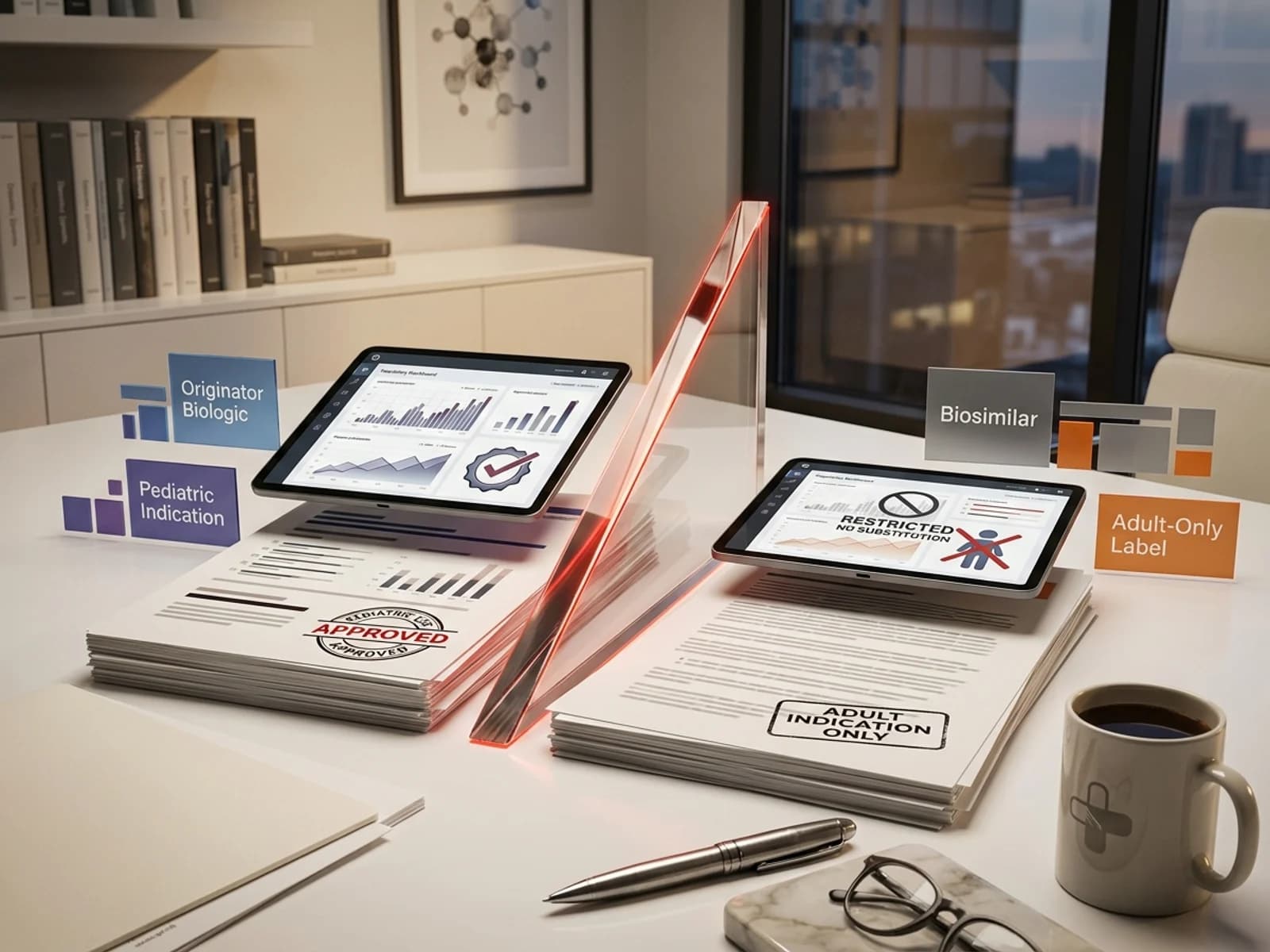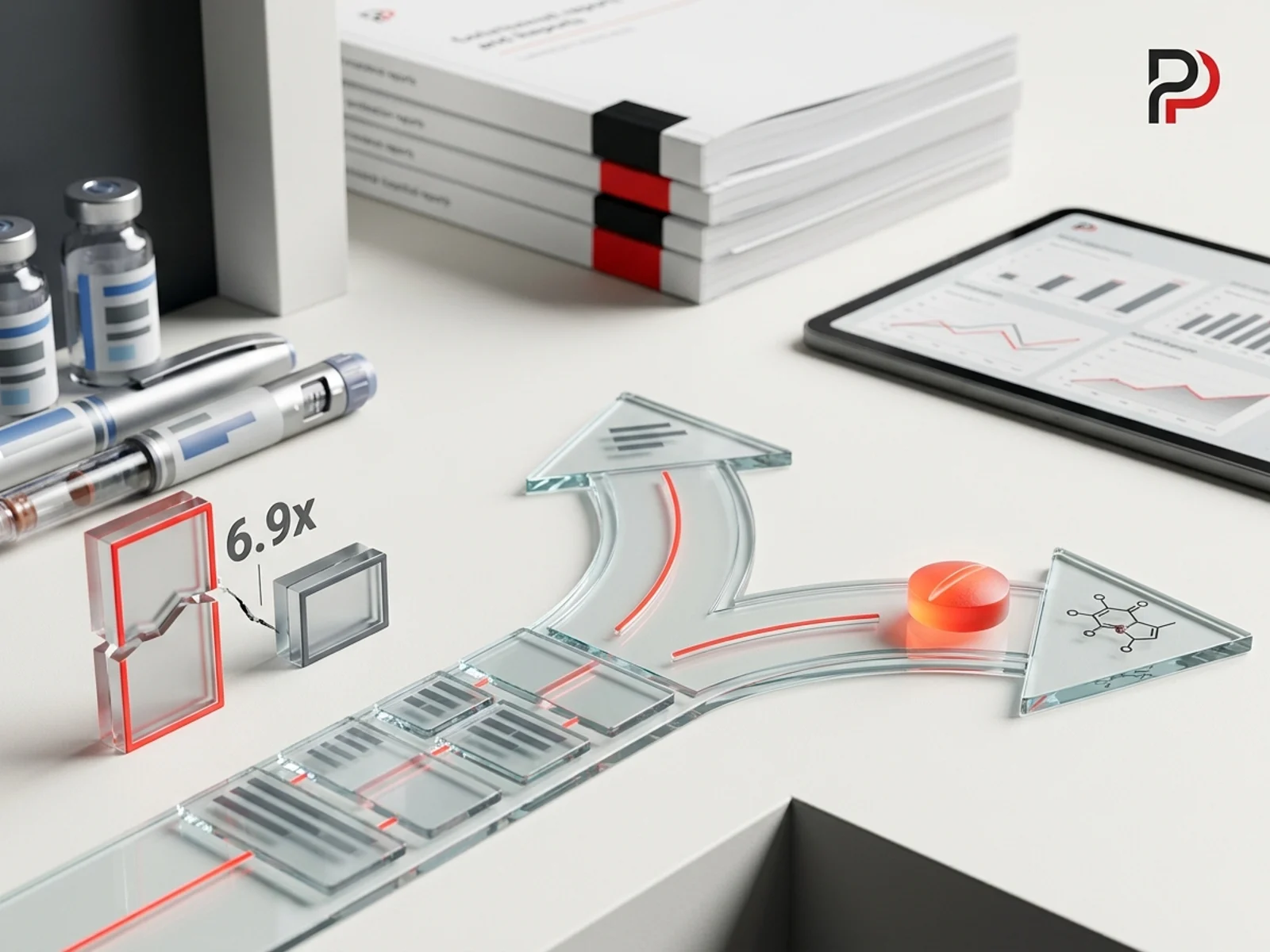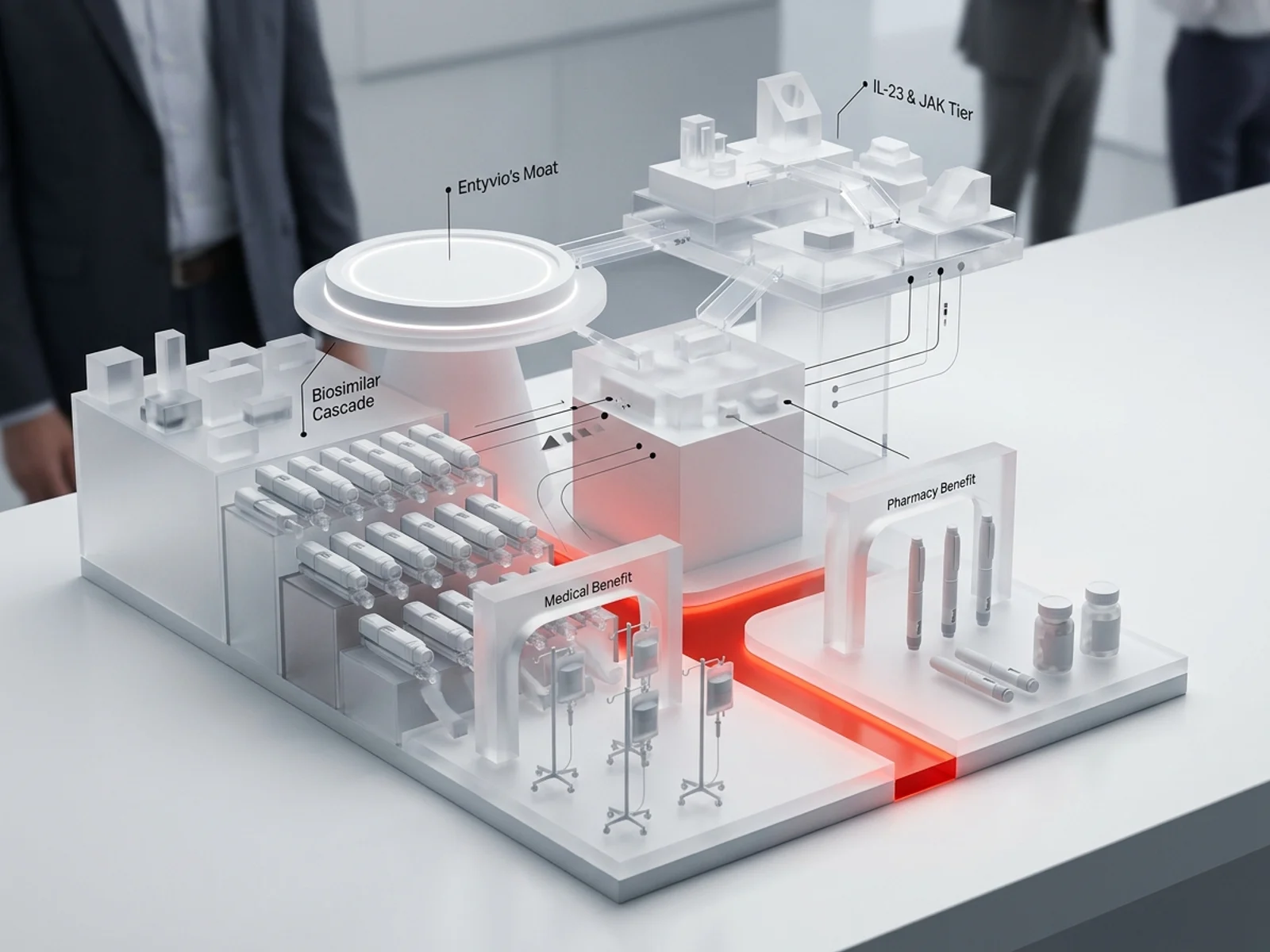
The pharmacologic management and payer access architecture for Inflammatory Bowel Disease (IBD)—encompassing Crohn's Disease (CD) and Ulcerative Colitis (UC)—has undergone a structural transformation in 2026. What was historically a dual-class landscape dominated by branded tumor necrosis factor (TNF) inhibitors and anti-integrin therapy is now a multi-tiered ecosystem shaped by three concurrent forces:
The Maturing Adalimumab Biosimilar Market: Ten FDA-approved adalimumab biosimilars (8 interchangeable), where National Average Drug Acquisition Cost (NADAC) data reveals realized pharmacy acquisition prices ranging from approximately $493 to $1,594 per 40 mg unit, forcing pharmacy benefit managers (PBMs) to convert preferred formulary tiers to low-WAC biosimilar options.
The Live 2025–2026 Ustekinumab (Stelara) Biosimilar Cascade: Following Stelara's practical U.S. loss of exclusivity on January 1, 2025 (established via Amgen-Janssen patent settlement agreements), 8 FDA-approved ustekinumab biosimilars (7 designated interchangeable) have entered the market at 80% to 85% WAC discounts, triggering mandatory step edits across commercial and Medicare Advantage formularies.
The Ascendant IL-23p19 & Oral Targeted Tier: Second- and third-generation targeted mechanisms—including IL-23p19 monoclonal antibodies (AbbVie's Skyrizi, J&J's Tremfya, and Eli Lilly's Omvoh), oral Janus kinase (JAK) inhibitors (AbbVie's Rinvoq, Pfizer's Xeljanz), and sphingosine 1-phosphate (S1P) receptor modulators (BMS's Zeposia, Pfizer's Velsipity)—which offer superior endoscopic healing but remain gated behind mandatory step therapy through preferred biosimilar TNF or IL-12/23 agents.
Meanwhile, Takeda's gut-selective anti-integrin Entyvio (vedolizumab) maintains a unique commercial moat with zero FDA-approved biosimilars as of mid-2026, even as the first interchangeable biosimilar Biologics License Applications (BLAs) work through regulatory review toward expected 2027 decisions.
                     2026 IBD Treatment Access & Payer Sequence
                                         │
        ┌────────────────────────────────┼────────────────────────────────┐
        │                                │                                │
  [Tier 1: Biosimilar Foundation]  [Tier 2: Targeted Biologics]    [Tier 3: Oral Targeted & Rescue]
  • Adalimumab Biosimilars (10)    • Entyvio (IV / SC; No Biosim)  • Rinvoq (JAK1 - CD & UC)
    (7 Interchangeable, $493 floor)• Skyrizi (IL-23p19 - CD & UC)  • Xeljanz (Pan-JAK - UC only;
  • Infliximab Biosimilars (4)     • Tremfya (IL-23p19 - CD & UC)    38 generic ANDAs in OB)
  • Ustekinumab Biosimilars (8)    • Omvoh (IL-23p19 - CD & UC)    • Zeposia / Velsipity (S1P - UC)
    (7 Interchangeable, 85% disc)  • Zymfentra (SC Infliximab)     • Refractory / Surgery
Which Humira (adalimumab) biosimilars are interchangeable and how does their pharmacy price vary?
The U.S. adalimumab market represents the largest biosimilar conversion in pharmaceutical history. As tracked in the FDA Purple Book database, there are 10 distinct FDA-approved adalimumab biosimilar products, of which 8 have achieved FDA interchangeable status.
Interchangeability Designation & Pharmacy Substitution
Under Section 351(k)(4) of the Public Health Service Act, an interchangeable biosimilar may be substituted for the reference product (Humira) at the retail pharmacy counter by the dispensing pharmacist without requiring an explicit intervention or new prescription from the prescribing physician, subject to state pharmacy substitution laws.
| Biosimilar Brand Name | Nonproprietary Proper Name | BLA Holder / Sponsor | FDA Approval Date | Interchangeability Status | Citrate-Free / High-Concentration (100 mg/mL) |
|---|---|---|---|---|---|
| Amjevita | adalimumab-atto | Amgen Inc. | Sep 23, 2016 | Biosimilar (Interchangeable 50 mg/mL) | Yes (50 mg/mL & 100 mg/mL available) |
| Cyltezo | adalimumab-adbm | Boehringer Ingelheim | Aug 25, 2017 | Interchangeable (First Oct 15, 2021) | Yes (50 mg/mL & 100 mg/mL) |
| Hyrimoz | adalimumab-adaz | Sandoz Inc. | Oct 30, 2018 | Interchangeable | Yes (High-concentration 100 mg/mL) |
| Hadlima | adalimumab-bwwd | Samsung Bioepis / Organon | Jul 23, 2019 | Interchangeable | Yes (High-concentration 100 mg/mL) |
| Abrilada | adalimumab-afzb | Pfizer Inc. | Nov 15, 2019 | Interchangeable | Yes (High-concentration 100 mg/mL) |
| Hulio | adalimumab-fkjp | Viatris / Biocon Biologics | Jul 6, 2020 | Interchangeable (granted May 2025) | Citrate-free (50 mg/mL) |
| Yusimry | adalimumab-aqvh | Coherus BioSciences | Dec 17, 2021 | Biosimilar | Citrate-free (50 mg/mL) |
| Idacio | adalimumab-aacf | Fresenius Kabi | Dec 13, 2022 | Biosimilar | Citrate-free (50 mg/mL) |
| Yuflyma | adalimumab-aaty | Celltrion Inc. | May 23, 2023 | Interchangeable | Yes (High-concentration 100 mg/mL) |
| Simlandi | adalimumab-ryvk | Alvotech / Teva | Feb 23, 2024 | Interchangeable | Yes (High-concentration, Citrate-free) |
Realized Pharmacy Acquisition Pricing (NADAC Analysis)
While published Wholesale Acquisition Cost (WAC) list prices often reflect dual-pricing strategies (a high-WAC/high-rebate option alongside a low-WAC/no-rebate option), analysis of CMS National Average Drug Acquisition Cost (NADAC) records reveals the actual per-unit acquisition cost paid by retail and specialty community pharmacies across the country:
Price Spread: NADAC data across 155 individual National Drug Code (NDC) submissions and 34 distinct unit pricing schedules demonstrates that adalimumab acquisition costs range from a floor of $493.18 per 40 mg prefilled syringe/pen (represented by Celltrion's Yuflyma and private-label co-packs) to $1,594.40 per unit for legacy high-WAC versions.
Reference Product Disparity: By comparison, branded Humira's published WAC remains above $3,400 per 40 mg unit, representing an acquisition premium of nearly 700% over the lowest-cost interchangeable biosimilars.
Formulation Preferences: In clinical gastroenterology, high-concentration ($100\text{ mg/mL}$), citrate-free formulations (such as Simlandi, Yuflyma, Hadlima, and Hyrimoz) account for over 85% of total new patient starts due to reduced injection-site pain and smaller injection volumes ($0.4\text{ mL}$ vs. $0.8\text{ mL}$).
For a detailed breakdown of individual adalimumab biosimilar formulations and packaging, see our guide on Humira biosimilars compared.
How is the 2024–2025 Stelara (ustekinumab) biosimilar cascade reshaping IBD formularies?
Ustekinumab, a fully human IgG1$\kappa$ monoclonal antibody that selectively binds the shared p40 subunit of interleukin-12 (IL-12) and interleukin-23 (IL-23), has been a cornerstone of biologic therapy for moderate-to-severe Crohn's disease (FDA approval letter dated September 23, 2016, BLA 761044) and Ulcerative Colitis (FDA approval letter dated October 18, 2019, BLA 761044 S-003 / BLA 125261 S-152).
The Ustekinumab Biosimilar Roster
Following the landmark Amgen-Janssen patent settlement that set the practical U.S. market opening for January 1, 2025, the FDA Purple Book lists 8 approved ustekinumab biosimilars, with 7 designated as interchangeable.
                   Ustekinumab (Stelara) Biosimilar Landscape
                                       │
        ┌──────────────────────────────┼──────────────────────────────┐
        │                              │                              │
[8 Total Approved Biosimilars]  [7 Designated Interchangeable]  [1 Biosimilar-Only]
• Wezlana (Amgen - First Appr)  • Wezlana (1st Interchangeable) • Imuldosa (Dong-A/Intas/
• Selarsdi (Alvotech/Teva)      • Selarsdi (Interchangeable)      Accord)
• Pyzchiva (Samsung Bioepis)    • Pyzchiva (Interchangeable)     (Standard 351(k) approval,
• Otulfi (Fresenius Kabi)       • Otulfi (Interchangeable)        no interchangeability)
• Steqeyma (Celltrion)          • Steqeyma (Interchangeable)    [Commercial Dynamics]
• Yesintek (Biocon Biologics)   • Yesintek (Interchangeable)    • Launch: Jan 1, 2025 LOE
• Starjemza (Bio-Thera/Hikma)   • Starjemza (Interchangeable)   • WAC Discounts: 80% to 85%
• Imuldosa (Dong-A/Meiji/Intas)                                   • Mandatory step edits on
major commercial PBMs| Product Name | Nonproprietary Name | BLA Holder & US Commercial Partner | FDA Approval Date | Interchangeability Designation | Route & Strengths Available |
|---|---|---|---|---|---|
| Wezlana | ustekinumab-auub | Amgen Inc. | Oct 31, 2023 | Interchangeable (First Approved) | $45\text{ mg/0.5 mL}$, $90\text{ mg/mL}$ SC; $130\text{ mg/26 mL}$ IV |
| Selarsdi | ustekinumab-aekn | Alvotech / Teva Pharmaceuticals | Apr 16, 2024 | Interchangeable | $45\text{ mg/0.5 mL}$, $90\text{ mg/mL}$ SC |
| Pyzchiva | ustekinumab-ttwe | Samsung Bioepis / Sandoz | Jun 28, 2024 | Interchangeable | $45\text{ mg/0.5 mL}$, $90\text{ mg/mL}$ SC; $130\text{ mg/26 mL}$ IV |
| Otulfi | ustekinumab-aauz | Fresenius Kabi / Formycon | Sep 27, 2024 | Interchangeable | $45\text{ mg/0.5 mL}$, $90\text{ mg/mL}$ SC; $130\text{ mg/26 mL}$ IV |
| Imuldosa | ustekinumab-srlf | Dong-A ST / Meiji Seika / Intas / Accord | Oct 10, 2024 | Biosimilar | $45\text{ mg/0.5 mL}$, $90\text{ mg/mL}$ SC; $130\text{ mg/26 mL}$ IV |
| Yesintek | ustekinumab-kfce | Biocon Biologics | Nov 29, 2024 | Interchangeable | $45\text{ mg/0.5 mL}$, $90\text{ mg/mL}$ SC; $130\text{ mg/26 mL}$ IV |
| Steqeyma | ustekinumab-stba | Celltrion Inc. | Dec 17, 2024 | Interchangeable | $45\text{ mg/0.5 mL}$, $90\text{ mg/mL}$ SC; $130\text{ mg/26 mL}$ IV |
| Starjemza | ustekinumab-bmsb | Bio-Thera Solutions / Hikma | May 22, 2025 | Interchangeable | $45\text{ mg/0.5 mL}$, $90\text{ mg/mL}$ SC; $130\text{ mg/26 mL}$ IV |
Regulatory Distinction Note: While FDA approval dates spanned from October 2023 through May 2025, commercial launches were legally restricted until January 1, 2025, when Amgen's first-mover entry began. Wezlana held first-interchangeable exclusivity under section 351(k)(6) for its initial launch window, which has since closed, opening the market to broad multi-interchangeable competition.
For an in-depth product-by-product comparison of excipients, latex content, and device ergonomics, review our clinical analysis of Stelara biosimilars compared.
Payer Formulary Restructuring
The entrance of ustekinumab biosimilars priced at roughly 80% to 85% below Stelara's historical list price has radically altered commercial formulary design. Major PBMs (CVS Caremark, Express Scripts, OptumRx) have instituted the following policies:
Exclusion of Branded Stelara: Branded Stelara has been moved to non-formulary / excluded status on standard commercial templates, requiring medical exception appeals for grandfathered patients.
Preferred Biosimilar Tiers: Payers typically designate 1 to 2 preferred biosimilars (e.g., Wezlana or Pyzchiva) on Tier 2/Tier 4 specialty tiers.
Induction vs. Maintenance Splitting: Ustekinumab therapy in IBD requires a weight-based intravenous induction infusion ($260\text{ mg}$, $390\text{ mg}$, or $520\text{ mg}$) administered under the medical benefit, followed 8 weeks later by $90\text{ mg}$ subcutaneous self-injections every 8 weeks under the pharmacy benefit. P&T committees must ensure cross-benefit alignment so that patients receive an approved IV biosimilar induction (e.g., Wezlana IV or Pyzchiva IV) that seamlessly transitions to the contracted subcutaneous biosimilar pen.
Why does Entyvio (vedolizumab) still have no US biosimilar, and how does Zymfentra change infliximab access?
While TNF inhibitors and IL-12/23 antagonists face dense biosimilar competition, Takeda's gut-selective anti-integrin Entyvio (vedolizumab) remains one of the few blockbuster IBD biologics with an intact biosimilar moat.
                      Entyvio & Infliximab Access Dynamic
                                       │
        ┌──────────────────────────────┴──────────────────────────────┐
        │                                                             │
  [Entyvio (Vedolizumab)]                                       [Zymfentra vs. IV Infliximab]
  • First approved: May 20, 2014 (IV)                           • 4 FDA-approved IV biosimilars
  • SC approved: UC 09/27/23, CD 04/18/24                         (Inflectra, Renflexis, Avsola)
  • 0 approved biosimilars in 2026                              • 0 interchangeable IV biosimilars
  • AVT16 (Alvotech) BLA accepted Jun 2026 (target 2027)        • Zymfentra (Celltrion, BLA 761358):
  • PB016 (Fresenius) BLA accepted Jul 2026                       First SC Infliximab reference product
  • Patent moat runs through ~2029–2032                           (Pharmacy benefit maintenance)
Entyvio's Formulations & Biosimilar Pipeline
Entyvio is a humanized monoclonal antibody that specifically targets the $\alpha_4\beta_7$ integrin heterodimer, blocking its binding to mucosal vascular addressin cell adhesion molecule-1 (MAdCAM-1) on intestinal endothelial venules. Because $\alpha_4\beta_7$ expression is restricted to gut-homing lymphocytes, Entyvio provides targeted gastrointestinal immunosuppression without the systemic risks (such as PML) associated with non-selective $\alpha_4$ integrin blockers like Tysabri (natalizumab).
FDA Approval Timeline:
Intravenous (IV) Formulation (BLA 125476): Approved May 20, 2014 for both adult UC and Crohn's disease ($300\text{ mg}$ infusion at Weeks 0, 2, 6, then every 8 weeks).
Subcutaneous (SC) Formulation: Approved for UC maintenance on September 27, 2023 (BLA 761133) and for Crohn's disease maintenance on April 18, 2024 (BLA 761359), utilizing a $108\text{ mg}$ single-dose prefilled pen or syringe administered every 2 weeks following IV induction.
Biosimilar Pipeline & Patent Runway:
As of mid-2026, there are zero FDA-approved vedolizumab biosimilars.
Alvotech's BLA for AVT16 (a proposed interchangeable biosimilar for both IV and SC vedolizumab) was accepted for review by the FDA in early June 2026, with an action date expected in Q1 2027.
Fresenius Kabi / Polpharma Biologics submitted a BLA for PB016 (IV vedolizumab), accepted on July 31, 2026.
Takeda holds a robust patent thicket protecting recombinant host cell expression, antibody formulation, and subcutaneous administration methods extending through 2029 to 2032, ensuring significant patent litigation before generic market formation.
For guidance on navigating prior authorization and dosing for vedolizumab, see our Entyvio (vedolizumab) coverage guide.
The Infliximab Dynamic: 4 Biosimilars vs. Subcutaneous Zymfentra
Infliximab, the founding biologic in IBD history (Remicade, BLA 103772; Crohn's approved August 24, 1998; Ulcerative Colitis approved September 15, 2005), presents a distinct market structure:
Intravenous Biosimilars: Four 351(k) biosimilars have been approved: Inflectra (infliximab-dyyb, Celltrion/Pfizer, approved Apr 5, 2016), Renflexis (infliximab-abda, Samsung Bioepis/Organon, approved Apr 21, 2017), Ixifi (infliximab-qbtx, Pfizer, approved Dec 13, 2017; unmarketed), and Avsola (infliximab-axxq, Amgen, approved Dec 6, 2019). None are designated interchangeable, meaning pharmacy-level auto-substitution does not occur; switches require clinician prescription.
Subcutaneous Innovation (Zymfentra): In October 2023, the FDA approved Celltrion's Zymfentra (infliximab-dyyb, BLA 761358) not as a 351(k) biosimilar, but as a standalone 351(a) reference biologic for subcutaneous maintenance in moderate-to-severe UC and CD. Zymfentra allows patients to complete IV induction and transition to bi-weekly self-injections, shifting drug spend from hospital outpatient infusion centers (medical benefit) to specialty pharmacies (pharmacy benefit) and competing directly against Entyvio SC, Skyrizi SC, and Tremfya SC.
Where do Skyrizi, Rinvoq, Tremfya, and Omvoh sit in the IL-23/JAK step-therapy sequence?
The clinical treatment paradigm in IBD has increasingly shifted toward targeted IL-23p19 subunit inhibitors and oral JAK inhibitors, which have demonstrated superior rates of clinical remission, steroid-free remission, and deep endoscopic mucosal healing compared to older TNF antagonists in head-to-head and network meta-analyses.
However, because these therapies carry high annual acquisition costs (typically $75,000 to $110,000 per patient per year), payers gate access behind strict step-therapy algorithms.
                  Advanced Mechanism Approvals & Indications
                                       │
         ┌─────────────────────────────┴─────────────────────────────┐
         │                                                           │
   [Targeted IL-23p19 Biologics]                               [Oral Targeted Agents]
   • Skyrizi (Risankizumab - AbbVie)                           • Rinvoq (Upadacitinib - AbbVie)
     CD: 06/16/22 | UC: 06/18/24                                 UC: 03/16/22 | CD: 05/18/23
     (IV Induction + OBI / SC Maint)                             (15 mg / 30 mg / 45 mg Oral)
   • Tremfya (Guselkumab - J&J)                                • Xeljanz (Tofacitinib - Pfizer)
     UC: 09/11/24 | CD: 03/20/25                                 UC: 05/30/18 (NO CD Indication)
     (SC & IV Induction Options)                                 (38 Generic ANDAs in OB)
   • Omvoh (Mirikizumab - Lilly)                               • Zeposia (Ozanimod - BMS)
     UC: 10/26/23 | CD: 01/15/25                                 UC: 05/27/21 (S1P - NO CD Indication)
     (Single-dose maint approved 10/27/25)                     • Velsipity (Etrasimod - Pfizer)
UC: 10/12/23 (S1P - NO CD Indication)| Drug & Brand Name | Molecular Target & Modality | BLA / NDA & Sponsor | FDA Approval Dates (CD / UC) | Primary Formulary Tier & Placement | Standard Payer Step-Therapy Requirements |
|---|---|---|---|---|---|
| Skyrizi (risankizumab-rzaa) | IL-23p19 inhibitor (monoclonal antibody) | BLA 761105 (AbbVie) | CD: Jun 16, 2022 UC: Jun 18, 2024 | Preferred Specialty Biologic (Tier 4 / Tier 5) | Step through 1 preferred TNF inhibitor (adalimumab/infliximab biosimilar) or ustekinumab biosimilar. |
| Tremfya (guselkumab) | IL-23p19 inhibitor (monoclonal antibody) | BLA 761061 (Johnson & Johnson) | UC: Sep 11, 2024 CD: Mar 20, 2025 | Preferred / Non-Preferred Specialty Biologic | Step through 1 preferred biosimilar TNF; fully subcutaneous induction offers facility-free alternative. |
| Omvoh (mirikizumab-mrkz) | IL-23p19 inhibitor (monoclonal antibody) | BLA 761279 (Eli Lilly) | UC: Oct 26, 2023 CD: Jan 15, 2025 | Preferred / Non-Preferred Specialty Biologic | Step through 1 preferred TNF or ustekinumab biosimilar; single-injection auto-injector maintenance. |
| Rinvoq (upadacitinib) | JAK1-selective inhibitor (small molecule oral) | NDA 211675 (AbbVie) | UC: Mar 16, 2022 CD: May 18, 2023 | Preferred Oral Specialty (Tier 4 / Tier 5) | Prior trial/failure of $\ge 1$ TNF inhibitor (FDA-labeled requirement under Boxed Warning, updated Oct 2025). |
| Xeljanz (tofacitinib) | Pan-JAK inhibitor (small molecule oral) | NDA 203214 (Pfizer) | UC Only: May 30, 2018 (Not approved for CD) | Generic / Non-Preferred Oral Specialty | 38 approved generic ANDAs in Orange Book; step through TNF required. |
| Zeposia (ozanimod) | S1P receptor modulator ($1,5$) (oral) | NDA 209899 (Bristol Myers Squibb) | UC Only: May 27, 2021 (Not approved for CD) | Non-Preferred Oral Specialty | Step through conventional therapy (corticosteroid/immunomodulator) or TNF biosimilar. |
Indications Asymmetry: Crohn's vs. Ulcerative Colitis
A critical nuance in utilization management is that therapeutic indications across advanced mechanisms are not symmetrical between Crohn's disease and ulcerative colitis:
Crohn's Disease Only: Cimzia (certolizumab pegol, BLA 125160, approved Apr 22, 2008) and Tysabri (natalizumab, BLA 125104, approved Jan 14, 2008 under TOUCH REMS) are FDA-labeled exclusively for CD and lack UC indications.
Ulcerative Colitis Only: Simponi (golimumab, BLA 125289, approved May 15, 2013), Xeljanz (tofacitinib), Zeposia (ozanimod), and Velsipity (etrasimod) are approved exclusively for UC. Prescribing these agents for Crohn's disease is off-label and almost universally rejected by automated payer prior-authorization engines.
Approved for Both CD and UC: Remicade/infliximab biosimilars, Humira/adalimumab biosimilars, Stelara/ustekinumab biosimilars, Entyvio, Skyrizi, Tremfya, Omvoh, and Rinvoq.
To explore how AbbVie built its post-Humira immunology defense around Skyrizi and Rinvoq, review our analysis of the AbbVie immunology franchise. Additional specific coverage criteria can be found in our Skyrizi (risankizumab) coverage guide.
Medical benefit versus pharmacy benefit: How are IBD infusions and self-injections billed?
Access to IBD therapeutics divides across two distinct insurance benefit structures, each with separate reimbursement methodologies, coding frameworks, and financial exposures for clinics and patients.
                 IBD Benefit Channel Distribution & Billing
                                       │
        ┌──────────────────────────────┴──────────────────────────────┐
        │                                                             │
  [Medical Benefit (Buy & Bill / HOPD)]                         [Pharmacy Benefit (PBM / Specialty)]
  • IV Infusions: Infliximab, Entyvio IV,                       • SC Injections & Oral Small Molecules:
    Stelara IV Induction, Skyrizi IV Induction,                   Adalimumab SC, Stelara SC, Entyvio SC,
    Tremfya IV Induction, Omvoh IV Induction                      Skyrizi OBI, Zymfentra SC, Rinvoq, Xeljanz
  • Billed via CMS HCPCS J-Codes                                • Billed via NCPDP / 11-digit NDC
  • ASP + 6% (or 340B acquisition margin)                       • Tiered copay / coinsurance (20%–33%)
• Facility fees & infusion chair time • Copay accumulator / maximizer exposure| Benefit Category & Channel | Representative IBD Formulations | Billing Identifiers & Procedure Codes | Reimbursement Architecture | Primary Clinical & Operational Gateways |
|---|---|---|---|---|
| Medical Benefit (Provider-Administered Infusion) | • Infliximab IV (Inflectra, Renflexis, Avsola) • Vedolizumab IV (Entyvio) • Ustekinumab IV Induction ($130\text{ mg}$ vials) • Risankizumab IV Induction ($600\text{ mg}$ vials) • Mirikizumab IV Induction ($300\text{ mg}$ vials) | HCPCS Level II J-Codes: • J1745 (Infliximab, 10 mg) • Q5103 (Inflectra, 10 mg) • Q5104 (Renflexis, 10 mg) • Q5121 (Avsola, 10 mg) • J3380 (Entyvio, 1 mg) • J3358 (Stelara IV, 1 mg) • J2327 (Skyrizi IV, 1 mg) • CPT 96413 / 96415 (IV Chemotherapy / Biologic Infusion) | Average Sales Price (ASP) plus statutory add-on (typically ASP + 6% in commercial/Medicare Part B; discounted under 340B programs). | Administered in hospital outpatient departments (HOPDs), physician-office infusion suites, or ambulatory infusion centers (AICs). Subject to "site-of-care" steerage mandates by commercial payers directing patients away from HOPDs to lower-cost standalone infusion suites. |
| Pharmacy Benefit (Self-Administered Specialty) | • Adalimumab SC Pens/Syringes • Ustekinumab SC ($90\text{ mg}$ Pens) • Vedolizumab SC ($108\text{ mg}$ Pens) • Risankizumab SC On-Body Injector ($180\text{ mg}, 360\text{ mg}$) • Guselkumab SC ($100\text{ mg}, 200\text{ mg}$) • Zymfentra SC ($120\text{ mg}$ Pens) • Upadacitinib (Rinvoq $15\text{ mg}, 30\text{ mg}, 45\text{ mg}$ oral tablets) | NCPDP Electronic Claims: • 11-digit National Drug Code (NDC) • Pharmacy BIN / PCN / Group Number | Contracted ingredient cost (AWP minus discount) plus dispensing fee. Cost-sharing structured as fixed copayment (Tier 4/5) or coinsurance (20% to 33%). | Dispensed exclusively through payer-owned or contracted specialty pharmacies (e.g., CVS Specialty, Accredo/Evernorth, Optum Specialty). High risk of copay accumulator and maximizer programs that block manufacturer copay assistance from counting toward patient deductibles. |
What does the 2026 IBD access map mean for a patient controlled on a now-non-preferred biologic?
One of the most pressing clinical dilemmas facing gastroenterologists is the management of patients in stable clinical, biomarker, and endoscopic remission on an originator biologic (e.g., branded Stelara or Humira) whose payer initiates a mandatory non-medical switching policy to a preferred biosimilar.
                   Payer Non-Medical Switching Decision Tree
                                       │
        ┌──────────────────────────────┴──────────────────────────────┐
        │                                                             │
  [Accept Preferred Biosimilar Switch]                          [Pursue Medical Exception Appeal]
  • Interchangeable or 351(k) biosimilar                        • Documented historical failure of alternative
  • Zero difference in immunogenicity or efficacy                 biosimilar or excipient allergy
  • Preserves Tier 2/4 copay support                            • Clinical instability / brittle disease history
  • Manufacturer copay bridge programs                          • Peer-to-peer review with medical director
1. Clinical Evidence on Biosimilar Switching in IBD
Robust prospective randomized controlled trials (including the NOR-SWITCH study and the VOLUMES study) and extensive real-world registry data from the European Crohn's and Colitis Organisation (ECCO) and the American Gastroenterological Association (AGA) confirm that switching from an originator biologic to an FDA-approved biosimilar does not result in loss of clinical efficacy, increased immunogenicity (anti-drug antibody formation), or novel safety signals.
2. Navigating Formulary Disruption
When a health plan removes an originator drug from formulary:
Automatic Substitution (Interchangeable): If the payer mandates an interchangeable biosimilar (e.g., Wezlana for Stelara, or Cyltezo/Simlandi for Humira), the prescription may be substituted at the pharmacy level (where permitted by state law), though clinic communication remains best practice.
Non-Interchangeable Biosimilar (Standard 351k): If the payer selects a biosimilar lacking interchangeable designation (or for IV infusions under medical benefit), the prescriber must issue a new prescription specifying the exact biosimilar product and NDC.
Filing a Medical Exception Appeal: If a patient has a documented severe excipient allergy (e.g., sensitivity to specific polysorbates or latex components in older autoinjectors) or a documented prior adverse reaction, clinicians can submit an expedited formulary exception appeal citing clinical continuity of care and the risk of disease flare requiring hospitalization.
Frequently Asked Questions
Which Stelara biosimilar is interchangeable and can be substituted at the pharmacy without a new prescription?
As of mid-2026, the FDA has granted interchangeable status to 7 ustekinumab biosimilars: Wezlana (Amgen), Selarsdi (Alvotech/Teva), Pyzchiva (Samsung Bioepis/Sandoz), Otulfi (Fresenius Kabi), Yesintek (Biocon Biologics), Steqeyma (Celltrion), and Starjemza (Bio-Thera/Hikma). Only Imuldosa (Dong-A/Meiji/Intas/Accord) holds a standard 351(k) biosimilar designation without interchangeability. Under state pharmacy laws, any of the 7 interchangeable products can be substituted for reference Stelara at the pharmacy counter without a new clinician prescription.
Are Entyvio biosimilars available in the US in 2026, and when might the first one launch?
No. There are currently zero FDA-approved vedolizumab biosimilars in the United States. However, two BLAs are under active review: Alvotech's AVT16 (proposed interchangeable for both IV and SC) with an expected FDA decision in Q1 2027, and Fresenius Kabi's PB016 (IV) submitted in mid-2026. Commercial launch timing will depend on the resolution of ongoing patent litigation with Takeda, whose patent estate extends through roughly 2029–2032.
Do payers prefer an IL-23 inhibitor (Skyrizi/Tremfya) before or after a TNF inhibitor in Crohn's and UC?
On the vast majority of commercial and Medicare Advantage formularies in 2026, payers require patients to first "step through" (try and fail, or have a documented contraindication to) at least one preferred biosimilar TNF inhibitor (such as an adalimumab or infliximab biosimilar) or a preferred ustekinumab biosimilar before authorizing an IL-23p19 inhibitor like Skyrizi, Tremfya, or Omvoh. However, for patients presenting with severe disease, extraintestinal manifestations, or contraindications to anti-TNF therapy (e.g., demyelinating disease, severe heart failure), gastroenterologists can often secure first-line IL-23 approval through expedited prior-authorization exception criteria.
Is Xeljanz (tofacitinib) generic, and how does its price compare to JAK-class Rinvoq?
Yes. The FDA Orange Book lists 38 approved generic ANDA products for tofacitinib from 21 different generic applicants across 5 mg and 10 mg strengths. As generic market penetration deepens, the acquisition cost of generic tofacitinib has dropped substantially compared to branded Rinvoq (upadacitinib). However, Xeljanz is FDA-approved exclusively for Ulcerative Colitis and carries no approved indication for Crohn's disease, whereas Rinvoq is FDA-approved for both UC and Crohn's disease and demonstrates significantly higher mucosal healing rates in moderate-to-severe IBD.
Why is Cimzia approved for Crohn's but not ulcerative colitis, and Simponi for UC but not Crohn's?
This asymmetry is rooted in registrational clinical trial outcomes: UCB's Cimzia (certolizumab pegol) demonstrated clinical efficacy and maintenance of response in Phase 3 trials for Crohn's disease (PRECiSE 1 and 2), leading to FDA approval on April 22, 2008, but was never successfully developed or approved for UC. Conversely, Janssen's Simponi (golimumab) demonstrated mucosal healing and clinical remission in moderate-to-severe UC in the PURSUIT program (approved May 15, 2013), but did not achieve registrational endpoints in Crohn's disease. Consequently, payers will automatically deny Cimzia for UC or Simponi for Crohn's as off-label indications.
Sources
U.S. Food and Drug Administration (FDA): Purple Book: Database of Licensed Biological Products. Biosimilar and Interchangeable Approvals for Adalimumab, Infliximab, Ustekinumab, and Vedolizumab. Available at:
https://www.fda.gov/drugs/biosimilars/biosimilar-and-interchangeable-products.Centers for Medicare & Medicaid Services (CMS): National Average Drug Acquisition Cost (NADAC) Pricing Files (2025–2026). Medicaid Pharmacy Pricing Data. Available at:
https://data.medicaid.gov/managed-care/Pharmacy/nadac-national-average-drug-acquisition-cost.U.S. FDA Drugs@FDA: Approval History and Package Inserts for Remicade (BLA 103772), Humira (BLA 125057), Cimzia (BLA 125160), Simponi (BLA 125289), Entyvio (BLA 125476 / 761133 / 761359), and Stelara (BLA 761044 / 125261). Available at:
https://www.accessdata.fda.gov/scripts/cder/daf/index.cfm.U.S. FDA Center for Drug Evaluation and Research (CDER): Orange Book: Approved Drug Products with Therapeutic Equivalence Evaluations (NDA 203214 Tofacitinib Generics). Available at:
https://www.accessdata.fda.gov/scripts/cder/ob/index.cfm.U.S. FDA Approval Documentation: Skyrizi (BLA 761105 S-016 CD Approval Letter June 16, 2022; S-029 UC Approval Letter June 18, 2024); Tremfya (BLA 761061 S-021 UC Approval September 11, 2024; S-024 CD Approval March 20, 2025); Omvoh (BLA 761279 UC Approval October 26, 2023; CD Approval January 15, 2025); Rinvoq (NDA 211675 UC Approval March 16, 2022; CD Approval May 18, 2023).
American Gastroenterological Association (AGA): Clinical Practice Guidelines on the Pharmacological Management of Moderate-to-Severe Crohn's Disease and Ulcerative Colitis. Gastroenterology. 2024–2025.
IPD Analytics: IBD Market Snapshot: Payer Formulary Management, Biosimilar Adoption, and IL-23 Utilization Trends in Commercial and Medicare Channels (2025–2026).