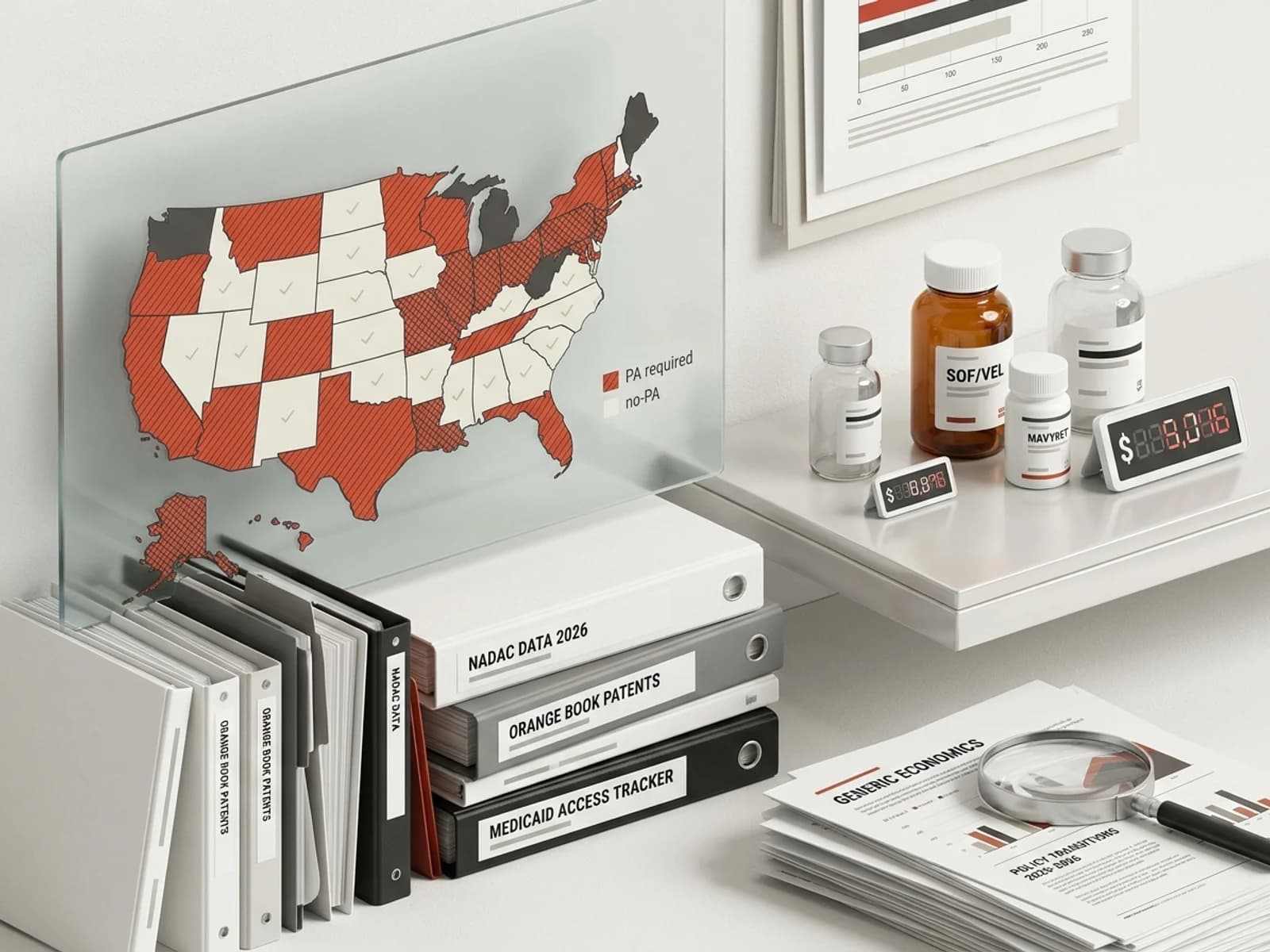
More than twelve years after the approval of sofosbuvir ignited the modern drug pricing debate, the hepatitis C virus (HCV) direct-acting antiviral (DAA) market presents a striking paradox. On one hand, clinical access barriers that once blocked millions of infected Americans from curative treatment have largely collapsed: for the first time in history, zero state Medicaid programs enforce sobriety or substance-use abstinence mandates, fibrosis staging restrictions have been universally eliminated, and two-thirds of U.S. jurisdictions have dropped prior authorization (PA) entirely for first-line treatment.
On the other hand, the long-promised wave of multi-source generic price erosion has not materialized. Despite headlines heralding the "generic era," the direct-acting antiviral market remains an authorized-generic and single-source duopoly. Independent generic manufacturers have not entered the market, the only Abbreviated New Drug Application (ANDA) ever approved was discontinued without commercial launch, and primary Orange Book patent walls on pan-genotypic regimens extend well into the 2030s.
For state Medicaid pharmacy directors, Pharmacy and Therapeutics (P&T) committees, public health leaders, and market-access strategists evaluating 2027 coverage policies, understanding this divergence between clinical policy liberalization and wholesale acquisition economics is essential.
This dossier provides a comprehensive, data-audited analysis of the 2026 hepatitis C treatment access landscape, synthesizing National Average Drug Acquisition Cost (NADAC) benchmarks, FDA Orange Book patent listings, national Medicaid restriction trackers, and public health elimination economics.
Which states still require prior authorization for hepatitis C treatment in 2026?
According to national tracking data from the Center for Health Law and Policy Innovation (CHLPI) at Harvard Law School and the National Viral Hepatitis Roundtable (NVHR) (Hepatitis C: State of Medicaid Access), 34 of 51 U.S. jurisdictions (including Washington, D.C.) have eliminated prior authorization requirements for most patients initiating standard first-line DAA therapy as of early 2026.
In these 34 "no-PA" jurisdictions, any licensed prescriber—including primary care physicians, nurse practitioners, and physician assistants—can prescribe preferred pan-genotypic regimens (such as Mavyret or authorized generic Epclusa) with standard pharmacy point-of-sale adjudication, enabling true "test-and-treat" clinical workflows.
However, 17 jurisdictions still maintain active prior authorization protocols for treatment-naive patients. While these remaining 17 programs no longer demand proof of advanced liver damage or prolonged sobriety, they enforce administrative gates such as mandatory viral load confirmation, genotype documentation, prescriber specialty attestations, or adherence counseling agreements before approving therapy.
┌─────────────────────────────────────────────────────────────────────────────┐
│               2026 U.S. MEDICAID HEPATITIS C RESTRICTION MAP                │
└──────────────────────────────────────┬──────────────────────────────────────┘
                                       │
                  ┌────────────────────┴────────────────────┐
                  ▼                                         ▼
   ┌───────────────────────────────┐         ┌───────────────────────────────┐
   │ 34 NO-PA JURISDICTIONS        │         │ 17 PA-RETAINING JURISDICTIONS │
   │ (Universal / Preferred DAA)   │         │ (Administrative Criteria)     │
   ├───────────────────────────────┤         ├───────────────────────────────┤
   │ • Point-of-sale pharmacy fill │         │ • Pre-treatment PA form       │
   │ • Any licensed prescriber     │         │ • Genotype / RNA confirmation │
   │ • Test-and-treat enabled      │         │ • Preferred agent step edits  │
   │ • Zero fibrosis criteria      │         │ • Zero fibrosis criteria      │
   │ • Zero sobriety criteria      │         │ • Zero sobriety criteria      │
   └───────────────────────────────┘         └───────────────────────────────┘
Key Policy Transitions in 2025 and 2026
Recent state-level policy updates documented by TIICANN's HIV/HCV Co-Infection Watch and state Medicaid bulletins illustrate the ongoing evolution of state preferred drug lists (PDLs):
Arkansas (The End of the Sobriety Era): In 2025, Arkansas Medicaid removed its remaining substance-use screening and counseling prerequisites, eliminating the final state-level sobriety barrier in the United States.
Louisiana: Expanded access by removing prior authorization for authorized generic direct-acting antivirals, aligning its managed care organizations (MCOs) with its modified subscription payment model.
Ohio: Updated its unified Medicaid PDL to cover expanded treatment options—including Mavyret, authorized generic Epclusa, Pegasys, and ribavirin—with streamlined prescriber attestations.
North Dakota: Eliminated prior authorization for preferred Mavyret dispensing across both Fee-for-Service (FFS) and managed care networks.
Nevada (Formulary Consolidation): In late 2025, Nevada Medicaid consolidated its HCV formulary, narrowing preferred coverage to four primary options: generic Epclusa (sofosbuvir/velpatasvir), brand Mavyret, Pegasys, and ribavirin, while requiring strict non-preferred PA for other branded combinations.
Maryland: Realigned formulary tiers, shifting brand Harvoni to non-preferred status subject to clinical exception PA while preserving preferred access for first-line pan-genotypic regimens.
For a broader analysis of how state-level utilization management laws intersect with specialty pharmacy workflows, see our state prior authorization reform tracker.
What does a curative HCV course actually cost a payer at acquisition in 2026?
When Gilead Sciences launched Sovaldi (sofosbuvir) in December 2013 at $1,000 per pill ($84,000 per 12-week course) and Harvoni (ledipasvir/sofosbuvir) in October 2014 at $94,500, state Medicaid budgets faced immediate fiscal strain. Over the subsequent decade, wholesale acquisition costs and pharmacy invoice benchmarks have compressed significantly, though unevenly across brand and generic labels.
To establish the actual acquisition baseline across community retail and specialty pharmacies, we recomputed per-unit and full-course acquisition costs from the Centers for Medicare & Medicaid Services (CMS) National Average Drug Acquisition Cost (NADAC) dataset for the weekly survey effective July 22, 2026 (cross-validated against the live CMS Medicaid API).
Course costs below multiply the per-tablet NADAC by the labeled regimen: one tablet daily for the sofosbuvir/velpatasvir products (84 tablets per 12-week course), and three tablets once daily for Mavyret (168 tablets per 8-week course, 252 per 12-week course, per the FDA-approved labeling and standard payer quantity limits of 84 tablets per 28 days). Vosevi, the salvage regimen, is omitted because it has no published NADAC row in the 2026 weekly files - absence from NADAC reflects its limited-distribution channel, not its list price.
| Product & Strength | Labeler / Marketer | Application & NDC | NADAC Per Unit (2026-07-22) | Labeled Course (Tablets) | NADAC Full Course Cost | Pricing Category |
|---|---|---|---|---|---|---|
| Mavyret (glecaprevir/pibrentasvir 100-40 mg) | AbbVie | NDA 209394 NDC 00074262528 | $153.03829 / tablet | 8 Weeks (168 Tablets) | $25,710.43 | Brand (B) |
| Mavyret (glecaprevir/pibrentasvir 100-40 mg) | AbbVie | NDA 209394 NDC 00074262528 | $153.03829 / tablet | 12 Weeks (252 Tablets) | $38,565.65 | Brand (B) |
| Sofosbuvir/Velpatasvir (400-100 mg) | Asegua / Gilead | NDA 208341 NDC 72626270101 | $278.16591 / tablet | 12 Weeks (84 Tablets) | $23,365.94 | Generic (G) |
| Epclusa (sofosbuvir/velpatasvir 400-100 mg) | Gilead Sciences | NDA 208341 NDC 61958220101 | $865.95518 / tablet | 12 Weeks (84 Tablets) | $72,740.23 | Brand (B) |
Key Economic Takeaways from NADAC Acquisition Data
Authorized Generic Sofosbuvir/Velpatasvir Is the Lowest-Cost Curative Course: Gilead's authorized generic (distributed via Asegua Therapeutics) costs $278.17 per tablet ($23,365.94 per 12-week course), compared to $865.96 per tablet ($72,740.23 per course) for brand-labeled Epclusa - identical chemical composition and manufacturing origin at 32.1% of the brand acquisition price, a 68% per-unit discount.
Mavyret Is the Lowest-Cost Brand Course: At $153.04 per tablet (three tablets once daily), AbbVie's brand-only Mavyret runs $25,710.43 for an 8-week curative course - above the authorized generic's 12-week course, but roughly a third the acquisition cost of brand Epclusa. For treatment-naive, non-cirrhotic patients with any HCV genotype (1 through 6), the per-patient economics no longer justify PA as catastrophic-cost protection.
Acquisition Cost vs. Medicaid Net Spend: While NADAC captures true pharmacy invoice acquisition cost, it is not identical to Medicaid net cost. Under the Medicaid Drug Rebate Program (MDRP), brand drugs (Epclusa, Mavyret) pay statutory basic rebates (minimum 23.1% of Average Manufacturer Price, or AMP) plus inflation-penalty rebates, whereas authorized generics pay a modified generic rebate structure. Depending on confidential supplemental rebates negotiated by state purchasing pools (such as Sovereign States Drug Consortium or TOP$ Dollar), some state Medicaid programs achieve net costs on brand Mavyret or brand Epclusa that are lower than the acquisition cost of the authorized generic.
To understand how NADAC survey metrics function across retail and specialty channels, review our guide on what NADAC can and cannot tell you.
Why is there no real generic Epclusa — and what is an authorized generic?
In casual healthcare discourse, sofosbuvir/velpatasvir is frequently referred to as "generic Epclusa." However, from an FDA regulatory and patent perspective, there is no true generic Epclusa in the United States.
The Authorized Generic Mechanism
The generic-labeled sofosbuvir/velpatasvir and ledipasvir/sofosbuvir sold in U.S. pharmacies are Authorized Generics (AGs).
An authorized generic is an exact pharmaceutical duplicate of the brand-name innovator drug produced by the original New Drug Application (NDA) holder, marketed under a non-brand generic label, and distributed without brand trade dress.
In September 2018, Gilead Sciences established a wholly owned subsidiary, Asegua Therapeutics LLC, to launch authorized generic versions of Epclusa and Harvoni at a wholesale list price of $24,000 for an 84-tablet 12-week course, effective January 2019.
In the FDA Orange Book, these authorized generic products do not possess separate Abbreviated New Drug Applications (ANDAs). They remain approved under Gilead's own New Drug Applications - NDA 204671 (Sovaldi), NDA 205834 (Harvoni), and NDA 208341 (Epclusa) - with the Asegua-labeled products tracked on FDA's separate authorized-generics list rather than as independent applications. The 2026 NADAC of $23,365.94 per 12-week course shows the AG price has essentially not eroded in the seven years since that launch.
┌─────────────────────────────────────────────────────────────────────────────┐
│                    AUTHORIZED GENERIC VS. TRUE ANDA GENERIC                 │
└──────────────────────────────────────┬──────────────────────────────────────┘
                                       │
                  ┌────────────────────┴────────────────────┐
                  ▼                                         ▼
   ┌───────────────────────────────┐         ┌───────────────────────────────┐
   │ AUTHORIZED GENERIC (AG)       │         │ INDEPENDENT ANDA GENERIC      │
   │ (Asegua / Gilead Sciences)    │         │ (Teva - the only approval)    │
   ├───────────────────────────────┤         ├───────────────────────────────┤
   │ • Approved under Brand NDA    │         │ • Approved under 505(j) ANDA  │
   │ • Identical manufacturing line│         │ • Independent bioequivalence  │
   │ • Launched by brand sponsor   │         │ • Paragraph IV patent challenge│
   │ • Price set by brand owner    │         │ • Multi-source price collapse │
   │ • Current 2026 reality ($23k) │         │ • ZERO currently marketed     │
   └───────────────────────────────┘         └───────────────────────────────┘
The Case of the Discontinued Teva ANDA
Across the entire direct-acting antiviral class, only one independent generic ANDA has ever received FDA approval:
ANDA 211353 (Sofosbuvir Tablets, 400 mg): Sponsored by Teva Pharmaceuticals USA, approved by the FDA on January 27, 2022.
However, a relational review of the FDA Drugs@FDA database (snapshot 20260730) reveals that ANDA 211353 carries MarketingStatusID = 3 (Discontinued). Teva never commercially manufactured or distributed generic sofosbuvir in the United States following approval.
Because single-agent sofosbuvir (Sovaldi) has been superseded in clinical guidelines by fixed-dose pan-genotypic combinations (Epclusa, Mavyret), standalone generic sofosbuvir offered little commercial viability, while Gilead's dense combination patent estates blocked generic velpatasvir and ledipasvir entry.
For a comparative look at how ANDA pipelines challenge oral small-molecule patent estates, explore our Farxiga ANDA playbook and our analysis of Orange Book therapeutic equivalence explained.
When does actual ANDA generic entry arrive for sofosbuvir, Epclusa, and Mavyret?
Because the current market consists exclusively of brand and authorized generic products, true multi-source generic competition—which typically drives generic prices down by 80% to 95% below brand levels—cannot occur until the underlying Orange Book patent estates expire or are successfully invalidated.
An audit of the FDA Orange Book (snapshot 20260725) reveals that the patent walls protecting direct-acting antivirals remain robust well into the 2030s.
| Brand Drug & Application | Active Ingredient(s) | Distinct Listed Patents (Rows) | Latest Non-PED Patent Expiry | Latest Expiry with Pediatric Exclusivity (PED) |
|---|---|---|---|---|
| Sovaldi (NDA 204671) | sofosbuvir | 9 (17) | December 11, 2030 | June 11, 2031 |
| Harvoni (NDA 205834) | ledipasvir / sofosbuvir | 17 (34) | January 30, 2034 | July 30, 2034 |
| Epclusa (NDA 208341) | sofosbuvir / velpatasvir | 15 (30) | January 30, 2034 | July 30, 2034 |
| Vosevi (NDA 209195) | SOF / VEL / voxilaprevir | 18 (19) | June 1, 2037 | December 1, 2037 |
| Mavyret (NDA 209394) | glecaprevir / pibrentasvir | 10 (10) | June 24, 2036 | December 24, 2036 |
Counts reflect distinct patent numbers per application, not raw Orange Book listing rows (rows repeat per product strength); PED columns include six-month pediatric exclusivity where granted.
Patent Expiry Timelines and Commercial Implications
Sovaldi Patent Estate (December 2030 / June 2031): The sofosbuvir substance and formulation estate runs to late 2030 - the longest-running drug-substance patents are U.S. Patent 8,618,076 (December 11, 2030) and U.S. Patent 9,284,342 (September 13, 2030) - with pediatric exclusivity extending protection to June 11, 2031.
Epclusa Patent Estate (January 2034 / July 2034): The fixed-dose combination of sofosbuvir and velpatasvir is shielded by 15 distinct listed patents spanning chemical structures, polymorphic forms, and solid oral dosage co-formulations. The latest non-pediatric patent expires on January 30, 2034 (PED extends to July 30, 2034). Independent generic versions of Epclusa cannot enter before 2034 unless an ANDA filer successfully challenges the estate under Paragraph IV certification. Harvoni's terminal wall lands on the same date (January 30, 2034 / July 30, 2034 across 17 distinct patents).
Vosevi Patent Estate (June 2037 / December 2037): The salvage regimen's voxilaprevir estate runs the longest in the class - 18 distinct patents, latest non-PED expiry June 1, 2037 (PED to December 1, 2037) - which matters for retreatment economics since Vosevi is the fallback when first-line therapy fails.
Mavyret Patent Estate (June 2036 / December 2036): AbbVie's glecaprevir/pibrentasvir estate includes 10 distinct patents, with the primary substance and co-formulation patents extending through June 24, 2036 (PED extends to December 24, 2036). Additionally, Mavyret holds unexpired pediatric exclusivity code I-967 through June 10, 2028.
As a result, payers projecting pharmacy expenditures for the remainder of the decade must plan on direct-acting antivirals remaining an authorized-generic and negotiated-brand class rather than anticipating a multi-source generic cliff.
For clinical context on adjacent antiviral development, see our analysis of BIC/LEN HIV regimen access.
What restrictions survive PA removal — MCO parity, retreatment, prescriber limits?
While the elimination of sobriety and fibrosis mandates marks monumental progress, public health researchers and hepatology clinicians emphasize that removing prior authorization on paper does not guarantee frictionless access in practice.
1. Managed Care Organization (MCO) Carve-In Friction
In states where Medicaid pharmacy benefits are managed by multiple commercial MCOs rather than a single unified Fee-for-Service state PDL, commercial MCOs may implement differing preferred drug designations. For example, if an MCO prefers Mavyret while a clinic prescribes generic Epclusa, the prescription triggers a point-of-sale claim rejection that requires an administrative step-therapy exception.
2. Retreatment Restrictions Following Reinfection or Treatment Failure
Patients who achieve a sustained virologic response (SVR12) but later experience HCV reinfection (particularly individuals with ongoing injection drug use), as well as the 2% to 5% of patients who fail first-line DAA therapy, face heightened utilization management.
While AASLD/IDSA guidelines strongly recommend immediate retreatment for reinfected patients, many state Medicaid programs maintain strict PA requirements for second-course therapy.
Salvage therapy with Vosevi (sofosbuvir/velpatasvir/voxilaprevir) is universally subject to prior authorization requiring specialist consultation and resistance testing documentation, and its patent estate - the longest in the class, running to June 2037 - makes it the least exposed to near-term generic relief.
┌─────────────────────────────────────────────────────────────────────────────┐
│                   HCV CARE CASCADE BOTTLENECKS IN 2026                      │
└──────────────────────────────────────┬──────────────────────────────────────┘
                                       │
                  ┌────────────────────┴────────────────────┐
                  ▼                                         ▼
   ┌───────────────────────────────┐         ┌───────────────────────────────┐
   │ ELIMINATED BARRIERS (HISTORIC)│         │ SURVIVING BOTTLENECKS (2026)  │
   ├───────────────────────────────┤         ├───────────────────────────────┤
   │ • 0 Sobriety Mandates (Gone)  │         │ • MCO formulary misalignment  │
   │ • 0 Fibrosis Stages (Gone)    │         │ • Strict retreatment PA rules │
   │ • 34 States Removed PA        │         │ • Non-specialist prescriber PA│
   │ • Universal screening guidance│         │ • Diagnostic lab confirmation │
   └───────────────────────────────┘         └───────────────────────────────┘
3. Prescriber Specialty Limitations in the Remaining 17 Jurisdictions
In several of the 17 jurisdictions retaining prior authorization, prescriptions written by primary care physicians, family practice clinicians, or addiction medicine specialists require a formal consultation with a board-certified gastroenterologist, hepatologist, or infectious disease specialist. Given the severe shortage of specialist clinicians in rural and underserved areas, prescriber specialty rules remain a significant barrier to decentralized elimination programs.
What should Medicaid programs and health plans do to accelerate elimination?
The Centers for Disease Control and Prevention (CDC) estimates that between 2.4 million and 4.0 million Americans are living with chronic hepatitis C (Hall et al., Hepatology 2024). Direct-acting antivirals cure more than 95% of infections in 8 to 12 weeks of well-tolerated oral therapy, and CDC has recommended universal one-time screening for all adults aged 18 and older since April 2020.
To close the remaining gap and advance national hepatitis C elimination goals, Medicaid directors, commercial health plans, and health-system leaders should execute five actionable policy reforms:
Eliminate Initial-Treatment PA Across All Remaining 17 Jurisdictions: Given that the lowest-cost curative course (authorized generic sofosbuvir/velpatasvir) sits at $23,365.94 at acquisition and the lowest-cost brand course (Mavyret) at $25,710.43—and net Medicaid costs are significantly lower after statutory and supplemental rebates—the administrative cost of reviewing thousands of prior authorization forms exceeds the marginal cost-containment benefit.
Mandate Complete MCO Unified PDL Parity: Enforce strict single-formulary rules across all contracted Medicaid managed care organizations to prevent point-of-sale claim rejections when patients switch plans or fill prescriptions at community pharmacies.
Authorize All Licensed Prescribers for First-Line DAAs: Remove specialist consultation requirements and empower primary care providers, Federally Qualified Health Centers (FQHCs), and correctional health medical staff to prescribe pan-genotypic regimens immediately upon diagnostic confirmation.
Establish Streamlined Simplified Retreatment Pathways: Align Medicaid coverage with AASLD/IDSA guidance by allowing point-of-sale coverage for a second course of pan-genotypic therapy in patients with documented reinfection.
Integrate Point-of-Care RNA Reflex Testing: Couple universal antibody screening with automatic reflex HCV RNA viral load testing on the same initial blood sample to eliminate diagnostic loss-to-follow-up before therapy begins.
Frequently Asked Questions
Do any states still require sobriety or evidence of liver damage before covering HCV treatment?
No. As of early 2026, zero state Medicaid programs require periods of drug or alcohol sobriety or proof of advanced liver fibrosis (such as Metavir score F2, F3, or F4) as a condition of coverage for initial treatment. Arkansas removed the nation's last remaining substance-use restriction in 2025.
Is generic Epclusa a real generic or Gilead's own authorized generic?
The generic sofosbuvir/velpatasvir marketed in U.S. pharmacies is an authorized generic manufactured by Gilead Sciences and distributed through its subsidiary, Asegua Therapeutics LLC. It is approved under Gilead's original New Drug Application (NDA 208341) rather than an independent generic Abbreviated New Drug Application (ANDA).
How much does hepatitis C treatment cost Medicaid at acquisition versus list?
At CMS NADAC pharmacy invoice acquisition cost (week of July 22, 2026), a 12-week course of authorized generic sofosbuvir/velpatasvir costs $23,365.94, an 8-week course of brand Mavyret costs $25,710.43 (three tablets daily, 168 tablets), and brand Epclusa costs $72,740.23. Medicaid net spend after statutory and supplemental rebates is lower than acquisition cost.
Why was the only HCV generic ANDA discontinued without launching?
Teva Pharmaceuticals received FDA approval for ANDA 211353 (sofosbuvir 400 mg tablets) on January 27, 2022. However, because standalone sofosbuvir was commercially obsolete compared to fixed-dose combination regimens (Epclusa, Mavyret), Teva designated the application as Discontinued in FDA records and never brought the product to market.
What is the difference between the 34 no-PA jurisdictions and the rest?
In the 34 jurisdictions that have eliminated prior authorization, any licensed healthcare provider can prescribe preferred pan-genotypic DAAs with standard point-of-sale pharmacy processing. The remaining 17 jurisdictions still require pre-treatment prior authorization paperwork verifying viral RNA, genotype, or prescriber specialty attestations.
Can patients be retreated if reinfected, and do state programs cover retreatment?
Yes. Direct-acting antivirals cure chronic infection but do not confer immunity against future viral exposure. AASLD/IDSA guidelines recommend retreatment for reinfected individuals. While Medicaid covers retreatment, most states require a formal prior authorization for second-course therapy.
Sources
Centers for Medicare & Medicaid Services (CMS): National Average Drug Acquisition Cost (NADAC) 2026 Weekly Survey Files, Effective July 22, 2026. https://data.medicaid.gov/dataset/fbb83258-11c7-47f5-8b18-5f8e79f7e704
U.S. Food and Drug Administration (FDA): Approved Drug Products with Therapeutic Equivalence Evaluations (Orange Book), Snapshot July 2025. https://www.accessdata.fda.gov/scripts/cder/ob/
U.S. Food and Drug Administration (FDA): Drugs@FDA Database, Application Records for NDA 204671, NDA 205834, NDA 208341, NDA 209195, NDA 209394, and ANDA 211353. https://www.accessdata.fda.gov/scripts/cder/daf/
Center for Health Law and Policy Innovation (CHLPI) & National Viral Hepatitis Roundtable (NVHR): Hepatitis C: State of Medicaid Access (2025 Report Cards and 2026 National Snapshot). https://stateofhepc.org/
The International Interdisciplinary Association on Co-Infection (TIICANN): HIV/HCV Co-Infection Watch Q1 (January 2026). https://www.tiicann.org/blog/hiv-hcv-co-infection-watch-q1-january-2026
Centers for Disease Control and Prevention (CDC): Hepatitis C Basics and Clinical Overview, citing Hall EW, et al., Hepatology 2024. https://www.cdc.gov/hepatitis-c/about/index.html
American Association for the Study of Liver Diseases (AASLD) & Infectious Diseases Society of America (IDSA): HCV Guidance: Recommendations for Testing, Managing, and Treating Hepatitis C. https://www.hcvguidelines.org/
Gilead Sciences, Inc.: Gilead Subsidiary to Launch Authorized Generics of Epclusa and Harvoni (September 24, 2018). https://www.gilead.com/news/news-details/2018/gilead-subsidiary-to-launch-authorized-generics-of-epclusa-sofosbuvirvelpatasvir-and-harvoni-ledipasvirsofosbuvir-for-the-treatment-of-chronic-hepatitis-c
Texas Health and Human Services: Texas Vendor Drug Program: Hepatitis C Treatment Formulary Guidelines. https://www.txvendordrug.com/formulary/hepatitis-c-treatment