On April 29, 2026, the U.S. Food and Drug Administration (FDA) accepted Gilead Sciences' New Drug Application (NDA) for an investigational, once-daily, two-drug single-tablet regimen (STR) combining bictegravir 75 mg and lenacapavir 50 mg (BIC/LEN), granting Priority Review with a Prescription Drug User Fee Act (PDUFA) target action date of August 27, 2026. If approved, BIC/LEN will become the first single-tablet regimen to pair an integrase strand transfer inhibitor (INSTI) with a first-in-class capsid inhibitor, offering a complete, once-daily oral antiretroviral regimen without nucleoside reverse transcriptase inhibitors (NRTIs).
The application is supported by 48-week primary endpoint data from the pivotal Phase 3 ARTISTRY-2 trial (NCT06333808) and Phase 2/3 ARTISTRY-1 data (NCT05502341), evaluating virologically suppressed adults with HIV-1, including switch from Biktarvy and from complex multi-tablet regimens. In ARTISTRY-2, BIC/LEN demonstrated non-inferior virologic suppression compared to continued Biktarvy (bictegravir 50 mg / emtricitabine 200 mg / tenofovir alafenamide 25 mg), with only 1.3% of participants on BIC/LEN presenting with HIV-1 RNA $\ge$50 copies/mL at Week 48 by FDA snapshot analysis (versus 1.0% continuing Biktarvy). Gilead also states that, if approved, the fixed-dose tablet will be the smallest single-tablet regimen on the market.
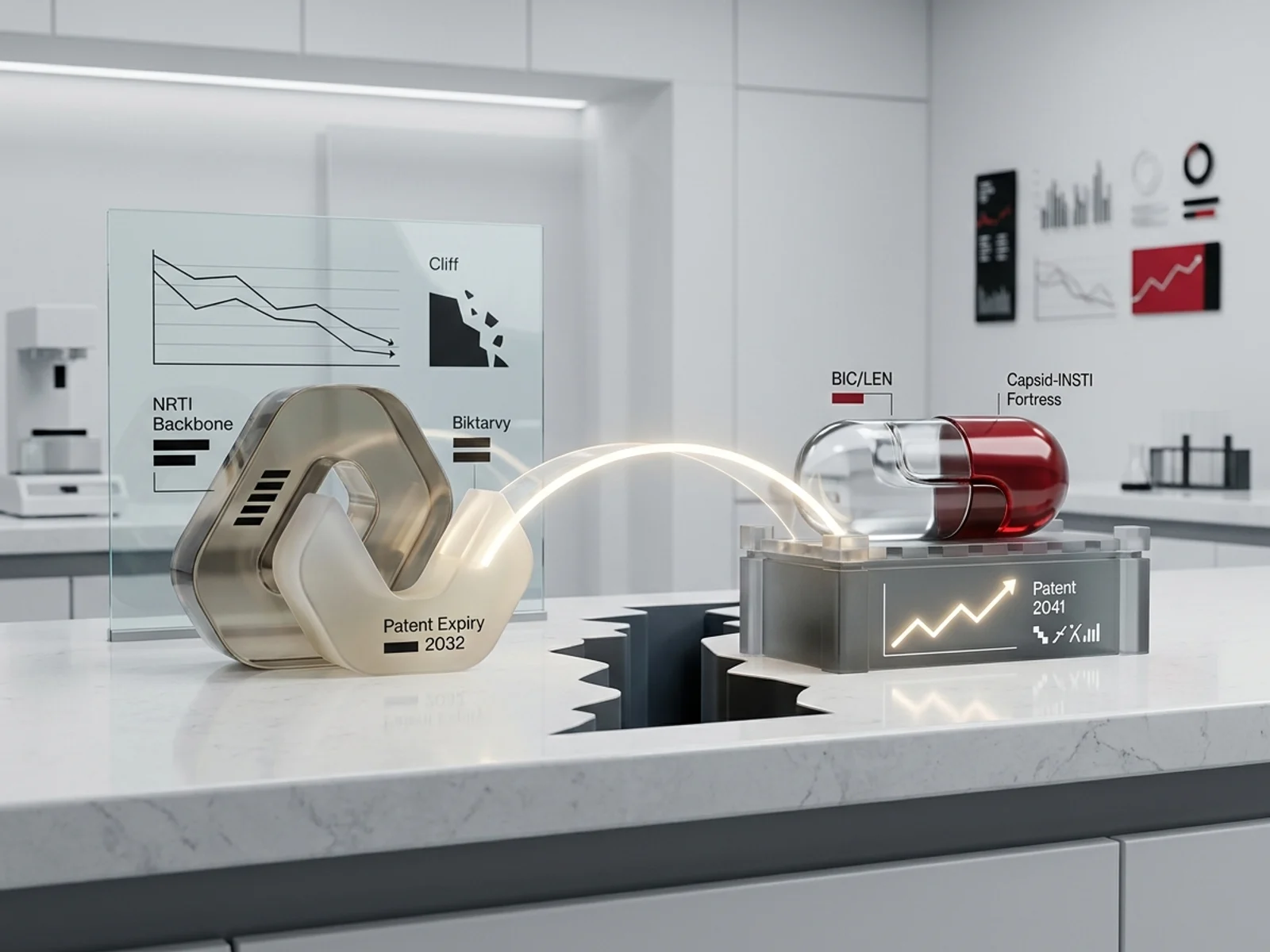
For biopharma strategists, pharmacy and therapeutics (P&T) committees, and market access leaders, BIC/LEN represents far more than an incremental clinical optimization. It is the centerpiece of Gilead's defensive lifecycle strategy around the Biktarvy patent estate. Biktarvy's core substance and product patents (U.S. Patents 8,754,065 and 9,296,769) expire August 15, 2032 — but October 2025 patent-litigation settlements with Lupin, Cipla, and Laurus Labs now block U.S. generic Biktarvy until April 1, 2036, and later-listed Orange Book product patents run to November 8, 2036. By pairing bictegravir with lenacapavir—whose substance patent (U.S. Patent 9,951,043) extends to February 28, 2034, with later formulation and product patents reaching 2040–2041—Gilead can move patients off an NRTI backbone that is already a generic commodity (generic TDF sells for $0.35 per tablet in CMS NADAC pricing) onto a two-drug regimen whose listed IP estate extends well past the settled Biktarvy entry date.
                  BIC/LEN Single-Tablet Regimen (STR) Architecture
                                         │
        ┌────────────────────────────────┼────────────────────────────────┐
        │                                │                                │
  [Components]                     [Clinical Trials]                [Commercial & IP]
  • Bictegravir (INSTI) 75 mg      • Phase 3 ARTISTRY-2 Switch      • PDUFA: August 27, 2026
  • Lenacapavir (Capsid) 50 mg     • Non-inferior to Biktarvy       • Priority Review Granted
  • Once-daily oral STR            • Week 48 RNA >=50 c/mL: 1.3%    • Biktarvy base patents: 2032
  • Smallest STR (per Gilead)      • Zero emergent resistance       • Settled US generic: Apr 2036
  • NRTI-sparing (No TAF/TDF/FTC)  • High barrier to resistance     • Benchmarked vs Dovato/Juluca
What is bictegravir/lenacapavir and how is it different from Biktarvy?
Single-tablet regimens have anchored HIV management for two decades, progressing from first-generation NNRTI-based combinations (such as Atripla) to second-generation INSTI-based triple therapy. Current gold-standard treatment guidelines from the Department of Health and Human Services (HHS) and the International Antiviral Society-USA (IAS-USA) heavily favor second-generation INSTI-anchored regimens due to their high barrier to resistance, rapid viral decay kinetics, and minimal drug-drug interactions.
Gilead's Biktarvy—combining bictegravir 50 mg with emtricitabine (FTC) 200 mg and tenofovir alafenamide (TAF) 25 mg—has held dominant market share across the United States and Europe since its 2018 approval. However, Biktarvy relies on a three-drug regimen containing two NRTIs. While TAF significantly reduced renal and bone mineral density toxicities compared to older tenofovir disoproxil fumarate (TDF) formulations, long-term exposure to nucleoside reverse transcriptase inhibitors remains associated with weight gain, metabolic perturbations, and potential subclinical tubular or mitochondrial effects in aging patient populations.
BIC/LEN alters this paradigm by removing the entire NRTI backbone. Instead, it pairs:
Bictegravir (75 mg): An unboosted, second-generation integrase strand transfer inhibitor that blocks the catalytic insertion of viral cDNA into the host chromosome. In BIC/LEN, the bictegravir dose is adjusted to 75 mg to account for pharmacokinetic co-formulation parameters with oral lenacapavir, maintaining robust plasma trough concentrations ($C_{trough}$) well above the protein-adjusted $IC_{95}$ across 24 hours.
Lenacapavir (50 mg): A first-in-class, multi-stage selective HIV-1 capsid inhibitor. Unlike reverse transcriptase or integrase inhibitors that act at single enzymatic steps, lenacapavir disrupts multiple essential capsid-dependent functions throughout both the early and late viral lifecycle:
Inhibition of capsid disassembly: Prevents nuclear import of viral pre-integration complexes.
Disruption of capsid assembly: Prevents proper viral core formation during virion maturation.
Capsid transport inhibition: Blocks the interaction of capsid proteins with host transport factors (such as CPSF6 and Nup153).
                      BIC/LEN Dual Mechanism of Action
                                     │
         ┌───────────────────────────┴───────────────────────────┐
         │                                                       │
  [Bictegravir 75 mg]                                     [Lenacapavir 50 mg]
  • INSTI Class Mechanism                                 • Capsid Function Inhibitor
  • Prevents viral cDNA integration into host DNA        • Multi-stage lifecycle disruption:
  • High genetic barrier to resistance                     - Blocks capsid core disassembly
  • Unboosted once-daily PK profile                        - Prevents nuclear translocation
  • High plasma trough over protein-adjusted IC95          - Inhibits virion core assembly
By combining two distinct high-barrier pharmacophores with complementary mechanisms, BIC/LEN achieves complete viral suppression without requiring tenofovir or emtricitabine. Gilead also emphasizes tablet size: the company states that the co-formulated product will be the smallest single-tablet regimen available, a relevant point for aging patients managing multiple comorbidities and pill burden.
Clinical Pharmacology & Pharmacokinetic Synergy
Understanding why Gilead paired bictegravir 75 mg with lenacapavir 50 mg requires examining the clinical pharmacology, absorption pathways, and metabolic disposition of both molecules.
Bictegravir Pharmacokinetics in the Co-Formulation
In the standalone Biktarvy formulation, bictegravir is dosed at 50 mg once daily. In the BIC/LEN fixed-dose combination, the bictegravir dose is 75 mg; Gilead has described the combination as using "optimized dosing" for the co-formulation, and the detailed pharmacokinetic rationale has not been laid out in public labeling-level documents. What is known from the approved Biktarvy labeling:
Absorption: Bictegravir is dosed once daily with or without food; absorption is not meaningfully altered by gastric pH modifiers, but polyvalent cation antacids can chelate bictegravir and require dose separation.
Metabolism and Elimination: Bictegravir undergoes dual clearance through CYP3A4-mediated metabolism and UGT1A1-mediated glucuronidation.
Protein Binding and Half-Life: Bictegravir is $>99%$ bound to human plasma proteins, with an elimination half-life ($t_{1/2}$) of approximately 17.3 hours, providing forgiveness for missed or delayed doses.
Lenacapavir Daily Oral Pharmacokinetics
While lenacapavir is widely known as a twice-yearly subcutaneous injection (Sunlenca), the molecule's long persistence and oral availability support daily oral dosing in the co-formulation:
Absorption: Oral lenacapavir is absorbed slowly and continuously from the gastrointestinal tract and can be taken with or without food.
Metabolism: Per Sunlenca labeling, lenacapavir is a substrate of CYP3A4, P-gp, and UGT1A1, with biliary/fecal elimination predominating and only minor oxidative metabolism.
Long Half-Life Buffer: Lenacapavir's long terminal elimination profile is the property that makes twice-yearly subcutaneous dosing possible; in a once-daily 50 mg oral tablet, the same persistence creates a deep pharmacological reservoir. Even if a patient misses a scheduled daily dose, lenacapavir exposure is expected to remain well above target antiviral thresholds for an extended window, limiting selective viral breakthrough. Lenacapavir is $>99.9%$ plasma protein bound.
BIC/LEN Pharmacokinetic Summary Matrix
| Pharmacokinetic Parameter | Bictegravir (75 mg) | Lenacapavir (50 mg) |
|---|---|---|
| Target Antiviral Class | INSTI | HIV-1 Capsid Inhibitor |
| Terminal Half-Life | ~17.3 hours (label) | Long (basis for 2x/yr |
| Sunlenca injection) | ||
| Primary Clearance Route | CYP3A4 + UGT1A1 | Biliary/fecal predomin. |
| Plasma Protein Binding | > 99% | > 99.9% |
| Food Requirement | With or without food | With or without food |
| Missed-Dose Forgiveness Character | Moderate (daily t1/2) | Exceptional (long t1/2) |
Drug-Drug Interaction Profile & Co-Medication Guidance
Because individuals living with HIV on long-term antiretroviral therapy frequently manage age-related comorbidities—including dyslipidemia, hypertension, gastroesophageal reflux disease, and mood disorders—evaluating drug-drug interaction (DDI) liability is essential for clinical practice and formulary design. No BIC/LEN label exists yet, so the expected interaction profile below is triangulated from the approved U.S. labeling of the two components (Biktarvy and Sunlenca); final labeled guidance may differ.
BIC/LEN Co-Medication Management Matrix
| Concomitant Medication Class | Specific Example Agents | Clinical Recommendation & Mechanism |
|---|---|---|
| Polyvalent Cation Antacids | Al/Mg hydroxide, Calcium | Administer BIC/LEN at least 2 hours before |
| carbonate, oral iron | or 6 hours after cation antacids (chelation | |
| Potent CYP3A / P-gp Inducers | Rifampin, carbamazepine, | CONTRAINDICATED; markedly reduces plasma |
| St. John's wort, phenyt. | concentrations of both BIC and LEN | |
| Moderate CYP3A Inducers | Efavirenz, etravirine, | Co-administration not recommended; may |
| modafinil, bosentan | lead to loss of virologic suppression | |
| Statins (HMG-CoA Reductase Inh.) | Atorvastatin, rosuvast., | Safe to co-administer; monitor for mild |
| pravastatin, pitavastatin | statin exposure increases with atorvastatin | |
| Acid Reducers (H2RAs & PPIs) | Famotidine, omeprazole, | Safe with no dose separation required; |
| pantoprazole | BIC/LEN absorption is gastric pH-independ. | |
| Oral Contraceptives & HRT | Ethinyl estradiol, | Safe to co-administer; no clinically |
| norgestimate, progestins | meaningful alteration in hormone levels | |
| Phosphodiesterase-5 Inhibitors | Sildenafil, tadalafil | Safe to co-administer; standard dosing |
Unlike older protease inhibitor-based regimens that require pharmacokinetic boosting with ritonavir or cobicistat—which extensively inhibit CYP3A4, CYP2D6, and transport proteins—BIC/LEN contains no pharmacokinetic booster. Consequently, BIC/LEN avoids the severe DDI liabilities associated with inhaled/injected corticosteroids (e.g., fluticasone, triamcinolone), antiarrhythmics, and direct-acting oral anticoagulants.
What did the ARTISTRY-1 and ARTISTRY-2 Phase 3 trials show?
The clinical development program for BIC/LEN focused on establishing whether a two-drug INSTI + capsid inhibitor regimen could match the virologic suppression, durability, and safety of standard three-drug regimens in patients who had already achieved undetectable viral loads on baseline antiretroviral therapy.
                          ARTISTRY-2 Phase 3 Trial Design
                                         │
                 ┌───────────────────────┴───────────────────────┐
                 │                                               │
     [BIC/LEN Switch Arm]                             [Biktarvy Continuation]
     • Bictegravir 75 mg / Lenacapavir 50 mg          • BIC 50 mg / FTC 200 mg / TAF 25 mg
     • Once-daily oral STR                            • Standard once-daily oral 3-drug STR
     • N = 383 randomized (2:1)                       • N = 191 randomized
     • Primary Endpoint: Week 48 HIV-1 RNA >=50 c/mL  • Non-inferiority margin: 4.0%
     • Total enrollment: 574 adults suppressed >=6 mo on Biktarvy
Primary Efficacy Readout (ARTISTRY-2, NCT06333808)
The pivotal Phase 3 ARTISTRY-2 trial enrolled 574 adults with HIV-1 who had been virologically suppressed on Biktarvy for at least six months, randomizing them 2:1 to switch to once-daily BIC/LEN (n = 383) or continue Biktarvy (n = 191). Week 48 results were presented at CROI 2026 and published in The Lancet HIV (Meissner et al., 2026):
Virologic Failure Rate (FDA Snapshot Algorithm, Week 48):
BIC/LEN Arm: 1.3% (5/383 participants with $\text{HIV-1 RNA} \ge 50\text{ copies/mL}$)
Biktarvy Continuation Arm: 1.0% (2/191)
Treatment Difference: $+0.3%$ (95% CI: $-1.9%$ to $+2.4%$). Because the upper bound of the CI was below the pre-specified non-inferiority margin of 4.0%, BIC/LEN demonstrated non-inferiority.
Suppression Maintenance: Virologic suppression was maintained at similar rates in both arms through Week 48, with stable CD4 counts.
ARTISTRY-2 Week 48 Virologic Outcomes (FDA Snapshot)
| Endpoint Metric | BIC/LEN | Biktarvy | Difference (95% CI) |
|---|---|---|---|
| HIV-1 RNA >= 50 copies/mL (Failure) | 1.3% (5/383) | 1.0% (2/191) | +0.3% (-1.9%, +2.4%) |
| CD4 count change | Stable | Stable | N/A |
| Met resistance-analysis criteria | 2 pts | 2 pts | N/A |
| Confirmed emergent resistance | 0 | 0 | N/A |
Cohort Context: Who Was Actually Studied
The ARTISTRY-2 population is instructive for payer planning because it mirrors the switch candidates plans will see:
An aging, comorbidity-heavy cohort: Median age was 49 (range 23-77), with 19% female, 27% Black, and 27% Hispanic or Latine participants. About 80% were taking at least one other medication — mainly lipid-lowering therapy (71%), blood-pressure agents (55%), and diabetes therapy (23%).
Realistic renal spread: eGFR was above 60 mL/min in 85% of participants, with 15% in the 30-to-60 range — the kind of mild-to-moderate CKD population for whom removing tenofovir exposure is most attractive.
Suppression durability: Participants had been undetectable for at least six months on Biktarvy before randomization, matching the expected labeled switch population.
ARTISTRY-1: Treatment-Naive and Complex-Regimen Cohorts
ARTISTRY-1 (NCT05502341) enrolled both treatment-naive adults and virologically suppressed adults on complex multi-tablet regimens. In the complex-regimen switch population (557 randomized 2:1; median 28 years on antiretroviral therapy, median age 60), Week 48 results presented at CROI 2026 showed:
HIV-1 RNA $\ge$50 copies/mL in 0.8% of BIC/LEN switchers versus 1.1% of those continuing their complex regimen (difference $-0.3%$; 95% CI $-2.3$ to $+1.8$; non-inferiority margin 4%).
Virologic suppression ($<50$ copies/mL) in 96% versus 94%, with no virologic data available in the Week 48 window for 3% versus 5%.
No treatment-emergent resistance in either arm.
A 96-week follow-up from the earlier phase 2 part of ARTISTRY-1 was also presented at CROI 2026. One operational detail worth noting for launch: per the registered ARTISTRY-2 protocol, initiation included a two-day 600 mg oral lenacapavir lead-in alongside the daily BIC/LEN tablet — whether the commercial label carries such a lead-in will matter for pharmacy workflow.
Resistance and Safety Profile
Resistance Development: Gilead reported no treatment-emergent resistance through Week 48 across the ARTISTRY program. In ARTISTRY-2, two participants in each arm met resistance-analysis criteria, and none developed resistance mutations to bictegravir or lenacapavir (capsid mutations such as M66I, Q67H, or N74D remain laboratory phenomena rather than clinical trial findings to date).
Adverse Events and Tolerability: BIC/LEN was generally well tolerated, with no significant or new safety concerns identified in the trial.
As analyzed in the comprehensive antiretroviral adverse events by the numbers safety report, INSTI-based regimens possess one of the lowest spontaneous adverse-event reporting rates in post-marketing databases, and pairing bictegravir with lenacapavir preserves this safety envelope.
Genetic Barrier to Resistance: Capsid vs NRTI Backbones
A critical question for HIV clinicians and P&T committees evaluating two-drug regimens is whether dropping the NRTI backbone creates vulnerability to resistance emergence during intermittent non-adherence.
                      Antiretroviral Genetic Resistance Hierarchy
                                         │
        ┌────────────────────────────────┼────────────────────────────────┐
        │                                │                                │
  [Low Genetic Barrier]            [Moderate Genetic Barrier]       [High Genetic Barrier]
  • 1st Gen NNRTIs (EFV, NVP)      • 1st Gen INSTIs (RAL, EVG)      • 2nd Gen INSTIs (BIC, DTG)
  • 3TC / FTC (Single M184V)       • Boosted PIs (DRV/r, ATV/r)     • Lenacapavir (Capsid)
  • Single point mutation breaks   • Multiple mutations required    • Multi-step core disruption
Why BIC/LEN Outperforms Historical 2-Drug Regimens
Historical two-drug regimens encountered resistance vulnerabilities because they paired a core agent with a low-barrier partner:
Dolutegravir + Rilpivirine (Juluca): Rilpivirine has a low genetic barrier; single NNRTI mutations (e.g., E138K, K101E) can cause failure if viral load rebounds.
Dolutegravir + Lamivudine (Dovato): While highly effective, lamivudine has a low genetic barrier, where a single nucleotide change producing the M184V/I substitution completely knocks out 3TC activity, leaving dolutegravir as functional monotherapy.
In contrast, BIC/LEN is the first two-drug regimen where BOTH agents possess high genetic barriers to resistance:
Antiretroviral Class Resistance & Mutation Penalty Matrix
| Antiretroviral Agent | Class | Key Resistance Mutations | Impact on Fitness / Barrier |
|---|---|---|---|
| Bictegravir (75 mg) | 2nd Gen INSTI | Q148H/K/R + G140S, R263K | Extreme fitness penalty; requires multiple mutations |
| Lenacapavir (50 mg) | Capsid Inh | M66I, Q67H, K70N, N74D | Severe replicative defect; high in vitro barrier |
| Lamivudine (in Dovato) | NRTI | M184V, M184I | Low barrier; single base change confers >100x resist |
| Rilpivirine (in Juluca) | NNRTI | E138K, K101E, Y181C | Low barrier; vulnerable to baseline NNRTI mutations |
| TAF (in Biktarvy) | NRTI | K65R, K70E | High barrier in combination |
Because lenacapavir acts simultaneously on viral entry, capsid disassembly, nuclear transport, and virion assembly, viable escape mutants suffer crippling viral fitness penalties. Pairing lenacapavir with bictegravir establishes a dual-fortress mechanism that resists single-step breakthrough mutations.
Metabolic, Weight, and Cardiovascular Considerations
Over the past decade, antiretroviral clinical trials have documented significant body weight increases following initiation or switch to second-generation INSTI- and TAF-containing regimens. This phenomenon has sparked intensive discussion across endocrinology and HIV clinical forums regarding cardiovascular risk in aging patients.
Weight Gain Dynamics: TAF vs NRTI-Free Regimens
Weight gain after initiating or switching to second-generation INSTI- and TAF-containing regimens is one of the most discussed long-term tolerability questions in HIV care, particularly for aging patients watching cardiometabolic risk. BICtegravir itself is part of that class effect, and removing TAF/FTC does not remove the INSTI; the honest positioning is that BIC/LEN eliminates the tenofovir and FTC components — with their renal-tubular and bone considerations — rather than promising weight neutrality. Gilead's topline communications have not highlighted differential weight outcomes for BIC/LEN versus Biktarvy, so formulary teams should treat metabolic neutrality as an open question until full publications and labeling land. By maintaining an unboosted INSTI, BIC/LEN at least avoids the lipid penalties associated with boosted protease inhibitors such as Symtuza.
When is the BIC/LEN FDA decision date and what is the likely approval outcome?
The regulatory review for BIC/LEN is advancing under FDA Priority Review:
NDA Acceptance Announced: April 29, 2026
PDUFA Target Action Date: August 27, 2026
Regulatory Pathway: Priority Review NDA
Proposed Indication: For the treatment of HIV-1 infection in adults who are virologically suppressed ($\text{HIV-1 RNA} < 50\text{ copies/mL}$) on a stable antiretroviral regimen with no history of treatment failure and no known substitutions associated with resistance to the individual components of BIC/LEN.
Given that bictegravir is already approved as a component of Biktarvy and lenacapavir is approved as Sunlenca (for heavily treatment-experienced HIV) and Yeztugo (for PrEP), the pharmacological, pharmacokinetic, and toxicology profiles of both active pharmaceutical ingredients (APIs) are already vetted by CDER. Combined with clean non-inferiority data from ARTISTRY-2, approval on or before the August 27 PDUFA date is widely viewed as likely — though the label scope is the real variable to watch.
The primary regulatory scrutiny centers on two labeling parameters:
Initial Population Scope: Whether the initial indication will be strictly limited to switch patients (virologically suppressed) or if language will allow broader treatment-naive initiation based on extrapolation from individual component data (initial label is expected to specify switch therapy).
Hepatitis B Co-infection Warning: Because BIC/LEN lacks tenofovir (TAF or TDF) and emtricitabine/lamivudine—agents that exhibit dual activity against hepatitis B virus (HBV)—the label will mandate HBV screening prior to initiation and include a warning regarding potential severe acute exacerbations of hepatitis B in HBV/HIV co-infected patients switching off tenofovir-containing regimens.
How does BIC/LEN change the Biktarvy patent-cliff and Gilead franchise math?
The strategic imperative behind BIC/LEN is rooted in biopharmaceutical intellectual property and franchise defense. For broader corporate context on Gilead's commercial pipeline, see our Gilead Sciences portfolio dossier.
Biktarvy is the single highest-revenue antiretroviral product in history, generating $14.3 billion in FY2025 global sales (about $11.5 billion from the United States), per Gilead's results. Its U.S. exclusivity runway is longer than the raw patent-expiry table suggests, because litigation settlements — not just Orange Book dates — now govern the earliest realistic generic entry.
                     Gilead HIV Franchise Exclusivity Horizon
                                        │
        ┌───────────────────────────────┴───────────────────────────────┐
        │                                                               │
  [Biktarvy (NDA 210251)]                                 [Lenacapavir Franchise]
  • US Patent 8,754,065: Aug 15, 2032                     • US Patent 9,951,043: Feb 28, 2034
  • US Patent 9,296,769: Aug 15, 2032                     • US Patent 10,071,985: Aug 17, 2037
  • Pediatric Exclusivity: Feb 15, 2033                   • US Patent 11,807,625: Nov 25, 2040
  • Settled generic entry: Apr 1, 2036                    • US Patent 11,944,611: Aug 28, 2041
  • Latest product patents: Nov 8, 2036                   • Generic Backbone: Already $0.35/tab TDF
Orange Book Patent Analysis
An inspection of the FDA Orange Book for Biktarvy (NDA 210251) and lenacapavir (Sunlenca NDA 215973 / Yeztugo NDA 220018) reveals the cliff dynamics:
Biktarvy (NDA 210251):
U.S. Patent 8,754,065 (Bictegravir chemical entity / substance): Expires August 15, 2032 (Feb 15, 2033 with pediatric exclusivity).
U.S. Patent 9,296,769 (Bictegravir compound and methods): Expires August 15, 2032 (Feb 15, 2033 with pediatric exclusivity).
U.S. Patents 9,216,996 & 9,732,092: Expire December 19, 2033 (substance/product).
U.S. Patent 9,708,342 & 10,385,067 (Formulation/combination): Expire June 19, 2035.
U.S. Patents 10,548,846, 11,744,802 & 12,594,244 (product patents): Expire November 8, 2036.
Settlement overlay: October 2025 patent settlements with Lupin, Cipla, and Laurus Labs license U.S. generic Biktarvy entry from April 1, 2036.
Lenacapavir (NDA 215973 / NDA 220018):
U.S. Patent 9,951,043 (Lenacapavir chemical entity / active substance): Expires February 28, 2034.
U.S. Patents 10,071,985 & 10,654,827 (listed across Sunlenca/Yeztugo): Expire August 17, 2037.
U.S. Patents 12,594,267 & 11,807,625 (product/use patents): Expire July 15, 2039 to November 25, 2040.
U.S. Patent 11,944,611 (Formulation compositions): Expires August 28, 2041.
Orange Book Patent Runway Comparison (FDA Listed Patents)
| Product / Asset | NDA Number | Earliest Sub Pat | Effective Cliff | Latest Listed Patent |
|---|---|---|---|---|
| Biktarvy (BIC/FTC/TAF) | NDA 210251 | US 8,754,065 | Apr 2036 (settl. | Nov 8, 2036 |
| (Aug 15, 2032) | /Nov 2036 pats) | |||
| Sunlenca (Lenacapavir) | NDA 215973 | US 9,951,043 | Feb 28, 2034 | Aug 28, 2041 |
| Yeztugo (Lenacapavir) | NDA 220018 | US 9,951,043 | Feb 28, 2034 | Nov 25, 2040 |
| BIC/LEN STR (Combined) | Pending 2026 | US 9,951,043 | See note | Aug 28, 2041 (est.) |
Note: the BIC/LEN NDA will list the lenacapavir estate plus any new combination patents; the
effective exclusivity of BIC/LEN is not yet knowable until its own Orange Book listing exists.
The settlement overlay matters for franchise math. Biktarvy's base substance patents lapse in August 2032 (February 2033 with pediatric exclusivity), but the settled filers are licensed from April 1, 2036, and later-listed product patents reach November 8, 2036 — so the effective U.S. Biktarvy cliff is now mid-2036 unless a new challenger invalidates the later patents or settles earlier. When generic bictegravir/emtricitabine/tenofovir alafenamide does enter, the erosion pattern for a first-wave small-molecule anchor is typically steep — analysts generally model 80%+ price erosion over the first few generic years.
If Gilead leaves its patient base on Biktarvy, that $14+ billion revenue stream deflates from 2036. By launching BIC/LEN in 2026 — roughly a decade before settled generic entry — Gilead can migrate virologically suppressed Biktarvy patients onto BIC/LEN well ahead of the cliff. Because BIC/LEN contains lenacapavir, generic Biktarvy will not be pharmacy-substitutable for it. One nuance worth flagging: the lenacapavir substance patent (February 2034) actually expires before the settled Biktarvy entry date, so the longer BIC/LEN runway rests on the formulation and product patents reaching 2040–2041, plus whatever new patents list when the BIC/LEN NDA clears — a key detail for lifecycle analysts who assume automatic exclusivity symmetry across the franchise.
How does BIC/LEN pricing compare with Biktarvy, Dovato, and generic backbones?
To understand how payers will evaluate BIC/LEN, we analyze unit acquisition costs across the U.S. antiretroviral marketplace using National Average Drug Acquisition Cost (NADAC) data published by the Centers for Medicare & Medicaid Services (CMS).
                     CMS NADAC Unit Pricing for HIV Regimens
                                        │
        ┌───────────────────────────────┼───────────────────────────────┐
        │                               │                               │
  [Brand 3-Drug STRs]             [Brand 2-Drug STRs]             [Generic Backbones]
  • Symtuza: $152.94/tab          • Juluca: $121.95/tab           • Generic FTC/TDF: $0.52/tab
  • Stribild: $143.38/tab         • Dovato: $105.29/tab           • Generic TDF 300mg: $0.35/tab
  • Biktarvy: $136.70/tab         • Tivicay (Single): $77.66/tab  • Generic EFV/FTC/TDF: $1.39/tab
  • Genvoya: $136.65/tab          • BIC/LEN: Est. $136-$140/tab   • Generic 3TC 300mg: $1.36/tab
CMS NADAC Benchmark Matrix
The table below outlines per-unit and annual acquisition costs across key single-tablet regimens, individual components, and generic backbones based on the CMS NADAC pricing snapshot:
HIV Antiretroviral Regimen Acquisition Costs (CMS NADAC)
| Product / Brand Name | Regimen Type | NADAC Unit $ | Annual Cost | Clinical Backbone / Note |
|---|---|---|---|---|
| Symtuza (DRV/COBI/FTC/TAF) | 3-Drug + Bst | $152.94 / EA | $55,823 / yr | Protease Inhibitor STR |
| Stribild (EVG/COBI/FTC/TDF) | 3-Drug + Bst | $143.38 / EA | $52,334 / yr | 1st-Gen INSTI + TDF |
| Biktarvy (BIC/FTC/TAF 50-200) | 3-Drug STR | $136.70 / EA | $49,896 / yr | Gold Standard INSTI STR |
| Genvoya (EVG/COBI/FTC/TAF) | 3-Drug + Bst | $136.65 / EA | $49,877 / yr | 1st-Gen INSTI + TAF |
| Triumeq (DTG/ABC/3TC 600-50) | 3-Drug STR | $130.00 / EA | $47,450 / yr | ViiV Dolutegravir 3-drug |
| Juluca (DTG/RPV 50-25 mg) | 2-Drug STR | $121.95 / EA | $44,512 / yr | ViiV INSTI + NNRTI |
| Dovato (DTG/3TC 50-300 mg) | 2-Drug STR | $105.29 / EA | $38,431 / yr | ViiV INSTI + 3TC |
| Tivicay (Dolutegravir 50 mg) | Single Agent | $77.66 / EA | $28,346 / yr | Component Integrase |
| Descovy (FTC/TAF 200-25 mg) | 2-NRTI Dual | $71.43 / EA | $26,072 / yr | Backbone NRTI Pair |
| Truvada (FTC/TDF 200-300 mg) | Brand Dual | $59.74 / EA | $21,805 / yr | Older Brand Backbone |
| Generic FTC/TDF 200-300 mg | Generic Dual | $0.52 / EA | $190 / yr | Commodity Generic Dual |
| Generic TDF 300 mg | Generic Single | $0.35 / EA | $128 / yr | Commodity Single NRTI |
| Generic EFV/FTC/TDF 600-200 | Generic STR | $1.39 / EA | $507 / yr | Generic Atripla Triple |
The Payer Pricing Tension
The pricing data illustrates the central economic battleground in HIV market access:
The Premium Pricing Ceiling: Biktarvy currently commands $136.70 per tablet ($49,896 annually). Gilead is expected to price BIC/LEN at price parity with Biktarvy (approximately $136 to $140 per day) at launch, framing it as an upgraded, NRTI-free option.
The ViiV 2-Drug Benchmark: ViiV Healthcare—whose franchise is detailed in our ViiV HIV portfolio dossier—deliberately priced its two-drug STR Dovato (dolutegravir/lamivudine) at $105.29 per tablet ($38,431 annually), creating a ~23% discount relative to Biktarvy. Payers have leveraged Dovato's price point to extract higher rebates on Biktarvy.
The Commodity Generic Disconnect: While single-tablet regimens cost $38,000 to $50,000 annually, the underlying individual agents can be assembled generically for a fraction of the cost: generic efavirenz/emtricitabine/tenofovir DF is $1.39/day ($507/year), and unbundled generic TDF is $0.35/day. Furthermore, Merck's investigational Idvynso (doravirine/islatravir) is set to enter the two-drug STR ring, creating a three-way market access dynamic between Gilead, ViiV, and Merck.
Cross-Regimen Competitive Landscape (Single-Tablet Regimens)
| Feature / Dimension | BIC/LEN | Biktarvy | Dovato | Idvynso (Investigational) |
|---|---|---|---|---|
| Drug Count | 2 Drugs | 3 Drugs | 2 Drugs | 2 Drugs |
| NRTI Backbone | Spared (0) | 2 (TAF/FTC) | 1 (3TC) | Spared (0 - NRTI/NNRTI Hybrid) |
| Core Classes | INSTI + Cap | INSTI + NRTIs | INSTI + NRTI | NNRTI + NRTTI (Islatravir) |
| Resistance Barrier | Dual-High | High | Moderate-High | High |
| Physical Pill Size | Smallest STR | Small | Moderate | Small |
| Annual NADAC Cost | ~$49,800 est | $49,896 | $38,431 | TBD at Launch |
| HBV Activity | None | Potent (TAF) | Moderate(3TC) | None |
| Renal/Bone Liability | Zero | Low (TAF) | Minimal | Zero |
| Exclusivity Horizon | 2034–2041 | Settled 2036 | Late 2020s | 2030s (OB list. pending) |
What will payers require for BIC/LEN coverage?
When BIC/LEN launches in late 2026, health plans, pharmacy benefit managers (PBMs such as CVS Caremark, Express Scripts, and OptumRx), and state Medicaid programs will conduct initial formulary reviews.
                      Payer Prior Authorization Decision Tree
                                         │
        ┌────────────────────────────────┼────────────────────────────────┐
        │                                │                                │
  [Virologic Status]               [Resistance History]             [Clinical Justification]
  • Documented viral load          • Baseline genotypic testing     • Intolerance or toxicity
    <50 c/mL for >= 6 months         confirming no INSTI or           from TAF/TDF (bone/renal)
  • Stable on current ART            capsid mutations (M66I/Q67H)   • Step-through preferred
  • No prior virologic failure     • Negative HBV screening         • Pill burden / size need
Anticipated Prior Authorization (PA) Criteria
Commercial and Medicare Part D formularies are expected to place BIC/LEN on Tier 4 or Tier 5 (Specialty Tier) with the following standard coverage criteria:
Confirmed Diagnosis & Virologic Suppression: Patient must be $\ge$18 years old with documented HIV-1 infection and maintained viral suppression ($\text{HIV-1 RNA} < 50\text{ copies/mL}$) on a stable ART regimen for at least 6 consecutive months prior to the switch request.
Absence of Baseline Resistance: Medical records must confirm no documented history of treatment failure or known resistance-associated substitutions to integrase strand transfer inhibitors (e.g., Q148H/K/R, N155H, R263K) or capsid inhibitors.
Hepatitis B Screening & Exclusion: Confirmed negative Hepatitis B surface antigen (HBsAg) or, if positive, documentation of a separate, ongoing anti-HBV treatment regimen (such as entecavir), since BIC/LEN does not treat HBV.
Step-Therapy Requirements: On formularies that heavily rebate Biktarvy or Dovato, plans may require a documented contraindication, intolerance, or clinical rationale for switching away from Biktarvy (e.g., worsening renal markers, osteopenia/osteoporosis, or documented metabolic intolerance to NRTIs).
Formulary Tiering & PBM Rebate Economics
Because Biktarvy already sits in a preferred formulary position on virtually all major commercial and Part D formularies, Gilead will utilize its comprehensive portfolio contracting—tying rebates across Biktarvy, Descovy, Sunlenca, and Epclusa—to ensure BIC/LEN receives Tier 2/3 preferred status or co-preferred status alongside Biktarvy without restrictive prior authorization barriers.
Specialty Pharmacy Distribution & Co-Pay Card Mechanics
In the commercial insured market, patient out-of-pocket costs for specialty antiretroviral agents are heavily mitigated by manufacturer copay assistance programs. Gilead's Advancing Access program is expected to extend commercial copay assistance to BIC/LEN, with the annual cap disclosed at launch (recent Gilead HIV caps have run in the mid-four to low-five figures per year). However, market access teams must account for aggressive payer accumulator and maximizer programs:
Copay Accumulators: Prevent manufacturer copay card funds from counting toward the patient's annual out-of-pocket maximum, resulting in sudden deductible cliffs once assistance funds are exhausted.
Copay Maximizers: Spread the full annual value of the manufacturer copay card across 12 equal monthly installments in plan designs where the drug sits outside the essential-health-benefit set, without applying it to patient cost-sharing.
Public Health & ADAP Formulary Inclusion
Under the Ryan White HIV/AIDS Program, State AIDS Drug Assistance Programs (ADAPs) provide critical safety-net coverage for low-income and uninsured individuals. HRSA guidance expects ADAP formularies to include options across antiretroviral classes, so a first-in-class capsid-inhibitor STR is a natural formulary addition. Because ADAPs purchase under 340B ceiling pricing (which provides a statutory minimum 23.1% discount off average manufacturer price plus additional inflation penalties), Gilead will prioritize rapid ADAP formulary submissions across key high-prevalence states (California, Florida, New York, Texas, Georgia) in the first months post-approval.
Furthermore, Federally Qualified Health Centers (FQHCs), Ryan White Part C clinics, and Disproportionate Share Hospitals (DSH) rely heavily on 340B Prime Vendor Program (PVP) sub-ceiling pricing to fund wraparound clinical support, case management, and adherence counseling. Pharmacy directors across covered entities will evaluate whether transitioning patients from 340B-discounted Biktarvy to BIC/LEN maintains clinical margin parity while advancing patient safety through NRTI elimination.
P&T Committee Formulary Evaluation Scorecard
To assist managed care pharmacy directors and P&T committee members in systematically assessing BIC/LEN against incumbent options, we present a structured 5-pillar formulary evaluation framework:
P&T Committee 5-Pillar Evaluation Framework
| Evaluation Pillar | Score (1 to 5) | Key Analytical Findings & P&T Deliberations |
|---|---|---|
| 1. Clinical Non-Inferiority | 5 / 5 | Non-inferior to Biktarvy at W48 (1.3% vs 1.0% failure); |
| suppression 94-96% across switch cohorts. | ||
| 2. Genetic Resistance Safety | 5 / 5 | Zero treatment-emergent resistance; dual-high barrier |
| eliminates vulnerability of 3TC/RPV-based dual regimens. | ||
| 3. Long-Term Organ Toxicity | 4.5 / 5 | NRTI-sparing design removes tenofovir/FTC exposure (renal, |
| bone, and HBV implications to verify against final label). | ||
| 4. Operational Ease & Size | 5 / 5 | Smallest physical STR tablet volume; once-daily oral dosing |
| without meal restrictions or booster interactions. | ||
| 5. Economic & Rebate Impact | 3.5 / 5 | Premium brand pricing ($49.8k/yr) requires portfolio rebate |
| concessions to compete with lower-cost Dovato ($38.4k/yr). |
In summary, BIC/LEN establishes a formidable new benchmark in HIV treatment optimization. By delivering the virologic potency and resistance resilience of modern three-drug regimens while removing the cumulative toxicities and patent vulnerability of the NRTI backbone, Gilead has engineered a multi-decade bridge that will reshape formulary design and clinical practice well into the 2030s.
Global Regulatory & Pipeline Expansion Horizons
Beyond the FDA PDUFA date of August 27, 2026, Gilead's Q2 2026 earnings call laid out the near-term regulatory and pipeline picture:
Global filings: Gilead has said it plans to file the ARTISTRY data with regulatory authorities globally; specific European decision timelines (EMA/CHMP, HTA bodies such as HAS and G-BA, and NICE in the UK) are not yet public. Those assessments will scrutinize the non-inferiority magnitude against a backdrop of cheap generic backbones and ViiV's two-drug STRs.
Weekly oral regimen behind it: Phase 3 data for the once-weekly oral islatravir/lenacapavir (ISL/LEN) regimen support a planned 2027 launch — meaning BIC/LEN is a stepping stone, not the endpoint, of Gilead's simplification strategy.
Second weekly program: GS-1720 has received FDA clearance to advance into Phase 2, giving Gilead two parallel wholly owned once-weekly oral HIV programs.
Treatment-naive expansion: The initial filing is switch-focused (virologically suppressed adults). Broader first-line positioning would require additional data and label expansion; ARTISTRY-1's treatment-naive cohort is the early evidence base to watch.
Practical Clinical Switching & Lab Monitoring Protocols
For infectious disease specialists, clinical pharmacists, and HIV care coordinators preparing for the commercial availability of BIC/LEN, transitioning patients from established regimens requires systematic baseline screening and longitudinal monitoring.
                    Clinical Switching Protocol for BIC/LEN
                                       │
     ┌─────────────────────────────────┼─────────────────────────────────┐
     │                                 │                                 │
[Pre-Switch Checklist]         [Switch Day 0]                  [Post-Switch Monitoring]
• Confirm viral load <50 c/mL  • Discontinue baseline ART       • Week 4: Tolerability check
• Screen HBsAg / Anti-HBc      • Initiate 1 tab BIC/LEN daily   • Week 12: Repeat viral load
• Review historical genotypes  • Counsel on meal-independence   • Week 24: Renal & bone panel
• Check CrCl & urine protein   • Confirm entecavir if HBV(+)    • Week 48: Annual DXA if indicated
Step-by-Step Clinical Checklist
Virologic Stability Verification: Document at least two consecutive viral load measurements showing $\text{HIV-1 RNA} < 50\text{ copies/mL}$ over the preceding 6 to 12 months. Confirm whether the approved regimen requires an oral lenacapavir lead-in at initiation (the ARTISTRY-2 protocol used a two-day 600 mg lead-in) before counseling patients on day-one workflow.
Hepatitis B Status Confirmation: Obtain serum HBsAg, anti-HBs, and total anti-HBc. If the patient is HBsAg-positive, switching off a TAF/FTC-containing regimen without initiating concurrent HBV-active therapy (e.g., oral entecavir 0.5 mg daily) carries a severe risk of hepatic flare.
Historical Resistance Review: Review all historical viral genotype reports. Any documented history of multi-class INSTI failure or transmitted capsid resistance warrants expert resistance panel evaluation before initiating BIC/LEN.
Longitudinal Lab Schedule:
Week 4: Assess medication adherence, tolerability, pill swallowing ease, and any early mild gastrointestinal symptoms or headache.
Week 12: Measure plasma HIV-1 viral load by quantitative real-time PCR to confirm sustained virologic suppression ($\text{HIV-1 RNA} < 50\text{ copies/mL}$).
Week 24 & 48: Comprehensive metabolic panel, fasting lipid profile, serum creatinine, estimated glomerular filtration rate (eGFR by CKD-EPI formula), and quantitative urine protein-to-creatinine ratio (uPCR) to document renal recovery following TAF discontinuation.
Frequently Asked Questions
Is bictegravir/lenacapavir (BIC/LEN) FDA approved yet?
No. Gilead announced FDA acceptance of the BIC/LEN New Drug Application on April 29, 2026, with Priority Review. The PDUFA target action date is August 27, 2026. Commercial launch in the United States is anticipated shortly after approval.
Will BIC/LEN replace Biktarvy or is it a switch/optimization regimen?
BIC/LEN was studied in the ARTISTRY-2 Phase 3 trial specifically as a switch regimen for adults with HIV-1 who are already virologically suppressed on stable antiretroviral therapy. While it provides an NRTI-sparing alternative for patients experiencing or at risk for tenofovir-related toxicities, Biktarvy will remain an active option for treatment-naive patients until broader first-line clinical data are reviewed.
Does BIC/LEN contain tenofovir or emtricitabine?
No. BIC/LEN is an NRTI-sparing two-drug regimen containing only bictegravir (75 mg) and lenacapavir (50 mg). It completely eliminates tenofovir (both TAF and TDF) and emtricitabine (FTC).
How does lenacapavir work as a daily oral tablet compared to the twice-yearly injection?
Lenacapavir is chemically identical in both formulations. While Sunlenca is administered as a subcutaneous injection every 6 months for heavily treatment-experienced HIV, the 50 mg daily oral tablet in BIC/LEN provides steady, sustained daily systemic exposure optimized for co-administration with daily oral bictegravir.
Does BIC/LEN treat Hepatitis B co-infection?
No. Unlike Biktarvy, Genvoya, or Truvada—which contain tenofovir and/or emtricitabine with potent activity against Hepatitis B virus (HBV)—BIC/LEN has no anti-HBV activity. Patients with HIV/HBV co-infection who switch to BIC/LEN must receive concomitant anti-HBV therapy (such as entecavir) to prevent severe hepatitis B flares.
Why is the bictegravir dose 75 mg in BIC/LEN instead of 50 mg as in Biktarvy?
In Biktarvy, bictegravir is dosed at 50 mg. In the BIC/LEN fixed-dose combination, the dose is 75 mg — an adjustment Gilead attributes to optimized dosing for the co-formulation with daily oral lenacapavir. Gilead has not published a full pharmacokinetic rationale at the labeling level; the final approved labeling will be the authoritative source.
Sources
U.S. Food and Drug Administration (FDA). Novel Drug Approvals for 2026. CDER Drug and Biologic Approvals Pipeline. Available at: fda.gov.
Gilead Sciences, Inc. U.S. FDA Grants Priority Review of New Drug Application for Gilead's Once-Daily HIV Treatment of Bictegravir Plus Lenacapavir. Press Release, April 29, 2026. Available at: gilead.com.
Gilead Sciences, Inc. Gilead's Single-Tablet Regimen of Bictegravir and Lenacapavir Maintained Virological Suppression in People With HIV Who Switched Antiretroviral Therapy (ARTISTRY-2 and ARTISTRY-1 Week 48 results, CROI 2026). Press Release, February 25, 2026. Available at: gilead.com.
Meissner EG, et al. Safety and efficacy of switching to bictegravir-lenacapavir versus continuing bictegravir-emtricitabine-tenofovir alafenamide in virologically suppressed people with HIV-1 (ARTISTRY-2): a double-blind, multicentre, randomised, controlled, phase 3, non-inferiority trial. The Lancet HIV, 2026; 13(8):e538-e547. Available at: pubmed.ncbi.nlm.nih.gov.
HIV i-Base. CROI 2026: Once-daily oral BIC/LEN simplifies ART for those on complex combinations (ARTISTRY-1 and ARTISTRY-2 detailed results). Available at: i-base.info.
ClinicalTrials.gov. A Study to Compare Bictegravir/Lenacapavir Versus Current Therapy in People With HIV-1 Who Are Successfully Treated With Biktarvy (ARTISTRY-2). Identifier: NCT06333808. Available at: clinicaltrials.gov.
ClinicalTrials.gov. A Study to Evaluate the Safety, Tolerability, and Efficacy of Bictegravir and Lenacapavir in Treatment-Naïve and Virologically Suppressed Adults With HIV-1 (ARTISTRY-1). Identifier: NCT05502341. Available at: clinicaltrials.gov.
U.S. Food and Drug Administration (FDA). Approved Drug Products with Therapeutic Equivalence Evaluations (Orange Book). Patent and Exclusivity Data for NDA 210251 (Biktarvy), NDA 215973 (Sunlenca), and NDA 220018 (Yeztugo). Available at: accessdata.fda.gov.
Centers for Medicare & Medicaid Services (CMS). National Average Drug Acquisition Cost (NADAC) Pricing Database, 2026-07-24 Snapshot. Available at: data.medicaid.gov.
Drugs.com. Bictegravir and Lenacapavir FDA Approval History and Regulatory Timeline. Available at: drugs.com.
AllSci. Gilead Q2 2026 earnings call: BIC/LEN FDA decision by August 27; ISL/LEN weekly launch plans and GS-1720 Phase 2 clearance. Available at: allsci.com.
Department of Health and Human Services (HHS). Guidelines for the Use of Antiretroviral Agents in Adults and Adolescents with HIV. Clinical Guidelines Portal. Available at: clinicalinfo.hiv.gov.