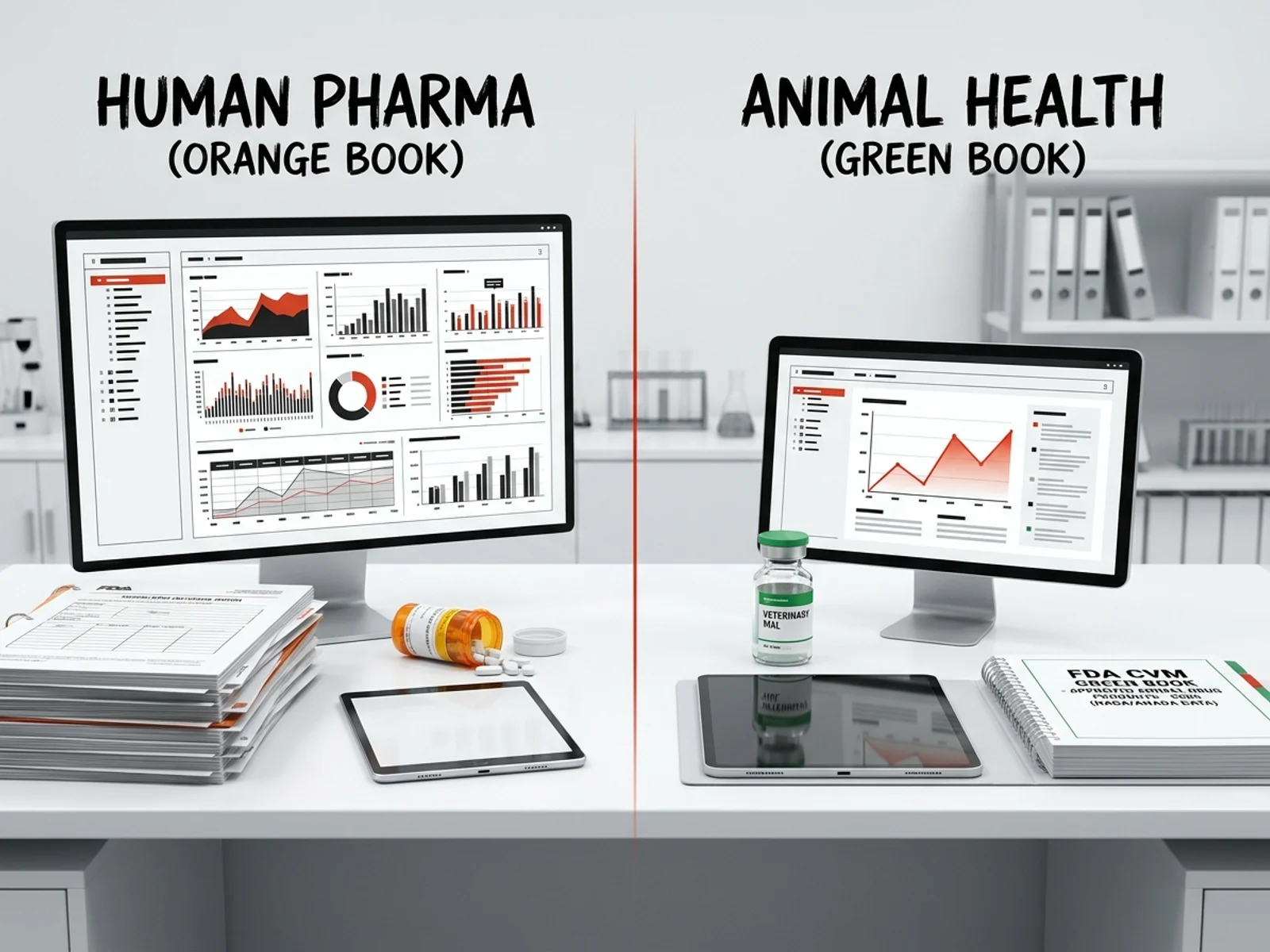
For pharmaceutical professionals and generic planners accustomed to the human drug market, the veterinary drug sector offers a distinct, parallel regulatory landscape. In the United States, approved animal drugs are documented not in the Orange Book, but in the Food and Drug Administration (FDA) Center for Veterinary Medicine (CVM) registry officially known as the Green Book (Approved Animal Drug Products). A registry-wide scan of the Green Book (snapshot taken 25 July 2026) reveals 2,882 approved animal drug product records across 2,427 applications, showing a market with lower generic penetration, high sponsor concentration, and unique agricultural dimensions compared to human health. The registry lists every application FDA has ever approved, including 677 that have since been voluntarily withdrawn from the market, so "approved" here means "ever approved," not "currently sold."
Of the 2,427 applications on file, 1,834 are pioneer New Animal Drug Applications (NADAs), 7 are conditionally approved applications (CNADAs), and 586 are generic Abbreviated New Animal Drug Applications (ANADAs). This yields a generic application ratio of 24.1%, meaning generics represent less than a quarter of all approved veterinary applications—a stark contrast to the human market where generics account for over 78% of applications.
In addition to NADA and ANADA splits, the Green Book documents the marketing status of veterinary drugs: Prescription (Rx) products account for 1,347 (46.7%), Over-the-Counter (OTC) products represent 1,184 (41.1%), and Veterinary Feed Directive (VFD) products account for 240 (8.3%). The market is heavily consolidated: the top sponsor, Zoetis, controls 507 product records (17.6%), followed by Phibro Animal Health with 251, and Intervet (Merck Animal Health) with 203. Active protection is also concentrated: there are 214 active patent records representing 158 unique active patents and 54 active exclusivities currently shielding veterinary products from generic entry.
This numbers-first registry analysis dissects the Green Book database, detailing NADA vs. ANADA dynamics, marketing status splits, sponsor rankings, species and ingredient distributions, and the active patents and exclusivities that shape generic veterinary entry.
How many animal drug products are approved in the FDA Green Book?
The FDA Green Book is the official repository for all approved new animal drugs under Section 512 of the Federal Food, Drug, and Cosmetic Act (21 U.S.C. 360b). However, like the human Orange Book, raw product counts can be misleading because one approved application can spawn multiple product entries based on strength, presentation, and packaging variations.
A scan of the Green Book registry shows 2,882 approved proprietary product records distributed across 2,427 applications. The application counts represent the distinct approvals granted to sponsors, while the product counts capture the market-ready formulations available to veterinarians and animal owners.
Understanding this difference is critical for competitive intelligence. In the veterinary sector, a single application for an active ingredient—such as a canine parasiticide or a bovine antibiotic—frequently lists multiple product strengths (e.g., 5 mg, 10 mg, and 20 mg tablets) under separate product rows. The 2,882 proprietary product records reflect these individual market presentations, while the 2,427 applications reflect the underlying regulatory approvals.
Additionally, the Green Book lists the regulatory type of each application:
| Application Type | Count | Share of Applications | Statutory Purpose |
|---|---|---|---|
| Approved (NADA) | 1,834 | 75.6% | Fully approved pioneer products that have demonstrated safety and effectiveness for their target species. |
| Approved generic (ANADA) | 586 | 24.1% | Generic products shown to be bioequivalent to an approved pioneer NADA. |
| Conditionally Approved (CNADA) | 7 | 0.3% | Temporary approvals (up to 5 years) for minor species or minor uses in major species (MUMS), requiring annual renewal while final effectiveness data is gathered. |
| Total Applications | 2,427 | 100.0% | The complete base of approved animal-drug applications (including 677 since voluntarily withdrawn). |
The overwhelming dominance of fully approved NADAs and ANADAs (99.7% combined) shows that the vast majority of the veterinary drug supply is held to the complete safety and efficacy standards. The conditional approval (CNADA) pathway, while commercially vital for rare animal diseases, remains a narrow exception, with seven applications currently listed. A separate Index of Legally Marketed Unapproved New Animal Drugs exists for certain non-food minor species (such as ornamental fish or exotic pets) that cannot support the cost of a full approval, but indexed products are not filed as NADA/CNADA/ANADA applications and therefore do not appear as a distinct type in the application registry scanned here.
How do brand (NADA) and generic (ANADA) approvals compare?
The central economic driver of the human pharmaceutical market is generic substitution, where generics represent the vast majority of filled prescriptions. In the veterinary market, the dynamic is different. Generic veterinary drugs are approved under the Abbreviated New Animal Drug Application (ANADA) pathway, established by the Generic Animal Drug and Patent Term Restoration Act (GADPTRA) of 1988.
Matching the Green Book applications with their regulatory type codes reveals a generic penetration rate that is significantly lower than the human drug counterpart:
| Application Type | Applications | Share of Applications | Market Function |
|---|---|---|---|
| NADA (Innovator Brand) | 1,834 | 75.6% | Pioneer approvals requiring full clinical safety and effectiveness studies. |
| CNADA (Conditionally Approved) | 7 | 0.3% | Time-limited minor-use/minor-species approvals requiring annual renewal. |
| ANADA (Generic) | 586 | 24.1% | Abbreviated approvals requiring demonstration of bioequivalence and manufacturing quality. |
| Total Applications | 2,427 | 100.0% | The complete base of approved animal-drug applications (677 since withdrawn). |
A generic ratio of 24.1% means that brand-name products still command more than three-quarters of the active veterinary drug approvals. This stands in contrast to the human market, where the FDA approval engine database shows generics (ANDAs) making up over 78% of all approved applications.
There are several structural reasons for this low generic penetration in animal health:
Smaller Market Sizes: Many veterinary drugs target highly specific animal populations (e.g., feline hypertension or equine colic). The total market revenue for these products is often too small to justify the $1 million to $3 million development and bioequivalence study costs required for a generic competitor to file an ANADA.
Clinical Bioequivalence Barriers: Unlike human oral solids where bioequivalence is demonstrated through simple pharmacokinetic studies in healthy volunteers, veterinary bioequivalence frequently requires complex target animal studies in specific breeds or species, raising clinical trial complexity.
Payer and Distribution Channels: The veterinary channel lacks the aggressive, automated PBM-driven generic substitution that rules human retail pharmacy. Veterinarians act as both prescribers and dispensaries, and their inventory decisions are driven by sponsor relationships, clinic-level bundles, and brand trust rather than third-party formulary mandates.
OTC and Feed Segments: As detailed in the next section, a massive share of the Green Book consists of OTC and feed-additive products, where commercial competition relies on agricultural distribution networks and volume manufacturing rather than prescription retail erosion.
For generic animal health developers, this lower ratio signals significant white-space opportunity. Large pioneer veterinary franchises that have been off patent for years frequently face zero generic competitors, allowing innovators to maintain high pricing and margin structures long after human drugs would have faced complete commodity price erosion.
What is the marketing status distribution: Rx vs OTC vs VFD?
The marketing status of a new animal drug is determined by the FDA CVM during the NADA review. Unlike human drugs—which are almost exclusively divided into prescription (Rx) and over-the-counter (OTC) categories—veterinary medicine includes a third, legally distinct category designed for agricultural food-producing animals: the Veterinary Feed Directive (VFD).
A breakdown of the 2,882 approved product records by marketing status shows the unique composition of the animal health market:
| Marketing Status | Product Records | Share of Registry | Regulatory Framework |
|---|---|---|---|
| Prescription (Rx) | 1,347 | 46.7% | Requires veterinary diagnosis, prescription, and professional supervision for administration. |
| Over-the-Counter (OTC) | 1,184 | 41.1% | Can be purchased without a prescription; labeling must be sufficient for safe layperson use. |
| Veterinary Feed Directive (VFD) | 240 | 8.3% | Requires a written VFD order from a licensed veterinarian for use in animal feed. |
| Blank / Not Stated | 99 | 3.4% | Historical approvals or bulk drug substances with unclassified marketing status. |
| Rx / OTC Split | 12 | 0.4% | Dual-status products where marketing status varies by pack size or species indication. |
Prescription (Rx) products represent the largest segment at 46.7%, driven by companion animal diagnostics, parasiticides, and specialty therapeutics (such as newer oncology and immunology assets). However, the Over-the-Counter (OTC) segment is nearly as large at 41.1%. This massive OTC presence reflects the historic structure of both the companion animal flea/tick market and the agricultural livestock market, where farmers and pet owners have long purchased vaccines, dewormers, and topical treatments directly from retail cooperatives and supply stores without veterinary intervention.
The Veterinary Feed Directive (VFD) accounts for 8.3% of the approved product base. The VFD category was created by the Animal Drug Availability Act of 1996 and heavily expanded under the FDA's Guidance for Industry (GFI) #213. VFD products are primarily feed-additive antibiotics (such as tylosin or monensin) used in livestock production.
Under the VFD framework, these feed additives are prohibited from being sold over-the-counter; instead, feed mills can only mix and sell VFD medicated feed to a producer upon receipt of a signed VFD form from a veterinarian who has a valid veterinarian-client-patient relationship (VCPR). This regulatory structure was designed to combat antimicrobial resistance by ensuring that medically important antimicrobials are not used for growth promotion or disease prevention in food animals without professional veterinary oversight.
For market access and commercial planning, the Rx-vs-OTC-vs-VFD distribution defines the channel strategy. While companion animal Rx products resemble human specialty drug models, VFD products require coordination with commercial feed mills, agricultural distributors, and farm-consulting veterinarians, making the veterinary market highly fragmented across species lines.
Which animal-health sponsors lead the proprietary product list?
Sponsor concentration in the FDA Green Book is significantly higher than in human pharmaceuticals. While the human drug market is fragmented across hundreds of global manufacturers, a small group of consolidated multinational corporations dominates the veterinary registry.
By aggregating the approved proprietary product records by their registered sponsor name, we can establish the animal health sponsor leaderboard:
| Rank | Sponsor Name | Approved Product Records | Share of Registry | Key Therapeutic Areas & Franchises |
|---|---|---|---|---|
| 1 | Zoetis Inc. | 507 | 17.6% | Apoquel (oclacitinib), Convenia, Simparica, Cytopoint, agricultural vaccines |
| 2 | Phibro Animal Health Corp. | 251 | 8.7% | Medicated feed additives, monensin, tylosin, agricultural antibiotics |
| 3 | Intervet, Inc. (Merck Animal Health) | 203 | 7.0% | Bravecto (fluralaner), Numelvi (atinvicitinib), veterinary vaccines |
| 4 | Huvepharma EOOD | 202 | 7.0% | Veterinary antibiotics, enzymes, feed additives, generic veterinarics |
| 5 | Elanco US Inc. | 198 | 6.9% | Seresto, Credelio, Zenrelia (ilunocitinib), Rumensin (monensin) |
| 6 | Bimeda Animal Health Ltd. | 117 | 4.1% | Parasiticides, anti-inflammatories, generic veterinary injectables |
| 7 | Cronus Pharma Specialities India Pvt Ltd | 99 | 3.4% | Generic veterinary injectables, oral solids, and companion-animal generics |
| 8 | Boehringer Ingelheim Animal Health USA* | 140 | 4.9% | Heartgard (ivermectin), NexGard (afoxolaner), Metacam (meloxicam) |
| 9 | Dechra Veterinary Products LLC | 57 | 2.0% | Vetoryl (trilostane), Felimazole, veterinary dermatology and endocrinology |
| 10 | All Other Sponsors | 1,108 | 38.4% | Small generic players, minor species sponsors, and local distributors |
Note: Boehringer Ingelheim Animal Health USA appears under two separate spelling variations in the raw database: "Boehringer lngelheim Animal Health USA, Inc." with 73 records and "Boehringer lngelheim Animal Health USA Inc." with 67 records. Combined, the entity holds 140 approved product records (4.9% of the registry), placing it 6th on the true consolidated leaderboard.
Zoetis holds a massive lead with 507 approved product records, representing 17.6% of the entire Green Book database. Zoetis—which was spun off from Pfizer in 2013—has maintained its position as the world's largest animal health company by dominating both the companion animal specialty market (with blockbusters like the itch-treatment Apoquel) and the livestock biologicals market.
The presence of Phibro Animal Health (251 records, 8.7%) and Huvepharma (202 records, 7.0%) in the top five highlights the scale of the agricultural livestock sector. These companies specialize in large-volume medicated feed additives and water-soluble antibiotics, where a single active ingredient is registered across dozens of different concentrations, carrier mixtures, and bag sizes for beef cattle, swine, and poultry.
Elanco (198 records) and Merck Animal Health (Intervet, 203 records) represent the other major consolidated players. Elanco’s portfolio was expanded through the acquisition of Bayer Animal Health in 2020, bringing blockbusters like the Seresto collar into its portfolio. The concentration is clear: the top five sponsors (Zoetis, Phibro, Intervet, Huvepharma, and Elanco) collectively control 1,361 product records—47.2% of the entire approved veterinary drug base.
This high concentration restricts retail leverage. Unlike human pharmacy chains (like CVS or Walgreens) that can play multiple generic manufacturers against each other to extract margin, veterinary clinics must buy directly from these consolidated sponsors or their authorized distributors, giving animal health sponsors high pricing power.
Which species and active ingredients dominate the Green Book?
Veterinary drug approvals are tied to the target species. A drug that is safe and effective for dogs cannot be legally used in cats or cattle without an explicit species-specific approval, and human drug labels cannot be substituted at the veterinary clinic level.
Classifying the Green Book's per-product target-species rows into species groups reveals the primary targets. Each product can list more than one species, so the record counts below are product×species rows (which can exceed the number of unique applications, and need not sum to the total row count); "unique applications" counts the distinct application numbers that name that species in at least one row.
| Species / Target Class | Targeting Records | Unique Applications | Market Significance |
|---|---|---|---|
| Cattle (Beef, Dairy, Calf) | 1,170 | 485 | Dominates livestock medicated feed and herd health management. |
| Chickens (Broilers, Layers) | 755 | 392 | Large-scale flock treatment via water and feed. |
| Dogs (Canine) | 706 | 636 | The primary companion animal market by revenue and application breadth. |
| Horses (Equine) | 343 | 285 | Specialty companion and performance animal therapeutics. |
| Cats (Feline) | 324 | 303 | Growing companion segment; historically underserved due to feline safety concerns. |
| Swine (Pigs) | 262 | 102 | Antibiotic and growth-regulation feed additives. |
| Sheep (Ovine) | 128 | 71 | Agricultural livestock; primarily anti-parasitic drenches. |
| Turkeys (Poultry) | 95 | 78 | Medicated feed additives for commercial poultry operations. |
| Goats (Caprine) | 27 | 24 | Livestock; minor species designation often applies. |
| Honeybees | 25 | 12 | Specialty minor species; antibiotic treatments for foulbrood. |
Cattle lead the species registry with 1,170 targeting records, reflecting the agricultural demand for herd-level disease management and feed efficiency. Cattle approvals span 485 unique applications — fewer than dogs' 636 but spread across far more product presentations, because the feed-additive model registers a single molecule (like monensin) across many concentrations, carrier types, and bag sizes for different feed mill mixers.
Dogs, at 706 targeting records, lead in unique applications with 636 distinct approvals. This is the companion animal specialty model: dogs are treated as individual patients, and developers file separate applications for highly targeted indications (such as oncology, immunology, and behavior), mirroring human drug development.
Cats trail dogs with 324 records across 303 applications. Developing feline drugs has historically been difficult due to the unique metabolic pathways of cats—particularly their sensitivity to liver toxicity and slow drug clearance—making target animal safety studies expensive and risky. However, feline specialty approvals have grown rapidly, driven by diabetes, arthritis, and chronic pain assets.
The active ingredients that dominate the Green Book reflect this livestock-heavy profile:
| Active Ingredient | Product Record Count | Primary Therapeutic Use |
|---|---|---|
| Tylosin Phosphate | 141 | Macrolide antibiotic used in swine, beef cattle, and poultry feed. |
| Monensin | 127 | Ionophore coccidiostat and feed efficiency agent for cattle. |
| Roxarsone | 97 | Organoarsenical compound historically used in poultry feed (now largely withdrawn). |
| Sulfamethazine | 65 | Sulfonamide antibiotic for livestock herd water treatment. |
| Melengestrol Acetate | 63 | Progestin hormone used to improve feed efficiency and suppress estrus in heifers. |
| Bacitracin Methylenedisalicylate | 63 | Polypeptide antibiotic used in swine and poultry feed. |
| Bacitracin Zinc | 56 | Antibiotic feed additive for poultry and swine. |
| Salinomycin Sodium | 53 | Coccidiostat feed additive for broiler chickens. |
| Ivermectin | 53 | Broad-spectrum parasiticide for dogs, cats, cattle, and swine. |
| Neomycin Sulfate | 52 | Aminoglycoside antibiotic for livestock oral/water treatment. |
The leaderboard is dominated by feed-additive antibiotics and coccidiostats. Tylosin phosphate leads with 141 product records, reflecting its use across swine, beef cattle, and poultry operations to prevent liver abscesses and necrotic enteritis. Monensin follows with 127 records, acting as the standard agricultural ionophore to control coccidiosis and shift rumen fermentation. Ivermectin (53 records) is the primary parasiticide on the list, reflecting its status as the generic foundation of both companion animal heartworm prevention and livestock deworming.
How many active patents and exclusivities protect approved animal drugs?
To protect their R&D investments, animal health innovators rely on patents and marketing exclusivities, which are listed in the Green Book's patent and exclusivity registry. While the legal framework is parallel to the human Orange Book, the volume of active protections is smaller, reflecting the smaller number of novel veterinary entities approved each year.
A scan of the active Green Book patent and exclusivity registry expiring on or after 25 July 2026 reveals the following:
Active Patent Records: 214 package/strength-level rows
Unique Active Patent Numbers: 158 distinct patents
Active Exclusivities: 54 active exclusivity periods
The distribution of active patents by expiration year shows the generic entry timeline facing the industry over the next decade:
| Patent Expiration Year | Active Patents Expiring | Key Sponsors Affected |
|---|---|---|
| 2026 | 7 | Zoetis, Elanco |
| 2027 | 15 | Zoetis, Elanco, Dechra |
| 2028 | 9 | Intervet (Merck), Zoetis |
| 2029 | 12 | Boehringer Ingelheim, Ridley USA |
| 2030 | 9 | Zoetis, Elanco |
| 2031 | 9 | Intervet (Merck), Boehringer Ingelheim |
| 2032 | 22 | Boehringer Ingelheim, Elanco |
| 2033 | 15 | Elanco, Zoetis |
| 2034 | 13 | Intervet (Merck), Zoetis |
| 2035 | 12 | Boehringer Ingelheim, Elanco |
| 2036 | 11 | Intervet (Merck), Zoetis |
| 2037–2043 | 25 | Long-term pipeline patents |
The patent cliff peaks in 2032 with 22 patent expirations, representing a significant window of generic opportunity for generic veterinary manufacturers. The top sponsors holding these active patents are Boehringer Ingelheim (51 records), Elanco (49 records), Intervet/Merck (39 records), and Zoetis (28 records), showing that the major consolidated sponsors control the intellectual property protection in animal health.
Active Exclusivity: SGLT2s and Specialty Veterinary Assets
The FDA CVM grants marketing exclusivity under the GADPTRA framework, providing 5 years of exclusivity for New Chemical Entities (NCE) and 3 years for supplements requiring new clinical trials (similar to human FDA market exclusivity rules).
Of the 54 active exclusivities in the Green Book, the sponsor distribution is led by Intervet/Merck (11), Zoetis (9), and Elanco (8). The sample active exclusivities below highlight the commercial battlegrounds:
Application 141-607 (Exzolt - Intervet/Merck): Exclusivities expiring 17 July 2028 and 16 July 2029 for the treatment and control of northern fowl mites (Ornithonyssus sylviarum) in laying hens and breeder chickens. Exzolt (fluralaner) represents the migration of companion-animal ectoparasiticides into large-scale commercial poultry operations, protected by targeted indications.
Application 141-566 (Bexacat - Elanco): Exclusivity expiring 8 December 2027 to improve glycemic control in cats with diabetes mellitus not previously treated with insulin.
Bexacat (bexagliflozin tablets), approved 8 December 2022, is a once-daily oral SGLT2 inhibitor designed specifically for cats and the first single-dose chewable tablet for feline diabetes. Before SGLT2 inhibitors entered the veterinary market, managing feline diabetes required twice-daily insulin injections, blood glucose curves, and strict dietary management, which frequently resulted in owners euthanizing diabetic cats due to compliance burdens.
The veterinary SGLT2 inhibitor pathway directly mirrors the human market (where SGLT2s like Jardiance and Farxiga are blockbusters). By developing bexagliflozin for cats, Elanco secured NADA 141-566 and 5 years of new-chemical-entity exclusivity (expiring December 2027), establishing a high-margin, specialty companion-animal franchise. Boehringer Ingelheim's parallel approval Senvelgo (velagliflozin oral solution, NADA 141-568) is the second feline SGLT2 inhibitor — a once-daily oral liquid dosed by body weight. Both approvals represent the new wave of animal health innovation: adapting human therapeutic classes for veterinary indications, backed by administrative Green Book exclusivity — the same dynamic behind the veterinary JAK inhibitor approvals (Zoetis's Apoquel and Elanco's Numelvi) for canine allergic dermatitis.
FAQs
What is the difference between NADA, ANADA, and CNADA?
NADA (New Animal Drug Application): Filed for pioneer (brand-name) animal drugs. Requires full clinical safety, effectiveness, and environmental data to secure FDA CVM approval.
ANADA (Abbreviated New Animal Drug Application): Filed for generic animal drugs. Does not require safety and effectiveness trials; instead, the generic sponsor must demonstrate bioequivalence to the pioneer NADA and establish manufacturing quality.
CNADA (Conditional New Animal Drug Application): A temporary approval (up to 5 years) granted to drugs for minor species or minor uses in major species (MUMS). Requires proof of safety and a reasonable expectation of effectiveness, allowing the sponsor to market the drug while collecting the final effectiveness data required for a full NADA.
What is a Veterinary Feed Directive (VFD) product?
A VFD product is a medicated feed additive (primarily antibiotics) that requires a written directive from a licensed veterinarian before it can be mixed into animal feed and sold to a livestock producer. Under the VFD rules, these medicated feeds are prohibited from being sold over-the-counter or used for animal growth promotion, ensuring that medically important antimicrobials are used only for disease treatment, control, or prevention under professional oversight.
Does the Green Book list patents and exclusivities like the Orange Book?
Yes. The Green Book lists all approved animal drugs along with active patents (including patent numbers and expiration dates) and active marketing exclusivities (including codes and expiration dates). Generic animal health companies use this data to determine when they can legally file an ANADA and challenge active patents (similar to the Paragraph IV certification process in human pharmaceuticals).
Can a human generic drug be substituted for an animal drug?
No. Under the Animal Medicinal Drug Use Clarification Act (AMDUCA) of 1994, veterinarians are permitted to prescribe human drugs for animals off-label under highly specific clinical conditions (known as extra-label drug use, or ELDU). However, a retail pharmacist cannot automatically substitute a human generic drug for a prescribed animal drug at the counter. The substitution is legally restricted, and the veterinary prescription must specify the animal drug or the explicit human product to be dispensed.
Sources
U.S. Food and Drug Administration (FDA) Center for Veterinary Medicine (CVM). "Approved Animal Drug Products (Green Book)" (database query, active ingredients, proprietary products, product species, patents, and exclusivities exports). fda.gov
U.S. Government Publishing Office. "21 U.S.C. 360b - New animal drugs" (statutory basis for NADA, ANADA, conditional approvals, and the VFD framework under Section 512 of the FD&C Act). govinfo.gov
U.S. FDA CVM. "Guidance for Industry #213" (recommendations for transitioning medically important antimicrobials in animal feed from OTC to VFD status). fda.gov
U.S. Congress. "Generic Animal Drug and Patent Term Restoration Act (GADPTRA) of 1988" (amendments establishing the ANADA generic pathway and veterinary patent restoration). congress.gov