On February 25, 2026, the FDA approved Numelvi (atinvicitinib tablets) for the control of pruritus associated with allergic dermatitis in dogs — the first and only second-generation Janus kinase (JAK) inhibitor approved in veterinary medicine. The approval, sponsored by Intervet (Merck Animal Health), marks the third JAK inhibitor to reach the US veterinary market and the most selective one yet.
For pharmaceutical professionals, veterinary drug approvals are more than a curiosity. The same JAK pathway targeted by blockbuster human medicines like Rinvoq (upadacitinib), Olumiant (baricitinib), and Xeljanz (tofacitinib) is now being exploited in animal health with increasing precision. The evolution from Apoquel's first-generation, nonselective JAK inhibition to Numelvi's 10-fold JAK1 selectivity mirrors the selectivity race happening in human immunology — and illustrates how FDA's Center for Veterinary Medicine (CVM) evaluates drugs through a distinct but structurally parallel process.
This article maps the three veterinary JAK inhibitors, their FDA approval pathways, the science of JAK selectivity, and what the parallel evolution means for regulatory and commercial teams. It is independent information and not veterinary or medical advice.
The three veterinary JAK inhibitors compared
| Parameter | Apoquel (oclacitinib) | Zenrelia (ilunocitinib) | Numelvi (atinvicitinib) |
|---|---|---|---|
| Sponsor | Zoetis | Elanco | Merck Animal Health (Intervet) |
| FDA approval date | May 2013 | September 2024 | February 25, 2026 |
| NADA number | 141-345 | 141-585 | 141-596 |
| Indication | Control of pruritus associated with allergic dermatitis; control of atopic dermatitis in dogs ≥12 months | Control of pruritus associated with allergic dermatitis; control of atopic dermatitis in dogs ≥12 months | Control of pruritus associated with allergic dermatitis in dogs ≥6 months |
| Minimum age | 12 months | 12 months | 6 months |
| JAK selectivity | Nonselective: JAK1 (IC₅₀ 10 nM), JAK2 (18 nM), JAK3 (99 nM), TYK2 (84 nM) — only 1.8-fold selectivity for JAK1 over JAK2 | Nonselective: high affinity for JAK1, JAK2, and TYK2 | Second-generation: ≥10-fold selectivity for JAK1 over JAK2, JAK3, and TYK2 |
| Dosing | 0.4–0.6 mg/kg BID for 14 days, then SID | 0.6–0.8 mg/kg SID | 1.2 mg/kg SID with food |
| Generation | First | First | Second |
| Key safety note | BID-to-SID dose adjustment needed to limit JAK2 effects | Boxed warning: inadequate immune response to vaccines; avoid concomitant immunosuppressants | No known drug interactions; no impairment of vaccination response in registration studies |
How FDA CVM approves veterinary drugs
Veterinary drugs are regulated under the Federal Food, Drug, and Cosmetic Act (FD&C Act) by FDA's Center for Veterinary Medicine (CVM). The approval vehicle is the New Animal Drug Application (NADA), which is structurally analogous to the human NDA but with distinct requirements:
Three-part evidence standard
For a NADA to be approved, the sponsor must demonstrate:
Effectiveness. The drug is effective for the intended use in the target species. For Numelvi, Merck conducted a randomized, placebo-controlled field study in client-owned dogs with allergic dermatitis, demonstrating significant pruritus reduction compared to placebo.
Target animal safety. The drug is safe for the animal receiving it. CVM evaluates adverse events, clinical pathology, and special safety studies.
Human food safety. If the drug is intended for food-producing animals, CVM must establish tolerances for drug residues in edible tissues. For Numelvi — a companion-animal-only drug — FDA did not require food-safety residue data, as noted in the FOI Summary.
Classification: Rx, OTC, or VFD
CVM determines the marketing status at the time of approval:
Prescription (Rx). Most new animal drugs, including all three veterinary JAK inhibitors, are classified as Rx because safe use requires veterinary professional supervision.
Over-the-counter (OTC). Limited to products where the labeling alone is sufficient for safe and effective use.
Veterinary Feed Directive (VFD). Drugs used in or on animal feed that require veterinary oversight but not a traditional prescription.
Generic veterinary drugs
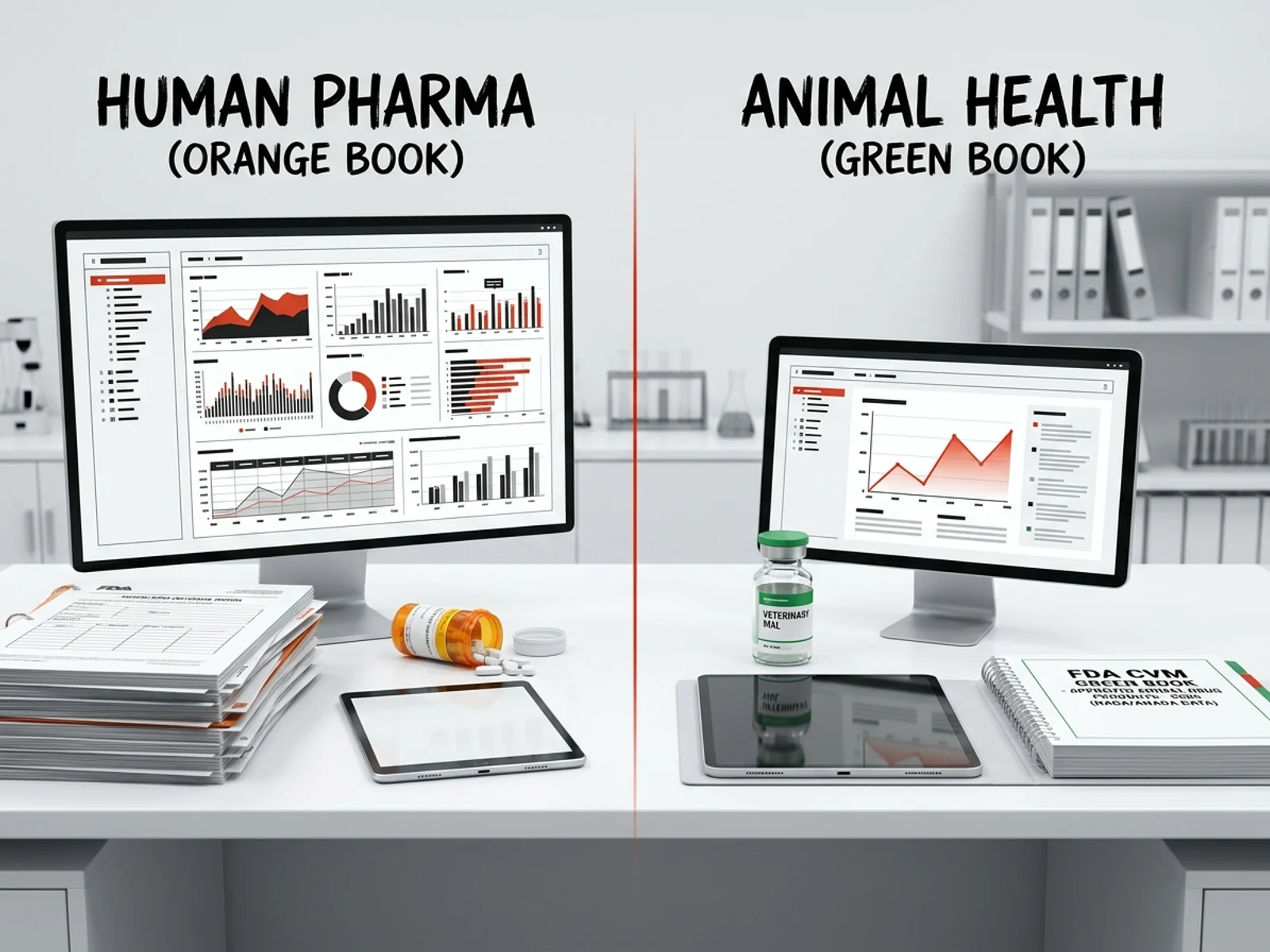
The Abbreviated New Animal Drug Application (ANADA) pathway, governed by the Generic Animal Drug and Patent Term Restoration Act (GADPTRA) and the Animal Generic Drug User Fee Act (AGDUFA), allows generic versions of approved animal drugs. The FDA Green Book — analogous to the Orange Book for human drugs — lists all approved animal drug products with patent and exclusivity information.
Why JAK selectivity matters
The JAK family consists of four members — JAK1, JAK2, JAK3, and TYK2 — each mediating signaling by different cytokine subsets:
JAK1: Mediates signaling by pruritogenic and pro-inflammatory cytokines including IL-31, IL-4, and IL-13 — the primary drivers of allergic itch and inflammation
JAK2: Mediates signaling by cytokines involved in hematopoiesis (erythropoietin, GM-CSF, thrombopoietin) — critical for blood cell production
JAK3: Mediates signaling by cytokines involved in lymphocyte function and host defense
TYK2: Mediates signaling by IL-12, IL-23, and type I interferons — involved in immune surveillance
Nonselective JAK inhibitors like oclacitinib block multiple JAK family members simultaneously. This produces effective itch control (via JAK1 inhibition) but also suppresses hematopoiesis (via JAK2 inhibition) and immune function (via JAK3 and TYK2 inhibition), requiring dose adjustment and monitoring.
Numelvi's ≥10-fold selectivity for JAK1 means it inhibits itch- and inflammation-driving cytokines while having minimal effect on hematopoiesis and host-defense cytokines. In registration studies, atinvicitinib showed no impairment of serological response to vaccination — a safety advantage over less selective JAK inhibitors.
This selectivity race directly parallels human drug development, where second-generation JAK inhibitors like Rinvoq (upadacitinib) were designed to be more JAK1-selective than Xeljanz (tofacitinib) to reduce hematologic and immunosuppressive side effects.
The head-to-head data gap
No head-to-head trial between atinvicitinib and the other veterinary JAK inhibitors has been published. Indirect comparison of pivotal trial results suggests comparable or better efficacy — atinvicitinib showed a ≥50% reduction in pruritus or lesion score in 87.5% of atopic dogs (vs 23.1% placebo), while ilunocitinib showed therapeutic success in 83% at day 28 (vs 31% placebo). For ilunocitinib and oclacitinib, a randomized, blinded, head-to-head study in 338 client-owned dogs (published in Veterinary Dermatology, 2025) found that once-daily ilunocitinib showed significantly better control of pruritus and skin lesions compared to oclacitinib dosed per label, with more dogs achieving clinical remission. However, cross-trial comparisons must be interpreted cautiously due to differences in study design, inclusion criteria, and endpoints.
The parallel with human JAK inhibitors
The veterinary JAK inhibitor trajectory mirrors the human market in several respects:
| Dimension | Human drugs | Veterinary drugs |
|---|---|---|
| First-generation | Xeljanz (tofacitinib) — nonselective, approved 2012 | Apoquel (oclacitinib) — nonselective, approved 2013 |
| Second-generation | Rinvoq (upadacitinib) — JAK1-selective, approved 2019 | Numelvi (atinvicitinib) — JAK1-selective (≥10-fold), approved 2026 |
| Key safety concern | JAK2 inhibition → cytopenias, infection risk, thromboembolic events (FDA black box warning class effect) | JAK2 inhibition → hematologic effects, reduced vaccination response |
| Regulatory driver | FDA requires boxed warnings for JAK inhibitors based on ORAL Surveillance and postmarket data | CVM requires target-animal safety studies; no formal boxed-warning equivalent but risk data in labeling |
| Selectivity benefit | Improved safety profile enables broader patient population and longer treatment duration | Improved safety profile enables use in younger dogs (6 months vs 12 months) and first-line positioning |
The key difference is that veterinary drug regulation does not require the same scale of postmarket surveillance or long-term cardiovascular outcome studies that human JAK inhibitors now face. However, the scientific principle — that greater JAK1 selectivity reduces off-target hematologic and immunologic effects — applies in both species.
What this means for animal health companies and the veterinary market
Competitive positioning. Numelvi enters a market where Apoquel has been the dominant product for over a decade. Its selectivity advantage and lower minimum age (6 months vs 12 months) provide a differentiated label.
Pipeline lessons. The speed with which veterinary JAK inhibitors have moved from first-in-class to second-generation suggests that animal health companies can learn from human drug development timelines — but must adapt clinical programs for veterinary endpoints, field study designs, and CVM's evidence standards.
Regulatory efficiency. CVM's approval of three JAK inhibitors over 13 years demonstrates a functioning regulatory pathway. The ANADA pathway for generics will eventually apply to Apoquel once exclusivity expires, mirroring the human biosimilar/generic dynamics.
Companion animal market growth. The global companion animal health market continues to expand, driven by pet ownership trends and willingness to pay for chronic disease management. Veterinary dermatology is a significant segment, and JAK inhibitors represent a major therapeutic advance over corticosteroids and antihistamines.
For regulatory professionals working in animal health or comparative medicine, the intersection of veterinary drug approval pathways and animal health regulation across species is a growing specialization. VetMedGuide provides veterinary medicine and animal-health guidance including veterinary device regulation and animal drug development.
Recent CVM actions beyond JAK inhibitors
The FDA's Center for Veterinary Medicine has been active in early 2026:
FY 2026 AVIC grants. On May 4, 2026, CVM opened applications for Animal and Veterinary Innovation Centers grants, targeting aquaculture therapeutics, minor ruminant species drugs, human food safety, and antimicrobial stewardship. Applications are due June 12, 2026.
GFI #273 on antimicrobial duration. In February 2026, CVM published final guidance (GFI #273) defining durations of use for medically important antimicrobials fed to food-producing animals — part of the agency's antimicrobial stewardship effort.
Bravecto Quantum supplement. On March 16, 2026, Intervet received approval for an expanded indication for Bravecto Quantum (fluralaner extended-release injectable) to include Asian longhorned tick and Gulf Coast tick in dogs.
Conditionally approved drug. CVM conditionally approved a drug for Chiari-like malformation and syringomyelia pain in dogs — using the conditional approval pathway that allows marketing while additional effectiveness data are collected.
First noise-aversion and separation-anxiety drug. CVM approved the first drug specifically for noise aversion and separation anxiety in dogs.
What to monitor next
Numelvi commercial launch. Merck Animal Health expects Numelvi to be available in US veterinary clinics in spring 2026. Watch for prescribing patterns, real-world safety data, and formulary positioning relative to Apoquel and Zenrelia.
Apoquel generic (ANADA) timeline. As Apoquel's exclusivity periods expire, generic oclacitinib applications are expected. Monitor the Green Book for ANADA filings.
ANADA user fee cycle. AGDUFA reauthorization negotiations will affect generic veterinary drug review timelines and costs.
Cross-species JAK inhibitor development. JAK inhibitors are being explored for feline and equine indications. These would require separate NADAs with species-specific safety and effectiveness data.
Comparative pharmacology. The convergence of JAK inhibitor science across human and veterinary medicine creates opportunities for One Health research and regulatory science collaboration.
Sources
FDA. "Recent Animal Drug Approvals." Updated 2026. https://www.fda.gov/animal-veterinary/approved-animal-drug-products-green-book/recent-animal-drug-approvals
FDA. "FOI Summary, NADA 141-596, Numelvi (atinvicitinib tablets)." February 25, 2026. https://animaldrugsatfda.fda.gov/adafda/app/search/public/document/downloadFoi/18155
Merck & Co. "FDA Approves NUMELVI (atinvicitinib tablets) for Dogs." February 25, 2026. https://www.merck.com/news/fda-approves-numelvi-atinvicitinib-tablets-for-dogs-from-merck-animal-health-the-first-and-only-second-generation-janus-kinase-jak-inhibitor-for-the-control-of-pruritus-associat
MSD Animal Health. "MSD Animal Health Launches NUMELVI (atinvicitinib) Tablets for Dogs." https://www.msd-animal-health.com/news-and-insights/news-releases/launches-numelvi
MDPI International Journal of Molecular Sciences. "Anti-Cytokine Drugs in the Treatment of Canine Atopic Dermatitis." 2025; 26(22):10990. https://www.mdpi.com/1422-0067/26/22/10990
PMC/NIH. "Anti-Cytokine Drugs in the Treatment of Canine Atopic Dermatitis." https://pmc.ncbi.nlm.nih.gov/articles/PMC12652870
DVM360. "FDA Approves First and Only Second-Generation JAK Inhibitor." 2026. https://www.dvm360.com/view/fda-approves-first-and-only-second-generation-jak-inhibitor
FDA. "The Journey of an Animal Drug through the Approval Process." https://www.fda.gov/animal-veterinary/animal-health-literacy/idea-marketplace-journey-animal-drug-through-approval-process
FDA. "Approved Animal Drug Products (Green Book)." https://www.fda.gov/animal-veterinary/products/approved-animal-drug-products-green-book
FDA. "CVM Updates." https://www.fda.gov/animal-veterinary/news-events/cvm-updates
Duane Morris. "FDA Announces FY2026 Grant Funding for Animal and Veterinary Innovation Centers." May 2026. https://www.duanemorris.com/alerts/fda_announces_fy2026_grant_funding_animal_veterinary_innovation_centers_0526.html
PubMed. "Comparative efficacy and safety of ilunocitinib and oclacitinib for the control of pruritus and associated skin lesions in dogs with atopic dermatitis." Veterinary Dermatology, 2025. https://pubmed.ncbi.nlm.nih.gov/39757965
DermaVet Pro. "Numelvi (Atinvicitinib) in Dogs: 2026 Monograph." https://pro.dermavet.com/numelvi-atinvicitinib-in-dogs-2026-monograph