Multiple sclerosis (MS) therapy has undergone a massive clinical evolution over the past three decades. However, the commercial battleground remains heavily influenced by historical blockbuster products. Chief among these is Teva Pharmaceuticals’ Copaxone (glatiramer acetate), which served as a foundational disease-modifying therapy (DMT) for relapsing-remitting multiple sclerosis (RRMS). Because glatiramer acetate is not a simple, well-characterized small molecule but rather a complex synthetic polypeptide mixture, its transition to generic competition has been one of the most legally and scientifically challenging chapters in the history of the Hatch-Waxman Act.
This analysis provides a comprehensive regulatory and commercial deep dive into the generic glatiramer acetate landscape. It explores the chemistry of complex mixtures, the FDA’s specific regulatory criteria for demonstrating active ingredient sameness, the current approved applications in the FDA Orange Book, and the dramatic long-term pricing erosion documented by Centers for Medicare & Medicaid Services (CMS) National Average Drug Acquisition Cost (NADAC) data. Finally, we analyze historical manufacturing-related Class II recalls that emphasize the ongoing quality and supply-chain vigilance required by specialty pharmacy directors and formulary managers.
Short Answer
Generic Copaxone (glatiramer acetate) is fully available in the United States in both the 20 mg/mL (daily injection) and 40 mg/mL (three-times-weekly injection) strengths. Teva’s original brand-name Copaxone (approved under NDA 020622) faces direct multi-source competition from Sandoz's Glatopa (approved under ANDAs 090218 and 206921) and Mylan/Viatris’s glatiramer acetate (approved under ANDAs 091646 and 206936).
Across all strengths and package configurations, the FDA Orange Book tracks 11 unique approved applications for glatiramer acetate, comprising Teva's brand NDA and 10 approved Abbreviated New Drug Applications (ANDAs). This multi-source environment has driven massive specialty drug price erosion. According to CMS NADAC data from June 2026, the average pharmacy acquisition cost for brand Copaxone 20 mg/mL is $230.1972 per mL, while generic glatiramer 20 mg/mL is priced at $46.0199 per mL (an 80.0% cost reduction). For the higher-volume 40 mg/mL formulation, brand Copaxone has a NADAC of $541.0738 per mL, whereas generic glatiramer is priced at $97.1718 per mL (an 82.0% cost reduction).
Who This Is For
This dossier is written for specialty pharmacy directors, formulary managers, PBM clinical analysts, and generic pharmaceutical portfolio planners who must model long-term MS drug class spend, design prior authorization (PA) criteria, and evaluate the risk profile of multi-source complex generics. For the broader NDC registry these glatiramer products sit inside, see our analysis of the U.S. drug product landscape through NDC data; for a contrasting peptide-generic timeline that is still blocked by active patents, see when generic Ozempic becomes available.
Understanding the Complex Generic Class: How FDA Regulates Glatiramer Acetate
Standard small-molecule generics receive FDA approval by demonstrating chemical identity and bioequivalence via simple pharmacokinetic parameters (such as $C_{max}$ and AUC). Complex generics, however, present structural and analytical challenges that prevent simple replication. Glatiramer acetate is classified as a complex drug product because its active ingredient is a complex synthetic polypeptide mixture.
The Chemistry of Copolymer-1
Glatiramer acetate is the acetate salt of a mixture of synthetic polypeptides containing four naturally occurring amino acids:
L-alanine
L-glutamic acid
L-lysine
L-tyrosine
These amino acids are polymerized in a specific molar ratio of approximately 4.6 parts L-alanine, 1.5 parts L-glutamic acid, 3.4 parts L-lysine, and 1.0 part L-tyrosine. The polymerization process is followed by a controlled partial acid depolymerization step. Because the reaction is stochastic, the resulting drug substance does not consist of a single defined peptide sequence. Instead, it is an extremely heterogeneous mixture of millions of distinct polypeptide sequences, with an average molecular weight ranging between 5,000 and 9,000 Daltons.
Because of this extreme heterogeneity, conventional analytical methods cannot fully sequence the mixture. Under standard Hatch-Waxman paradigms, a generic sponsor cannot easily prove that their product is "identical" to the reference listed drug (RLD) in the traditional sense.
The FDA's Product-Specific Guidance (PSG) Framework
To clear this scientific hurdle without requiring generic manufacturers to run cost-prohibitive Phase III clinical trials, the FDA developed a product-specific guidance (PSG) document for glatiramer acetate. This guidance establishes a multi-step analytical framework to demonstrate "active ingredient sameness" through four structural and biological criteria:
+---------------------------------------------------------------------------------+
|                         FDA Glatiramer Sameness Framework                       |
+---------------------------------------------------------------------------------+
|                                                                                 |
|  1. Equivalence of Starting Materials & Polymerization                          |
|     - Ensures the same amino acid molar ratios and polymerization chemistry.     |
|                                                                                 |
|  2. Structural & Physicochemical Characterization                               |
|     - Verifies molecular weight distribution, peptide mapping, and charges.     |
|                                                                                 |
|  3. Controlled Depolymerization & Sequence Patterns                            |
|     - Compares the peptide breakdown profiles and N/C-terminal sequences.        |
|                                                                                 |
|  4. Biological & Immunological Functional Assays                                |
|     - Confirms identical ex vivo cellular activation and potency profile.       |
|                                                                                 |
+---------------------------------------------------------------------------------+
Sameness of starting materials and polymerization chemistry: The sponsor must show that the polymerization process utilizes the same amino acid N-carboxyanhydrides in the correct molar ratios, resulting in the same initiating and terminating structures.
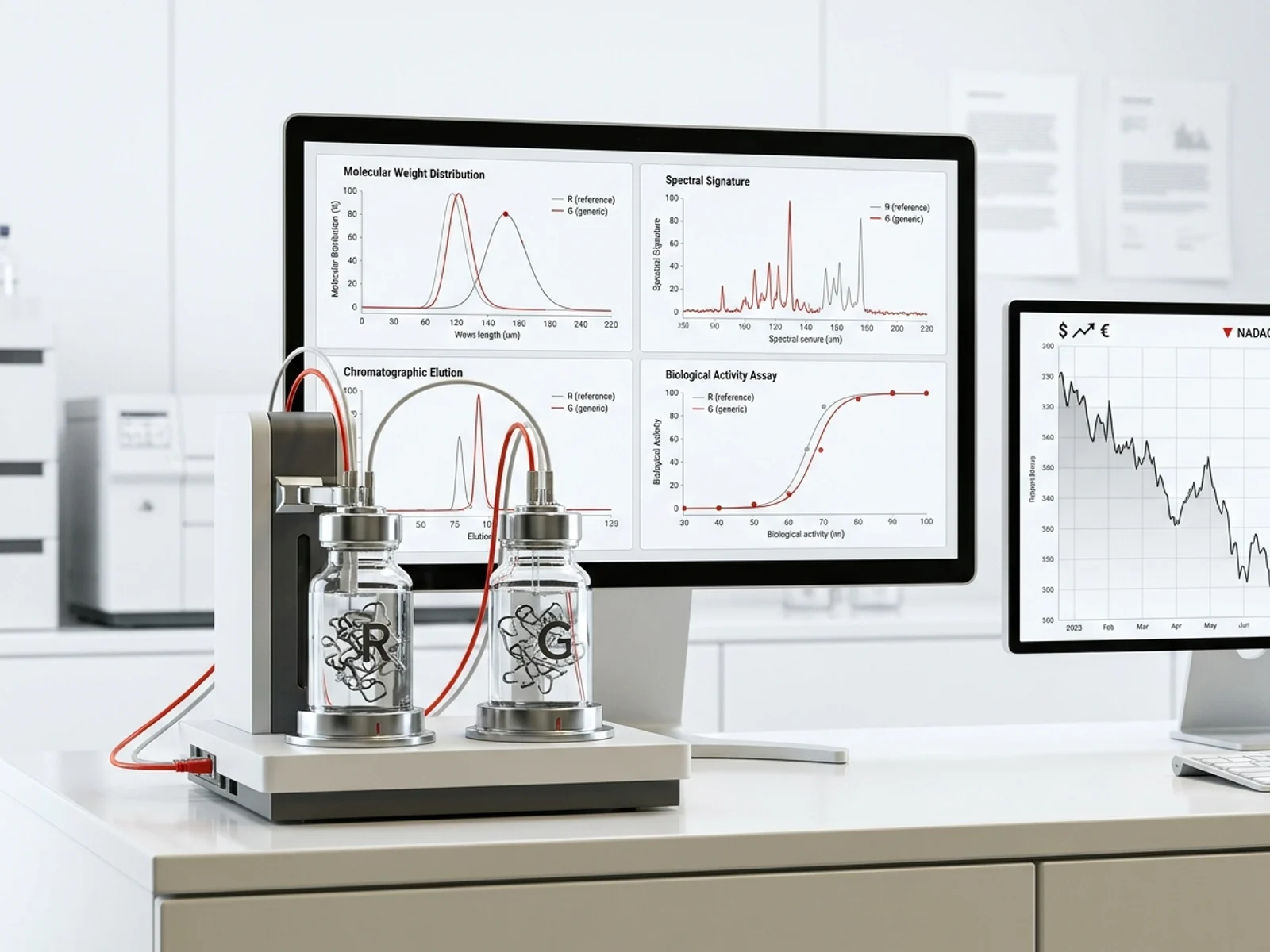
Equivalence of structural and physicochemical properties: The manufacturer must utilize advanced analytical tools to compare the molecular weight distribution, spectroscopic profiles (circular dichroism, Fourier-transform infrared spectroscopy), chromatographic elution profiles, and charge distribution.
Equivalence of the depolymerization process: Since the depolymerization step determines the final length and sequence distribution of the polypeptide chains, the sponsor must demonstrate that the enzymatic or chemical cleavage kinetics match the RLD, verified by peptide mapping and terminal amino acid sequencing.
Equivalence of biological and immunological functions: The generic product must exhibit equivalent potency and biological activity in established biological models. This includes testing the product's ability to inhibit antigen-specific T-cell activation and measuring ex vivo cytokine release profiles.
By fulfilling these four criteria, generic applicants can secure an "AB" rating, signifying therapeutic equivalence and permitting automatic pharmacy-level substitution.
Orange Book Landscape: Analyzing the Approved ANDAs and Developers
The regulatory path for generic glatiramer acetate was marked by intense litigation, citizen petitions, and scientific debate. Sandoz was the pioneer, launching its 20 mg/mL formulation under the brand name Glatopa in 2015 after years of review. Mylan (now Viatris) followed, securing approvals for both the 20 mg/mL and 40 mg/mL strengths in 2017.
A comprehensive extract from the FDA Orange Book (as of June 2026) reveals that there are 11 unique approved drug applications for glatiramer acetate injection. This includes Teva’s original brand NDA (020622) and 10 approved ANDAs held by 6 distinct generic sponsors: Sandoz, Mylan/Viatris, Synthon, Chemi SpA, Scinopharm (Taiwan), and Hybio Pharmaceutical.
| Application Number | Application Type | Sponsor | Strength(s) | Approval Date | TE Code | Trade / Product Name |
|---|---|---|---|---|---|---|
| NDA 020622 | NDA (RLD/RS) | Teva Pharmaceuticals | 20 mg/mL; 40 mg/mL | Dec 20, 1996 (original); 40 mg/mL added Jan 28, 2014 | RS | Copaxone |
| ANDA 090218 | ANDA | Sandoz (Novartis) | 20 mg/mL | Apr 16, 2015 | AP | Glatopa |
| ANDA 206921 | ANDA | Sandoz (Novartis) | 40 mg/mL | Feb 12, 2018 | AP | Glatopa |
| ANDA 091646 | ANDA | Viatris (Mylan) | 20 mg/mL | Oct 3, 2017 | AP | Glatiramer Acetate |
| ANDA 206936 | ANDA | Viatris (Mylan) | 40 mg/mL | Oct 3, 2017 | AP | Glatiramer Acetate |
| ANDA 203857 | ANDA | Synthon | 20 mg/mL | Sep 25, 2024 | AP | Glatiramer Acetate |
| ANDA 206873 | ANDA | Synthon | 40 mg/mL | Sep 25, 2024 | AP | Glatiramer Acetate |
| ANDA 208468 | ANDA | Chemi SpA | 20 mg/mL & 40 mg/mL | May 7, 2025 | AP | Glatiramer Acetate |
| ANDA 214741 | ANDA | Scinopharm (Taiwan) | 20 mg/mL & 40 mg/mL | Dec 31, 2025 | AP | Glatiramer Acetate |
| ANDA 213382 | ANDA | Hybio Pharmaceutical | 20 mg/mL | Feb 11, 2026 | AP | Glatiramer Acetate |
| ANDA 214022 | ANDA | Hybio Pharmaceutical | 40 mg/mL | Feb 11, 2026 | AP | Glatiramer Acetate |
Source: FDA Orange Book, June 2026 snapshot. Sandoz, Synthon, and Hybio hold separate per-strength ANDAs; Chemi SpA and Scinopharm each received a single ANDA covering both strengths.
Key Regulatory Milestones:
April 16, 2015: Sandoz receives the historic approval for ANDA 090218 (Glatopa 20 mg/mL), representing the first complex generic polypeptide mixture approved in the U.S.
October 3, 2017: Mylan receives FDA approval for both its daily (20 mg/mL) and three-times-weekly (40 mg/mL) glatiramer acetate formulations. This was a critical blow to Teva, as Teva had successfully transitioned more than 80% of brand Copaxone volume to the 40 mg/mL strength to delay generic exposure.
February 12, 2018: Sandoz secures approval for Glatopa 40 mg/mL (ANDA 206921), restoring its competitive footprint across both dosage forms.
A seven-year gap, then a second wave: After Sandoz and Mylan operated a near-duopoly through 2018, the FDA did not approve another glatiramer ANDA until late 2024. Synthon (ANDAs 203857 and 206873, Sep 25, 2024), Chemi SpA (ANDA 208468, May 7, 2025), Scinopharm Taiwan (ANDA 214741, Dec 31, 2025), and Hybio Pharmaceutical (ANDAs 213382 and 214022, Feb 11, 2026) then entered in quick succession, expanding the field from two sponsors to six and deepening multi-source pricing pressure on the brand.
NADAC Price Analysis: Quantifying the Cost Savings of Generic Glatiramer
To understand how generic entry has impacted the financial landscape, we analyze the National Average Drug Acquisition Cost (NADAC) dataset published by CMS. NADAC represents the average invoice price paid by retail community pharmacies to acquire drug products from wholesalers, serving as a highly accurate proxy for actual market transaction prices before manufacturer rebates.
20 mg/mL Strength Pricing Comparison
The 20 mg/mL daily injection was the original dosage form of Copaxone. Multi-source generic competition has driven extensive price erosion in this strength.
Brand Copaxone 20 mg/mL (NDA 020622): The NADAC is $230.1972 per mL. For a standard package of 30 pre-filled syringes (30 mL total), the pharmacy acquisition cost stands at $6,905.92.
Generic Glatiramer Acetate 20 mg/mL (ANDAs): The NADAC is $46.0199 per mL. For the equivalent 30-syringe package, the pharmacy acquisition cost is $1,380.60.
Calculated Cost Reduction: $$\text{Savings %} = 1 - \left( \frac{46.0199}{230.1972} \right) = 80.0084% \approx 80.0%$$ This represents a direct savings of $5,525.32 per patient per month for retail pharmacies.
40 mg/mL Strength Pricing Comparison
The 40 mg/mL formulation is administered three times weekly, totaling 12 injections (12 mL) per 28-day cycle. Payers actively pushed for generic adoption in this strength because it represents the vast majority of patient volume.
Brand Copaxone 40 mg/mL (NDA 020622): The NADAC is $541.0738 per mL. For a package of 12 pre-filled syringes (12 mL total), the pharmacy acquisition cost is $6,492.89.
Generic Glatiramer Acetate 40 mg/mL (ANDAs): The NADAC is $97.1718 per mL. For the equivalent 12-syringe package, the pharmacy acquisition cost is $1,166.06.
Calculated Cost Reduction: $$\text{Savings %} = 1 - \left( \frac{97.1718}{541.0738} \right) = 82.0411% \approx 82.0%$$ This translates to a monthly savings of $5,326.83 per patient at the wholesale level.
+---------------------------------------------------------------------------------+
|                       NADAC Price Erosion Summary (2026)                        |
+---------------------------------------------------------------------------------+
|                                                                                 |
|  20 mg/mL Strength (Daily)                                                      |
|  [Brand Copaxone]  ========================================> $230.1972/mL       |
|  [Generic]         ========> $46.0199/mL  (80.0% Savings)                       |
|                                                                                 |
|  40 mg/mL Strength (3x Weekly)                                                  |
|  [Brand Copaxone]  ========================================> $541.0738/mL       |
|  [Generic]         ========> $97.1718/mL  (82.0% Savings)                       |
|                                                                                 |
+---------------------------------------------------------------------------------+
Payer Formulary Integration & Market Access Mechanics
For pharmacy benefit managers (PBMs) and commercial health plans, these price differentials have completely restructured the MS drug class.
Exclusion of Brand Copaxone: Major national formularies (such as CVS Caremark, Express Scripts, and OptumRx) have placed brand-name Copaxone on their formulary exclusion lists. To obtain coverage, patients must switch to generic glatiramer acetate or Glatopa.
Preferred Tier Placement: Generic glatiramer acetate is placed on Preferred Generic or Preferred Specialty tiers, requiring lower patient copays.
Rebate Strategy Inversion: Historically, Teva offered high rebates to PBMs to maintain preferred status for brand Copaxone. However, as generic acquisition costs fell past 80%, the net cost of the generic became significantly lower than the post-rebate brand price, prompting payers to mandate generic substitution.
Manufacturing and Quality Risks: Class II Recalls
While small-molecule oral drugs have relatively simple supply chains, glatiramer acetate is a sterile, injectable combination product. Pre-filled syringe manufacturing requires strict sterile processing controls, specialized syringe components, and advanced quality assurance.
A review of the FDA Enforcement Reports database reveals 4 distinct Class II recalls associated with glatiramer acetate, illustrating the operational risks in this product class.
1. Teva Recall D-1442-2012 (Copaxone 20 mg/mL)
Classification: Class II
Reason for Recall: A foreign particle identified from a customer complaint. Teva initiated the recall after a customer complaint surfaced a foreign particle inside a pre-filled syringe, prompting quarantine of the affected lot.
Payer & Pharmacy Triage: Pharmacies had to quarantine affected lots immediately, and payers monitored patient claims to identify individuals who had received the recalled batches, coordinating replacements.
2. Teva Recall D-249-2013 (Copaxone 20 mg/mL)
Classification: Class II
Reason for Recall: Visible medical-grade silicone oil in the syringe. Teva initiated this recall after receiving an elevated number of patient complaints about a visible presence of silicone oil, which is integral to the lubrication of the syringe and plunger-stopper system. Excess or displaced silicone oil can appear as suspended droplets that patients mistake for contamination.
Operational Impact: This recall highlighted the vulnerability of the drug-device interface in pre-filled syringes, where quality signals often originate in the rubber/glass/silicone delivery components rather than the active polypeptide API itself.
3. Teva Recall D-001-2014 (Copaxone 20 mg/mL)
Classification: Class II
Reason for Recall: Particulate matter in a pre-filled syringe. A consumer complaint identified a foreign particle inside a Copaxone pre-filled syringe. Foreign particulate in an injectable polypeptide raises concerns about protein aggregation and syringe clogging during administration; while not acutely toxic, it makes syringe-assembly quality a critical clinical parameter for this product class.
4. Kroger Specialty Pharmacy Recall D-0778-2018 (Compounded Glatiramer)
Classification: Class II
Reason for Recall: Processing control failures. This recall did not originate from an ANDA manufacturer but rather from a 503B compounding facility (Kroger Specialty Pharmacy) that prepared customized batches of glatiramer. The FDA cited a lack of appropriate environmental and sterility controls during the syringe filling process.
Policy Implications: This event emphasized to payers the safety of FDA-approved ANDA generics (which must meet strict cGMP combination product standards) compared to non-standard compounded alternatives, which often carry higher sterility and safety risks.
Specialty Pharmacy Routing and Operational Triage
Because glatiramer acetate requires subcutaneous injection and carries a high annual cost, its dispensing is restricted to specialized channels.
+---------------------------------------------------------------------------------+
|                        Specialty Pharmacy Triage Workflow                       |
+---------------------------------------------------------------------------------+
|                                                                                 |
|  [Prescription Written]                                                          |
|        │                                                                        |
|        ▼                                                                        |
|  [Specialty Pharmacy Intake] ──> Prior Authorization Check                      |
|        │                                                                        |
|        ├─> If Brand Copaxone: Rejection / PBM Exclusion Alert                   |
|        │   └─> Pharmacy contacts prescriber to switch to Generic Glatiramer      |
|        │                                                                        |
|        └─> If Generic Glatiramer: Approve based on MS diagnostic code           |
|              │                                                                  |
|              ▼                                                                  |
|  [Cold-Chain Logistics]                                                         |
|        │                                                                        |
|        ├─> Maintain constant refrigerated storage (36°F to 46°F / 2°C to 8°C)    |
|        ├─> Pack in insulated shipping container with temperature indicator      |
|        │                                                                        |
|        ▼                                                                        |
|  [Patient Dispensing & Training]                                                |
|        │                                                                        |
|        ├─> Coordinate copay card assistance ($0 co-pay programs)                 |
|        └─> Confirm patient understands injection technique and safety warnings    |
|                                                                                 |
+---------------------------------------------------------------------------------+
1. Prior Authorization (PA) and Step-Therapy Rules
Most commercial health plans require prior authorization for glatiramer acetate. The criteria typically mandate:
A confirmed diagnosis of relapsing-remitting multiple sclerosis (RRMS) or clinically isolated syndrome (CIS) supported by magnetic resonance imaging (MRI) showing characteristic demyelinating lesions.
A prescriber specialty in neurology or neuro-immunology.
An explicit clinical rationale if the prescriber requests brand-name Copaxone instead of generic glatiramer, often requiring a documented treatment failure, severe injection-site reaction, or adverse event with the generic product that was not resolved by switching generic suppliers.
Annual reauthorization criteria requiring the prescriber to document clinical benefit, defined as a stable or decreased rate of clinical relapses, stable MRI lesion burden, or lack of progressive disability progression.
2. Cold-Chain Logistical Requirements and Temperature Excursions
Glatiramer acetate is a peptide mixture that degrades if exposed to extreme temperatures or repeated freeze-thaw cycles.
Temperature Ranges: It must be stored under refrigeration between $36^\circ\text{F}$ and $46^\circ\text{F}$ ($2^\circ\text{C}$ to $8^\circ\text{C}$). However, to accommodate travel and daily use, it can remain unrefrigerated at room temperature ($59^\circ\text{F}$ to $86^\circ\text{F}$ / $15^\circ\text{C}$ to $30^\circ\text{C}$) for up to 30 days if kept away from direct heat and light.
Thermal Excursions: During delivery, specialty pharmacies must protect the shipment against both summer heat and winter freezing. If the product freezes, the polypeptides can aggregate, rendering the injection ineffective or immunogenic. Pharmacies utilize validated insulated shippers containing phase-change gel packs and digital or chemical temperature sensors. If a sensor indicates a temperature excursion occurred (e.g., dropping below $32^\circ\text{F}$ or exceeding $90^\circ\text{F}$ for more than 4 hours), the pharmacy must replace the entire shipment and file a return with the wholesale distributor.
3. Injection Aids, Auto-injectors, and Patient Compliance
One of the major clinical challenges with glatiramer acetate is injection-site fatigue. Because the drug is administered via frequent subcutaneous injections (daily for 20 mg/mL or three times weekly for 40 mg/mL), patients frequently develop localized lipoatrophy (loss of fat tissue), erythema, pain, and pruritus.
Auto-injectors: To reduce injection pain and ensure consistent injection depth, many patients use mechanical auto-injectors (such as the Autoject 2 device or manufacturer-specific injection aids). These devices house the pre-filled syringe, automatically insert the needle to a preset depth (e.g., 8mm or 10mm), and plunge the syringe at a controlled speed.
Generic Device Compatibility: A key operational detail for specialty pharmacies is ensuring that generic syringes are compatible with these auto-injectors. Sandoz designed Glatopa pre-filled syringes to fit the exact physical specifications of the Glatopa Autoject device, which mirrors the functionality of Teva's brand-name Copaxone injection aids. If a pharmacy switches a patient from brand Copaxone to generic glatiramer, they must confirm the patient has a compatible auto-injector or provide counseling on manual syringe administration.
4. Copay Assistance and Patient Support Programs
The high list price of generic glatiramer (over $1,100 per month) would represent a significant barrier under coinsurance structures. Generic manufacturers (like Sandoz and Viatris) offer copay card programs that lower the patient's out-of-pocket obligation to $0, while brand Copaxone's support programs have been scaled back or restricted in response to PBM exclusions. Specialty pharmacies must navigate these manufacturer co-pay coupons to prevent patient abandonment at the counter. For government-insured patients (Medicare/Medicaid), pharmacies must screen for foundation assistance (e.g., PAN Foundation) to bypass federal anti-kickback restrictions.
FAQ
Is Glatopa fully substitutable for brand-name Copaxone at the pharmacy level?
Yes. Sandoz’s Glatopa is approved under the 505(j) ANDA pathway and carries an "AP" therapeutic equivalence rating in the FDA Orange Book. This indicates that it is therapeutically equivalent to Teva's brand-name Copaxone. In states with mandatory or permissive generic substitution laws, pharmacists can automatically substitute Glatopa for a Copaxone prescription without obtaining permission from the prescribing physician.
Why did it take so long for the first generic glatiramer acetate to receive FDA approval?
The delay was due to the complex nature of the drug substance. Because glatiramer acetate is a highly heterogeneous polypeptide mixture rather than a single chemical entity, there was no established regulatory pathway to prove "sameness" under Hatch-Waxman rules. The FDA had to develop a rigorous, multi-faceted product-specific guidance (PSG) requiring extensive analytical characterization, starting material controls, depolymerization mapping, and biological assays. Sandoz’s first approval in 2015 occurred nearly two decades after brand Copaxone was first approved.
How do payers handle patient transitions from 20 mg/mL daily to 40 mg/mL three-times-weekly generic formulations?
Because the 20 mg/mL and 40 mg/mL formulations have different dosing frequencies and pre-filled syringe configurations, they are not therapeutically equivalent to each other in the Orange Book. A pharmacist cannot automatically substitute a prescription written for Copaxone 40 mg/mL with generic glatiramer 20 mg/mL. Payers manage this transition by aligning prior authorization and formulary preferences, preferring the generic 40 mg/mL strength to capture the 82% discount while preserving the patient’s preferred three-times-weekly dosing schedule.
Sources
FDA, Approved Drug Products with Therapeutic Equivalence Evaluations (Orange Book). Search criteria: "Glatiramer Acetate" (NDA 020622; ANDAs 090218, 206921, 091646, 206936, 203857, 206873, 208468, 214741, 213382, 214022). https://www.accessdata.fda.gov/scripts/cder/ob/
Centers for Medicare & Medicaid Services (CMS), National Average Drug Acquisition Cost (NADAC) Files, June 10, 2026 snapshot. NDCs compared: Brand Copaxone 20 mg/mL (68546-0317-30), Brand Copaxone 40 mg/mL (68546-0325-12), Generic Glatiramer 20 mg/mL (00378-6960-93), Generic Glatiramer 40 mg/mL (00378-6961-12). https://www.medicaid.gov/medicaid/prescription-drugs/pharmacy-pricing/index.html
FDA, Product-Specific Guidance for Glatiramer Acetate Injection (Draft Guidance, revised April 2016). https://www.fda.gov/drugs/guidances-drugs/product-specific-guidances-generic-drug-development
FDA Enforcement Reports and Recalls Database. Recalls tracked: Teva Copaxone foreign-particle complaint (D-1442-2012), visible medical-grade silicone oil complaints (D-249-2013), particulate matter in a pre-filled syringe (D-001-2014), and Kroger Specialty Pharmacy compounded glatiramer lack of processing controls (D-0778-2018). https://www.fda.gov/safety/recalls-market-withdrawals-safety-alerts
Sandoz Inc., "Sandoz announces U.S. FDA approval of Glatopa® 20 mg/mL," Press Release, April 16, 2015. https://www.sandoz.com/news/media-releases/
Mylan NV, "Mylan Announces FDA Approval of Glatiramer Acetate Injection, 20 mg/mL and 40 mg/mL," Press Release, October 3, 2017. https://newsroom.viatris.com/
Disclaimer: This article provides independent regulatory, clinical-pipeline, and market-access analysis for biopharma professionals and does not constitute clinical, legal, or investment advice.