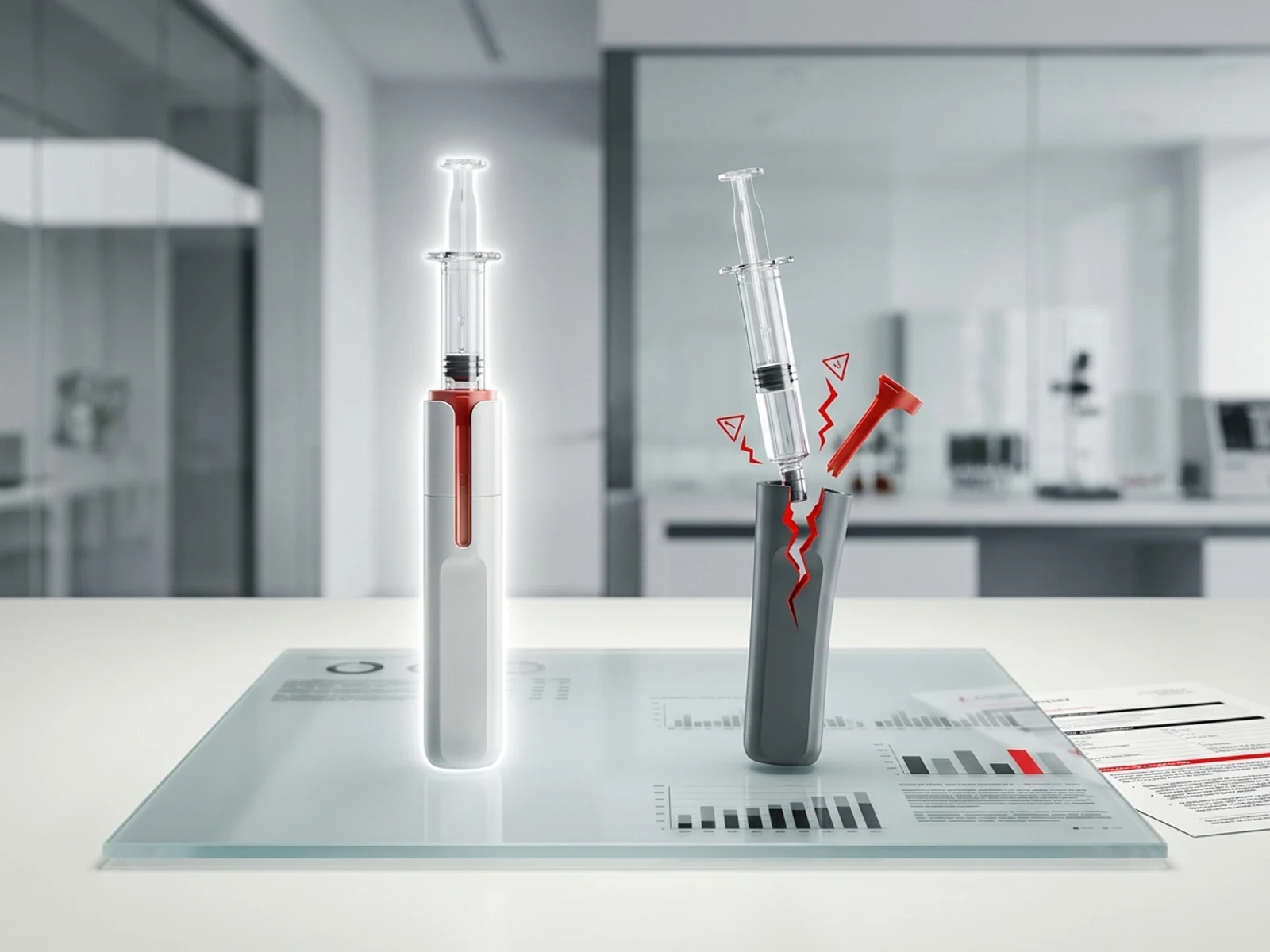
For drug-device combination products—such as autoinjectors, pen injectors, prefilled syringes, and on-body delivery systems (the same products covered in our FDA drug-device combination product pathway and PMOA assignment guide)—the device constituent is not merely a container. It is the interface through which the patient receives the therapeutic dose. If a patient struggles to hold an autoinjector for the required injection time, misinterprets a dose-indicator window, or accidentally fires a needle shield, the result is an underdose or a missed dose, directly impacting clinical outcomes.
Because usability is critical to safety and efficacy, the U.S. Food and Drug Administration (FDA) subjects combination products to rigorous human factors (HF) validation requirements. Historically, sponsors have treated HF validation as a document-collection exercise to be completed at the end of development.
Today, this approach represents a significant risk. Usability-related deficiencies—including under-powered studies, incomplete risk analyses, and poorly defined user cohorts—are a leading cause of Complete Response Letters (CRLs) and regulatory delays for NDAs and BLAs.
[CDx / Device Co-Development]
       │
       ▼  (Phase 3 Parallel Track)
[Use-Related Risk Analysis (URRA) & Formative Usability Testing]
       │
       ▼  (Design Freeze)
[Summative (Validation) Usability Testing (Min. 15 Users per Cohort)]
       │
       ▼  (FDA May 2026 Category Assignment)
       ├─► Category 1 / 2 ──► Streamlined Submission
       └─► Category 3 ──────► Comprehensive HF Package (PMA / NDA / BLA)
                                  │
                                  ▼ (Common Deficiencies)
                             [Complete Response Letter (CRL) / Launch Delay]
Navigating this pathway requires a clear understanding of the FDA’s risk-based framework. This article details the May 2026 FDA final guidance on human factors submissions, synthesizes it with the September 2023 combination product HF Q&A, outlines the 15-user-per-group validation standard, and identifies the four usability deficiencies that commonly delay product launches.
The FDA's human factors framework
The regulatory expectations for human factors engineering in combination product submissions are established across three key FDA publications:
1. Content of Human Factors Information in Medical Device Marketing Submissions (Final Guidance, May 29, 2026)
This guidance (Docket No. FDA-2026-D-10734) replaces previous drafts and updates the framework for submitting HF information. It introduces new risk-based Human Factors Submission Categories (Categories 1, 2, and 3) that dictate how much usability data must be included in marketing submissions based on device risk and modification complexity.
2. Application of Human Factors Engineering Principles for Combination Products: Q&A (Final Guidance, September 2023)
This combination-product-specific guidance addresses how drug properties (such as viscosity, injection volume, dose frequency, and emergency use) influence the use-related risk analysis (URRA) and the design of HF validation studies. It clarifies how sponsors should evaluate the interaction between the drug constituent and the delivery device.
3. Applying Human Factors and Usability Engineering to Medical Devices (Final Guidance, February 2016)
This foundational guidance remains the primary reference for designing, conducting, and documenting human factors validation (summative) testing. It establishes the clinical and methodological parameters for usability studies.
Under the May 2026 FDA human factors guidance and its risk-based submission categories for device and combination-product submissions, manufacturers must self-classify their submissions into one of three HF categories. This classification determines whether the sponsor must submit a simple rationale, a summary of modifications, or a full human factors validation report:
┌────────────────────────────────────────────────────────┐
│ FDA Human Factors Submission Categories                │
├────────────────────────────────────────────────────────┤
│ Category 3: High-Risk / Major Redesign                 │
│  - Requires Full Summative Validation Report           │
├────────────────────────────────────────────────────────┤
│ Category 2: Moderate Change / Interface Impact          │
│  - Requires Comparative Task Analysis & Validation     │
├────────────────────────────────────────────────────────┤
│ Category 1: Low-Risk / Minor Change                    │
│  - Requires HF Rationale & Risk Analysis Only         │
└────────────────────────────────────────────────────────┘
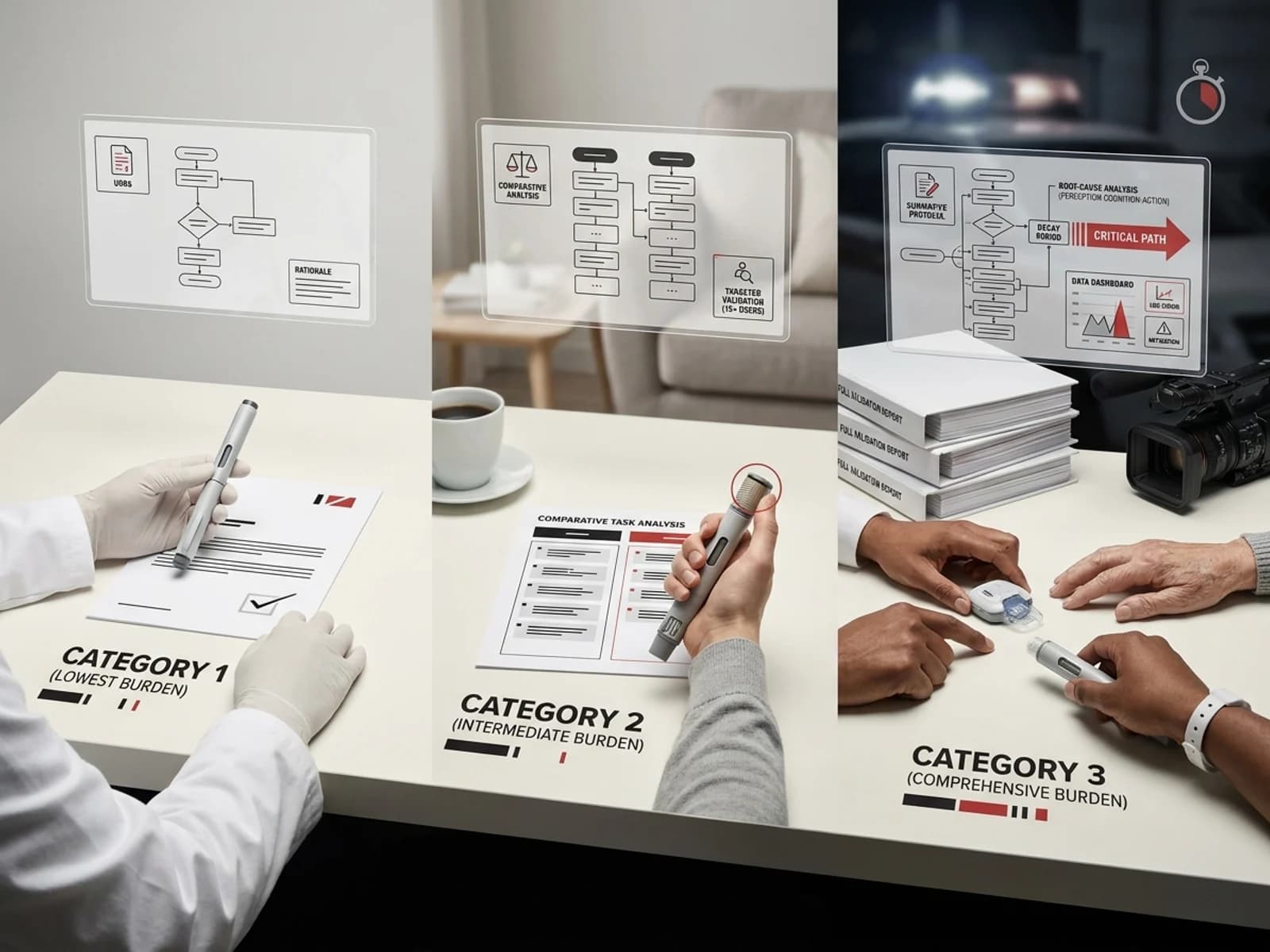
HF Submission Category 1: Applies to low-risk modifications or devices with minimal clinical risk. This category typically covers minor user interface adjustments that do not introduce new use-related risks or affect critical tasks. Examples include minor changes to the external label font size or changing the color of a non-functional outer housing. The sponsor must submit a brief HF rationale and an updated use-related risk analysis (URRA).
HF Submission Category 2: Applies to moderate design changes that affect some user interactions but do not represent a complete redesign of the platform. Examples include changing the cap removal force of an autoinjector, updating the display interface of a digital dose counter, or modifying the grip material of a pen injector. The submission must include a comparative task analysis and validation data for the modified tasks to demonstrate that the changes do not introduce new hazards.
HF Submission Category 3: Applies to high-risk devices, novel delivery platforms, or major redesigns that introduce new workflows or user populations. Examples include transitioning from a prefilled syringe to an autoinjector, introducing a brand-new on-body delivery system, or expanding a caregiver-administered product to a patient-self-administered product. Sponsors must submit a comprehensive human factors validation report, including the complete protocol, raw validation data, video/observational recordings, and a detailed root-cause analysis of all observed use errors. Most original autoinjector, pen-injector, and on-body delivery system NDAs/BLAs fall into Category 3.
Detailed breakdown of the May 2026 HF categories
Sponsors must understand how the FDA reviews the self-assigned categories to avoid refuse-to-file decisions.
HF Submission Category 1 (Lowest Burden)
Category 1 requires the least documentation. The sponsor must provide a Use-Related Risk Analysis (URRA) and a brief human factors rationale showing that the modification has no impact on safety-critical user tasks.
For example, if a manufacturer updates the packaging layout of an approved autoinjector to include a new corporate logo, the user's interaction with the device itself remains unchanged. The sponsor submits the updated URRA demonstrating that no new use-related hazards are introduced, and the FDA does not require a usability study report.
HF Submission Category 2 (Intermediate Burden)
Category 2 applies when a modification changes the user interface but is limited in scope. The sponsor must submit a comparative task analysis detailing the user steps for both the original and modified devices.
If the analysis shows that the change impacts a critical task (for example, modifying the cap design to make it easier to grip), the sponsor must conduct a targeted usability study. This study must test at least 15 participants on the modified task to prove the change does not increase use error rates. The full validation report is not required for the entire device, only for the tasks affected by the modification.
HF Submission Category 3 (Comprehensive Burden)
Category 3 requires a full summative usability study report. The sponsor must submit the complete testing protocol, representative user screening criteria, raw observational data, and a root-cause analysis of every use error, close call, or user difficulty.
The FDA reviews these submissions closely, evaluating whether the simulated-use environment was realistic, whether the moderators remained neutral, and whether all critical tasks were evaluated under expected conditions (including emergency use or decay periods, if applicable).
Appendix examples from the May 2026 guidance
To help sponsors understand how the categories apply, the FDA’s May 2026 guidance features several detailed appendix examples:
Reusable Duodenoscope: This example highlights the high reprocessing and cleaning risks associated with reusable devices. The FDA places modifications that impact the cleaning protocol directly in Category 3, requiring extensive validation to ensure clinical staff can follow the instructions without errors.
Stereotaxic Navigation System: Modifications to surgical navigation software interfaces are placed in Category 3 if they alter the spatial display of surgical paths. Even minor changes in how the software visualizes the target tissue are treated as critical task changes.
Continuous Glucose Monitor (CGM) and Glycemic Controller: The guidance details a case where a manufacturer updates the software of an interoperable glycemic controller. Because the software makes automated dosing decisions (calculating insulin delivery), any changes to the user alerts or historical data screens are classified as Category 3. The manufacturer must validate that patients can interpret the alerts under real-world conditions without experiencing severe hypoglycemic or hyperglycemic events.
The 15-user-per-group standard
To conduct a valid human factors validation (summative) study, sponsors must recruit a cohort of representative users that reflects the real-world patient and provider population. The FDA’s 2016 guidance establishes a practical minimum of 15 participants per distinct user group for the final validation testing.
This sample size is based on statistical modeling of usability testing. Testing 15 users in a group provides a 97% probability of detecting a usability issue that occurs with a 20% frequency in the user population. Because human factors testing is qualitative and focused on risk identification rather than statistical hypothesis testing, the FDA does not require studies to be powered for statistical significance. Instead, the focus is on identifying and mitigating all potential use errors on critical tasks.
Sponsors must avoid the mistake of treating "15 participants" as the total study sample size. The requirement is 15 participants per distinct user group. If a combination product is used by different populations, the sample size multiplies:
[User Group 1: Adult Patients (n=15)]
                 +
[User Group 2: Pediatric Caregivers (n=15)]  ==► Total Study Sample: 45 Participants
                 +
[User Group 3: Healthcare Providers (n=15)]
For an autoinjector designed to treat severe asthma, the sponsor might need to recruit three distinct user groups:
Adult Patients (Ages 18–65): Patients who will self-administer the drug at home.
Lay Caregivers: Family members or friends who will administer the drug to patients (including adolescents or elderly patients who cannot self-inject).
Healthcare Providers (Nurses/Physicians): Professionals who will administer the drug in a clinical setting or train patients on device use.
In this scenario, the validation study must include a minimum of 45 total participants (3 groups × 15 users). If the therapeutic indication covers both adult and pediatric populations, or if the device has separate configurations for different doses, the number of cohorts—and the required sample size—will increase. Sponsors must justify the definition of their user groups in the protocol, ensuring they capture users with physical limitations, such as joint stiffness or visual impairments, which are common in the target patient population.
Designing simulated-use environments for Category 3 validation
When executing a Category 3 validation study, the testing environment must simulate the real-world conditions under which the product will be used. A quiet conference room with bright overhead lighting is rarely acceptable.
Sponsors must incorporate the following environmental controls:
Site-of-Use Simulation: If the drug is self-administered at home, the testing room should resemble a home environment (such as a living room or bathroom). For a rescue medication (e.g., an epinephrine autoinjector), the simulation should include auditory and visual distractions to mimic a chaotic public space.
Moderator Neutrality: Study moderators must remain silent and avoid guiding the participant. Any verbal or physical intervention by the moderator during a task must be documented as an "assisted run," which counts as a use error.
Collecting Subjective Feedback: Following simulated use, the moderator must conduct a structured interview to evaluate the participant's perception of the device. This includes assessing whether the patient felt the needle insert, understood the clicks, and verified that the drug window cleared.
The methodology of usability testing: training and decay
A key design parameter in summative testing is the management of participant training. Sponsors must document how real-world users will be trained and replicate this process in the validation study:
Trained vs. Untrained Use: If the drug is designed to be administered with no training (e.g., an over-the-counter device or a rescue auto-injector), the test subjects must receive no pre-test instructions. If the drug is prescribed with clinician-led training, the study must incorporate a simulated training session before testing.
Training Decay Time: To simulate the real-world interval between training and self-administration, the study must include a "decay period." For daily therapies, the decay period might be 24–48 hours. For weekly or monthly therapies, the FDA expects a decay period of at least 10–14 days. During this time, participants must have no access to the device or training materials.
Synthesizing drug properties and usability: the September 2023 Q&A
A common error in combination product development is treating the device constituent as a standalone system. The September 2023 FDA Combination Product HF Q&A addresses this issue by detailing how the drug's properties shape the use-related risk analysis (URRA).
Sponsors must evaluate several key drug properties during the HF design process:
1. Viscosity and Injection Time
High-viscosity formulations (such as concentrated monoclonal antibodies) require greater force to inject, which can extend the injection time from a typical 3–5 seconds to 15 seconds or more.
In HF validation studies, this creates a risk: patients may withdraw the needle before the full dose is delivered. The HF protocol must evaluate whether the device’s visual, audible, or tactile feedback is sufficient to guide the user to hold the device in place until the injection is complete. The validation must document "wet injections" (injections completed outside the body or prematurely interrupted) as critical use errors.
2. Dose Timing and Schedule
If a drug is administered daily, the user develops routine habits. If the drug is administered once every six months, the user is likely to forget how to operate the device between doses.
The FDA expects HF validation studies for long-interval therapies to incorporate a decay period (typically 14 days or longer) between the training session and the usability assessment to simulate the forgetfulness that occurs in real-world use.
3. Emergency Use
For rescue therapies (such as epinephrine for anaphylaxis or naloxone for opioid overdose), users must operate the device under extreme stress.
The HF validation study must simulate this high-stress environment by testing users under timed conditions, using simulated emergency prompts, and evaluating whether the packaging and instructions can be interpreted rapidly without training. Testing must show that users can complete the critical steps of injection under pressure without consulting the manual.
Root-cause analysis: the FDA's cognitive model
When a use error, close call, or user difficulty is observed during a summative usability study, the sponsor must conduct a formal root-cause analysis. The FDA expects this analysis to go beyond simple observations and apply a cognitive engineering framework. Sponsors must trace each error back to a failure in the user’s cognitive processing, using the Perception-Cognition-Action model:
Perception Failure: The user did not see, hear, or feel the device cue. For example, the click indicating the start of the injection was too quiet to be heard in a room with background noise, or the dose-window font was too small for an elderly patient to read.
Cognition Failure: The user perceived the cue but misunderstood its meaning. For example, the patient heard the click and assumed the injection was finished, withdrawing the needle immediately, when the click actually indicated the start of the fluid delivery.
Action Failure: The user understood the task but could not physically execute the required action. For example, a patient with rheumatoid arthritis could not exert the force required to remove the autoinjector cap, or a pediatric caregiver slipped while trying to hold the activation button down.
The FDA will reject submissions that attribute use errors to "user carelessness," "lack of attention," or "failure to follow instructions." Such statements indicate a failure of usability engineering. The device must be designed to accommodate predictable user behavior and limitations. If a patient fails to follow an instruction, the root-cause analysis must explain why the instruction was not read, why it was misunderstood, or how the device design failed to guide the patient intuitively.
Case study: root-causing a premature withdrawal error
Consider a validation study for an autoinjector where three patients prematurely withdrew the device, resulting in partial doses (wet injections).
Perception: The patients heard the first click when the needle deployed and the fluid path opened.
Cognition: Because the device's labeling did not explain that a second click occurs when the injection is complete, the patients assumed the first click meant the dose was fully delivered. They withdrew the device after 2 seconds, whereas the viscous formulation required 12 seconds to flow.
Mitigation: The manufacturer redesigned the labeling to include a large warning: "Do not remove until the green window changes completely." They also added a secondary audible indicator for completion. The modified device was re-tested in a formative study, showing zero premature withdrawals.
International harmonization: FDA vs. EU MDR
For global drug-device development, sponsors must reconcile the FDA's human factors requirements with the European Union’s Medical Device Regulation (MDR) 2017/745.
Under the EU MDR, usability is evaluated under the General Safety and Performance Requirements (GSPRs) listed in Annex I.
European regulators focus on compliance with the harmonized standard EN ISO 62366-1:2015/A1:2020 (Medical devices — Part 1: Application of usability engineering to medical devices).
While the FDA and ISO frameworks share similar goals, there are key differences in documentation:
Terminology: The FDA uses the term "Human Factors Validation," whereas the ISO standard uses "Summative Evaluation."
User Groups: The FDA expects distinct user cohorts of at least 15 participants per group, while the ISO standard does not specify a fixed sample size, allowing the manufacturer to justify the sample size based on risk analysis. Practically, manufacturers must use the 15-user floor to satisfy both regulators.
Dossier Structure: The FDA expects a dedicated Human Factors Report following a specific outline, while EU Notified Bodies review usability as part of the Technical Documentation under the Usability Engineering File.
Four common HF deficiencies that trigger CRLs
An analysis of Complete Response Letters (CRLs) and review-cycle delays for combination products reveals four recurring usability deficiencies:
1. Under-powered or Non-representative Cohorts
Sponsors often recruit healthy volunteers for convenience. If the drug is indicated for rheumatoid arthritis or multiple sclerosis, testing the device on users who do not have hand tremors, joint stiffness, or cognitive limitations is invalid. The FDA expects the validation cohort to reflect the target patient population's physical and cognitive profile.
2. Incorrect Submission Category
Under the May 2026 guidance, self-classifying a submission as Category 1 (minor change) when a modification affects a critical task is a common mistake. For example, changing the color of an autoinjector cap or updating a labeling instruction might seem minor, but if the cap change affects how users identify the needle end, it impacts a critical task. This requires a Category 2 or 3 filing.
3. Incomplete Use-Related Risk Analysis (URRA)
The URRA is the foundation of the human factors submission. It must identify every user task, determine which tasks are "critical" (where a use error could result in patient harm), and map those tasks to specific design mitigations. If the URRA fails to identify a critical task—such as checking the drug window for turbidity—the FDA will reject the validation protocol.
4. Confusing Usability Validation with Clinical Efficacy Studies
Usability data collected during a Phase 3 trial is observational and cannot replace a summative HF study. In a clinical trial, patients are trained by coordinators, monitored closely, and cannot be observed in simulated use-error scenarios (such as recovering from a dropped device or using expired drug). The FDA expects the summative HF study to be a standalone, simulated-use study designed to evaluate use-error rates under controlled conditions.
Sequencing HF on the launch critical path
To prevent human factors deficiencies from delaying a commercial launch, sponsors should integrate HF activities into the product development lifecycle from the start.
[Phase 1/2: URRA & Formative Usability Testing]
                     │
                     ▼
             [Design Freeze]
                     │
                     ▼
[Phase 3 Parallel: Summative Validation (Min. 15 Users/Cohort)]
                     │
                     ▼
  [NDA/BLA Submission (May 2026 Category Assignment)]
                     │
                     ▼
             [Commercial Launch]
1. Conduct formative usability testing before design freeze
Formative studies (typically using smaller cohorts of 5–8 users) should be conducted early to evaluate alternative device designs, packaging layouts, and instructions for use (IFU). These studies identify usability issues while the design can still be modified, allowing the engineering team to iterate on cap design, window size, and auditory feedback.
2. Freeze the device design and labeling before summative testing
The summative (validation) study must be conducted using the final, commercial-ready device configuration, including the final packaging, labeling, and instructions. Any design changes implemented after the validation study may invalidate the data, requiring a new usability study.
3. Submit the HF protocol to the FDA for review
Sponsors should submit their proposed human factors validation protocol to the FDA via the pre-submission (Q-Sub) process before initiating the study. This allows the agency to review the defined user groups, critical tasks, and simulated-use scenarios, ensuring alignment before the sponsor invests in the study.
4. Compile the human factors report using the May 2026 structure
The final human factors submission should be organized according to the risk-based category requirements detailed in the May 2026 guidance. The report must include the URRA, the validation protocol, a root-cause analysis of all observed use errors using the Perception-Cognition-Action model, and a clear justification of why the remaining usability risks are acceptable and have been mitigated to the lowest possible level.
Frequently Asked Questions (FAQ)
Does the May 2026 FDA human factors guidance apply to combination products like autoinjectors?
Yes. The May 2026 final guidance “Content of Human Factors Information in Medical Device Marketing Submissions” explicitly applies to medical devices, including the device constituents of combination products (such as autoinjectors, pen injectors, and prefilled syringes). Sponsors must use the guidance to determine the appropriate HF submission category (Category 1, 2, or 3) for their NDA, BLA, or PMA applications.
Can HF validation use the same patients as the Phase 3 efficacy study?
No. Human factors validation must be conducted as a standalone, simulated-use study. In a Phase 3 trial, patient interactions with the device are influenced by clinical protocols, investigator training, and regular monitoring, which does not reflect real-world use. Additionally, clinical trials cannot simulate use-error recovery scenarios. The FDA expects the summative HF study to evaluate usability in a simulated-use environment with representative users who have not been pre-trained by clinical trial staff.
What sample size does FDA require for human factors validation testing?
The FDA requires a minimum of 15 participants per distinct user group in the final human factors validation (summative) study. This sample size must be maintained for every unique cohort defined in the context of use. For example, if a device is used by patients, lay caregivers, and clinicians, the study must include at least 15 participants in each of those three cohorts, resulting in a total sample size of at least 45 participants.
What is a "decay period" in human factors testing?
A decay period is a designated time delay (typically 14 days or longer) between the training session and the final usability assessment in an HF validation study. It is designed to simulate real-world use intervals for therapies that are not administered daily (such as bi-weekly or monthly injections). This delay evaluates whether the user can safely operate the device after a realistic period of non-use without requiring re-training.
What is the difference between a formative and summative usability study?
A formative study is conducted during the device design phase to identify usability issues, test alternative user interface designs, and inform the risk analysis. It is iterative and typically uses smaller cohorts. A summative study (also called a validation study) is conducted at the end of development using the final device design to prove that the device can be used safely and effectively by representative users without critical use errors.
What happens if a patient experiences a use error during the summative study?
If a use error occurs, the study must not be stopped. The moderator records the error, and the participant continues the study. After the session, the sponsor must conduct a root-cause analysis to determine why the error occurred using the Perception-Cognition-Action model. The sponsor must evaluate whether the error represents a systemic design hazard. If the risk is unacceptable, the sponsor must implement design mitigations and conduct a new usability study.
What is the difference between an "assisted run" and a use error?
An "assisted run" occurs when a moderator intervenes during usability testing to prevent a participant from injuring themselves or damaging the device, or when the moderator must provide guidance to allow the test to proceed. The FDA treats every assisted run as a use error on that specific task, as the user could not complete the step independently.
Sources
U.S. Food and Drug Administration (FDA). Content of Human Factors Information in Medical Device Marketing Submissions: Guidance for Industry and FDA Staff. May 2026 (Docket No. FDA-2026-D-10734). https://www.fda.gov/regulatory-information/search-fda-guidance-documents/content-human-factors-information-medical-device-marketing-submissions
U.S. Food and Drug Administration (FDA). Application of Human Factors Engineering Principles for Combination Products: Questions and Answers; Guidance for Industry and FDA Staff. September 2023. https://www.fda.gov/regulatory-information/search-fda-guidance-documents/application-human-factors-engineering-principles-combination-products-questions-and-answers
U.S. Food and Drug Administration (FDA). Applying Human Factors and Usability Engineering to Medical Devices: Guidance for Industry and Food and Drug Administration Staff. February 2016. https://www.fda.gov/regulatory-information/search-fda-guidance-documents/applying-human-factors-and-usability-engineering-medical-devices
Federal Register. Content of Human Factors Information in Medical Device Marketing Submissions; Guidance for Industry and Food and Drug Administration Staff; Availability. May 29, 2026 (Federal Register 2026-10734). https://www.federalregister.gov/documents/2026/05/29/2026-10734/content-of-human-factors-information-in-medical-device-marketing-submissions-guidance-for-industry
Association for the Advancement of Medical Instrumentation (AAMI). ANSI/AAMI/IEC 62366-1:2015 - Medical devices - Part 1: Application of usability engineering to medical devices. https://www.aami.org/
PureGlobal. FDA Human Factors Guidance 2026 Update for Device Submissions.
Emergo by UL. Common Use Errors and Design Considerations for Combination Products. White Paper. https://www.emergobyul.com/
Last updated July 16, 2026. This article is for informational purposes only and does not constitute medical advice, regulatory counsel, or engineering guidelines. Regulated teams should consult with usability engineering specialists and refer to the primary FDA texts before executing validation studies.