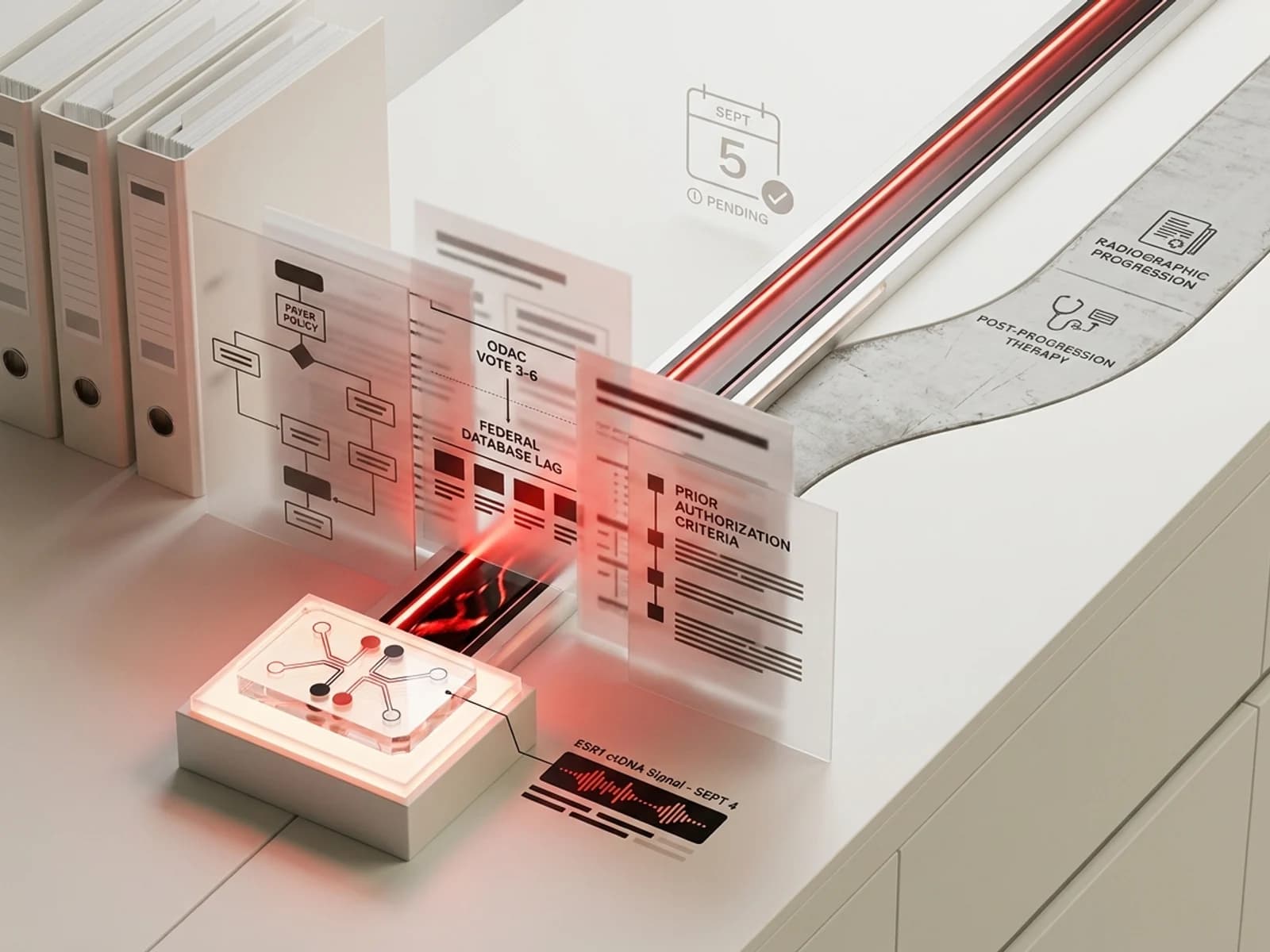
For global drug launch teams, the companion diagnostic (CDx) is often the rate-limiting step in securing regulatory approvals and commercial access. While regulatory strategies typically focus on the primary therapeutic molecule, the clinical evidence for a targeted drug is legally and operationally locked to the diagnostic assay used to select patients in registration trials. This regulatory linkage creates a significant challenge when the diagnostic assay undergoes post-approval changes.
Whether driven by a platform migration (e.g., transitioning from an older analyzer to a high-throughput system), a reagent or antibody clone swap, a software update for automated scoring, or a manufacturing site relocation, any change to an approved CDx triggers a web of regulatory change-control filings. The core challenge is the deep divergence in how the two largest medical markets process post-approval diagnostic modifications.
While the U.S. Food and Drug Administration (FDA) provides well-defined, modular Premarket Approval (PMA) supplement pathways under 21 CFR 814.39—allowing many modifications to be handled via 30-day notices, real-time reviews, or annual reports—the European Union’s In Vitro Diagnostic Regulation (IVDR) routes similar changes through Annex IX, Section 5.2(f). Under this EU pathway, even minor analytical changes can be classified as "significant," requiring a notified body conformity assessment and a fresh consultation with the European Medicines Agency (EMA) or a national competent authority.
This article details the regulatory mechanics of companion diagnostic change control, quantifies the volume of post-approval supplements using historical FDA PMA datasets, maps specific assay changes to their U.S. and EU regulatory pathways, and provides a sequencing playbook for global launch and market access teams.
The U.S. vs. EU regulatory gap
When a companion diagnostic manufacturer modifies a cleared or approved test, the regulatory burden scales with the potential impact on patient safety and therapeutic efficacy. If an assay change leads to a false-positive result, a patient may receive a highly toxic, ineffective targeted drug. Conversely, a false-negative result denies a patient a potentially life-saving therapy.
Despite this shared safety concern, the U.S. and EU regulatory frameworks handle post-approval change control differently:
[CDx Modification (e.g., Reagent Swap or Software Update)]
       │
       ├─► U.S. FDA (21 CFR 814.39) ──► Modular Pathway: 30-Day Notice, 135-Day, or 180-Day Supplement
       │
       └─► EU IVDR (Annex IX 5.2(f)) ─► Team-NB Flowchart Assessment:
                                             │
                                             ├─► Non-Significant: Notified Body notification
                                             └─► Significant: Re-assessment + EMA Consultation (6-12 month slip)
In the United States, companion diagnostics are historically classified as Class III medical devices requiring a Premarket Approval (PMA) application, although the FDA has proposed down-classifying certain oncology nucleic acid-based companion diagnostics to Class II (510(k)). Under the Class III PMA framework, post-approval changes are governed by 21 CFR 814.39, which establishes a tiered, risk-based supplement structure. This allows manufacturers to implement minor manufacturing or labeling changes through 30-day notices, real-time reviews, changes being effected (CBE) filings, or annual reports, while reserving 180-day reviews for changes that directly impact the device's safety or effectiveness.
In the European Union, companion diagnostics are classified as Class C (high-risk individual/moderate public risk) under the In Vitro Diagnostic Regulation (EU) 2017/746. Under the IVDR, a CDx cannot be placed on the market without a conformity assessment by an independent, third-party Notified Body.
Furthermore, IVDR Article 48(3) and Annex IX, Section 5.2 require the Notified Body to consult the EMA or a national competent authority designated under Directive 2001/83/EC to obtain a scientific opinion on the suitability of the CDx in relation to the concerned medicinal product. When a manufacturer modifies an approved Class C CDx, Annex IX, Section 5.2(f) dictates that the Notified Body must assess the change. If the change is deemed "significant"—meaning it could affect the safety, performance, or benefit-risk profile of the diagnostic or the linked drug—the Notified Body must issue a certificate supplement and initiate a new consultation with the EMA or the national authority.
How FDA classifies CDx changes: 21 CFR 814.39
The FDA’s approach to postmarket device modifications is modular. Under 21 CFR 814.39, the diagnostic manufacturer must submit a PMA supplement for any change affecting the safety or effectiveness of the device, unless the change is minor enough to qualify for an annual report. The FDA organizes these filings into four primary categories:
1. 180-Day PMA Supplement (PMA 'Panel-Track' or '180-Day' Supplement)
Governed by 21 CFR 814.39(a), this supplement is required for significant changes that affect the safety and effectiveness of the device, such as a new clinical indication, a change in the intended use population, a major change in the assay's operating principles (e.g., moving from immunohistochemistry to next-generation sequencing), or a change in the clinical cutoff values. The FDA review clock is 180 days, and the agency may consult an advisory panel.
The submission must include comprehensive analytical validation data (precision, reproducibility, analytical sensitivity, and specificity) and clinical validation data (either from a new clinical trial or a bridging study using archived specimens from the original drug trials).
2. Special PMA Supplement — Changes Being Effected (21 CFR 814.39(d))
Under 21 CFR 814.39(d), this pathway lets the manufacturer place certain safety-enhancing changes into effect before FDA issues a written approval order, provided the supplement is plainly marked "Special PMA Supplement—Changes Being Effected" and FDA has acknowledged receipt. The eligible changes are defined narrowly in 814.39(d)(2): labeling changes that add or strengthen a contraindication, warning, or precaution; labeling changes that add an instruction intended to enhance safe use; deletion of misleading, false, or unsupported indications; and changes in quality controls or manufacturing processes that add a new specification or test method (e.g., tightening a release-testing criterion). Because these changes enhance safety, FDA permits implementation on the acknowledgement date rather than at the end of a full review cycle. The related "135-day PMA supplement" is a separate, distinct route, described in Section 4.
3. Real-Time PMA Supplement
Real-time supplements are reserved for minor design, software, or manufacturing changes where the review can be completed rapidly based on pre-approved protocols. These reviews are conducted interactively, often during a single teleconference, resulting in immediate approval. The manufacturer must pre-negotiate the protocol and acceptance criteria with the FDA in a previous submission (such as the original PMA or a subsequent supplement).
4. 30-Day Notice and 135-Day PMA Supplement
Under 21 CFR 814.39(f), a manufacturer may submit a 30-day notice for modifications to manufacturing procedures or methods of manufacture that affect the safety and effectiveness of the device but are eligible for this expedited route. The notice must describe the change in detail, summarize the supporting data, and state that the change was made under the quality system requirements of 21 CFR Part 820. If the FDA does not notify the applicant within 30 days that the notice is not adequate, the manufacturer may distribute the device from the 31st day. If the FDA determines that the notice is not adequate, it informs the applicant in writing that a 135-day PMA supplement is needed — and, per the regulation, the days already spent under 30-day review are credited toward that 135-day review period rather than the clock starting over.
5. PMA Annual Report (Periodic Report)
For minor modifications that do not affect safety or effectiveness—such as minor software bug fixes, routine updates to raw material suppliers, or minor packaging changes—the manufacturer is not required to submit a prior supplement. Instead, these modifications are documented and submitted in the annual PMA periodic report. This represents the lowest regulatory burden for approved devices.
Quantifying the FDA postmarket reality: dataset analysis
To understand the scale of post-approval change control, we analyzed FDA's publicly available Premarket Approval (PMA) database — the device-advisory-committee and supplement records FDA publishes for approved devices — reflecting PMA actions through mid-2026, filtering for filings associated with in vitro diagnostics (IVDs). The analysis focused on four medical device advisory committees that regulate diagnostic assays: Microbiology (MI), Pathology (PA), Clinical Chemistry (CH), and Immunology (IM).
Across these four IVD-relevant committees, the database contains 6,308 total records, representing 298 original PMA applications and 6,010 PMA supplements. This yields an overall supplement-to-original ratio of 20.2:1.
┌────────────────────────────────────────────────────────┐
│ FDA IVD-Relevant PMA Dataset Analysis (20.2:1 Ratio)   │
├────────────────────────────────────────────────────────┤
│ Original PMAs:  [298]                                  │
│ Supplements:    [6,010]                                │
├────────────────────────────────────────────────────────┤
│ Top Supplement Reasons:                                │
│  - Process Change (Manufacturer/Supplier):  3,439      │
│  - Design/Components/Material Changes:      1,214      │
│  - Labeling (Indications/Instructions):       654      │
│  - Location (Manufacturing Relocation):       285      │
└────────────────────────────────────────────────────────┘
This ratio highlights that once an assay is approved, it enters a continuous cycle of postmarket modifications. Over its commercial lifespan, a single companion diagnostic will average more than 20 regulatory filings to maintain compliance.
To understand what drives these filings, we analyzed the taxonomy of the supplement_reason field for the 6,010 IVD supplements:
| Supplement Reason | Count of Filings | Percentage | Regulatory Burden |
|---|---|---|---|
| Process Change - Manufacturer/Sterilizer/Packager/Supplier | 3,439 | 57.2% | Low-to-Moderate (often 30-Day Notices or CBE) |
| Change Design/Components/Specifications/Material | 1,214 | 20.2% | Moderate-to-High (Real-Time or 180-Day Supplements) |
| Labeling Change - Indications/instructions/shelf life/tradename | 654 | 10.9% | Variable (180-Day for new indications; CBE for warnings) |
| Location Change - Manufacturer/Sterilizer/Packager/Supplier | 285 | 4.7% | Moderate (typically 30-Day Notice or site audit) |
| Postapproval study protocol / express GMP / other (incl. unlabeled) | 418 | 7.0% | Variable (typically 135-Day or Annual Report) |
This data shows that more than three-quarters (77.4%) of all post-approval diagnostic changes are driven by manufacturing process adjustments or design and material modifications. In the United States, these changes are frequently managed through expedited pathways. For example, a process or supplier change is typically handled via a 30-day notice under 21 CFR 814.39(f). If the FDA does not object, the manufacturer can implement the change in a month.
Detailed analysis of the manufacturing and location change domain
In this FDA PMA dataset analysis, manufacturing location changes account for 285 supplements (4.7%), while process changes account for 3,439 supplements (57.2%). While these are treated as routine filings by U.S. teams, the regulatory overhead differs substantially between the FDA and EU frameworks.
U.S. FDA Manufacturing Site Change Requirements
Under 21 CFR 814.39, moving a manufacturing line to a new facility or onboarding a new raw material supplier is typically processed via a 30-Day Notice. The manufacturer must submit:
Validation protocols showing the new line produces assays that meet all existing release specifications.
Installation Qualification (IQ), Operational Qualification (OQ), and Performance Qualification (PQ) data for the new equipment.
Stability data (often real-time or accelerated) showing the reagents maintain shelf life when manufactured at the new site.
Verification of environmental controls (such as cleanroom air-handling validation).
If the FDA does not raise an objection within 30 days, the manufacturer can begin commercial distribution of the assays from the new facility. A physical site inspection is rarely required unless the site is a brand-new facility with no prior GMP history.
EU IVDR Site Relocation and Supplier Change Requirements
Under the EU IVDR, a manufacturing site relocation is classified as a significant change if it requires a physical Quality Management System (QMS) audit under Annex IX. The Notified Body must review the site transfer validation plan and may schedule an on-site audit before amending the CE certificate.
This process regularly takes 6 to 9 months, during which the manufacturer cannot ship assays from the new site to the European market. If the manufacturer shuts down the old facility before the CE certificate supplement is issued, they risk a commercial supply bottleneck in Europe, even if the U.S. market is already supplied from the new facility.
The EU IVDR reality: Annex IX 5.2(f)
Under the European Union's In Vitro Diagnostic Regulation (IVDR) 2017/746, a manufacturing or design change that is a simple 30-day notice in the U.S. can become a major regulatory hurdle.
Under IVDR Annex IX, Section 5.2(f), the manufacturer must inform the Notified Body of any planned change to the CDx device that could affect its safety and performance, or that could impact the conditions for its intended use. If the change is "significant," the Notified Body must evaluate the modification, issue a supplement to the EU technical documentation assessment certificate, and consult the EMA or the relevant national drug authority.
To establish consistent criteria for what constitutes a "significant" change, the European Association of Notified Bodies for Medical Devices (Team-NB) released Version 2 of its position paper on companion diagnostic devices under the EU IVDR on 29 October 2025.
This guidance, which focuses on Annex IX Section 5.2, outlines the notified body's role in evaluating modifications to CDx devices. It features a detailed decision-making flowchart to help manufacturers determine whether a change is reportable, whether it requires prior Notified Body approval, and whether it triggers a new consultation with the EMA or national competent authorities.
According to a summary of the October 2025 Team-NB guidance on when companion-diagnostic changes require notified-body approval under IVDR Annex IX, the determination of significance depends on a structured analysis of the change’s impact on three domains:
Analytical Performance: Does the modification (e.g., antibody clone swap, primer/probe sequence changes, or reagent formulation adjustments) alter the assay's sensitivity, specificity, clinical cutoff, or limit of detection?
Clinical Performance and Intended Use: Does the modification expand the patient population, add a new drug-combination indication, or change the clinical decision rule?
User Interaction and Interpretation: Does the modification update the software scoring algorithm, change the automated image analysis, or alter the instructions for use (IFU)?
If a change falls into any of these categories, the Notified Body will likely classify it as significant. This triggers a certificate supplement assessment and a new consultation with the EMA or a national authority.
The table below contrasts how common companion diagnostic changes are routed under the U.S. FDA 21 CFR 814.39 framework and the EU IVDR Annex IX 5.2(f) framework:
| CDx Modification Type | U.S. FDA Pathway (21 CFR 814.39) | EU IVDR Annex IX 5.2(f) Pathway | EMA/NCA Consultation Required? |
|---|---|---|---|
| Antibody Clone Swap (IHC) e.g., replacing a mouse monoclonal antibody with a rabbit monoclonal clone to improve assay stability. | 180-Day PMA Supplement Requires validation data showing analytical equivalence and clinical concordance. | Significant Change Triggers Notified Body conformity assessment and certificate supplement. | Yes The change in clone affects the primary capture reagent, requiring a new scientific opinion. |
| Platform Migration e.g., moving an approved NGS assay from an older instrument to a next-generation high-throughput sequencer. | 180-Day PMA Supplement Or Real-Time Supplement if the manufacturer has a pre-approved platform-migration protocol. | Significant Change The change in detection instrument alters the raw data-acquisition and processing environment. | Yes Requires national competent authority or EMA consultation to verify clinical decision concordance. |
| Software Update (Locked Algorithm) e.g., updating the software GUI or correcting a minor bug in the scoring calculation. | PMA Annual Report If the bug fix does not alter the clinical cutoff or classification output. | Non-Significant Change Reportable via regular notification; does not require prior approval if clinical output is unaffected. | No Simple notification to the Notified Body is sufficient. |
| Software Update (Adaptive AI / Scoring) e.g., updating the automated tumor-proportion score (TPS) algorithm to include a deep-learning classification module. | PMA Supplement Unless covered by a pre-approved PCCP, which allows implementation without a new submission. | Significant Change Triggers Notified Body conformity assessment. A U.S.-approved PCCP is not recognized under the EU AI Act. | Yes Updates to clinical interpretation algorithms require fresh regulatory consultation. |
| Manufacturing Site Relocation e.g., moving the reagent formulation line to a new facility owned by the same manufacturer. | 30-Day Notice Allowed under 814.39(f). If the FDA does not object within 30 days, the site can begin commercial supply. | Significant Change If the Notified Body determines the new site requires a physical QMS audit under Annex IX. | No Typically, site audits do not require EMA consultation unless the product formulation changes. |
| Adding a New Drug Indication e.g., expanding a cleared CDx to select patients for a competitor's drug in the same therapeutic class. | 180-Day PMA Supplement Requires clinical concordance data matching the new drug's registrational trial population. | Significant Change Requires a new conformity assessment or major certificate supplement. | Yes Mandatory EMA or national competent authority consultation for the new drug indication. |
Detailed analysis of the analytical performance domain
When Notified Bodies evaluate whether a change is "significant" under the analytical performance domain, they require comprehensive statistical validation. Sponsors must understand the specific metrics expected by European regulators, which often demand more granular data than the FDA.
For example, when validating an antibody clone swap or reagent optimization, European Notified Bodies expect the following parameters to be documented:
Positive Percent Agreement (PPA) and Negative Percent Agreement (NPA): The manufacturer must compare the performance of the modified assay against the original approved version using clinical specimens. The PPA and NPA must generally exceed 95% with a narrow 95% confidence interval.
Kappa Coefficient: For qualitative assays (e.g., immunohistochemistry scoring), the inter-rater and intra-rater agreement must be evaluated. Notified Bodies typically look for a Cohen's Kappa coefficient greater than 0.80, indicating near-perfect agreement.
Limit of Detection (LoD) and Limit of Quantitation (LoQ): For molecular assays (e.g., PCR or NGS), the manufacturer must demonstrate that the modification does not increase the LoD or LoQ. Any shift that degrades assay sensitivity is classified as a significant change and will trigger a full conformity assessment.
If the validation data shows a statistically significant shift in any of these parameters, the change cannot be handled via notification. The manufacturer must prepare a full technical documentation supplement.
Why the EU CDx gates the global drug label
The core risk of this regulatory asymmetry is that the EU diagnostic certificate supplement gates the drug’s European label.
In the United States, if a pharma sponsor and a diagnostic manufacturer update a companion diagnostic via a 30-day notice or a 180-day supplement, the drug's label can often be updated in parallel. In the European Union, the drug’s label expansion or launch cannot proceed until the companion diagnostic is CE-marked for that specific indication.
Under the IVDR, Notified Bodies face severe capacity constraints. Following the implementation of the IVDR, the number of designated Notified Bodies dropped significantly. Consequently, the review clock for a standard Class C diagnostic conformity assessment averages 13 to 18 months.
If a diagnostic modification is classified as a significant change under Annex IX 5.2(f), the Notified Body’s evaluation and the subsequent EMA/national-authority consultation can add 6 to 12 months to the timeline.
During this period, the diagnostic cannot be placed on the European market with the updated labeling, which prevents the drug sponsor from launching the therapeutic or expanding its label in Europe. An EFPIA survey of companies running companion-diagnostic-linked programs reported that 43% of respondents expect 6 to 12-month delays to current clinical trials and commercial launches due to IVDR implementation issues, with 48% anticipating similar delays to future trials.
Payer follow-through: US coverage desynchronization
The regulatory divergence between the U.S. and EU is a major launch-sequencing challenge. However, assay modifications can also disrupt commercial access in the United States, even when the FDA approves the change.
In the U.S. market, commercial reimbursement for molecular testing relies on a dual-gate system:
Medicare National Coverage Determination (NCD) 90.2: This policy provides national coverage for FDA-approved next-generation sequencing (NGS) companion diagnostics in patients with advanced cancer.
The MolDx Program (administered by Palmetto GBA): This program manages molecular diagnostic reimbursement across multiple Medicare Administrative Contractor (MAC) jurisdictions.
To secure reimbursement under the MolDx program, every molecular test must register and obtain a DEX Z-Code. This unique identifier maps the specific laboratory test to its billing CPT code. Payers use this code to verify that the test meets the NCD 90.2 coverage criteria.
When a diagnostic manufacturer implements an FDA-approved assay change (such as migrating to a new platform or updating the software), the laboratory must update its registry status with MolDx. If the laboratory submits the updated billing codes before MolDx processes the change, the claim may be denied.
This creates a reimbursement gap where the test is FDA-approved but temporarily non-reimbursable. During this gap, oncologists who order the modified test may face denials, which can disrupt patient testing and delay drug prior authorization — the same payer-side companion diagnostic denial in oncology prior authorization failure mode that access teams appeal separately from the device-regulatory change-control process described here.
A sequencing playbook for launch teams
To mitigate the risk of launch delays and reimbursement gaps, global pharmaceutical and diagnostic co-development teams should adopt a parallel, risk-adjusted sequencing strategy.
[Design Freeze]
       │
       ├─► 12 Months Before Launch: File EU IVDR Change-Control Package (Annex IX 5.2(f))
       │        │
       │        └─► (Notified Body Review + EMA Consultation: 9-12 Months)
       │
       ├─► 6 Months Before Launch: File FDA 21 CFR 814.39 Supplement (180-Day Clock)
       │        │
       │        └─► (FDA Review: 6 Months)
       │
       └─► 3 Months Before Launch: Register Z-Code Update with MolDx / DEX Registry
                │
                └─► (MolDx Processing: 2-3 Months)
                       │
                       ▼
             [Synchronized Global Launch]
1. Map change-control requirements at design freeze
Launch teams should establish a "design freeze" for the companion diagnostic at least 18 months before the planned drug submission. Any subsequent modifications must be evaluated against both the FDA 21 CFR 814.39 supplement criteria and the Team-NB V2 significance flowchart.
2. File the EU IVDR package 6 to 12 months ahead of the U.S. supplement
Because the EU IVDR review clock for a significant change (including Notified Body review and EMA consultation) can take up to a year, the EU submission should be filed well ahead of the U.S. supplement. Attempting to file these submissions sequentially will delay the EU drug launch.
3. Maintain separate clinical validation datasets for EU Notified Bodies
EU Notified Bodies frequently request raw clinical trial data and analytical concordance studies to support a significant change, even when the FDA has cleared the modification based on laboratory validation. Co-development agreements should ensure that the diagnostic manufacturer has direct access to the pharma sponsor's clinical trial datasets to address Notified Body audits.
4. Coordinate Z-Code updates with MolDx before U.S. commercial release
To prevent reimbursement disruptions, the diagnostic laboratory should submit its Z-code update request to the DEX registry immediately upon receiving FDA approval for the supplement. The commercial launch of the modified test should be held until the registry confirms the updated code is active and mapped to the coverage policy.
5. Establish clear IP-sharing and data-access agreements
Pharma and diagnostic partners must establish robust data-sharing agreements early in the co-development process. The diagnostic manufacturer needs legal access to patient-level clinical trial data to support its submissions to European Notified Bodies. Conversely, the pharma sponsor needs visibility into the diagnostic's manufacturing and design change logs to evaluate potential risks to the drug's label.
Frequently Asked Questions (FAQ)
Does an antibody-clone swap on a companion diagnostic require a new PMA or just a supplement in the US?
An antibody-clone swap does not require a new Premarket Approval (PMA) application. Instead, it is typically processed as a 180-day PMA supplement under 21 CFR 814.39(a). The manufacturer must submit analytical validation data demonstrating that the new clone has equivalent binding affinity, specificity, and concordance with the original clone used in the clinical trials, along with clinical concordance data matching the established clinical cutoff values.
Can I implement a CDx software update in the EU before the notified body approves it?
If the software update is classified as a "significant change" under the Team-NB V2 flowchart (for example, if it alters the scoring algorithm, changes the clinical interpretation output, or updates the user interface), you cannot implement it in the European Union before obtaining Notified Body approval. Implementing a significant change without a certificate supplement violates the IVDR and can result in the withdrawal of the device's CE mark. Non-significant changes (such as minor bug fixes or security patches) can be implemented immediately, provided they are documented and reported to the Notified Body in the next routine notification.
If my CDx changes, do I have to update the linked drug's label and payer coverage criteria?
It depends on whether the modification changes the diagnostic's intended use or target patient population. If the change is analytical (such as a manufacturing site relocation or reagent optimization) and does not alter the clinical cutoff, the drug label and payer coverage criteria remain unchanged. However, if the diagnostic change introduces a new indication, a platform migration that alters testing availability, or a clinical cutoff change, the drug sponsor must submit a corresponding labeling supplement to the FDA and EMA to update the drug's package insert. Payer coverage criteria (such as Medicare NCDs or commercial prior authorization rules) must also be updated to reference the new platform or testing methodology.
What happens if the FDA proposed down-classification is finalized?
If the FDA finalizes the down-classification of oncology companion diagnostics from Class III (PMA) to Class II (510(k)), the regulatory burden in the United States will decrease. Post-approval changes that currently require 180-day PMA supplements may be handled via 510(k) modifications or internal documentation under design controls. However, this change will not affect the European Union, meaning the regulatory gap between the U.S. and EU pathways will widen further.
How does the EU AI Act impact companion diagnostics?
The EU AI Act classifies AI-enabled companion diagnostics (which require third-party conformity assessments under the IVDR) as "high-risk" AI systems. This introduces additional obligations, including data governance requirements, human oversight mechanisms, and cybersecurity standards. These requirements will be evaluated by Notified Bodies alongside the IVDR conformity assessment, potentially increasing review times and complexity for software-based diagnostics.
What is the difference between a clinical concordance study and a clinical bridging study?
A clinical concordance study compares the performance of a new or modified assay against an approved reference test using a set of clinical specimens, determining whether they select the same patients. A clinical bridging study re-tests clinical trial specimens from the drug's original registration study using the modified assay. This is done to prove that the clinical efficacy observed in the trial is maintained when patients are selected with the new version of the test. Bridging studies carry a higher regulatory standard and are typically required for major platform migrations or changes to clinical cutoffs.
Sources
European Union. Regulation (EU) 2017/746 of the European Parliament and of the Council of 5 April 2017 on in vitro diagnostic medical devices (IVDR). Annex IX, Section 5.2: Procedure for companion diagnostics. https://eur-lex.europa.eu/eli/reg/2017/746/oj
Team-NB. Position Paper: Significant Changes Regarding the Transitional Provisions under Article 110(3) of the IVDR. Version 2.0, October 29, 2025. https://www.team-nb.org/wp-content/uploads/2025/10/Team-NB-PositionPaper-IVDR-Significant-changes-V2.pdf
U.S. Food and Drug Administration (FDA). 21 CFR Part 814, Subpart B: Premarket Approval Supplements (Section 814.39). https://www.ecfr.gov/current/title-21/chapter-I/subchapter-H/part-814/subpart-B/section-814.39
U.S. Food and Drug Administration (FDA). PMA Supplements and Amendments: Guidance for Industry and FDA Staff. https://www.fda.gov/medical-devices/premarket-approval-pma/pma-supplements-and-amendments
European Medicines Agency (EMA). Questions and answers on the implementation of the Medical Devices Regulation (MDR) and the In Vitro Diagnostic Medical Devices Regulation (IVDR). https://www.ema.europa.eu/en/documents/regulatory-procedural-guideline/questions-answers-implementation-medical-devices-vitro-diagnostic-medical-devices-regulations-eu-2017-745-eu-2017-746_en.pdf
U.S. Food and Drug Administration (FDA). List of Cleared or Approved Companion Diagnostic Devices (In Vitro and Imaging Tools). https://www.fda.gov/medical-devices/in-vitro-diagnostics/list-cleared-or-approved-companion-diagnostic-devices-in-vitro-and-imaging-tools
European Federation of Pharmaceutical Industries and Associations (EFPIA). EFPIA IVDR Survey: impact on companion diagnostic clinical trials and launches. https://efpia.eu/media/677143/efpia_ivdr_survey-slides.pdf
PureGlobal. EU IVDR 2025 Update: New Guidance Clarifies Change Requirements for Companion Diagnostics.
Centers for Medicare & Medicaid Services (CMS). National Coverage Determination (NCD) for Next Generation Sequencing (NGS) (90.2). https://www.cms.gov/medicare-coverage-database/view/ncd.aspx?ncdid=372
Last updated July 16, 2026. This article is for informational purposes only and does not constitute medical advice, regulatory counsel, or legal representation. Regulated teams should consult with qualified regulatory experts and primary legal texts before implementing assay modifications.