A drug-eluting stent, a prefilled biologic syringe, an on-body wearable injector for a specialty drug — each is a combination product regulated by the FDA under rules that span both drug and device law. For launch teams, the classification question is not academic: it determines which FDA center leads the review, which pathway the product takes to market, which quality system applies, and how long approval will take.
The number of combination product approvals has risen steadily. In recent years, the FDA has approved drug-device combinations including the EMPAVELI Injector (pegcetacoplan enFuse wearable) for subcutaneous self-administration (approved October 2023), and Lasix ONYU (furosemide on-body infusor) for at-home heart failure management (approved October 2025). These products represent a growing class where drug or biologic and device are so intertwined that neither can be evaluated in isolation.
This guide maps the regulatory framework, classification process, pathway options, and commercial implications for drug-device combination products. It is independent information and not regulatory advice for a specific product.
What is a combination product?
Under 21 CFR 3.2(e), the FDA defines a combination product as a product composed of two or more regulated components — drug and device, biologic and device, or drug, device, and biologic — that are physically, chemically, or otherwise combined, co-packaged, or cross-labeled for use together.
The FDA recognizes nine specific types, but drug-device combinations most commonly fall into these categories:
| Type | Description | Examples |
|---|---|---|
| Type 2: Prefilled drug delivery device | Drug filled into or combined with a device whose sole purpose is to deliver the drug | Prefilled syringes, autoinjectors, metered-dose inhalers, transdermal patches |
| Type 3: Prefilled biologic delivery device | Biologic filled into or combined with a delivery device | Biologic in a prefilled syringe, biologic autoinjector |
| Type 4: Device coated or combined with drug | Device has a function beyond drug delivery; drug provides adjunct benefit | Drug-eluting stents, antimicrobial-coated catheters, antibiotic bone cements |
| Type 1: Convenience kit or co-package | Drug and device packaged together but separate | Vial with transfer device, surgical kit with antiseptic |
For a broader look at how medical devices are regulated in their own right — across multiple countries and registration pathways — MedDeviceGuide provides country-by-country device registration and regulatory-affairs guidance.
Primary Mode of Action determines everything
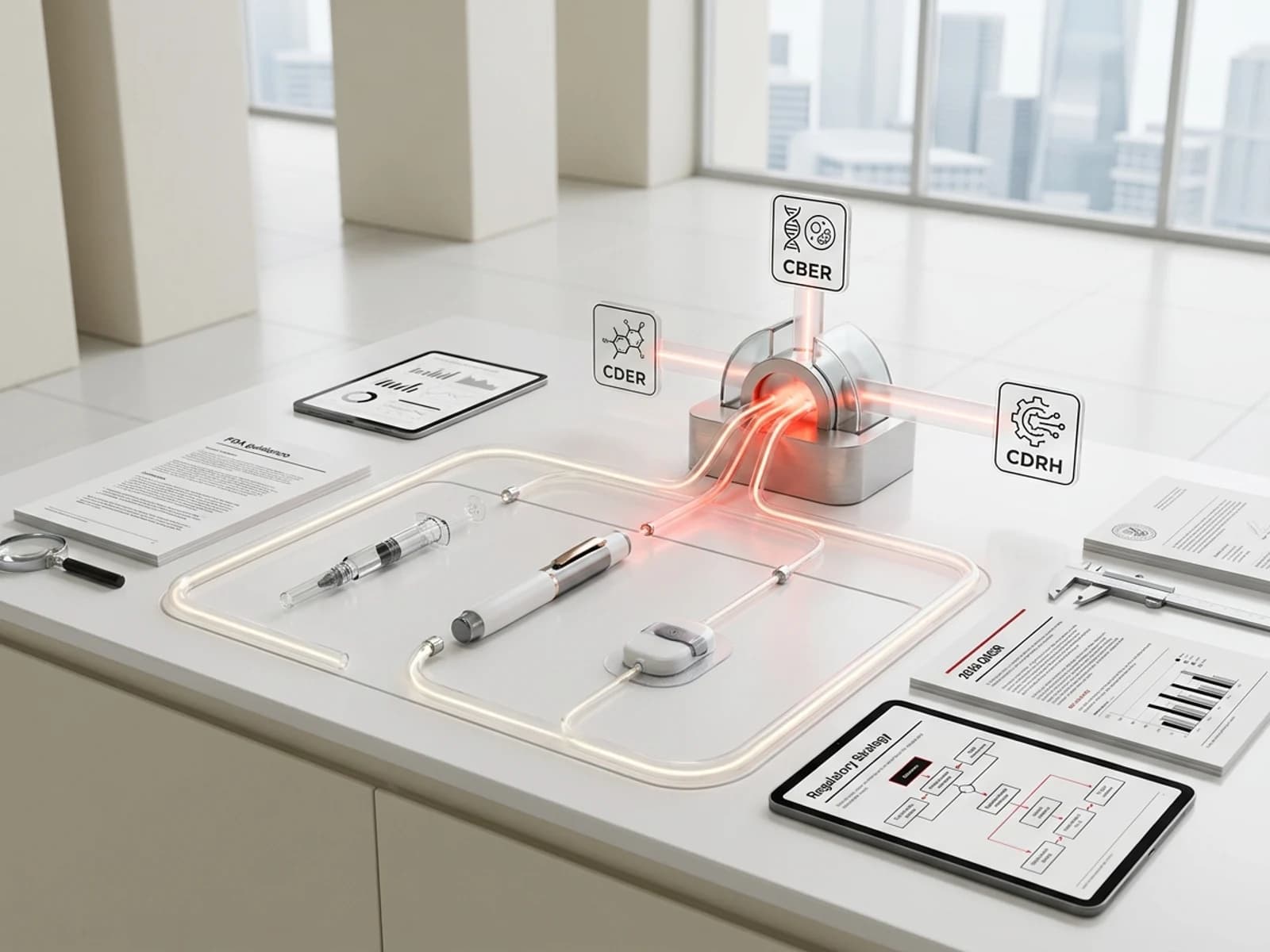
The single most important classification decision is the Primary Mode of Action (PMOA). The PMOA is the single mode of action of a combination product that provides the most important therapeutic effect. It determines which FDA center has primary jurisdiction:
| PMOA | Lead FDA center | Regulatory pathway | Typical timeline |
|---|---|---|---|
| Drug (chemical/metabolic) | CDER | NDA (505(b)(1) or 505(b)(2)) or ANDA | 10–12 months (standard); 6 months (priority) |
| Biologic (immunological/biologic) | CDER or CBER | BLA | 10–12 months (standard); 6 months (priority) |
| Device (physical/mechanical) | CDRH | PMA, 510(k), or De Novo | 180 days (PMA); 90 days (510(k)); varies (De Novo) |
How PMOA is determined
Sponsor assessment. The sponsor analyzes the product and proposes a PMOA based on which constituent part provides the greatest therapeutic contribution.
Pre-RFD or RFD. If the PMOA is unclear, the sponsor can submit a Pre-Request for Designation (Pre-RFD) to FDA's Office of Combination Products (OCP) for informal, non-binding feedback. For a binding determination, the sponsor submits a Request for Designation (RFD), which OCP must answer within 60 days.
OCP assignment. If the PMOA remains unclear after the RFD process, the OCP assigns the product to the center with the most expertise in the predominant mode of action, using a default algorithm.
Getting the PMOA wrong is expensive. If FDA disagrees with a sponsor's PMOA determination, the submission pathway, required studies, quality system, and inspection requirements may all change — forcing a regulatory restart that can cost months and hundreds of thousands of dollars.
The 505(b)(2) pathway for drug-device combinations
The 505(b)(2) pathway has become increasingly important for combination products. A 505(b)(2) application is an NDA that relies in part on data not developed by the applicant — for example, relying on the FDA's finding of safety and efficacy for an already-approved drug while providing new data on the device component.
Key considerations for 505(b)(2) drug-device combinations:
Bridging studies. The applicant must bridge from the reference product to the new combination, including bioequivalence or bioavailability data and device-performance testing.
Device-specific modules. The quality section must include the quality manual, device specifications, manufacturing process for the device, and design control documentation.
Human factors. Usability studies demonstrating that patients or healthcare providers can use the device correctly are expected for most user-operated combination products.
Stability. Stability studies must evaluate the drug-device combination as a system, not just the drug alone — including leachables, extractables, and device functionality over the shelf life.
Quality system requirements: the February 2026 QMSR change
Effective February 2, 2026, the FDA's Quality Management System Regulation (QMSR) replaced the previous device Quality System Regulation (21 CFR Part 820). The QMSR incorporates by reference ISO 13485:2016 — the international standard for medical device quality management systems.
For combination product sponsors, this means:
Drug-led combination products must still comply with drug cGMP (21 CFR Parts 210/211), but the device constituent must also meet QMSR requirements
The FDA no longer uses the Quality System Inspection Technique (QSIT) for device inspections as of February 2, 2026
Combination product manufacturers need integrated quality systems that address both drug and device requirements simultaneously
FDA Warning Letters have historically cited combination product sponsors for design control, change control, and purchasing control deficiencies (e.g., the 2014 Amgen Warning Letter for Prolia and Enbrel prefilled syringe/autoinjector products)
Recent FDA guidance documents for combination products
The FDA has issued several guidance documents that affect combination product development:
| Guidance | Status | Date | Relevance |
|---|---|---|---|
| Principles of Premarket Pathways for Combination Products | Final | January 2022 | Defines how FDA determines appropriate regulatory pathway; implements 21st Century Cures Act provisions |
| Cross-Center Master Files: Where to Submit | Draft | November 2025 | Addresses where device master files should be submitted when supporting drug-led combination product applications |
| Pre-Request for Designation (Pre-RFD) | Final (revised) | November 2025 | Updates process for informal PMOA feedback |
| Essential Drug Delivery Outputs (EDDO) | Draft | June 2024 | Defines performance parameters for drug delivery devices |
| UDI Requirements for Combination Products | Draft | June 2025 | Clarifies Unique Device Identifier obligations for combination product device components |
Commercial and access implications
Combination product classification affects more than the approval pathway. It also has downstream implications for:
Coding and reimbursement. Drug-led products typically bill under pharmacy (NDC) or medical benefit (J-code, HCPCS) pathways. Device-led products bill under CPT and device-specific codes. Misalignment between the product's regulatory classification and the billing pathway can create reimbursement friction.
Site of care. On-body injectors and wearable delivery systems that enable self-administration may shift a product from a buy-and-bill, provider-administered therapy to a pharmacy-benefit specialty pharmacy product — changing the entire access model.
Supply chain. Combination products often involve multiple contract manufacturers — one for the drug, one for the device, and sometimes a third for final assembly. Quality agreements, change control, and inspection readiness must span the entire network.
Lifecycle management. Post-approval changes to the device component (design changes, material changes, manufacturing site changes) may trigger separate device reporting obligations (MDR reports, PMA supplements) in addition to drug supplemental applications.
Practical steps for combination product teams
Determine PMOA early. Engage OCP through a Pre-RFD during early development, before committing to a clinical program and submission strategy.
Build an integrated quality system. Do not bolt device quality requirements onto a drug quality system. Design the quality system from the ground up to satisfy both drug cGMP and device QMSR requirements.
Plan human factors studies. For prefilled syringes, autoinjectors, and on-body delivery systems, human factors validation is expected by the FDA and is frequently a source of review cycle delays.
Coordinate cross-center review. Even when one center leads, the other center will consult. Sponsors should prepare device-specific modules in drug submissions (and vice versa) with the same rigor as the primary application.
Watch the master-file guidance. The November 2025 draft guidance on cross-center master files may simplify the process of supporting a drug-led application with device information housed in a CDRH master file — reducing the risk that the drug review clock triggers device inspection timelines.
Monitor QMSR inspections. With the transition away from QSIT effective February 2026, combination product manufacturers should expect updated inspection approaches and ensure their quality systems are aligned with ISO 13485.
What to monitor next
Final guidance on cross-center master files. The draft guidance from November 2025 is expected to be finalized; watch for changes to how device master files support drug-led combination submissions.
EDDO final guidance. The Essential Drug Delivery Outputs guidance, once finalized, will define performance parameters that combination product sponsors must characterize and control.
UDI rule finalization. Combination product sponsors should prepare for Unique Device Identifier requirements on device components.
On-body delivery platform approvals. Multiple on-body injector platforms (BD Libertas, Enable enFuse, Ypsomed) are in late-stage development or approval; each new approval sets precedent for the next.
International harmonization. Combination product regulation remains poorly harmonized outside the US. The EU has no centralized decision-making body for combination products, and many markets lack specific regulations, creating complexity for global launches.
Sources
FDA. "Combination Products Guidance Documents." Updated November 25, 2025. https://www.fda.gov/combination-products/guidance-regulatory-information/combination-products-guidance-documents
FDA. "Overview of Device Regulation." Updated February 2, 2026. https://www.fda.gov/medical-devices/device-advice-comprehensive-regulatory-assistance/overview-device-regulation
FDA. "Principles of Premarket Pathways for Combination Products." Final Guidance, January 2022. https://www.fda.gov/regulatory-information/search-fda-guidance-documents/principles-premarket-pathways-combination-products
21 CFR 3.2(e). "Definition of combination product." https://www.ecfr.gov/current/title-21/chapter-I/subchapter-A/part-3/section-3.2
McGuireWoods. "FDA Guidance Clarifies Classification of Combination Drug-Device Products." February 2022. https://www.mcguirewoods.com/client-resources/alerts/2022/2/fda-guidance-clarifies-classification-of-combination-drug-device-products
Drug Delivery Leader. "Drug-Device Combination Products: 4 Evolving Platforms for 2026." 2026. https://www.drugdeliveryleader.com/doc/drug-device-combination-products-evolving-platforms-for-0001
Premier Research. "Using the 505(b)(2) Pathway to Streamline Regulatory Approval for Combination Products." January 7, 2026. https://premier-research.com/perspectives/505b2-pathway-regulatory-combination-products
J&J Consulting Group. "Drug Device Combination Products: The Complete Guide." https://jjccgroup.org/drug-device-combination-products
Frontiers in Medical Technology. "US regulatory compliance for medical combination products." 2024. https://www.frontiersin.org/journals/medical-technology/articles/10.3389/fmedt.2024.1486318/full