When the FDA completes its review of a New Drug Application (NDA), Biologics License Application (BLA), or Abbreviated New Drug Application (ANDA) and determines the application cannot be approved in its current form, the agency issues a Complete Response Letter (CRL). A CRL is not a final rejection — it describes specific deficiencies and, when possible, recommends actions the sponsor could take to obtain approval.
This guide is for regulatory professionals, launch teams, commercial strategists, and investors who need to understand what a CRL means, how the response process works, and what the FDA's new transparency policy changes for development-stage companies.
What a CRL is and what triggers one
Under 21 CFR 314.110, a CRL is the FDA's standard communication when a review cycle is complete and the application is not ready for approval. The CRL replaces the former approvable and not-approvable letters that FDA discontinued using in 2008.
Common reasons the FDA issues a CRL include:
Safety concerns: Identified safety signals, insufficient risk-benefit profile, or inadequate risk mitigation proposals
Efficacy deficiencies: Primary endpoints not met, insufficient effect size, or inadequate dose-response data
Manufacturing (CMC) issues: cGMP violations, facility inspection failures, inadequate process validation, or stability data gaps
Labeling problems: False or misleading labeling, inadequate prescribing information, or REMS deficiencies
Bioequivalence failures (for ANDAs): Failure to demonstrate bioequivalence to the reference listed drug
Clinical trial design: Inadequate study design, insufficient patient population, or missing key subgroups
The CRL is supposed to describe all identified deficiencies in a single letter, giving the sponsor a complete picture of what must be addressed.
What happens after a CRL: the three options
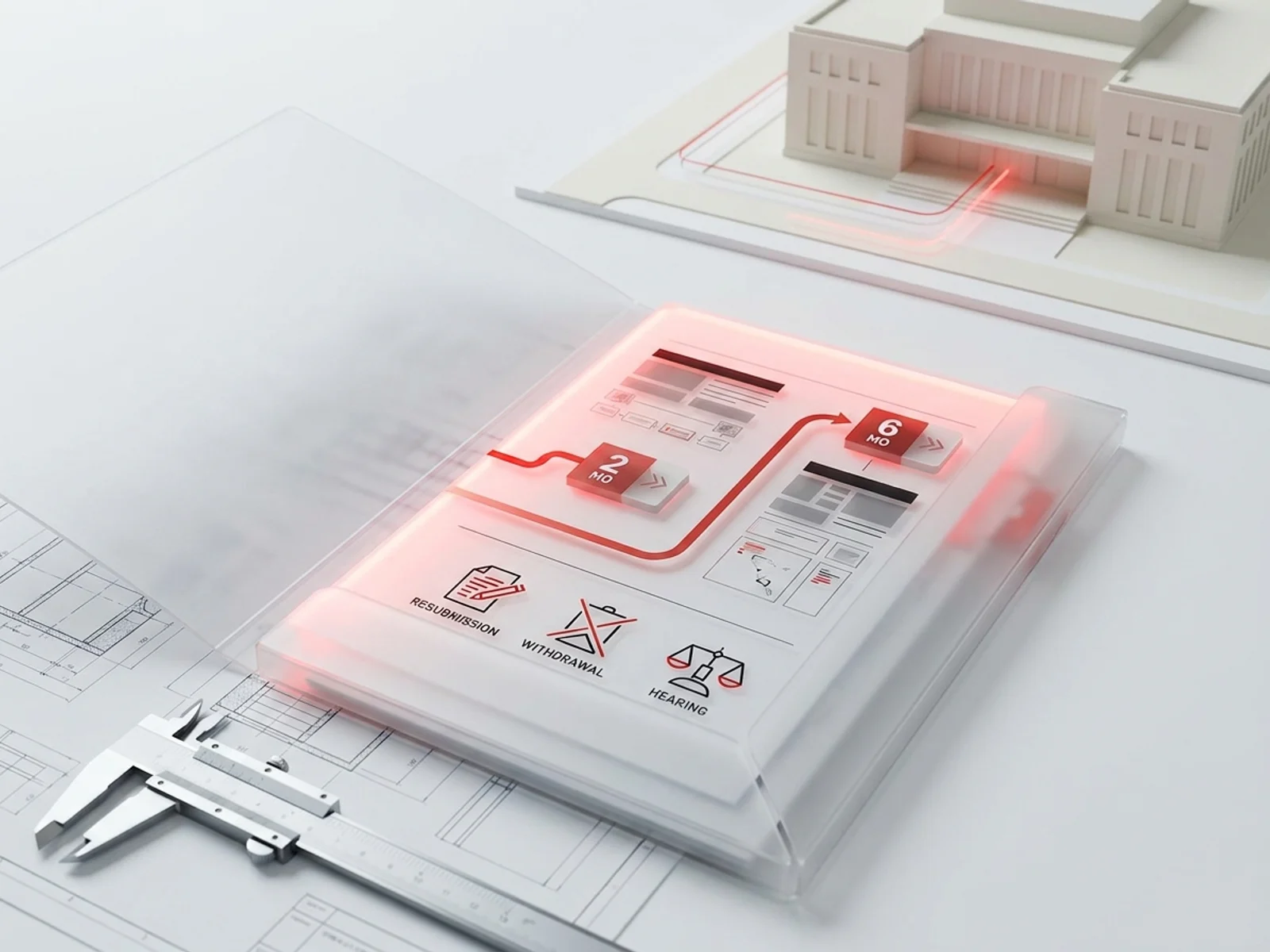
Under 21 CFR 314.110(b), a sponsor receiving a CRL must take one of three actions:
Option 1: Resubmission
The sponsor addresses all deficiencies identified in the CRL and resubmits the application. The resubmission is classified by FDA as either Class 1 or Class 2, which determines the review timeline.
| Classification | Typical deficiencies | FDA review timeline | Examples |
|---|---|---|---|
| Class 1 | Minor amendments: labeling revisions, assay validation, minor data re-analysis | 2 months (60 days) from receipt of resubmission | Labeling clarifications, minor CMC updates |
| Class 2 | Major deficiencies: new clinical data required, manufacturing reinspection, extensive CMC changes | 6 months from receipt of resubmission | New pivotal trial data, facility reinspection, major protocol amendments |
FDA's MAPP 6020.4 Rev. 3 governs the classification process. Within 30 calendar days of receiving a resubmission, FDA determines whether it is complete (addresses all CRL deficiencies) and assigns a Class 1 or Class 2 designation. If the resubmission is incomplete, FDA notifies the sponsor and does not start a new review cycle.
Option 2: Withdrawal
The sponsor can withdraw the application entirely. Withdrawal is without prejudice — the sponsor may refile later. This option is typically chosen when the deficiencies are infeasible to address, the clinical program needs fundamental redesign, or the sponsor is making a strategic pivot.
Option 3: Request a hearing
Under 21 CFR 314.110(b)(3) and 314.120, the sponsor may request a formal hearing on whether grounds exist for denying the application. This option is rarely exercised because hearings are public and the standard of proof is high. The sponsor must demonstrate that the CRL was issued in error based on the criteria in 21 CFR 314.125.
The CRL response timeline
The practical timeline from CRL receipt to potential approval varies dramatically based on the nature of deficiencies:
| Milestone | Class 1 resubmission | Class 2 resubmission |
|---|---|---|
| CRL receipt | Day 0 | Day 0 |
| Gap analysis and internal review | Days 1-14 | Days 1-14 |
| Type A meeting request (if needed) | Not typically needed | Days 1-30 |
| Type A meeting held | N/A | Days 60-90 |
| Response development | Days 1-60 | Days 60-180+ |
| Resubmission filed | Days 60-90 | Days 180-365+ |
| FDA review goal date | 2 months after receipt | 6 months after receipt |
There is no regulatory deadline for when a sponsor must resubmit. However, under 21 CFR 314.110(c), if a sponsor fails to take any action within one year of a CRL, FDA may consider the application withdrawn. The agency will grant reasonable extension requests.
What changed: FDA's 2025 CRL transparency policy
July 2025: Initial batch release
On July 10, 2025, FDA Commissioner Marty Makary announced that the agency would publish CRLs "in real time" — releasing them shortly after issuance regardless of whether the product is ultimately approved. The agency released approximately 200 CRLs associated with approved applications on openFDA, with letters redacted for trade secrets and confidential commercial information.
September 2025: Unapproved-drug CRL release
On September 4, 2025, FDA released an additional batch of 89 previously unpublished CRLs associated with pending or withdrawn applications. This was a significant departure from prior practice, where the existence of unapproved applications was protected from disclosure under FDA regulations.
The new policy going forward:
Newly issued CRLs will be released promptly after issuance to sponsors
CRLs for approved applications will be released when the application is approved
Historical CRLs for withdrawn or abandoned applications will be published in batches
All CRLs will be redacted for trade secrets, confidential commercial information, and personal privacy, but will contain company names
Commercial and regulatory implications
The transparency policy has several practical implications:
Investor relations: Companies can no longer selectively disclose CRL contents. The public availability of CRLs provides investors with direct access to FDA's assessment of application deficiencies.
Development strategy: Sponsors can now study precedent CRLs to understand common deficiency patterns and proactively address them in their submissions.
Competitive intelligence: CRLs for competitor products are now accessible, providing insight into the FDA's thinking on specific therapeutic areas, endpoints, and evidence standards.
Legal risk: Companies must ensure public statements about regulatory interactions are consistent with the CRL content, since the letter itself will be publicly available.
Rare pediatric diseases: Recent CRLs suggest FDA may be applying more traditional evidence standards even in rare pediatric indications, despite rhetoric about regulatory flexibility.
CRLs by the numbers: recent trends
According to Pink Sheet/Citeline tracking:
The FDA started 2026 with 55 novel agents under review
More CRLs were issued than approvals for novel neuroscience candidates in 2025, with orphan neurology therapies hit hardest
Median review times for novel agents approved in 2025 remained close to PDUFA goals despite significant policy changes
At least one CRL was revised after issuance to improve clarity rather than change facts, suggesting FDA is now writing CRLs with a broader audience in mind
ANDA-specific CRL considerations
For generic drug applications (ANDAs), the FDA issued updated guidance on failure to respond to a CRL within the regulatory timeframe, revised to incorporate GDUFA III performance goals:
If an ANDA applicant fails to respond to a CRL within one year, FDA may deem the application withdrawn
Extension requests are evaluated based on factors including public health emergencies, supply chain disruptions, and the complexity of required studies
Major resubmissions of ANDAs trigger a new 6-month review cycle
What to monitor after a CRL
Resubmission classification. Whether FDA assigns Class 1 or Class 2 determines whether the timeline is 2 months or 6 months. Early engagement with the review division can clarify expectations.
Type A meeting outcomes. For Class 2 resubmissions, a Type A meeting with FDA can clarify deficiency interpretation and align on the scope of required new data before committing resources.
Investor communications. With CRLs now public, companies should ensure that earnings calls, press releases, and SEC filings are consistent with the CRL's stated deficiencies.
Competitor CRLs. The new transparency policy means sponsor teams can study CRLs for competitor products in the same therapeutic area to anticipate FDA expectations.
Pipeline priority shifts. Companies with multiple programs should reassess resource allocation based on the scope and cost of addressing CRL deficiencies versus advancing other candidates.
Commissioner's National Priority Voucher (CNPV) program. This new program could affect the CRL landscape for qualifying products, potentially enabling faster resubmission review for agents designated as national priorities.
Sources
FDA. "Complete Response Letter Final Rule." 21 CFR 314.110. https://www.fda.gov/drugs/laws-acts-and-rules/complete-response-letter-final-rule
FDA. "Failure to Respond to an ANDA Complete Response Letter Within the Regulatory Timeframe: Guidance for Industry." Revised for GDUFA III. https://www.fda.gov/regulatory-information/search-fda-guidance-documents/failure-respond-anda-complete-response-letter-within-regulatory-timeframe-guidance-industry
FDA. "FDA Announces Real-Time Release of Complete Response Letters, Posts Previously Unpublished Batch." September 4, 2025. https://www.fda.gov/news-events/press-announcements/fda-announces-real-time-release-complete-response-letters-posts-previously-unpublished-batch-89
FDA. "FDA Embraces Radical Transparency by Publishing Complete Response Letters." July 10, 2025. https://www.fda.gov/news-events/press-announcements/fda-embraces-radical-transparency-publishing-complete-response-letters
FDA. "Complete Response Letters API." openFDA. https://open.fda.gov/apis/transparency/completeresponseletters
FDA. "MAPP 6020 Rev. 2: Classification of Resubmissions." https://www.fda.gov/media/72727/download
eCFR. "21 CFR 314.110 — Complete response letter to the applicant." https://www.ecfr.gov/current/title-21/chapter-I/subchapter-D/part-314/subpart-D/section-314.110
Arnold Porter. "Transparency So Radical It Overlooks Law and Tradition: FDA Releases Complete Response Letters for Unapproved Drugs." September 4, 2025. https://www.arnoldporter.com/en/perspectives/advisories/2025/09/fda-releases-complete-response-letters-for-unapproved-drugs
Sidley Austin. "FDA Release of Complete Response Letters Raises Confidentiality, Disclosure Questions." July 14, 2025. https://datamatters.sidley.com/2025/07/14/fda-release-of-complete-response-letters-raises-confidentiality-disclosure-questions-but-offers-insights-for-development
Citeline Pink Sheet. "Complete Response Letters." https://insights.citeline.com/pink-sheet/product-reviews/complete-response-letters
Avalere Health. "What is a Complete Response Letter?" https://advisory.avalerehealth.com/insights/what-is-a-complete-response-letter