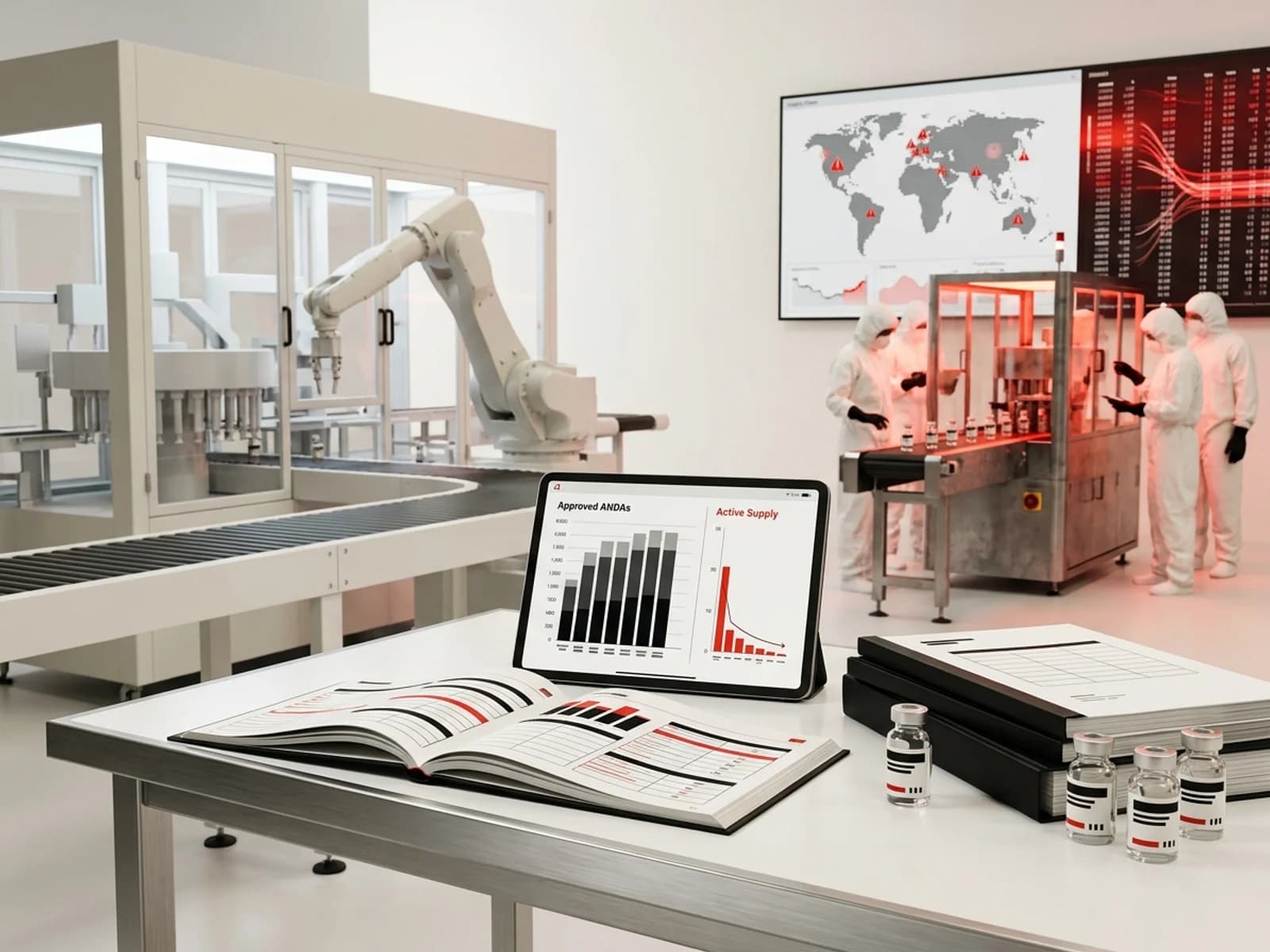
The WHO Prequalification programme lists 1,139 medical products as of June 2026: 664 finished pharmaceutical products, 193 active pharmaceutical ingredients, and 282 vaccines. India-based manufacturers hold 59% of finished-product listings and the world's single largest vaccine supplier, Serum Institute of India, accounts for 72 of 282 prequalified vaccine entries — one in four. HIV/AIDS, tuberculosis, and malaria together account for 74% of all finished-product listings, reflecting the programme's origins in the global infectious-disease response.
This analysis draws on the WHO Prequalification of Medical Products list, which evaluates medicines, vaccines, and APIs against WHO standards of quality, safety, and efficacy to guide procurement by UN agencies, the Global Fund, and national governments.
The product landscape: 1,139 listings across three streams
| Product stream | Count | Share |
|---|---|---|
| Finished pharmaceutical products | 664 | 58.3% |
| Vaccines | 282 | 24.8% |
| Active pharmaceutical ingredients | 193 | 17.0% |
| Total | 1,139 | 100% |
Of the 664 finished products, 633 (95.3%) are conventional finished pharmaceutical products and 30 (4.5%) are biotherapeutic products. The finished-product list is dominated by oral solid dosage forms: film-coated tablets (239, 36.0%), plain tablets (142, 21.4%), and dispersible tablets (69, 10.4%) together account for 67.8% of all listings.
The API list is smaller at 193 entries, but represents the upstream supply chain. Dolutegravir sodium leads with 13 prequalified API sources, followed by artemether (10) and tenofovir disoproxil fumarate (10). Multiple sources per INN are critical for supply-chain resilience: the 13 dolutegravir sources come from manufacturers in India, China, and Europe, reducing single-source dependency for a drug that anchors first-line HIV treatment worldwide.
Therapeutic concentration: three diseases dominate
| Therapeutic area | Finished products | APIs | Combined | Combined share |
|---|---|---|---|---|
| HIV/AIDS | 262 | 64 | 326 | 38.0% |
| Tuberculosis | 130 | 36 | 166 | 19.4% |
| Malaria | 97 | 45 | 142 | 16.6% |
| Reproductive health | 64 | 14 | 78 | 9.1% |
| Covid-19 | 21 | 14 | 35 | 4.1% |
| Neglected tropical diseases | 18 | 12 | 30 | 3.5% |
| Hepatitis B and C | 18 | 5 | 23 | 2.7% |
| Oncology | 18 | 0 | 18 | 2.1% |
| Influenza | 12 | 2 | 14 | 1.6% |
| All others | 24 | 1 | 25 | 2.9% |
HIV/AIDS, tuberculosis, and malaria together represent 74.0% of all finished-product and API listings. This concentration reflects the programme's founding mission: WHO established the Prequalification of Medicines Programme in 2001 specifically to guide UN procurement of antiretrovirals for the HIV/AIDS pandemic. The 262 HIV/AIDS finished products span 142 film-coated tablets, 55 plain tablets, 15 dispersible tablets, and a range of oral solutions and injectables — evidence of the dosage-form diversification needed for adult, pediatric, and resource-limited settings.
Malaria has 97 finished products and 45 APIs, the highest API-to-product ratio of any therapeutic area. Artemether appears in 10 API listings and 17 finished products; lumefantrine in 5 API listings and 17 finished products. The multiple API sources support the WHO's artemisinin-based combination therapy (ACT) strategy, where diversified supply reduces the risk of monotherapy-driven resistance.
Reproductive health holds 64 listings, including levonorgestrel, ethinylestradiol/levonorgestrel combinations, and medroxyprogesterone acetate. The 2025 WHO annual report highlights the first generic self-injectable contraceptive (DMPA SubQ) as a milestone prequalification.
Who manufactures: India's dominant position
Among the 664 finished pharmaceutical products, India-based manufacturers hold 394 listings (59.3%). China-based manufacturers hold 36 (5.4%), while EU and US-based innovators account for 29 (4.4%). The remaining 205 (30.9%) come from companies whose nationality is not readily identifiable from the applicant name alone.
The top 10 finished-product applicants by volume:
| Applicant | Listings | Share | Cumulative |
|---|---|---|---|
| Macleods Pharmaceuticals Ltd | 90 | 13.6% | 13.6% |
| Mylan Laboratories Ltd | 50 | 7.5% | 21.1% |
| Micro Labs Limited | 33 | 5.0% | 26.1% |
| Lupin Ltd | 31 | 4.7% | 30.7% |
| Cipla Ltd | 30 | 4.5% | 35.2% |
| Aurobindo Pharma Ltd | 28 | 4.2% | 39.5% |
| Hetero Labs Ltd | 26 | 3.9% | 43.4% |
| Laurus Labs Limited | 18 | 2.7% | 46.1% |
| Guilin Pharmaceutical Co Ltd | 17 | 2.6% | 48.6% |
| Ipca Laboratories Ltd | 17 | 2.6% | 51.2% |
Macleods Pharmaceuticals alone holds 90 prequalified finished products — nearly one in seven. The top six applicants are all India-based and together hold 262 listings, or 39.5% of all finished products. This concentration reflects India's role as the world's largest generic-drug producer by volume, supplying an estimated 20% of global generic medicines.
Among API manufacturers, Matrix Pharmacorp Private Limited leads with 22 listings, followed by Mangalam Drugs and Organics Ltd and Shanghai Desano Chemical Pharmaceutical Co Ltd with 17 each.
The vaccine supply: one company in four
The vaccine list is even more concentrated than the pharmaceutical list.
| Manufacturer | Vaccine listings | Share |
|---|---|---|
| Serum Institute of India Pvt. Ltd. | 72 | 25.5% |
| Biological E. Limited | 35 | 12.4% |
| GlaxoSmithKline Biologicals SA | 25 | 8.9% |
| PT Bio Farma (Persero) | 16 | 5.7% |
| Bharat Biotech International Limited | 10 | 3.5% |
| BB-NCIPD EAD (Bul Bio) | 8 | 2.8% |
| Sanofi Winthrop Industrie | 8 | 2.8% |
| LG Chem Ltd | 7 | 2.5% |
| Sanofi Pasteur Inc. | 7 | 2.5% |
| GC Biopharma Corp. | 6 | 2.1% |
Serum Institute of India holds 72 of 282 vaccine listings (25.5%). Combined with Biological E. Limited (35, 12.4%), the top two India-based manufacturers account for 38.0% of all prequalified vaccines. GSK is the leading non-Indian manufacturer with 25 listings (8.9%).
The vaccine portfolio spans 35 distinct vaccine types. The most represented are pentavalent vaccines (DTP-HepB-Hib, 18 listings), seasonal trivalent influenza (15), oral bivalent polio (14), hepatitis B (13), and inactivated polio (12). India's Central Drugs Standard Control Organization (CDSCO) serves as the responsible national regulatory authority for 130 of 282 vaccine listings (46.1%), followed by Korea's Ministry of Food and Drug Safety (23) and the European Medicines Agency / Belgian Federal Agency (21 each).
Alternative listings and regulatory reliance
Of 664 finished products, 82 (12.3%) are listed through the "Alternative Listing" pathway rather than through full WHO assessment. The basis for these alternative listings:
| Alternative basis | Count |
|---|---|
| USFDA – PEPFAR | 74 |
| EMA Article 58 | 7 |
| Health Canada Access programme | 1 |
The PEPFAR pathway accounts for 90% of alternative listings. Products approved by the US FDA under the President's Emergency Plan for AIDS Relief can receive WHO listing without separate dossier evaluation, a reliance mechanism that accelerates access to HIV treatments in low- and middle-income countries.
The remaining 429 products (64.6%) hold "Prequalification – Full" status, meaning they underwent complete WHO dossier assessment, while 139 (20.9%) received "Prequalification – Abridged" evaluation, typically applied to products already approved by a stringent regulatory authority.
What this means for global pharmaceutical supply chains
1. Single-country dependency remains the defining risk. India supplies nearly 60% of finished products and 26% of vaccines on the WHO PQ list. A major quality failure, regulatory action, or geopolitical disruption affecting Indian pharmaceutical manufacturing would cascade across global procurement for HIV, TB, and malaria programs. The WHO's 2025 annual report notes continued investment in regulatory capacity building, but diversification of supply sources remains a structural challenge.
2. API concentration is even tighter than finished products. The 193 prequalified APIs come from a small manufacturer base, with Matrix Pharmacorp alone holding 22 API listings. For critical antiretrovirals like dolutegravir, multiple API sources exist (13), but for many essential medicines, the number of prequalified API suppliers is in single digits. Supply-chain managers should monitor API-level concentration when assessing risk for critical products.
3. The programme is expanding beyond its infectious-disease origins. The inclusion of 18 oncology products and 35 Covid-19 products signals broadening scope. The WHO's 2025–2028 strategic plan emphasizes extending prequalification to "essential emerging health products," which could include oncology generics, antimicrobials, and novel therapeutic categories as countries seek WHO-assured procurement channels beyond the traditional focus areas.
4. Vaccine manufacturing is a two-company ecosystem. Serum Institute and Biological E. together hold 38% of all vaccine listings. While GSK, Sanofi, and emerging manufacturers in Korea and Indonesia provide additional capacity, the concentration ratio remains high for vaccines purchased by UNICEF and Gavi. The WHO's reactivation of the Collaborative Registration Procedure for prequalified vaccines in 2025 is a step toward faster in-country registration, but it does not address the underlying concentration of manufacturing capacity.
5. Regulatory reliance pathways are accelerating access. The PEPFAR alternative listing accounts for 74 products that reached WHO listing via FDA approval rather than separate WHO assessment. As more national regulatory authorities achieve WHO maturity level targets, reliance-based pathways are likely to expand, reducing the time from first regulatory approval to global procurement eligibility.
Sources
WHO Prequalification of Medical Products list; analysis by PharmaDossier, run date 2026-06-10. Data includes medicines (finished pharmaceutical products and active pharmaceutical ingredients) and vaccines listed as prequalified by WHO. https://extranet.who.int/prequal/
WHO, "Prequalification of health products," fact sheet, updated April 2026. https://www.who.int/news-room/fact-sheets/detail/prequalification-of-medicines-by-who
WHO Department of Regulation and Prequalification, "2025 Annual Report." https://cdn.who.int/media/docs/default-source/medicines/regulatory-updates/rpq/who_rpq_annualreport2025.pdf
WHO, "Essential medicines," fact sheet, January 2026. https://www.who.int/news-room/fact-sheets/detail/essential-medicines
Shah SS, Puranik SB. "Benefits of WHO Prequalification of Pharmaceutical Product." Int J Pharm Pharm Res. 2020;19(2):679-692. https://ijppr.humanjournals.com/wp-content/uploads/2020/10/44.Shiv-Shankar-Shah-S.B.Puranik.pdf
US FDA, "First Generic Drug Approvals." https://www.fda.gov/drugs/drug-and-biologic-approval-and-ind-activity-reports/first-generic-drug-approvals