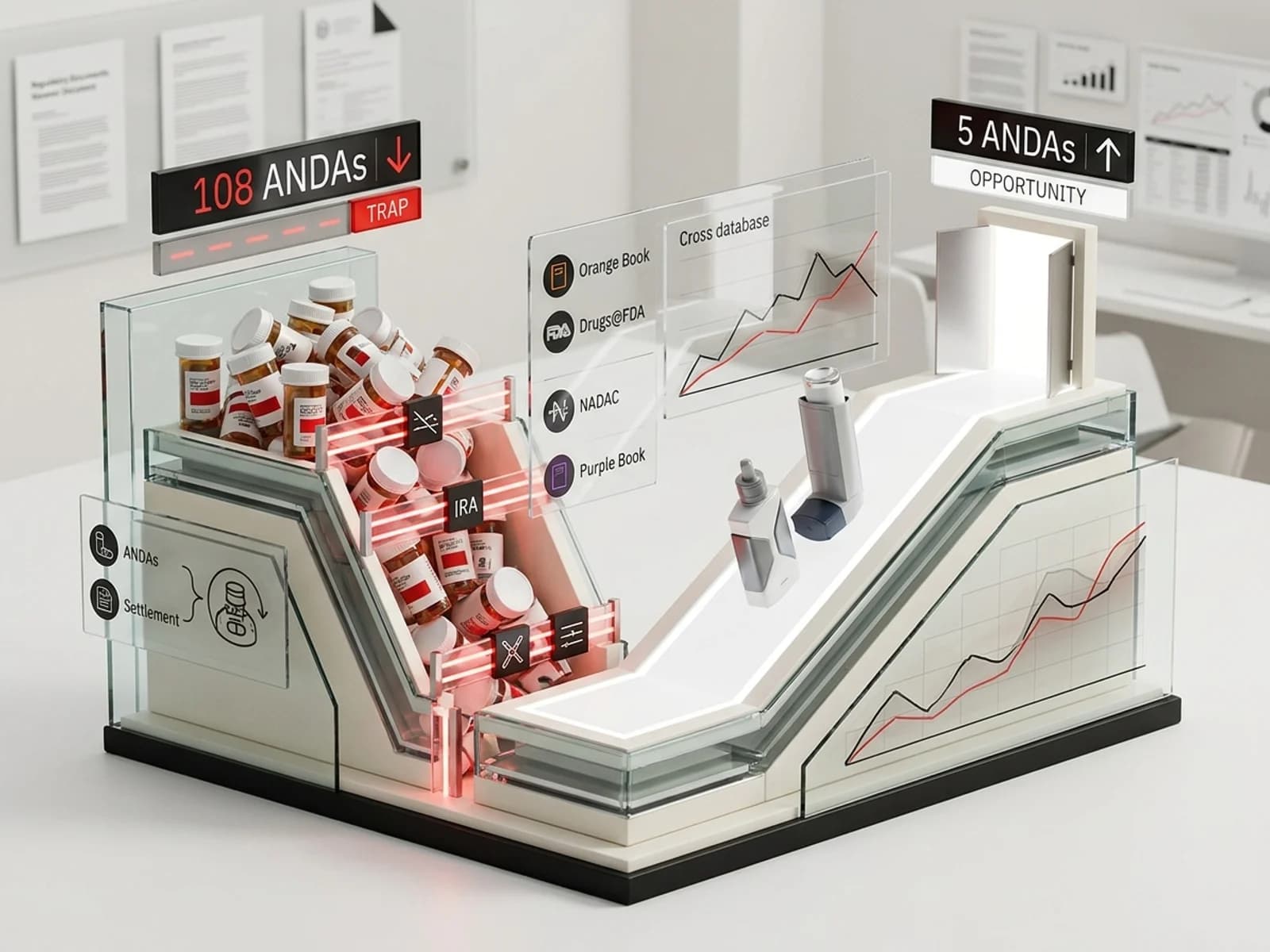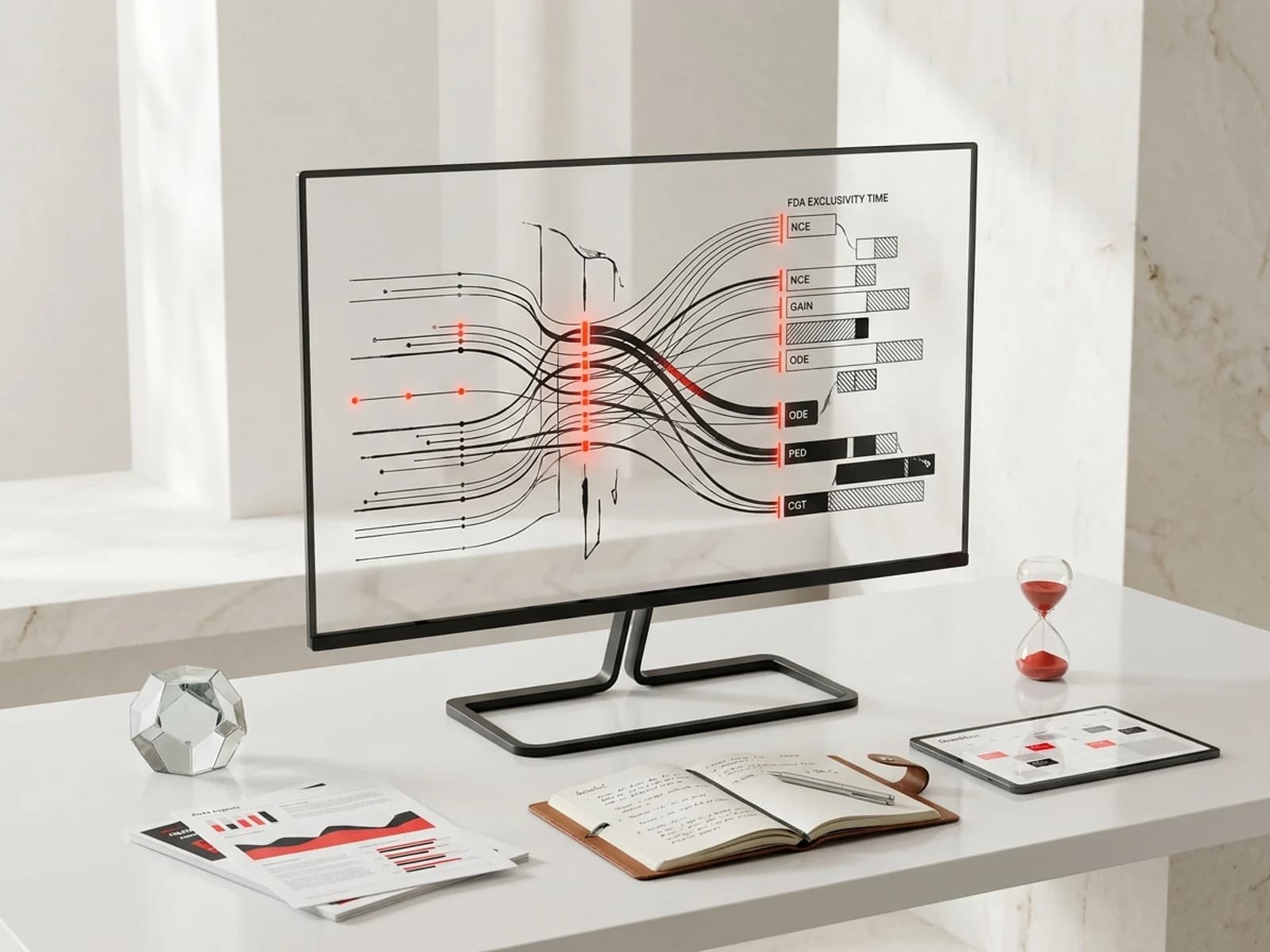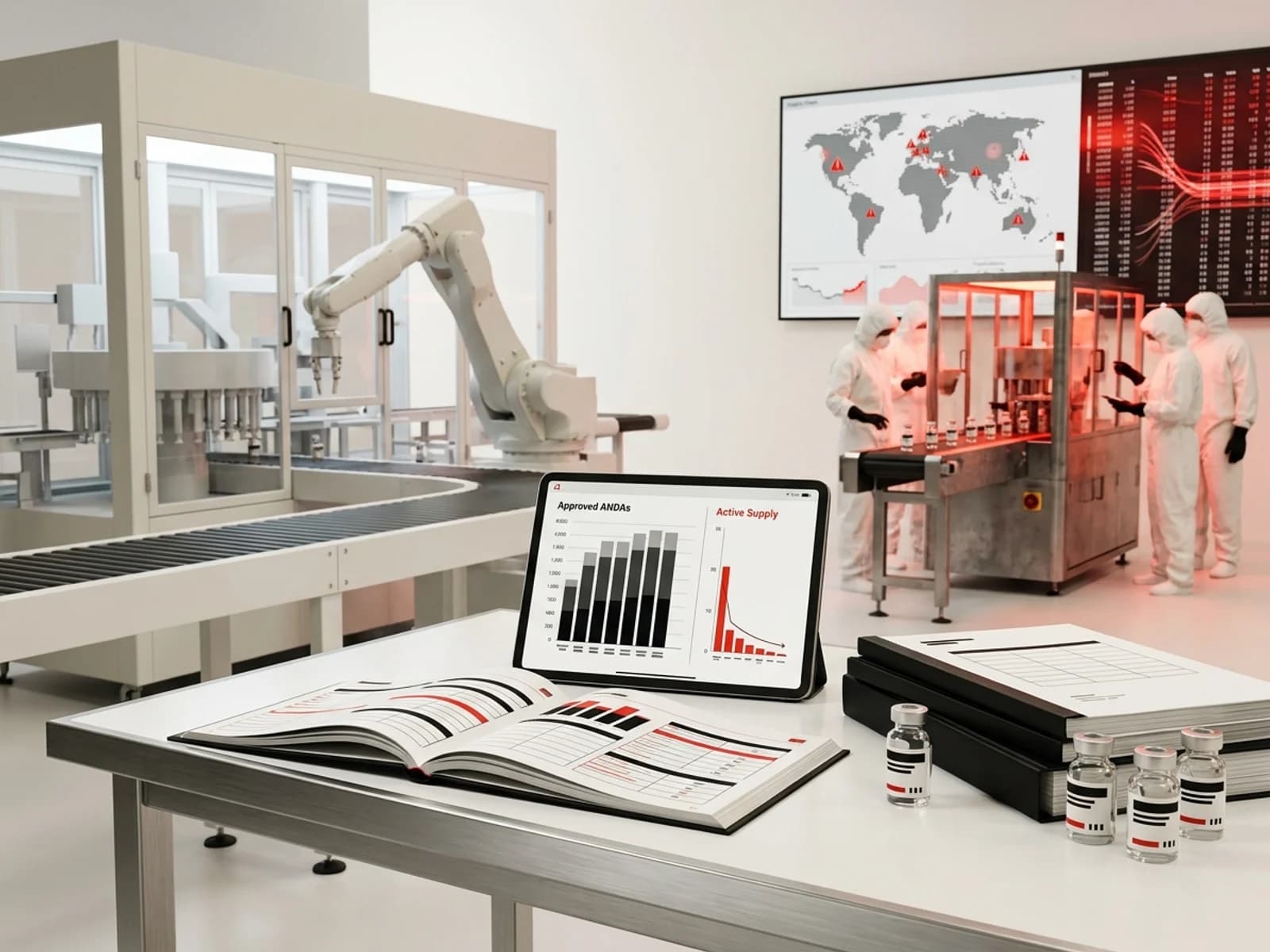
Generic manufacturers, sterile-injectable Contract Development and Manufacturing Organizations (CDMOs), supply-chain directors, and health-system pharmacy leaders face a persistent paradox in the U.S. pharmaceutical market: some of the most critical, longest-duration drug shortages occur in molecules that already have dozens, or even hundreds, of approved generic applications.
For commercial strategy teams, the prevailing assumption that a drug shortage represents an opportunity to file a new Abbreviated New Drug Application (ANDA) is frequently incorrect. In the sterile-injectable market, the rate-limiting barrier is rarely a lack of regulatory approvals. Instead, the bottleneck resides in sterile manufacturing capacity, quality control compliance, and low-margin reimbursement economics. Entering these markets by simply filing another ANDA is a commercial error that adds to the approval backlog without addressing the root cause of the shortage.
This analysis cross-references the live FDA Drug Shortages database (export dated July 9, 2026) with the FDA Drugs@FDA database and CMS National Average Drug Acquisition Cost (NADAC) registry (July 8, 2026). The data establishes that the true commercial entry opportunity sits in acquiring, upgrading, or scaling sterile-manufacturing capacity—not in filing redundant ANDAs—and identifies the rare thin-approval molecules where a new filing remains a viable route.
Why the worst shortages have the most generics: the capacity-vs-approval proof
The structural divergence between drug approvals and active manufacturing is most visible in the sterile-injectable segment. A review of the FDA shortages dataset shows that the worst-offending molecules—those with multi-year shortages and acute clinical demand—possess highly saturated ANDA pipelines.
Saturated approval fields with minimal active supply
Under standard economic theory, a drug with 50 or more approved generic applications should have a highly resilient supply chain. If one manufacturer encounters a quality issue, others should scale up to fill the gap. In practice, the opposite is true for low-margin sterile injectables.
Epinephrine Injection: The Drugs@FDA database contains 67 approved ANDA products spanning 25 distinct sponsors. Yet, epinephrine has been in a rolling, active FDA shortage for 9.7 years. Only two manufacturers are actively supplying the U.S. health-system market with the clinical vial presentations.
Fentanyl Injection: There are 98 approved ANDA products from 19 distinct sponsors in the database. Despite this deep approval field, fentanyl has been in an active shortage for 14.5 years, with only three active producers supplying the market.
Morphine Sulfate Injection: This clinical staple has 153 approved ANDA products from 32 distinct sponsors, yet health systems face perpetual allocation limits and shortages.
Cefazolin Injection: Cefazolin has 74 approved ANDAs from 20 distinct sponsors, yet remains in rolling shortage.
Metronidazole Injection: There are 80 approved ANDA products from 41 distinct sponsors, with only three active manufacturers supplying.
This data proves that filing the 68th epinephrine ANDA or the 99th fentanyl ANDA will do nothing to resolve the shortage. The approved applications represent "paper generics"—registrations that are either inactive, held by sponsors without manufacturing lines, or economically unviable to produce at current reimbursement rates. The real constraint is the lack of active, GMP-compliant sterile-injectable manufacturing lines.
GPO bidding wars and the sole-source trap
The primary driver of this approval-production gap is the procurement structure of U.S. hospitals. Group Purchasing Organizations (GPOs) aggregate purchase volume for thousands of hospitals and negotiate national contracts with generic manufacturers. To secure the lowest possible price, GPOs frequently award "sole-source" or "dual-source" contracts.
When a manufacturer wins a sole-source GPO contract for a sterile injectable, it captures massive volume but at a razor-thin profit margin. The losing manufacturers, unable to sell their products without GPO contract placement, quietly shut down their production lines or exit the molecule entirely, keeping their ANDA registrations on paper but manufacturing zero vials.
If the sole-source contract winner subsequently encounters a quality failure at its plant, the entire U.S. hospital system loses its supply. The losing manufacturers cannot simply turn their lines back on; re-starting a sterile fill-finish line requires clearing lines, running validation batches, conducting media fills, and obtaining FDA clearance, a process that takes 6 to 18 months. Consequently, the shortage persists for years despite dozens of theoretically approved suppliers.
The opportunity ledger: duration, maker count, and clinical demand for the top entrenched-shortage molecules
To guide CDMOs and generic sponsors toward the most viable capacity-entry opportunities, we have analyzed the 1,152 active shortages in the FDA database. A total of 26 base ingredients meet our criteria for "entrenched shortage": having 3 or fewer active producers and a median shortage duration of at least 1.5 years.
Epinephrine, fentanyl, and the critical-care cohort
Critical-care and anesthesia agents represent the most commercially stable targets for capacity entry. Because these products are administered in hospital and emergency settings, demand is inelastic.
The shortage duration metrics are striking:
Fentanyl (14.5 years): This represents a permanent market failure. The shortage is sustained by DEA quota allocations, low margins, and the extreme complexity of manufacturing controlled substances under sterile conditions.
Cefotaxime (11.4 years): With only 2 active producers and 30 approved ANDAs, the market has ceased to function competitively. Cefotaxime is a broad-spectrum cephalosporin that has been largely replaced in clinical practice by ceftriaxone, but it remains critical for specific pediatric and neonatal indications.
Dopamine & Dobutamine (8.7 years): These vasoactive agents have 3 active producers each. They are critical for managing cardiogenic shock and heart failure, and their shortages require clinicians to use high-risk compounding alternatives.
The Actionable Opportunity: For a CDMO or generic sponsor with open sterile fill-finish capacity, these molecules represent a guaranteed volume opportunity. Health systems are willing to pay a premium for supply-guaranteed contracts (such as those offered by Civica Rx) to bypass the traditional wholesaling channel. Entering this segment does not require developing new intellectual property; it requires securing a reliable supply of API and dedicating line time to a high-demand, low-margin molecule.
Regulatory Inspections, Warning Letters, and Quality Exits
The physical exit of approved manufacturers from the sterile injectable market is almost always preceded by regulatory enforcement actions. The FDA's Center for Drug Evaluation and Research (CDER) inspects manufacturing sites under a risk-based surveillance model, assessing compliance with Current Good Manufacturing Practice (cGMP) regulations codified at 21 CFR Parts 210 and 211.
For sterile injectables, the standards are exceptionally high due to the lack of physiological barriers; any particulate or microbiological contamination introduced directly into the bloodstream bypasses the body's natural defenses, posing immediate life-threatening risks of sepsis or embolism.
Warning Letter triggers in aseptic processing
A review of FDA warning letters issued to sterile injectable manufacturing plants reveals several recurring compliance failures:
Aseptic Simulation (Media Fill) Failures: Manufacturers must periodically run culture media through the filling lines to prove that their systems can operate without contamination. Finding even one contaminated vial in a run of 5,000 indicates a systemic cleanroom failure, requiring a complete halt to commercial production.
Inadequate Investigation of Sterility Failures (OOS): If a commercial batch fails sterility testing (Out-of-Specification), the manufacturer must conduct a thorough root-cause investigation. The FDA frequently issues warning letters when plants perform superficial investigations, attributing contamination to "operator error" rather than systemic mechanical or environmental issues, and attempt to re-test the batch to obtain a passing result.
Clean Utility System Excursions: Water-for-Injection (WFI) systems, which supply the water used to formulate injectables and wash vials, must be monitored daily for microbial levels and endotoxins. Recurrent biofilms or endotoxin spikes in the WFI loop will trigger a facility-wide shutdown.
Airflow Disruption and HEPA Failures: Aseptic filling must occur under unidirectional Grade A laminar airflow. Airflow visualization studies (smoke studies) must prove that there is no turbulent airflow or "air sweeps" from lower-grade areas (Grade B or C) into the critical filling zone. If HEPA filters are damaged or smoke studies are poorly executed, the FDA will issue warning letters.
When a plant receives a warning letter, it faces a grim economic choice. Remediation—upgrading HEPA systems, installing isolator barriers, and retutoring operators—can cost tens of millions of dollars and require shutting down the facility for a year or more. For low-margin products like cefazolin or metronidazole, sponsors often decide to discontinue production rather than fund the remediation, leading to immediate quality exits and driving the market into shortage.
The thin-approval exceptions: valproate, sufentanil, hydroxocobalamin and where an ANDA is still the move
While most shortages are capacity-driven, there is a small, high-value subset of molecules where the approved ANDA pipeline is genuinely thin. In these cases, filing an ANDA is still the correct strategic move, as the regulatory barrier itself remains intact.
Valproate Sodium Injection
Valproate sodium injection (indicated for status epilepticus and severe seizures) is in an active shortage with a 5.5-year median duration. Unlike epinephrine, the approved pipeline is thin: there are only 4 approved ANDA products from 4 distinct sponsors.
The shortage is driven by a combination of API shortages and manufacturing quality issues at the primary site. Because the approval field is not saturated, a generic developer who files an ANDA and secures approval can capture a significant portion of the market with only three other competitors.
Sufentanil Citrate Injection
Sufentanil is a high-potency opioid used in surgical anesthesia and epidural administration. It has been in shortage for 4.2 years, and the pipeline consists of only 3 approved ANDA products from 3 distinct sponsors.
As a controlled substance, the barrier is dual: securing DEA manufacturing quotas and navigating sterile-injectable manufacturing. For sponsors with experience in controlled substances, sufentanil represents an exceptionally high-value, thin-pipeline opportunity.
Hydroxocobalamin Injection
Hydroxocobalamin (used as an antidote for cyanide poisoning and for severe vitamin B12 deficiency) has been in shortage for 1.7 years. The database shows only 5 approved ANDA products from 5 distinct sponsors.
The low competitor count, combined with its role as a critical emergency antidote, makes hydroxocobalamin an attractive target for niche generic developers. Payer reimbursement is stable, and emergency stockpiling contracts from state and federal agencies provide a reliable revenue floor. The primary barrier here is sourcing the cobalt-containing raw materials and executing the sterile crystallization process without introducing heavy metal impurities.
API Sourcing Vulnerabilities and Geopolitical Supply Chain Risks
The vulnerability of the sterile-injectable market is not limited to finished product fill-finish sites; it extends deep into the active pharmaceutical ingredient (API) supply chain.
Extreme concentration in India and China
FDA, ASPE, and USP analyses of the sterile-injectable API supply chain consistently find that active pharmaceutical ingredient manufacturing for these molecules is concentrated in a limited number of facilities in India and China. Published supply-chain reviews (including FDA- and ASPE-commissioned work) attribute a large share of sterile-injectable API capacity to Indian and Chinese plants, and emphasize that for specific molecules — including sterile oncology agents (such as cisplatin, carboplatin, and methotrexate) and the beta-lactam penicillins — only a handful of qualified API suppliers serve the U.S. market.
Two structural facts make this concentration a recurring shortage driver:
Oncology APIs: The sterile API for key platinum salts and antifolates is supplied by a small number of plants, so a single quality failure or Import Alert can cut national supply. The 2022–2023 cisplatin and carboplatin shortages traced directly to a Quality issue at one Intas (India) facility that produced a major share of those APIs.
Beta-Lactam Antibiotics: The synthesis of sterile penicillins and cephalosporins requires dedicated, isolated manufacturing buildings to prevent cross-contamination (which poses severe allergic-reaction risks), which structurally limits how many sites can economically produce them and leaves the category with few qualified suppliers.
The Import Alert threat
When the FDA inspects a foreign API chemical plant and issues an Import Alert (under which customs agents can seize all imports from that site without physical examination), the downstream impact on the U.S. drug supply is catastrophic. If the U.S. finished-product sponsor has only listed that foreign plant in its ANDA's Module 3 Chemistry, Manufacturing, and Controls (CMC) section, the sponsor must halt all manufacturing immediately.
To resolve the blockade, the sponsor must submit a Prior Approval Supplement (PAS) to add a new API manufacturer. Under FDA GDUFA review timelines, approving a PAS for a new API source takes 4 to 6 months if the new facility has a clean inspection history, and up to 10 months if the FDA must perform an on-site inspection of the new API plant. This regulatory lead time ensures that any API-level disruption triggers a multi-month finished product shortage.
Economics of sterile injectables: NADAC unit prices, margins, and why manufacturers exit
The root cause of the sterile-injectable crisis is economic. Branded drugs lose patent protection, generic sponsors flood the market with ANDA filings, and buying consortia (GPOs) compress the generic acquisition cost to the floor. Once the price reaches a certain level, manufacturers can no longer afford to reinvest in facility maintenance, leading to quality failures, FDA warning letters, and facility shutdowns.
The NADAC price compression proof
A review of the CMS NADAC registry (July 2026) shows the extreme price compression that drives manufacturers out of the market:
Generic Cefazolin Injection: The NADAC acquisition cost for a 1g vial is $0.97442. This sub-dollar price must cover the API synthesis, sterile vial filling, labeling, serialization, shipping, and distributor margin.
Generic Fentanyl Injection: A 100mcg/2mL vial runs $1.27269 in NADAC.
Generic Epinephrine Injection (Vial): The generic API vial is priced at pennies per unit, whereas the generic 0.15mg auto-injector (EpiPen-class) is priced at $127.83215 per unit. The price difference is entirely driven by the device component, illustrating why manufacturers prefer to allocate sterile lines to complex device products rather than simple clinical vials.
Generic Valproic Acid: A 250mg capsule runs $0.23790 in NADAC.
The vicious cycle of facility abandonment
At these sub-dollar price points, generic manufacturers operate on razor-thin margins. When a facility receives an FDA Form 483 with significant observations (e.g., particulate contamination, sterile barrier failures), the cost to remediate the facility often exceeds the projected lifetime cash flow of the molecules produced there.
Rather than spend $20 million to upgrade a line producing $0.97 cefazolin, manufacturers choose to exit the molecule or shut down the facility entirely. This triggers an immediate supply contraction, leaving the remaining 1 or 2 active producers unable to scale up, resulting in a multi-year shortage.
The engineering barriers of sterile fill-finish
Sterile injectable manufacturing is the most technically demanding discipline in pharmaceutical engineering. The FDA requires strict adherence to cGMP guidelines for sterile products:
Aseptic Processing: Unlike oral tablets which can be terminal-sterilized or manufactured under standard cleanroom conditions, many sterile injectables cannot tolerate heat sterilization (autoclaving) without degrading the active molecule. They must be manufactured using sterile filtration and aseptic filling.
Cleanroom Environments: Filling lines must operate under Grade A laminar flow conditions within a Grade B background cleanroom. Operators must wear sterile, particulate-free garments and follow strict sanitization protocols.
Isolator Technology: Modern manufacturing has shifted from traditional open cleanrooms to Restricted Access Barrier Systems (RABS) and closed isolators. Isolators separate the manufacturing line from the human operators entirely, sterilizing the interior using vaporized hydrogen peroxide (VHP). Standing up these lines is extremely capital intensive: a single high-speed isolator filling line can exceed $25 million in equipment costs alone, excluding facility installation and validation.
Media Fills: To validate a line, the manufacturer must run thousands of vials of liquid culture media (broth) through the filling line without introducing a single microorganism. A single contaminated vial fails the media fill validation, requiring the manufacturer to shut down the line, investigate the cause, and repeat the entire validation process.
Entry pathways: capacity build/buy vs. FDA importation (the 53 importable equivalents) vs. compounding
For generic sponsors and CDMOs looking to capture the market share left open by these shortages, four distinct entry pathways exist, each with its own regulatory and capital profiles.
Comparison of Shortage Entry Pathways
| Pathway | Capital Cost | Time-to-Market | Regulatory Risk | Market Scope | Revenue Durability |
|---|---|---|---|---|---|
| Build Modular Capacity | Very High (~$25M+) | 12–18 Months | Moderate | Full U.S. Commercial | High (Permanent asset) |
| Acquire Distressed Plant | High (~$10–20M) | 6–12 Months | High (Remediation) | Full U.S. Commercial | High (Permanent asset) |
| FDA Temp Importation | Low (<$500K) | 2–4 Months | Low | U.S. Hospital / GPO | Low (Temporary authority) |
| 503B Compounding | Low (<$1M) | Immediate | Moderate | Direct to Hospital | Low (Sunsets when shortage ends) |
1. The Build/Buy Capacity Path (Long-term)
The most capital-intensive but sustainable pathway is acquiring distressed sterile-injectable facilities or building new modular fill-finish lines.
The Buy Strategy: Several distressed generic facilities have been sold or liquidated. Acquiring these facilities allows a CDMO to bypass the 2-year construction timeline, but requires significant capital to remediate outstanding FDA warning letters and Form 483 observations.
The Modular Build Strategy: Utilizing pre-fabricated, isolator-based modular cleanrooms allows sponsors to stand up fill-finish capacity in under 12 months. By focusing on highly automated, small-batch isolator lines, developers can switch between different shortage molecules (e.g., fentanyl, epinephrine, and cefazolin) with minimal downtime.
2. FDA Temporary Importation (Short-to-Medium term)
During acute shortages, the FDA can exercise enforcement discretion under Section 801(d)(1)(B) of the FD&C Act to permit the temporary importation of foreign-approved equivalents from well-regulated jurisdictions (e.g., EMA, Health Canada, TGA Australia).
A 2025 analysis of shortage data showed that of 125 off-patent sterile injectables in shortage, 53 had importable equivalents in well-regulated markets.
The FDA has authorized at least 21 temporary importation actions for sterile injectables since 2017.
The Actionable Opportunity: For international manufacturers with EMA-approved sterile lines, partnering with a U.S. distributor to secure temporary FDA importation clearance is the fastest route to market. It bypasses the standard 30-month ANDA approval review and provides immediate volume, though the importation authority sunsets once the domestic shortage is resolved.
3. The 503B Compounding Route (Immediate)
Under the 2013 Drug Quality and Security Act (DQSA), 503B outsourcing facilities are permitted to compound copies of FDA-approved drugs that appear on the official FDA Drug Shortages list.
Compounding pharmacies do not need approved ANDAs to manufacture these drugs, and they are exempt from standard labeling and serialization requirements.
The Actionable Opportunity: 503B compounding has become a major competitor to traditional generic manufacturers, capturing significant hospital volume for pre-filled syringes of anesthesia and critical care agents (e.g., fentanyl, morphine, and epinephrine syringes). However, this route is highly vulnerable: once the FDA declares a shortage resolved, 503B facilities must immediately stop compounding that drug, making it a highly volatile long-term business model.
Case Study: The Bicillin-LA (benzathine penicillin G) Shortage
The benzathine penicillin G shortage of 2023–2024 serves as a textbook example of the capacity-vs-approval crisis and the regulatory pathways used to resolve it. Benzathine penicillin G is the gold standard, and often the only approved, treatment for syphilis (particularly in pregnant women to prevent congenital transmission).
The Single-Source Manufacturing Failure
In the Drugs@FDA database, penicillin G benzathine has a deep approval field spanning numerous distinct sponsors. However, in the physical market, Pfizer is the sole-source manufacturer supplying the U.S. market under the brand name Bicillin L-A.
The FDA dates the Bicillin L-A shortage to April 26, 2023, when demand for syphilis treatment outpaced supply. The failure was not due to regulatory changes or patent extensions; it was a physical capacity issue. Pfizer's dedicated sterile manufacturing facility could not keep pace, and a surge in syphilis infection rates (congenital syphilis rates have risen sharply) depleted inventory. Because the other approved sponsors had inactive production lines, they could not scale up to fill the supply gap.
The Importation Resolution
To prevent congenital syphilis deaths, the FDA used its temporary importation authority under FD&C Act Section 801(d)(1)(B). Beginning in 2023, the FDA first authorized temporary importation of Extencilline (a French penicillin G benzathine product), followed in 2024 by Lentocilin (penicillin G benzathine injectable suspension) manufactured by Atral, a Portuguese pharmaceutical company, distributed in the U.S. through the Mark Cuban Cost Plus Drug Company. Neither product held a U.S. approval.
This temporary importation bypassed the ANDA approval queue, allowing Atral to capture U.S. market share within weeks of listing. But the importation authority is strictly bounded: it remains in force only while the domestic shortage is unresolved. As of early 2026 the Bicillin L-A shortage was still active (FDA's projected recovery stretched into the second half of 2026), and Lentocilin continued to be imported to fill the gap — illustrating both the speed and market impact of the importation pathway, and its dependence on a still-open shortage that can close at any time.
Hospital Pharmacy Mitigation Workflows and Clinical Risks
When critical sterile injectables fall into shortage, health-system pharmacists and clinicians must implement complex mitigation workflows to preserve patient safety. These workflows are guided by guidelines from the American Society of Health-System Pharmacists (ASHP) and the Institute for Safe Medication Practices (ISMP).
The administrative burden of hospital pharmacy workarounds
To stretch a limited supply of sterile injectables, hospital pharmacy buyers must execute a sequence of workarounds:
Therapeutic Class Substitution: If cefazolin is unavailable, the pharmacy must work with the Pharmacy and Therapeutics (P&T) committee to modify electronic health record (EHR) order sets, substituting alternative cephalosporins (e.g., cefuroxime or ceftriaxone) for surgical prophylaxis. This requires updating order entry systems, retraining nursing staff, and modifying barcoded medication administration (BCMA) systems to prevent dispensing errors.
Conservation and Allocation Protocols: The pharmacy restricts the shortage drug to specific patient subgroups (e.g., reserving epinephrine for cardiac arrest teams and requiring anesthesiologists to use phenylephrine for routine surgical hypotension).
Vial-Splitting and Aseptic Compounding: Instead of using single-dose vials for single patients (where any residual drug is discarded), pharmacists will split larger multi-dose vials under Grade A laminar flow hoods to compound multiple patient-specific syringes. This process, while necessary to conserve supply, increases the risk of contamination and medication errors.
Medication errors and clinical consequences
Substituting drugs or altering concentrations during shortages introduces severe patient safety risks. The ISMP has documented numerous medication errors directly associated with drug shortages:
Concentration Mismatches: If a hospital substitutes fentanyl 10mcg/mL bags with 50mcg/mL bags due to availability, nurses accustomed to the lower concentration may inadvertently administer a 5-fold overdose.
Look-Alike Packaging: When hospitals purchase imported equivalents (such as Lentocilin during the penicillin shortage), the packaging and labeling are in different languages and formats, bypassing the nurses' visual recognition of standard warning labels.
Smart-Pump Programming Gaps: Smart infusion pumps utilize pre-set drug libraries to prevent dosing errors. When a shortage forces the pharmacy to purchase a different concentration or a substitute drug, the pumps' programming must be updated manually. If a nurse administers the new drug before the pump library is updated, the pump's safety overrides are deactivated.
Sponsors who can offer supply-guaranteed contracts directly to hospital consortia can capture high market share by positioning themselves as the safety-enhancing alternative to these high-risk workarounds.
The CARES Act Risk Management Mandate
In response to these rolling facility failures, the federal government has implemented new risk management mandates for generic manufacturers. Section 3112 of the Coronavirus Aid, Relief, and Economic Security (CARES) Act amended the FD&C Act to require all manufacturers of critical drugs (including sterile injectables) to develop and maintain redundant Active Pharmaceutical Ingredient (API) sourcing and Risk Management Plans (RMPs).
Under these regulations, sterile-injectable sponsors must:
Establish backup suppliers for critical raw materials and APIs.
Conduct annual vulnerability assessments of their cleanrooms, clean utility systems (Water-for-Injection and clean steam), and supply chain logistics.
Provide the FDA with immediate notification of any production disruption that could lead to a supply shortage.
While these mandates increase the administrative burden on generic sponsors, they represent a significant quality differentiator for CDMOs. Sponsors who can demonstrate a fully redundant supply chain and a validated RMP are increasingly preferred by GPOs and health-system networks, even when their unit prices are slightly higher than single-source competitors.
FAQ
If a drug is in shortage, doesn't that mean there aren't enough generics?
No. In the sterile-injectable market, the worst shortages occur in drugs with dozens of approved generics. For example, fentanyl has 98 approved ANDAs but has been in shortage for 14.5 years. The shortage is caused by a lack of active, GMP-compliant manufacturing capacity and low profit margins, which lead approved manufacturers to stop producing the drug.
Which shortages are a genuine ANDA-filing opportunity?
A genuine ANDA-filing opportunity exists only where the approved competitor count is low (typically under 8 sponsors). In the 2026 shortage cohort, valproate sodium injection (4 ANDAs), sufentanil citrate injection (3 ANDAs), and hydroxocobalamin injection (5 ANDAs) are the primary examples. For these molecules, a new filing can capture market share without immediately triggering a price war.
Why do manufacturers exit sterile injectables even when dozens of ANDAs are already approved?
Generic prices are driven down by purchasing consortia to extremely low levels (e.g., cefazolin at $0.97 per vial). At these prices, manufacturers cannot afford the high cost of facility upgrades and compliance audits. When an FDA audit reveals quality issues, manufacturers choose to discontinue the product rather than invest millions of dollars to remediate a low-margin line.
Sources
FDA Drug Shortages Database: Live database extract dated July 9, 2026. Used for active shortage statuses, initial posting dates, and active manufacturer reporting. FDA Drug Shortages Portal
FDA Drugs@FDA Database: July 9, 2026 export. Source for ANDA application counts, sponsor counts, and product active ingredient listings. openFDA Drugs@FDA Portal
CMS National Average Drug Acquisition Cost (NADAC): July 8, 2026 registry. Source for generic unit price acquisition costs (cefazolin 1g vial ~$0.97442, fentanyl 100mcg/2mL vial ~$1.27269, epinephrine auto-injector ~$127.83215). Medicaid.gov NADAC Portal
NCBI Bookshelf (NBK611681): FDA-commissioned Drug Shortage Analysis (2018–2023). Reference for historical drug shortage duration, dosage-form distribution, and resolution rates. NCBI Bookshelf
HHS ASPE (Office of the Assistant Secretary for Planning and Evaluation): "Economic Analysis of the Causes of Drug Shortages" (2011/2023 update). Reference for the economic analysis of sterile-injectable low margins and facility exits. HHS ASPE Portal
Think Global Health: "Importing Generic Drugs Could Ease U.S. Shortages" (2025). Used for statistics on off-patent sterile injectables in shortage (125 total, 81 with <=3 makers, 53 with importable equivalents). Think Global Health
Springer Drug Safety 2026: "US REMS with ETASU: A Longitudinal Analysis of REMS Modifications (2008–2022)". Reference for program counts and dashboard statistics. Springer Link