The FDA Drug Shortages database lists 222 presentations under Schedule II ADHD stimulants — amphetamine mixed salts, methylphenidate, lisdexamfetamine, and their salts — and every single one is tagged status = Current (run date June 10, 2026). Of those 222 records, 75 — roughly 34 percent — are not fully available right now: 25 are listed as Unavailable and 50 as Limited Availability. Three molecule families account for all of them, across 24 distinct manufacturers, and the disruption is not new: the median record was first posted 1,067 days ago, every one of the 222 records is more than a year old, and 218 are more than two years old. The newest posting on the list dates to February 2025 — meaning nothing has freshly entered this shortage set in over a year, even as the underlying listings persist.
This is a narrow read of the controlled-substance stimulant segment of the FDA Drug Shortages database, written for retail and specialty pharmacy operations, payer pharmacy-benefit teams, employer-plan designers, and prescribers who model stimulant-access risk for ADHD patients. Every figure is computed from the public FDA Drug Shortages list, run date June 10, 2026. For the database-wide shortage picture, see the companion FDA drug shortage analysis; for the injectable sub-segments, see anesthesia injectables and cisplatin and carboplatin. This article stays on oral Schedule II stimulants, which are unlike those injectable shortages in one structural respect: their binding constraint is a federal production quota, not sterile-manufacturing capacity.
Methodology, in one paragraph
The source is the FDA Drug Shortages dataset (openFDA /drug/shortages endpoint), run date June 10, 2026, 1,680 records total. A "record" is a single package-level NDC presentation (one company, one strength, one package) on the shortage list — not one drug. I filtered to records whose generic_name names an ADHD stimulant active ingredient (amphetamine, methylphenidate, lisdexamfetamine, dextroamphetamine, dexmethylphenidate), excluding methamphetamine products, and then grouped them into three molecule families. All 222 records carry therapeutic_category = Psychiatry and status = Current; none are Resolved. "Not fully available" combines the Unavailable and Limited Availability availability values; one record with a typo'd availability field ("Avaliable") is read as Available. Durations are computed from each record's initial_posting_date through June 15, 2026. Molecule families follow the active-ingredient name rather than the brand, so Takeda's branded Vyvanse and its 14-plus generics both roll up under lisdexamfetamine.
The stimulant segment at a glance
Unlike the anesthesia and oncology injectable segments, which are dominated by sterile-injected generic molecules, the stimulant shortage is entirely oral — tablets, capsules, chewable tablets, and one extended-release film — and it is entirely Schedule II controlled substance. The dosage-form distribution reflects that:
| Dosage form | Records |
|---|---|
| Tablet (mostly extended-release) | 110 |
| Capsule | 90 |
| Tablet, chewable | 18 |
| Film, extended release | 4 |
All 222 records sit in the Psychiatry therapeutic category, and all are current. The segment spans three molecule families and 24 distinct companies — a far more fragmented supply base than the two-company concentration that dominates the anesthesia injectable shortage, which is itself a clue that the binding constraint here is upstream of the finished-dose manufacturer.
What is unavailable today, by molecule family
| Molecule family | Presentations on list | Not fully available | Share unavailable/limited | Companies |
|---|---|---|---|---|
| Lisdexamfetamine (Vyvanse and generics) | 108 | 31 | 29% | 14 |
| Amphetamine mixed salts (Adderall and generics) | 73 | 28 | 38% | 11 |
| Methylphenidate (Ritalin, Concerta, generics) | 41 | 16 | 39% | 8 |
| Total | 222 | 75 | 34% | 24 |
Three observations follow. First, lisdexamfetamine has the deepest shortage by raw record count (108 presentations, 31 not fully available), a direct consequence of the August 2023 Vyvanse patent expiry that let 14 manufacturers launch generics simultaneously onto a quota base sized for a single supplier. Second, the hardest-hit families by proportion are amphetamine mixed salts (38% not fully available) and methylphenidate (39%), the two oldest molecules — meaning the problem is not concentrated in the newest entrant. Third, the company base is fragmented: Teva (25 records), Lannett (18), Sun Pharma (17), SpecGx (16), Elite Laboratories (14), Takeda (13), Alvogen (12), and Vertical Pharmaceuticals (11) lead, but no single company dominates the way Fresenius Kabi and Hospira/Pfizer dominate the anesthesia injectable shortage.
Why the shortage reason field points straight at the quota
The shortage_reason field is unevenly populated, but where FDA attributes a cause, the signal is unusually concentrated — and it names a constraint the injectable shortage articles do not have:
| Shortage reason (FDA-coded) | Records |
|---|---|
| Shortage of an active ingredient | 48 |
| Demand increase for the drug | 13 |
| Discontinuation of the manufacture of the drug | 7 |
| GMP / manufacturing compliance | 3 |
| Other | 3 |
| Delay in shipping | 1 |
"Shortage of an active ingredient" is the single most-cited reason, at 48 records — and for Schedule II stimulants that active ingredient is, by law, supply-constrained upstream by the DEA's annual Aggregate Production Quota (APQ) for amphetamine, methylphenidate, and lisdexamfetamine. Under the Controlled Substances Act the DEA sets an APQ each year for every Schedule II substance; once manufacturers exhaust their individual quotas they cannot make more product, even during a declared shortage. That regulatory layer is why a shortage with 24 manufacturers and no sterile-manufacturing bottleneck still fails to clear: the relief valve is not idle factory capacity, it is a federal production cap calibrated to prior-year consumption.
The duration problem: this shortage is old
The most striking feature of the stimulant shortage set is its age. The Adderall shortage was formally announced by the FDA on October 12, 2022 after Teva manufacturing delays, and the record-level data shows how that single event cascaded:
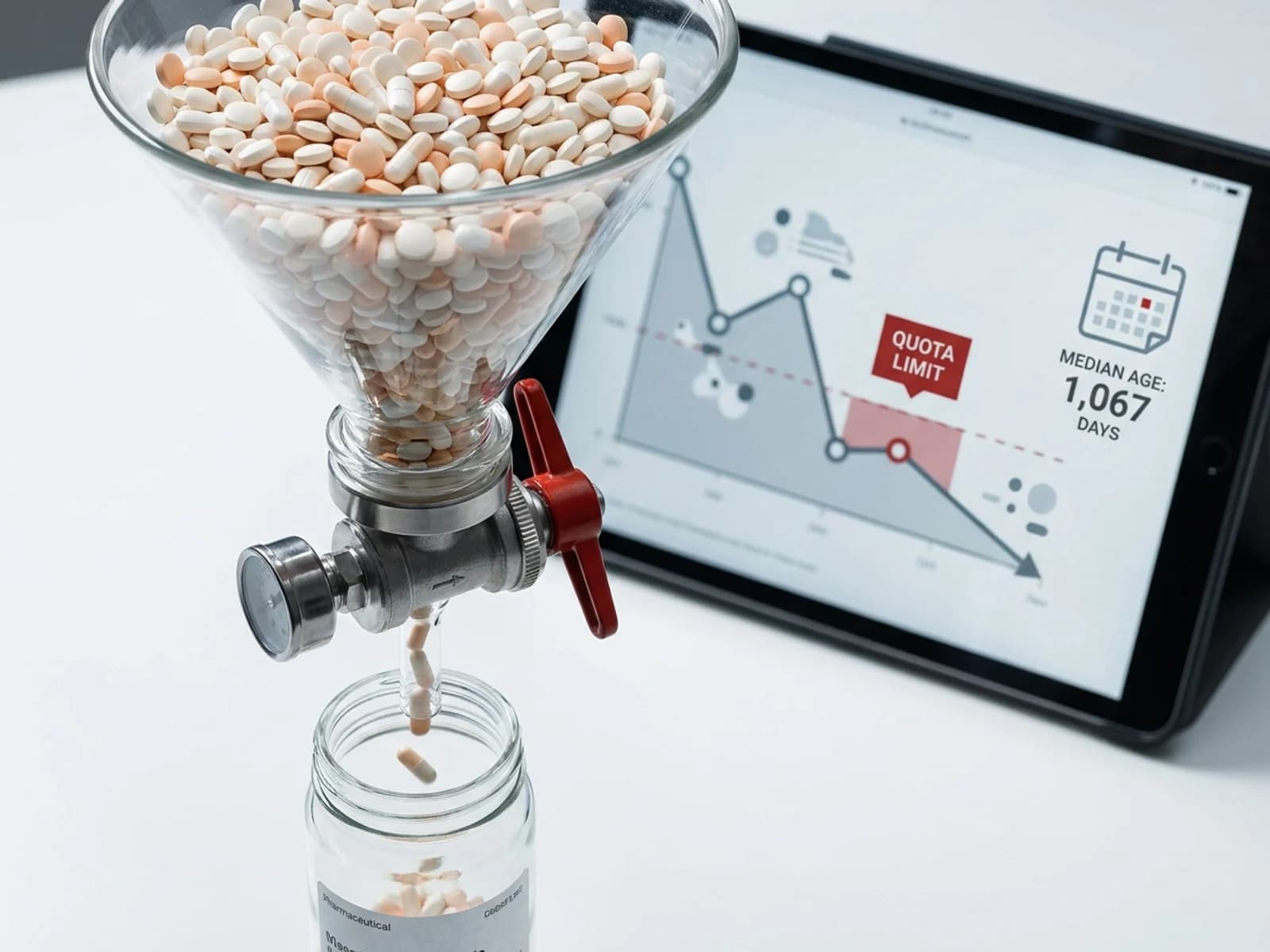
Median age of a record: 1,067 days (about 2.9 years)
Mean age: 1,138 days (about 3.1 years)
Records more than 1 year old: 222 of 222 (all of them)
Records more than 2 years old: 218 of 222
Oldest active record: first posted October 12, 2022
Newest active record: first posted February 28, 2025
Bucketed by initial posting year, 72 records entered the list in 2022, 145 in 2023, only 1 in 2024, and 4 in 2025. The 2023 spike is the cascade: the October 2022 Adderall disruption pushed demand onto lisdexamfetamine just as Vyvanse lost exclusivity and 14 generics launched, and the August 1, 2023 FDA–DEA joint letter on prescription stimulant shortages formalized the class-wide problem. Nothing has meaningfully entered the set since — which means the current listings are not fresh 2026 disruptions but the same structural deficit the field has been navigating since late 2022.
Why these shortages do not clear — and what has moved
The quota constraint has been loosened, but slowly and incompletely. The timeline of federal action tracks the data:
September 5, 2024: the DEA raised the lisdexamfetamine and d-amphetamine (for conversion) APQs by roughly 24%, acting on a July 12, 2024 FDA letter that formally identified "shortage of an active ingredient" as the reason for the lisdexamfetamine shortage under the 21 U.S.C. 356c notification framework.
June 13, 2024: the CDC issued Health Advisory HAN-00510 warning that disrupted stimulant access could increase injury and overdose risk.
September 19 and October 2, 2025: the DEA raised the lisdexamfetamine APQ by ~22% and the d-amphetamine APQ by ~25% (to about 26.5 million grams) plus methylphenidate by ~9%.
January 5, 2026: the final 2026 APQs set d,l-amphetamine at 24,234,443 grams (up 14.3% from the 21.2-million-gram proposal after 5,044 public comments), d-amphetamine for conversion at 34,602,790 grams (up 18.6%), and lisdexamfetamine at 51,290,743 grams (up 22%), while methylphenidate was held at 2025 levels.
The reason the adjustments have been incremental is that the APQ formula is backward-looking by design: it is calibrated to prior-year consumption, so it lags rising demand by roughly twelve to eighteen months. The DEA's own 2026 proposed-rule data show domestic stimulant use rose 6.74% in 2024 versus 2023, with a projected 8.94% domestic increase and a 14.85% export increase for 2026 — Vyvanse is now approved for ADHD in roughly 29 countries, and the agency noted bulk manufacturers entered 2025 holding less than the 40% inventory allowance permitted under 21 CFR 1303.24. Manufacturer-specific shocks compounded the quota lag: Ascent Pharmaceuticals, a sizable producer of generic amphetamine, was halted by the DEA over recordkeeping concerns around late 2022, pulling meaningful supply out of the mixed-salts market at the moment demand spiked. A CDC MMWR from October 2024 estimated 15.5 million U.S. adults had an ADHD diagnosis, and 71.5% of those on stimulants reported difficulty filling their prescriptions. As of June 2026, generic immediate-release amphetamine salts remain the hardest formulation to find, branded Vyvanse is generally available, and generic lisdexamfetamine availability is still spotty by manufacturer and strength.
What this means for pharmacy, payer, and prescriber teams
Model stimulant access as a quota problem, not a manufacturing problem. With 24 companies and 48 records citing active-ingredient shortage, the binding constraint is the DEA APQ and bulk API availability, not finished-dose capacity. Adding more ANDA-holders does not relieve a quota-constrained system; only APQ increases and API supply do.
Expect lisdexamfetamine availability to vary by generic manufacturer, not by molecule. Because 14 companies launched lisdexamfetamine generics onto a single-supplier quota base in August 2023, individual manufacturers cycle in and out of allocation. Prior-authorization and formulary systems that force a single preferred generic create fill failures when that manufacturer is on backorder; permitting generic substitution across the lisdexamfetamine list is the operational mitigation.
Pre-authorize therapeutic substitution across the three families before a stockout. Amphetamine mixed salts (38% not available), methylphenidate (39%), and lisdexamfetamine (29%) are not interchangeable molecules, but within each family the immediate- and extended-release strengths should be pre-vetted for substitution so a same-day pharmacy change does not require a new prior-authorization cycle.
Dose-strength concentration matters for adult patients. Manufacturer-reported resupply dates slip most often for higher-dose formulations commonly prescribed to adults, so formulary and PA design should not assume uniform availability across the strength range.
The shortage directly undercuts telehealth-driven access. DEA telehealth prescribing flexibilities for controlled substances — extended through the end of 2026 — expand the prescribing channel, but the supply layer they feed remains quota-bound, so access policy and supply policy are working against each other.
Do not expect near-term full resolution. These are off-patent molecules with no sterile-manufacturing bottleneck, yet the deficit has persisted over three years. The realistic bridge is incremental APQ growth, manufacturer reallocation, and generic-substitution flexibility, with equilibrium not projected before late 2026 to 2027.
Sources
US FDA, Drug Shortages database (openFDA
/drug/shortages), run date June 10, 2026 — 1,680 records; Psychiatry/stimulant aggregates computed by PharmaDossier from the public extract. https://www.accessdata.fda.gov/scripts/cder/drugshortages/US FDA, "FDA Announces Shortage of Adderall," October 12, 2022. https://www.fda.gov/drug-shortages
US FDA and DEA, "Joint Letter to the Public on Prescription Stimulant Shortages," August 1, 2023. https://www.fda.gov/drugs/drug-shortages
US FDA, "FDA Approves Multiple Generics of ADHD and BED Treatment (Vyvanse/lisdexamfetamine dimesylate)," August 28, 2023 (14 manufacturers; Vyvanse patent expiry August 2023; boxed warning for abuse and dependence). https://www.fda.gov/drugs/news-events-human-drugs/fda-approves-multiple-generics-adhd-and-bed-treatment
DEA, "Adjustment to the Aggregate Production Quota for Lisdexamfetamine and d-Amphetamine (For Conversion) for 2024," 89 Fed. Reg. 72724, September 5, 2024 (FDA July 12, 2024 letter citing "shortage of an active ingredient"; ~24% increase). https://www.federalregister.gov/documents/2024/09/05/2024-20114
DEA, Established and Proposed Aggregate Production Quotas for Schedule I and II Controlled Substances, 2024–2026 Federal Register notices; final 2026 APQs (d,l-amphetamine 24,234,443 g, lisdexamfetamine 51,290,743 g) published January 5, 2026; d-amphetamine ~25% increase October 2, 2025; lisdexamfetamine ~22% increase September 19, 2025. https://www.federalregister.gov
DEA, "Proposed Aggregate Production Quotas for Schedule I and II Controlled Substances for 2026," 90 Fed. Reg. (proposed Nov 28, 2025) (6.74% domestic stimulant-use increase 2024 vs 2023; projected 8.94% domestic and 14.85% export increase 2026; Vyvanse approved in ~29 countries; manufacturers below 40% inventory allowance, 21 CFR 1303.24). https://www.federalregister.gov/documents/2025/11/28/2025-21509
Currie J, Malinovskaya A. "Manufacturing Supply Chains and Imports in the ADHD Drug Shortage," JAMA Health Forum, 2026;7(3):e260041 (ARCOS retail grams of amphetamine, lisdexamfetamine, and methylphenidate dispensed; supply-chain and import analysis). https://pmc.ncbi.nlm.nih.gov/articles/PMC13005163
CDC, Health Advisory HAN-00510, "Disrupted Access to Prescription Stimulant Medications," June 13, 2024. https://emergency.cdc.gov/han/2024/han00510.asp
CDC MMWR, "ADHD Diagnosis, Treatment, and Telehealth Use in Adults," October 2024 (15.5 million U.S. adults with ADHD; 71.5% of those on stimulants reported difficulty filling prescriptions). https://www.cdc.gov/mmwr
Sacco L, "The Federal Role in Addressing the Adderall Drug Shortage," Congressional Research Service, May 4, 2023 (Controlled Substances Act APQ framework; 21 U.S.C. 826; 21 C.F.R. 1303). https://crsreports.congress.gov