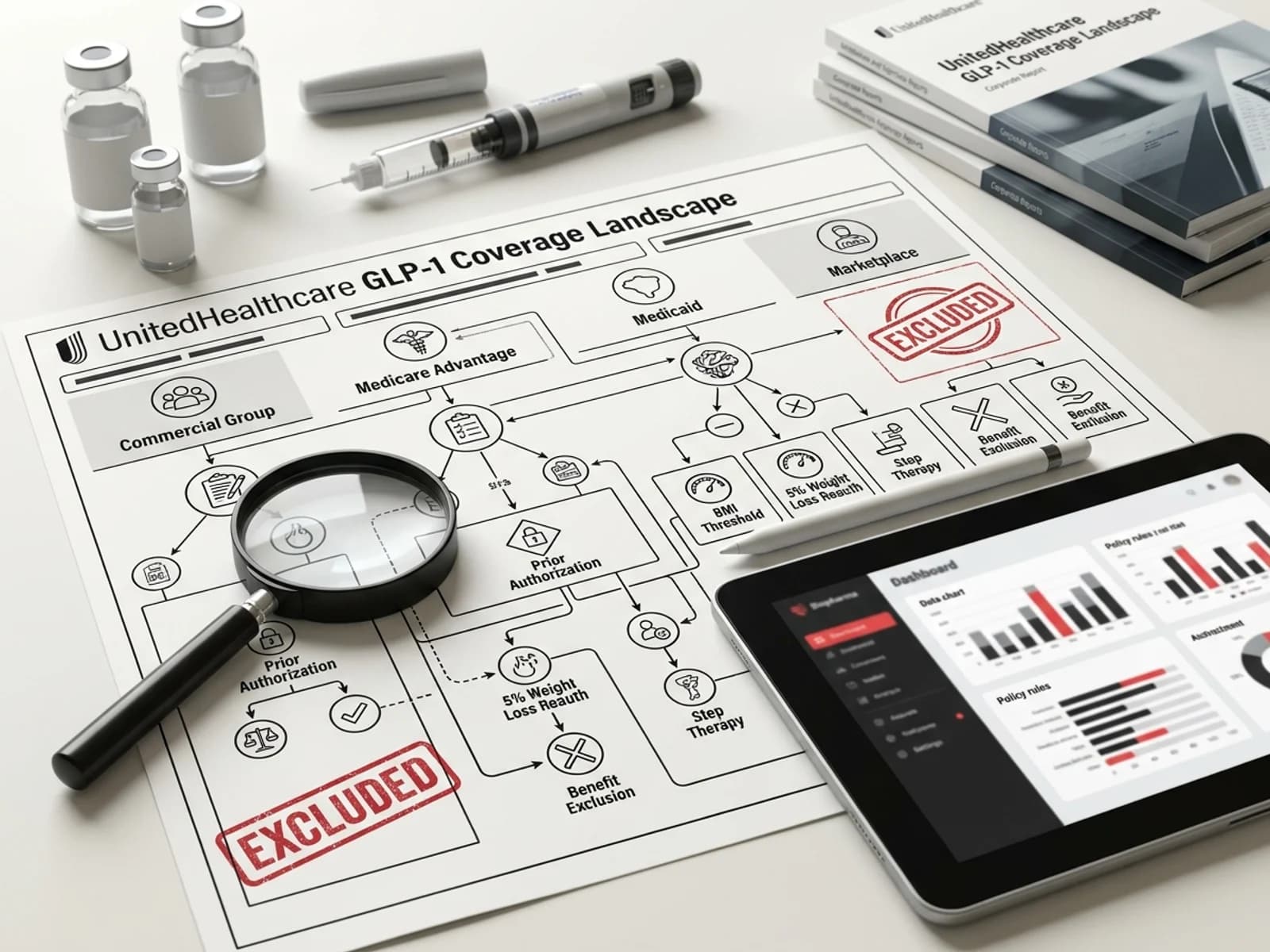
UnitedHealthcare is the largest commercial health insurer in the United States, covering more than 50 million members across employer-sponsored plans, Medicare Advantage, marketplace, and Medicaid managed care. GLP-1 coverage under UHC is not uniform — it varies significantly by plan type, employer election, and whether the plan includes a weight-loss medication benefit. Some UHC plans cover Wegovy and Zepbound with prior authorization, while others exclude them entirely. Understanding which UHC plans cover which GLP-1s, and what documentation is required, is essential for prescribers, benefit verification teams, and market access professionals.
This guide maps UHC GLP-1 coverage by plan type, details the prior authorization criteria from UHC's published clinical programs, explains reauthorization requirements including the weight-loss threshold, and identifies common denial scenarios. It is independent information and not medical advice or reimbursement guidance for a specific patient or plan.
Quick answer
| UHC Plan Type | Weight-Loss GLP-1 Coverage | Key Requirements | Common Exclusions |
|---|---|---|---|
| Commercial group (fully insured) | Covered with PA | BMI ≥30 or BMI ≥27 with comorbidity; lifestyle modification; step therapy may apply | Some employers exclude weight-loss meds |
| Commercial group (self-funded) | Employer-determined | Coverage depends entirely on employer benefit design | If employer excludes, no PA pathway |
| UHC Marketplace/Individual | Varies by state | Limited formulary; primarily Contrave and Qsymia | GLP-1s often excluded on individual plans |
| UHC Medicare Advantage (Part D) | Expanding for 2026 | Part D formulary; semaglutide on select plans; step therapy and PA | Must follow Medicare Part D rules |
| UHC Medicaid managed care | State-determined | State Medicaid GLP-1 policy controls | Many states restrict or exclude GLP-1s |
| Plans with explicit weight-loss exclusion | Not covered | Benefit exclusion — cannot be appealed | Applies regardless of medical necessity |
Who this is for
Market access and payer strategy teams at GLP-1 manufacturers tracking UHC policy
Benefit verification and prior authorization specialists handling UHC plans
Prescribers who need to understand UHC GLP-1 PA criteria and documentation requirements
Employer benefit consultants evaluating GLP-1 coverage across UHC plan designs
Patients navigating UHC GLP-1 coverage for themselves or family members
Source standard
Every fact in this guide is sourced from UnitedHealthcare provider-facing pharmacy clinical program documents, OptumRx formulary materials, UHC's published PA criteria, and trade reporting dated 2025–2026. Coverage rules vary by plan, employer election, and state. Always verify current formulary and PA criteria on the specific UHC plan's member or provider portal, or by calling the number on the member's ID card.
UHC GLP-1 coverage by plan type
Commercial group plans (fully insured)
UHC's fully insured commercial group plans are the most likely to cover weight-loss GLP-1 medications. Under UHC Pharmacy Clinical Program 2026 P 1114-20 ("Plans with Weight Loss/Appetite Suppression Medication Coverage"), Wegovy, Zepbound, Saxenda, Qsymia, Contrave, and other weight-loss medications are covered when the plan includes a weight-loss medication benefit and the member meets PA criteria.
Coverage requires:
The plan must include a weight-loss medication benefit (not all fully insured plans do)
Prior authorization must be approved before the prescription is filled
BMI and comorbidity criteria must be met
Lifestyle modification documentation is required
Commercial group plans (self-funded)
Self-funded employer plans determine their own GLP-1 coverage. UHC administers the claims but the employer decides whether weight-loss medications are a covered benefit. This means:
Some self-funded employers cover GLP-1s broadly
Some cover GLP-1s only for specific indications (e.g., T2D or cardiovascular risk reduction)
Some exclude weight-loss medications entirely
For self-funded plans, there is no single UHC PA policy that overrides the employer's benefit design. Contact the employer's benefits team or UHC's employer services line for plan-specific information.
Marketplace and individual plans
UHC marketplace and individual plan GLP-1 coverage is more limited:
Formularies are typically narrower than employer group plans
GLP-1 agonists for weight loss are often excluded or placed on the highest tier with strict PA
Coverage varies by state and plan level (Bronze, Silver, Gold, Platinum)
Contrave and Qsymia are more commonly covered than Wegovy or Zepbound on these plans
UHC Medicare Advantage (Part D)
UHC Medicare Advantage plans with Part D coverage are expanding GLP-1 access for 2026. Key points:
Wegovy for cardiovascular risk reduction: UHC has a specific PA pathway for Wegovy when prescribed to reduce the risk of major adverse cardiovascular events in adults with established cardiovascular disease and either obesity or overweight (Program 2025 P 1445-2). This pathway exists even on plans that exclude weight-loss medications as a benefit
Wegovy for weight loss: Covered on select Part D plans with PA, subject to Medicare Part D rules
Zepbound: Availability varies by plan; check the specific Part D formulary
Diabetes GLP-1s: Ozempic, Mounjaro, Trulicity, and other T2D GLP-1s are covered on most UHC Medicare Advantage plans with PA
Medicare GLP-1 Bridge: Starting July 1, 2026, CMS will offer eligible Medicare beneficiaries access to GLP-1 medications for $50/month through a time-limited demonstration. This may provide an additional pathway for UHC Medicare Advantage members
UHC Medicaid managed care
UHC administers Medicaid managed care plans in several states. GLP-1 coverage on these plans is determined by state Medicaid policy, not by UHC. State Medicaid programs vary widely:
13 state Medicaid programs covered GLP-1s for obesity treatment under fee-for-service as of January 2026 (per KFF analysis)
Several states (California, New Hampshire, Pennsylvania, South Carolina) eliminated GLP-1 obesity coverage in late 2025/early 2026
Benefits verification is essential before starting treatment on UHC Medicaid plans
UHC prior authorization criteria for weight-loss GLP-1s
UHC's Pharmacy Clinical Programs document (2026 P 1114-20) outlines the PA criteria for plans that include weight-loss medication coverage.
Initial authorization
For Wegovy injection, Wegovy tablet, Zepbound, Saxenda, Contrave, Qsymia, and other covered weight-loss medications:
BMI requirement (one of the following):
BMI ≥ 30 kg/m², OR
For pediatric patients: BMI > 120% of the 95th percentile
BMI ≥ 27 kg/m² with a weight-related comorbidity (dyslipidemia, hypertension, type 2 diabetes, sleep apnea, coronary heart disease, MASH/NASH), OR
Wegovy injection is being requested for treatment of MASH
Lifestyle modification:
Must be used as an adjunct to lifestyle modification (dietary or caloric restriction, exercise, behavioral support, community-based program)
Exclusions:
Must not be used in combination with other GLP-1 receptor agonists or combination products
Some plans require step therapy with lower-cost agents before GLP-1 approval
Authorization duration:
Wegovy injection or tablet: 5 months initial authorization
Zepbound: 6 months initial authorization
Contrave, Qsymia, or Saxenda: 4 months
Benzphetamine, diethylpropion, phentermine, phendimetrazine: 3 months
Reauthorization requirements
This is a critical area where many patients encounter coverage gaps. UHC requires demonstrated weight loss for reauthorization:
Zepbound reauthorization: Weight loss of ≥ 5% of baseline body weight
Wegovy reauthorization (injection): Weight loss of ≥ 5% of baseline body weight; documentation must include current weight and comparison to baseline
Wegovy reauthorization (tablet): Same ≥ 5% weight-loss threshold
Saxenda, Contrave, Qsymia reauthorization: Weight loss of ≥ 3–5% of baseline body weight (varies by agent)
If the patient has not met the weight-loss threshold, reauthorization will be denied. The prescriber may need to submit additional documentation or appeal.
Wegovy for cardiovascular risk reduction only
On UHC plans that exclude weight-loss medications, Wegovy may still be covered for cardiovascular risk reduction through a separate PA program (2025 P 1445-2). Criteria include:
Treatment is being requested to reduce the risk of major adverse cardiovascular events
Patient is 45 years of age or older
BMI ≥ 27 kg/m²
Established cardiovascular disease documented by one of the following:
Prior myocardial infarction
Prior stroke (ischemic or hemorrhagic)
Symptomatic peripheral arterial disease
Used in combination with a reduced-calorie diet and increased physical activity
Patient does not have a diagnosis of diabetes or HbA1c > 6.5%
Patient does not have New York Heart Association class IV heart failure
Authorization issued for 12 months
This pathway is important because it allows Wegovy access even on plans with weight-loss medication exclusions, since it is billed under the cardiovascular indication.
GLP-1 for MASH, OSA, and other expanding indications
UHC's PA forms also include pathways for:
MASH (metabolic dysfunction-associated steatohepatitis): Diagnosis confirmed by liver biopsy, FibroScan, or magnetic resonance elastography; prescribed by or in consultation with a gastroenterologist or hepatologist
Obstructive sleep apnea: Diagnosis confirmed by sleep study; may require documented CPAP/BiPAP trial and failure
Major adverse cardiovascular events (MACE) risk reduction: Requires optimized cardiovascular pharmacotherapy based on current consensus guidelines
OptumRx formulary positioning
OptumRx administers the pharmacy benefit for many UHC plans. GLP-1 formulary positioning on OptumRx-managed plans typically includes:
Wegovy: Tier 2–3 (varies by plan), PA required, quantity limits apply
Zepbound: Tier 2–3 (varies by plan), PA required, quantity limits apply
Ozempic: Tier 2–3 for T2D, PA required
Mounjaro: Tier 2–3 for T2D, PA required
Saxenda: Tier 2, PA required
Exact tier placement and cost-sharing vary by specific plan. Some plans have moved Wegovy and Zepbound to higher tiers (Tier 4 specialty or Tier 5 non-preferred specialty) with increased member cost-sharing.
UHC Total Weight Support program
UnitedHealthcare has developed "Total Weight Support," a whole-person weight management program for employer groups that integrates:
Pharmaceutical options (including GLP-1s where covered)
Clinical support
Behavioral health resources
Digital tools
This program is designed to address weight management holistically and may provide additional support for members receiving GLP-1 medications, though it does not override plan-level coverage decisions.
Common denial scenarios and how to address them
"Weight-loss medication is a benefit exclusion"
If the UHC plan has a weight-loss medication exclusion, the PA will be denied regardless of medical necessity. Options:
Check if Wegovy can be prescribed for cardiovascular risk reduction instead (separate PA pathway)
Check if Zepbound can be prescribed for OSA instead
Contact the employer's benefits team (self-funded plans) to explore adding GLP-1 coverage
Use manufacturer savings programs
"Prior authorization denied — weight-loss threshold not met"
If reauthorization is denied because the patient did not lose ≥ 5% of baseline body weight:
The prescriber can appeal with additional documentation of clinical improvement (e.g., comorbidity improvement, medication adherence despite weight plateau)
Document any dose titration delays, supply interruptions, or side effects that may have impeded weight loss
Peer-to-peer review with a UHC medical director may be available as part of the appeals process
"Step therapy requirement not met"
Some UHC plans require trial of lower-cost weight-loss medications (Contrave, Qsymia, phentermine) before approving a GLP-1. The prescriber must document:
12-week trial of the required step therapy agent
Failure, inadequate response, or contraindication
"BMI documentation insufficient"
The prescriber must submit chart documentation of the patient's BMI from a clinical visit. Self-reported weight or BMI calculated from self-reported measurements is typically not accepted.
Benefit verification workflow for UHC GLP-1s
Confirm plan type: Determine if the patient has commercial group, marketplace, Medicare Advantage, or Medicaid managed care coverage
Check for weight-loss medication benefit: Not all UHC plans include this benefit; contact UHC or check the plan's summary of benefits
Verify formulary tier and PA requirements: Use UHC's provider portal or call UHC provider services
Identify alternative PA pathways: If weight-loss is excluded, check if the patient qualifies for Wegovy CV risk reduction, Zepbound OSA, or MASH pathways
Submit PA with complete documentation: Include BMI, comorbidities, lifestyle modification history, step therapy documentation, and diagnosis codes
Monitor authorization duration: Initial authorization is 5 months for Wegovy and 6 months for Zepbound; reauthorization requires demonstrated weight loss
Prepare for reauthorization: Schedule follow-up visits to document weight loss before the authorization expires
UHC prior authorization landscape
In May 2026, UnitedHealthcare announced it would cut prior authorization requirements by an additional 30% by the end of 2026, including select outpatient surgeries, diagnostic tests, and outpatient therapies. UHC reported that prior authorization is currently required for only 2% of medical services, and approximately 92% of submitted authorizations are approved in less than 24 hours on average. While this initiative primarily targets medical services rather than pharmacy PA, it signals UHC's broader direction on utilization management and may influence pharmacy PA processes over time.
Within Medicare Advantage, UnitedHealthcare has fewer prior authorization requirements than any other insurer, according to UHC's public reporting. More than 70% of UHC's prior authorizations will use a standardized electronic submission process by year-end 2026.
What to monitor
Formulary tier changes: UHC and OptumRx periodically update formulary positioning, which can affect cost-sharing and PA requirements
New FDA indications: Additional GLP-1 approvals (heart failure, Alzheimer's, addiction) may create new coverage pathways
Medicare GLP-1 Bridge (July 2026): The CMS demonstration may significantly expand access for UHC Medicare Advantage members
Employer plan redesign: Open enrollment periods may change GLP-1 coverage for self-funded plans
State Medicaid policy changes: States continue to modify GLP-1 Medicaid coverage, affecting UHC Medicaid managed care plans
IRA negotiated prices: If GLP-1 drugs are selected for Medicare negotiation, lower prices could influence commercial coverage decisions
UHC PA simplification: Watch for potential pharmacy PA streamlining as part of UHC's broader PA reduction initiative
Sources
UnitedHealthcare Provider. "Prior Authorization/Notification — Plans with Weight Loss/Appetite Suppression Medication Coverage." Program 2026 P 1114-20. https://www.uhcprovider.com/content/dam/provider/docs/public/prior-auth/drugs-pharmacy/commercial/r-z/PA-Notification-Weight-Loss.pdf
UnitedHealthcare Provider. "Prior Authorization/Non-Formulary Medication — Wegovy (semaglutide) — Cardiovascular Risk Reduction Only." Program 2025 P 1445-2. https://www.uhcprovider.com/content/dam/provider/docs/public/prior-auth/drugs-pharmacy/commercial/r-z/PA-Non-Formulary-Wegovy.pdf
UnitedHealthcare Provider. "GLP-1 Receptor Agonists Prior Authorization Form." https://www.uhcprovider.com/content/dam/provider/docs/public/prior-auth/uhccp-pharmacy-forms/d-g/PA-GLPs-PA-Form.pdf
OptumRx. "2026 Premium Formulary." https://contenthub-aem.optumrx.com/content/dam/contenthub/onboarding/assets/wespath/Jan-01-2026-Premium-Formulary-Booklet.pdf
OptumRx. "2026 Non-Medicare Comprehensive Formulary." https://contenthub-aem.optumrx.com/content/dam/contenthub/rx-assets/en/documents/clients/mpser/2026/2026-Non-Medicare-Comprehensive-Formulary.pdf
UnitedHealthcare. "Rising GLP-1 demand challenges employer health plans." https://www.uhc.com/agents-brokers/employer-sponsored-plans/news-strategies/demand-for-glp-1-drugs
CMS.gov. "Coming Soon: CMS to Provide $50 Monthly Access to GLP-1 Medications for Medicare Beneficiaries." 2026. https://www.cms.gov/newsroom/press-releases/coming-soon-cms-provide-50-monthly-access-glp-1-medications-medicare-beneficiaries
KFF. "Medicaid Coverage of and Spending on GLP-1s." 2026. https://www.kff.org/medicaid/medicaid-coverage-of-and-spending-on-glp-1s
UnitedHealth Group. "UnitedHealthcare Cuts Prior Authorization Requirements by 30%." May 5, 2026. https://www.unitedhealthgroup.com/newsroom/2026/2026-05-05-uhc-cuts-prior-authorization-requirements-by-30-percent.html