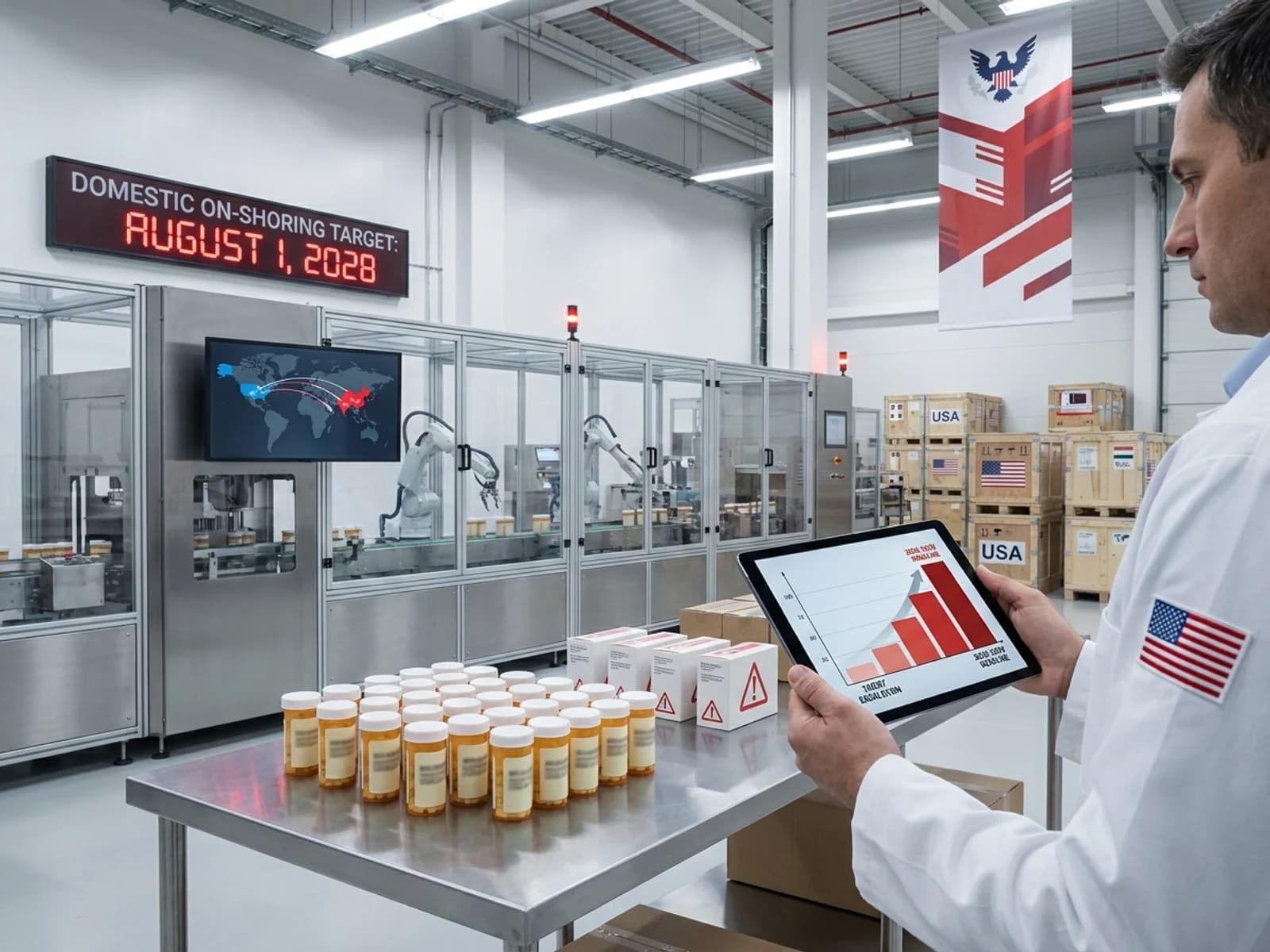
On July 21, 2026, the Trump administration announced a sweeping trade policy initiative targeting the biopharmaceutical supply chain: imported generic drugs will face a 0% tariff for a two-year grace period starting August 1, 2026, followed by a 100% duty beginning August 1, 2028, and escalating to a 200% duty from August 1, 2029, unless manufacturing is reshored to the United States. Framed as a penalty for pharmaceutical companies that fail to build domestic plant and equipment, the policy seeks to compel onshoring for essential off-patent medicines.
For generic-drug commercial leaders, contract development and manufacturing organization (CDMO) strategists, group purchasing organization (GPO) formulary staff, and regulatory affairs teams, this announcement creates an immediate strategic reckoning.
Direct Answer: The Generic Tariff at a Glance
Executive Summary & Direct Answer: On July 21, 2026, the administration set a strict phased schedule for imported generic drugs: a 0% tariff through July 31, 2028, followed by a 100% duty starting August 1, 2028, and a 200% duty from August 1, 2029. Patented branded drugs, biologics, and biosimilars are excluded from this tariff order and remain governed by the April 2, 2026 Section 232 framework (which exempted generics, biosimilars, and APIs), with major branded originators (such as Eli Lilly, Pfizer, and Novo Nordisk) holding separate 3-year Most-Favored-Nation (MFN) tariff exemptions. US generic reliance is structural: generic drugs fill ~90% of US prescriptions, India manufactures over 50% of finished generic doses consumed in the US, and China supplies ~95% of imported ibuprofen, ~70% of acetaminophen, and up to 45% of penicillin APIs. Analysis of FDA's Orange Book reveals 37,651 active ANDA product entries dominated by foreign-headquartered holders (such as Aurobindo, Zydus, Sun Pharma, Teva, Sandoz, and Hikma). National Average Drug Acquisition Cost (NADAC) data demonstrates that core essential generics sell for pennies (e.g., atorvastatin $0.025/tab, lisinopril $0.019/tab, amlodipine $0.017/tab) — margins that make absorbing a 100–200% tariff or building new US plants economically impossible without massive federal subsidies or drastic price inflation.
What did the administration announce, and what is the exact 2028–2029 generic drug tariff timeline?
The July 21, 2026 policy statement outlines a clear two-tier escalation timeline designed to force biopharmaceutical manufacturers to break their reliance on foreign manufacturing hubs in India, China, and Europe.
The announcement establishes three distinct operational phases:
Phase 1: The Two-Year Grace Period (August 1, 2026 – July 31, 2028): Imported generic finished dosage forms and designated bulk active pharmaceutical ingredients (APIs) enter the United States at a 0% tariff rate. This period is explicitly intended as a build-out window for manufacturers to break ground on domestic facilities, secure US FDA facility registrations, and execute technology transfers.
Phase 2: Initial Penalty Rate (August 1, 2028 – July 31, 2029): All imported generic drug products originating from non-US facilities face an ad valorem 100% tariff at customs entry points, effectively doubling the landed import cost.
Phase 3: Terminal Penalty Rate (August 1, 2029 Onward): The tariff escalates to 200% on imported generic finished dosage forms and un-reshored generic APIs, creating an prohibitive cost structure for non-domestic generic supply chains.
| Phase | Time Window | Tariff Rate | Target Manufacturer Action | Customs Valuation Baseline |
|---|---|---|---|---|
| Grace Period | Aug 1, 2026 – Jul 31, 2028 | 0% | Site selection, US plant construction, FDA tech transfer | Standard 19 U.S.C. § 1401a Transaction Value |
| Tier 1 Levy | Aug 1, 2028 – Jul 31, 2029 | 100% | Penalty applied to non-US imported generic dosage forms | Landed CIF value at US Customs Port of Entry |
| Tier 2 Levy | Aug 1, 2029 Onward | 200% | Maximum penalty rate to compel domestic market closure | Landed CIF value at US Customs Port of Entry |
White House policy advisors emphasized that the two-year grace period provides adequate time for "serious capital deployment," but trade experts and industry leaders — including the Association for Accessible Medicines (AAM) — immediately countered that building, qualifying, and validating a cGMP sterile injectable or solid oral dose facility typically requires 36 to 60 months.
How do generic drug tariffs fit with the April 2 Section 232 branded-drug duties and the MFN exemptions?
To evaluate corporate risk, pharmaceutical legal and trade teams must distinguish the July 21 generic tariff announcement from earlier trade actions enacted throughout 2026.
Earlier in the year, on April 2, 2026, the administration issued a Section 232 national security tariff order imposing 100% duties on patented branded pharmaceuticals and single-source biopharmaceuticals. However, that April order explicitly exempted generic small-molecule drugs, biosimilars, and active pharmaceutical ingredients to prevent immediate consumer price spikes and health system disruption. Furthermore, leading multinational brand originators — including Eli Lilly, Pfizer, and Novo Nordisk — negotiated individual 3-year Most-Favored-Nation (MFN) tariff exemption agreements in exchange for domestic capital investment commitments and direct-to-consumer pricing caps through platforms like TrumpRx.gov (which expanded to over 600 generic and branded drugs in May 2026).
The July 21 announcement pivots policy directly toward off-patent, commodity generic drugs. While branded originators enjoy high gross margins (often 80–90%) and regulatory exclusivity windows that cushion trade friction or afford MFN negotiated carve-outs, generic manufacturers operate in a hyper-commoditized market with low single-digit margins.
                    ┌────────────────────────────────────────────────────────┐
                    │       US PHARMACEUTICAL TRADE REGIME (2026)            │
                    └───────────────────────────┬────────────────────────────┘
                                                │
                 ┌──────────────────────────────┴──────────────────────────────┐
                 ▼                                                             ▼
┌─────────────────────────────────┐                         ┌──────────────────────────────────┐
│   PATENTED BRANDED DRUGS        │                         │      GENERIC DRUG PRODUCTS       │
│  (Section 232 / April 2, 2026)  │                         │     (July 21, 2026 Order)        │
└────────────────┬────────────────┘                         └─────────────────┬────────────────┘
                 │                                                            │
    ┌────────────┴────────────┐                                  ┌────────────┴────────────┐
    ▼                         ▼                                  ▼                         ▼
┌───────┐             ┌──────────────┐                     ┌───────────┐             ┌───────────┐
│ 100%  │             │  3-Year MFN  │                     │ Aug 2028  │             │ Aug 2029  │
│ Tariff│             │ Exemptions   │                     │  100%     │             │  200%     │
└───────┘             │ (Lilly, etc) │                     │ Tariff    │             │ Tariff    │
                      └──────────────┘                     └───────────┘             └───────────┘
This structural asymmetry creates a profound policy paradox: high-cost branded medications are sheltered by corporate MFN agreements, whereas low-cost, essential generic medicines face steep punitive tariffs despite lacking the margin structure needed to absorb them.
How dependent is the US on imported generics and APIs, and which ANDA holders are most exposed?
US health care security rests on a highly concentrated, globalized generic supply chain. According to FDA metrics, generic drugs account for 90% of all prescriptions dispensed in the United States, yet domestic manufacturing produces less than 15% of finished generic doses.
Macro-level import dependency is heavily skewed toward specific geographic regions:
India: Supplies over 50% of all finished generic oral solid doses consumed by American patients, according to findings from the Senate Special Committee on Aging (2025). India's generic sector relies heavily on Chinese API inputs, creating a two-tier foreign dependency chain.
China: Controls key global key starting materials (KSMs) and bulk APIs. Data from the Coalition for a Prosperous America (2023) indicates China supplies approximately 95% of imported US ibuprofen, 70% of acetaminophen, and up to 45% of penicillin active ingredients.
Europe & Israel: European hubs (Germany, Italy, Austria) and Israel supply high-complexity sterile injectables, narrow-therapeutic-index generics, and specialized biosimilar formulations.
Orange Book ANDA Roster Analysis
Analysis of the official FDA Orange Book database (48,502 total product rows) reveals that 37,651 product rows represent Abbreviated New Drug Applications (ANDAs). An audit of top ANDA holders underscores that the US off-patent drug supply is overwhelmingly controlled by foreign-headquartered pharmaceutical corporations:
Top US ANDA Holders by Orange Book Product-Row Footprint (Appl_Type = "A")
| ANDA Holder (grouped applicant-of-record) | Headquarters | ANDA Product Rows |
|---|---|---|
| Teva group (Teva, Watson, Actavis, Ivax) | Israel | ~3,100 |
| Aurobindo group (Aurobindo, Eugia, Aurolife) | India | ~1,520 |
| Sun Pharmaceutical (incl. Prinston) | India | ~1,480 |
| Hikma Pharmaceuticals | UK / Jordan | ~990 |
| Zydus Lifesciences | India | ~940 |
| Amneal Pharmaceuticals | US / India | ~810 |
| Mylan / Viatris | US / India | ~725 |
| Dr. Reddy's Laboratories | India | ~690 |
| Apotex | Canada | ~670 |
| Sandoz (Novartis spinoff) | Switzerland | ~635 |
| Lupin | India | ~540 |
| Alembic Pharmaceuticals | India | ~525 |
| Fresenius Kabi | Germany | ~430 |
| Macleods Pharmaceuticals | India | ~390 |
| Alkem Laboratories | India | ~350 |
Counts above group an applicant's multiple legal filing entities (for example, Teva files under Teva, Watson, Actavis, and Ivax; Aurobindo under Aurobindo, Eugia, and Aurolife). India-headquartered holders — Aurobindo, Sun, Zydus, Dr. Reddy's, Lupin, Alembic, Macleods, Alkem, Torrent, Glenmark, and Cipla — dominate the top of the list, alongside Israel's Teva, Switzerland's Sandoz, Germany's Fresenius Kabi, and UK/Jordan's Hikma. This applicant roster is the portfolio most directly exposed to an import duty on finished generics.
For detailed analysis on how regulatory filing requirements affect foreign API supplier changes, see our briefing on API supplier change control and DMF letter-of-authorization traps. Furthermore, to review overall product density, consult the US drug product landscape NDC directory analysis.
Can penny-a-pill generics actually be reshored — what does NADAC margin reality say?
The economic viability of reshoring generic drugs collapses when evaluated against National Average Drug Acquisition Cost (NADAC) benchmarks. Over two decades of intense GPO purchasing consolidation (dominated by Red Oak, ClarusONE, and Vizient) and aggressive price erosion have reduced core US essential generics to pennies per unit.
An inspection of CMS NADAC data illustrates the extreme low-cost baseline of top-volume essential medicines:
Per-Unit Acquisition Pricing of Top US Essential Generics (CMS NADAC Data)
| Generic Medication | Dosage Form & Strength | NADAC Per-Unit Price | Package Baseline Cost |
|---|---|---|---|
| Amlodipine Besylate | Tablet, 10 mg | $0.01671 / tablet | $1.67 / 100-ct bottle |
| Lisinopril | Tablet, 10 mg | $0.01877 / tablet | $1.88 / 100-ct bottle |
| Gabapentin | Capsule, 100 mg | $0.02119 / capsule | $2.12 / 100-ct bottle |
| Atorvastatin Calcium | Tablet, 10 mg | $0.02546 / tablet | $2.55 / 100-ct bottle |
| Levothyroxine Sodium | Tablet, 100 mcg | $0.05712 / tablet | $5.71 / 100-ct bottle |
| Hydrochlorothiazide | Tablet, 25 mg | $0.01203 / tablet | $1.20 / 100-ct bottle |
| Amoxicillin | Oral Susp, 250mg/5mL | $0.02462 / mL | $2.46 / 100 mL bottle |
Consider the unit economics of amlodipine 10 mg at $0.0167 per tablet ($1.67 per 100-count bottle). A representative illustrative breakdown of the landed cost for an Indian manufacturer runs roughly:
Raw API & excipient cost: ~$0.006
Primary packaging (blister/bottle): ~$0.003
Ocean freight & customs handling: ~$0.002
Manufacturer gross margin: ~$0.006
If a 100% tariff ($0.0167 levy) is applied in August 2028, followed by a 200% tariff ($0.0334 levy) in August 2029, the customs duty alone exceeds the entire gross selling price of the drug.
Land-Cost Breakdown of Amlodipine 10mg vs. 200% Tariff Impact ($/unit)
$0.06 ┌──────────────────────────────────────────────────────────────────┐
      │                                                   [200% Tariff]  │
$0.05 │                                                      $0.0334     │
      │                                                 ┌────────────────┤
$0.04 │                                                 │                │
      │                                  [100% Tariff]  │                │
$0.03 │                                     $0.0167     │                │
      │   [Baseline NADAC]             ┌────────────────┼────────────────┤
$0.02 │       $0.0167                  │                │                │
      │ ┌────────────────┐             │                │                │
$0.01 │ │  Base Cost     │             │  Base Cost     │  Base Cost     │
      │ │  $0.0167       │             │  $0.0167       │  $0.0167       │
$0.00 └─┴────────────────┴─────────────┴────────────────┴────────────────┴─┘
            Current                     Aug 2028                 Aug 2029
Because generic manufacturers operate on razor-thin profit margins (often $0.001 to $0.003 per tablet), absorbing a 100% to 200% levy is mathematically impossible. Generic companies cannot absorb the tax, nor can foreign manufacturers construct a US manufacturing facility — costing $150M to $300M in capital expenditure — to produce a medicine that sells for under two cents.
Without federal floor-price guarantees, long-term procurement contracts, or direct capital grants, applying punitive tariffs to penny-a-pill generics will force manufacturers to abandon low-margin ANDAs entirely rather than reshore production.
Analytical Deep Dive: Customs Harmonized Tariff Schedule (HTS) Classification and Import Entry Mechanics
To understand how customs duties will be assessed, corporate trade compliance departments must review the specific Harmonized Tariff Schedule of the United States (HTSUS) codes governing pharmaceutical imports.
Imports of finished generic pharmaceuticals enter under HTSUS Chapter 30 (Pharmaceutical Products), specifically heading 3004.90 (Medicaments consisting of mixed or unmixed products for therapeutic uses). Bulk active pharmaceutical ingredients enter under HTSUS Chapter 29 (Organic Chemicals) under specific heading classifications such as 2933.99 or 2941.90 (Antibiotics).
Customs Valuation and Country-of-Origin Rules
Customs Valuation Baseline (19 U.S.C. § 1401a): Duties are calculated on the declared Transaction Value — defined as the price actually paid or payable for the merchandise when sold for exportation to the United States. For intra-company transfers between a foreign parent manufacturer (e.g., in Hyderabad) and its US distribution subsidiary (e.g., in New Jersey), U.S. Customs and Border Protection (CBP) applies strict transfer pricing scrutiny under the arms-length transaction standard.
Substantial Transformation Rule (19 CFR Part 134): Determining whether a drug is "foreign" or "domestic" depends on the legal concept of substantial transformation. CBP precedent holds that processing a bulk active pharmaceutical ingredient (API) into a finished dosage form (e.g., blending, granulating, and compressing API into finished tablets) constitutes a substantial transformation that confers country-of-origin status on the country where formulation occurred.
The API Country-of-Origin Trap: If a generic drug is formulated in the United States using bulk API imported from India or China, CBP may classify the finished drug as US-origin for customs purposes, but FDA regulations under 21 CFR § 201.1 require labeling the country of origin of the API. If the administration extends generic tariffs to cover imported bulk APIs under Chapter 29, domestic US formulators will still face 100% to 200% tariffs on their raw material inputs.
Vulnerability Index Across Specific Generic Product Classes
The operational and financial impact of the 2028–2029 generic tariff will not be uniform across all drug categories. Trade analysts divide the off-patent drug universe into four distinct vulnerability tiers based on manufacturing complexity, margin depth, and supply chain redundancy:
1. Low-Margin Oral Solid Commodities (Extreme Vulnerability)
Examples: Amlodipine, lisinopril, metformin, atorvastatin, gabapentin, hydrochlorothiazide.
Vulnerability Drivers: NADAC unit prices under $0.03 per tablet; extreme market concentration in India (>60% share); zero remaining domestic US production capacity.
Expected Fallout: High probability of ANDA discontinuation by foreign holders. Importers cannot absorb the tariff, and GPOs will refuse initial price increases until shortages materialize.
2. Sterile Injectables & Parenterals (High Vulnerability & Shortage Risk)
Examples: Ondansetron IV, propofol, heparin, saline solutions, injectable antibiotics (cefazolin, piperacillin-tazobactam).
Vulnerability Drivers: Existing US sterile injectable plants operate at 95%+ capacity; foreign suppliers (Fresenius Kabi, Hikma, Sandoz) supply over 40% of US hospital demand; cleanroom build-outs require 48+ months.
Expected Fallout: Immediate hospital supply shortages. Because sterile injectables cannot be rapidly reshored, applying tariffs will instantly inflate hospital drug budgets or force emergency FDA importation waivers.
3. Narrow Therapeutic Index (NTI) Medications (High Regulatory & Clinical Risk)
Examples: Levothyroxine sodium, warfarin, digoxin, lithium, carbamazepine, tacrolimus.
Vulnerability Drivers: Precise dosage requirements where minor bioequivalence variations can cause therapeutic failure or toxicity; patient switching carries severe clinical risks.
Expected Fallout: High regulatory switching friction. Patients cannot easily transition between generic suppliers if foreign ANDA holders exit the market, complicating retail pharmacy substitution.
4. High-Complexity & Topically Administered Generics (Moderate Vulnerability)
Examples: Inhaled corticosteroids (fluticasone), ophthalmic drops, transdermal patches, topical ointments.
Vulnerability Drivers: Higher unit pricing ($10 to $50 per package) provides partial margin buffer to absorb tariff costs; however, specialized delivery devices are manufactured in specialized European or Asian facilities.
Expected Fallout: Price inflation passed to commercial health plans, accompanied by selective product withdrawals for lower-volume SKUs.
What are the technical, cGMP, and regulatory timelines for reshoring generic plants?
To evaluate why the two-year grace period (August 2026 – August 2028) is structurally insufficient for pharmaceutical manufacturing reshoring, trade and engineering teams must examine the mandatory regulatory steps required by FDA under the Federal Food, Drug, and Cosmetic Act (FD&C Act).
Building a new domestic pharmaceutical plant or executing a technology transfer to a US CDMO is not equivalent to shifting textile or electronics assembly. It requires strict adherence to Current Good Manufacturing Practice (cGMP) regulations under 21 CFR Parts 210 and 211.
Mandatory cGMP & Regulatory Timeline for Domestic Plant Reshoring
| Project Milestone Phase | Execution Time | Regulatory / Engineering Output |
|---|---|---|
| **1. Site Selection & Engineering** | Months 1 – 9 | Facility architectural design, HVAC spec, environmental impact approvals |
| **2. Civil Build & Cleanroom Const.** | Months 10 – 24 | Class 100/10,000 cleanrooms, WFI loops, isolator line installation |
| **3. Equipment Qualification** (FAT / SAT / IQ / OQ / PQ) | Months 25 – 33 | IQ/OQ/PQ protocols, Factory Acceptance Testing (FAT), Site Acceptance (SAT) |
| **4. Process Validation & Stability** | Months 34 – 42 | 3 consecutive commercial validation batches; 6-month accelerated stability testing |
| **5. FDA Supplement & Inspection** (PAS Filing & cGMP PAI Inspection) | Months 43 – 54 | Prior Approval Supplement (PAS) filing; FDA Pre-Approval Inspection (PAI) approval |
| **Total Real-World Timeline** | **4.5 to 5.5 Yrs** | **48 to 60 Months Minimum Required** |
As demonstrated in the timeline matrix above, completing a compliant greenfield pharmaceutical site build-out requires 48 to 60 months. Even an accelerated brownfield expansion of an existing US facility requires 30 to 36 months to complete 6-month ICH stability testing and secure FDA Prior Approval Supplement (PAS) clearance.
Consequently, any foreign generic manufacturer that had not already broken ground on a US facility before January 2026 cannot bring a new domestic plant online before the August 1, 2028 tariff penalty deadline.
What does the tariff mean for generic price erosion, shortages, and the AAM/industry response?
The announcement triggered immediate, widespread concern across trade associations, policy institutes, and healthcare supply chain leaders.
Industry and Policy Reactions
Association for Accessible Medicines (AAM): The generics trade group, led by President and CEO John Murphy III, signaled surprise at the proposal and cautioned that abrupt tariffs on low-margin products risk triggering drug withdrawals, price spikes for health plans and patients, and shortages of essential medicines.
Brookings Institution: Healthcare scholar Dr. Marta Wosińska noted that "a tariff can be part of a broader strategy, but is not going to by itself lead to onshoring." She emphasized that without structural reform in GPO purchasing habits and CMS reimbursement, tariffs simply penalize low-margin suppliers without creating viable domestic economic conditions.
Group Purchasing Organizations (GPOs): Supply chain leaders noted that if foreign suppliers exit the market, health systems will face catastrophic shortfalls in basic oral solids, emergency injectables, and anti-infectives.
Three Industry Fallout Scenarios
┌────────────────────────────────────────────────────────────────────────┐
│                   GENERIC TARIFF MARKET IMPACT MODES                   │
└───────────────────────────────────┬────────────────────────────────────┘
                                    │
    ┌───────────────────────────────┼───────────────────────────────┐
    ▼                               ▼                               ▼
┌──────────────────────┐  ┌──────────────────────┐  ┌──────────────────────┐
│  1. ANDA Abandonment │  │ 2. Chronic Shortages │  │ 3. Price Inflation   │
│ Foreign holders drop │  │ US plants lack       │  │ Landed tariff costs  │
│ low-margin US NDCs   │  │ reserve capacity     │  │ passed to payers     │
└──────────────────────┘  └──────────────────────┘  └──────────────────────┘
Mass ANDA Abandonment: Foreign generic holders will voluntarily relinquish low-margin ANDAs for products where tariff rates wipe out profitability. Multi-source generic markets could rapidly collapse into single-source or zero-source markets.
Exacerbation of Critical Shortages: Domestic sterile injectable facilities are already operating at near 100% capacity. Tariff-driven exclusion of foreign supply will trigger severe shortages across hospital emergency rooms, oncology clinics, and intensive care units. (For a related case study on emergency foreign product access, see our report on the Bicillin L-A shortage and FDA foreign-product importation).
Payer and Patient Price Inflation: For essential generics where no domestic alternative exists, importers will pass 100% to 200% tariff costs directly to health plans, PBMs, and cash-paying patients.
For an evaluation of generic market opportunities created by capacity constraints, consult our analysis on sterile injectable shortage opportunity and generic capacity entry.
How should generics commercial, supply-chain, and policy teams plan for the two-year runway?
With the 0% tariff grace period running through July 31, 2028, generic manufacturers and health-system buyers must execute a structured risk-mitigation framework.
                    ┌────────────────────────────────────────────────────────┐
                    │     GENERIC TARIFF TWO-YEAR ACTION WORKFLOW            │
                    └───────────────────────────┬────────────────────────────┘
                                                │
                 ┌──────────────────────────────┴──────────────────────────────┐
                 ▼                                                             ▼
┌─────────────────────────────────┐                         ┌──────────────────────────────────┐
│    FOR GENERIC MANUFACTURERS    │                         │  FOR GPOs, PAYERS & HEALTH SYSTEM│
└────────────────┬────────────────┘                         └─────────────────┬────────────────┘
                 │                                                            │
┌────────────────┴────────────────┐                         ┌─────────────────┴────────────────┐
│ 1. Portfolio Exposure Audit     │                         │ 1. Essential Drug Supply Audit   │
│    Categorize ANDAs by landed   │                         │    Map health-system NDCs to     │
│    margin & foreign origin.     │                         │    foreign manufacturing sites.  │
│                                 │                         │                                  │
│ 2. API / CDMO Dual-Sourcing     │                         │ 2. Long-Term Reshoring Contracts │
│    File Prior Approval          │                         │    Guarantee floor prices for    │
│    Supplements (PAS) for domestic│                         │    domestic generic makers.      │
│    or near-shore API sites.     │                         │                                  │
│ 3. Tariff Carve-Out Advocacy    │                         │ 3. Buffer Stock Accumulation     │
│    Petition USTR/FDA for        │                         │    Build 6-12 month critical     │
│    essential-drug exemptions.   │                         │    inventory reserves before 2028│
└─────────────────────────────────┘                         └──────────────────────────────────┘
Action Plan for Generic Manufacturers
Portfolio Exposure Audit: Instantly audit all commercial ANDAs against site-of-origin registration data. Classify products into three buckets: (A) Domestic-manufactured (safe), (B) Foreign high-margin (can absorb partial tariff), and (C) Foreign low-margin penny-generics (high risk of discontinuation).
Dual-Sourcing & PAS Filings: Initiate FDA Prior Approval Supplements (PAS) or Changes Being Effected (CBE-30) to add US-based or near-shore CDMO backup sites for critical finished dosage forms. Align this work with the policy framework outlined in the BIOSECURE Act and the API supply chain DMF strategy.
Petition for Essential Drug Carve-Outs: Work through trade groups (AAM, Accessible Meds) to formalize an FDA/USTR exemption list for essential generic medicines that lack domestic manufacturing alternatives.
Action Plan for GPOs, Payers, and Health Systems
Supply-Chain Footprint Mapping: Identify high-volume essential drugs sourced from top foreign ANDA holders (Aurobindo, Zydus, Sun, Teva) and demand supply-chain transparency down to the API facility level.
Value-Based Domestic Procurement: Transition generic contracting away from sole-source lowest-cost bidding toward multi-year guaranteed volume contracts that incentivize domestic producers.
Strategic Inventory Stockpiling: Utilize the 2026–2028 grace period to build 6-to-12-month strategic reserves of critical oral solids and sterile injectables before the 100% duty takes effect in August 2028.
Frequently Asked Questions
When do Trump's generic drug tariffs start, and what are the rates?
The policy establishes a two-year 0% tariff grace period starting August 1, 2026. Non-US imported generic drugs face a 100% tariff starting August 1, 2028, escalating to a 200% tariff beginning August 1, 2029, unless domestic manufacturing is established.
Do the generic drug tariffs apply to branded drugs, biologics, or biosimilars?
No. The July 21, 2026 order applies specifically to generic off-patent small-molecule medicines and their active pharmaceutical ingredients. Patented branded drugs and biologics remain governed by the April 2, 2026 Section 232 framework, under which major brand originators (such as Pfizer, Eli Lilly, and Novo Nordisk) secured separate 3-year Most-Favored-Nation (MFN) tariff exemptions.
Why is the US so dependent on Indian and Chinese generic and API manufacturing?
Over the past thirty years, low labor costs, lower environmental compliance overhead, scale economics, and aggressive government subsidies enabled India and China to capture global generic manufacturing. India now supplies over 50% of US finished generic prescriptions, while China produces up to 95% of key starting materials and APIs for essential medicines like ibuprofen, acetaminophen, and penicillin.
Can generic drugmakers realistically move production to the US before August 2028?
Industry experts argue that a two-year window is insufficient for widespread reshoring. Building, equipping, validating, and securing FDA cGMP approval for a new pharmaceutical manufacturing facility takes 3 to 5 years and costs between $150 million and $300 million. Given that essential generics sell for pennies per unit under current NADAC benchmarks, manufacturers cannot justify domestic capital investment without long-term price guarantees or government subsidies.
Sources
U.S. Food and Drug Administration (FDA): Orange Book: Approved Drug Products with Therapeutic Equivalence Evaluations (Data export July 25, 2026). Drugs@FDA / Orange Book Database
Centers for Medicare & Medicaid Services (CMS): National Average Drug Acquisition Cost (NADAC) Weekly File (Data export July 24, 2026). CMS NADAC Pricing Clearinghouse
U.S. Senate Special Committee on Aging: Examining Foreign Dependency in the U.S. Healthcare Supply Chain (2025 Committee Report on Indian Generic Prescription Share).
Coalition for a Prosperous America (CPA): U.S. Active Pharmaceutical Ingredient Supply Chain Vulnerabilities Report (2023 Analysis of Chinese API Market Share).
CBS News: Trump plans 100% tariffs on imported generic drugs to spur U.S. manufacturing (Published July 22, 2026). CBS News Coverage
Fierce Pharma: Trump floats countdown to 200% tariff rate on generic drugs imported to US (Published July 22, 2026). Fierce Pharma Coverage
CNBC: Trump plans steep tariffs on generic drugs starting in 2028 (Published July 22, 2026). CNBC Trade Coverage
Bloomberg Government: Trump's 100% generic drug duty threatens US low-cost supply (Published July 22, 2026). Bloomberg Law / BGov