The pharmaceutical supply chain in the United States continues to face severe vulnerabilities in sole-source, high-volume sterile injectable products. One of the most critical ongoing crises is the multi-year shortage of penicillin G benzathine—marketed by Pfizer as Bicillin L-A (NDA 050141).
First posted to the FDA Drug Shortages database on April 26, 2023, Bicillin L-A has remained on limited or unavailable status for over three years. Because penicillin G benzathine is the only FDA-approved therapy recommended by the CDC for treating syphilis in pregnant patients to prevent congenital transmission, the shortage has forced clinical and market access teams to navigate emergency substitution, temporary importation of foreign products, and complex medical billing crosswalks.
Short Answer
To mitigate the Bicillin L-A shortage, the FDA exercised regulatory discretion in late 2023 to permit the temporary importation and distribution of Lentocilin (penicillin G benzathine), manufactured by Laboratórios Atral, S.A. in Portugal and distributed in the U.S. through the Mark Cuban Cost Plus Drug Company (MCCPDC) under NDC 84383-110-01 (or 11-digit format 84383-0110-01).
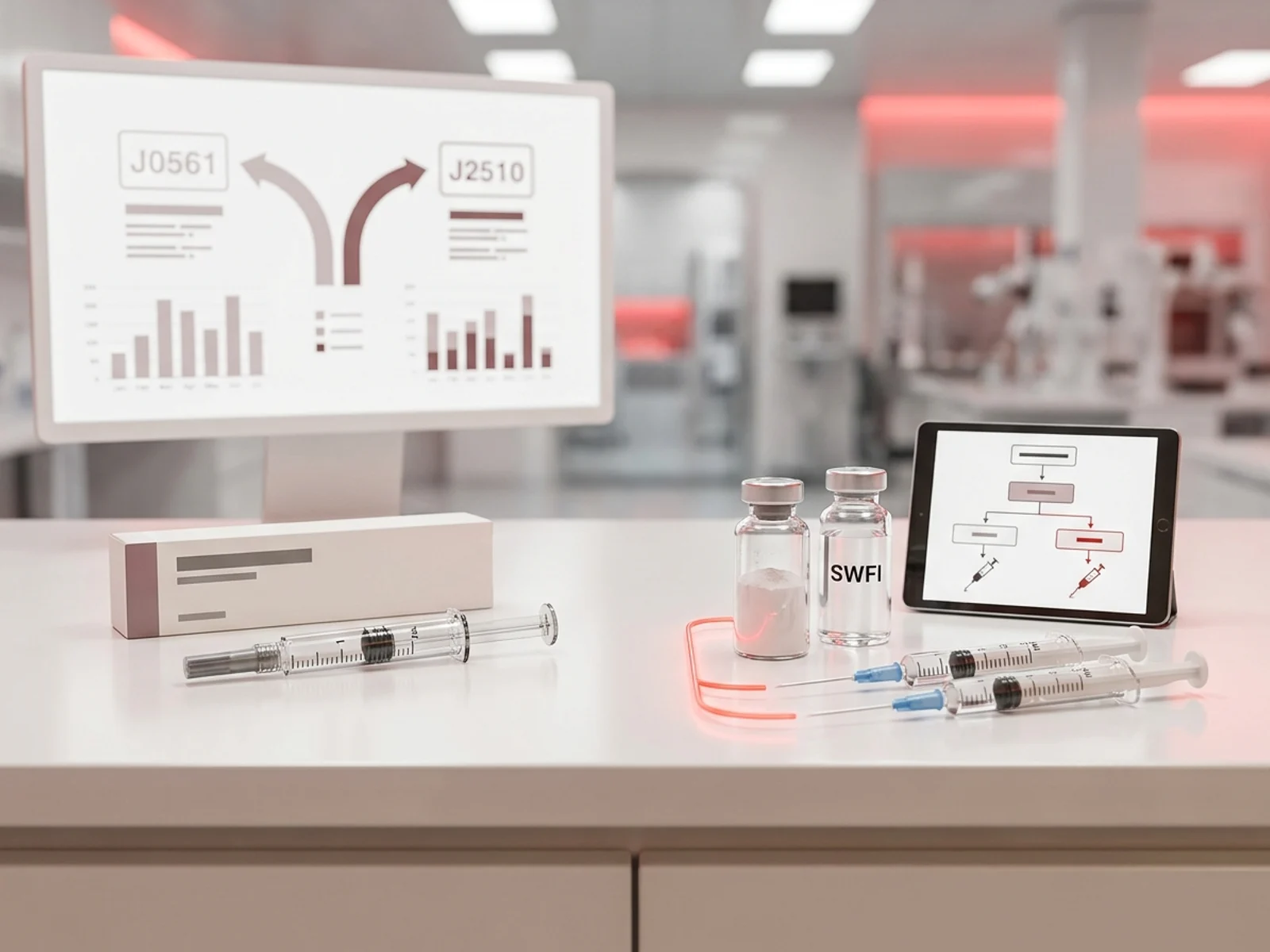
For reimbursement teams, Lentocilin must be billed under the standard penicillin G benzathine HCPCS code J0561 (Injection, penicillin G benzathine, 100,000 units) at 12 billing units per 1,200,000-unit vial, rather than the procaine code J2510. For clinical teams, Lentocilin introduces critical differences from Bicillin L-A: it is a powder for reconstitution rather than a pre-filled syringe, and it requires a 4 mL injection volume for 1.2 million units (compared to Bicillin L-A's 2 mL volume), requiring separate gluteal injection sites to reduce administration pain and complications.
Who This Is For
This reimbursement and clinical guide is designed for hospital pharmacy directors, specialty drug billing managers, clinical access coordinators, and infectious disease specialists managing drug supply triage.
FDA Shortage Profile and Recovery Timelines
Data compiled from the FDA and ASHP Drug Shortages registries reveals the stark reality of Pfizer’s manufacturing backlog. Pfizer is the sole domestic manufacturer of penicillin G benzathine. The shortage has impacted all product strengths, with full recovery not anticipated until late 2027:
| Product Presentation | NDC (Package) | Availability Status | Next Delivery Date | Estimated Recovery |
|---|---|---|---|---|
| Bicillin L-A 600,000 units/1 mL | 60793-700-10 | Unavailable | October 2027 | December 2027 |
| Bicillin L-A 1,200,000 units/2 mL | 60793-701-10 | Limited Availability | October 2026 | December 2027 |
| Bicillin L-A 2,400,000 units/4 mL | 60793-702-10 | Limited Availability | October 2026 | December 2027 |
| Lentocilin (Imported) 1,200,000 units (Powder) | 84383-110-01 | Available | Ongoing (Imported) | N/A |
Clinical Differences: Reconstitution vs. Pre-Filled Suspension
While Lentocilin is clinically equivalent to Bicillin L-A, the physical product and clinical administration workflows differ significantly:
Reconstitution Requirement: Bicillin L-A is supplied as a ready-to-use, pre-filled syringe containing an aqueous suspension of penicillin G benzathine. Lentocilin is supplied as a sterile powder in a single-dose vial containing 1,200,000 units of benzathine benzylpenicillin tetrahydrate. Clinicians must reconstitute the powder using 4 mL of sterile water for injection (SWFI) provided with the vial.
Volume and Injection Site Splitting: When reconstituted, Lentocilin results in a total volume of approximately 4 mL. For a standard 1,200,000-unit dose, a patient must receive 4 mL. According to nursing protocols and CDC administration guidelines:
Injection volumes exceeding 2 mL in a single site can cause severe tissue irritation, localized pain, and sterile abscesses.
Clinicians are advised to divide the reconstituted 4 mL dose into two separate 2 mL deep intramuscular injections, administered in different gluteal muscle sites (e.g., left and right ventrogluteal muscles) during the same visit.
In contrast, Bicillin L-A delivers the same 1,200,000 units in a dense 2 mL suspension, allowing for a single injection.
Medical Billing and Claims Crosswalk for Lentocilin
Reimbursement teams have faced claim rejections due to NDC mismatches, as Lentocilin is an unapproved foreign drug and is not natively indexed in standard electronic health record (EHR) and pharmacy systems. The following parameters must be met for successful medical benefit billing:
1. HCPCS Code Assignment
Lentocilin is a penicillin G benzathine formulation and must be billed under the active benzathine code, not the procaine code:
Correct Code: J0561 (Injection, penicillin G benzathine, 100,000 units)
Billing Units: 1 unit = 100,000 units. Therefore, a single 1,200,000-unit vial of Lentocilin equals 12 units.
Incorrect Code: J2510 (Injection, penicillin G procaine, up to 600,000 units). This code is frequently misapplied by automated billing systems but represents a different chemical salt (procaine) which is not interchangeable with benzathine.
2. NDC Conversion for Electronic Claims
Medical claims require a standard 11-digit NDC format. Because the imported Portuguese packaging displays a 10-digit NDC, billing teams must insert a leading zero in the middle segment:
Package Label NDC: 84383-110-01
11-Digit Medical Claim NDC: 84383-0110-01
3. Electronic Health Record (EHR) Manual Build
Because Lentocilin is imported under temporary discretionary authorization, standard barcode scanners in hospital pharmacies will not recognize the Portuguese barcode. IT teams must manually build the product into their formulary catalogs:
Map NDC 84383-0110-01 to the generic description "penicillin G benzathine 1.2M unit vial (Lentocilin import)".
Associate the product with HCPCS J0561 and set the charge multiplier to 12.
Configure clinical alerts reminding providers that the product is a powder requiring reconstitution and split gluteal injections.
Payer Coverage and Policy Variations
State Medicaid programs and commercial payers have published specific bulletins to facilitate coverage for the imported product:
Medicaid Coverage: Most state Medicaid agencies (such as California Medi-Cal and North Carolina DHHS) have updated their claims engines to accept NDC 84383-0110-01 for HCPCS J0561 backdated to late 2023.
Prior Authorization (PA) Bypass: Payers generally bypass prior authorization requirements for penicillin G benzathine when used for primary, secondary, or latent syphilis, especially in pregnant patients, due to the public health urgency. However, claims for non-syphilis indications (such as rheumatic fever prophylaxis) may face strict step-edit audits.
Sources
FDA, FDA Drug Shortages Database, "Penicillin G Benzathine (Bicillin L-A) Injection" entry, updated May 22, 2026. Pfizer Bicillin NDCs (60793-700-10, 60793-701-10, 60793-702-10). https://www.accessdata.fda.gov/scripts/cder/drugshortages/default.cfm
FDA, Temporary Importation Letter: Penicillin G Benzathine (Lentocilin) Distribution to Address Shortage, FDA Center for Drug Evaluation and Research, March 2026 update. https://www.fda.gov/media/192256/download
Centers for Disease Control and Prevention (CDC), Syphilis Treatment Guidelines and Bicillin L-A Shortage Priorities, CDC Division of STD Prevention, May 2026. https://www.cdc.gov/std/treatment/drug-notices/bicillin-shortage.htm
North Carolina Department of Health and Human Services (NCDHHS), Medicaid Bulletin: Billing and Coding Guidelines for Imported Penicillin G Benzathine (Lentocilin), HCPCS J0561 and NDC 84383-0110-01 billing rules. https://medicaid.ncdhhs.gov/blog/2024/02/15/billing-imported-penicillin-g-benzathine
American Society of Health-System Pharmacists (ASHP), Drug Shortages Detail: Penicillin G Benzathine Injection, updated May 2026. https://www.ashp.org/drug-shortages/current-shortages/drug-shortage-detail.aspx?id=909
Disclaimer: This article provides independent regulatory and market access analysis for biopharma professionals and does not constitute clinical, medical, billing, or legal advice.